MECHANICAL MEASUREMENT & METROLOGY
(3141901)
CH-5: FORCE, TORQUE, PRESSURE, STRAIN AND
TEMPERATURE MEASUREMENT
PREPARED BY:
PROF. SURAJ A. SHUKLA
FORCE MEASUREMENT
• Force may be defined as a cause that produces resistance or obstruction to any moving body, or changes the
motion of a body, or tends to produce these effects. Force is usually measured by applying it to a calibrated
device which resists the force and indicates or records its magnitude.
• The unknown force may be measured by the following methods:
1. Balancing the unknown force against known gravitational force due to standard mass. Scales and balances
work based on this principle.
2. Applying unknown force to an Elastic member (spring, beam, cantilever, ring, etc) and measuring the
resulting deflection on a calibrated force scale or the deflection may be measured by using a secondary
transducer. i.e. Spring scale, Cantilever beam, proving ring, Strain gauge load cell.
3. Translating the force to fluid pressure and then measuring the resultant pressure. Hydraulic and pneumatic
load cells work on this principle.
4. Applying force to known mass and then measuring the resulting acceleration.
5. Balancing force against a magnetic force which is developed by the interaction of a magnet and current in
the coil.
FORCE MEASUREMENT
 Scales and Balances:
 Equal arms beam balance scale:
• The equal arm beam balance scale operates on the principle of moment comparison. The moment produced
by the unknown mass or force is compared with that produced by a gravitational force due to known standard
mass. When the null balance is obtained, the two weights or forces are equal.
• For null balance, W1l1 = W2l2. For equal arms, l1 = l2.
⸫ W1 = W2.
FORCE MEASUREMENT
 Scales and Balances:
 Even or unequal arms balance scale:
• The main disadvantage of equal arms balance scale is requiring a set of weights at least as heavy as the heaviest
load to be measured. In the unequal arms balance scale, two arms are used one is called load arm (which is
associated with unknown load) and the other is called the power arm (which is associated with known
weights).
• For null balance, W1b = W2a.
W2 = W1 × (b / a)
• In this scale known weight can be decreased by increasing length b, hence heavier load can be measure with
the help of small known mass and large arm. Further power arm b may be calibrated to read the unknown
weight W2 directly if W1 and a are fixed.
FORCE MEASUREMENT
 Scales and Balances:
 Even or unequal arms balance scale:
 Platform scale:
• When large weights are to be measured, the equal and unequal arms balance scales are not suitable. In such a
case, the platform scale is used. It consists of a multi-level system.
• In this system, a large weight W is measured in terms of smaller weights WP (poise weight) and Ws (pan
weight). Before the unknown load W is placed to the platform, the poise weight WP is set at zero of the beam
scale and the counterweight is adjusted to get initial zero balance.
• For simplification of analysis, it is assumed that load W is replaced by two arbitrary weights W1 and W2, and
WP sets at zero position.
• For equilibrium position,
T × b = Ws × a ……….(1)
But T × c = W1 {(f / d) × e} + W2 × h ……….(2)
If lever system is so proportional that (h / e) = (f / d), then
T × c = (W1 + W2) × h = W × h ……….(3)
FORCE MEASUREMENT
 Scales and Balances:
 Even or unequal arms balance scale:
 Platform scale:
• From the above equation, it is clear that the weight W may be placed anywhere on the platform and its position
relative to two knife edges of the platform does not affect the reading. From equations, we get
W = {(a / b) × (c / h)} × Ws = M × Ws ……….(4)
where, M = {(a / b) × (c / h)} called multiplication ratio of the scale
• If M = 1000, means that Ws (weight put on pan) = 1 kg can be used to measure weight W = 1000 kg put on the
platform. Further pan weight Ws can be reduced by changing the position of poise weight on calibrated length
in terms of weight. Hence beam is balanced by proper combination of pan weight and adjustment of poise
weight along with calibrated beam scale.
FORCE MEASUREMENT
 Scales and Balances:
 Even or unequal arms balance scale:
 Pendulum scale:
• The pendulum scale is a deflection type instrument in which the unknown weight is converted to a torque that is then
balanced by the torque of a fixed standard mass arranged as a pendulum.
• When unknown weight W is applied to the load rod, sectors tend to rotate due to tension in the loading tubes, and
consequently the counterweights we swing-out.
• The system equilibrium conditions are attained when the moment due to counterweights is becoming the same as the
moment due to the applied load.
• The motion of the equalizer bar is converted into an angular movement of the indicator by a rack and pinion
arrangement. The deflection of the pointer is calibrated in terms of applied force.
FORCE MEASUREMENT
 Scales and Balances:
 Elastic Force Meter:
• The elastic elements (spring, rod, cantilever, simply supported beam, ring, bellows, diaphragm, etc.) can be
used for the measurement of force directly or indirectly through the displacement of the elastic element.
 Spring scale:
• In the spring scale, the unknown weight is suspended from a hook. The deflection of spring concerning weight
is read on the scale in terms of the weight. The scale is calibrated based on the stiffness of the spring (F = K.x,
where K is the stiffness of spring, x is deflection, F is load).
FORCE MEASUREMENT
 Scales and Balances:
 Elastic Force Meter:
 Cantilever beams load cell:
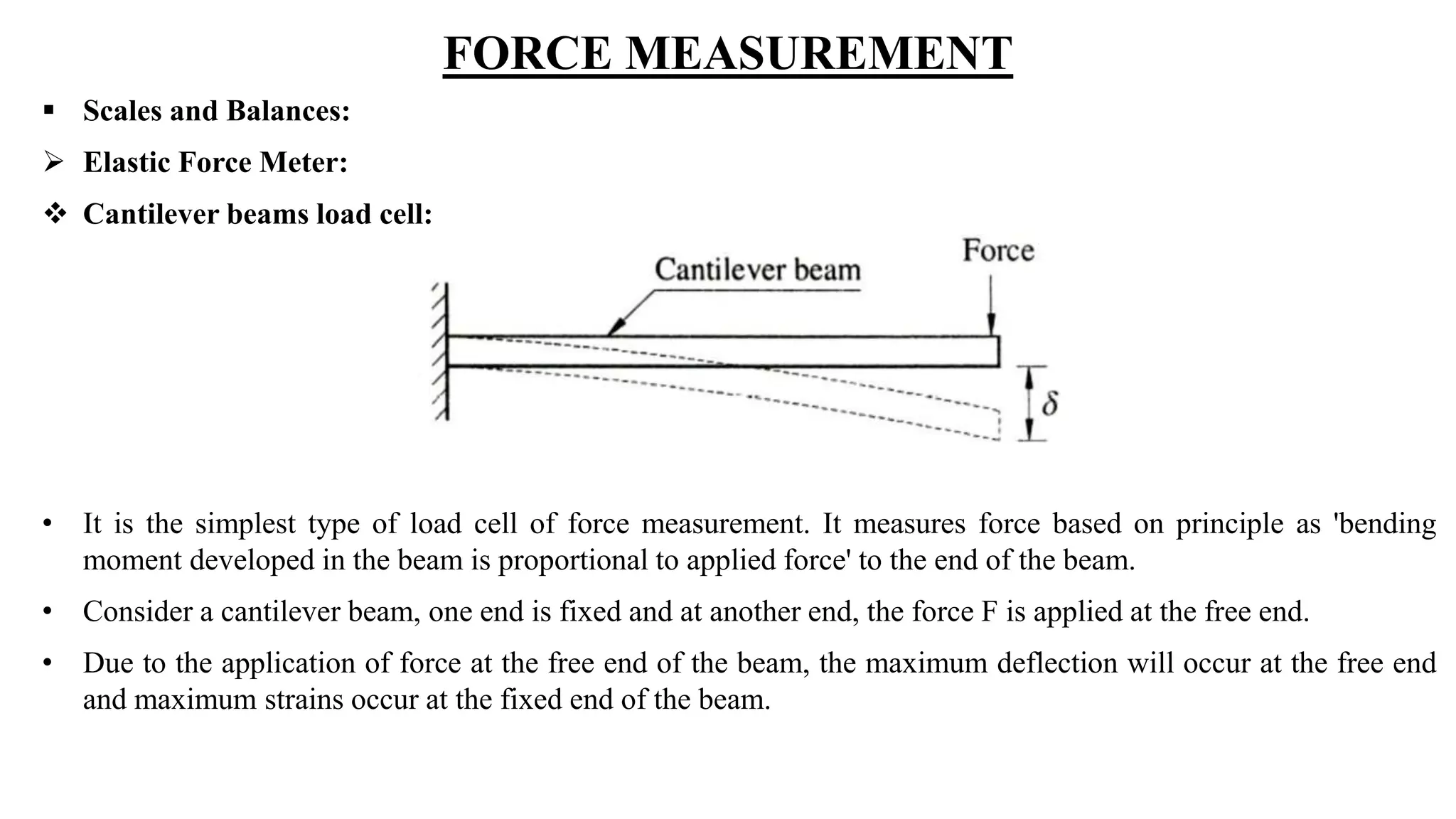
• It is the simplest type of load cell of force measurement. It measures force based on principle as 'bending
moment developed in the beam is proportional to applied force' to the end of the beam.
• Consider a cantilever beam, one end is fixed and at another end, the force F is applied at the free end.
• Due to the application of force at the free end of the beam, the maximum deflection will occur at the free end
and maximum strains occur at the fixed end of the beam.
FORCE MEASUREMENT
 Scales and Balances:
 Elastic Force Meter:
 Proving ring:
• In manufacturing industries, proving rings are most commonly used for the measurement of large forces (2 KN
to 2 MN). A proving ring consists of a circular ring of precisely known diameter, providing with projection lugs
for compressive loading.
• The force is determined by measuring the deflection of a steel ring. When an external compressive or tensile
load is applied to the lugs, the ring changes in its diameter. The change of ring diameter is proportional to the
applied load.
• The amount of the deflection of the steel ring can be measured using a micrometer and a vibrating reed which
are attached to the internal bosses.
FORCE MEASUREMENT
 Scales and Balances:
 Elastic Force Meter:
 Proving ring:
• The micrometer is adjusted with the help of a screw and the vibrating reed helps in determining when contact is
made. Before applying the load, the micrometer tip is moved up by a rotating screw until the contact of reed
and micrometer reading is noted.
• Now, down the tip of micrometer and applied compressive load on the ring, again micrometer tip is advanced
by rotating the screw and micrometer reading is noted.
• The difference in the micrometer reading taken before and after the application of load is the measure of the
amount of deflection of the ring.
• This deflection is calibrated in terms of applied force. The deflection of proving ring can be measured by
LVDT, which senses the movement of the core that is attached to the 1ing and moves because of the deflection
of the ring.
FORCE MEASUREMENT
 Scales and Balances:
 Elastic Force Meter:
 Proving ring:
Advantages:
i. Wide range of force measuring capacities.
ii. Good accuracy of force measurement.
iii. These instruments furnish a relatively high output signal.
FORCE MEASUREMENT
 Scales and Balances:
 Elastic Force Meter:
 Hydraulic Force Meter (Load cell):
• The hydraulic force meter operates on the principle of a force counterbalance. When force is applied to a
definite area of an enclosed fluid, the resulting fluid pressure increases.
• The resulting fluid pressure is transmitted to some form of a pressure sensing device such as a bourdon tube or
manometer. The pressure gauge reading is calibrated in terms of force applied.
FORCE MEASUREMENT
 Scales and Balances:
 Elastic Force Meter:
 Hydraulic Force Meter (Load cell):
Construction and working:
• Hydraulic force meter or load cell consists of a metal diaphragm on which force to be measured is applied. The fluid
space below the diaphragm is connected to a bourdon tube pressure through the tubing.
• When the force (to be measured) acts on the loading platform, the diaphragm deflects in downward, which increases
the pressure of the fluid. This pressure is equal to the magnitude of load applied divided by the effective area of the
diaphragm.
• The pressure is transmitted to a bourdon tube which calibrated in terms of load. The hydraulic load cell may be used
to measured forces in the range 0 to 2.5 MN with accuracy 0.1 % of full scale.
Advantages:
i. It has a good response against load variation.
ii. It is self-contained and requires no outside power.
iii. It is available for both compression and tensile force.
iv. It has good sensitivity.
v. It is well suited for high impact loads.
vi. It can withstand high overloads without loss of accuracy.
FORCE MEASUREMENT
 Scales and Balances:
 Elastic Force Meter:
 Pneumatic Force Meter (Load cell):
• Bourdon tube pressure gauge Pneumatic force meter also operates on the principle of a force counter-balance.
In this type of force meter variable downward force (to be measured) is balanced by the upward force of air
pressure against the effective area of the diaphragm.
Construction & Working:
• A pneumatic load cell consists of a diaphragm made from flexible materials to regulate the balancing pressure·
automatically, and bleed valve which is attached to the diaphragm.
• Space below the diaphragm is connected with an air supply system and a pressure measuring device
(manometer). When the force to be measured acts on the diaphragm, it moves downward which causes to close
the bleed valve and results in increased backpressure in the system.
• The increased pressure acts on the diaphragm, this produces an effective upward force which tends to return the
diaphragm to its preload position.
FORCE MEASUREMENT
 Scales and Balances:
 Elastic Force Meter:
 Pneumatic Force Meter (Load cell):
Construction & Working:
• For any constant applied force, the system attains equilibrium at a specific bleed valve opening and a
corresponding pressure is indicated by the manometer.
• The maximum pressure in the system is limited to air supply pressure. The pneumatic force meters are
available in ranges 0 to 250 kN with an accuracy of 0.5% of full scale.
FORCE MEASUREMENT
 Scales and Balances:
 Elastic Force Meter:
 Pneumatic Force Meter (Load cell):
Advantages:
i. It is suitable for use in hazardous or explosive areas.
ii. It is not required a special transmitting system.
iii. It is relatively free from temperature-related errors.
Disadvantages:
i. Poor response.
ii. The range of the instrument depends on the air supply pressure.
iii. It requires a high-pressure air source.
FORCE MEASUREMENT
 Scales and Balances:
 Elastic Force Meter:
 Strain Gauge Load cell:
• The strain gauge load cell is an electromechanical transducer that translates change in force into a change in
voltage.
Working principle:
• When stress (force on unit area) is applied to a body, it gets deformed (strain) and these deformations are
related to the applied stress or force. The resistance strain gauge works on the principle that the resistance of a
wire conductor (strain gauge) changes when it is strained.
• The change in the resistance has a definite relation with the strain or the applied force. This change in
resistance can be measured by the Wheatstone bridge circuit in terms of voltage.
FORCE MEASUREMENT
 Scales and Balances:
 Elastic Force Meter:
 Strain Gauge Load cell:
Construction & Working:
• A strain gauge load cell consists of a steel cylinder that has four identical strain gauges (wire grids). The strain
gauge is bonded to a steel cylinder.
• The strain gauges R1 and R4 are along the direction of applied load and the strain gauges R2 and R3 are
attached circumferentially at right angles to strain gauges R1 and R4.
• These four strain gauges are connected electrically to the four limbs of a Wheatstone b1idge circuit. In the no-
load condition, all the four gauges resistance are the same and hence the Wheatstone bridge circuit in balance
condition, no output on the indicator.
• When a compressive load is applied, the vertical gauges R1 and R4 undergo compression (negative strain),
therefore their resistance is decreased.
• The circumferential gauges R2 and R3 undergo tension (positive strain), therefore their resistance is increased.
The change in resistance of the strain gauges causes unbalance of the Wheatstone bridge circuit and hence it
produces an output that is proportional to an applied force.
FORCE MEASUREMENT
 Scales and Balances:
 Elastic Force Meter:
 Strain Gauge Load cell:
Advantages:
i. It is small and compact.
ii. Fast response against load variations.
iii. It is very suitable to measure transient and non-steady forces.
iv. It can be measured compressive as well as tensile load.
FORCE MEASUREMENT
 Scales and Balances:
 Elastic Force Meter:
 Linear Variable Differential Transformer (LVDT) load cell:
• In this type of load cell, the load or force is converted in form of displacement by the mechanical transducer
(elastic diaphragm) called a primary transducer and then the displacement is sensed by LVDT (called a
secondary transducer) which represents voltage change concerning force on diaphragm.
• This device can be used for static as well as dynamic force measurements.
MEASUREMENT OF TORQUE AND SHAFT POWER
• Elastic diaphragm force, the measurement of torque is associated with the determination of the power
developed or consumed by the rotating part.
• The different types of dynamometers are used for the measurement of torque as well as power. The torque may
be measured in terms of reaction force and arm length or angular twist.
Classification of torque and power measurement techniques:
 Absorption dynamometer:
In these types of dynamometers, the energy produced by the engine is absorbed by frictional resistance of the
brake and finally transformed into heat.
Examples:
i. Prony brake dynamometer – block type and band type
ii. Rope brake dynamometer
iii. Hydraulic dynamometer
iv. Eddy current dynamometer
MEASUREMENT OF TORQUE AND SHAFT POWER
Classification of torque and power measurement techniques:
 Transmission dynamometer:
In these types of dynamometer, the energy is not wasted in friction but energy is conveyed to the surrounding in a
useful mechanical or electrical form.
Examples:
i. Belt transmission dynamometer
ii. Epicyclic train dynamometer
iii. Torsion dynamometer
iv. Strain gauge dynamometer
 Driving dynamometer:
In this type of dynamometer, the power-producing/absorbing device (whose power to be measured) is coupled
with the electrical generator or electrical motor.
The motor or generator measure power and also supply energy to operate the tested devices. This type of
dynamometer is employed with pumps and compressors for determining their performance.
Examples: Electric cradled dynamometer
MEASUREMENT OF TORQUE AND SHAFT POWER
 Torsion bar dynamometer:
• The torque of the rotating element can be measured based on the rigidity of the rotating element (elastic
deflection). In this dynamometer, the torque or rotating element (shaft) can be measured by measuring the
angle of the twist of the shaft.
• Consider, hollow shaft inner and outer radiuses are ri and ro respectively, subjected to torque T the torsion
deflection or angle of twist in radian of the hollow shaft is given by
θ = 2TL / {πG (ro
4 - ri
4)}
where, G = shear modulus and
L = the length of the shaft under the case study of measuring the twisting angle.
MEASUREMENT OF TORQUE AND SHAFT POWER
 Torsion bar dynamometer:
• The angle of twist θ in the shaft due to torque T can be measured by torsion meter either optical or an electrical
arrangement and then torque T is calculated by the above equation.
• An optical arrangement consists of calibrated scales is used to read the relative angular displacement of two
sections at a specified distance of the torsion bar.
• The discs A and B mounted at distance L on the shaft move relative to each other through an angle θ. Due to
the application of torque T, the shaft is twisted with an angle θ. This is recorded by the observer with the help
of the optical arrangement.
MEASUREMENT OF TORQUE AND SHAFT POWER
 Prony brake dynamometer:
• The prony brake dynamometer is an absorption-type dynamometer in which the kinetic energy of the rotating
shaft is converted into heat by friction between the brake drum or pulley and the friction element (block or
band). This dynamometer can be classified based on friction element as block type prony brake and band type
prony brake dynamometer.
• The block type prony brake dynamometer consists of two wooden blocks clamped together with a pulley
between them. The pulley is fixed to the shaft of the engine or motor.
• The blocks are clamped using two bolts with nuts. A helical spring is provided between the nut and upper block
to maintain the constant pressure between the blocks and pulley.
• The one-block carries a lever arm to the one end of which a force can be applied using a known weight (W) or
spring balance. Another end of the arm carries a counter-weight to balance the brake when unloaded.
MEASUREMENT OF TORQUE AND SHAFT POWER
 Prony brake dynamometer:
• When dynamometer in action, the friction between the blocks and the pulley tends to rotate the blocks in the
direction of the rotation of the shaft. This tendency is prevented by adding weights at lever end so that its
moment balances the moment of the friction resistance between the blocks and pulley. The two stops are
provided to limit the motion of the lever.
• Torque on the shaft is given by,
T = F × R = W × l Nm
Power P = ω × T, where ω = 2πN / 60
P = 2πNT / 60000 = 2πN (W × l) / 60000 kW
where N = revolutions of shaft per minute
ω = angular velocity of shaft
F = frictional force
l = length of arm
W = applied load at the end of the arm
MEASUREMENT OF TORQUE AND SHAFT POWER
 Prony brake dynamometer:
 Advantages:
• Simple in construction.
• Less cost.
• Suitable for measurement of small power.
 Disadvantages:
• The coefficient of friction is reduced due to wear out of the block, hence in the long run dynamometer becomes
unserviceable for measurement of large power.
• Due to heat generation, the temperature rises, resulting in a decrease in the coefficient of friction. Hence the
cooling system is required.
• When the driving torque on the shaft is not uniform, this dynamometer is subjected to severe oscillations.
MEASUREMENT OF TORQUE AND SHAFT POWER
 Rope brake dynamometer:
• Rope brake dynamometer is also an absorption-type dynamometer. The rope brake dynamometer consists of
two or three ropes wound around the flywheel or pulley which is fixed on engine or motor shaft.
• The upper end of the ropes is attached to a spring balance and the lower end of ropes is kept in position by
applying weight W on it. The wooden blocks are placed at intervals around the circumferences of the flywheel
to prevent the slipping of the ropes over the flywheel.
MEASUREMENT OF TORQUE AND SHAFT POWER
 Rope brake dynamometer:
• When the engine shaft rotates at a constant speed, the frictional torque is created by means weight placing at
the end of the rope. The frictional torque due to rope and pulley is equal to torque transmitted by engine shaft.
• Let W = weight at end of the rope
S = spring balance reading
N = revolution of engine shaft per minute
D = diameter of pulley or flywheel
d = diameter of rope
Reff = Effective radius of brake wheel = (D + d) / 2
Braking torque is given by, T = tangential force × radius of wheel = (W – S) × Reff
⸫
Brake power = 2πNT / 60000 kW
P = 2πN (W – S) × Reff / 60000 kW
• The cooling system is provided to cool the rope and flywheel.
• Range and speed: Rope and band brakes dynamometers may be used for the range of 75 to 36800 W and
speed up to 4000 rpm.
MEASUREMENT OF TORQUE AND SHAFT POWER
 Rope brake dynamometer:
 Advantages:
• Simple in construction.
• It is more suitable than a prony brake dynamometer.
• It can be used for a wide range of power.
• It can be used for the long test with little overheating and without requiring adjustment.
 Disadvantages:
• Less accuracy because of the change co-efficient of friction of rope with temperature.
• The cooling system is required.
MEASUREMENT OF TORQUE AND SHAFT POWER
 Hydraulic (fluid friction) dynamometer:
• The hydraulic dynamometer operates on the water brake principle. Thus dynamometer uses fluid friction rather
than dry friction (in case of rope brake and prony brake dynamometer) to create the braking torque.
• The hydraulic dynamometer consists of a rotor (rotating disc) and stator (stationary casing).
• The rotating disc is fixed on the engine or motor shaft and it rotates with a shaft inside the stationary casing, the
casing is mounted on anti-friction bearings and has a brake arm and a balance system attached to it.
• This bearing allows the casing to rotate freely except restraint imposed by the brake arm. The casing is in two
halves, one of which is placed on either side of the rotating disc. The casing having semi-elliptical grooves.
MEASUREMENT OF TORQUE AND SHAFT POWER
 Hydraulic (fluid friction) dynamometer:
• These semi-elliptical grooves match with corresponding grooves inside the rotating disc to form helix
chambers through which a stream of water flow is maintained.
• When the dynamometer in operation, the rotor rotating with a speed of engine shaft. Due to rotation of the rotor
concerning stator, the vortex and eddy currents (turbulence of water) are set up in the water. These tend to tum
the casing (stator) in the direction of rotation of the rotor.
• This tendency of the stator to rotate is opposed by an arm with a balancing weight that measures torque. The
control of braking action is carried out by changing either the quantity of water or its pressure or changing
space between the stator and rotor.
• Let W = weight placed at end of the lever arm, N
N = revolution per minute of shaft
K = dynamometer constant
Power = WN / K
MEASUREMENT OF TORQUE AND SHAFT POWER
 Hydraulic (fluid friction) dynamometer:
 Range and speed: Hydraulic dynamometer may be used for the power up to 20,000 kW and for speed up to
10,000 rpm.
 Advantages:
• It can be used for high power measurement at high speed.
• Water supplied to the dynamometer is served two purposes as providing braking action and cooling.
• High absorption capacity in a small space and at a low cost.
MEASUREMENT OF TORQUE AND SHAFT POWER
 Eddy Current Dynamometer:
• Eddy current dynamometer utilizes the principle that the power loss produced on account of eddy current
which is generated when rotating conductor cuts across magnetic flux. These eddy currents get dissipated in the
form of heat. Therefore this dynamometer acts as an absorption- type dynamometer.
• An eddy current dynamometer consists of a toothed steel rotor fixed on the engine shaft. The rotor rotates
inside a smooth bored cast iron stator. The exiting coil is fitted into the inner surface groove of the stator.
• The exiting coil is energized by the direct current supplied from an external source. The stator is mounted on
anti-friction bearings and has a brake arm and a balance system attached to it. This allows the stator (casing) to
rotate freely.
MEASUREMENT OF TORQUE AND SHAFT POWER
 Eddy Current Dynamometer:
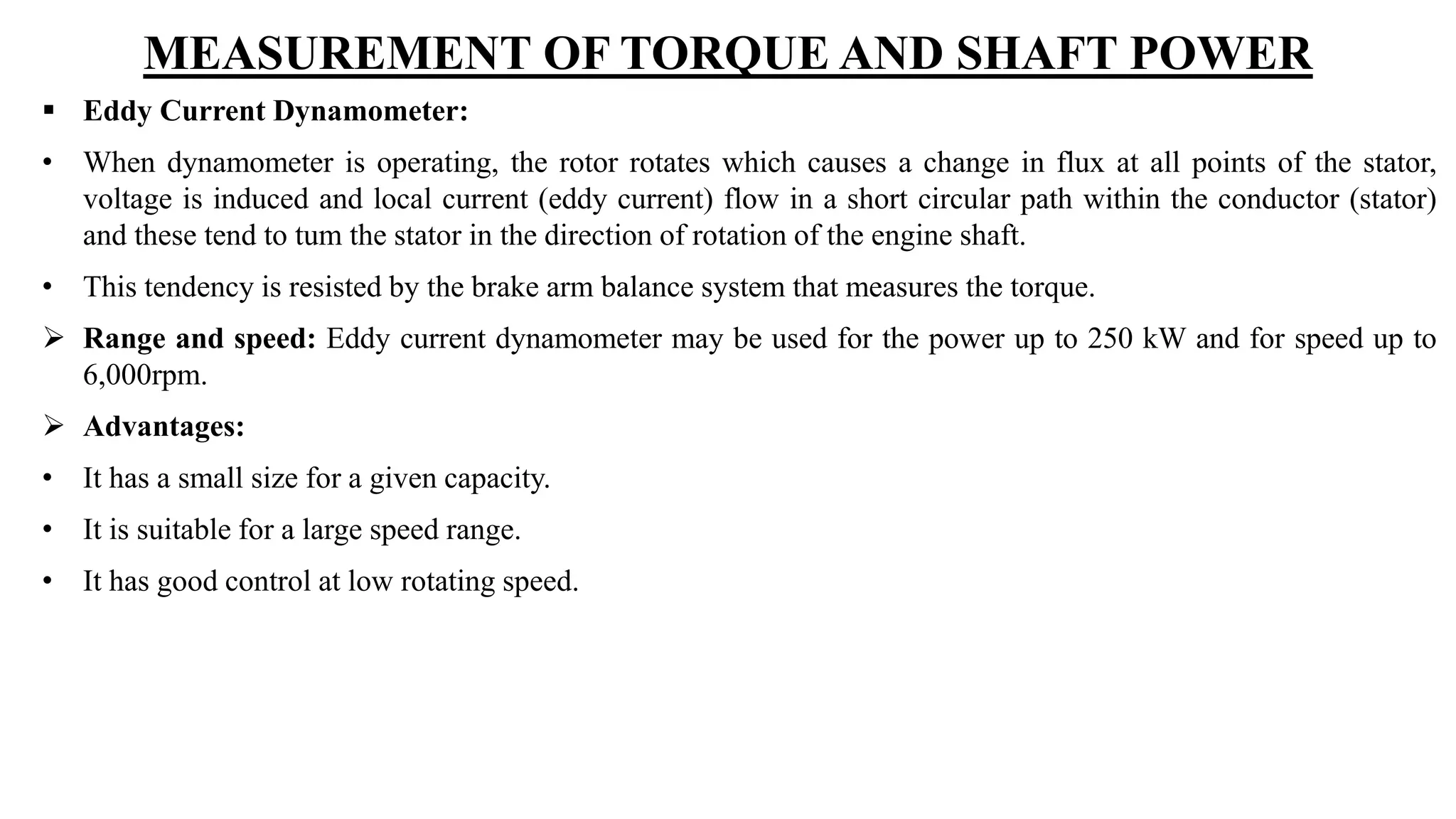
• When dynamometer is operating, the rotor rotates which causes a change in flux at all points of the stator,
voltage is induced and local current (eddy current) flow in a short circular path within the conductor (stator)
and these tend to tum the stator in the direction of rotation of the engine shaft.
• This tendency is resisted by the brake arm balance system that measures the torque.
 Range and speed: Eddy current dynamometer may be used for the power up to 250 kW and for speed up to
6,000rpm.
 Advantages:
• It has a small size for a given capacity.
• It is suitable for a large speed range.
• It has good control at low rotating speed.
MEASUREMENT OF TORQUE AND SHAFT POWER
 Servo controlled dynamometer:
• The servo control dynamometer is used to test the engine in the laboratory with the artificial creation of actual
torque and speed variation of the actual automobile engine.
• Torque and speed are measured under actual driving conditions of an automobile engine; tape recordings of
such an exercise of an engine are obtained and then simulated under the laboratory conditions.
• Engine speed and torque are controlled by two feedback systems. The actual speed signal generated by the
tachometer generator from the dynamometer is compared with the preferred speed that is set in the tape
recorder (previously recorded in actual condition).
• If actual and preferred speeds are not the same, the dynamometer control is automatically adjusted until they
are equal. The load cell on the dynamometer measures the actual torque from the engine and is compared with
the preferred torque that is set in the tape recorder.
MEASUREMENT OF STRAIN
• In the design and construction of machines and structures, it is necessary to know whether the mechanical
components can carry the loads which are demanded on it without any excessive deformation or failure. Hence,
the stress and strain play a very important role.
• Stress is defined as the force applied per unit area. The strain is defined as the change in length per unit original
length. The stress cannot be measured directly and hence, normally, strain (change in dimension per unit
original dimension) is measured with the help of strain gauges.
• A strain gauge is a device used for measuring dimensional change on the surface of a structural member under
the test. The basic principle of operation of a strain gage is simple:
• When strain is applied to a thin metallic wire, its dimension changes, thus changing the resistance of the wire.
It has got a wide range of applications. It can be used for the measurement of load, force, thrust, pressure,
torque, displacement, and flow, etc.
• The effects of the above variables to be measured are first measures by primary transducer like bellows,
bourdon tube or cantilever beam, etc. and then converted into small displacement. The displacement is then
measured by the strain gauge.
TYPES OF STRAIN GAUGES
• The strain gauge may be classified as:
1. Mechanical strain gauge
2. Optical strain gauge
3. Electrical strain gauge
• The electrical strain gauges especially electrical resistance strain gauges are most popular because of the many
advantages they offer in the process of measurement.
 Mechanical strain gauges:
• In these strain gauges, the change in length of the test specimen is magnified using mechanical devices like
levers or gears. In the initial stage, an extensometer of the single mechanical lever type was introduced. In this
gauge, a lever system is employed to obtain the magnification (10 to 1) of the movable knife-edge of an
extensometer to a fixed knife-edge.
• With the advancement of technology, extensometers employing compound levers (dial gauge) having a
magnification of 2000 to 1 were introduced and at the same time, these operated over small gauge length. The
most commonly used mechanical strain gauges are of Berry-type and Huggen Berger type.
TYPES OF STRAIN GAUGES
 Mechanical strain gauges:
 Advantage: It has a self-contained magnification system and no auxiliary equipment is needed as required in
case of an electrical strain gauge.
 Disadvantages:
• Comparatively larger and it is suitable only in cases where sufficient area is available on the test specimen for
mounting the gauge.
• The high inertia of the gauge makes it unsuitable for dynamic measurements and varying strains.
• There is no method of recording the readings.
• These gauges are employed for static strain measurement only and also in cases where the point of
measurement is accessible for visual observation.
TYPES OF STRAIN GAUGES
 Optical strain gauges:
• Optical strain gauges are very similar to mechanical strain gauges except that the magnification is achieved
with multiple reflectors using mirrors or prisms.
• The inertia of this strain gauge is reduced compared to the mechanical strain gauge. The measurement accuracy
of the optical strain gauge is high compared to the mechanical strain gauge.
• Also, it is independent of temperature variations. In Martin's mirror type extensometer, a plane mirror is rigidly
attached to a movable knife edge.
• When it subjected to stress the minors rotates through an angle and the reflected light beam from the minor
subtends an angle twice that of the incident light.
• The most commonly used strain gauge in this category is developed by L. B. Tuckerman. It combines
mechanical and optical levers and consists of two parts as an extensometer and as an autocollimator.
• This gauge is also satisfactory only for static measurements and suffers from the obstacles inherent in all
mechanical systems if it used for dynamic measurements.
TYPES OF STRAIN GAUGES
 Electrical strain gauges:
• In these strain gauges, a change in strain produces a change in some electrical characteristics.
• The basic principle of an electrical strain gauge is based upon the measurement of the changes in resistance,
capacitance or inductance that are proportional to the strain transferred from the specimen to the gauge
element. The output can be magnified by some auxiliary electronic equipment.
• The electrical strain gauge can be classified as (i) Resistance gauge, (ii) Capacitance gauge, (iii) Inductance
gauge, and (iv) Piezoelectric or semiconductor gauge. Out of these, resistance strain gauge most commonly
used. Capacitance and inductance type are only employed for special applications. Piezoelectric gauge for
measurement of strain has limited application.
• However, now a day, the semiconductor type strain gauge has got increasing attention due to its high
sensitivity, small size, and adaptability for both static and dynamic measurements.
• The basic concept of resistance strain gauge is that the resistance of a copper or iron wire changes when
subjected to tension. The resistance of the wire changes as a function of strain, increasing with tension and
reducing with compression.
TYPES OF STRAIN GAUGES
 Electrical strain gauges:
 Advantages:
• It is simple in construction.
• Less inertia effect and very sensitive.
• It is small size and hence can be installed at a place that is not easily accessible.
• Linear measurement is accomplished.
• The output of the gauge can be utilized for recording and indicating purpose.
• The strain gauge can be calibrated in terms of force, displacement, pressure, and acceleration.
• It is reliable and inexpensive.
TYPES OF STRAIN GAUGES
 Gauge factor or Strain Sensitivity factor:
• Gauge factor is the important parameter of strain gauge. It measures the amount of resistance change for a
given strain and therefore serves as an index of the strain sensitivity of the gauge.
• It is also called the strain sensitivity factor. In another word, gauge factor (F) is the fractional change in
resistance divided by the unit strain.
F = (ΔR/R) / (Δl/l), where, ΔR = change in resistance
Δl = change in length
R = initial resistance
l = initial length
• The resistance and length are changed due to the straining of the gauge along the surface to which it is bonded
by the application of force. The higher gauge factor represents the higher sensitivity of gauge. A higher gauge
factor gives higher electrical output for recording and indication.
• The gauge factor is normally supplied by the manufacturer and may range from 1.7 to 4 depending on the
length of the gauge. The metallic gauge has a lower gauge factor due to low resistivity. The semiconductor has
a very high gauge factor.
RESISTANCE STRAIN GAUGE
• When a metallic conductor is stretched or compressed, its resistance changes since both the length and
diameter of conductor change. This principle is utilized to measure the displacement in terms of resistance
change of strain gauge.
• When strain gauge is mounted to surface whose displacement to be measured, it contracts or expands with that
surfaces.
• This deformation of the strain gauge wire causes a change in resistance to it. This change in resistance can be
measured in terms of voltage by the Wheatstone bridge circuit.
• Consider a strain gauge wire diameter D and length is subjected to a simple tensile loading. The change in the
physical dimension of wire (conductor) will cause a change in its resistance.
• ln other words, wire changes its resistance when mechanically strained within the elastic limit due to physical
effects (change in its length and cross-sectional area).
RESISTANCE STRAIN GAUGE
 Types of Resistance strain gauges:
 Bounded strain gauge:
• In this type of gauges, a grid of fine wire is cemented or bonded to a thin Bakelite sheet or thin paper sheet and
covered with a protective sheet of paper or thin Bakelite.
• Bonding the gauge to the strained material (structure understudy) makes it works for compressive strains or
tensile strain.
• The tensile strain makes its resistance increase and compressive strain makes it decreases. These types of strain
gauges are useful only for the measurement of small strain or displacement.
 Flat grid type:
• In this type, a wire is wound back and forth as a grid.
• The grid structure is bonded to a backing material such as paper or epoxy with a bonding agent (adhesive) that
can hold wire element to the base firmly, permitting a good transference of strain from base to the wires.
RESISTANCE STRAIN GAUGE
 Types of Resistance strain gauges:
 Bounded strain gauge:
 Flat grid type:
• This type of gauge is wound on a flattened tube of paper, or alternately on a thin strip of card. In this gauge, the
gauge length is smaller than that of the flat grid type.
• This gauge achieved the same resistance value for smaller length compared to flat grid gauge, however, it has
higher surface thickness since the grid wire is in two planes and higher hysteresis and higher creep.
 Woven grid type:
• In this type of gauge, Eureka wire is wound as weft on a rayon wrap to form a woven type gauge. This gauge is
useful for tests on fabrics and leather. This gauge can be measured large strain.e.
RESISTANCE STRAIN GAUGE
 Types of Resistance strain gauges:
 Bounded strain gauge:
 Etched foil type:
• The metal foil type strain gauge is manufactured by the photo-etching technique. Here the thin strips of the foil
are the active elements of the strain gauge, while the thick ones are for providing electrical connections.
• Because of the large area of the thick portion, their resistance is small and they do not contribute to any change
in resistance due to strain but increase the heat dissipation area and hence higher thermal stability and better
bonding properties.
• Also, it is easier to connect the lead wires with the strain gauge.
• In this gauge, there is no stress concentration at the terminals due to the absence of joints, thereby extending
the life of the gauge.
RESISTANCE STRAIN GAUGE
 Types of Resistance strain gauges:
 Bounded strain gauge:
 Etched foil type:
• These gauges are produced in wafers from silicon or germanium crystal in which the exact amount of special
impurities such as boron has been added to impart certain desirable characteristics.
• They can be of two types: p-type and n-type. In the former, the resistance increases with positive strain while in
the later the resistance decreases with temperature.
• The semiconductor gauges are usually provided with plastic or stainless steel backing and are bonded to the
test surface by the same methods as wire and foil gauges.
• The main advantages of semiconductor gauge are high gauge factor (about 100 to 200) and sensitivity (no need
for amplification of output), which can be used for dynamic strain and low hysteresis.
• However, it is suitable only for small strain measurement because of the brittle characteristic of gauge material.
RESISTANCE STRAIN GAUGE
 Types of Resistance strain gauges:
 Bounded strain gauge:
 Etched foil type:
• The single element strain gage can measure strain in one direction only. But if we want to measure the strain in
two or more directions at the same point, multiple strain gauges are used.
• Multiple strain gages configuration is manufactured by stacking multiple strain gages in different directions.
• This multiple strain gauges configuration in which more than one strain gauges bonded to the same supporting
material in definite relative positions, this configuration of gauges called a rosette. There are three types of
rosettes as rectangular, delta or T -delta rosettes.
RESISTANCE STRAIN GAUGE
 Types of Resistance strain gauges:
 Unbounded strain gauge:
• It consists of a stationary frame and moving armature which connected with a body (whose displacement to be
measured).
• A four-strain sensitive wire fitted on or inside the armature. The one end of the wire is fixed at the frame and another
on the armature.
• The movement of the armature is limited by strain gauge wires. When external force or displacement applied to the
armature, the strain gauge wire stretched.
• The strain gauges and in compression and are in tensile. The resistance change of four strain gauges is proportional
to their change in length, and this change can be measured with a Wheatstone bridge circuit.
METALLIC STRAIN GAUGE MATERIALS
• All electrical conductors exhibit a strain gauge effect, but only a few fulfill the requirements to be useful as
strain gauges.
• The major properties of concern are (1) Gauge factor, (2) resistance, (3) temperature coefficient of gauge
factor, (4) thermal coefficient of resistivity, and (5) stability.
• High gauge factor materials tend to be more sensitive to temperature and less stable than the lower gauge factor
materials. Strain gauge materials that have been commonly used are given as follow:
 Constantan (45%Ni/55%Cu): Constantan or advance (copper-nickel alloy) is most commonly used for wire
strain gauge for static strain measurement because of its low and controllable temperature coefficient. They
exhibit high specific resistance, constant gauge factor over a wide strain range and good stability over a
reasonably large temperature range. For static measurements, under ideal compensation conditions, or for
dynamic measurements, the alloy may be used from 73.3 to 283°C.
 Karma (74 % Ni 20% Cr/ 3% Fe): Karma (nickel-chrome alloy with precipitation forming additives)
provides a wider temperature compensation range than constantan. Special treatment of this alloy gives
minimum drift to 316°C and excellent self-temperature compensation characteristics to 4270˚C.
 Nichrome (80% Ni/20% Cr): Nichrome V (nickel-chrome alloy) is commonly used for high- temperature
static and dynamic strain measurements. Under ideal conditions, this alloy may be used for static
measurements to 649°C and dynamic measurements to 982°C.
METALLIC STRAIN GAUGE MATERIALS
 Isoelastic (36% Ni18% Cr/0.5% Mo/ 55% Fe): Isoelastic (nickel-iron alloy plus other ingredients) is used
for dynamic tests. The higher gauge factor is a distinct advantage of good sensitivity where dynamic strains of
small magnitude are measured. However, it has poor stability.
 479PT (platinum-tungsten alloy): It shows an unusually high stability at elevated temperatures. It also has a
relatively high gauge factor for an alloy. A gauge of this material is recommended for dynamic tests to 816°C
and static tests to 649°C.
Strain Gauge Bonding Agents:
• The importance of the adhesive that bonds the strain gauge to the metal structure under test or as part of a
transducer cannot be overemphasized.
• An ideal adhesive should be suited to its intended environment, transmit all strain from the surface to the
gauge, have high mechanical strength, high electrical isolation, low thermal insulation, and be very thin.
• Also, it should not be affected by temperature changes. The adhesive must provide a strong bond while
electrically isolating the gauge from the surface to which it is attached. In the case of wire resistance strain
gauge, commonly used bonding agents are Durofix, Eastman 910, Araldite, Ceramic cement, Silicone varnish,
etc.
METALLIC STRAIN GAUGE MATERIALS
Backing Material:
• The backing material is that portion of the strain gauge to which the strain sensitive grid structure is attached.
• In addition to the primary electrical insulation backing, it also helps retain the geometric shape of the grid
pattern and protects the gauge.
• Commonly used backing material with wire strain gauge is paper, Bakelite, fiberglass, transfer gauge, etc.
WHEATSTONE BRIDGE CIRCUIT
• The Wheatstone bridge is an electric circuit suitable for the detection of minute resistance changes. It is
therefore used to measure resistance changes of a strain gauge. The bridge is configured by combining four
resistors.
Null Mode:
• In the null model, the resistance, with no straining is so arranged that the galvanometer gives zero deflection,
Vo =0.
• Normally, a strain gauge (resistance Rg) is connected in place of R1, R3 and R4 are fixed, and is variable
resistance.
WHEATSTONE BRIDGE CIRCUIT
• When the gauge is strained, its resistance Rg or R1 changes by an amount dR1. This change unbalances the
bridge resulting in deflection of output Vo.
• The balance (null) is then regained by adjusting R2 by an amount dR2. The rebalance condition gives
(R1 + dR1) / (R2 + dR2) = R3 / R4
• If R1 = R2 = R3 = R4, the change in the value of R2 is directly measurement of strain applied at Rg.
TEMPERATURE COMPENSATION IN STRAIN GAUGE
• In the strain gauge and bridge configuration in addition to strain, temperature change would also change the
output.
• This is due to resistance change of the wire in the strain gauge with a change in temperature and due to
different coefficient of expansion of gauges and metal to which they are bonded.
• Different coefficient of expansion causes the differential expansion in gauges and metal to which they are
bonded.
• In the strain gauge configuration, the temperature effect can be minimized or avoided by (i) Compensation or
cancelation method and (ii) evaluation as a part of the reduction problem.
• The first method is extensively used for both metallic as well as semiconductor gauges while the second
method used only for semiconductor gauges.
Adjacent arm balancing or compensating gauge:
1. Use of dummy gauge
2. Use of two active gauges in adjacent arms
3. Use of four active gauges
4. Poisson’s method
TEMPERATURE COMPENSATION IN STRAIN GAUGE
Self-temperature compensation:
1. Selected melt gauge
2. Duel element gauge
Active Dummy method:
• The active-dummy method uses the 2-gauge system where an active gauge 1 is bonded to the measuring object
and a dummy gauge 2 is bonded to a dummy block which is free from the stress of the measuring object but
under the same temperature condition as that affecting the measuring object.
• The dummy block should be made of the same material as the measuring object.
TEMPERATURE COMPENSATION IN STRAIN GAUGE
Self-temperature compensation gauge:
• Theoretically, the active dummy method is an ideal temperature compensation method. But the method
involves problems in the form of an extra task to bond two gauges and install the dummy block.
• To solve these problems, the self-temperature compensation gauge is used with a single gauge.
• With the self-temperature-compensation gauge, the temperature coefficient of resistance of the sensing element
is controlled based on the linear expansion coefficient of the measuring object.
• Thus, the gauge enables strain measurement without receiving any thermal effect if it is matched with the
measuring object.
• Let, consider the strain gauge resistor of linear expansion coefficient βg is bonded to the measuring object of
linear expansion coefficient βm.
TEMPERATURE COMPENSATION IN STRAIN GAUGE
Self-temperature compensation gauge:
• The strain gauge bears thermally induced apparent strain is given by
et = (α / F) + (βm – βg)
where α = temperature coefficient of resistance of resistive element of a strain gauge
F = gauge factor of strain gauge
• From the above equation, it is clear that controlling the temperature coefficient of resistance (α) to make the
thermally induced apparent strain zero (et = 0) in the equation
For et = 0, α = (βm – βg)
• The temperature coefficient of resistance (α) of the resistive element can be controlled through heat treatment
in the foil production process.
TEMPERATURE MEASUREMENT
• Temperature is probably the most widely measured and frequently controlled variable encountered in industrial
processing of all kinds. Measurement of temperature potential is involved in thermodynamics, heat transfer and
many chemical operations.
• All the properties of matter such as size, color, electrical and magnetic characteristics, and the physical states
(i.e. solid, liquid and gas) change with changing temperature.
• The occurrence of physical and chemical changes is governed by the temperature at which a system is
maintained. Even the vast difference between life in the tropic, temperate and arctic regions of the earth can be
attributed to temperature.
• The temperature may be defined as the:
1. Degree of hotness and coldness of a body or an environment measured on a definite scale
2. Driving force or potential causing the flow of energy as heat
3. The measure of the mean kinetic energy of the molecules of a substance
4. A change in the temperature of the system accounts for the change in the molecular motion and hence the
kinetic energy of the molecules
TEMPERATURE MEASUREMENT
 Temperature Scales:
• A quantitative measure of the temperature of a body requires reference to some datum plane or reference
condition and the establishment of a suitable temperature unit.
• Many temperature scales and reference points have been proposed; the important ones are listed below:
Centigrade and Fahrenheit scales:
• On both these scales, the freezing point and the boiling point water are used as fixed points. The centigrade
scale abbreviated ℃, assigns 0 ℃ to the ice point and 100℃ to the steam point and the interval between these
points is divided into 100 equal parts. The corresponding values on the Fahrenheit scale, abbreviated ℉, are 32
℉ and 212 ℉ with the interval divided into 180 equal parts.
Kelvin and Rankine absolute scales:
• Thermodynamically, there does exist a condition of no molecular activity and hence no heat content in a body
The temperature at this condition is the lowest temperature possible and is referred to as absolute zero. On the
Kelvin and Rankine scales, the absolute zero temperature is hypothetically placed at -273.2 ˚C and - 459.7˚ F.
˚C = (5/9) (˚F – 32)
˚K = (˚C + 273.2)
˚R = (˚F + 459.7)
TEMPERATURE MEASUREMENT
 Temperature Scales:
INTERNATIONAL TEMPERATURE SCALE
• This scale has been established and adopted to provide an experimental basis for the calibration of specific
thermometers to indicate temperatures as close as possible to the Kelvin thermodynamic scale.
• The International temperature scale covers the range from the boiling point of oxygen to the highest
temperatures of incandescent bodies and flames. The main features of this scale, adopted in 1948 at the Ninth
General Conference on Weights and Measures are:
1. Temperatures are to be designated as °C and denoted by the symbol t. The name Celsius was officially
adopted to replace the name Centigrade.
2. The scale is based upon several fixed and reproducible equilibrium temperatures to which numerical values
are assigned. The fixed points and numerical values assigned to them are tabulated in the following table.
Fixed Point Temperature ˚C
Temperature of equilibrium between liquid oxygen and its vapor (Oxygen point) - 182.97
Temperature of equilibrium between ice and saturated water (ice point) Fundamental fixed point 0
Temperature of equilibrium between liquid water and its vapor (Steam point) Fundamental fixed
point
100
Temperature of equilibrium between liquid Sulphur and its vapor (Sulphur point) 444.6
Temperature of equilibrium between solid and liquid silver (Silver point) 960.8
Temperature of equilibrium between solid and liquid gold (Gold point) 1063.0
TEMPERATURE MEASURING INSTRUMENTS
• Temperature measuring instruments may be classified either according to the range of temperature
measurement or according to the nature of change produced in the temperature sensing element. The best
classification is probably that given in ASME Code on Instruments which is as follows:
 Glass thermometers with mercury, alcohol, pentane, and other organic liquids.
 Pressure-gauge thermometers with vapors or liquids as the actuating fluids. There are two classes of these
thermometers:
i. the vapor-pressure type partially filled with liquid ether, sulfur dioxide, ethyl chloride, methyl chloride, etc., and
ii. those filled with a liquid or gas, such as mercury, alcohol, nitrogen, etc.
Instruments of the first type have scales that are made up of non-uniform divisions, whereas the instruments of the
second type have uniform divisions.
 Differential expansion thermometers in which the differential expansion of two solids is used as an
indication of the temperature.
 Electrical resistance thermometers with which temperature is determined by measuring the resistance of a
calibrated wire.
 Thermocouple pyrometers in which the electromotive force set up at the junction of two dissimilar metals is
used as an indication of temperature.
TEMPERATURE MEASURING INSTRUMENTS
 Optical pyrometers with which temperature is determined by matching the luminosity of the hot body with
that of a calibrated source or by other means, which utilize the visible radiation emitted from a hot body.
 Radiation pyrometers with which temperature is estimated by absorbing radiation of all wavelengths upon a
small body and determining the temperature of the source from the temperature attained by the absorber.
 Fusion pyrometers with which temperature is determined by noting which of a series of materials with
graduated fusion temperatures melt or soften when exposed to the temperature under investigation.
 Calorimetric pyrometers with which temperature is determined by noting the quantity of heat removed in
bringing the body of known thermal capacity from the temperature to be measured to some lower known
temperature.
 Color-temperature charts with which temperature is estimated by comparing the color of a luminous hot
body with colors given on the chart.
TEMPERATURE MEASURING INSTRUMENTS
• The instruments mentioned above can also be divided into electrical and non-electrical groups.
• The term thermometry is sometimes applied without any scientific basis to the measurement temperatures up to
about 325 °C, and the term pyrometry to the measurement of high temperatures. A summary of the operating
range of the different temperature measuring devices are given in the figure below.
Non-electrical methods Electrical methods
Liquids, vapour pressure and gas
thermometers
Electrical resistance pyrometers
Bimetal strip thermometers Thermocouple pyrometers
Refractory cones, paints and crayons Total radiation, photoelectric and optical
pyrometers
TEMPERATURE MEASURING INSTRUMENTS
 Liquid-in-glass thermometers:
• Liquid-in-glass thermometer is one of the most common types of temperature measuring devices. The unit
consists of a glass envelope, a responsive liquid, and an indicating scale.
• The envelope comprises a thick-walled glass tube with a capillary bore, and a spherical or cylindrical bulb
filled with the liquid.
• The two parts are filled together and the top end of the capillary tube is sealed. The size of the capillary
depends on the size of the sensing bulb, responsive liquid and the desired temperature range of the instrument.
• Changes in the temperature will cause the fluid to expand and raise the stem. Since the area of the stem is much
less than the bulb, the relatively small changes of fluid volume will result in a significant fluid rise in the stem.
• The length of the movement of the free surface of the fluid column serves, by a prior calibration, to indicate the
temperature of the bulb.
TEMPERATURE MEASURING INSTRUMENTS
 Liquid-in-glass thermometers:
• The laboratory work thermometers have a scale engraved directly on the glass stem, while the industry types
have a separate scale located adjacent to the stem.
• Quite often the top of the capillary tube is also bulb-shaped to provide safety features in case the temperature
range of the instrument is inadvertently exceeded.
• The thermometer bulb is usually filled with mercury. It has the advantages of a broad temperature span
between its freezing and boiling points, a nearly linear coefficient of expansion, relative ease of obtaining it in
a very pure state and its non-wetting of glass characteristics.
• When measuring temperatures above the boiling point of mercury (390°C at atmospheric pressure), mercury
may evaporate and condense at the top of the stem.
• This is prevented by filling the space above mercury with nitrogen or carbon dioxide under high pressure. This
raises the boiling point and allows temperature up to 610 °C to be measured.
• However, in many industrial applications, the escape of mercury through breakage causes considerable damage
to the products. This may necessitate the use of other liquids such as alcohol, pentane, and toluene, etc., which
do not cause contamination.
• These liquids are also used for temperature measurements below the freezing point of mercury. These liquids
have further advantages of superior readability to mercury when colored with inert dyes and of low cost.
TEMPERATURE MEASURING INSTRUMENTS
 Liquid-in-glass thermometers:
• However, they have low boiling points, a greater tendency to separate in the capillary, and wetting glass
characteristics. The range of applications of different liquids is stated in the table.
• The choice in the type of glass used is a matter of economics influenced by the range of the thermometer-the
higher the range, the higher the cost.
• For temperatures up to 450 °C, normal glass is used. At high temperatures up to 520 °C, borosilicate glass is
used. Above this temperature, quartz thermometers have been used but they are not common.
Liquid Range (˚C)
Mercury -35 to 510
Alcohol -80 to 70
Toluene -80 to 100
Pentane -200 to 30
Creosote -5 to 200
TEMPERATURE MEASURING INSTRUMENTS
 Liquid-in-glass thermometers:
• Salient features/characteristics:
a) The simplicity of use and relatively low cost
b) Easily portable
c) Ease of checking for physical damage
d) Absence of need for auxiliary power
e) No need for additional indicating instruments
f) Fragile construction; range limited to about 600 °C
g) Lack of adaptability to remote reading
h) The time lag between the change of temperature and thermometer response due to the relatively high heat
capacity of the bulb.
TEMPERATURE MEASURING INSTRUMENTS
 Bimetallic strip:
• Let's consider n as the ratio of moduli of elasticity of low to high expansion material, E1 / E2
α1 is a lower coefficient of expansion
α2 is a higher coefficient of expansion
T is operating temperature
T0 is initial bonding temperature
• If the 𝑡1 = 𝑡2 and if the materials are so chosen that 𝐸1 ≅ 𝐸2, then
r = 2t / [3(T – T0) (α2 – α1)]
• Generally, r is very large and the movement of the free tip is very small. However, the tip deflection can be
increased with the choice of materials that give a large value to the factor (α1 − α2).
• Normally the low expansion materials are invar (an iron-nickel alloy containing about 36% nickel) and high
expansion metal is brass. The respective coefficient of expansion for invar and brass are 0.009 × 10⁻⁴ per ℃
and 0.189 × 10⁻⁴ per ℃.
TEMPERATURE MEASURING INSTRUMENTS
 Bimetallic strip:
• When a bi-metallic strip, in the form of a cantilever, is assumed to bend through a circular arc then,
(r + dr) / r = expanded length of strip having higher expansion coefficient / expanded length of strip having
lower expansion coefficient
= l[1 + α2(T – T0)] / l[1 + α(T1 – T0)]
TEMPERATURE MEASURING INSTRUMENTS
 Bimetallic strip:
• Simplification gives,
r = dr [1 + α1(T – T0)] / [(α2 – α1)(T1 – T0)]
• With the low expansion metal of invar and the thickness of each metal strip t/2,
α1 ≈ 0 and dr = t/2
• With these stipulations, the equation reduces to,
r = t / [2α2 (T – T0)]
• The movement of the free end of the cantilever in a perpendicular direction from the initial horizontal line is
worked out as follows:
Angular displacement θ = 1/r
Vertical displacement y = OB – OA = r – r cos θ = r(1 - cos θ)
TEMPERATURE MEASURING INSTRUMENTS
 Bimetallic strip:
• When one end of the bimetallic strip is fixed, the position of the free end is a direct indication of the
temperature of the strip.
• Bimetallic elements can be arranged in the flat, spiral, the single helix, and the multiple helix configurations.
• One end of the helix is anchored permanently to the casing and the other end is secured to a pointer that sweeps
over a circular dial graduated in degree of temperature.
• In response to temperature change, the bimetal expands and the helical bimetal rotates at its free end, thus
turning the stem and pointer to a new position on the dial. Likewise, the curvature of the bimetal spiral strip
varies with temperature and causes a pointer to deflect.
• The continuous strip wound into helical or spiral form has the advantages of compactness while providing a
long length of strip required for adequate indicator movement.
TEMPERATURE MEASURING INSTRUMENTS
 Pressure Thermometer:
• Pressure thermometers consist of a sensitive bulb, an interconnecting capillary tube, and a pressure measuring
device such as a Bourdon tube, bellows, or diaphragm.
• When the system is filled with a liquid (mercury and xylene are common) under an initial pressure, the
compressibility of the liquid is often small enough relative to the pressure gage Δ𝑉/Δ𝑝 that the measurement is
essentially one of volume change.
TEMPERATURE MEASURING INSTRUMENTS
 Pressure Thermometer:
• For gas or vapor systems, the reverse is true, and the basic effect is one of pressure change at constant volume.
Capillary tubes as long as 60 m may be used for remote measurement.
• Temperature variations along the capillary and at the pressure-sensing device generally require compensation,
except in the vapor- pressure type, where pressure depends on only the temperature at the liquid’s free surface,
located at the bulb.
• The motion of the compensating system is due to the interfering effects only and is subtracted from the total
motion of the main system, resulting in an output dependent on only bulb temperature.
• The “trimming” capillary (which may be lengthened or shortened) allows the volume to be changed to attain
accurate case compensation by experimental test. Bimetal elements also are used to obtain cases and partial
capillary compensation.
TEMPERATURE MEASURING INSTRUMENTS
 Pressure Thermometer:
• The volatile-liquid surface is always in the bulb. Capillary and case corrections are not needed in such a device
since the vapor pressure of a liquid depends on only the temperature of its free surface.
• Commonly used volatile liquids include ethane (vapor pressure changes from 140 kPa to 4 MPa gage for a
temperature change from -73 to 27°C), ethyl chloride (0 to 4 MPa gage for 4 to 180°C), and chlorobenzene (0
to 400 kPa gage for 135 to 200°C).
• The accuracy of pressure thermometers under the best conditions is of the order ±0.5 percent of the scale range.
Adverse environmental conditions may increase this error considerably.
THERMOCOUPLE
• If two wires of different materials A and B are connected in a circuit with one junction at temperature T1 and
the other at T2, then an infinite-resistance voltmeter detects an electromotive force E, or if an ammeter is
connected, a current is measured.
• The magnitude of the voltage E depends on the materials and temperatures. The current ‘I’ is simply E divided
by the total resistance of the circuit, including the ammeter resistance.
THERMOCOUPLE
 Common thermocouples:
• Thermocouples formed by welding, soldering, or merely pressing the two materials together give identical
voltages.
• If the current is allowed to flow, the currents may be different since the contact resistance differs for the various
joining methods.
• Welding (either gas or electric) is used most widely although both silver solder and soft solder (low
temperatures only) are used in copper/constantan couples.
• Special capacitor-discharge welding devices (particularly needed for very-fine-wire thermocouples) are
available. Ready-made thermocouple pairs are, of course, available in a wide range of materials and wire sizes.
 Laws of thermocouple:
• The thermal emf of a thermocouple with junctions at T1 and T2 is unaffected by temperature elsewhere in the
circuit if the two metals used are each homogeneous (Fig. a).
• If a third homogeneous metal C is inserted into either A or B (see Fig. b), as long as the two new thermal
junctions are at like temperatures, the net emf of the circuit is unchanged irrespective of the temperature of C
away from the junctions.
THERMOCOUPLE
 Laws of thermocouple:
• If metal C is inserted between A and B at one of the junctions, the temperature of C at any point away from the
AC and BC junctions is immaterial. As long as the junctions AC and BC are both at the temperature T1, the net
emf is the same as if C were not there (Fig. c).
• If the thermal emf of metals A and C is EAC and that of metals B and C is ECB, then the thermal emf of metals
A and B is EAC + ECB (Fig. d).
• If a thermocouple produces emf E1 when its junctions are at T1 and T2, and E2 when at T2 and T3, then it will
produce E1 + E2 when the junctions are at T1 and T3 (Fig. e).
THERMOCOUPLE
 Thermocouple materials:
• Platinum/platinum-rhodium thermocouples are employed mainly in the range of 0 to 1500°C. The main
features of this combination are its chemical inertness and stability at high temperatures in oxidizing
atmospheres.
• Reducing atmospheres cause rapid deterioration at high temperatures as the thermocouple metals are
contaminated by absorbing small quantities of other metals from nearby objects (such as protecting tubes). This
difficulty, causing loss of calibration, is unfortunately common to most thermocouple materials above 1000°C.
• Chromel (Ni90Cr10)/Alumel (Ni94Mn3Al2Si1) couples are useful over the range 200 to +1300°C. Their main
application, however, is from about 700 to 1200°C in non-reducing atmospheres. The temperature/voltage
characteristic is quite linear for this combination.
THERMOCOUPLE
 Thermocouple materials:
• Copper/constantan (Cu57Ni43) is used at temperatures as low as -200°C; its upper limit is about 350°C
because of the oxidation of copper above this range.
• Iron/constantan is the most widely utilized thermocouple for industrial applications and covers the range -150
to +1000°C. It is usable in oxidizing atmospheres to about 760°C and reducing atmospheres to 1000°C.
TOTAL RADIATION PYROMETER
• The radiation pyrometers are intended to measure the total energy of radiation from a heated body. The energy
is represented by the area under the spectral distribution curve and is given by the Stefan -Boltzmann law.
• Practical radiation pyrometers respond to a wide band of radiation of approximately 0.1 to 8.0 microns within
the visible and infrared, and the actual width of this band depends entirely on the physical construction of the
radiation receiver.
• The pyrometer is designed to collect the radiations from the radiating object (furnace) and focus it using
mirrors or lens onto a detector (say hot junction of a thermocouple).
• The emf developed by the thermocouple circuit is measured by a suitable mili voltmeter or potentiometer,
which after suitable calibration becomes a measure of the temperature of the radiating object.
• The pyrometer consists of a blackened tube T open at one end to receive radiations from the object whose
temperature is desired. The other end of the tube carries the sighting hole E which is essentially an adjustable
eyepiece.
• The thermal radiations impinge on a concave mirror M whose position can be adjusted by a rack and pinion.
The mirror is centrally pierced to allow light to reach the eyepiece.
TOTAL RADIATION PYROMETER
• The mirror provides a maximum reflection of the incoming radiations onto a thermocouple C which is shielded from
the incoming radiations and carries a blackened copper target disk. Two small semicircular flat mirrors are inclined at
a slight angle from the vertical plane.
• The resulting hole is smaller than the target and this allows radiation from the concave mirror to reach the
thermocouple. The eyepiece and concave mirror are adjusted to focus the radiation from the furnace onto the target.
Small mirrors help in the focusing process.
• These mirrors appear as shown at (i) when the radiation is not focused onto the target and when focusing, is
achieved they appear as at (ii). The object of directing radiations from the measured surface onto the temperature
sensing element can also be achieved by a parabolic reflector [Fig. (b)], or by a lens system [Fig. (c)].
TOTAL RADIATION PYROMETER
 Characteristics of radiation pyrometer:
• High speed of response (0.01 to 0.02 min), a fast response is due to the small thermal capacitance of the
detector. Accuracy ± 2% of the scale range.
• No direct contact is necessary with the object where the temperature is to be measured. This fact allows its use
in situations where it is impossible or undesirable to bring the measuring instrument in contact with the object
under consideration.
• Primarily used to measure temperatures in the range 700 - 2000 °C where thermocouple and resistance
thermometers cannot be employed.
• Capable to measure the temperature of an object which may be either stationary or moving, and so adaptable to
continuous industrial processing.
• Suitable for measuring temperatures where the atmospheric or other environmental conditions prevent
satisfactory operation of other temperature sensing devices.
• Relatively independent of the distance between the measuring element and the heated body. The intensity of
radiation decreases as the square of the distance between the object and the pyrometer, but the area of the cone
of radiation received by the pyrometer increases in the same proportion within the limits of the size of the
radiating source. However, for optimum working the distance from target to receiver should not be greater than
10 or 20 times the maximum useful diameter of the target. The fraction (target diameter/distance from target to
receiver) is called the target area factor.
TOTAL RADIATION PYROMETER
 Characteristics of radiation pyrometer:
• If the temperature of the radiation body is not uniform, the total emitted radiation will not be directly
proportional to the area.
• Further, with an increase in the distance there will be greater opportunity for gases, smoke, etc. to intervene and
absorb some of the radiant energy.
• This would tend to reduce the indicated temperature. The effect of dust and dirt on the mirrors or lens is to
cause the instrument to read too low. Cooling is required to protect the instrument from overheating where the
temperature may be high because of operating conditions.
TOTAL RADIATION PYROMETER
 Characteristics of radiation pyrometer:
• Pyrometer is calibrated under black body conditions. Because the emissivity of most substances is less than
unity, the temperature would be a function of the emissivity of the surface whose temperature is desired. If
emissivity of a surface is known, its actual temperature may be determined by the following relation,
Tactual = Tobserved / 4
ϵ
• Radiation detectors: The pyrometers use some means (a tube, parabolic reflector, a lens system) to direct the
radiations from the measured surface onto some sort of radiation detectors which produce an electrical signal.
Detectors may be classified as thermal detectors and photon detectors. Commonly used thermal detectors are
thermocouple or thermopile, metallic bolometer (resistance thermometers) and semi-conductors bolometers
(thermistors). These detectors are blackened to improve their ability to absorb maximum radiant energy at all
the wavelengths. A thermopile detector gives a comparatively large output, has a quite low response time and is
adaptable in industrial fittings. Resistance thermometers have adequate sensitivity, fast speed of response but
cost more. Thermistors have the lowest response time but are generally not used because of poor repeatability
and compensation difficulties.
• The photon detectors produce an output because the photons associated with the arriving thermal radiation
release electrons from the detector material. These electrons migrate to electrodes and produce a voltage
output. The photon detectors have a fast speed of response, quite large sensitivity but their application is
limited due to limited spectral sensitivity.
OPTICAL PYROMETERS
• A metallic surface is usually dark and dull-colored at room temperature. When the surface is heated, it emits
radiations of different wavelengths; these radiations are, however, not visible at low temperatures.
• As the temperature is progressively increased beyond 540 °C, the surface becomes dark red, orange and finally
white.
• The high temperature is the result of the concentration of radiations in a short wavelength portion of the
spectrum. A color variation with temperature growth may thus be taken as an index of the probable
temperature; the possible temperature -the color chart is given below:
• The typical old-time black-smith was trained by experience to judge the temperature of hot metals by noting
the color of the metal surface. The method is, however, subjective, i.e., it depends on the judgment of the
observer and its accuracy and sensitivity cannot be relied upon.
Temperature ˚C Colour
540-650 Dull cherry red
700-820 Orange
870-1050 Yellow
1100+ White, radiation is harmful to the naked eye
OPTICAL PYROMETERS
• This principle of temperature measurement by color or brightness comparison is utilized in optical pyrometers
designed to measure temperatures in the range of 700 - 3000 °C.
• These pyrometers compare the energy emitted by a body at a given wavelength with that of a black body
calibrated lamp.
• Radiations from the target surface are focused by an objective lens (L) upon the plane filament (F) of an
incandescent electric light bulb. The eye price (is) is also adjusted until filaments are in sharp focus and under
these conditions, the filament is seen superimposed on the image of the target surface.
OPTICAL PYROMETERS
• A red filter (R) is placed between the eyepiece and filament, and it allows only a narrow band of wavelength
0.65 p to pass through it.
• Matching of the brightness of the lamp filament with that of the target surface is achieved by adjusting current
through the standard lamp by changing the value of circuit resistance.
• The variable resistance or the magnitude of milli ammeter reading (a measure of current through the lamp) may
then be calibrated in terms of the target temperature.
• When the filament is indistinguishable, in terms of brightness, from the image of the target surface, then it is
radiating at the same intensity as the target surface. When the filament is colder than the target surface, it
appears as a dark wire against a light-colored background.
• Filament brightness is then increased by causing more current to pass through the filament. A filament hotter
than the object would appear brighter than the target surface.
• The current through the filament is then reduced to provide correct merging of filament and the object. In an
alternative approach, the current through the lamp filament is maintained constant.
• An optical wedge of absorbing material is moved up and down and its variable thickness accentuates the
incoming energy to match the filament. The wedge position is then calibrated for temperature. The pyrometer is
calibrated by sighting it upon a black body at various known temperatures.
OPTICAL PYROMETERS
 Characteristics of optical pyrometers:
• No direct contact is necessary with the object whose temperature is to be measured. This aspect allows their
use in situations where the measuring target is remote and inaccessible such as molten metals, furnace interiors,
etc.
• Excellent accuracy; the temperature in the useful operating range (700 -1000°C) can be determined within ± 5
°C. This pyrometer has been accepted as the standard means for determining temperatures on the International
Temperature Scale from the gold point and upwards.
• Measurement is independent of the distance between the target and the measuring instrument. The image of the
target, however, should be sufficiently large to make it possible to secure a definite brightness match with the
filament of the test spot.
• The skill in operating the thermometer can be acquired readily. However, the skill of the operator has more
effect on the resulting temperature measurements when an optical pyrometer is used than when a radiation
pyrometer is used.
• Because of its manual null-balance operation, this pyrometer is not suitable for continuous recording or
automatic control applications. The lower measuring temperature is limited to 700℃. Below this temperature,
the eye is incentives to wavelength characteristics.
RESISTANCE THERMOMETERS AND THERMISTORS
• The resistance R (ohms) of an electrical conductor of resistivity 𝜌(ohms.c), length L (cm) and cross-sectional
area A (cm2) is given by,
𝑅 =𝜌𝐿 / 𝐴
• As temperature changes, the resistance of the conductor also changes. This is due to two factors: (i)
dimensional change due to expansion or contraction and (ii) change in the current opposing properties of the
material itself.
• For an unconstrained conductor, the latter is much more than 99% of the total change for copper. This change
in resistance with temperature is used for measuring temperature.
 Resistance Thermometers:
• Most metals become more resistant to the passage of electric current as they become hotter, i.e., their resistance
increases with growth m temperature. An adequate approximation of the resistance-temperature relationship is
given by:
𝑅𝑡 = 𝑅0(1 + 𝛼𝑡 + 𝛽𝑡
2)
• Where 𝑅𝑡 is resistance at any temperature 𝑡 ℃, 𝑅0 is resistance at zero °C, 𝛼, and 𝛽 are constants depending on
the material. The constants R0, 𝛼, and 𝛽 are determined at the ice, steam and Sulphur points respectively. For
platinum resistance thermometer, 𝑅𝑡 / 𝑅0 must not be less than 1.39 for 𝑡 = 100℃ to indicate the purity of the
metal and the stability.
RESISTANCE THERMOMETERS AND THERMISTORS
 Resistance Thermometers:
• The thermometer comprises a resistance element or bulb, suitable electrical leads, and an indicating-recording
or resistance measuring instrument.
• The resistance element is usually in the form of a coil often fine platinum, nickel or copper wound non-
conductively onto an insulating ceramic former which is protected externally by a metal sheath.
• A laboratory-type of resistance thermometer is often wound on a crossed mica former and enclosed in a pyrex
tube. The tube may be evacuated or filled with an inert gas to protect the metal wire.
• Care is to be taken to ensure that the resistance wire-free from mechanical stresses. A metal that has been
strained will suffer a change in the resistance characteristics; the metal is therefore usually annealed at a
temperature higher than that at which it is so operated.
RESISTANCE THERMOMETERS AND THERMISTORS
 Resistance Thermometers:
• Leads are taken out of the thermometer for the measurement of changes in resistance to determine the value of
temperature.
• The change in resistance is usually measured by a wheat stone bridge which may be used either in the null
(balanced) condition or the deflection (out of balance) condition.
• For steady-state measurements, the null condition suffices whereas transient conditions usually require the use
of the deflection mode.
• A metal used for the fabrication of sensing elements is required to satisfy the following characteristics:
1. The linearity of resistance - temperature relationship for convenience in measurement
2. Relatively large change in resistance with temperature to produce a resistance thermometer with good
sensitivity
3. No change of phase or state within a reasonable temperature change
4. Resistant to corrosion and absorption under conditions of use
5. Availability in a reproducible condition, consistent resistance-temperature relationship to provide reliable
uniformity
6. High resistivity so that the unit can be fabricated in a compact and convenient size
RESISTANCE THERMOMETERS AND THERMISTORS
 Resistance Thermometers:
• Industrial resistance thermometers, often referred to as resistance temperature detectors (RTD) are usually
made with elements of platinum (shows little volatilization below 1000℃), nickel (up to 600 ℃) and copper
(upto250℃).
• For precise temperature measurements, platinum is preferred because it is physically stable (i.e, relatively
indifferent to its environment, resists corrosion and chemical attack and is not readily oxidized) and has high
electrical resistance characteristics.
• It is stated that with careful and in scientific hands, the accuracy attainable with a platinum resistance
thermometer is of the order of ± 0.01 °C up to 500℃)., and within ± 0.1 °C up to 1200℃).
• Because of accuracy, stability, and sensitivity, the platinum resistance thermometer has been used to define
International Temperature Scale from the boiling point of oxygen ( −182.9℃) to the freezing point of antimony
(630.5℃).
RESISTANCE THERMOMETERS AND THERMISTORS
 Resistance Thermometers:
• Act of temperature measurement by a resistance thermometer affords the following advantages:
1. Simplicity and accuracy of operation
2. Possibility of easy installation and replacement of the sensitive bulb
3. Easy check on the accuracy of the measuring circuit by substituting a standard resistance for the resistance
element
4. Flexibility about the choice of the measuring equipment, and interchangeability of element and assembly of
components
5. Possibility of much large distance between the temperature-sensitive element and the indicating element than
that with the pressure-actuated thermometers
6. Absence of any reference junction, and so more effective at room temperature when compared to a
thermocouple
7. Possibility of average temperature measurements by suitably connecting the temperature- sensitive element
8. A positive temperature coefficient of resistance is relatively well-behaved function compared with the output
of a thermocouple
9. Higher working signal level, simplicity of lead wires and termination schemes compared with a thermocouple
RESISTANCE THERMOMETERS AND THERMISTORS
 Thermistors:
• A thermistor is a contraction of the term Thermal Resistor. They are essentially semi-conductors which behave as
resistors with a high negative temperature coefficient.
• As the temperature increases, the resistance goes down, and as the temperature decreases, the resistance goes up.
This is just opposite to the effect of temperature changes on metals.
• A high sensitivity to temperature changes (decrease in resistance as much as 6% for each 1℃ rise in temperature in
some cases) makes the thermistors extremely useful for precision temperature measurement, control, and
compensation in the temperature range of −100℃ 𝑡𝑜 300℃.
• Thermistors are composed of a sintered mixture of metallic oxides such as manganese, nickel, cobalt, copper, iron,
and uranium.
• These metallic oxides are milled, mixed in appropriate proportions, are pressed into the desired shape with
appropriate binders and finally sintered.
• The electrical terminals are either embedded before sintering or baked afterward. The electrical characteristics of
thermistors are controlled by varying the type of oxide used and the physical size and configuration of the thermistor.
• Thermistors may be shaped in the form of beads, disks, washers, rods, etc. Disks and rods are used more as time
delay elements, temperature compensators and for voltage and power control in electrical circuits. Glass and metal
probes less than 2 mm diameter are used for temperature measurements of metal surfaces, gases, and liquids.
RESISTANCE THERMOMETERS AND THERMISTORS
 Thermistors:
• Thermistors may be used bare but are usually glass coated or positioned under a thin metal cap.
• The change in resistance is measured by using circuitry similar to that of metal conductors. Thermistors differ
from metal resistors in the following aspects:
1. Resistance change in metals is positive (increase in resistance with temperature growth). Thermistors have a
relatively large but negative resistance change (reduced resistance with temperature rise)
2. Metals have an approximately linear temperature-resistance relationship. The corresponding relation for a
thermistor is:
Rt = R0 eβ {(1/T) – (1/T0)}
Where 𝑅𝑡 is the resistance at 𝑇 °𝐾, 𝑅0is the resistance at absolute temperature 𝑇0, 𝛽 is constant depending on the
thermistor's formulation or grade, the typical range is (3400 − 4000°K).
RESISTANCE THERMOMETERS AND THERMISTORS
 Thermistors:
• The practical operating range of thermistors lies between approximately −100℃to 300℃. The range for
resistance thermometers is much greater, being from −160℃ to 600℃.
• Thermistors have the advantages of high sensitivity, availability in very small sizes, fast thermal response,
fairly low cost and easy adaptability to electrical read-out devices.
INTRODUCTION TO PRESSURE MEASUREMENTS
• The pressure is an essential component of the everyday life of human beings. We talk about atmospheric
pressure, blood pressure, gauge pressure, vacuum, etc. Hence, it becomes imperative to know the elementary
details about pressure and its measurement. Pressure can be defined in many ways.
• The pressure is the force exerted by a medium, usually a fluid, on a unit area. Measuring devices usually
register a differential pressure—gauge pressure. The pressure is also defined as the force exerted over a unit
area. Force may be exerted by liquids, gases, and solids.
• Pressure may be measured in atmospheres, bars, or in terms of the height of a liquid column. Standard
atmospheric pressure is usually referred to as 760 mmHg.
• The standard atmospheric level is always measured at the sea level. It is to be noted that atmospheric pressure
decreases with increasing altitude. The units of pressure normally depend on the context in which pressure is
measured.
• Measurement of pressure becomes an important aspect due to the following reasons:
1. It is a quantity that describes a system.
2. It is invariably a significant process parameter.
3. Many a time, the pressure difference is used as a means of measuring the flow rate of a fluid.
4. From the lowest to the highest pressures usually encountered in practice, the level of pressure has a range of
nearly 18 orders of magnitude.
INTRODUCTION TO PRESSURE MEASUREMENTS
 Pressure Measurement Scales:
• The following basic scales are employed in pressure measurement:
1. Gauge pressure is measured above the local atmospheric pressure.
2. Total absolute pressure is the total pressure measured from zero pressure as the datum point. When the absolute
pressure exceeds the local atmospheric pressure, it may be considered to be the sum of the gauge pressure and the
local atmospheric pressure. The total pressure is the sum of atmospheric pressure and gauge pressure.
Total absolute pressure = Atmospheric pressure + Gauge pressure
3. Differential pressure is the difference in pressure measured between two points.
4. When the pressure to be measured is less than the local atmospheric pressure, it is called vacuum pressure. In
other words, when the gauge pressure is negative, it is termed as the vacuum.
A vacuum is defined by the following relation:
Vacuum = Atmospheric pressure − Absolute pressure
5. Absolute pressure is measured above the total vacuum or zero absolute. Zero absolute represents a total lack of
pressure.
INTRODUCTION TO PRESSURE MEASUREMENTS
 Pressure Measurement Scales:
• The following are the units and conversion factors that are normally used:
a) 1 Pa = 1 N/m2
b) 1 atm = 760 mmHg = 1.013 × 10⁵ Pa
c) 1 mmHg = 1 Torr
d) 1 Torr = 1.316 × 10⁻³ atm = 133.3 Pa
e) 1 bar = 105 Pa
INTRODUCTION TO PRESSURE MEASUREMENTS
 Classification of Pressure Measuring Devices:
• The different instruments/devices used for the measurement of pressure can be classified as follows:
 Gravitation-type manometers
 Mechanical displacement-type manometers:
(a) Ring balance
(b) Bell-type
 Elastic pressure transducers:
(a) Bourdon tube pressure gauges
(b) Diaphragm-type gauges
(c) Bellow gauges
 Electrical pressure transducers:
(a) Resistance-type pressure transducer
(b) Potentiometer devices
(c) Inductive-type transducer
(d) Capacitive-type transducer
(e) Piezoelectric pressure transducer
(f) Bridgman gauges
INTRODUCTION TO PRESSURE MEASUREMENTS
 Classification of Pressure Measuring Devices:
• The different instruments/devices used for the measurement of pressure can be classified as follows:
 Low-pressure measurement gauges:
(a) McLeod gauges
(b) Pirani or thermal conductivity gauges
(c) Ionization gauges
 Engine indicator (for varying pressure measurements)
PITOT TUBE
• The pitot tube is a device that is used to measure the local velocity and total pressure of a fluid, as against the
velocity measured across the tube in case of an orifice plate and a venturi meter. It finds extensive application
in aircraft.
• A pitot tube consists of an ‘L’ shaped structure held upfront against the fluid flow. It consists of a static probe
and an impact probe.
• The impact probe should face a direction that is against the fluid flow. While the static probe measures the
static pressure in the system, the impact probe is meant to measure the total pressure of the system.
• When the fluid flows against the tip of the impact probe, it is brought to rest. This affects (rise) on the pressure
(P2) corresponding to P1 at the static probe. Applying Bernoulli’s Theorem for an incompressible fluid, we get
the following equation:
V = 2(𝑃2 − 𝑃1) / ρ
ELASTIC TRANSDUCERS
• Single diaphragms, stacks of diaphragms, and bellows are some of the important elastic transducers used for
pressure measurement.
• Diaphragms are generally used as primary transducers for dynamic pressure measurement. These may be of a
flat or corrugated type, as shown in the figure below.
• Flat diaphragms are used along with electrical secondary transducers for better amplification of small-
diaphragm deflections.
• For large deflections, corrugated diaphragms are preferred. Corrugated diaphragms generally find application
in static pressure measurement due to their increased size and deflection, which affect the dynamic response.
• A single diaphragm in its simplest form is shown in the figure below. It is a thin, flat, circular plate fixed at the
two ends; upon application of pressure, it will deflect and the resulting differential pressure is given by P1 − P2.
ELASTIC TRANSDUCERS
• This can be used only for relatively small movements wherein the relationship between pressure and deflection
is linear. The deflection attained by flat diaphragms is limited by linearity constraints or stress requirements.
• However, for practical applications, some modification is required. Sometimes, a mechanical linkage system or
an electrical secondary transducer needs to be connected to the diaphragm at its center.
• To enable this, a metal disc or any other rigid material is provided at the center with diaphragms on either side.
The diaphragm may be made up of a variety of materials such as nylon, plastic, leather, silk, or rubberized
fabric.
• This type of transducer, which is used for pressure measurement, is known as the slack diaphragm or fabric
diaphragm differential pressure gauge. The construction of a fabric diaphragm is shown in the figure below.
ELASTIC TRANSDUCERS
• It comprises a rigid centerpiece, which is held on either side by diaphragms made of fabric. A secondary
transducer, which may be an electrical or a mechanical linkage system, or a recording pen, is connected to the
center.
• The slack diaphragm is used to measure low pressures. Since the centerpiece is rigid, there may be a reduction
in the flexibility of the diaphragm.
• A pressure capsule or a metal capsule can be formed by joining two or more diaphragms, as shown in the figure
below.
• The use of corrugated diaphragms increases linear deflections and reduces stress.
• Differential pressure can be created by applying one pressure from inside the capsule and another from the
outside. In a metallic capsule, the relationship between deflection and pressure remains linear as long as the
movement is not excessive.
ELASTIC TRANSDUCERS
• Metallic bellows can be employed as pressure-sensing elements. A thin-walled tube is converted into a
corrugated diaphragm by using a hydraulic press and is stacked as shown in the figure below.
• Due to the differential pressure, there will be a deflection, y0. Normally, materials such as phosphor bronze,
brass, beryllium copper, and stainless steel are used for making bellows.
• Metallic bellows are often associated with zero shift and hysteresis problems.
• The modification of a metallic bellow for differential pressure measurement is shown in the figure below. An
industrial gauge, called an industrial bellows gauge, has a double-bellow arrangement.
• One end of the double bellow is connected to a pointer or a recorder pen. High pressure of P2 and low pressure
of P1 are applied to create a differential pressure.
BOURDON TUBE
• The most widely used gauge for pressure measurement is the Bourdon tube.
• It was first developed in 1849 by E. Bourdon. This tube is composed of a C-shaped hollow metal tube having
an elliptical cross-section.
• One end of the Bourdon tube is fixed and can be used as the pressure inlet, as shown in the figure below.
• The other end is free and closed. Due to the applied pressure, the tube straightens out and tends to acquire a
circular cross-section. Thus, the pressure causes the free end to move. This movement is proportional to the
difference between inside and outside pressures.
• To measure pressure, movement of the free end is often magnified and transmitted to a pointer that moves over
the scale through linkage and gearing mechanism.
BOURDON TUBE
• The pointer indicates gauge pressure since the reference pressure is atmospheric. In case higher sensitivity is
required, the Bourdon tube may be formed into a helix containing several turns.
• Bourdon tubes can also assume helical, twisted, or spiral forms, and the operation of all these gauges is similar
to that of C-shaped tubes commonly employed for differential pressure measurement.
• Bourdon tubes are usually made of phosphor bronze, brass, and beryllium copper.
• However, the choice of material depends on the range of pressure to be measured and the elastic limit of the
material under consideration. Bourdon gauges are employed to measure pressures of up to 500 MPa.
MEASUREMENT OF VACUUM
• Pressures below the atmosphere are generally termed as low pressures or vacuum pressures. When the term
vacuum is mentioned it means that the gauge pressure is negative.
• However, atmospheric pressure serves as a reference and absolute pressure is positive. Low pressures are more
difficult to measure than medium pressures.
• Pressures above 1 Torr can easily be measured by the direct measurement method, wherein the force applied
causes a displacement.
• Manometers, diaphragms, bellows, and Bourdon tubes are some examples of the instruments used in direct
measurement of pressure.
• These devices are generally employed to measure a pressure value of about 10 mmHg. For measuring pressures
below 1 Torr, indirect or inferential methods are often employed.
• In these methods, the pressure is determined by drawing indirect references to pressure-controlling properties
such as volume, thermal conductivity, and ionization of the gas.
• Some of the devices that fall under this category include McLeod gauge, Pirani gauge, and ionization gauge.
MEASUREMENT OF VACUUM
 McLeod Gauge:
• McLeod gauge, which was developed in 1874 by Herbert McLeod, is perhaps the most widely used.
• It is employed as an absolute standard of vacuum measurement for pressures ranging from 10 to 10−4 Torr. A
McLeod gauge, which is also known as a compression gauge, is used for vacuum measurement by compressing
the low-pressure gas whose pressure is to be measured.
• The trapped gas gets compressed in a capillary tube. The vacuum is measured by measuring the height of a
column of mercury.
• McLeod gauge works on Boyle’s law, which states that by compressing a known volume of the low- pressure
gas to a higher pressure, initial pressure can be calculated by measuring the resulting volume and pressure.
• The following fundamental relation represents Boyle’s law:
P1 = P2V2 / V1
where P1 and P2 are the initial and final pressures, respectively, and V1 and V2 are the corresponding
volumes.
• A McLeod gauge is composed of a capillary tube A, which is sealed at the top, and two limbs B and C, which
are connected to the vacuum system. Both limbs A and B are capillary tubes and their diameters are the same.
MEASUREMENT OF VACUUM
 McLeod Gauge:
• The diameter of limb C is wider and hence reduces capillary errors. The McLeod gauge is schematically
represented in the figure below.
• Initially, the movable reservoir is lowered to allow the mercury column to fall below the opening level O. In
this position, the capillary and limbs are connected to the unknown pressure source.
• The movable reservoir is then raised such that the mercury fills up the bulb. The mercury level in capillary tube
A also rises and compresses the trapped gas in the capillary
• tube A according to Boyle’s law. It is important to note here that, in practice, the mercury level in capillary tube
B is raised to the same level as that of limb C, which represents the zero level on the scale.
MEASUREMENT OF VACUUM
 McLeod Gauge:
• The difference in levels of the two columns in limbs A and B gives a measure of trapped pressure, which can
directly be read from the scale.
• Let V1 be the volume of the bulb in capillary A above the level O, P1 the unknown pressure of the gas in the
system connected to B and C, P2 the pressure of the gas in the limb after compression, and V2 the volume of the
gas in the sealed limb after compression. Then,
P1V1 = P2V2
where P1 and P2 are measured in units of mmHg.
• If the cross-sectional area of the capillary tube is a and the difference in levels of the two columns in limbs A
and B is h, then V2 = ah, where h is the difference between pressures P1 and P2, that is, h = P2 − P1. Therefore,
one gets the following equations:
P1V1 = (P2)ah
P1V1 = (h + P1)ah
P1V1 = ah2 + ahP1
P1(V1 - ah) = ah2
P1 = ah2 / (V1 – ah)
MEASUREMENT OF VACUUM
 McLeod Gauge:
• To measure low pressures, the value of V1 is made large compared to that of a. The ratio of V1 to a is called the
compression ratio.
• If a is made too small, the mercury tends to stick inside the capillary tube; this restricts the upper limit of the
compression ratio. The compression ratio gets limited due to the excessive weight of mercury if V1 is very
large. McLeod gauges are regularly employed to calibrate other high-vacuum measuring devices.
• The presence of condensable vapors in the gas whose pressure is to be measured poses a serious limitation as
Boyle’s law is not followed, which may induce errors.
MEASUREMENT OF VACUUM
 Pirani Gauge:
• The principle on which a Pirani gauge works is thus: when a heated wire is placed in a chamber of gas, the
thermal conductivity of the gas depends on its pressure. Hence, it follows that energy transfer from the wire to
the gas is proportional to the gas pressure.
• The temperature of the wire can be altered by keeping the heating energy supplied to the wire constant and
varying the pressure of the gas, thus providing a method for pressure measurement.
• On the other hand, a change in the temperature of the wire causes a change in the resistance, providing a
second method for the measurement of pressure.
• Three attributes, namely magnitude of the current, resistivity of the current, and the rate at which heat is
dissipated govern the temperature of the given wire through which an electric current flows. The conductivity
of the surrounding media determines the heat dissipation rate.
• Thermal conductivity reduces due to the reduction in pressure and, consequently, for a given input of electrical
energy, the filament attains a higher temperature.
MEASUREMENT OF VACUUM
 Pirani Gauge:
• A resistance bridge is employed when the resistance of the wire filament is measured. The bridge is balanced at
some reference pressure and the out-of-balance currents are used at all other pressures as a measure of the
relative pressures.
• Heat loss from the filament due to the variations in ambient temperatures can be compensated. This can be
accomplished by connecting the two gauges in the series in one arm of the bridge, as depicted in the figure
below.
• One of the gauges whose pressure is to be measured is connected to a vacuum source and the other is
evacuated and sealed. Since both are exposed to the same ambient conditions, the measurement gauge will
respond only to variations in the vacuum pressure.
• By adjusting R2, the bridge circuit can be balanced to give a null reading. The deflection of the bridge from the
null reading, due to the exposure of the measurement gauge to test the pressure environment, will be
independent of variations in ambient temperatures.

Ch-5: Force, Torque, Pressure, Strain and Temperature measurement

  • 1.
    MECHANICAL MEASUREMENT &METROLOGY (3141901) CH-5: FORCE, TORQUE, PRESSURE, STRAIN AND TEMPERATURE MEASUREMENT PREPARED BY: PROF. SURAJ A. SHUKLA
  • 2.
    FORCE MEASUREMENT • Forcemay be defined as a cause that produces resistance or obstruction to any moving body, or changes the motion of a body, or tends to produce these effects. Force is usually measured by applying it to a calibrated device which resists the force and indicates or records its magnitude. • The unknown force may be measured by the following methods: 1. Balancing the unknown force against known gravitational force due to standard mass. Scales and balances work based on this principle. 2. Applying unknown force to an Elastic member (spring, beam, cantilever, ring, etc) and measuring the resulting deflection on a calibrated force scale or the deflection may be measured by using a secondary transducer. i.e. Spring scale, Cantilever beam, proving ring, Strain gauge load cell. 3. Translating the force to fluid pressure and then measuring the resultant pressure. Hydraulic and pneumatic load cells work on this principle. 4. Applying force to known mass and then measuring the resulting acceleration. 5. Balancing force against a magnetic force which is developed by the interaction of a magnet and current in the coil.
  • 3.
    FORCE MEASUREMENT  Scalesand Balances:  Equal arms beam balance scale: • The equal arm beam balance scale operates on the principle of moment comparison. The moment produced by the unknown mass or force is compared with that produced by a gravitational force due to known standard mass. When the null balance is obtained, the two weights or forces are equal. • For null balance, W1l1 = W2l2. For equal arms, l1 = l2. ⸫ W1 = W2.
  • 4.
    FORCE MEASUREMENT  Scalesand Balances:  Even or unequal arms balance scale: • The main disadvantage of equal arms balance scale is requiring a set of weights at least as heavy as the heaviest load to be measured. In the unequal arms balance scale, two arms are used one is called load arm (which is associated with unknown load) and the other is called the power arm (which is associated with known weights). • For null balance, W1b = W2a. W2 = W1 × (b / a) • In this scale known weight can be decreased by increasing length b, hence heavier load can be measure with the help of small known mass and large arm. Further power arm b may be calibrated to read the unknown weight W2 directly if W1 and a are fixed.
  • 5.
    FORCE MEASUREMENT  Scalesand Balances:  Even or unequal arms balance scale:  Platform scale: • When large weights are to be measured, the equal and unequal arms balance scales are not suitable. In such a case, the platform scale is used. It consists of a multi-level system. • In this system, a large weight W is measured in terms of smaller weights WP (poise weight) and Ws (pan weight). Before the unknown load W is placed to the platform, the poise weight WP is set at zero of the beam scale and the counterweight is adjusted to get initial zero balance. • For simplification of analysis, it is assumed that load W is replaced by two arbitrary weights W1 and W2, and WP sets at zero position. • For equilibrium position, T × b = Ws × a ……….(1) But T × c = W1 {(f / d) × e} + W2 × h ……….(2) If lever system is so proportional that (h / e) = (f / d), then T × c = (W1 + W2) × h = W × h ……….(3)
  • 6.
    FORCE MEASUREMENT  Scalesand Balances:  Even or unequal arms balance scale:  Platform scale: • From the above equation, it is clear that the weight W may be placed anywhere on the platform and its position relative to two knife edges of the platform does not affect the reading. From equations, we get W = {(a / b) × (c / h)} × Ws = M × Ws ……….(4) where, M = {(a / b) × (c / h)} called multiplication ratio of the scale • If M = 1000, means that Ws (weight put on pan) = 1 kg can be used to measure weight W = 1000 kg put on the platform. Further pan weight Ws can be reduced by changing the position of poise weight on calibrated length in terms of weight. Hence beam is balanced by proper combination of pan weight and adjustment of poise weight along with calibrated beam scale.
  • 7.
    FORCE MEASUREMENT  Scalesand Balances:  Even or unequal arms balance scale:  Pendulum scale: • The pendulum scale is a deflection type instrument in which the unknown weight is converted to a torque that is then balanced by the torque of a fixed standard mass arranged as a pendulum. • When unknown weight W is applied to the load rod, sectors tend to rotate due to tension in the loading tubes, and consequently the counterweights we swing-out. • The system equilibrium conditions are attained when the moment due to counterweights is becoming the same as the moment due to the applied load. • The motion of the equalizer bar is converted into an angular movement of the indicator by a rack and pinion arrangement. The deflection of the pointer is calibrated in terms of applied force.
  • 8.
    FORCE MEASUREMENT  Scalesand Balances:  Elastic Force Meter: • The elastic elements (spring, rod, cantilever, simply supported beam, ring, bellows, diaphragm, etc.) can be used for the measurement of force directly or indirectly through the displacement of the elastic element.  Spring scale: • In the spring scale, the unknown weight is suspended from a hook. The deflection of spring concerning weight is read on the scale in terms of the weight. The scale is calibrated based on the stiffness of the spring (F = K.x, where K is the stiffness of spring, x is deflection, F is load).
  • 9.
    FORCE MEASUREMENT  Scalesand Balances:  Elastic Force Meter:  Cantilever beams load cell: • It is the simplest type of load cell of force measurement. It measures force based on principle as 'bending moment developed in the beam is proportional to applied force' to the end of the beam. • Consider a cantilever beam, one end is fixed and at another end, the force F is applied at the free end. • Due to the application of force at the free end of the beam, the maximum deflection will occur at the free end and maximum strains occur at the fixed end of the beam.
  • 10.
    FORCE MEASUREMENT  Scalesand Balances:  Elastic Force Meter:  Proving ring: • In manufacturing industries, proving rings are most commonly used for the measurement of large forces (2 KN to 2 MN). A proving ring consists of a circular ring of precisely known diameter, providing with projection lugs for compressive loading. • The force is determined by measuring the deflection of a steel ring. When an external compressive or tensile load is applied to the lugs, the ring changes in its diameter. The change of ring diameter is proportional to the applied load. • The amount of the deflection of the steel ring can be measured using a micrometer and a vibrating reed which are attached to the internal bosses.
  • 11.
    FORCE MEASUREMENT  Scalesand Balances:  Elastic Force Meter:  Proving ring: • The micrometer is adjusted with the help of a screw and the vibrating reed helps in determining when contact is made. Before applying the load, the micrometer tip is moved up by a rotating screw until the contact of reed and micrometer reading is noted. • Now, down the tip of micrometer and applied compressive load on the ring, again micrometer tip is advanced by rotating the screw and micrometer reading is noted. • The difference in the micrometer reading taken before and after the application of load is the measure of the amount of deflection of the ring. • This deflection is calibrated in terms of applied force. The deflection of proving ring can be measured by LVDT, which senses the movement of the core that is attached to the 1ing and moves because of the deflection of the ring.
  • 12.
    FORCE MEASUREMENT  Scalesand Balances:  Elastic Force Meter:  Proving ring: Advantages: i. Wide range of force measuring capacities. ii. Good accuracy of force measurement. iii. These instruments furnish a relatively high output signal.
  • 13.
    FORCE MEASUREMENT  Scalesand Balances:  Elastic Force Meter:  Hydraulic Force Meter (Load cell): • The hydraulic force meter operates on the principle of a force counterbalance. When force is applied to a definite area of an enclosed fluid, the resulting fluid pressure increases. • The resulting fluid pressure is transmitted to some form of a pressure sensing device such as a bourdon tube or manometer. The pressure gauge reading is calibrated in terms of force applied.
  • 14.
    FORCE MEASUREMENT  Scalesand Balances:  Elastic Force Meter:  Hydraulic Force Meter (Load cell): Construction and working: • Hydraulic force meter or load cell consists of a metal diaphragm on which force to be measured is applied. The fluid space below the diaphragm is connected to a bourdon tube pressure through the tubing. • When the force (to be measured) acts on the loading platform, the diaphragm deflects in downward, which increases the pressure of the fluid. This pressure is equal to the magnitude of load applied divided by the effective area of the diaphragm. • The pressure is transmitted to a bourdon tube which calibrated in terms of load. The hydraulic load cell may be used to measured forces in the range 0 to 2.5 MN with accuracy 0.1 % of full scale. Advantages: i. It has a good response against load variation. ii. It is self-contained and requires no outside power. iii. It is available for both compression and tensile force. iv. It has good sensitivity. v. It is well suited for high impact loads. vi. It can withstand high overloads without loss of accuracy.
  • 15.
    FORCE MEASUREMENT  Scalesand Balances:  Elastic Force Meter:  Pneumatic Force Meter (Load cell): • Bourdon tube pressure gauge Pneumatic force meter also operates on the principle of a force counter-balance. In this type of force meter variable downward force (to be measured) is balanced by the upward force of air pressure against the effective area of the diaphragm. Construction & Working: • A pneumatic load cell consists of a diaphragm made from flexible materials to regulate the balancing pressure· automatically, and bleed valve which is attached to the diaphragm. • Space below the diaphragm is connected with an air supply system and a pressure measuring device (manometer). When the force to be measured acts on the diaphragm, it moves downward which causes to close the bleed valve and results in increased backpressure in the system. • The increased pressure acts on the diaphragm, this produces an effective upward force which tends to return the diaphragm to its preload position.
  • 16.
    FORCE MEASUREMENT  Scalesand Balances:  Elastic Force Meter:  Pneumatic Force Meter (Load cell): Construction & Working: • For any constant applied force, the system attains equilibrium at a specific bleed valve opening and a corresponding pressure is indicated by the manometer. • The maximum pressure in the system is limited to air supply pressure. The pneumatic force meters are available in ranges 0 to 250 kN with an accuracy of 0.5% of full scale.
  • 17.
    FORCE MEASUREMENT  Scalesand Balances:  Elastic Force Meter:  Pneumatic Force Meter (Load cell): Advantages: i. It is suitable for use in hazardous or explosive areas. ii. It is not required a special transmitting system. iii. It is relatively free from temperature-related errors. Disadvantages: i. Poor response. ii. The range of the instrument depends on the air supply pressure. iii. It requires a high-pressure air source.
  • 18.
    FORCE MEASUREMENT  Scalesand Balances:  Elastic Force Meter:  Strain Gauge Load cell: • The strain gauge load cell is an electromechanical transducer that translates change in force into a change in voltage. Working principle: • When stress (force on unit area) is applied to a body, it gets deformed (strain) and these deformations are related to the applied stress or force. The resistance strain gauge works on the principle that the resistance of a wire conductor (strain gauge) changes when it is strained. • The change in the resistance has a definite relation with the strain or the applied force. This change in resistance can be measured by the Wheatstone bridge circuit in terms of voltage.
  • 19.
    FORCE MEASUREMENT  Scalesand Balances:  Elastic Force Meter:  Strain Gauge Load cell: Construction & Working: • A strain gauge load cell consists of a steel cylinder that has four identical strain gauges (wire grids). The strain gauge is bonded to a steel cylinder. • The strain gauges R1 and R4 are along the direction of applied load and the strain gauges R2 and R3 are attached circumferentially at right angles to strain gauges R1 and R4. • These four strain gauges are connected electrically to the four limbs of a Wheatstone b1idge circuit. In the no- load condition, all the four gauges resistance are the same and hence the Wheatstone bridge circuit in balance condition, no output on the indicator. • When a compressive load is applied, the vertical gauges R1 and R4 undergo compression (negative strain), therefore their resistance is decreased. • The circumferential gauges R2 and R3 undergo tension (positive strain), therefore their resistance is increased. The change in resistance of the strain gauges causes unbalance of the Wheatstone bridge circuit and hence it produces an output that is proportional to an applied force.
  • 20.
    FORCE MEASUREMENT  Scalesand Balances:  Elastic Force Meter:  Strain Gauge Load cell: Advantages: i. It is small and compact. ii. Fast response against load variations. iii. It is very suitable to measure transient and non-steady forces. iv. It can be measured compressive as well as tensile load.
  • 21.
    FORCE MEASUREMENT  Scalesand Balances:  Elastic Force Meter:  Linear Variable Differential Transformer (LVDT) load cell: • In this type of load cell, the load or force is converted in form of displacement by the mechanical transducer (elastic diaphragm) called a primary transducer and then the displacement is sensed by LVDT (called a secondary transducer) which represents voltage change concerning force on diaphragm. • This device can be used for static as well as dynamic force measurements.
  • 22.
    MEASUREMENT OF TORQUEAND SHAFT POWER • Elastic diaphragm force, the measurement of torque is associated with the determination of the power developed or consumed by the rotating part. • The different types of dynamometers are used for the measurement of torque as well as power. The torque may be measured in terms of reaction force and arm length or angular twist. Classification of torque and power measurement techniques:  Absorption dynamometer: In these types of dynamometers, the energy produced by the engine is absorbed by frictional resistance of the brake and finally transformed into heat. Examples: i. Prony brake dynamometer – block type and band type ii. Rope brake dynamometer iii. Hydraulic dynamometer iv. Eddy current dynamometer
  • 23.
    MEASUREMENT OF TORQUEAND SHAFT POWER Classification of torque and power measurement techniques:  Transmission dynamometer: In these types of dynamometer, the energy is not wasted in friction but energy is conveyed to the surrounding in a useful mechanical or electrical form. Examples: i. Belt transmission dynamometer ii. Epicyclic train dynamometer iii. Torsion dynamometer iv. Strain gauge dynamometer  Driving dynamometer: In this type of dynamometer, the power-producing/absorbing device (whose power to be measured) is coupled with the electrical generator or electrical motor. The motor or generator measure power and also supply energy to operate the tested devices. This type of dynamometer is employed with pumps and compressors for determining their performance. Examples: Electric cradled dynamometer
  • 24.
    MEASUREMENT OF TORQUEAND SHAFT POWER  Torsion bar dynamometer: • The torque of the rotating element can be measured based on the rigidity of the rotating element (elastic deflection). In this dynamometer, the torque or rotating element (shaft) can be measured by measuring the angle of the twist of the shaft. • Consider, hollow shaft inner and outer radiuses are ri and ro respectively, subjected to torque T the torsion deflection or angle of twist in radian of the hollow shaft is given by θ = 2TL / {πG (ro 4 - ri 4)} where, G = shear modulus and L = the length of the shaft under the case study of measuring the twisting angle.
  • 25.
    MEASUREMENT OF TORQUEAND SHAFT POWER  Torsion bar dynamometer: • The angle of twist θ in the shaft due to torque T can be measured by torsion meter either optical or an electrical arrangement and then torque T is calculated by the above equation. • An optical arrangement consists of calibrated scales is used to read the relative angular displacement of two sections at a specified distance of the torsion bar. • The discs A and B mounted at distance L on the shaft move relative to each other through an angle θ. Due to the application of torque T, the shaft is twisted with an angle θ. This is recorded by the observer with the help of the optical arrangement.
  • 26.
    MEASUREMENT OF TORQUEAND SHAFT POWER  Prony brake dynamometer: • The prony brake dynamometer is an absorption-type dynamometer in which the kinetic energy of the rotating shaft is converted into heat by friction between the brake drum or pulley and the friction element (block or band). This dynamometer can be classified based on friction element as block type prony brake and band type prony brake dynamometer. • The block type prony brake dynamometer consists of two wooden blocks clamped together with a pulley between them. The pulley is fixed to the shaft of the engine or motor. • The blocks are clamped using two bolts with nuts. A helical spring is provided between the nut and upper block to maintain the constant pressure between the blocks and pulley. • The one-block carries a lever arm to the one end of which a force can be applied using a known weight (W) or spring balance. Another end of the arm carries a counter-weight to balance the brake when unloaded.
  • 27.
    MEASUREMENT OF TORQUEAND SHAFT POWER  Prony brake dynamometer: • When dynamometer in action, the friction between the blocks and the pulley tends to rotate the blocks in the direction of the rotation of the shaft. This tendency is prevented by adding weights at lever end so that its moment balances the moment of the friction resistance between the blocks and pulley. The two stops are provided to limit the motion of the lever. • Torque on the shaft is given by, T = F × R = W × l Nm Power P = ω × T, where ω = 2πN / 60 P = 2πNT / 60000 = 2πN (W × l) / 60000 kW where N = revolutions of shaft per minute ω = angular velocity of shaft F = frictional force l = length of arm W = applied load at the end of the arm
  • 28.
    MEASUREMENT OF TORQUEAND SHAFT POWER  Prony brake dynamometer:  Advantages: • Simple in construction. • Less cost. • Suitable for measurement of small power.  Disadvantages: • The coefficient of friction is reduced due to wear out of the block, hence in the long run dynamometer becomes unserviceable for measurement of large power. • Due to heat generation, the temperature rises, resulting in a decrease in the coefficient of friction. Hence the cooling system is required. • When the driving torque on the shaft is not uniform, this dynamometer is subjected to severe oscillations.
  • 29.
    MEASUREMENT OF TORQUEAND SHAFT POWER  Rope brake dynamometer: • Rope brake dynamometer is also an absorption-type dynamometer. The rope brake dynamometer consists of two or three ropes wound around the flywheel or pulley which is fixed on engine or motor shaft. • The upper end of the ropes is attached to a spring balance and the lower end of ropes is kept in position by applying weight W on it. The wooden blocks are placed at intervals around the circumferences of the flywheel to prevent the slipping of the ropes over the flywheel.
  • 30.
    MEASUREMENT OF TORQUEAND SHAFT POWER  Rope brake dynamometer: • When the engine shaft rotates at a constant speed, the frictional torque is created by means weight placing at the end of the rope. The frictional torque due to rope and pulley is equal to torque transmitted by engine shaft. • Let W = weight at end of the rope S = spring balance reading N = revolution of engine shaft per minute D = diameter of pulley or flywheel d = diameter of rope Reff = Effective radius of brake wheel = (D + d) / 2 Braking torque is given by, T = tangential force × radius of wheel = (W – S) × Reff ⸫ Brake power = 2πNT / 60000 kW P = 2πN (W – S) × Reff / 60000 kW • The cooling system is provided to cool the rope and flywheel. • Range and speed: Rope and band brakes dynamometers may be used for the range of 75 to 36800 W and speed up to 4000 rpm.
  • 31.
    MEASUREMENT OF TORQUEAND SHAFT POWER  Rope brake dynamometer:  Advantages: • Simple in construction. • It is more suitable than a prony brake dynamometer. • It can be used for a wide range of power. • It can be used for the long test with little overheating and without requiring adjustment.  Disadvantages: • Less accuracy because of the change co-efficient of friction of rope with temperature. • The cooling system is required.
  • 32.
    MEASUREMENT OF TORQUEAND SHAFT POWER  Hydraulic (fluid friction) dynamometer: • The hydraulic dynamometer operates on the water brake principle. Thus dynamometer uses fluid friction rather than dry friction (in case of rope brake and prony brake dynamometer) to create the braking torque. • The hydraulic dynamometer consists of a rotor (rotating disc) and stator (stationary casing). • The rotating disc is fixed on the engine or motor shaft and it rotates with a shaft inside the stationary casing, the casing is mounted on anti-friction bearings and has a brake arm and a balance system attached to it. • This bearing allows the casing to rotate freely except restraint imposed by the brake arm. The casing is in two halves, one of which is placed on either side of the rotating disc. The casing having semi-elliptical grooves.
  • 33.
    MEASUREMENT OF TORQUEAND SHAFT POWER  Hydraulic (fluid friction) dynamometer: • These semi-elliptical grooves match with corresponding grooves inside the rotating disc to form helix chambers through which a stream of water flow is maintained. • When the dynamometer in operation, the rotor rotating with a speed of engine shaft. Due to rotation of the rotor concerning stator, the vortex and eddy currents (turbulence of water) are set up in the water. These tend to tum the casing (stator) in the direction of rotation of the rotor. • This tendency of the stator to rotate is opposed by an arm with a balancing weight that measures torque. The control of braking action is carried out by changing either the quantity of water or its pressure or changing space between the stator and rotor. • Let W = weight placed at end of the lever arm, N N = revolution per minute of shaft K = dynamometer constant Power = WN / K
  • 34.
    MEASUREMENT OF TORQUEAND SHAFT POWER  Hydraulic (fluid friction) dynamometer:  Range and speed: Hydraulic dynamometer may be used for the power up to 20,000 kW and for speed up to 10,000 rpm.  Advantages: • It can be used for high power measurement at high speed. • Water supplied to the dynamometer is served two purposes as providing braking action and cooling. • High absorption capacity in a small space and at a low cost.
  • 35.
    MEASUREMENT OF TORQUEAND SHAFT POWER  Eddy Current Dynamometer: • Eddy current dynamometer utilizes the principle that the power loss produced on account of eddy current which is generated when rotating conductor cuts across magnetic flux. These eddy currents get dissipated in the form of heat. Therefore this dynamometer acts as an absorption- type dynamometer. • An eddy current dynamometer consists of a toothed steel rotor fixed on the engine shaft. The rotor rotates inside a smooth bored cast iron stator. The exiting coil is fitted into the inner surface groove of the stator. • The exiting coil is energized by the direct current supplied from an external source. The stator is mounted on anti-friction bearings and has a brake arm and a balance system attached to it. This allows the stator (casing) to rotate freely.
  • 36.
    MEASUREMENT OF TORQUEAND SHAFT POWER  Eddy Current Dynamometer: • When dynamometer is operating, the rotor rotates which causes a change in flux at all points of the stator, voltage is induced and local current (eddy current) flow in a short circular path within the conductor (stator) and these tend to tum the stator in the direction of rotation of the engine shaft. • This tendency is resisted by the brake arm balance system that measures the torque.  Range and speed: Eddy current dynamometer may be used for the power up to 250 kW and for speed up to 6,000rpm.  Advantages: • It has a small size for a given capacity. • It is suitable for a large speed range. • It has good control at low rotating speed.
  • 37.
    MEASUREMENT OF TORQUEAND SHAFT POWER  Servo controlled dynamometer: • The servo control dynamometer is used to test the engine in the laboratory with the artificial creation of actual torque and speed variation of the actual automobile engine. • Torque and speed are measured under actual driving conditions of an automobile engine; tape recordings of such an exercise of an engine are obtained and then simulated under the laboratory conditions. • Engine speed and torque are controlled by two feedback systems. The actual speed signal generated by the tachometer generator from the dynamometer is compared with the preferred speed that is set in the tape recorder (previously recorded in actual condition). • If actual and preferred speeds are not the same, the dynamometer control is automatically adjusted until they are equal. The load cell on the dynamometer measures the actual torque from the engine and is compared with the preferred torque that is set in the tape recorder.
  • 38.
    MEASUREMENT OF STRAIN •In the design and construction of machines and structures, it is necessary to know whether the mechanical components can carry the loads which are demanded on it without any excessive deformation or failure. Hence, the stress and strain play a very important role. • Stress is defined as the force applied per unit area. The strain is defined as the change in length per unit original length. The stress cannot be measured directly and hence, normally, strain (change in dimension per unit original dimension) is measured with the help of strain gauges. • A strain gauge is a device used for measuring dimensional change on the surface of a structural member under the test. The basic principle of operation of a strain gage is simple: • When strain is applied to a thin metallic wire, its dimension changes, thus changing the resistance of the wire. It has got a wide range of applications. It can be used for the measurement of load, force, thrust, pressure, torque, displacement, and flow, etc. • The effects of the above variables to be measured are first measures by primary transducer like bellows, bourdon tube or cantilever beam, etc. and then converted into small displacement. The displacement is then measured by the strain gauge.
  • 39.
    TYPES OF STRAINGAUGES • The strain gauge may be classified as: 1. Mechanical strain gauge 2. Optical strain gauge 3. Electrical strain gauge • The electrical strain gauges especially electrical resistance strain gauges are most popular because of the many advantages they offer in the process of measurement.  Mechanical strain gauges: • In these strain gauges, the change in length of the test specimen is magnified using mechanical devices like levers or gears. In the initial stage, an extensometer of the single mechanical lever type was introduced. In this gauge, a lever system is employed to obtain the magnification (10 to 1) of the movable knife-edge of an extensometer to a fixed knife-edge. • With the advancement of technology, extensometers employing compound levers (dial gauge) having a magnification of 2000 to 1 were introduced and at the same time, these operated over small gauge length. The most commonly used mechanical strain gauges are of Berry-type and Huggen Berger type.
  • 40.
    TYPES OF STRAINGAUGES  Mechanical strain gauges:  Advantage: It has a self-contained magnification system and no auxiliary equipment is needed as required in case of an electrical strain gauge.  Disadvantages: • Comparatively larger and it is suitable only in cases where sufficient area is available on the test specimen for mounting the gauge. • The high inertia of the gauge makes it unsuitable for dynamic measurements and varying strains. • There is no method of recording the readings. • These gauges are employed for static strain measurement only and also in cases where the point of measurement is accessible for visual observation.
  • 41.
    TYPES OF STRAINGAUGES  Optical strain gauges: • Optical strain gauges are very similar to mechanical strain gauges except that the magnification is achieved with multiple reflectors using mirrors or prisms. • The inertia of this strain gauge is reduced compared to the mechanical strain gauge. The measurement accuracy of the optical strain gauge is high compared to the mechanical strain gauge. • Also, it is independent of temperature variations. In Martin's mirror type extensometer, a plane mirror is rigidly attached to a movable knife edge. • When it subjected to stress the minors rotates through an angle and the reflected light beam from the minor subtends an angle twice that of the incident light. • The most commonly used strain gauge in this category is developed by L. B. Tuckerman. It combines mechanical and optical levers and consists of two parts as an extensometer and as an autocollimator. • This gauge is also satisfactory only for static measurements and suffers from the obstacles inherent in all mechanical systems if it used for dynamic measurements.
  • 42.
    TYPES OF STRAINGAUGES  Electrical strain gauges: • In these strain gauges, a change in strain produces a change in some electrical characteristics. • The basic principle of an electrical strain gauge is based upon the measurement of the changes in resistance, capacitance or inductance that are proportional to the strain transferred from the specimen to the gauge element. The output can be magnified by some auxiliary electronic equipment. • The electrical strain gauge can be classified as (i) Resistance gauge, (ii) Capacitance gauge, (iii) Inductance gauge, and (iv) Piezoelectric or semiconductor gauge. Out of these, resistance strain gauge most commonly used. Capacitance and inductance type are only employed for special applications. Piezoelectric gauge for measurement of strain has limited application. • However, now a day, the semiconductor type strain gauge has got increasing attention due to its high sensitivity, small size, and adaptability for both static and dynamic measurements. • The basic concept of resistance strain gauge is that the resistance of a copper or iron wire changes when subjected to tension. The resistance of the wire changes as a function of strain, increasing with tension and reducing with compression.
  • 43.
    TYPES OF STRAINGAUGES  Electrical strain gauges:  Advantages: • It is simple in construction. • Less inertia effect and very sensitive. • It is small size and hence can be installed at a place that is not easily accessible. • Linear measurement is accomplished. • The output of the gauge can be utilized for recording and indicating purpose. • The strain gauge can be calibrated in terms of force, displacement, pressure, and acceleration. • It is reliable and inexpensive.
  • 44.
    TYPES OF STRAINGAUGES  Gauge factor or Strain Sensitivity factor: • Gauge factor is the important parameter of strain gauge. It measures the amount of resistance change for a given strain and therefore serves as an index of the strain sensitivity of the gauge. • It is also called the strain sensitivity factor. In another word, gauge factor (F) is the fractional change in resistance divided by the unit strain. F = (ΔR/R) / (Δl/l), where, ΔR = change in resistance Δl = change in length R = initial resistance l = initial length • The resistance and length are changed due to the straining of the gauge along the surface to which it is bonded by the application of force. The higher gauge factor represents the higher sensitivity of gauge. A higher gauge factor gives higher electrical output for recording and indication. • The gauge factor is normally supplied by the manufacturer and may range from 1.7 to 4 depending on the length of the gauge. The metallic gauge has a lower gauge factor due to low resistivity. The semiconductor has a very high gauge factor.
  • 45.
    RESISTANCE STRAIN GAUGE •When a metallic conductor is stretched or compressed, its resistance changes since both the length and diameter of conductor change. This principle is utilized to measure the displacement in terms of resistance change of strain gauge. • When strain gauge is mounted to surface whose displacement to be measured, it contracts or expands with that surfaces. • This deformation of the strain gauge wire causes a change in resistance to it. This change in resistance can be measured in terms of voltage by the Wheatstone bridge circuit. • Consider a strain gauge wire diameter D and length is subjected to a simple tensile loading. The change in the physical dimension of wire (conductor) will cause a change in its resistance. • ln other words, wire changes its resistance when mechanically strained within the elastic limit due to physical effects (change in its length and cross-sectional area).
  • 46.
    RESISTANCE STRAIN GAUGE Types of Resistance strain gauges:  Bounded strain gauge: • In this type of gauges, a grid of fine wire is cemented or bonded to a thin Bakelite sheet or thin paper sheet and covered with a protective sheet of paper or thin Bakelite. • Bonding the gauge to the strained material (structure understudy) makes it works for compressive strains or tensile strain. • The tensile strain makes its resistance increase and compressive strain makes it decreases. These types of strain gauges are useful only for the measurement of small strain or displacement.  Flat grid type: • In this type, a wire is wound back and forth as a grid. • The grid structure is bonded to a backing material such as paper or epoxy with a bonding agent (adhesive) that can hold wire element to the base firmly, permitting a good transference of strain from base to the wires.
  • 47.
    RESISTANCE STRAIN GAUGE Types of Resistance strain gauges:  Bounded strain gauge:  Flat grid type: • This type of gauge is wound on a flattened tube of paper, or alternately on a thin strip of card. In this gauge, the gauge length is smaller than that of the flat grid type. • This gauge achieved the same resistance value for smaller length compared to flat grid gauge, however, it has higher surface thickness since the grid wire is in two planes and higher hysteresis and higher creep.  Woven grid type: • In this type of gauge, Eureka wire is wound as weft on a rayon wrap to form a woven type gauge. This gauge is useful for tests on fabrics and leather. This gauge can be measured large strain.e.
  • 48.
    RESISTANCE STRAIN GAUGE Types of Resistance strain gauges:  Bounded strain gauge:  Etched foil type: • The metal foil type strain gauge is manufactured by the photo-etching technique. Here the thin strips of the foil are the active elements of the strain gauge, while the thick ones are for providing electrical connections. • Because of the large area of the thick portion, their resistance is small and they do not contribute to any change in resistance due to strain but increase the heat dissipation area and hence higher thermal stability and better bonding properties. • Also, it is easier to connect the lead wires with the strain gauge. • In this gauge, there is no stress concentration at the terminals due to the absence of joints, thereby extending the life of the gauge.
  • 49.
    RESISTANCE STRAIN GAUGE Types of Resistance strain gauges:  Bounded strain gauge:  Etched foil type: • These gauges are produced in wafers from silicon or germanium crystal in which the exact amount of special impurities such as boron has been added to impart certain desirable characteristics. • They can be of two types: p-type and n-type. In the former, the resistance increases with positive strain while in the later the resistance decreases with temperature. • The semiconductor gauges are usually provided with plastic or stainless steel backing and are bonded to the test surface by the same methods as wire and foil gauges. • The main advantages of semiconductor gauge are high gauge factor (about 100 to 200) and sensitivity (no need for amplification of output), which can be used for dynamic strain and low hysteresis. • However, it is suitable only for small strain measurement because of the brittle characteristic of gauge material.
  • 50.
    RESISTANCE STRAIN GAUGE Types of Resistance strain gauges:  Bounded strain gauge:  Etched foil type: • The single element strain gage can measure strain in one direction only. But if we want to measure the strain in two or more directions at the same point, multiple strain gauges are used. • Multiple strain gages configuration is manufactured by stacking multiple strain gages in different directions. • This multiple strain gauges configuration in which more than one strain gauges bonded to the same supporting material in definite relative positions, this configuration of gauges called a rosette. There are three types of rosettes as rectangular, delta or T -delta rosettes.
  • 51.
    RESISTANCE STRAIN GAUGE Types of Resistance strain gauges:  Unbounded strain gauge: • It consists of a stationary frame and moving armature which connected with a body (whose displacement to be measured). • A four-strain sensitive wire fitted on or inside the armature. The one end of the wire is fixed at the frame and another on the armature. • The movement of the armature is limited by strain gauge wires. When external force or displacement applied to the armature, the strain gauge wire stretched. • The strain gauges and in compression and are in tensile. The resistance change of four strain gauges is proportional to their change in length, and this change can be measured with a Wheatstone bridge circuit.
  • 52.
    METALLIC STRAIN GAUGEMATERIALS • All electrical conductors exhibit a strain gauge effect, but only a few fulfill the requirements to be useful as strain gauges. • The major properties of concern are (1) Gauge factor, (2) resistance, (3) temperature coefficient of gauge factor, (4) thermal coefficient of resistivity, and (5) stability. • High gauge factor materials tend to be more sensitive to temperature and less stable than the lower gauge factor materials. Strain gauge materials that have been commonly used are given as follow:  Constantan (45%Ni/55%Cu): Constantan or advance (copper-nickel alloy) is most commonly used for wire strain gauge for static strain measurement because of its low and controllable temperature coefficient. They exhibit high specific resistance, constant gauge factor over a wide strain range and good stability over a reasonably large temperature range. For static measurements, under ideal compensation conditions, or for dynamic measurements, the alloy may be used from 73.3 to 283°C.  Karma (74 % Ni 20% Cr/ 3% Fe): Karma (nickel-chrome alloy with precipitation forming additives) provides a wider temperature compensation range than constantan. Special treatment of this alloy gives minimum drift to 316°C and excellent self-temperature compensation characteristics to 4270˚C.  Nichrome (80% Ni/20% Cr): Nichrome V (nickel-chrome alloy) is commonly used for high- temperature static and dynamic strain measurements. Under ideal conditions, this alloy may be used for static measurements to 649°C and dynamic measurements to 982°C.
  • 53.
    METALLIC STRAIN GAUGEMATERIALS  Isoelastic (36% Ni18% Cr/0.5% Mo/ 55% Fe): Isoelastic (nickel-iron alloy plus other ingredients) is used for dynamic tests. The higher gauge factor is a distinct advantage of good sensitivity where dynamic strains of small magnitude are measured. However, it has poor stability.  479PT (platinum-tungsten alloy): It shows an unusually high stability at elevated temperatures. It also has a relatively high gauge factor for an alloy. A gauge of this material is recommended for dynamic tests to 816°C and static tests to 649°C. Strain Gauge Bonding Agents: • The importance of the adhesive that bonds the strain gauge to the metal structure under test or as part of a transducer cannot be overemphasized. • An ideal adhesive should be suited to its intended environment, transmit all strain from the surface to the gauge, have high mechanical strength, high electrical isolation, low thermal insulation, and be very thin. • Also, it should not be affected by temperature changes. The adhesive must provide a strong bond while electrically isolating the gauge from the surface to which it is attached. In the case of wire resistance strain gauge, commonly used bonding agents are Durofix, Eastman 910, Araldite, Ceramic cement, Silicone varnish, etc.
  • 54.
    METALLIC STRAIN GAUGEMATERIALS Backing Material: • The backing material is that portion of the strain gauge to which the strain sensitive grid structure is attached. • In addition to the primary electrical insulation backing, it also helps retain the geometric shape of the grid pattern and protects the gauge. • Commonly used backing material with wire strain gauge is paper, Bakelite, fiberglass, transfer gauge, etc.
  • 55.
    WHEATSTONE BRIDGE CIRCUIT •The Wheatstone bridge is an electric circuit suitable for the detection of minute resistance changes. It is therefore used to measure resistance changes of a strain gauge. The bridge is configured by combining four resistors. Null Mode: • In the null model, the resistance, with no straining is so arranged that the galvanometer gives zero deflection, Vo =0. • Normally, a strain gauge (resistance Rg) is connected in place of R1, R3 and R4 are fixed, and is variable resistance.
  • 56.
    WHEATSTONE BRIDGE CIRCUIT •When the gauge is strained, its resistance Rg or R1 changes by an amount dR1. This change unbalances the bridge resulting in deflection of output Vo. • The balance (null) is then regained by adjusting R2 by an amount dR2. The rebalance condition gives (R1 + dR1) / (R2 + dR2) = R3 / R4 • If R1 = R2 = R3 = R4, the change in the value of R2 is directly measurement of strain applied at Rg.
  • 57.
    TEMPERATURE COMPENSATION INSTRAIN GAUGE • In the strain gauge and bridge configuration in addition to strain, temperature change would also change the output. • This is due to resistance change of the wire in the strain gauge with a change in temperature and due to different coefficient of expansion of gauges and metal to which they are bonded. • Different coefficient of expansion causes the differential expansion in gauges and metal to which they are bonded. • In the strain gauge configuration, the temperature effect can be minimized or avoided by (i) Compensation or cancelation method and (ii) evaluation as a part of the reduction problem. • The first method is extensively used for both metallic as well as semiconductor gauges while the second method used only for semiconductor gauges. Adjacent arm balancing or compensating gauge: 1. Use of dummy gauge 2. Use of two active gauges in adjacent arms 3. Use of four active gauges 4. Poisson’s method
  • 58.
    TEMPERATURE COMPENSATION INSTRAIN GAUGE Self-temperature compensation: 1. Selected melt gauge 2. Duel element gauge Active Dummy method: • The active-dummy method uses the 2-gauge system where an active gauge 1 is bonded to the measuring object and a dummy gauge 2 is bonded to a dummy block which is free from the stress of the measuring object but under the same temperature condition as that affecting the measuring object. • The dummy block should be made of the same material as the measuring object.
  • 59.
    TEMPERATURE COMPENSATION INSTRAIN GAUGE Self-temperature compensation gauge: • Theoretically, the active dummy method is an ideal temperature compensation method. But the method involves problems in the form of an extra task to bond two gauges and install the dummy block. • To solve these problems, the self-temperature compensation gauge is used with a single gauge. • With the self-temperature-compensation gauge, the temperature coefficient of resistance of the sensing element is controlled based on the linear expansion coefficient of the measuring object. • Thus, the gauge enables strain measurement without receiving any thermal effect if it is matched with the measuring object. • Let, consider the strain gauge resistor of linear expansion coefficient βg is bonded to the measuring object of linear expansion coefficient βm.
  • 60.
    TEMPERATURE COMPENSATION INSTRAIN GAUGE Self-temperature compensation gauge: • The strain gauge bears thermally induced apparent strain is given by et = (α / F) + (βm – βg) where α = temperature coefficient of resistance of resistive element of a strain gauge F = gauge factor of strain gauge • From the above equation, it is clear that controlling the temperature coefficient of resistance (α) to make the thermally induced apparent strain zero (et = 0) in the equation For et = 0, α = (βm – βg) • The temperature coefficient of resistance (α) of the resistive element can be controlled through heat treatment in the foil production process.
  • 61.
    TEMPERATURE MEASUREMENT • Temperatureis probably the most widely measured and frequently controlled variable encountered in industrial processing of all kinds. Measurement of temperature potential is involved in thermodynamics, heat transfer and many chemical operations. • All the properties of matter such as size, color, electrical and magnetic characteristics, and the physical states (i.e. solid, liquid and gas) change with changing temperature. • The occurrence of physical and chemical changes is governed by the temperature at which a system is maintained. Even the vast difference between life in the tropic, temperate and arctic regions of the earth can be attributed to temperature. • The temperature may be defined as the: 1. Degree of hotness and coldness of a body or an environment measured on a definite scale 2. Driving force or potential causing the flow of energy as heat 3. The measure of the mean kinetic energy of the molecules of a substance 4. A change in the temperature of the system accounts for the change in the molecular motion and hence the kinetic energy of the molecules
  • 62.
    TEMPERATURE MEASUREMENT  TemperatureScales: • A quantitative measure of the temperature of a body requires reference to some datum plane or reference condition and the establishment of a suitable temperature unit. • Many temperature scales and reference points have been proposed; the important ones are listed below: Centigrade and Fahrenheit scales: • On both these scales, the freezing point and the boiling point water are used as fixed points. The centigrade scale abbreviated ℃, assigns 0 ℃ to the ice point and 100℃ to the steam point and the interval between these points is divided into 100 equal parts. The corresponding values on the Fahrenheit scale, abbreviated ℉, are 32 ℉ and 212 ℉ with the interval divided into 180 equal parts. Kelvin and Rankine absolute scales: • Thermodynamically, there does exist a condition of no molecular activity and hence no heat content in a body The temperature at this condition is the lowest temperature possible and is referred to as absolute zero. On the Kelvin and Rankine scales, the absolute zero temperature is hypothetically placed at -273.2 ˚C and - 459.7˚ F. ˚C = (5/9) (˚F – 32) ˚K = (˚C + 273.2) ˚R = (˚F + 459.7)
  • 63.
  • 64.
    INTERNATIONAL TEMPERATURE SCALE •This scale has been established and adopted to provide an experimental basis for the calibration of specific thermometers to indicate temperatures as close as possible to the Kelvin thermodynamic scale. • The International temperature scale covers the range from the boiling point of oxygen to the highest temperatures of incandescent bodies and flames. The main features of this scale, adopted in 1948 at the Ninth General Conference on Weights and Measures are: 1. Temperatures are to be designated as °C and denoted by the symbol t. The name Celsius was officially adopted to replace the name Centigrade. 2. The scale is based upon several fixed and reproducible equilibrium temperatures to which numerical values are assigned. The fixed points and numerical values assigned to them are tabulated in the following table. Fixed Point Temperature ˚C Temperature of equilibrium between liquid oxygen and its vapor (Oxygen point) - 182.97 Temperature of equilibrium between ice and saturated water (ice point) Fundamental fixed point 0 Temperature of equilibrium between liquid water and its vapor (Steam point) Fundamental fixed point 100 Temperature of equilibrium between liquid Sulphur and its vapor (Sulphur point) 444.6 Temperature of equilibrium between solid and liquid silver (Silver point) 960.8 Temperature of equilibrium between solid and liquid gold (Gold point) 1063.0
  • 65.
    TEMPERATURE MEASURING INSTRUMENTS •Temperature measuring instruments may be classified either according to the range of temperature measurement or according to the nature of change produced in the temperature sensing element. The best classification is probably that given in ASME Code on Instruments which is as follows:  Glass thermometers with mercury, alcohol, pentane, and other organic liquids.  Pressure-gauge thermometers with vapors or liquids as the actuating fluids. There are two classes of these thermometers: i. the vapor-pressure type partially filled with liquid ether, sulfur dioxide, ethyl chloride, methyl chloride, etc., and ii. those filled with a liquid or gas, such as mercury, alcohol, nitrogen, etc. Instruments of the first type have scales that are made up of non-uniform divisions, whereas the instruments of the second type have uniform divisions.  Differential expansion thermometers in which the differential expansion of two solids is used as an indication of the temperature.  Electrical resistance thermometers with which temperature is determined by measuring the resistance of a calibrated wire.  Thermocouple pyrometers in which the electromotive force set up at the junction of two dissimilar metals is used as an indication of temperature.
  • 66.
    TEMPERATURE MEASURING INSTRUMENTS Optical pyrometers with which temperature is determined by matching the luminosity of the hot body with that of a calibrated source or by other means, which utilize the visible radiation emitted from a hot body.  Radiation pyrometers with which temperature is estimated by absorbing radiation of all wavelengths upon a small body and determining the temperature of the source from the temperature attained by the absorber.  Fusion pyrometers with which temperature is determined by noting which of a series of materials with graduated fusion temperatures melt or soften when exposed to the temperature under investigation.  Calorimetric pyrometers with which temperature is determined by noting the quantity of heat removed in bringing the body of known thermal capacity from the temperature to be measured to some lower known temperature.  Color-temperature charts with which temperature is estimated by comparing the color of a luminous hot body with colors given on the chart.
  • 67.
    TEMPERATURE MEASURING INSTRUMENTS •The instruments mentioned above can also be divided into electrical and non-electrical groups. • The term thermometry is sometimes applied without any scientific basis to the measurement temperatures up to about 325 °C, and the term pyrometry to the measurement of high temperatures. A summary of the operating range of the different temperature measuring devices are given in the figure below. Non-electrical methods Electrical methods Liquids, vapour pressure and gas thermometers Electrical resistance pyrometers Bimetal strip thermometers Thermocouple pyrometers Refractory cones, paints and crayons Total radiation, photoelectric and optical pyrometers
  • 68.
    TEMPERATURE MEASURING INSTRUMENTS Liquid-in-glass thermometers: • Liquid-in-glass thermometer is one of the most common types of temperature measuring devices. The unit consists of a glass envelope, a responsive liquid, and an indicating scale. • The envelope comprises a thick-walled glass tube with a capillary bore, and a spherical or cylindrical bulb filled with the liquid. • The two parts are filled together and the top end of the capillary tube is sealed. The size of the capillary depends on the size of the sensing bulb, responsive liquid and the desired temperature range of the instrument. • Changes in the temperature will cause the fluid to expand and raise the stem. Since the area of the stem is much less than the bulb, the relatively small changes of fluid volume will result in a significant fluid rise in the stem. • The length of the movement of the free surface of the fluid column serves, by a prior calibration, to indicate the temperature of the bulb.
  • 69.
    TEMPERATURE MEASURING INSTRUMENTS Liquid-in-glass thermometers: • The laboratory work thermometers have a scale engraved directly on the glass stem, while the industry types have a separate scale located adjacent to the stem. • Quite often the top of the capillary tube is also bulb-shaped to provide safety features in case the temperature range of the instrument is inadvertently exceeded. • The thermometer bulb is usually filled with mercury. It has the advantages of a broad temperature span between its freezing and boiling points, a nearly linear coefficient of expansion, relative ease of obtaining it in a very pure state and its non-wetting of glass characteristics. • When measuring temperatures above the boiling point of mercury (390°C at atmospheric pressure), mercury may evaporate and condense at the top of the stem. • This is prevented by filling the space above mercury with nitrogen or carbon dioxide under high pressure. This raises the boiling point and allows temperature up to 610 °C to be measured. • However, in many industrial applications, the escape of mercury through breakage causes considerable damage to the products. This may necessitate the use of other liquids such as alcohol, pentane, and toluene, etc., which do not cause contamination. • These liquids are also used for temperature measurements below the freezing point of mercury. These liquids have further advantages of superior readability to mercury when colored with inert dyes and of low cost.
  • 70.
    TEMPERATURE MEASURING INSTRUMENTS Liquid-in-glass thermometers: • However, they have low boiling points, a greater tendency to separate in the capillary, and wetting glass characteristics. The range of applications of different liquids is stated in the table. • The choice in the type of glass used is a matter of economics influenced by the range of the thermometer-the higher the range, the higher the cost. • For temperatures up to 450 °C, normal glass is used. At high temperatures up to 520 °C, borosilicate glass is used. Above this temperature, quartz thermometers have been used but they are not common. Liquid Range (˚C) Mercury -35 to 510 Alcohol -80 to 70 Toluene -80 to 100 Pentane -200 to 30 Creosote -5 to 200
  • 71.
    TEMPERATURE MEASURING INSTRUMENTS Liquid-in-glass thermometers: • Salient features/characteristics: a) The simplicity of use and relatively low cost b) Easily portable c) Ease of checking for physical damage d) Absence of need for auxiliary power e) No need for additional indicating instruments f) Fragile construction; range limited to about 600 °C g) Lack of adaptability to remote reading h) The time lag between the change of temperature and thermometer response due to the relatively high heat capacity of the bulb.
  • 72.
    TEMPERATURE MEASURING INSTRUMENTS Bimetallic strip: • Let's consider n as the ratio of moduli of elasticity of low to high expansion material, E1 / E2 α1 is a lower coefficient of expansion α2 is a higher coefficient of expansion T is operating temperature T0 is initial bonding temperature • If the 𝑡1 = 𝑡2 and if the materials are so chosen that 𝐸1 ≅ 𝐸2, then r = 2t / [3(T – T0) (α2 – α1)] • Generally, r is very large and the movement of the free tip is very small. However, the tip deflection can be increased with the choice of materials that give a large value to the factor (α1 − α2). • Normally the low expansion materials are invar (an iron-nickel alloy containing about 36% nickel) and high expansion metal is brass. The respective coefficient of expansion for invar and brass are 0.009 × 10⁻⁴ per ℃ and 0.189 × 10⁻⁴ per ℃.
  • 73.
    TEMPERATURE MEASURING INSTRUMENTS Bimetallic strip: • When a bi-metallic strip, in the form of a cantilever, is assumed to bend through a circular arc then, (r + dr) / r = expanded length of strip having higher expansion coefficient / expanded length of strip having lower expansion coefficient = l[1 + α2(T – T0)] / l[1 + α(T1 – T0)]
  • 74.
    TEMPERATURE MEASURING INSTRUMENTS Bimetallic strip: • Simplification gives, r = dr [1 + α1(T – T0)] / [(α2 – α1)(T1 – T0)] • With the low expansion metal of invar and the thickness of each metal strip t/2, α1 ≈ 0 and dr = t/2 • With these stipulations, the equation reduces to, r = t / [2α2 (T – T0)] • The movement of the free end of the cantilever in a perpendicular direction from the initial horizontal line is worked out as follows: Angular displacement θ = 1/r Vertical displacement y = OB – OA = r – r cos θ = r(1 - cos θ)
  • 75.
    TEMPERATURE MEASURING INSTRUMENTS Bimetallic strip: • When one end of the bimetallic strip is fixed, the position of the free end is a direct indication of the temperature of the strip. • Bimetallic elements can be arranged in the flat, spiral, the single helix, and the multiple helix configurations. • One end of the helix is anchored permanently to the casing and the other end is secured to a pointer that sweeps over a circular dial graduated in degree of temperature. • In response to temperature change, the bimetal expands and the helical bimetal rotates at its free end, thus turning the stem and pointer to a new position on the dial. Likewise, the curvature of the bimetal spiral strip varies with temperature and causes a pointer to deflect. • The continuous strip wound into helical or spiral form has the advantages of compactness while providing a long length of strip required for adequate indicator movement.
  • 76.
    TEMPERATURE MEASURING INSTRUMENTS Pressure Thermometer: • Pressure thermometers consist of a sensitive bulb, an interconnecting capillary tube, and a pressure measuring device such as a Bourdon tube, bellows, or diaphragm. • When the system is filled with a liquid (mercury and xylene are common) under an initial pressure, the compressibility of the liquid is often small enough relative to the pressure gage Δ𝑉/Δ𝑝 that the measurement is essentially one of volume change.
  • 77.
    TEMPERATURE MEASURING INSTRUMENTS Pressure Thermometer: • For gas or vapor systems, the reverse is true, and the basic effect is one of pressure change at constant volume. Capillary tubes as long as 60 m may be used for remote measurement. • Temperature variations along the capillary and at the pressure-sensing device generally require compensation, except in the vapor- pressure type, where pressure depends on only the temperature at the liquid’s free surface, located at the bulb. • The motion of the compensating system is due to the interfering effects only and is subtracted from the total motion of the main system, resulting in an output dependent on only bulb temperature. • The “trimming” capillary (which may be lengthened or shortened) allows the volume to be changed to attain accurate case compensation by experimental test. Bimetal elements also are used to obtain cases and partial capillary compensation.
  • 78.
    TEMPERATURE MEASURING INSTRUMENTS Pressure Thermometer: • The volatile-liquid surface is always in the bulb. Capillary and case corrections are not needed in such a device since the vapor pressure of a liquid depends on only the temperature of its free surface. • Commonly used volatile liquids include ethane (vapor pressure changes from 140 kPa to 4 MPa gage for a temperature change from -73 to 27°C), ethyl chloride (0 to 4 MPa gage for 4 to 180°C), and chlorobenzene (0 to 400 kPa gage for 135 to 200°C). • The accuracy of pressure thermometers under the best conditions is of the order ±0.5 percent of the scale range. Adverse environmental conditions may increase this error considerably.
  • 79.
    THERMOCOUPLE • If twowires of different materials A and B are connected in a circuit with one junction at temperature T1 and the other at T2, then an infinite-resistance voltmeter detects an electromotive force E, or if an ammeter is connected, a current is measured. • The magnitude of the voltage E depends on the materials and temperatures. The current ‘I’ is simply E divided by the total resistance of the circuit, including the ammeter resistance.
  • 80.
    THERMOCOUPLE  Common thermocouples: •Thermocouples formed by welding, soldering, or merely pressing the two materials together give identical voltages. • If the current is allowed to flow, the currents may be different since the contact resistance differs for the various joining methods. • Welding (either gas or electric) is used most widely although both silver solder and soft solder (low temperatures only) are used in copper/constantan couples. • Special capacitor-discharge welding devices (particularly needed for very-fine-wire thermocouples) are available. Ready-made thermocouple pairs are, of course, available in a wide range of materials and wire sizes.  Laws of thermocouple: • The thermal emf of a thermocouple with junctions at T1 and T2 is unaffected by temperature elsewhere in the circuit if the two metals used are each homogeneous (Fig. a). • If a third homogeneous metal C is inserted into either A or B (see Fig. b), as long as the two new thermal junctions are at like temperatures, the net emf of the circuit is unchanged irrespective of the temperature of C away from the junctions.
  • 81.
    THERMOCOUPLE  Laws ofthermocouple: • If metal C is inserted between A and B at one of the junctions, the temperature of C at any point away from the AC and BC junctions is immaterial. As long as the junctions AC and BC are both at the temperature T1, the net emf is the same as if C were not there (Fig. c). • If the thermal emf of metals A and C is EAC and that of metals B and C is ECB, then the thermal emf of metals A and B is EAC + ECB (Fig. d). • If a thermocouple produces emf E1 when its junctions are at T1 and T2, and E2 when at T2 and T3, then it will produce E1 + E2 when the junctions are at T1 and T3 (Fig. e).
  • 82.
    THERMOCOUPLE  Thermocouple materials: •Platinum/platinum-rhodium thermocouples are employed mainly in the range of 0 to 1500°C. The main features of this combination are its chemical inertness and stability at high temperatures in oxidizing atmospheres. • Reducing atmospheres cause rapid deterioration at high temperatures as the thermocouple metals are contaminated by absorbing small quantities of other metals from nearby objects (such as protecting tubes). This difficulty, causing loss of calibration, is unfortunately common to most thermocouple materials above 1000°C. • Chromel (Ni90Cr10)/Alumel (Ni94Mn3Al2Si1) couples are useful over the range 200 to +1300°C. Their main application, however, is from about 700 to 1200°C in non-reducing atmospheres. The temperature/voltage characteristic is quite linear for this combination.
  • 83.
    THERMOCOUPLE  Thermocouple materials: •Copper/constantan (Cu57Ni43) is used at temperatures as low as -200°C; its upper limit is about 350°C because of the oxidation of copper above this range. • Iron/constantan is the most widely utilized thermocouple for industrial applications and covers the range -150 to +1000°C. It is usable in oxidizing atmospheres to about 760°C and reducing atmospheres to 1000°C.
  • 84.
    TOTAL RADIATION PYROMETER •The radiation pyrometers are intended to measure the total energy of radiation from a heated body. The energy is represented by the area under the spectral distribution curve and is given by the Stefan -Boltzmann law. • Practical radiation pyrometers respond to a wide band of radiation of approximately 0.1 to 8.0 microns within the visible and infrared, and the actual width of this band depends entirely on the physical construction of the radiation receiver. • The pyrometer is designed to collect the radiations from the radiating object (furnace) and focus it using mirrors or lens onto a detector (say hot junction of a thermocouple). • The emf developed by the thermocouple circuit is measured by a suitable mili voltmeter or potentiometer, which after suitable calibration becomes a measure of the temperature of the radiating object. • The pyrometer consists of a blackened tube T open at one end to receive radiations from the object whose temperature is desired. The other end of the tube carries the sighting hole E which is essentially an adjustable eyepiece. • The thermal radiations impinge on a concave mirror M whose position can be adjusted by a rack and pinion. The mirror is centrally pierced to allow light to reach the eyepiece.
  • 85.
    TOTAL RADIATION PYROMETER •The mirror provides a maximum reflection of the incoming radiations onto a thermocouple C which is shielded from the incoming radiations and carries a blackened copper target disk. Two small semicircular flat mirrors are inclined at a slight angle from the vertical plane. • The resulting hole is smaller than the target and this allows radiation from the concave mirror to reach the thermocouple. The eyepiece and concave mirror are adjusted to focus the radiation from the furnace onto the target. Small mirrors help in the focusing process. • These mirrors appear as shown at (i) when the radiation is not focused onto the target and when focusing, is achieved they appear as at (ii). The object of directing radiations from the measured surface onto the temperature sensing element can also be achieved by a parabolic reflector [Fig. (b)], or by a lens system [Fig. (c)].
  • 86.
    TOTAL RADIATION PYROMETER Characteristics of radiation pyrometer: • High speed of response (0.01 to 0.02 min), a fast response is due to the small thermal capacitance of the detector. Accuracy ± 2% of the scale range. • No direct contact is necessary with the object where the temperature is to be measured. This fact allows its use in situations where it is impossible or undesirable to bring the measuring instrument in contact with the object under consideration. • Primarily used to measure temperatures in the range 700 - 2000 °C where thermocouple and resistance thermometers cannot be employed. • Capable to measure the temperature of an object which may be either stationary or moving, and so adaptable to continuous industrial processing. • Suitable for measuring temperatures where the atmospheric or other environmental conditions prevent satisfactory operation of other temperature sensing devices. • Relatively independent of the distance between the measuring element and the heated body. The intensity of radiation decreases as the square of the distance between the object and the pyrometer, but the area of the cone of radiation received by the pyrometer increases in the same proportion within the limits of the size of the radiating source. However, for optimum working the distance from target to receiver should not be greater than 10 or 20 times the maximum useful diameter of the target. The fraction (target diameter/distance from target to receiver) is called the target area factor.
  • 87.
    TOTAL RADIATION PYROMETER Characteristics of radiation pyrometer: • If the temperature of the radiation body is not uniform, the total emitted radiation will not be directly proportional to the area. • Further, with an increase in the distance there will be greater opportunity for gases, smoke, etc. to intervene and absorb some of the radiant energy. • This would tend to reduce the indicated temperature. The effect of dust and dirt on the mirrors or lens is to cause the instrument to read too low. Cooling is required to protect the instrument from overheating where the temperature may be high because of operating conditions.
  • 88.
    TOTAL RADIATION PYROMETER Characteristics of radiation pyrometer: • Pyrometer is calibrated under black body conditions. Because the emissivity of most substances is less than unity, the temperature would be a function of the emissivity of the surface whose temperature is desired. If emissivity of a surface is known, its actual temperature may be determined by the following relation, Tactual = Tobserved / 4 ϵ • Radiation detectors: The pyrometers use some means (a tube, parabolic reflector, a lens system) to direct the radiations from the measured surface onto some sort of radiation detectors which produce an electrical signal. Detectors may be classified as thermal detectors and photon detectors. Commonly used thermal detectors are thermocouple or thermopile, metallic bolometer (resistance thermometers) and semi-conductors bolometers (thermistors). These detectors are blackened to improve their ability to absorb maximum radiant energy at all the wavelengths. A thermopile detector gives a comparatively large output, has a quite low response time and is adaptable in industrial fittings. Resistance thermometers have adequate sensitivity, fast speed of response but cost more. Thermistors have the lowest response time but are generally not used because of poor repeatability and compensation difficulties. • The photon detectors produce an output because the photons associated with the arriving thermal radiation release electrons from the detector material. These electrons migrate to electrodes and produce a voltage output. The photon detectors have a fast speed of response, quite large sensitivity but their application is limited due to limited spectral sensitivity.
  • 89.
    OPTICAL PYROMETERS • Ametallic surface is usually dark and dull-colored at room temperature. When the surface is heated, it emits radiations of different wavelengths; these radiations are, however, not visible at low temperatures. • As the temperature is progressively increased beyond 540 °C, the surface becomes dark red, orange and finally white. • The high temperature is the result of the concentration of radiations in a short wavelength portion of the spectrum. A color variation with temperature growth may thus be taken as an index of the probable temperature; the possible temperature -the color chart is given below: • The typical old-time black-smith was trained by experience to judge the temperature of hot metals by noting the color of the metal surface. The method is, however, subjective, i.e., it depends on the judgment of the observer and its accuracy and sensitivity cannot be relied upon. Temperature ˚C Colour 540-650 Dull cherry red 700-820 Orange 870-1050 Yellow 1100+ White, radiation is harmful to the naked eye
  • 90.
    OPTICAL PYROMETERS • Thisprinciple of temperature measurement by color or brightness comparison is utilized in optical pyrometers designed to measure temperatures in the range of 700 - 3000 °C. • These pyrometers compare the energy emitted by a body at a given wavelength with that of a black body calibrated lamp. • Radiations from the target surface are focused by an objective lens (L) upon the plane filament (F) of an incandescent electric light bulb. The eye price (is) is also adjusted until filaments are in sharp focus and under these conditions, the filament is seen superimposed on the image of the target surface.
  • 91.
    OPTICAL PYROMETERS • Ared filter (R) is placed between the eyepiece and filament, and it allows only a narrow band of wavelength 0.65 p to pass through it. • Matching of the brightness of the lamp filament with that of the target surface is achieved by adjusting current through the standard lamp by changing the value of circuit resistance. • The variable resistance or the magnitude of milli ammeter reading (a measure of current through the lamp) may then be calibrated in terms of the target temperature. • When the filament is indistinguishable, in terms of brightness, from the image of the target surface, then it is radiating at the same intensity as the target surface. When the filament is colder than the target surface, it appears as a dark wire against a light-colored background. • Filament brightness is then increased by causing more current to pass through the filament. A filament hotter than the object would appear brighter than the target surface. • The current through the filament is then reduced to provide correct merging of filament and the object. In an alternative approach, the current through the lamp filament is maintained constant. • An optical wedge of absorbing material is moved up and down and its variable thickness accentuates the incoming energy to match the filament. The wedge position is then calibrated for temperature. The pyrometer is calibrated by sighting it upon a black body at various known temperatures.
  • 92.
    OPTICAL PYROMETERS  Characteristicsof optical pyrometers: • No direct contact is necessary with the object whose temperature is to be measured. This aspect allows their use in situations where the measuring target is remote and inaccessible such as molten metals, furnace interiors, etc. • Excellent accuracy; the temperature in the useful operating range (700 -1000°C) can be determined within ± 5 °C. This pyrometer has been accepted as the standard means for determining temperatures on the International Temperature Scale from the gold point and upwards. • Measurement is independent of the distance between the target and the measuring instrument. The image of the target, however, should be sufficiently large to make it possible to secure a definite brightness match with the filament of the test spot. • The skill in operating the thermometer can be acquired readily. However, the skill of the operator has more effect on the resulting temperature measurements when an optical pyrometer is used than when a radiation pyrometer is used. • Because of its manual null-balance operation, this pyrometer is not suitable for continuous recording or automatic control applications. The lower measuring temperature is limited to 700℃. Below this temperature, the eye is incentives to wavelength characteristics.
  • 93.
    RESISTANCE THERMOMETERS ANDTHERMISTORS • The resistance R (ohms) of an electrical conductor of resistivity 𝜌(ohms.c), length L (cm) and cross-sectional area A (cm2) is given by, 𝑅 =𝜌𝐿 / 𝐴 • As temperature changes, the resistance of the conductor also changes. This is due to two factors: (i) dimensional change due to expansion or contraction and (ii) change in the current opposing properties of the material itself. • For an unconstrained conductor, the latter is much more than 99% of the total change for copper. This change in resistance with temperature is used for measuring temperature.  Resistance Thermometers: • Most metals become more resistant to the passage of electric current as they become hotter, i.e., their resistance increases with growth m temperature. An adequate approximation of the resistance-temperature relationship is given by: 𝑅𝑡 = 𝑅0(1 + 𝛼𝑡 + 𝛽𝑡 2) • Where 𝑅𝑡 is resistance at any temperature 𝑡 ℃, 𝑅0 is resistance at zero °C, 𝛼, and 𝛽 are constants depending on the material. The constants R0, 𝛼, and 𝛽 are determined at the ice, steam and Sulphur points respectively. For platinum resistance thermometer, 𝑅𝑡 / 𝑅0 must not be less than 1.39 for 𝑡 = 100℃ to indicate the purity of the metal and the stability.
  • 94.
    RESISTANCE THERMOMETERS ANDTHERMISTORS  Resistance Thermometers: • The thermometer comprises a resistance element or bulb, suitable electrical leads, and an indicating-recording or resistance measuring instrument. • The resistance element is usually in the form of a coil often fine platinum, nickel or copper wound non- conductively onto an insulating ceramic former which is protected externally by a metal sheath. • A laboratory-type of resistance thermometer is often wound on a crossed mica former and enclosed in a pyrex tube. The tube may be evacuated or filled with an inert gas to protect the metal wire. • Care is to be taken to ensure that the resistance wire-free from mechanical stresses. A metal that has been strained will suffer a change in the resistance characteristics; the metal is therefore usually annealed at a temperature higher than that at which it is so operated.
  • 95.
    RESISTANCE THERMOMETERS ANDTHERMISTORS  Resistance Thermometers: • Leads are taken out of the thermometer for the measurement of changes in resistance to determine the value of temperature. • The change in resistance is usually measured by a wheat stone bridge which may be used either in the null (balanced) condition or the deflection (out of balance) condition. • For steady-state measurements, the null condition suffices whereas transient conditions usually require the use of the deflection mode. • A metal used for the fabrication of sensing elements is required to satisfy the following characteristics: 1. The linearity of resistance - temperature relationship for convenience in measurement 2. Relatively large change in resistance with temperature to produce a resistance thermometer with good sensitivity 3. No change of phase or state within a reasonable temperature change 4. Resistant to corrosion and absorption under conditions of use 5. Availability in a reproducible condition, consistent resistance-temperature relationship to provide reliable uniformity 6. High resistivity so that the unit can be fabricated in a compact and convenient size
  • 96.
    RESISTANCE THERMOMETERS ANDTHERMISTORS  Resistance Thermometers: • Industrial resistance thermometers, often referred to as resistance temperature detectors (RTD) are usually made with elements of platinum (shows little volatilization below 1000℃), nickel (up to 600 ℃) and copper (upto250℃). • For precise temperature measurements, platinum is preferred because it is physically stable (i.e, relatively indifferent to its environment, resists corrosion and chemical attack and is not readily oxidized) and has high electrical resistance characteristics. • It is stated that with careful and in scientific hands, the accuracy attainable with a platinum resistance thermometer is of the order of ± 0.01 °C up to 500℃)., and within ± 0.1 °C up to 1200℃). • Because of accuracy, stability, and sensitivity, the platinum resistance thermometer has been used to define International Temperature Scale from the boiling point of oxygen ( −182.9℃) to the freezing point of antimony (630.5℃).
  • 97.
    RESISTANCE THERMOMETERS ANDTHERMISTORS  Resistance Thermometers: • Act of temperature measurement by a resistance thermometer affords the following advantages: 1. Simplicity and accuracy of operation 2. Possibility of easy installation and replacement of the sensitive bulb 3. Easy check on the accuracy of the measuring circuit by substituting a standard resistance for the resistance element 4. Flexibility about the choice of the measuring equipment, and interchangeability of element and assembly of components 5. Possibility of much large distance between the temperature-sensitive element and the indicating element than that with the pressure-actuated thermometers 6. Absence of any reference junction, and so more effective at room temperature when compared to a thermocouple 7. Possibility of average temperature measurements by suitably connecting the temperature- sensitive element 8. A positive temperature coefficient of resistance is relatively well-behaved function compared with the output of a thermocouple 9. Higher working signal level, simplicity of lead wires and termination schemes compared with a thermocouple
  • 98.
    RESISTANCE THERMOMETERS ANDTHERMISTORS  Thermistors: • A thermistor is a contraction of the term Thermal Resistor. They are essentially semi-conductors which behave as resistors with a high negative temperature coefficient. • As the temperature increases, the resistance goes down, and as the temperature decreases, the resistance goes up. This is just opposite to the effect of temperature changes on metals. • A high sensitivity to temperature changes (decrease in resistance as much as 6% for each 1℃ rise in temperature in some cases) makes the thermistors extremely useful for precision temperature measurement, control, and compensation in the temperature range of −100℃ 𝑡𝑜 300℃. • Thermistors are composed of a sintered mixture of metallic oxides such as manganese, nickel, cobalt, copper, iron, and uranium. • These metallic oxides are milled, mixed in appropriate proportions, are pressed into the desired shape with appropriate binders and finally sintered. • The electrical terminals are either embedded before sintering or baked afterward. The electrical characteristics of thermistors are controlled by varying the type of oxide used and the physical size and configuration of the thermistor. • Thermistors may be shaped in the form of beads, disks, washers, rods, etc. Disks and rods are used more as time delay elements, temperature compensators and for voltage and power control in electrical circuits. Glass and metal probes less than 2 mm diameter are used for temperature measurements of metal surfaces, gases, and liquids.
  • 99.
    RESISTANCE THERMOMETERS ANDTHERMISTORS  Thermistors: • Thermistors may be used bare but are usually glass coated or positioned under a thin metal cap. • The change in resistance is measured by using circuitry similar to that of metal conductors. Thermistors differ from metal resistors in the following aspects: 1. Resistance change in metals is positive (increase in resistance with temperature growth). Thermistors have a relatively large but negative resistance change (reduced resistance with temperature rise) 2. Metals have an approximately linear temperature-resistance relationship. The corresponding relation for a thermistor is: Rt = R0 eβ {(1/T) – (1/T0)} Where 𝑅𝑡 is the resistance at 𝑇 °𝐾, 𝑅0is the resistance at absolute temperature 𝑇0, 𝛽 is constant depending on the thermistor's formulation or grade, the typical range is (3400 − 4000°K).
  • 100.
    RESISTANCE THERMOMETERS ANDTHERMISTORS  Thermistors: • The practical operating range of thermistors lies between approximately −100℃to 300℃. The range for resistance thermometers is much greater, being from −160℃ to 600℃. • Thermistors have the advantages of high sensitivity, availability in very small sizes, fast thermal response, fairly low cost and easy adaptability to electrical read-out devices.
  • 101.
    INTRODUCTION TO PRESSUREMEASUREMENTS • The pressure is an essential component of the everyday life of human beings. We talk about atmospheric pressure, blood pressure, gauge pressure, vacuum, etc. Hence, it becomes imperative to know the elementary details about pressure and its measurement. Pressure can be defined in many ways. • The pressure is the force exerted by a medium, usually a fluid, on a unit area. Measuring devices usually register a differential pressure—gauge pressure. The pressure is also defined as the force exerted over a unit area. Force may be exerted by liquids, gases, and solids. • Pressure may be measured in atmospheres, bars, or in terms of the height of a liquid column. Standard atmospheric pressure is usually referred to as 760 mmHg. • The standard atmospheric level is always measured at the sea level. It is to be noted that atmospheric pressure decreases with increasing altitude. The units of pressure normally depend on the context in which pressure is measured. • Measurement of pressure becomes an important aspect due to the following reasons: 1. It is a quantity that describes a system. 2. It is invariably a significant process parameter. 3. Many a time, the pressure difference is used as a means of measuring the flow rate of a fluid. 4. From the lowest to the highest pressures usually encountered in practice, the level of pressure has a range of nearly 18 orders of magnitude.
  • 102.
    INTRODUCTION TO PRESSUREMEASUREMENTS  Pressure Measurement Scales: • The following basic scales are employed in pressure measurement: 1. Gauge pressure is measured above the local atmospheric pressure. 2. Total absolute pressure is the total pressure measured from zero pressure as the datum point. When the absolute pressure exceeds the local atmospheric pressure, it may be considered to be the sum of the gauge pressure and the local atmospheric pressure. The total pressure is the sum of atmospheric pressure and gauge pressure. Total absolute pressure = Atmospheric pressure + Gauge pressure 3. Differential pressure is the difference in pressure measured between two points. 4. When the pressure to be measured is less than the local atmospheric pressure, it is called vacuum pressure. In other words, when the gauge pressure is negative, it is termed as the vacuum. A vacuum is defined by the following relation: Vacuum = Atmospheric pressure − Absolute pressure 5. Absolute pressure is measured above the total vacuum or zero absolute. Zero absolute represents a total lack of pressure.
  • 103.
    INTRODUCTION TO PRESSUREMEASUREMENTS  Pressure Measurement Scales: • The following are the units and conversion factors that are normally used: a) 1 Pa = 1 N/m2 b) 1 atm = 760 mmHg = 1.013 × 10⁵ Pa c) 1 mmHg = 1 Torr d) 1 Torr = 1.316 × 10⁻³ atm = 133.3 Pa e) 1 bar = 105 Pa
  • 104.
    INTRODUCTION TO PRESSUREMEASUREMENTS  Classification of Pressure Measuring Devices: • The different instruments/devices used for the measurement of pressure can be classified as follows:  Gravitation-type manometers  Mechanical displacement-type manometers: (a) Ring balance (b) Bell-type  Elastic pressure transducers: (a) Bourdon tube pressure gauges (b) Diaphragm-type gauges (c) Bellow gauges  Electrical pressure transducers: (a) Resistance-type pressure transducer (b) Potentiometer devices (c) Inductive-type transducer (d) Capacitive-type transducer (e) Piezoelectric pressure transducer (f) Bridgman gauges
  • 105.
    INTRODUCTION TO PRESSUREMEASUREMENTS  Classification of Pressure Measuring Devices: • The different instruments/devices used for the measurement of pressure can be classified as follows:  Low-pressure measurement gauges: (a) McLeod gauges (b) Pirani or thermal conductivity gauges (c) Ionization gauges  Engine indicator (for varying pressure measurements)
  • 106.
    PITOT TUBE • Thepitot tube is a device that is used to measure the local velocity and total pressure of a fluid, as against the velocity measured across the tube in case of an orifice plate and a venturi meter. It finds extensive application in aircraft. • A pitot tube consists of an ‘L’ shaped structure held upfront against the fluid flow. It consists of a static probe and an impact probe. • The impact probe should face a direction that is against the fluid flow. While the static probe measures the static pressure in the system, the impact probe is meant to measure the total pressure of the system. • When the fluid flows against the tip of the impact probe, it is brought to rest. This affects (rise) on the pressure (P2) corresponding to P1 at the static probe. Applying Bernoulli’s Theorem for an incompressible fluid, we get the following equation: V = 2(𝑃2 − 𝑃1) / ρ
  • 107.
    ELASTIC TRANSDUCERS • Singlediaphragms, stacks of diaphragms, and bellows are some of the important elastic transducers used for pressure measurement. • Diaphragms are generally used as primary transducers for dynamic pressure measurement. These may be of a flat or corrugated type, as shown in the figure below. • Flat diaphragms are used along with electrical secondary transducers for better amplification of small- diaphragm deflections. • For large deflections, corrugated diaphragms are preferred. Corrugated diaphragms generally find application in static pressure measurement due to their increased size and deflection, which affect the dynamic response. • A single diaphragm in its simplest form is shown in the figure below. It is a thin, flat, circular plate fixed at the two ends; upon application of pressure, it will deflect and the resulting differential pressure is given by P1 − P2.
  • 108.
    ELASTIC TRANSDUCERS • Thiscan be used only for relatively small movements wherein the relationship between pressure and deflection is linear. The deflection attained by flat diaphragms is limited by linearity constraints or stress requirements. • However, for practical applications, some modification is required. Sometimes, a mechanical linkage system or an electrical secondary transducer needs to be connected to the diaphragm at its center. • To enable this, a metal disc or any other rigid material is provided at the center with diaphragms on either side. The diaphragm may be made up of a variety of materials such as nylon, plastic, leather, silk, or rubberized fabric. • This type of transducer, which is used for pressure measurement, is known as the slack diaphragm or fabric diaphragm differential pressure gauge. The construction of a fabric diaphragm is shown in the figure below.
  • 109.
    ELASTIC TRANSDUCERS • Itcomprises a rigid centerpiece, which is held on either side by diaphragms made of fabric. A secondary transducer, which may be an electrical or a mechanical linkage system, or a recording pen, is connected to the center. • The slack diaphragm is used to measure low pressures. Since the centerpiece is rigid, there may be a reduction in the flexibility of the diaphragm. • A pressure capsule or a metal capsule can be formed by joining two or more diaphragms, as shown in the figure below. • The use of corrugated diaphragms increases linear deflections and reduces stress. • Differential pressure can be created by applying one pressure from inside the capsule and another from the outside. In a metallic capsule, the relationship between deflection and pressure remains linear as long as the movement is not excessive.
  • 110.
    ELASTIC TRANSDUCERS • Metallicbellows can be employed as pressure-sensing elements. A thin-walled tube is converted into a corrugated diaphragm by using a hydraulic press and is stacked as shown in the figure below. • Due to the differential pressure, there will be a deflection, y0. Normally, materials such as phosphor bronze, brass, beryllium copper, and stainless steel are used for making bellows. • Metallic bellows are often associated with zero shift and hysteresis problems. • The modification of a metallic bellow for differential pressure measurement is shown in the figure below. An industrial gauge, called an industrial bellows gauge, has a double-bellow arrangement. • One end of the double bellow is connected to a pointer or a recorder pen. High pressure of P2 and low pressure of P1 are applied to create a differential pressure.
  • 111.
    BOURDON TUBE • Themost widely used gauge for pressure measurement is the Bourdon tube. • It was first developed in 1849 by E. Bourdon. This tube is composed of a C-shaped hollow metal tube having an elliptical cross-section. • One end of the Bourdon tube is fixed and can be used as the pressure inlet, as shown in the figure below. • The other end is free and closed. Due to the applied pressure, the tube straightens out and tends to acquire a circular cross-section. Thus, the pressure causes the free end to move. This movement is proportional to the difference between inside and outside pressures. • To measure pressure, movement of the free end is often magnified and transmitted to a pointer that moves over the scale through linkage and gearing mechanism.
  • 112.
    BOURDON TUBE • Thepointer indicates gauge pressure since the reference pressure is atmospheric. In case higher sensitivity is required, the Bourdon tube may be formed into a helix containing several turns. • Bourdon tubes can also assume helical, twisted, or spiral forms, and the operation of all these gauges is similar to that of C-shaped tubes commonly employed for differential pressure measurement. • Bourdon tubes are usually made of phosphor bronze, brass, and beryllium copper. • However, the choice of material depends on the range of pressure to be measured and the elastic limit of the material under consideration. Bourdon gauges are employed to measure pressures of up to 500 MPa.
  • 113.
    MEASUREMENT OF VACUUM •Pressures below the atmosphere are generally termed as low pressures or vacuum pressures. When the term vacuum is mentioned it means that the gauge pressure is negative. • However, atmospheric pressure serves as a reference and absolute pressure is positive. Low pressures are more difficult to measure than medium pressures. • Pressures above 1 Torr can easily be measured by the direct measurement method, wherein the force applied causes a displacement. • Manometers, diaphragms, bellows, and Bourdon tubes are some examples of the instruments used in direct measurement of pressure. • These devices are generally employed to measure a pressure value of about 10 mmHg. For measuring pressures below 1 Torr, indirect or inferential methods are often employed. • In these methods, the pressure is determined by drawing indirect references to pressure-controlling properties such as volume, thermal conductivity, and ionization of the gas. • Some of the devices that fall under this category include McLeod gauge, Pirani gauge, and ionization gauge.
  • 114.
    MEASUREMENT OF VACUUM McLeod Gauge: • McLeod gauge, which was developed in 1874 by Herbert McLeod, is perhaps the most widely used. • It is employed as an absolute standard of vacuum measurement for pressures ranging from 10 to 10−4 Torr. A McLeod gauge, which is also known as a compression gauge, is used for vacuum measurement by compressing the low-pressure gas whose pressure is to be measured. • The trapped gas gets compressed in a capillary tube. The vacuum is measured by measuring the height of a column of mercury. • McLeod gauge works on Boyle’s law, which states that by compressing a known volume of the low- pressure gas to a higher pressure, initial pressure can be calculated by measuring the resulting volume and pressure. • The following fundamental relation represents Boyle’s law: P1 = P2V2 / V1 where P1 and P2 are the initial and final pressures, respectively, and V1 and V2 are the corresponding volumes. • A McLeod gauge is composed of a capillary tube A, which is sealed at the top, and two limbs B and C, which are connected to the vacuum system. Both limbs A and B are capillary tubes and their diameters are the same.
  • 115.
    MEASUREMENT OF VACUUM McLeod Gauge: • The diameter of limb C is wider and hence reduces capillary errors. The McLeod gauge is schematically represented in the figure below. • Initially, the movable reservoir is lowered to allow the mercury column to fall below the opening level O. In this position, the capillary and limbs are connected to the unknown pressure source. • The movable reservoir is then raised such that the mercury fills up the bulb. The mercury level in capillary tube A also rises and compresses the trapped gas in the capillary • tube A according to Boyle’s law. It is important to note here that, in practice, the mercury level in capillary tube B is raised to the same level as that of limb C, which represents the zero level on the scale.
  • 116.
    MEASUREMENT OF VACUUM McLeod Gauge: • The difference in levels of the two columns in limbs A and B gives a measure of trapped pressure, which can directly be read from the scale. • Let V1 be the volume of the bulb in capillary A above the level O, P1 the unknown pressure of the gas in the system connected to B and C, P2 the pressure of the gas in the limb after compression, and V2 the volume of the gas in the sealed limb after compression. Then, P1V1 = P2V2 where P1 and P2 are measured in units of mmHg. • If the cross-sectional area of the capillary tube is a and the difference in levels of the two columns in limbs A and B is h, then V2 = ah, where h is the difference between pressures P1 and P2, that is, h = P2 − P1. Therefore, one gets the following equations: P1V1 = (P2)ah P1V1 = (h + P1)ah P1V1 = ah2 + ahP1 P1(V1 - ah) = ah2 P1 = ah2 / (V1 – ah)
  • 117.
    MEASUREMENT OF VACUUM McLeod Gauge: • To measure low pressures, the value of V1 is made large compared to that of a. The ratio of V1 to a is called the compression ratio. • If a is made too small, the mercury tends to stick inside the capillary tube; this restricts the upper limit of the compression ratio. The compression ratio gets limited due to the excessive weight of mercury if V1 is very large. McLeod gauges are regularly employed to calibrate other high-vacuum measuring devices. • The presence of condensable vapors in the gas whose pressure is to be measured poses a serious limitation as Boyle’s law is not followed, which may induce errors.
  • 118.
    MEASUREMENT OF VACUUM Pirani Gauge: • The principle on which a Pirani gauge works is thus: when a heated wire is placed in a chamber of gas, the thermal conductivity of the gas depends on its pressure. Hence, it follows that energy transfer from the wire to the gas is proportional to the gas pressure. • The temperature of the wire can be altered by keeping the heating energy supplied to the wire constant and varying the pressure of the gas, thus providing a method for pressure measurement. • On the other hand, a change in the temperature of the wire causes a change in the resistance, providing a second method for the measurement of pressure. • Three attributes, namely magnitude of the current, resistivity of the current, and the rate at which heat is dissipated govern the temperature of the given wire through which an electric current flows. The conductivity of the surrounding media determines the heat dissipation rate. • Thermal conductivity reduces due to the reduction in pressure and, consequently, for a given input of electrical energy, the filament attains a higher temperature.
  • 119.
    MEASUREMENT OF VACUUM Pirani Gauge: • A resistance bridge is employed when the resistance of the wire filament is measured. The bridge is balanced at some reference pressure and the out-of-balance currents are used at all other pressures as a measure of the relative pressures. • Heat loss from the filament due to the variations in ambient temperatures can be compensated. This can be accomplished by connecting the two gauges in the series in one arm of the bridge, as depicted in the figure below. • One of the gauges whose pressure is to be measured is connected to a vacuum source and the other is evacuated and sealed. Since both are exposed to the same ambient conditions, the measurement gauge will respond only to variations in the vacuum pressure. • By adjusting R2, the bridge circuit can be balanced to give a null reading. The deflection of the bridge from the null reading, due to the exposure of the measurement gauge to test the pressure environment, will be independent of variations in ambient temperatures.