9 
Humidity Measurement 
Introduction . . . . . . . . . . . . . . . . . . . . . . . . . . . . . . . . . . . . . . . . . . . . 253 
Principles of Humidity and Moisture Measurement. . . . . . . . . . . . 254 
Percent Relative Humidity Equation . . . . . . . . . . . . . . . . . . . . . . . . 254 
Dalton’s Law of Partial Pressures . . . . . . . . . . . . . . . . . . . . . . . . . . 255 
Humidity and Moisture Conversion Table . . . . . . . . . . . . . . . . . . . 256 
Psychrometric Chart . . . . . . . . . . . . . . . . . . . . . . . . . . . . . . . . . . . . . 258
Chapter 9/Humidity 253 
Introduction 
Popular devices for humidity measurement include the hygrometer, a 
device which measures only relative humidity; thermohygrometer, a 
device which measures both temperature and humidity; psychometer, 
which measures humidity and dew point through water evaporation 
rate interpretation; and dew point meter, which measures the tempera-ture 
at which moisture will form in the sampled environment. In 
process control, moisture and temperature often need to be measured 
in combination. 
Thermohygrometers are available in wall mount, dial meter type units 
that do not require electrical power and digital models. Battery oper-ated 
digital units are popular. Dial meter type thermohygrometers gen-erally 
use a “cellulose” sponge type sensor for humidity and a spring 
or glass bulb thermometer for temperature. As moisture increases, the 
sponge expands and the lever mechanism moves the indicating needle. 
Accuracies are typically in the +/- 3% range, and response time is slow. 
Electronic thermohygrometers generally use either a capacitance or 
resistance sensor. As the humidity rises, the circuit resistance or capac-itance 
changes a digital display reading. 
When portability is needed, a psychometer is often used. It typically has 
two thermometers-a normal “dry” bulb thermometer, plus another 
called the “wet” bulb, featuring a wick moistened with water. As air 
passes over the two thermometers, two temperatures (wet and dry 
bulb) are generated. Using a table, the humidity can be calculated.
254 ISA Handbook of Measurement Equations and Tables 
Principles of Humidity and Moisture Measurement 
Measurement 
Factor 
Percent Relative Humidity 
RH 
wvp 
wvp 
a 
s 
= ×100 
Measurement 
Description 
where 
RH = percent relative humidity 
wvpa = absolute water vapor pressure 
wvps = saturated water vapor pressure 
Units of 
Measure 
Wet Bulb 
Thermometer 
The temperature of a wetted 
thermometer in a stream of air. 
°F or °C 
Percent Relative 
Humidity 
The ratio of actual vapor pressure to 
saturation vapor pressure. 
0-100% 
Dew Point The temperature that air must be cooled 
to achieve saturation. 
°F or °C 
Volume or Mass Parts per million by volume or weight. ppmv or ppmw
Dalton’s Law of Partial Pressures 
John Dalton’s law: 
The Total Pressure of a gas mixture is the sum of the pressures of each 
gas component. 
P = Pn2 
+ Po2 
+ Par + . . . 
“Partial Pressure” is defined as the pressure of a single gas in the mix-ture 
as if that gas alone occupied the container. 
Water in its gaseous state (vapor) is an additional gas component of air, 
and also appears in Dalton’s law as: 
P = Pn2 
+ PO2 
+ PAr + PCO2 
…… + e = Pda + e 
where 
e = partial pressure of (water) vapor [mbar] 
Pda = partial pressure of dry air 
Chapter 9/Humidity 255 
Main Gas Components in Air 
Gas % Volume % Weight 
Nitrogen N2 78.03 75.47 
Oxygen O2 20.99 23.20 
Argon Ar 0.93 1.28 
Carbon Dioxide CO2 0.03 0.04 
All others: H2, He, Ne, Kr etc. 0.02 0.01
256 ISA Handbook of Measurement Equations and Tables 
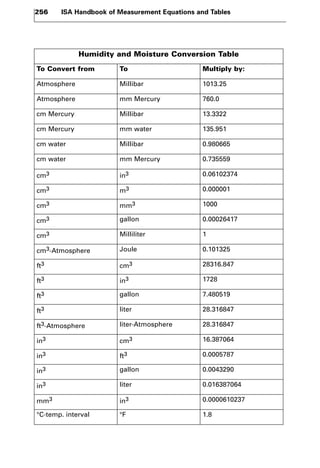
Humidity and Moisture Conversion Table 
To Convert from To Multiply by: 
Atmosphere Millibar 1013.25 
Atmosphere mm Mercury 760.0 
cm Mercury Millibar 13.3322 
cm Mercury mm water 135.951 
cm water Millibar 0.980665 
cm water mm Mercury 0.735559 
cm3 in3 0.06102374 
cm3 m3 0.000001 
cm3 mm3 1000 
cm3 gallon 0.00026417 
cm3 Milliliter 1 
cm3-Atmosphere Joule 0.101325 
ft3 cm3 28316.847 
ft3 in3 1728 
ft3 gallon 7.480519 
ft3 liter 28.316847 
ft3-Atmosphere liter-Atmosphere 28.316847 
in3 cm3 16.387064 
in3 ft3 0.0005787 
in3 gallon 0.0043290 
in3 liter 0.016387064 
mm3 in3 0.0000610237 
°C-temp. interval °F 1.8
Chapter 9/Humidity 257 
Humidity and Moisture Conversion Table (cont.) 
To Convert from To Multiply by: 
°C-temp. interval Kelvin 1.0 
°F-temp. interval °C or Kelvin 0.555556 
ft water Atmosphere 0.0294998 
ft water Bar 0.0298907 
ft/°F m/°C 0.54864 
gallon cm3 3785.412 
gallon ft3 0.13368 
gallon in3 231 
gallon liter 3.785412 
in Mercury Millibar 33.8639 
in Mercury Atmosphere 0.0334211 
in water Millibar 2.49089 
in/°F mm/°C 45.72 
liter ft3 0.03532467 
liter in3 61.02374 
liter gallon 0.26417205 
liter-Atmosphere ft3-Atmosphere 0.0353147 
liter-bar Joule 100 
mm Mercury Atmosphere 0.001315789 
mm Mercury Millibar 1.333224 
mm water Atmosphere 0.000096784 
mm water Millibar 0.098665 
part per million Milligram/Kilogram 1 
part per million Milliliter/m3 1
258 ISA Handbook of Measurement Equations and Tables 
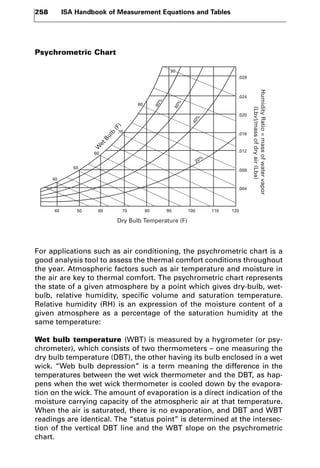
Psychrometric Chart 
40 50 60 70 80 90 100 110 120 
For applications such as air conditioning, the psychrometric chart is a 
good analysis tool to assess the thermal comfort conditions throughout 
the year. Atmospheric factors such as air temperature and moisture in 
the air are key to thermal comfort. The psychrometric chart represents 
the state of a given atmosphere by a point which gives dry-bulb, wet-bulb, 
relative humidity, specific volume and saturation temperature. 
Relative humidity (RH) is an expression of the moisture content of a 
given atmosphere as a percentage of the saturation humidity at the 
same temperature: 
Wet bulb temperature (WBT) is measured by a hygrometer (or psy-chrometer), 
which consists of two thermometers – one measuring the 
dry bulb temperature (DBT), the other having its bulb enclosed in a wet 
wick. “Web bulb depression” is a term meaning the difference in the 
temperatures between the wet wick thermometer and the DBT, as hap-pens 
when the wet wick thermometer is cooled down by the evapora-tion 
on the wick. The amount of evaporation is a direct indication of the 
moisture carrying capacity of the atmospheric air at that temperature. 
When the air is saturated, there is no evaporation, and DBT and WBT 
readings are identical. The “status point” is determined at the intersec-tion 
of the vertical DBT line and the WBT slope on the psychrometric 
chart. 
Dry Bulb Temperature (F) 
40 
50 
60 
70 
80 
90 
Wet Bulb (F) 
80% 
60% 
40% 
20% 
.028 
.024 
.020 
.016 
.012 
.008 
.004 
Humidity Ratio = mass of water vapor 
(Lbv)/mass of dry air (Lba)

Instrumentation and control

  • 1.
    9 Humidity Measurement Introduction . . . . . . . . . . . . . . . . . . . . . . . . . . . . . . . . . . . . . . . . . . . . 253 Principles of Humidity and Moisture Measurement. . . . . . . . . . . . 254 Percent Relative Humidity Equation . . . . . . . . . . . . . . . . . . . . . . . . 254 Dalton’s Law of Partial Pressures . . . . . . . . . . . . . . . . . . . . . . . . . . 255 Humidity and Moisture Conversion Table . . . . . . . . . . . . . . . . . . . 256 Psychrometric Chart . . . . . . . . . . . . . . . . . . . . . . . . . . . . . . . . . . . . . 258
  • 2.
    Chapter 9/Humidity 253 Introduction Popular devices for humidity measurement include the hygrometer, a device which measures only relative humidity; thermohygrometer, a device which measures both temperature and humidity; psychometer, which measures humidity and dew point through water evaporation rate interpretation; and dew point meter, which measures the tempera-ture at which moisture will form in the sampled environment. In process control, moisture and temperature often need to be measured in combination. Thermohygrometers are available in wall mount, dial meter type units that do not require electrical power and digital models. Battery oper-ated digital units are popular. Dial meter type thermohygrometers gen-erally use a “cellulose” sponge type sensor for humidity and a spring or glass bulb thermometer for temperature. As moisture increases, the sponge expands and the lever mechanism moves the indicating needle. Accuracies are typically in the +/- 3% range, and response time is slow. Electronic thermohygrometers generally use either a capacitance or resistance sensor. As the humidity rises, the circuit resistance or capac-itance changes a digital display reading. When portability is needed, a psychometer is often used. It typically has two thermometers-a normal “dry” bulb thermometer, plus another called the “wet” bulb, featuring a wick moistened with water. As air passes over the two thermometers, two temperatures (wet and dry bulb) are generated. Using a table, the humidity can be calculated.
  • 3.
    254 ISA Handbookof Measurement Equations and Tables Principles of Humidity and Moisture Measurement Measurement Factor Percent Relative Humidity RH wvp wvp a s = ×100 Measurement Description where RH = percent relative humidity wvpa = absolute water vapor pressure wvps = saturated water vapor pressure Units of Measure Wet Bulb Thermometer The temperature of a wetted thermometer in a stream of air. °F or °C Percent Relative Humidity The ratio of actual vapor pressure to saturation vapor pressure. 0-100% Dew Point The temperature that air must be cooled to achieve saturation. °F or °C Volume or Mass Parts per million by volume or weight. ppmv or ppmw
  • 4.
    Dalton’s Law ofPartial Pressures John Dalton’s law: The Total Pressure of a gas mixture is the sum of the pressures of each gas component. P = Pn2 + Po2 + Par + . . . “Partial Pressure” is defined as the pressure of a single gas in the mix-ture as if that gas alone occupied the container. Water in its gaseous state (vapor) is an additional gas component of air, and also appears in Dalton’s law as: P = Pn2 + PO2 + PAr + PCO2 …… + e = Pda + e where e = partial pressure of (water) vapor [mbar] Pda = partial pressure of dry air Chapter 9/Humidity 255 Main Gas Components in Air Gas % Volume % Weight Nitrogen N2 78.03 75.47 Oxygen O2 20.99 23.20 Argon Ar 0.93 1.28 Carbon Dioxide CO2 0.03 0.04 All others: H2, He, Ne, Kr etc. 0.02 0.01
  • 5.
    256 ISA Handbookof Measurement Equations and Tables Humidity and Moisture Conversion Table To Convert from To Multiply by: Atmosphere Millibar 1013.25 Atmosphere mm Mercury 760.0 cm Mercury Millibar 13.3322 cm Mercury mm water 135.951 cm water Millibar 0.980665 cm water mm Mercury 0.735559 cm3 in3 0.06102374 cm3 m3 0.000001 cm3 mm3 1000 cm3 gallon 0.00026417 cm3 Milliliter 1 cm3-Atmosphere Joule 0.101325 ft3 cm3 28316.847 ft3 in3 1728 ft3 gallon 7.480519 ft3 liter 28.316847 ft3-Atmosphere liter-Atmosphere 28.316847 in3 cm3 16.387064 in3 ft3 0.0005787 in3 gallon 0.0043290 in3 liter 0.016387064 mm3 in3 0.0000610237 °C-temp. interval °F 1.8
  • 6.
    Chapter 9/Humidity 257 Humidity and Moisture Conversion Table (cont.) To Convert from To Multiply by: °C-temp. interval Kelvin 1.0 °F-temp. interval °C or Kelvin 0.555556 ft water Atmosphere 0.0294998 ft water Bar 0.0298907 ft/°F m/°C 0.54864 gallon cm3 3785.412 gallon ft3 0.13368 gallon in3 231 gallon liter 3.785412 in Mercury Millibar 33.8639 in Mercury Atmosphere 0.0334211 in water Millibar 2.49089 in/°F mm/°C 45.72 liter ft3 0.03532467 liter in3 61.02374 liter gallon 0.26417205 liter-Atmosphere ft3-Atmosphere 0.0353147 liter-bar Joule 100 mm Mercury Atmosphere 0.001315789 mm Mercury Millibar 1.333224 mm water Atmosphere 0.000096784 mm water Millibar 0.098665 part per million Milligram/Kilogram 1 part per million Milliliter/m3 1
  • 7.
    258 ISA Handbookof Measurement Equations and Tables Psychrometric Chart 40 50 60 70 80 90 100 110 120 For applications such as air conditioning, the psychrometric chart is a good analysis tool to assess the thermal comfort conditions throughout the year. Atmospheric factors such as air temperature and moisture in the air are key to thermal comfort. The psychrometric chart represents the state of a given atmosphere by a point which gives dry-bulb, wet-bulb, relative humidity, specific volume and saturation temperature. Relative humidity (RH) is an expression of the moisture content of a given atmosphere as a percentage of the saturation humidity at the same temperature: Wet bulb temperature (WBT) is measured by a hygrometer (or psy-chrometer), which consists of two thermometers – one measuring the dry bulb temperature (DBT), the other having its bulb enclosed in a wet wick. “Web bulb depression” is a term meaning the difference in the temperatures between the wet wick thermometer and the DBT, as hap-pens when the wet wick thermometer is cooled down by the evapora-tion on the wick. The amount of evaporation is a direct indication of the moisture carrying capacity of the atmospheric air at that temperature. When the air is saturated, there is no evaporation, and DBT and WBT readings are identical. The “status point” is determined at the intersec-tion of the vertical DBT line and the WBT slope on the psychrometric chart. Dry Bulb Temperature (F) 40 50 60 70 80 90 Wet Bulb (F) 80% 60% 40% 20% .028 .024 .020 .016 .012 .008 .004 Humidity Ratio = mass of water vapor (Lbv)/mass of dry air (Lba)