THETECHNOLOGYSTREAM
Elliptic Curve Cryptography
Burt Kaliski
Chief Scientist and Director
RSA Laboratories
THETECHNOLOGYSTREAM
Outline
I. Elliptic curves
II. Elliptic curve cryptosystems
III. Advantages and disadvantages
IV. Standardization efforts
THETECHNOLOGYSTREAM
Notation
• GF(q) or Fq: finite field with q
elements
– typically, q = p where p is prime, or 2m
• E(Fq): elliptic curve over Fq
• (x, y): point on E(Fq)
• O: point at infinity
THETECHNOLOGYSTREAM
Acronyms
• EC = Elliptic Curve
– as in EC Digital Signature Algorithm
• ECC = Elliptic Curve Cryptography
THETECHNOLOGYSTREAM
Part I: Elliptic Curves
THETECHNOLOGYSTREAM
Elliptic Curves
• An elliptic curve is the set of solutions
(x, y) to an equation of the form
y2
= x3
+ ax + b
where 4a3
+ 27b2
≠ 0, together with a
point at infinity denoted O
• Originally developed to measure
circumference of an ellipse
THETECHNOLOGYSTREAM
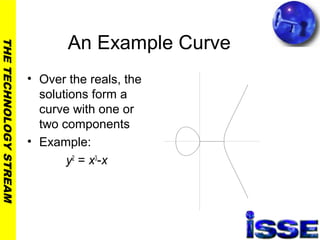
An Example Curve
• Over the reals, the
solutions form a
curve with one or
two components
• Example:
y2
= x3
-x
THETECHNOLOGYSTREAM
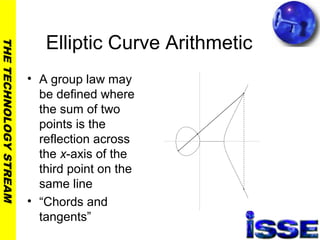
Elliptic Curve Arithmetic
• A group law may
be defined where
the sum of two
points is the
reflection across
the x-axis of the
third point on the
same line
• “Chords and
tangents”
THETECHNOLOGYSTREAM
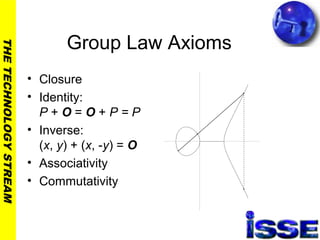
Group Law Axioms
• Closure
• Identity:
P + O = O + P = P
• Inverse:
(x, y) + (x, -y) = O
• Associativity
• Commutativity
THETECHNOLOGYSTREAM
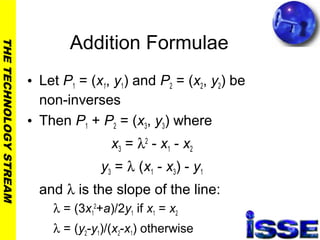
Addition Formulae
• Let P1 = (x1, y1) and P2 = (x2, y2) be
non-inverses
• Then P1 + P2 = (x3, y3) where
x3 = λ2
- x1 - x2
y3 = λ (x1 - x3) - y1
and λ is the slope of the line:
λ = (3x1
2
+a)/2y1 if x1 = x2
λ = (y2-y1)/(x2-x1) otherwise
THETECHNOLOGYSTREAM
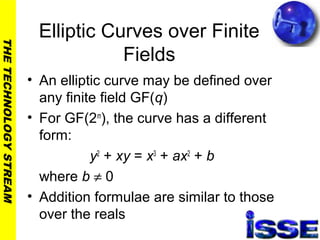
Elliptic Curves over Finite
Fields
• An elliptic curve may be defined over
any finite field GF(q)
• For GF(2m
), the curve has a different
form:
y2
+ xy = x3
+ ax2
+ b
where b ≠ 0
• Addition formulae are similar to those
over the reals
THETECHNOLOGYSTREAM
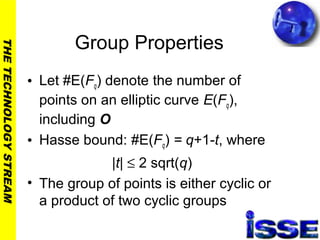
Group Properties
• Let #E(Fq) denote the number of
points on an elliptic curve E(Fq),
including O
• Hasse bound: #E(Fq) = q+1-t, where
|t| ≤ 2 sqrt(q)
• The group of points is either cyclic or
a product of two cyclic groups
THETECHNOLOGYSTREAM
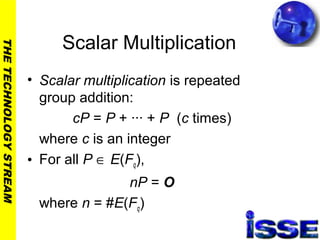
Scalar Multiplication
• Scalar multiplication is repeated
group addition:
cP = P + ··· + P (c times)
where c is an integer
• For all P ∈ E(Fq),
nP = O
where n = #E(Fq)
THETECHNOLOGYSTREAM
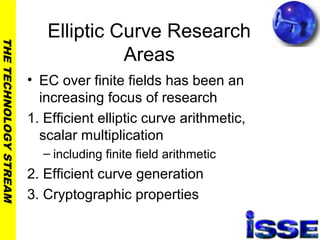
Elliptic Curve Research
Areas
• EC over finite fields has been an
increasing focus of research
1. Efficient elliptic curve arithmetic,
scalar multiplication
– including finite field arithmetic
2. Efficient curve generation
3. Cryptographic properties
THETECHNOLOGYSTREAM
Some Interesting
Applications
• Factoring (Lenstra 1985)
– running time of Elliptic Curve Method
(ECM) depends on size of prime factors
of a number, ideal for “smooth” numbers
• Primality proving (Goldwasser-Kilian 1986)
– under number-theory assumptions,
method for proving primality in random
polynomial time
• Fermat’s Last Theorem
THETECHNOLOGYSTREAM
Analogy with Multiplicative
Groups
Elliptic Curve
Group
Multiplicative
Group
point addition multiplication
scalar
multiplication
exponentiation
elliptic curve
discrete logarithm
discrete logarithm
THETECHNOLOGYSTREAM
Part II: Elliptic Curve
Cryptosystems
THETECHNOLOGYSTREAM
Elliptic Curve
Cryptosystems
• EC discrete logarithm problem
• Domain parameters
• Key pairs
• Cryptographic schemes
THETECHNOLOGYSTREAM
EC Discrete Logarithm
Problem
• Problem: Given two points W, G,
find s such that W = sG
– first suggested by Miller 1985, Koblitz 1987
• With appropriate cryptographic
restrictions, this is believed to take
exponential time
– O(sqrt(r)) time, where r is the order of W
THETECHNOLOGYSTREAM
EC Discrete Logarithm
Problem (cont’d)
• By comparison, factoring and
ordinary discrete logarithms can be
solved in subexponential time
• ECC thus offers much shorter key
sizes than other public-key
cryptosystems
THETECHNOLOGYSTREAM
Typical Cryptographic
Restrictions
• #E(Fq) = kr for large prime r
– k is cofactor
• GCD (k, r) = 1
• “Anomalous” condition: r ≠ q
• MOV condition: r does not divide qi
-1
for small i
THETECHNOLOGYSTREAM
Domain Parameters
• Common values shared by a group
of users from which key pairs may be
generated
• User or trusted party may generate
domain parameters
• Anyone may validate domain
parameters
THETECHNOLOGYSTREAM
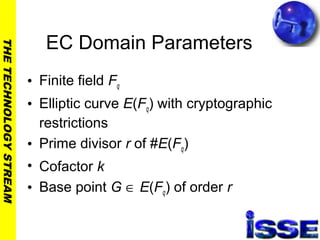
EC Domain Parameters
• Finite field Fq
• Elliptic curve E(Fq) with cryptographic
restrictions
• Prime divisor r of #E(Fq)
• Cofactor k
• Base point G ∈ E(Fq) of order r
THETECHNOLOGYSTREAM
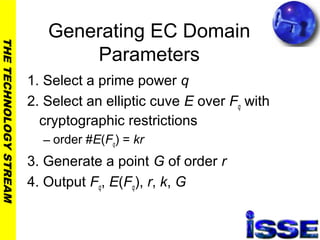
Generating EC Domain
Parameters
1. Select a prime power q
2. Select an elliptic cuve E over Fq with
cryptographic restrictions
– order #E(Fq) = kr
3. Generate a point G of order r
4. Output Fq, E(Fq), r, k, G
THETECHNOLOGYSTREAM
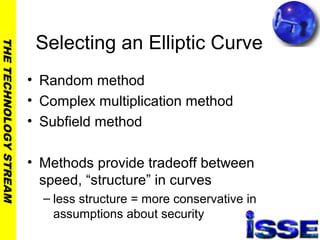
Selecting an Elliptic Curve
• Random method
• Complex multiplication method
• Subfield method
• Methods provide tradeoff between
speed, “structure” in curves
– less structure = more conservative in
assumptions about security
THETECHNOLOGYSTREAM
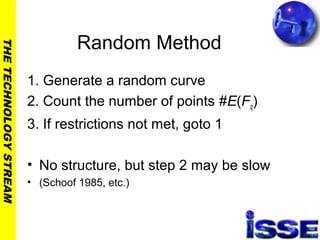
Random Method
1. Generate a random curve
2. Count the number of points #E(Fq)
3. If restrictions not met, goto 1
• No structure, but step 2 may be slow
• (Schoof 1985, etc.)
THETECHNOLOGYSTREAM
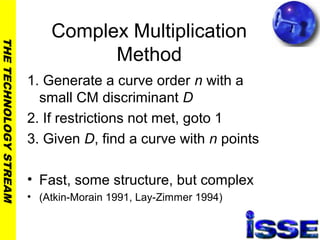
Complex Multiplication
Method
1. Generate a curve order n with a
small CM discriminant D
2. If restrictions not met, goto 1
3. Given D, find a curve with n points
• Fast, some structure, but complex
• (Atkin-Morain 1991, Lay-Zimmer 1994)
THETECHNOLOGYSTREAM
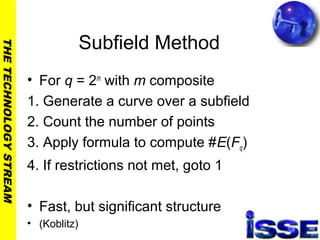
Subfield Method
• For q = 2m
with m composite
1. Generate a curve over a subfield
2. Count the number of points
3. Apply formula to compute #E(Fq)
4. If restrictions not met, goto 1
• Fast, but significant structure
• (Koblitz)
THETECHNOLOGYSTREAM
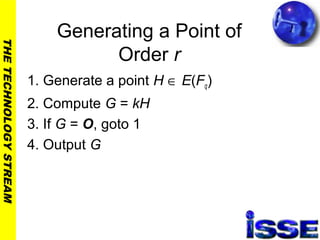
Generating a Point of
Order r
1. Generate a point H ∈ E(Fq)
2. Compute G = kH
3. If G = O, goto 1
4. Output G
THETECHNOLOGYSTREAM
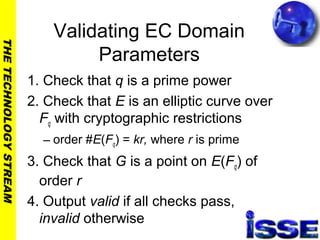
Validating EC Domain
Parameters
1. Check that q is a prime power
2. Check that E is an elliptic curve over
Fq with cryptographic restrictions
– order #E(Fq) = kr, where r is prime
3. Check that G is a point on E(Fq) of
order r
4. Output valid if all checks pass,
invalid otherwise
THETECHNOLOGYSTREAM
Key Pairs
• Pairs of public, private values with
which users may perform
cryptographic operations
• User or trusted third party may
generate key pair
• Anyone may validate public key
THETECHNOLOGYSTREAM
EC Key Pairs
• Public key W ∈ E(Fq)
• Private key s ∈ [1, r-1]
– where W = sG
THETECHNOLOGYSTREAM
Generating an EC Key
Pair
1. Randomly generate s ∈ [1, n-1]
2. Compute W = sG
3. Output (W, s)
THETECHNOLOGYSTREAM
Validating an EC Public
Key
• Assume valid domain parameters
1. Check that W is a point on E(Fq) of
order r
2. Output valid if so, invalid otherwise
THETECHNOLOGYSTREAM
Cryptographic Schemes
• Following general model from IEEE
P1363, a scheme is a set of related
operations providing the building
blocks for a protocol
• Examples:
– key agreement
– signature with appendix
– encryption
THETECHNOLOGYSTREAM
Scheme Operations
• Depending on the scheme, related
operations may include:
– domain parameter generation, validation
– key pair generation, public-key
validation
– one or more scheme-specific operations
THETECHNOLOGYSTREAM
Key Agreement Scheme
• Key agreement operation derives a
shared secret key from a private key,
another’s public key, and key
derivation parameters
• Multiple secret keys can be obtained
by varying parameters
THETECHNOLOGYSTREAM
Elliptic Curve Diffie-
Hellman
• Key agreement scheme based on
Diffie-Hellman protocol
• In IEEE P1363, ECKAS-DH1 with
ECSDVP-DH primitive
• Underlying function:
– KDF: key derivation function
THETECHNOLOGYSTREAM
ECDH Key Agreement
• Input: private key s, other’s public
key W*, key derivation parameters P
• Output: shared secret key K
1. Compute Z = sW*
2. Compute K = KDF (Z, P)
3. Output K
THETECHNOLOGYSTREAM
Key Agreement Modes
• Each key pair may be ephemeral,
authenticated, or a combination,
depending on security goals
• Examples of protocol modes:
– anonymous
– static-static
– signed ephemeral-ephemeral
– ephemeral-static
THETECHNOLOGYSTREAM
Signature Scheme
• Signature generation operation
computes a signature on a message
with a private key
• Signature verification operation
verifies a signature with a public key
THETECHNOLOGYSTREAM
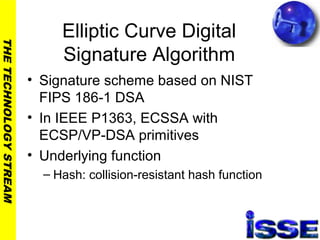
Elliptic Curve Digital
Signature Algorithm
• Signature scheme based on NIST
FIPS 186-1 DSA
• In IEEE P1363, ECSSA with
ECSP/VP-DSA primitives
• Underlying function
– Hash: collision-resistant hash function
THETECHNOLOGYSTREAM
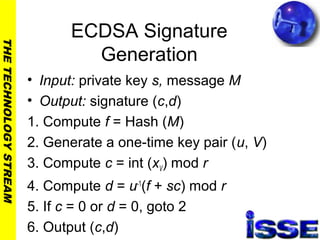
ECDSA Signature
Generation
• Input: private key s, message M
• Output: signature (c,d)
1. Compute f = Hash (M)
2. Generate a one-time key pair (u, V)
3. Compute c = int (xV) mod r
4. Compute d = u-1
(f + sc) mod r
5. If c = 0 or d = 0, goto 2
6. Output (c,d)
THETECHNOLOGYSTREAM
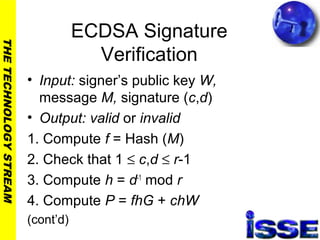
ECDSA Signature
Verification
• Input: signer’s public key W,
message M, signature (c,d)
• Output: valid or invalid
1. Compute f = Hash (M)
2. Check that 1 ≤ c,d ≤ r-1
3. Compute h = d-1
mod r
4. Compute P = fhG + chW
(cont’d)
THETECHNOLOGYSTREAM
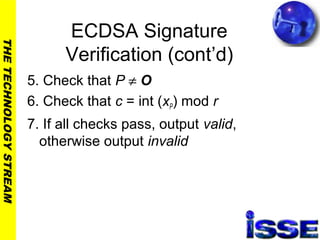
ECDSA Signature
Verification (cont’d)
5. Check that P ≠ O
6. Check that c = int (xP) mod r
7. If all checks pass, output valid,
otherwise output invalid
THETECHNOLOGYSTREAM
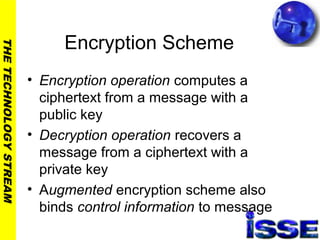
Encryption Scheme
• Encryption operation computes a
ciphertext from a message with a
public key
• Decryption operation recovers a
message from a ciphertext with a
private key
• Augmented encryption scheme also
binds control information to message
THETECHNOLOGYSTREAM
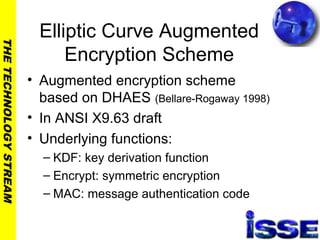
Elliptic Curve Augmented
Encryption Scheme
• Augmented encryption scheme
based on DHAES (Bellare-Rogaway 1998)
• In ANSI X9.63 draft
• Underlying functions:
– KDF: key derivation function
– Encrypt: symmetric encryption
– MAC: message authentication code
THETECHNOLOGYSTREAM
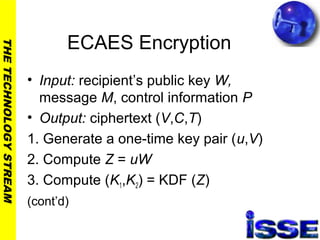
ECAES Encryption
• Input: recipient’s public key W,
message M, control information P
• Output: ciphertext (V,C,T)
1. Generate a one-time key pair (u,V)
2. Compute Z = uW
3. Compute (K1,K2) = KDF (Z)
(cont’d)
THETECHNOLOGYSTREAM
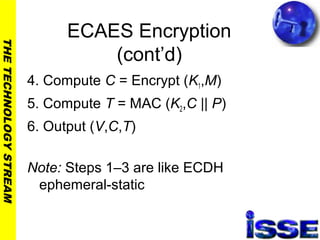
ECAES Encryption
(cont’d)
4. Compute C = Encrypt (K1,M)
5. Compute T = MAC (K2,C || P)
6. Output (V,C,T)
Note: Steps 1–3 are like ECDH
ephemeral-static
THETECHNOLOGYSTREAM
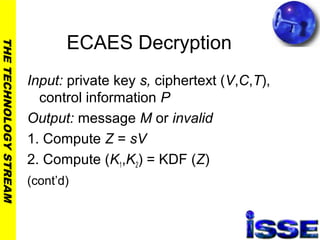
ECAES Decryption
Input: private key s, ciphertext (V,C,T),
control information P
Output: message M or invalid
1. Compute Z = sV
2. Compute (K1,K2) = KDF (Z)
(cont’d)
THETECHNOLOGYSTREAM
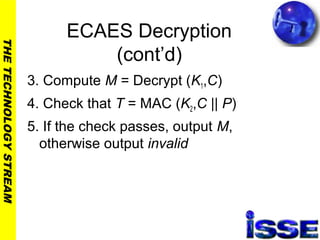
ECAES Decryption
(cont’d)
3. Compute M = Decrypt (K1,C)
4. Check that T = MAC (K2,C || P)
5. If the check passes, output M,
otherwise output invalid
THETECHNOLOGYSTREAM
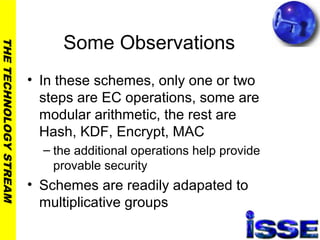
Some Observations
• In these schemes, only one or two
steps are EC operations, some are
modular arithmetic, the rest are
Hash, KDF, Encrypt, MAC
– the additional operations help provide
provable security
• Schemes are readily adapated to
multiplicative groups
THETECHNOLOGYSTREAM
Part III: Advantages and
Disadvantages
THETECHNOLOGYSTREAM
Advantages and
Disadvantages
• Three families
• Key size comparison
• Advantages
• Disadvantages
THETECHNOLOGYSTREAM
Three Families
• Today, three families of public-key
techniques are prominent
• Following P1363, named according
to the hard problem:
– DL: (ordinary) discrete logarithms
– EC: elliptic curve discrete logarithms
– IF: integer factorization
• Each has its own advantages
THETECHNOLOGYSTREAM
Key Size Comparison
• Key size is length in bits of:
– DL: field order q
• also consider group order r
– EC: group order r
– IF: modulus n
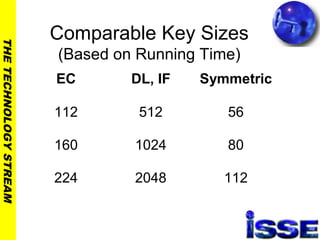
• Key sizes can be compared based
on running time for solving hard
problem with current methods
– other factors to consider
THETECHNOLOGYSTREAM
Comparable Key Sizes
(Based on Running Time)
EC DL, IF Symmetric
112 512 56
160 1024 80
224 2048 112
THETECHNOLOGYSTREAM
Advantages
• Alternative hard problem
• Speed
• Data size
• New types of schemes
• Many options
THETECHNOLOGYSTREAM
Alternative Hard Problem
• EC Discrete Logarithm Problem is
very different than DL, IF hard
problems
– does not appear feasible to apply DL, IF
approaches to solve it
• Thus, it is an effective alternative
against advances in methods for
other problems
THETECHNOLOGYSTREAM
Speed
• EC operations are generally faster
than DL, IF counterparts at
comparable key sizes
– GF(2m
) arithmetic affords further
speedups
• Key pair generation is much faster
than for IF
THETECHNOLOGYSTREAM
Data Size
• EC data are shorter than DL, IF
counterparts
• Intermediate values are shorter
• Keys are shorter
– benefit depends on certificate content
• Signatures with appendix are same
size as for DL, shorter than IF
THETECHNOLOGYSTREAM
New Types of Schemes
• EC family, like DL, has great flexibility
due to the availability of common
domain parameters
• Multiple schemes can be combined
efficiently, e.g.:
– signature + encryption
– signature / key agreement + certification
– (Zheng 1997, Arazi 1998, Vanstone)
THETECHNOLOGYSTREAM
Many Options
• EC family affords many choices:
– field type, size, representation
– curve formula
– group order
– base point
– cryptographic scheme
• Appropriate choices can meet
varying security and implementation
objectives
THETECHNOLOGYSTREAM
Disadvantages
• Alternative hard problem
• Curve generation
• Many options
THETECHNOLOGYSTREAM
Alternative Hard Problem
• ECDLP has not been studied as long
as DL, IF hard problems, and even a
modest improvement in methods
could have great impact
• However, the focus on this area has
grown considerably over the past few
years, with increased confidence
THETECHNOLOGYSTREAM
Curve Generation
• EC curve generation is complex, not
readily implemented
• However, implementers can rely on
third parties for curves, which can be
validated
– e.g., NIST curves
THETECHNOLOGYSTREAM
Many Options
• ECC affords many options, so
interoperability is challenging:
– no conversion between GF(2m
), GF(p)
– hardware optimizations may be specific
to one set of domain parameters
• However, much of this will be settled
by standards and industry practice
THETECHNOLOGYSTREAM
Part IV: Standardization
Efforts
THETECHNOLOGYSTREAM
Standardization Efforts
• Elliptic curves are parts of standards
being developed by several groups:
– ANSI X9F1
– IEEE P1363
– ISO JTC1 SC27
– SECG
– U.S. NIST
• Generally, all three families are
being developed together
THETECHNOLOGYSTREAM
ANSI X9F1
• Cryptographic techniques for U.S.
financial services industry
• ANSI X9.62 specifies ECDSA
• ANSI X9.63 (draft) specifies ECDH,
ECAES and more
• Technical Guideline on elliptic curve
mathematics
• www.x9.org
THETECHNOLOGYSTREAM
IEEE P1363
• Public-key cryptography
specifications, transnational
• Specifies ECDH, ECDSA and much
more (including other families)
– framework for ANSI X9F1 work
• ECAES proposed for addendum
• grouper.ieee.org/groups/1363
THETECHNOLOGYSTREAM
ISO SC27
• IT security techniques, international
• ISO/IEC DIS 14888-3 includes
ECDSA
– aligned with ANSI X9.62
• ISO/IEC CD 15946 covers elliptic
curve techniques including digital
signatures, key establishment
• www.iso.ch/meme/JTC1SC27.html
THETECHNOLOGYSTREAM
SECG
• Standards for Efficient Cryptography
Group
• Industry implementers agreements,
intended to profile other standards
• www.secg.org
THETECHNOLOGYSTREAM
U.S. NIST
• Information processing for U.S.
government
• FIPS 186 (Digital Signature
Standard) to add support for ANSI
X9.62
• Eventual ANSI X9.63 support likely
• Reference elliptic curves published
• csrc.nist.gov/fips
THETECHNOLOGYSTREAM
Summary
THETECHNOLOGYSTREAM
Summary
• ECC offers an attractive alternative to
other public-key cryptosystems
– new hard problem
– smaller key size
• Many standards are emerging
• Number theory continues to be useful

1524 elliptic curve cryptography