Digital Signatures
Presented by
signyourdoc
2
Outline
 Cryptographic goals
 Message Authentication Codes (MACs)
 Digital signatures
 RSA digital signature
 Elliptic curve digital signature
 Comparison of ECDSA and RSA
signature
3
Symmetric-key
ciphers:
Block ciphers
Stream ciphers
Public-key
ciphers
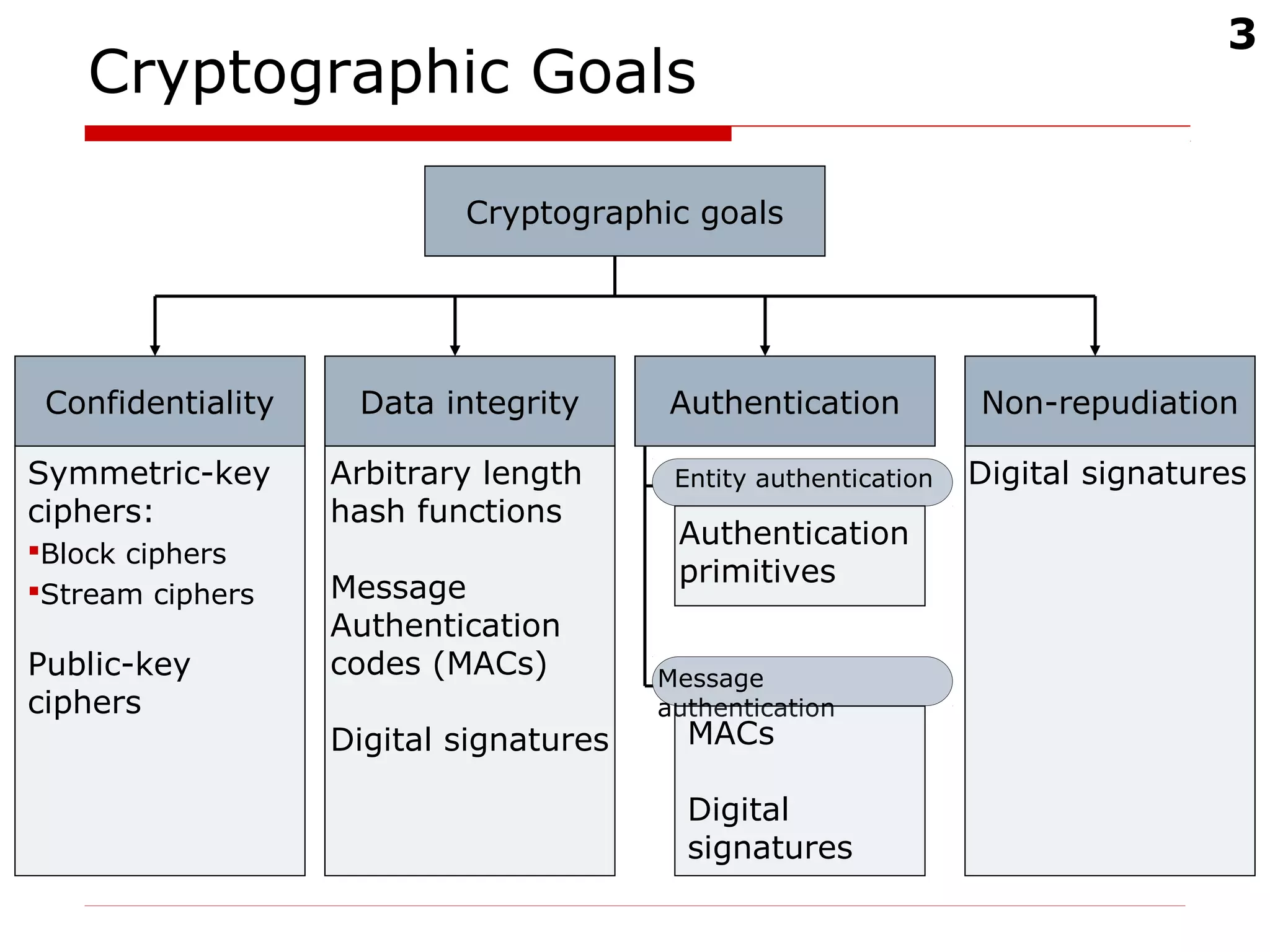
Cryptographic Goals
Cryptographic goals
Confidentiality Data integrity Authentication Non-repudiation
Message
authentication
Entity authenticationArbitrary length
hash functions
Message
Authentication
codes (MACs)
Digital signatures
Authentication
primitives
Digital signatures
MACs
Digital
signatures
4
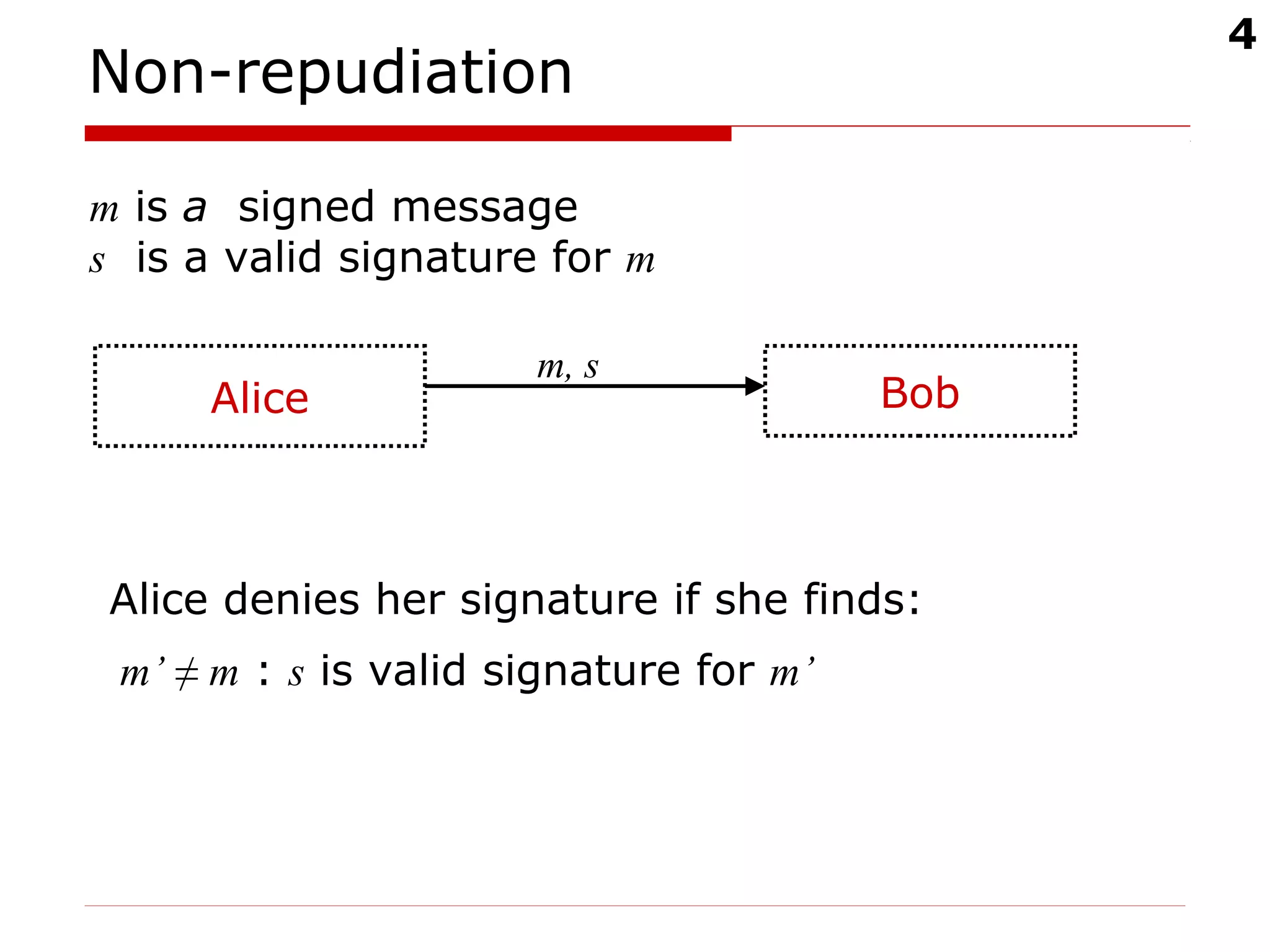
Non-repudiation
Alice Bob
m is a signed message
s is a valid signature for m
m, s
Alice denies her signature if she finds:
m’ ≠ m : s is valid signature for m’
5
Message Authentication Codes
 MAC f(x, key):{0,1}* → {0,1}n
 knowing x and key f is easy to compute
 it is infeasible to calculate f(x, key)
without the key
 MAC are often block cipher based
 message m, secret key k
 specification of block cipher E
 MAC (m) = E( m, key )
 MAC (m) = E(hash(m), key )
6
CBC-based MAC algorithm
E
key
0
X1(n bit)
E
key
X2 (n bit)
h1
…
h2
E
key
Xt (n bit)
ht-1
H = MAC
Optional
output transformationh1 = Ekey(x1)
hi = Ekey(hi-1 xi ), 2 ≤ i ≤ t
Algorithm CBC-MAC
INPUT: data x; specification of block cipher E; secret MAC key for E
OUTPUT: n-bit MAC on x
n bit
n bit
h1(n bit) h2(n bit)
7
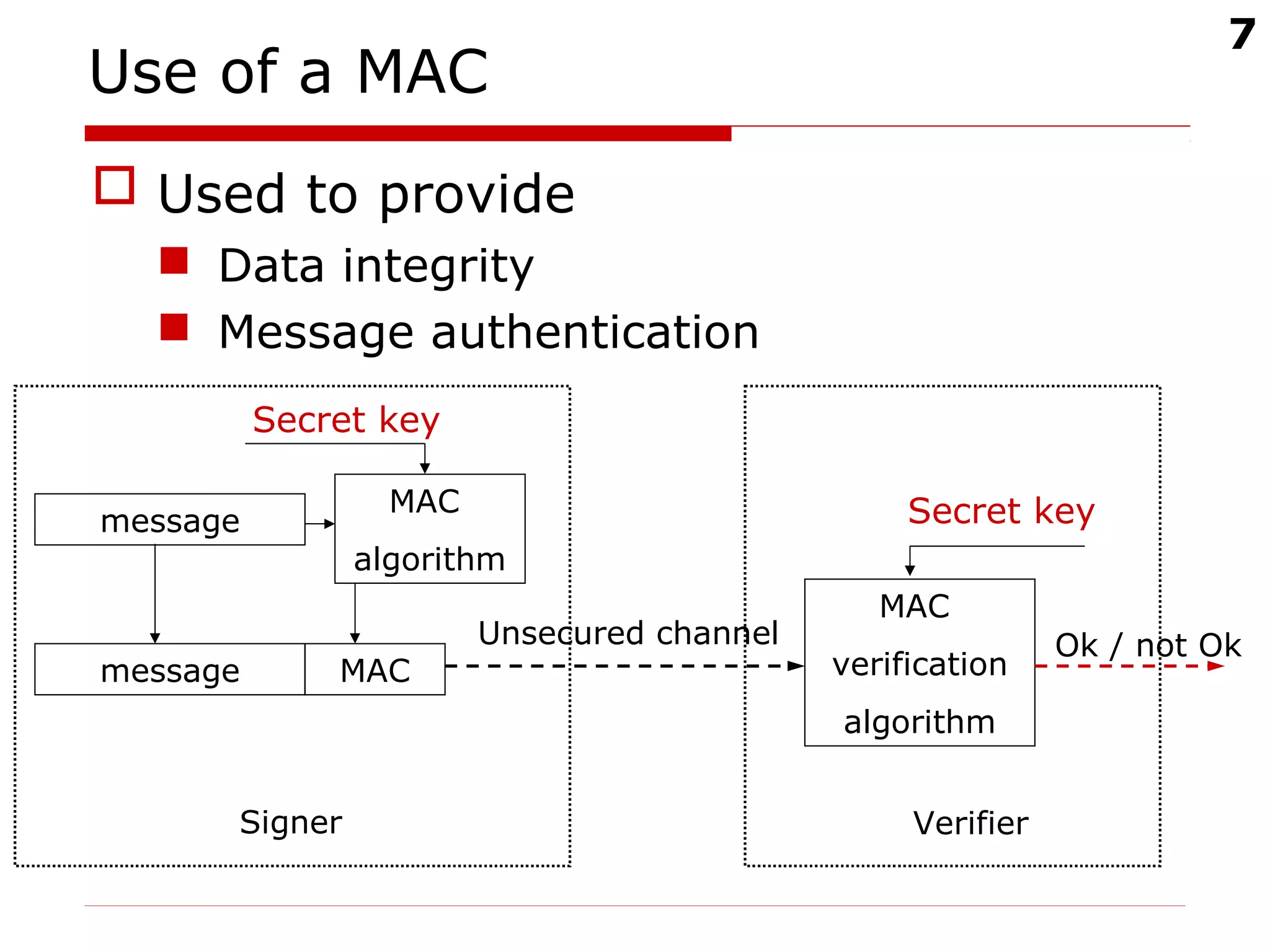
Use of a MAC
message
MAC
algorithm
message MAC
Secret key
Unsecured channel
Signer
MAC
verification
algorithm
Secret key
Verifier
Ok / not Ok
 Used to provide
 Data integrity
 Message authentication
8
Digital Signatures Scheme
 Used to provide
 Data integrity
 Message authentication
 Non-repudiation
message
Signing
algorithm
message signature
Signer’s private key
Unsecured channel
Signer
Signature
verification
algorithm
Signer’s public key
Verifier
Ok / not Ok
9
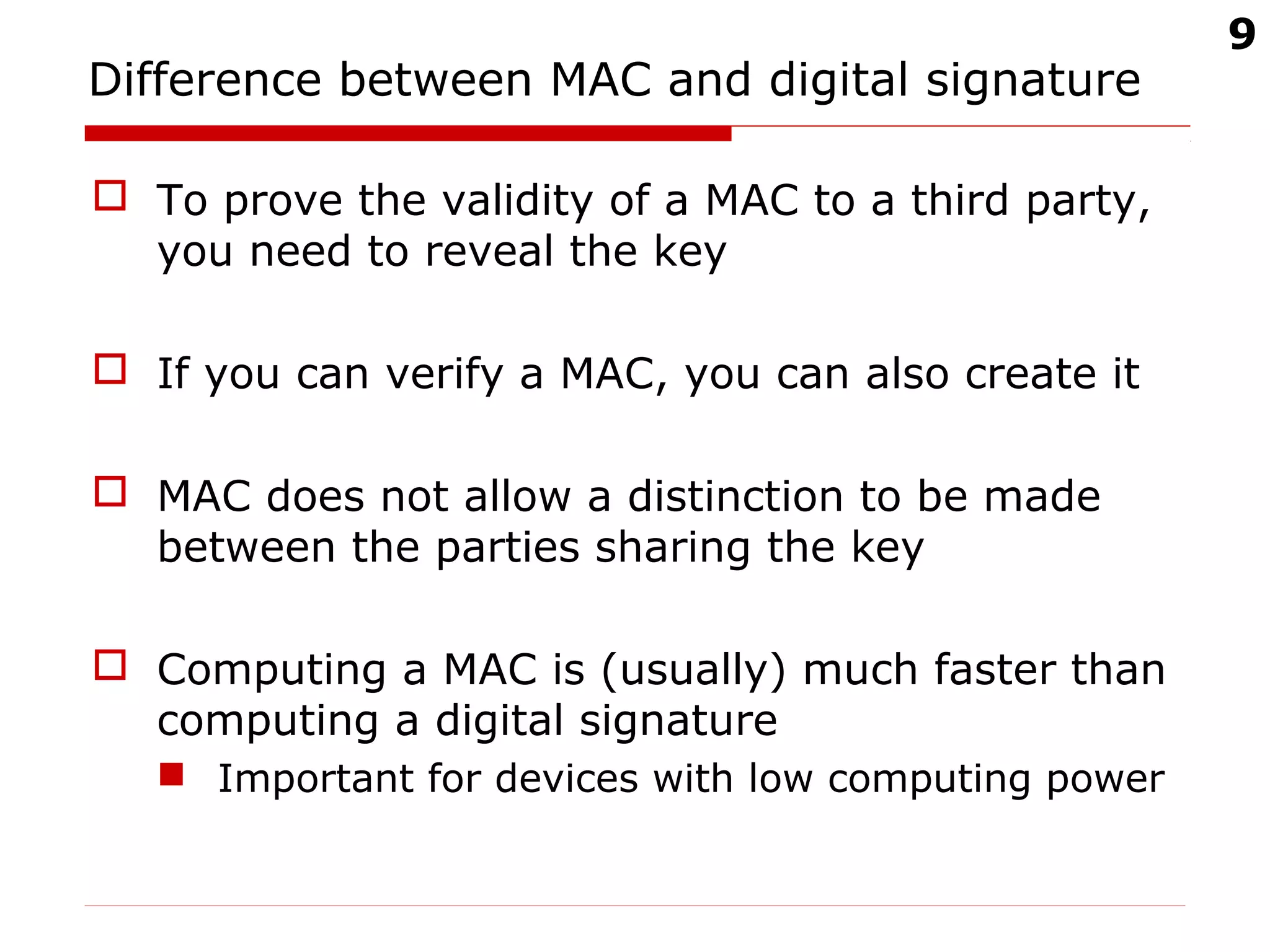
Difference between MAC and digital signature
 To prove the validity of a MAC to a third party,
you need to reveal the key
 If you can verify a MAC, you can also create it
 MAC does not allow a distinction to be made
between the parties sharing the key
 Computing a MAC is (usually) much faster than
computing a digital signature
 Important for devices with low computing power
10
RSA signature algorithm
11
RSA
 Developed in 1978 by Rivest, Shamir and
Adleman (RSA)
 Most popular public key cryptosystem
 Based on the hard problem of “integer
factorization”
12
Key-Generation for RSA(1)
1. Generate two large random distinct primes
p and q, each roughly the same size
2. Compute n = pq and
3. Select random integer e:
4. Compute unique integer d:
5. Public key is (n, e); Private key is d
( ) ( 1)( 1)n p qφ = − −
1 , such that gcd( , ) 1e eφ φ< < =
1 , such that 1modd edφ φ< < =
13
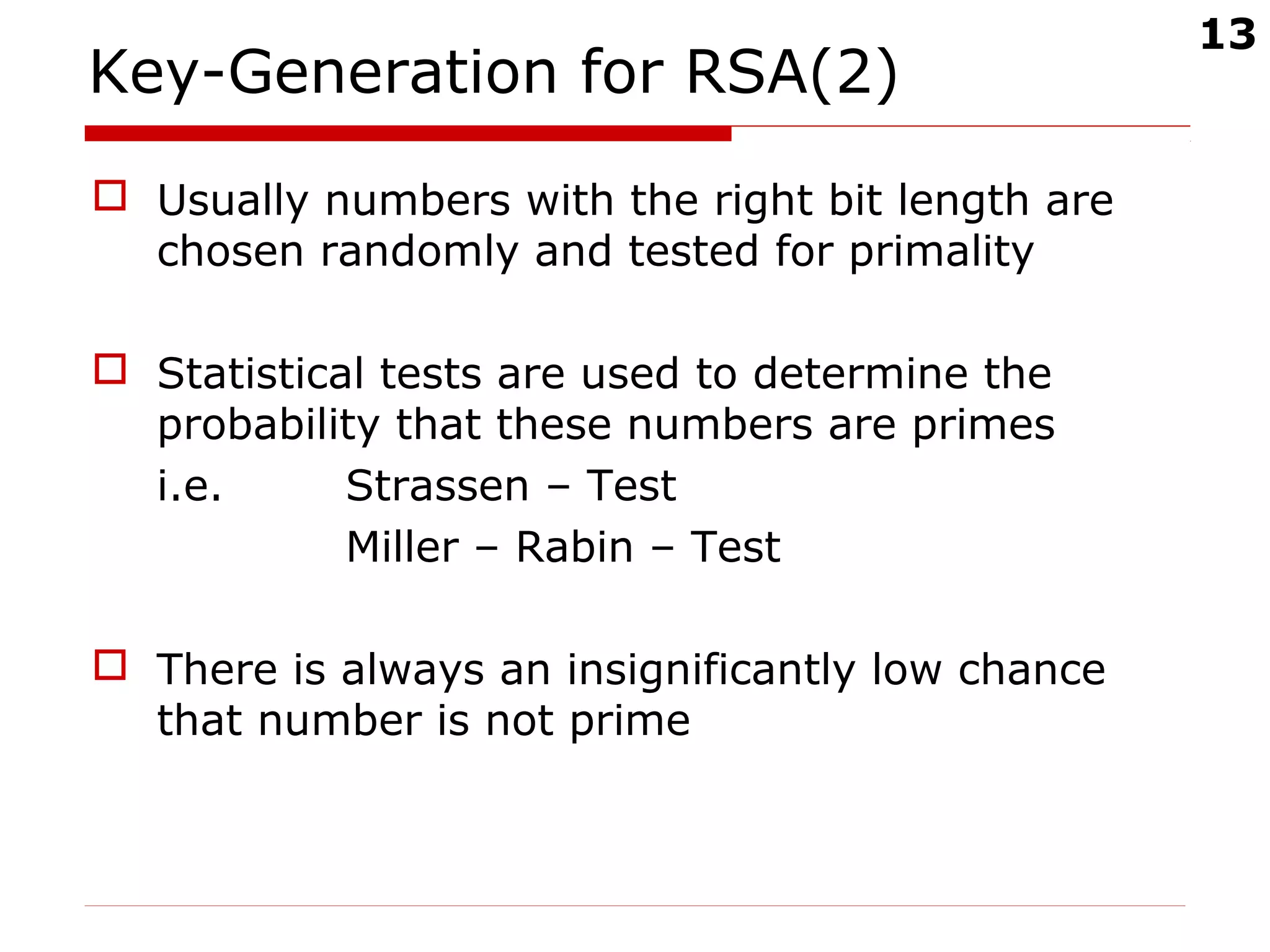
Key-Generation for RSA(2)
 Usually numbers with the right bit length are
chosen randomly and tested for primality
 Statistical tests are used to determine the
probability that these numbers are primes
i.e. Strassen – Test
Miller – Rabin – Test
 There is always an insignificantly low chance
that number is not prime
14
Used notation
 M is a set of elements, called the
message space = Zn
 MS is a set of elements, called the
signing space = Zn
 R is a 1 to 1 mapping from M to MS,
called the redundancy function
 MR is the image of R: {y| y = R(x), xЄ M}
 R-1
is the inverse of R: MR M
15
RSA signature generation and verification
 To sign a message A should:
 Compute:
where R(m) is a redundancy function
 Compute:
 A’s signature for m is s
 To verify A’s signature and recover m, B should:
 Obtain A’s authentic public key (n, e)
 Compute:
 Verify that ; if not, reject the signature
 Recover
]n,[),m(Rm~ 10 −= rangetheinintegeran
nmodm~s d
=
nmodsm~ e
=
RMm~ ∈
)m~(Rm 1−
=
Mm∈
16
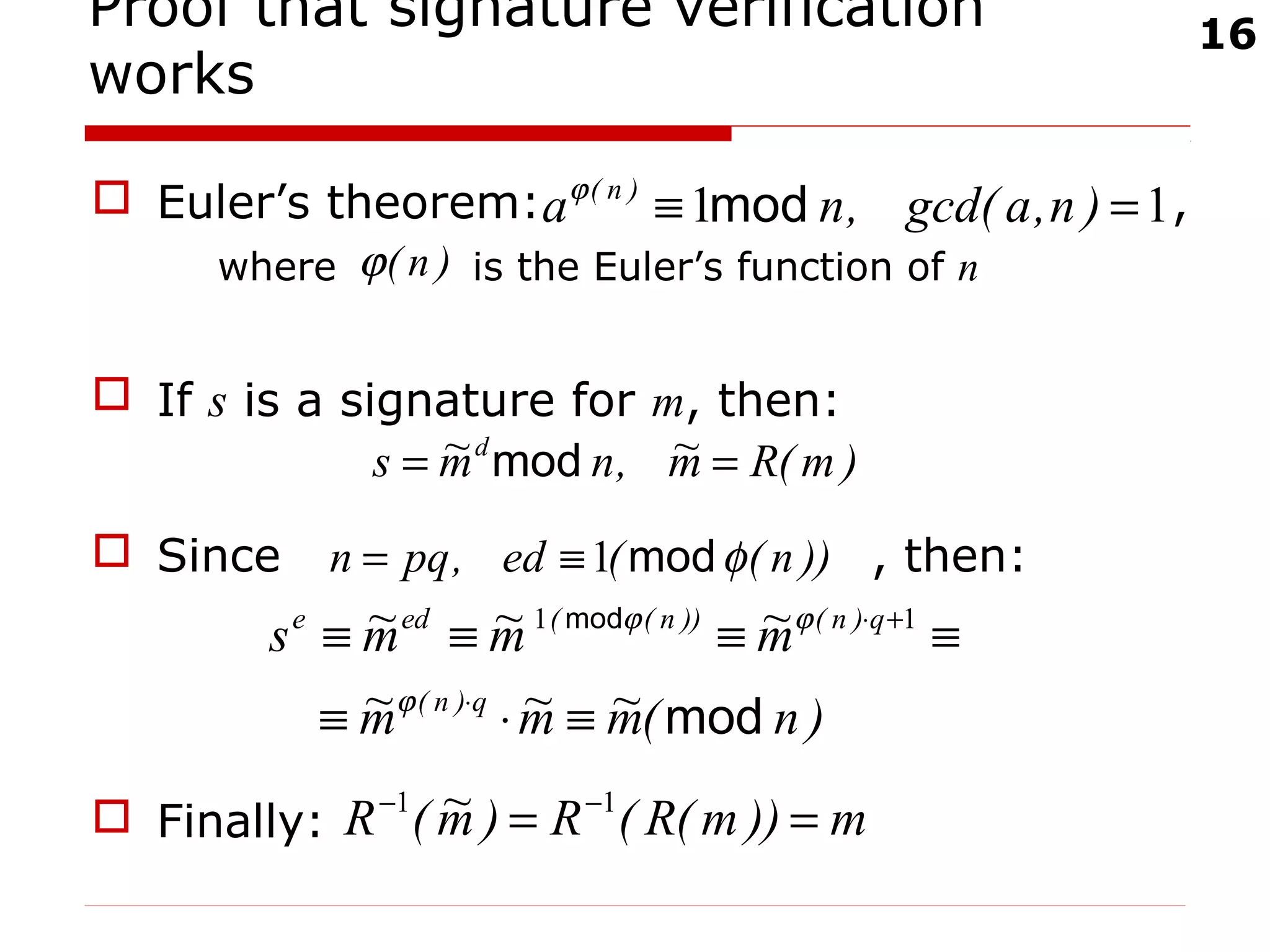
Proof that signature verification
works
 Euler’s theorem: ,
where is the Euler’s function of n
 If s is a signature for m, then:
 Since , then:
 Finally:
)m(Rm~,nm~s d
== mod
))n((ed,pqn φmod1≡=
)n(m~m~m~
m~m~m~s
q)n(
q)n())n((ede
mod
mod
≡⋅≡
≡≡≡≡
⋅
+⋅
ϕ
ϕϕ 11
m))m(R(R)m~(R == −− 11
11 =≡ )n,agcd(,na )n(
modϕ
)n(ϕ
17
RSA signature example
Alice
 p=5 q=7 n = 35 φ(n) = 4·6=24
 e = 5; d: ed = 5d=1 mod 24 => d = 5
Public key: (n=35, e=5) Private key: d=5
 M = [0, n-1]
 For all m Є M R(m)=m
 m = 26; R(m) = 26 s = 265
mod 35 = 31
Bob:
 R(m) = 315
mod 35 = 26 Є [0, n-1]
 m = R-1
(m) = 26
=m~
=m~
18
Possible Attacks on RSA signature
 Integer factorization
 If an adversary is able to factor n, then
 Multiplicative property of RSA
 If , then s is valid signature for m:
 Hence, to avoid this attack R must not be
multiplicative, i.e.
))n((ed:d)q)(p()n(,pqn φφ modfindand 111 ≡−−==
)n(ss)m~m~(m~sm~m~m~
)n(modm~s
)n(modm~s dd
d
d
modthenif 212121
22
11
====⇒
=
=
RMm~ ∈ )m(Rm~ =
)b(R)a(R)ba(RMb,a ⋅≠⋅∈∀
19
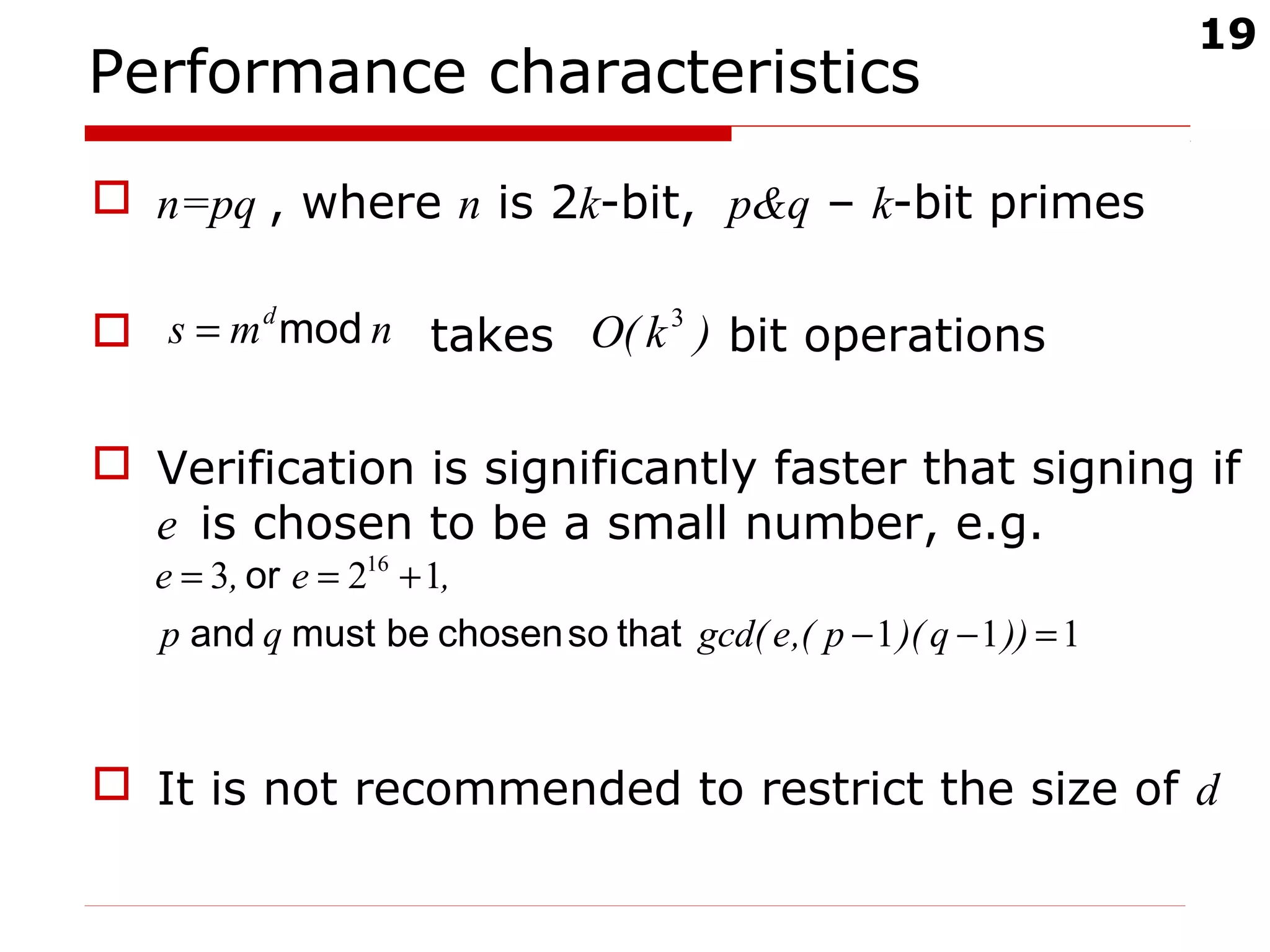
Performance characteristics
 n=pq , where n is 2k-bit, p&q – k-bit primes
 takes bit operations
 Verification is significantly faster that signing if
e is chosen to be a small number, e.g.
 It is not recommended to restrict the size of d
nms d
mod= )k(O 3
111
123 16
=−−
+==
))q)(p(,egcd(qp
,e,e
thatsochosenbemustand
or
20
 n=pq , where n is 2k-bits, p&q – k-bits primes
 ISO/IEC 9796
R:
 To sign a kt-bits message m:
 Divide m = m1|| m2|| m3||… || mt and sign each block
individually one transmits 2kt bits.
 Sign a l-bits hash(m), l ≤ k. Then one transmits
kt+2k bits. (kt – to transmit the message)
 If t > 2, then kt+2k < 2kt
2k bits
m~
Short vs. long messages
⇒
m
k bits
21
The Elliptic Curve Digital Signature
Algorithm (ECDSA)
22
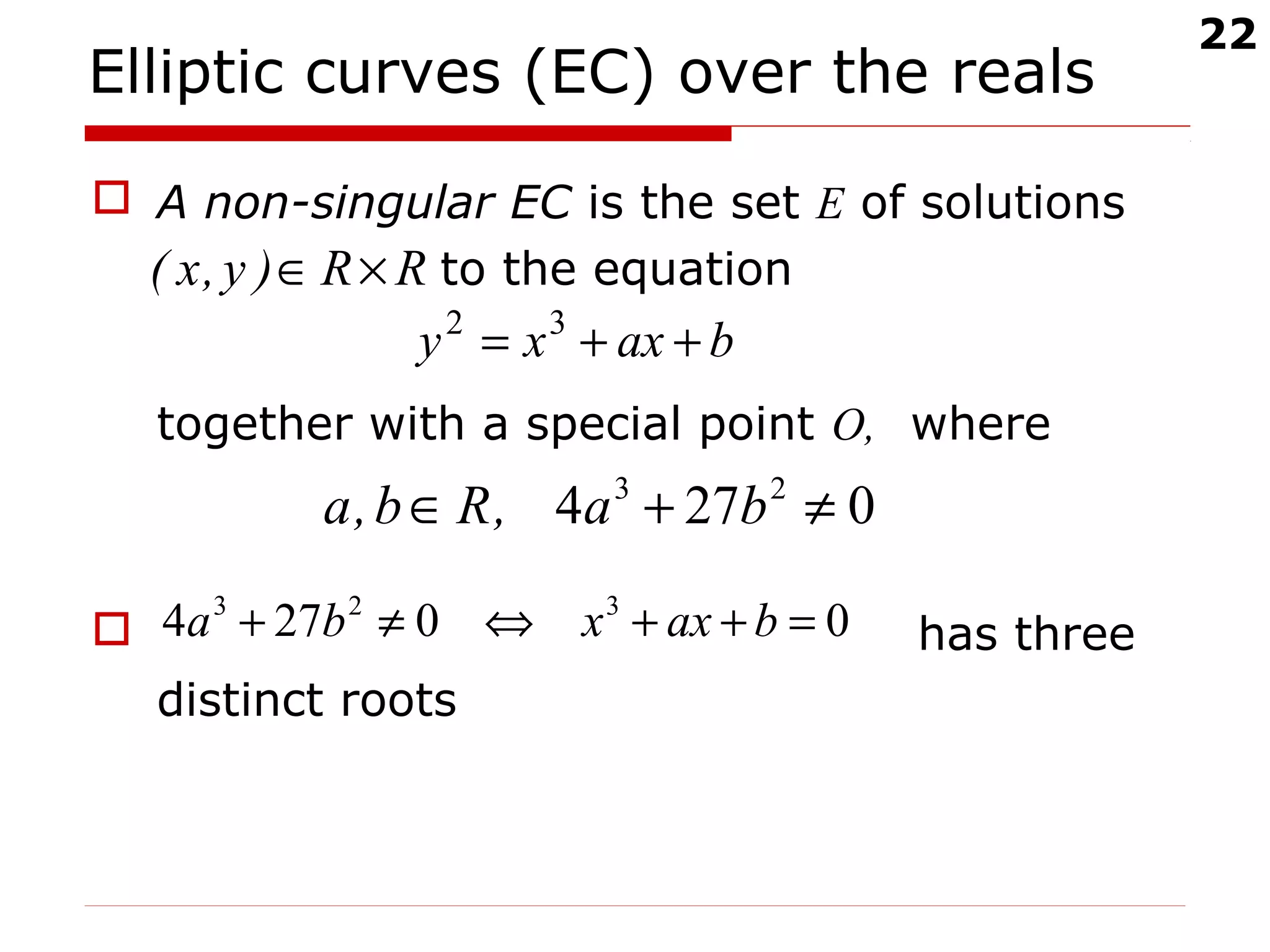
Elliptic curves (EC) over the reals
 A non-singular EC is the set E of solutions
to the equation
together with a special point O, where
 has three
distinct roots
RR)y,x( ×∈
baxxy ++= 32
0274 23
≠+∈ ba,Rb,a
00274 323
=++⇔≠+ baxxba
23
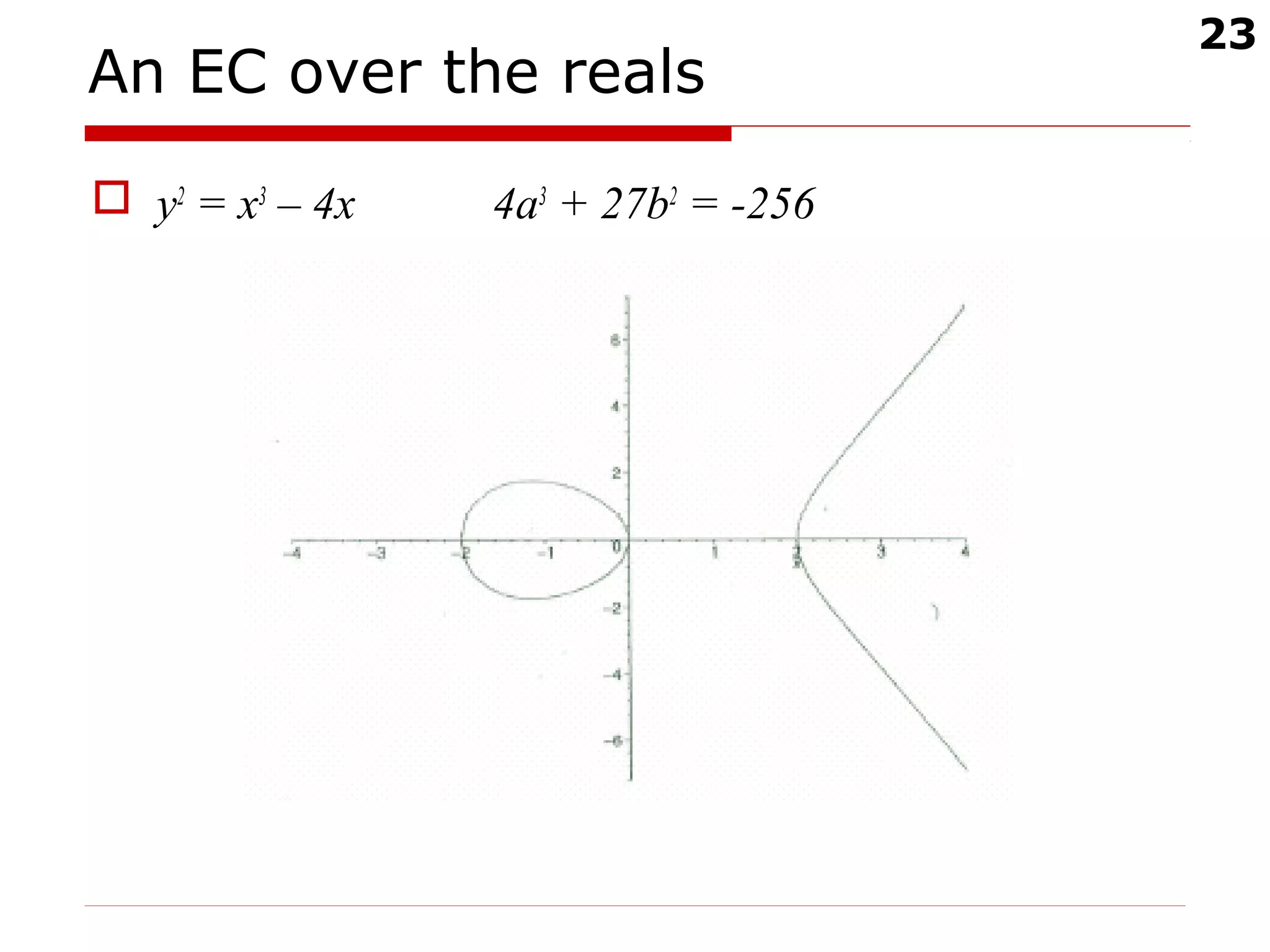
An EC over the reals
 y2
= x3
– 4x 4a3
+ 27b2
= -256
24
Addition – Geometric Approach
 Chord-and-tangent
rule P + Q = R, P ≠ Q
 Point doubling
P + P = 2 P = R
x
y
(x1, y1) = P
Q = (x2, y2)
R = (x3, y3)
x
y
P = (x1, y1)
R = (x3, y3)
-R = (x3, -y3)
-R = (x3, -y3)
Ο
25
Addition – Algebraic Approach
E is elliptic curve over the reals
1. ( is the identity element )
2. If
3.
4.
Ο=−+∈= )y,x()y,x(,E)y,x(P then
PPPEP =+=+∈∀ ΟΟ
whereThen
andLet
),y,x(QP
.QP,E)y,x(Q,E)y,x(P
33
2211
=+
±≠∈=∈=
( ) 21
2
3 12
12
xxx xx
yy
−−= −
−
( )( ) 1313 12
12
yxxy xx
yy
−−= −
−
where2ThenLet ),y,x(P.PP,E)y,x(P 3311 =−≠∈=
1
2
2
3
3 2
1
2
1
xx y
ax
−




=
+
( ) 1312
3
3 1
2
1
yxxy y
ax
−−




=
+
-P
Ο
26
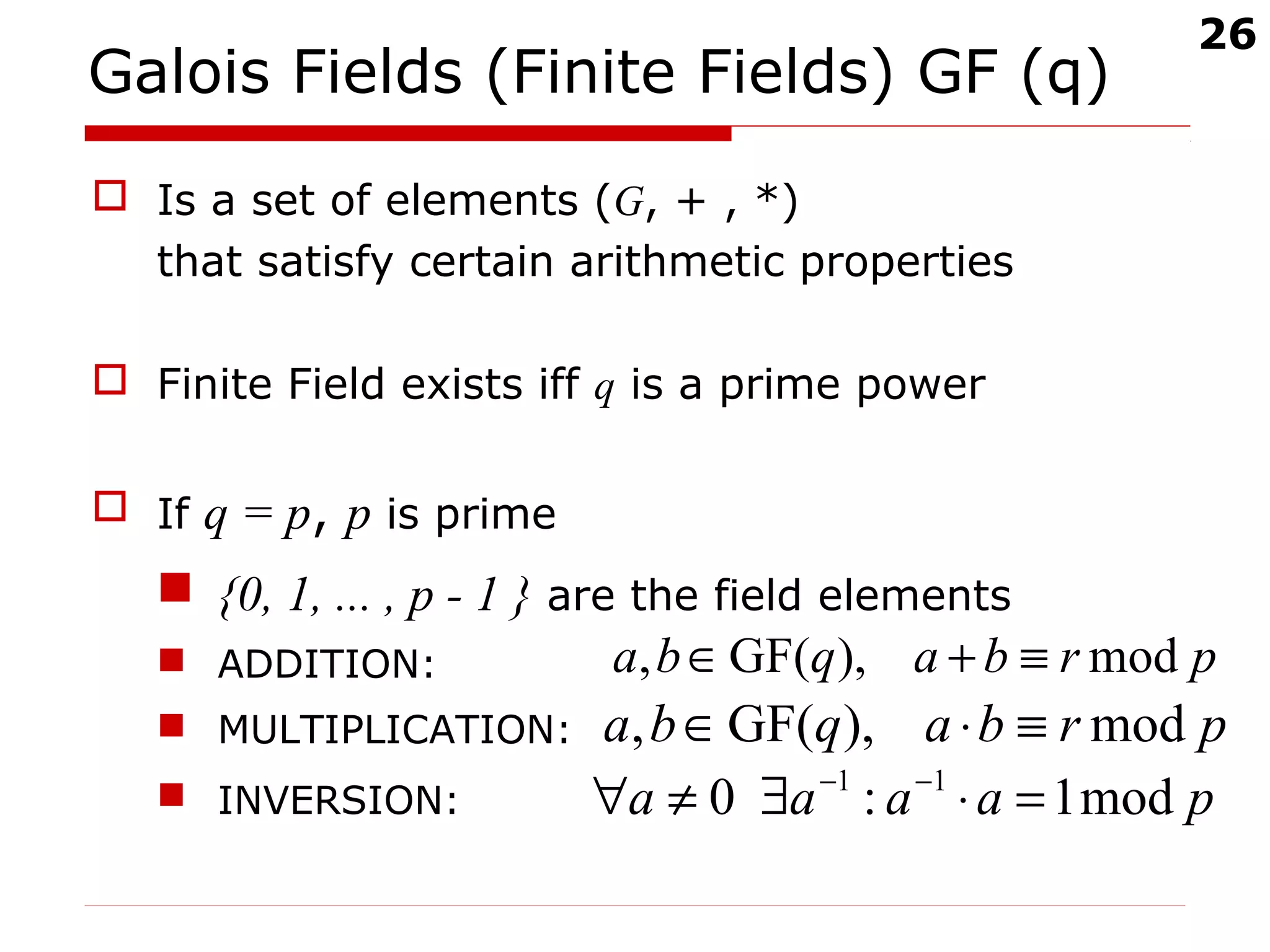
Galois Fields (Finite Fields) GF (q)
 Is a set of elements (G, + , *)
that satisfy certain arithmetic properties
 Finite Field exists iff q is a prime power
 If q = p, p is prime
 {0, 1, ... , p - 1 } are the field elements
 ADDITION:
 MULTIPLICATION:
 INVERSION:
prbaqba mod),GF(, ≡+∈
prbaqba mod),GF(, ≡⋅∈
paaaa mod1:0 11
=⋅∃≠∀ −−
27
Elliptic Curves Over Finite Fields
Over GF(p), p is prime, p > 3
 Elliptic curve E equation
where
 E consists of
 all pairs
satisfying curve equation
 special point - point at infinity
baxxy ++= 32
)p(modba),p(b,a 0274 23
≡/+∈ andGF
)p(y),p(x),y,x( GFGF ∈∈
),( 00=Ο
28
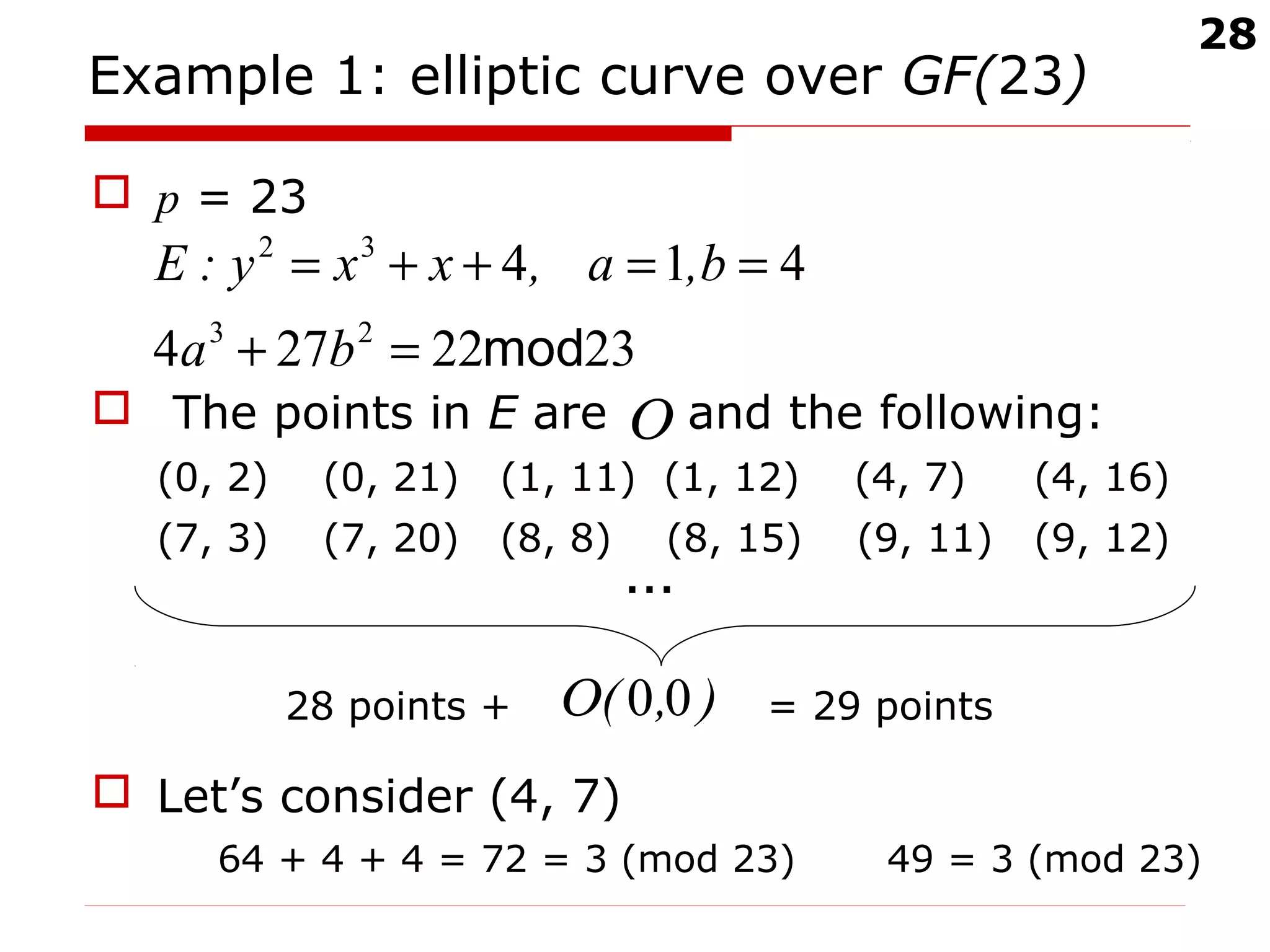
Example 1: elliptic curve over GF(23)
 p = 23
 The points in E are and the following:
(0, 2) (0, 21) (1, 11) (1, 12) (4, 7) (4, 16)
(7, 3) (7, 20) (8, 8) (8, 15) (9, 11) (9, 12)
…
28 points + = 29 points
 Let’s consider (4, 7)
64 + 4 + 4 = 72 = 3 (mod 23) 49 = 3 (mod 23)
2322274
414
23
32
mod=+
==++=
ba
b,a,xxy:E
Ο
),( 00Ο
29
Basic Facts
Let E(GF(q)) be an EC over GF(q)
 The points of E(GF(q)), form a group under
addition
 Hasse’s theorem:
Number of points on E (group order):
 If #E is prime then the group is cyclic and
 If #E has a prime factor, that there exists a
cyclic subgroup
qt,tq))q(GF(E 21 ≤−+=#
Ο
{ }#Ek:kP))q(GF(E:))q(GF(EP ≤≤=∈∃ 0
30
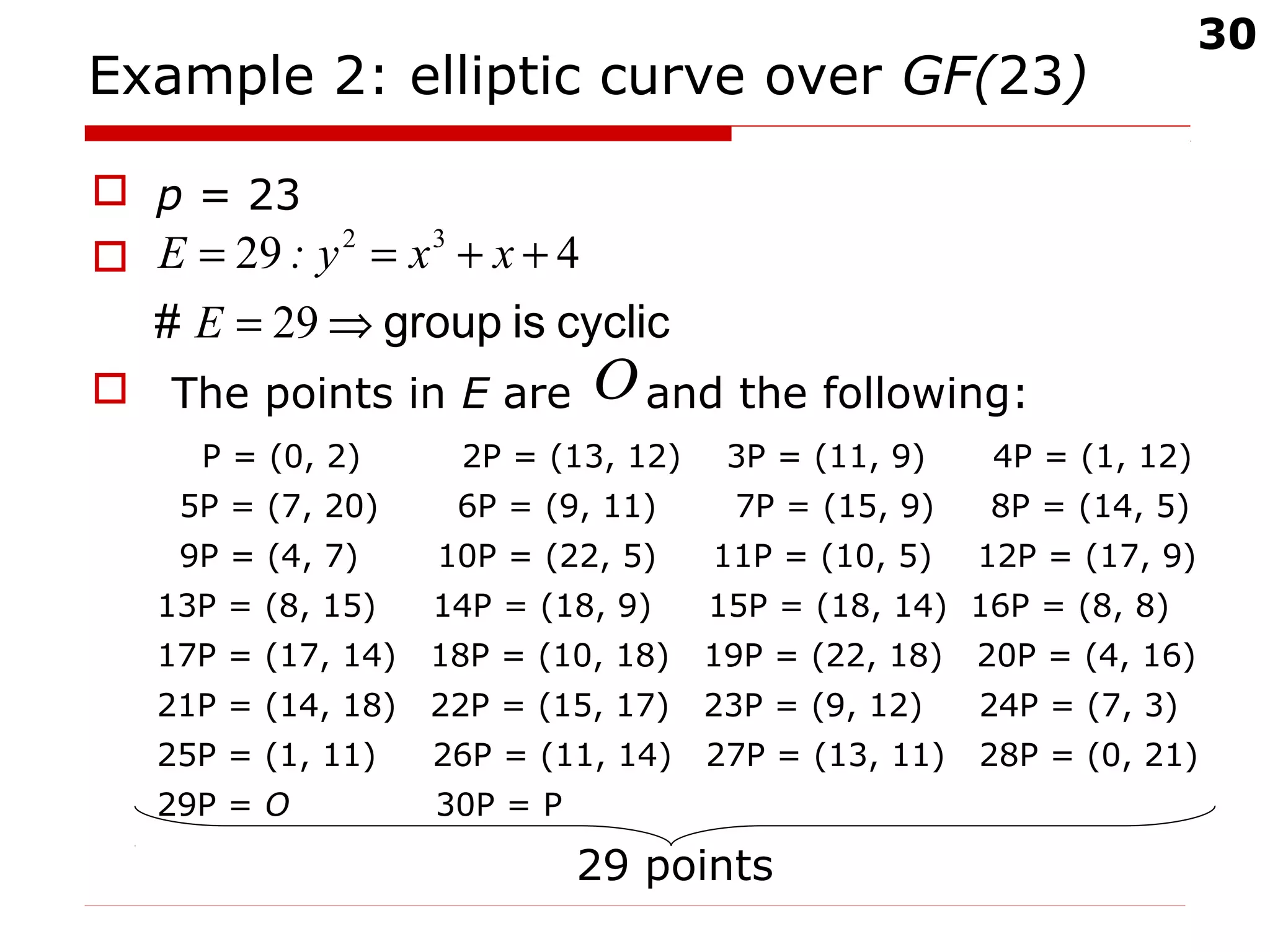
Example 2: elliptic curve over GF(23)
 p = 23

 The points in E are and the following:
P = (0, 2) 2P = (13, 12) 3P = (11, 9) 4P = (1, 12)
5P = (7, 20) 6P = (9, 11) 7P = (15, 9) 8P = (14, 5)
9P = (4, 7) 10P = (22, 5) 11P = (10, 5) 12P = (17, 9)
13P = (8, 15) 14P = (18, 9) 15P = (18, 14) 16P = (8, 8)
17P = (17, 14) 18P = (10, 18) 19P = (22, 18) 20P = (4, 16)
21P = (14, 18) 22P = (15, 17) 23P = (9, 12) 24P = (7, 3)
25P = (1, 11) 26P = (11, 14) 27P = (13, 11) 28P = (0, 21)
29P = O 30P = P
29 points
cyclicisgroup# ⇒=
++==
29
429 32
E
xxy:E
Ο
31
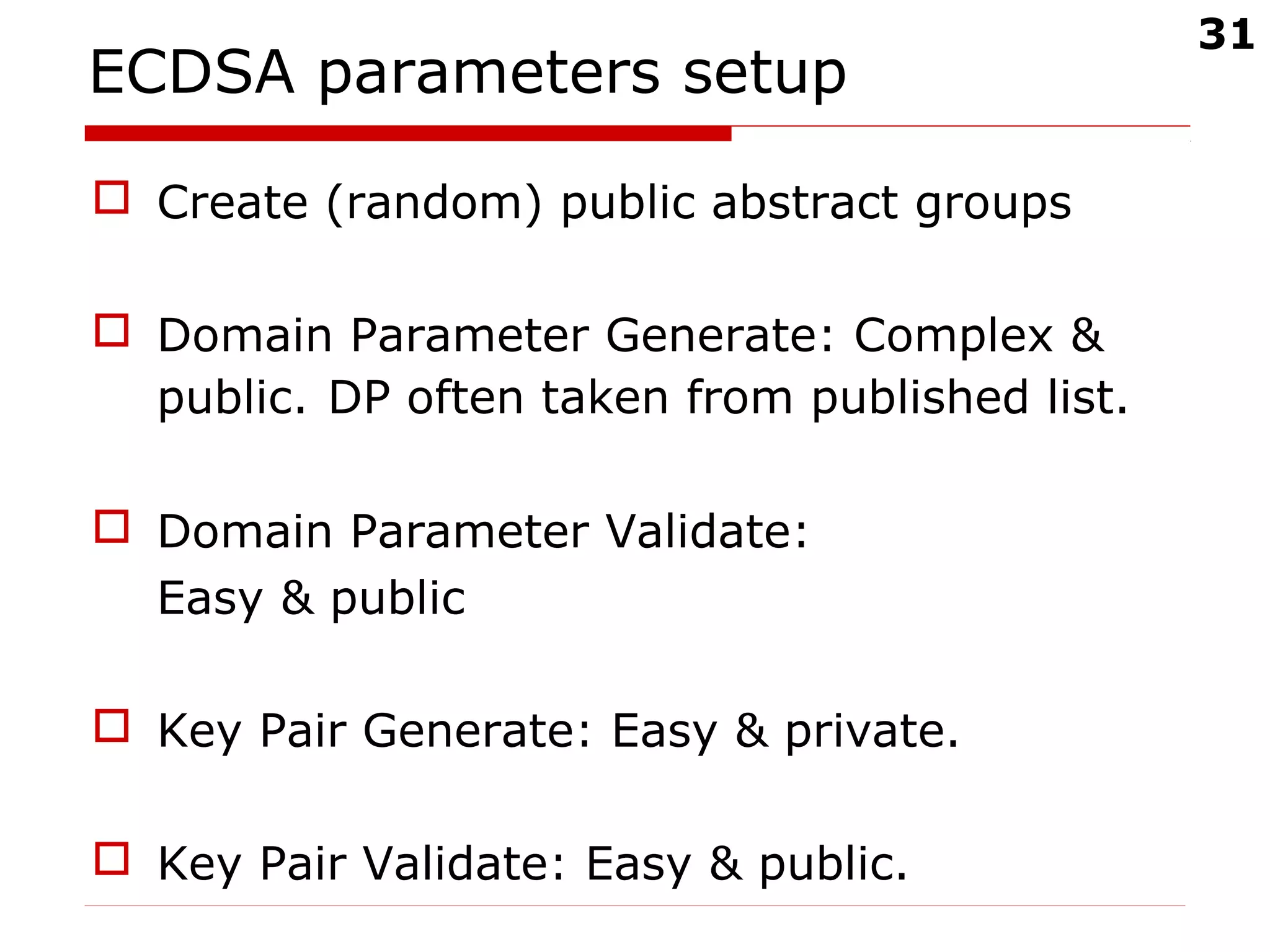
ECDSA parameters setup
 Create (random) public abstract groups
 Domain Parameter Generate: Complex &
public. DP often taken from published list.
 Domain Parameter Validate:
Easy & public
 Key Pair Generate: Easy & private.
 Key Pair Validate: Easy & public.
32
ECDSA Domain Parameters
 Domain parameters D = (q, a, b, G, n, h)
 Field size q, q = p or q = 2m
 Coefficients a, b in GF(q) of E=Ea,b
(GF(q)):
 Seed s of length ≥ 160 bits (Optional)
 Base point G=(xG, yG) on curve E, i.e.
 Order n of G: n is prime,
 Cofactor h: #E(GF(q)) = hn
qnn 4and2160
>>
0274 23
≠+ ba
)q(GFy,x GG ∈
33
Curve parameters generation(1)
 Input: GF(p), p is prime
 Output: seed, curve coefficients a & b
 Used notations: stv,
p
s ⋅−=




 −
= 160
160
12log
Hash
algorithm
g > 160 bits
Ν∈z
W0
v-1 bits
Arbitrary SEED
160 bits
Wstringbit
hash(z + 1) hash(z + 2) … hash(z + s)
(v-1)+ s·160 < log2 p bits
W0
34
Curve parameters generation(2)
1.
2. if abort and start again
3. Choose a,b
4. Result: y2
= x3
+ ax + b
 if
 Exclude singular curves
Ν∈→ rW



≡+
=
pr
r
mod0274
0
pabrb,a)p( mod:GF 32
00 ≡⋅≠≠∈





−=
==
⇒≡+
p
b
a
ba
pba
mod
and
EC)(singularmod
4
27
00
0274
2
323
35
Isomorphism classes of ECs(1)
 E1: y2
=x3
+a1x +b1 and E2: y2
=x3
+a2x +b2
are isomorphic
 Step 3: Choose a,b
 There only 2 variants for a and b on step 3
2
2
3
2
2
1
3
1
2
6
12
4
10
b
a
b
a
.e.i,bubauau),p(u ===≠∈∃ and:GF
⇔
pmodabrb,a)p(b,a 32
00 ≡⋅≠≠∈ :GF
36
Isomorphism classes of ECs(2)
 Let’s prove that there are precisely 2 choices for
(a, b) on step 3 :
 We can find a1, b1 and a2, b2:
 We can not find a3, b3 : E3 is not isomorphic to E1 orE2
isomorphicnotarecurvesandpmodr
b
a
b
a
pmodku:k
pmodbub
pmodaua
==⇒
≡∃/
=
=
2
2
3
2
2
1
3
1
2
1
3
2
1
2
2
( ) 2
1
toisomoprhici.e.Else
toisomoprhici.e.
If
sLet'
sLet'
E,pmodaa
pmodaua
pmodaua
E
,pmodblbub,pmodalauapmodul:l
pmodbub,pmodauapmodu
b
b
a
a
:u
pmodr
b
a
b
a
b
a
u
u
2
2
3
1
2
2
1
2
33
1
6
1
3
331
4
1
2
333
2
1
3
331
2
33
6
32
1
2
3
3
1
3
3
3
2
3
3
3
2
2
3
2
2
1
3
1
3
=⇒
=
=
====⇒≡∃
==⇒==∃
===
37
Domain Parameter Generation
 Domain parameters D = (q, a, b, G, n, h)
1. Generate EC coeffs a & b
E ( GF(q) ): y2
= x3
+ ax + b
2. Compute #E( GF(q) ) (e.g. Schoof’s algorithm)
3. Verify that , n is prime,
4. if not, go to step 1
5. Verify that if not, go to step 1
6. Verify that n≠q if not, go to step 1
7. Select an arbitrary point
Set
Repeat until
nhE =# qnn 4and2160
>>
2011 ≤≤−/ k,q|n k
)).q((E'G GF∈
'.G)n/N(G ⋅=
Ο≠G
38
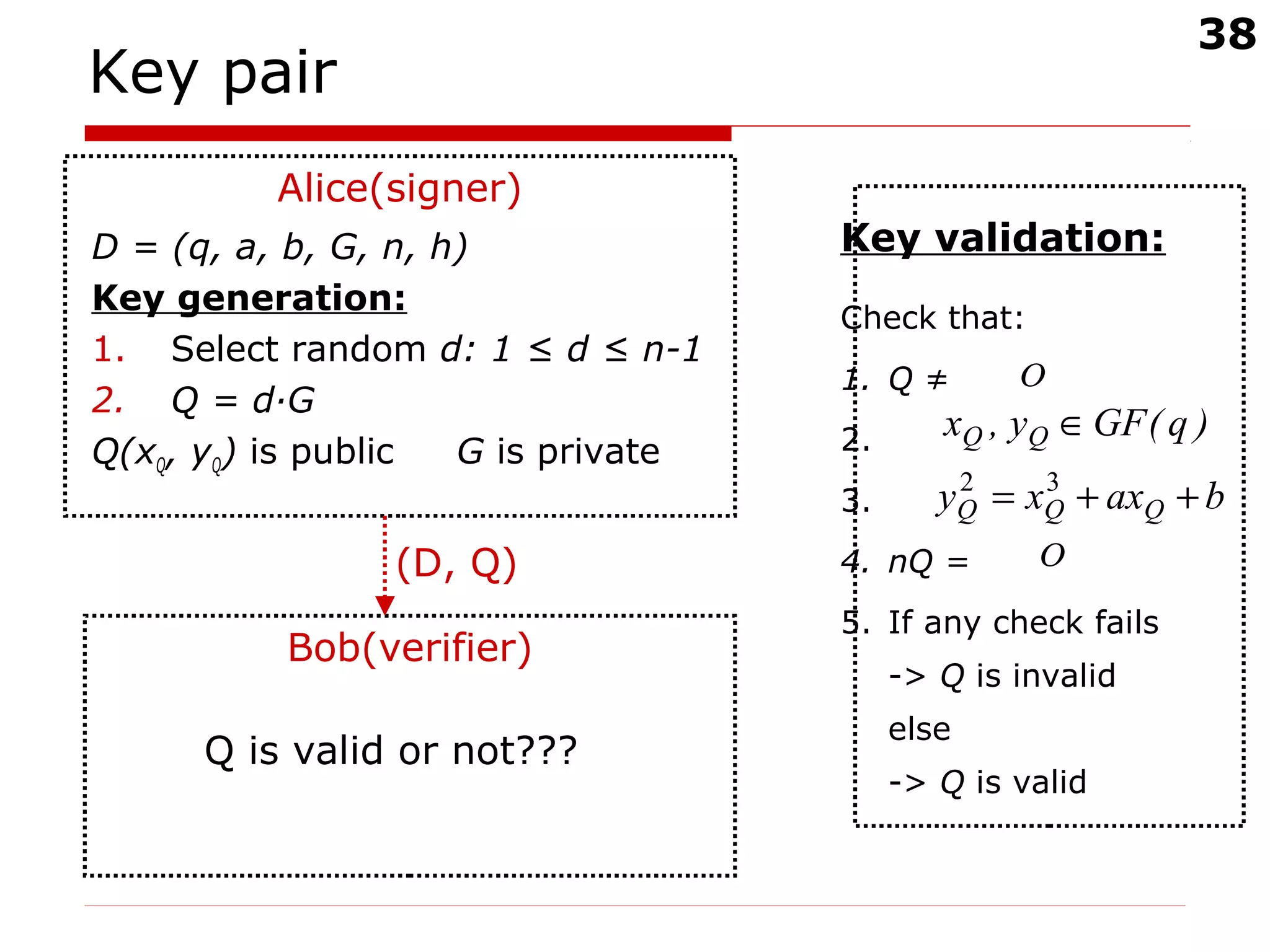
Alice(signer)
Key pair
D = (q, a, b, G, n, h)
Key generation:
1. Select random d: 1 ≤ d ≤ n-1
2. Q = d·G
Q(xQ, yQ) is public G is private
Bob(verifier)
(D, Q)
Q is valid or not???
Key validation:
Check that:
1. Q ≠
2.
3.
4. nQ =
5. If any check fails
-> Q is invalid
else
-> Q is valid
Ο
)q(GFy,x QQ ∈
Ο
baxxy QQQ ++= 32
39
Bob
Parameters D = (q, a, b, G, n, h)
Alice’s public key Q
Alice’s signature (r, s) on m
To sign message m:
1. k randomly chosen 0 < k < n-1
2. k·G = (x1, y1) r =x1 mod n
3. if r = 0 abort and start again
4. e = SHA-1(m)
5. s = k-1
· ( e + d·r) mod n
6. if s = 0 abort and start again
Output: (r, s)
ECDSA generation & verification
( ) ( )
rvkGG)duu(QuGu
nduuwrdwerdsesdreskndreks
=⇒=+=+
+≡+≡+≡+≡⇔+= −−−−
2121
21
1111
modmod
acceptif →= rv
Alice
Parameters D = (q, a, b, G, n, h)
Associated keys (d, Q)
Proof that signature verification works:
To verify signature (r, s):
1. check: 1 ≤ r ≤ n-1, 1 ≤ s ≤ n -1
2. e = SHA-1(m)
3. w = s-1
mod n
4. u1 = e·w mod n u2 = r·w mod n
5. X = u1·G + u2·Q, if
6. X=(x1, y1) v = x1 mod n
7.
reject→=ΟX
D, Q, m, r, s
40
Ordinary DLP
 Definition:
Given: prime p,
generator g of GF(p),
non zero element y‑ ∈ GF(p),
Find: the unique integer k, 0 ≤ k ≤ p – 2:
y ≡ gk
(mod p)
k is called the discrete logarithm of y to the base g
 Known attacks
The most efficient:
Index Calculus Method O( )
ppo
e
lnlnln))1(2/1( +
41
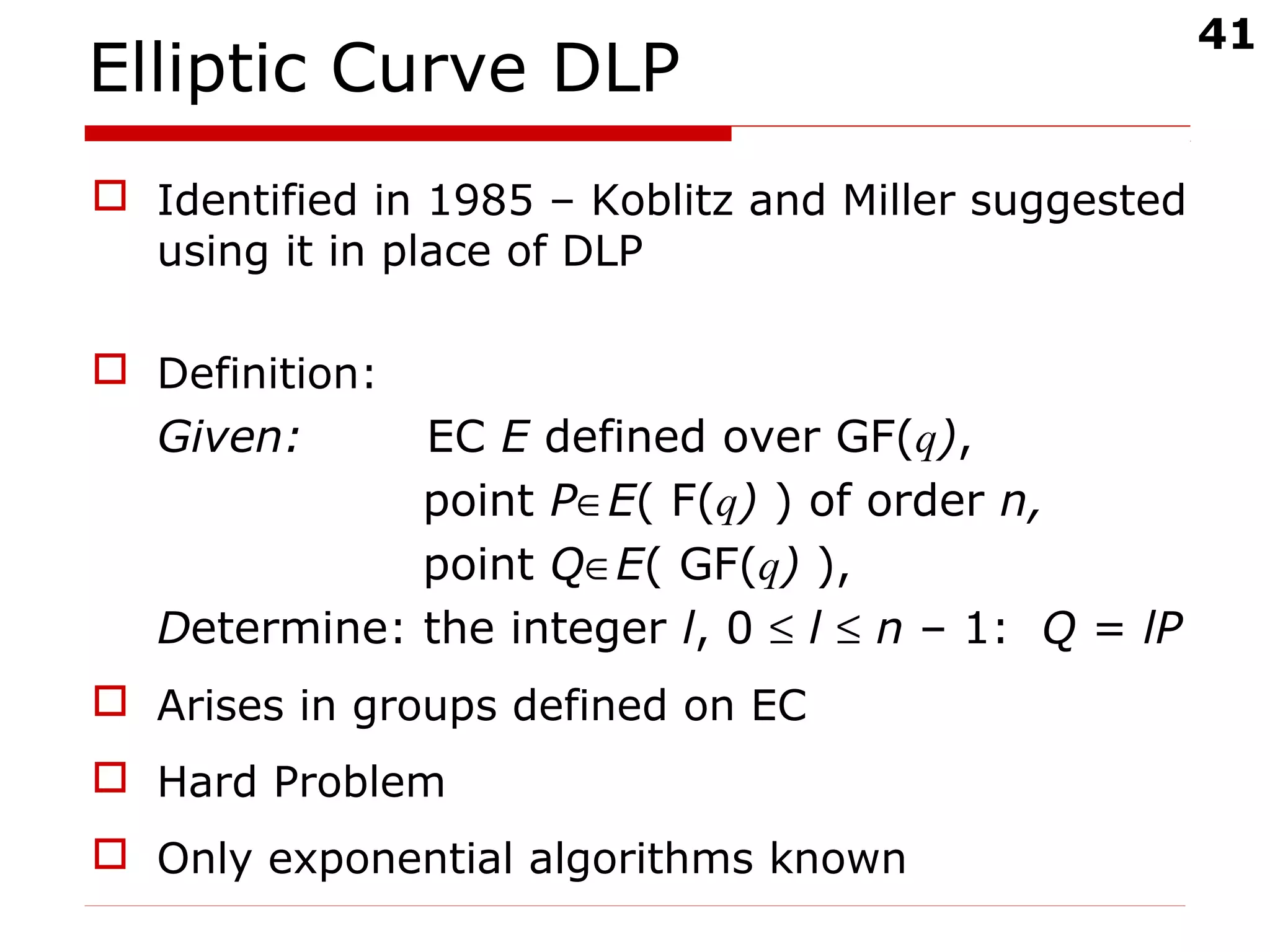
Elliptic Curve DLP
 Identified in 1985 – Koblitz and Miller suggested
using it in place of DLP
 Definition:
Given: EC E defined over GF(q),
point P∈E( F(q) ) of order n,
point Q∈E( GF(q) ),
Determine: the integer l, 0 ≤ l ≤ n – 1: Q = lP
 Arises in groups defined on EC
 Hard Problem
 Only exponential algorithms known
42
Known Attacks on ECDLP
 Pollard’s Rho Algorithm O( )
 Parallelized Pollard’s Rho O( )
r is the number of processors used
Precautions:
 Pohlig-Hellman Algorithm O( )
Precautions:
 Menezez-Okamoto-Vanstone (MOV) O( )
Precautions:
 No index calculus method found
n
r/n
q
)log(qk ⋅
160
2>n
primeisn
2011 ≤≤−/ k,q|n k
43
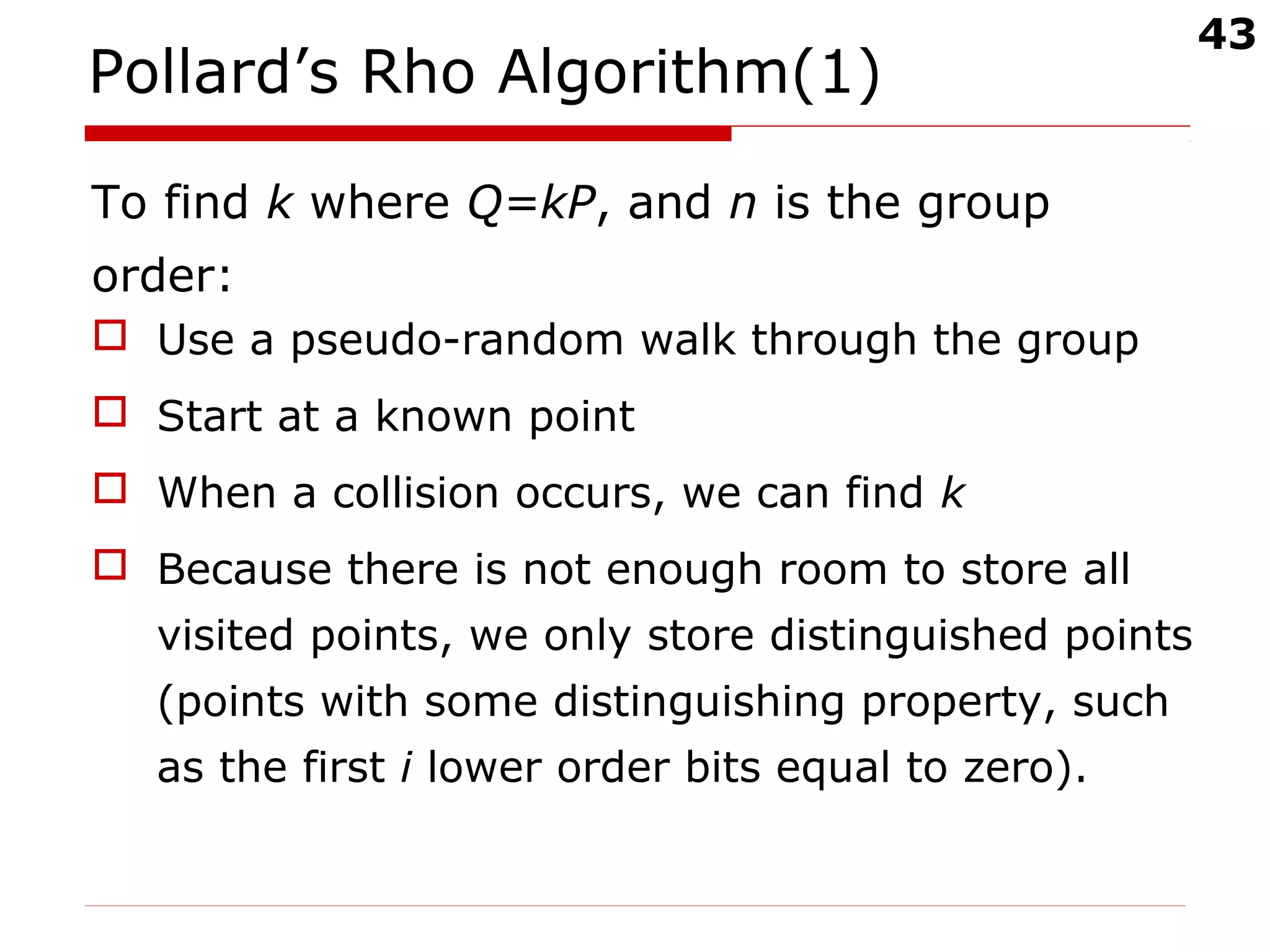
Pollard’s Rho Algorithm(1)
To find k where Q=kP, and n is the group
order:
 Use a pseudo-random walk through the group
 Start at a known point
 When a collision occurs, we can find k
 Because there is not enough room to store all
visited points, we only store distinguished points
(points with some distinguishing property, such
as the first i lower order bits equal to zero).
44
Pollard’s Rho Algorithm(2)
 The random walk is defined as:
 Where the Si are three sets of points (e.g. Si may be
points such that x mod 3 ≡ i), and the ri are
randomly chosen.





∈++
∈++
∈++
=+
365
243
121
1
SRQrPrR
SRQrPrR
SR,QrPrR
R
ii
ii
ii
i
for
for
for
45
Pollard’s Rho Algorithm(3)
 R0 is chosen to be a known multiple of P and Q.
 For each iteration, Ri+1 is found, and also what
multiple of P and Q it is.
 When a collision occurs, we have:
P
db
ac
Q
dQcPbQaP
RR ji




−
−
=
+=+
=
46
Pollard’s Rho Algorithm(4)
 The number of iterations is
 With this approach, the path of the pseudo-random
walk depends on Q.
 There is no precomputation.
 Calculations from previous ECDLP’s are of limited
usefulness in subsequent ECDLP’s, because collisions
are only detected for distinguished points.
( )nO
47
Duplicate-Signature Key Selection
 An adversary
 Selects arbitrary c:
 Computes:
 Forms:



≠+=
−≤≤
−−
0
11
11
)nmod)rcses((t
nc
:
( ))rQeG(GX)nmodt(G
)m(SHAerQseGsX
rce +==
−=+=
+
−
−−
11
11
1 )where(
GcQ)h,n,G,b,a,FR,q(D EE == and
Alice Bob
Adversary E
D, Q, m, r, s
DE, QE, m, r, s
Proof of work:
kGG)wrdwe(wrdGweGwrQweGw)rce(
)rwcew()cuu(GcuGuQuGuX
rce
rQeG
rce
rQeG
rce
rQeG
E
=+=+=+=⋅+⋅=
=+⋅=+⋅=+=+=
+
+
+
+
+
+
212121
48
Key Size Comparisons
Sym. key: 80, 112, 128, 192, 256
ECC n: 161, 224, 256, 384, 512
RSA n: 1024, 2048, 3072, 7680, 15360
49
ECDSA Advantages
 Elliptic curves offer a much shorter key length
than RSA.
 There are some environments where 1024-bit
RSA can not be implemented, while 163-bit
ECC can.
 No subexponential-time algorithm is known for
the EC discrete logarithm problem.
50
Discussion
???
51
Exercises(1)
 Does this equation define an EC over GF(17)?
y2
= x3
+ 10x + 5
 Do the points P(2,0) and Q(6,3) lie on the
elliptic curve y2
= x3
+ x + 7 over GF(17)?
 What are the negatives of the following elliptic
curve points over GF(17)?
P(5,8) Q(3,0) R(0,6)
 In the elliptic curve group defined by
y2
= x3
+ x + 7 over GF(17), what is P + Q
if P = (2,0) and Q = (1,3)?
52
Exercises(2)
 Suppose that p > 3 is an odd prime
a, b Є GF(p)
 Further suppose that
has 3 distinct roots in GF(p)
 Prove that the corresponding elliptic curve
E is not cyclic
pbaxx mod03
≡++
53
References
 Don Johnson, Alfred Menezes, The Elliptic
Curve Digital Signature, February 2000
http://www.cacr.math.uwaterloo.ca
 A. Menezes, P. van Oorschot, S. Vanstone,
Handbook of Applied cryptography, CRC Press
1996
http://www.cacr.math.uwaterloo.ca/hac
 Douglas R. Stinson Cryptography, Theory and
Practice, CRC Press
54
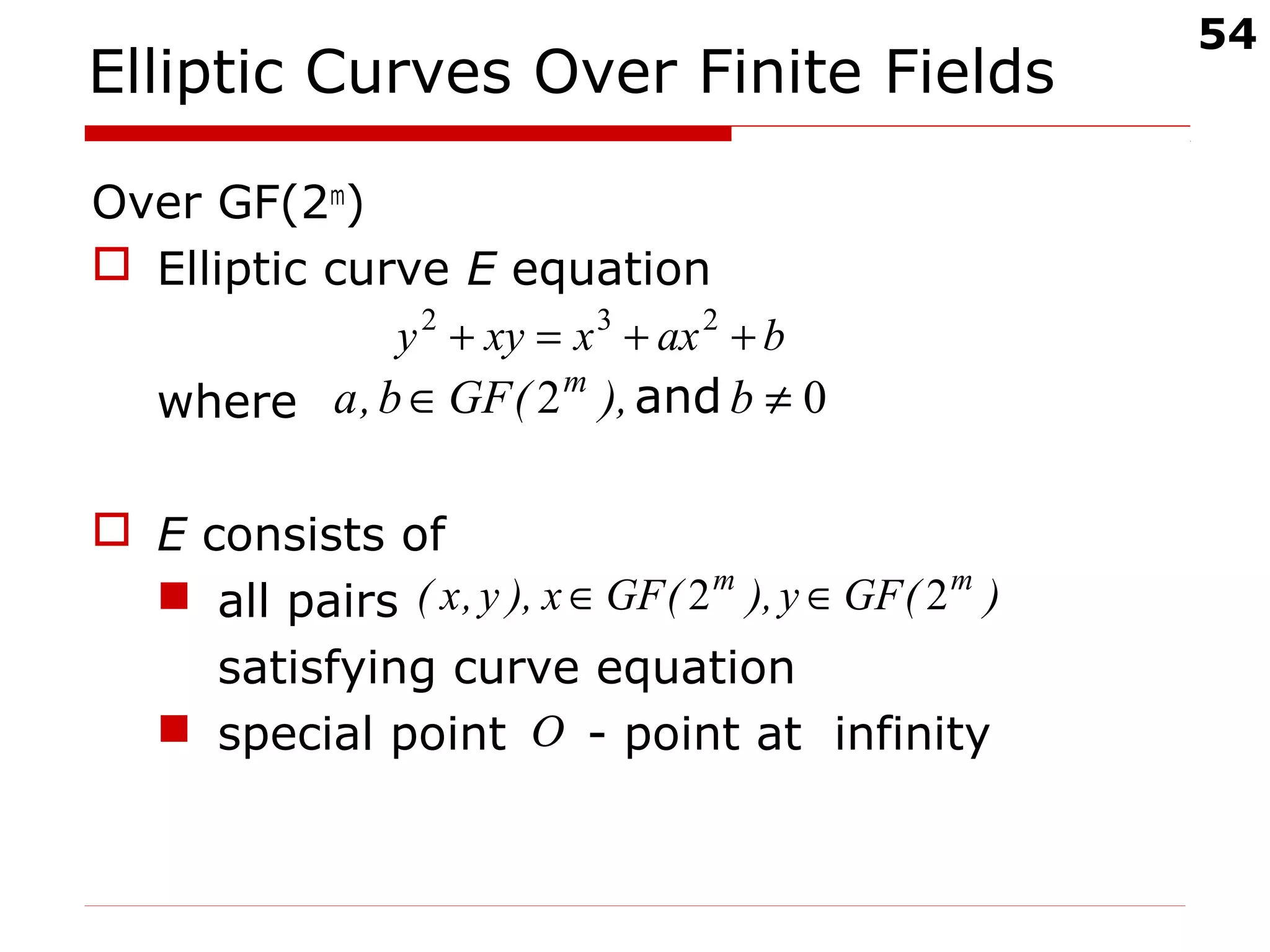
Elliptic Curves Over Finite Fields
Over GF(2m
)
 Elliptic curve E equation
where
 E consists of
 all pairs
satisfying curve equation
 special point - point at infinity
baxxxyy ++=+ 232
02 ≠∈ b),(GFb,a m
and
)(GFy),(GFx),y,x( mm
22 ∈∈
Ο
55
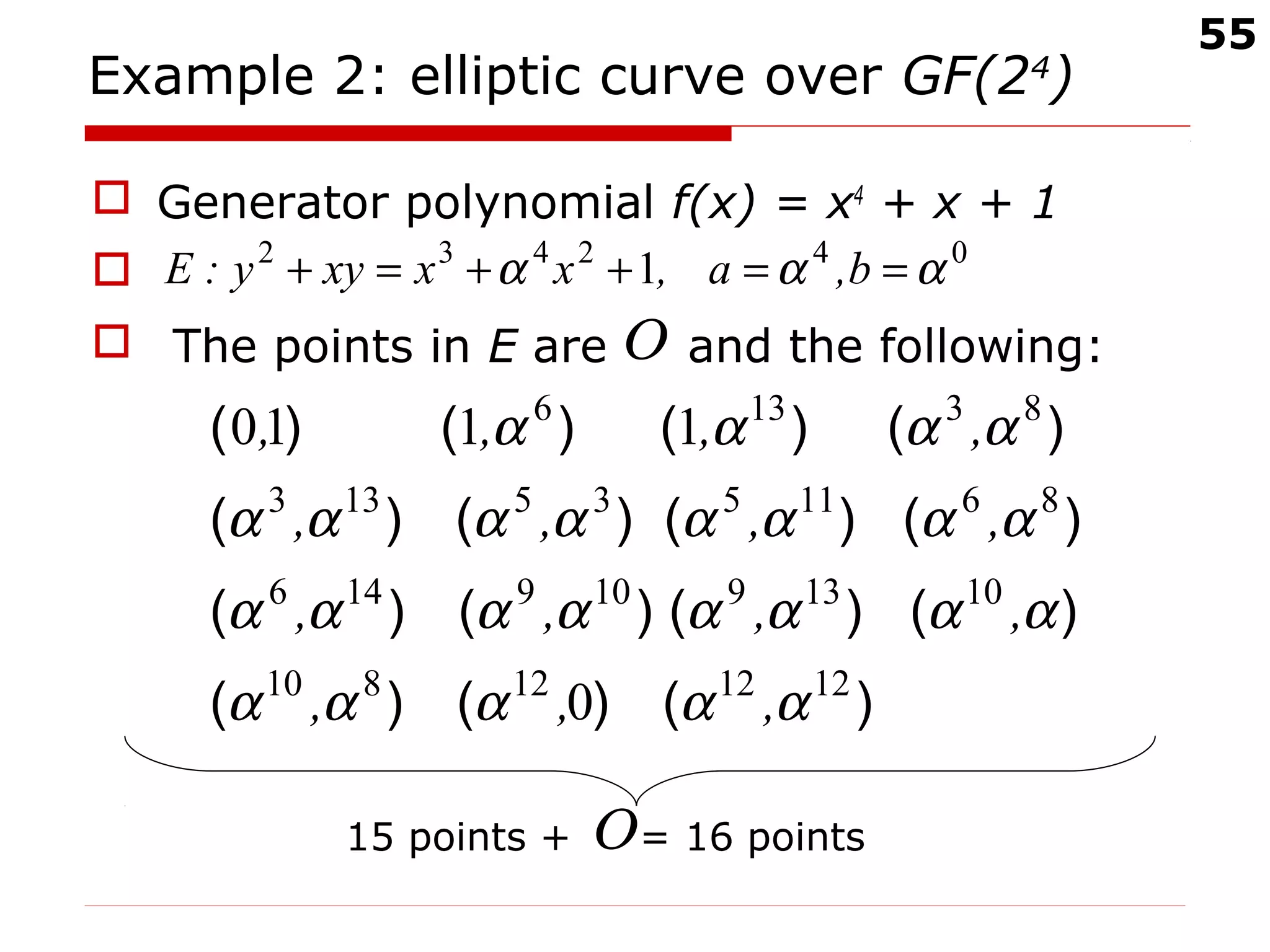
Example 2: elliptic curve over GF(24
)
 Generator polynomial f(x) = x4
+ x + 1

 The points in E are and the following:
15 points + = 16 points
042432
1 ααα ==++=+ b,a,xxxyy:E
Ο
Ο
)()()(
)()()()(
)()()()(
)()()()(
121212810
10139109146
8611535133
83136
0
1110
ααααα
αααααααα
αααααααα
αααα
,,,
,,,,
,,,,
,,,,
56
Addition – Algebraic Approach
E – elliptic curve over GF(2m
)
1.
2. If
3.
4.
Ο=++∈= )yx,x()y,x(,E)y,x(P then
PPPEP =+=+∈∀ ΟΟ
whereThen
andLet
),y,x(QP
.QP,E)y,x(Q,E)y,x(P
33
2211
=+
±≠∈=∈=
( ) axxx xx
yy
xx
yy
++++= +
+
+
+
21
2
3 21
21
21
21
( ) ( ) 13313 21
21
yxxxy xx
yy
+++⋅= +
+
where2ThenLet ),y,x(P.PP,E)y,x(P 3311 =−≠∈=
2
1
2
13 x
b
xx += ( ) 331
2
13 1
1
xxxxy x
y
+++=
-P
57
Curve parameters generation
 Used notations:
 Input: prime p
 Output: seed, curve coefficients a & b
 Algorithm:
1. Choose a bit string seedE: g = |seedE| ≥ 160 bits
2. H = SHA-1(seedE)
3. z = (int) seedE
4. For i from 1 to s do:
 si = (z+i) mod 2g
 Wi = SHA-1 (si)
1.
2. r= (int) W, if r = 0 or 4r + 27 ( 0 mod p ) go to step 1
3. Choose a,b
4. The elliptic curve is: y2
= x3
+ ax + b
5. Output (seedE, a, b)
≡
  ( )  stv,/ts,plogt ⋅−=−== 16016012
H
160 bits
W0
v-1 bits
W0 W1
… WsW =
pmodabrb,a)p(GF 32
00 ≡⋅≠≠∈ :
58
Alice domain
D = (q, FR, a, b, G, n, h)
D is valid or not?
D validation:
Check that:
1.
2.
3.
4.
5. n is prime AND n > 2160
6. #E ≠ q
7.
8.
9.
10. If any check fails
-> D is invalid
else
-> D is valid
m
qorpq 2==
Domain Parameters Validation
2011 ≤≤−/ k,q|n k
)|n(qn E#/> 2
4
Bob domain
D
0274 23
≠+ ba
Ο≠G
Ο=nG
  'hhn/)q('h =+= ,2
1
59
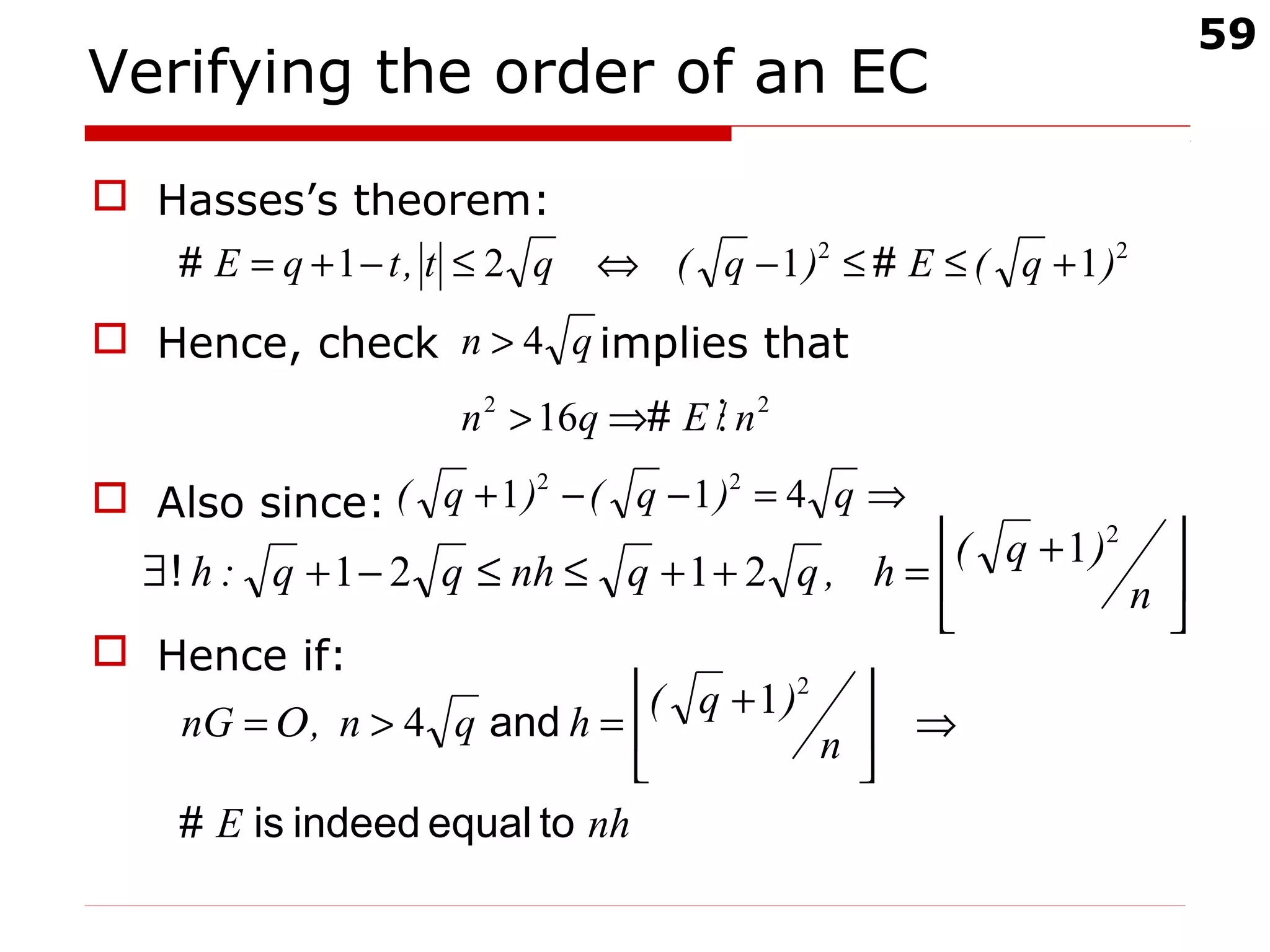
Verifying the order of an EC
 Hasses’s theorem:
 Hence, check implies that
 Also since:
 Hence if:
22
1121 )q(E)q(qt,tqE +≤≤−⇔≤−+= ##
qn 4>
22
16 nEqn /⇒> #





 +
=++≤≤−+∃
n
)q(
h,qqnhqq:h
2
1
2121!
⇒=−−+ q)q()q( 411 22
nhE
n
)q(
hqn,nG
toequalindeedis#
and ⇒




 +
=>=
2
1
4Ο
60
Potential CA Services
 POP - Proof of possession of private key.
Can use zero-knowledge proof.
 PKV - Public Key Validation
shows public key makes arithmetic sense.
 POP and PKV can be considered duals of
each other. Doing both provides strong
assurance.
61
Security Considerations
 Per-message secret k:

 Repeated usage of k:
 Check: 1 ≤ r ≤ n-1, 1 ≤ s ≤ n -1


)m(SHAs,r),b,(G 100 −===
0001
01 2
1
1
==⇒==+⋅=
==⋅= −
rv)b,(X,GGX
u,eeu
i.e.
nmod)eks(rdnmod)dre(ks −=⇔+= −− 11
nmod)ee()ss(k
nmodee)ss(k
nmoddreks
nmoddreks
nmod)dre(ks
nmod)dre(ks
21
1
21
2121
22
11
2
1
2
1
1
1
−−≡
−≡−
+≡
+≡
⇔
+≡
+≡
−
−
−
To verify signature (r, s):
1. check: 1 ≤ r ≤ n-1, 1 ≤ s ≤ n -1
2. e = SHA-1(m)
3. w = s-1 mod n
4. u1 = e·w mod n u2 = r·w mod n
5. X = u1·G + u2·Q, if
6. X(x1, y1) v = x1 mod n
7.
reject→=ΟX
acceptif →= rv
62
Attacks on Hash function
 SHA-1
 Preimage resistance hard to find x: H(x) = y
 Collision resistance hard to find x1 and x2 : H(x1) = H(x2)
 If not preimage resistant
 One can forge signature:
Calculate parameters r, s, e, m : e = SHA-1(m),
where (r, s) is valid signature for m
 If not collision resistant
 One can repudiate messages:
Generate m’: SHA-1(m) = SHA-1(m’)
63
Signature Forgery
 Signature Forgery
 A forgery is a signature computed without
the signer’s private key
 selective forgery: an adversary is able to
create a valid signature for a particular message
chosen a priori
 existential forgery – an adversary is able to
forge a signature for at least one message

Signyourd digital signature certificate provider

  • 1.
  • 2.
    2 Outline  Cryptographic goals Message Authentication Codes (MACs)  Digital signatures  RSA digital signature  Elliptic curve digital signature  Comparison of ECDSA and RSA signature
  • 3.
    3 Symmetric-key ciphers: Block ciphers Stream ciphers Public-key ciphers CryptographicGoals Cryptographic goals Confidentiality Data integrity Authentication Non-repudiation Message authentication Entity authenticationArbitrary length hash functions Message Authentication codes (MACs) Digital signatures Authentication primitives Digital signatures MACs Digital signatures
  • 4.
    4 Non-repudiation Alice Bob m isa signed message s is a valid signature for m m, s Alice denies her signature if she finds: m’ ≠ m : s is valid signature for m’
  • 5.
    5 Message Authentication Codes MAC f(x, key):{0,1}* → {0,1}n  knowing x and key f is easy to compute  it is infeasible to calculate f(x, key) without the key  MAC are often block cipher based  message m, secret key k  specification of block cipher E  MAC (m) = E( m, key )  MAC (m) = E(hash(m), key )
  • 6.
    6 CBC-based MAC algorithm E key 0 X1(nbit) E key X2 (n bit) h1 … h2 E key Xt (n bit) ht-1 H = MAC Optional output transformationh1 = Ekey(x1) hi = Ekey(hi-1 xi ), 2 ≤ i ≤ t Algorithm CBC-MAC INPUT: data x; specification of block cipher E; secret MAC key for E OUTPUT: n-bit MAC on x n bit n bit h1(n bit) h2(n bit)
  • 7.
    7 Use of aMAC message MAC algorithm message MAC Secret key Unsecured channel Signer MAC verification algorithm Secret key Verifier Ok / not Ok  Used to provide  Data integrity  Message authentication
  • 8.
    8 Digital Signatures Scheme Used to provide  Data integrity  Message authentication  Non-repudiation message Signing algorithm message signature Signer’s private key Unsecured channel Signer Signature verification algorithm Signer’s public key Verifier Ok / not Ok
  • 9.
    9 Difference between MACand digital signature  To prove the validity of a MAC to a third party, you need to reveal the key  If you can verify a MAC, you can also create it  MAC does not allow a distinction to be made between the parties sharing the key  Computing a MAC is (usually) much faster than computing a digital signature  Important for devices with low computing power
  • 10.
  • 11.
    11 RSA  Developed in1978 by Rivest, Shamir and Adleman (RSA)  Most popular public key cryptosystem  Based on the hard problem of “integer factorization”
  • 12.
    12 Key-Generation for RSA(1) 1.Generate two large random distinct primes p and q, each roughly the same size 2. Compute n = pq and 3. Select random integer e: 4. Compute unique integer d: 5. Public key is (n, e); Private key is d ( ) ( 1)( 1)n p qφ = − − 1 , such that gcd( , ) 1e eφ φ< < = 1 , such that 1modd edφ φ< < =
  • 13.
    13 Key-Generation for RSA(2) Usually numbers with the right bit length are chosen randomly and tested for primality  Statistical tests are used to determine the probability that these numbers are primes i.e. Strassen – Test Miller – Rabin – Test  There is always an insignificantly low chance that number is not prime
  • 14.
    14 Used notation  Mis a set of elements, called the message space = Zn  MS is a set of elements, called the signing space = Zn  R is a 1 to 1 mapping from M to MS, called the redundancy function  MR is the image of R: {y| y = R(x), xЄ M}  R-1 is the inverse of R: MR M
  • 15.
    15 RSA signature generationand verification  To sign a message A should:  Compute: where R(m) is a redundancy function  Compute:  A’s signature for m is s  To verify A’s signature and recover m, B should:  Obtain A’s authentic public key (n, e)  Compute:  Verify that ; if not, reject the signature  Recover ]n,[),m(Rm~ 10 −= rangetheinintegeran nmodm~s d = nmodsm~ e = RMm~ ∈ )m~(Rm 1− = Mm∈
  • 16.
    16 Proof that signatureverification works  Euler’s theorem: , where is the Euler’s function of n  If s is a signature for m, then:  Since , then:  Finally: )m(Rm~,nm~s d == mod ))n((ed,pqn φmod1≡= )n(m~m~m~ m~m~m~s q)n( q)n())n((ede mod mod ≡⋅≡ ≡≡≡≡ ⋅ +⋅ ϕ ϕϕ 11 m))m(R(R)m~(R == −− 11 11 =≡ )n,agcd(,na )n( modϕ )n(ϕ
  • 17.
    17 RSA signature example Alice p=5 q=7 n = 35 φ(n) = 4·6=24  e = 5; d: ed = 5d=1 mod 24 => d = 5 Public key: (n=35, e=5) Private key: d=5  M = [0, n-1]  For all m Є M R(m)=m  m = 26; R(m) = 26 s = 265 mod 35 = 31 Bob:  R(m) = 315 mod 35 = 26 Є [0, n-1]  m = R-1 (m) = 26 =m~ =m~
  • 18.
    18 Possible Attacks onRSA signature  Integer factorization  If an adversary is able to factor n, then  Multiplicative property of RSA  If , then s is valid signature for m:  Hence, to avoid this attack R must not be multiplicative, i.e. ))n((ed:d)q)(p()n(,pqn φφ modfindand 111 ≡−−== )n(ss)m~m~(m~sm~m~m~ )n(modm~s )n(modm~s dd d d modthenif 212121 22 11 ====⇒ = = RMm~ ∈ )m(Rm~ = )b(R)a(R)ba(RMb,a ⋅≠⋅∈∀
  • 19.
    19 Performance characteristics  n=pq, where n is 2k-bit, p&q – k-bit primes  takes bit operations  Verification is significantly faster that signing if e is chosen to be a small number, e.g.  It is not recommended to restrict the size of d nms d mod= )k(O 3 111 123 16 =−− +== ))q)(p(,egcd(qp ,e,e thatsochosenbemustand or
  • 20.
    20  n=pq ,where n is 2k-bits, p&q – k-bits primes  ISO/IEC 9796 R:  To sign a kt-bits message m:  Divide m = m1|| m2|| m3||… || mt and sign each block individually one transmits 2kt bits.  Sign a l-bits hash(m), l ≤ k. Then one transmits kt+2k bits. (kt – to transmit the message)  If t > 2, then kt+2k < 2kt 2k bits m~ Short vs. long messages ⇒ m k bits
  • 21.
    21 The Elliptic CurveDigital Signature Algorithm (ECDSA)
  • 22.
    22 Elliptic curves (EC)over the reals  A non-singular EC is the set E of solutions to the equation together with a special point O, where  has three distinct roots RR)y,x( ×∈ baxxy ++= 32 0274 23 ≠+∈ ba,Rb,a 00274 323 =++⇔≠+ baxxba
  • 23.
    23 An EC overthe reals  y2 = x3 – 4x 4a3 + 27b2 = -256
  • 24.
    24 Addition – GeometricApproach  Chord-and-tangent rule P + Q = R, P ≠ Q  Point doubling P + P = 2 P = R x y (x1, y1) = P Q = (x2, y2) R = (x3, y3) x y P = (x1, y1) R = (x3, y3) -R = (x3, -y3) -R = (x3, -y3) Ο
  • 25.
    25 Addition – AlgebraicApproach E is elliptic curve over the reals 1. ( is the identity element ) 2. If 3. 4. Ο=−+∈= )y,x()y,x(,E)y,x(P then PPPEP =+=+∈∀ ΟΟ whereThen andLet ),y,x(QP .QP,E)y,x(Q,E)y,x(P 33 2211 =+ ±≠∈=∈= ( ) 21 2 3 12 12 xxx xx yy −−= − − ( )( ) 1313 12 12 yxxy xx yy −−= − − where2ThenLet ),y,x(P.PP,E)y,x(P 3311 =−≠∈= 1 2 2 3 3 2 1 2 1 xx y ax −     = + ( ) 1312 3 3 1 2 1 yxxy y ax −−     = + -P Ο
  • 26.
    26 Galois Fields (FiniteFields) GF (q)  Is a set of elements (G, + , *) that satisfy certain arithmetic properties  Finite Field exists iff q is a prime power  If q = p, p is prime  {0, 1, ... , p - 1 } are the field elements  ADDITION:  MULTIPLICATION:  INVERSION: prbaqba mod),GF(, ≡+∈ prbaqba mod),GF(, ≡⋅∈ paaaa mod1:0 11 =⋅∃≠∀ −−
  • 27.
    27 Elliptic Curves OverFinite Fields Over GF(p), p is prime, p > 3  Elliptic curve E equation where  E consists of  all pairs satisfying curve equation  special point - point at infinity baxxy ++= 32 )p(modba),p(b,a 0274 23 ≡/+∈ andGF )p(y),p(x),y,x( GFGF ∈∈ ),( 00=Ο
  • 28.
    28 Example 1: ellipticcurve over GF(23)  p = 23  The points in E are and the following: (0, 2) (0, 21) (1, 11) (1, 12) (4, 7) (4, 16) (7, 3) (7, 20) (8, 8) (8, 15) (9, 11) (9, 12) … 28 points + = 29 points  Let’s consider (4, 7) 64 + 4 + 4 = 72 = 3 (mod 23) 49 = 3 (mod 23) 2322274 414 23 32 mod=+ ==++= ba b,a,xxy:E Ο ),( 00Ο
  • 29.
    29 Basic Facts Let E(GF(q))be an EC over GF(q)  The points of E(GF(q)), form a group under addition  Hasse’s theorem: Number of points on E (group order):  If #E is prime then the group is cyclic and  If #E has a prime factor, that there exists a cyclic subgroup qt,tq))q(GF(E 21 ≤−+=# Ο { }#Ek:kP))q(GF(E:))q(GF(EP ≤≤=∈∃ 0
  • 30.
    30 Example 2: ellipticcurve over GF(23)  p = 23   The points in E are and the following: P = (0, 2) 2P = (13, 12) 3P = (11, 9) 4P = (1, 12) 5P = (7, 20) 6P = (9, 11) 7P = (15, 9) 8P = (14, 5) 9P = (4, 7) 10P = (22, 5) 11P = (10, 5) 12P = (17, 9) 13P = (8, 15) 14P = (18, 9) 15P = (18, 14) 16P = (8, 8) 17P = (17, 14) 18P = (10, 18) 19P = (22, 18) 20P = (4, 16) 21P = (14, 18) 22P = (15, 17) 23P = (9, 12) 24P = (7, 3) 25P = (1, 11) 26P = (11, 14) 27P = (13, 11) 28P = (0, 21) 29P = O 30P = P 29 points cyclicisgroup# ⇒= ++== 29 429 32 E xxy:E Ο
  • 31.
    31 ECDSA parameters setup Create (random) public abstract groups  Domain Parameter Generate: Complex & public. DP often taken from published list.  Domain Parameter Validate: Easy & public  Key Pair Generate: Easy & private.  Key Pair Validate: Easy & public.
  • 32.
    32 ECDSA Domain Parameters Domain parameters D = (q, a, b, G, n, h)  Field size q, q = p or q = 2m  Coefficients a, b in GF(q) of E=Ea,b (GF(q)):  Seed s of length ≥ 160 bits (Optional)  Base point G=(xG, yG) on curve E, i.e.  Order n of G: n is prime,  Cofactor h: #E(GF(q)) = hn qnn 4and2160 >> 0274 23 ≠+ ba )q(GFy,x GG ∈
  • 33.
    33 Curve parameters generation(1) Input: GF(p), p is prime  Output: seed, curve coefficients a & b  Used notations: stv, p s ⋅−=      − = 160 160 12log Hash algorithm g > 160 bits Ν∈z W0 v-1 bits Arbitrary SEED 160 bits Wstringbit hash(z + 1) hash(z + 2) … hash(z + s) (v-1)+ s·160 < log2 p bits W0
  • 34.
    34 Curve parameters generation(2) 1. 2.if abort and start again 3. Choose a,b 4. Result: y2 = x3 + ax + b  if  Exclude singular curves Ν∈→ rW    ≡+ = pr r mod0274 0 pabrb,a)p( mod:GF 32 00 ≡⋅≠≠∈      −= == ⇒≡+ p b a ba pba mod and EC)(singularmod 4 27 00 0274 2 323
  • 35.
    35 Isomorphism classes ofECs(1)  E1: y2 =x3 +a1x +b1 and E2: y2 =x3 +a2x +b2 are isomorphic  Step 3: Choose a,b  There only 2 variants for a and b on step 3 2 2 3 2 2 1 3 1 2 6 12 4 10 b a b a .e.i,bubauau),p(u ===≠∈∃ and:GF ⇔ pmodabrb,a)p(b,a 32 00 ≡⋅≠≠∈ :GF
  • 36.
    36 Isomorphism classes ofECs(2)  Let’s prove that there are precisely 2 choices for (a, b) on step 3 :  We can find a1, b1 and a2, b2:  We can not find a3, b3 : E3 is not isomorphic to E1 orE2 isomorphicnotarecurvesandpmodr b a b a pmodku:k pmodbub pmodaua ==⇒ ≡∃/ = = 2 2 3 2 2 1 3 1 2 1 3 2 1 2 2 ( ) 2 1 toisomoprhici.e.Else toisomoprhici.e. If sLet' sLet' E,pmodaa pmodaua pmodaua E ,pmodblbub,pmodalauapmodul:l pmodbub,pmodauapmodu b b a a :u pmodr b a b a b a u u 2 2 3 1 2 2 1 2 33 1 6 1 3 331 4 1 2 333 2 1 3 331 2 33 6 32 1 2 3 3 1 3 3 3 2 3 3 3 2 2 3 2 2 1 3 1 3 =⇒ = = ====⇒≡∃ ==⇒==∃ ===
  • 37.
    37 Domain Parameter Generation Domain parameters D = (q, a, b, G, n, h) 1. Generate EC coeffs a & b E ( GF(q) ): y2 = x3 + ax + b 2. Compute #E( GF(q) ) (e.g. Schoof’s algorithm) 3. Verify that , n is prime, 4. if not, go to step 1 5. Verify that if not, go to step 1 6. Verify that n≠q if not, go to step 1 7. Select an arbitrary point Set Repeat until nhE =# qnn 4and2160 >> 2011 ≤≤−/ k,q|n k )).q((E'G GF∈ '.G)n/N(G ⋅= Ο≠G
  • 38.
    38 Alice(signer) Key pair D =(q, a, b, G, n, h) Key generation: 1. Select random d: 1 ≤ d ≤ n-1 2. Q = d·G Q(xQ, yQ) is public G is private Bob(verifier) (D, Q) Q is valid or not??? Key validation: Check that: 1. Q ≠ 2. 3. 4. nQ = 5. If any check fails -> Q is invalid else -> Q is valid Ο )q(GFy,x QQ ∈ Ο baxxy QQQ ++= 32
  • 39.
    39 Bob Parameters D =(q, a, b, G, n, h) Alice’s public key Q Alice’s signature (r, s) on m To sign message m: 1. k randomly chosen 0 < k < n-1 2. k·G = (x1, y1) r =x1 mod n 3. if r = 0 abort and start again 4. e = SHA-1(m) 5. s = k-1 · ( e + d·r) mod n 6. if s = 0 abort and start again Output: (r, s) ECDSA generation & verification ( ) ( ) rvkGG)duu(QuGu nduuwrdwerdsesdreskndreks =⇒=+=+ +≡+≡+≡+≡⇔+= −−−− 2121 21 1111 modmod acceptif →= rv Alice Parameters D = (q, a, b, G, n, h) Associated keys (d, Q) Proof that signature verification works: To verify signature (r, s): 1. check: 1 ≤ r ≤ n-1, 1 ≤ s ≤ n -1 2. e = SHA-1(m) 3. w = s-1 mod n 4. u1 = e·w mod n u2 = r·w mod n 5. X = u1·G + u2·Q, if 6. X=(x1, y1) v = x1 mod n 7. reject→=ΟX D, Q, m, r, s
  • 40.
    40 Ordinary DLP  Definition: Given:prime p, generator g of GF(p), non zero element y‑ ∈ GF(p), Find: the unique integer k, 0 ≤ k ≤ p – 2: y ≡ gk (mod p) k is called the discrete logarithm of y to the base g  Known attacks The most efficient: Index Calculus Method O( ) ppo e lnlnln))1(2/1( +
  • 41.
    41 Elliptic Curve DLP Identified in 1985 – Koblitz and Miller suggested using it in place of DLP  Definition: Given: EC E defined over GF(q), point P∈E( F(q) ) of order n, point Q∈E( GF(q) ), Determine: the integer l, 0 ≤ l ≤ n – 1: Q = lP  Arises in groups defined on EC  Hard Problem  Only exponential algorithms known
  • 42.
    42 Known Attacks onECDLP  Pollard’s Rho Algorithm O( )  Parallelized Pollard’s Rho O( ) r is the number of processors used Precautions:  Pohlig-Hellman Algorithm O( ) Precautions:  Menezez-Okamoto-Vanstone (MOV) O( ) Precautions:  No index calculus method found n r/n q )log(qk ⋅ 160 2>n primeisn 2011 ≤≤−/ k,q|n k
  • 43.
    43 Pollard’s Rho Algorithm(1) Tofind k where Q=kP, and n is the group order:  Use a pseudo-random walk through the group  Start at a known point  When a collision occurs, we can find k  Because there is not enough room to store all visited points, we only store distinguished points (points with some distinguishing property, such as the first i lower order bits equal to zero).
  • 44.
    44 Pollard’s Rho Algorithm(2) The random walk is defined as:  Where the Si are three sets of points (e.g. Si may be points such that x mod 3 ≡ i), and the ri are randomly chosen.      ∈++ ∈++ ∈++ =+ 365 243 121 1 SRQrPrR SRQrPrR SR,QrPrR R ii ii ii i for for for
  • 45.
    45 Pollard’s Rho Algorithm(3) R0 is chosen to be a known multiple of P and Q.  For each iteration, Ri+1 is found, and also what multiple of P and Q it is.  When a collision occurs, we have: P db ac Q dQcPbQaP RR ji     − − = +=+ =
  • 46.
    46 Pollard’s Rho Algorithm(4) The number of iterations is  With this approach, the path of the pseudo-random walk depends on Q.  There is no precomputation.  Calculations from previous ECDLP’s are of limited usefulness in subsequent ECDLP’s, because collisions are only detected for distinguished points. ( )nO
  • 47.
    47 Duplicate-Signature Key Selection An adversary  Selects arbitrary c:  Computes:  Forms:    ≠+= −≤≤ −− 0 11 11 )nmod)rcses((t nc : ( ))rQeG(GX)nmodt(G )m(SHAerQseGsX rce +== −=+= + − −− 11 11 1 )where( GcQ)h,n,G,b,a,FR,q(D EE == and Alice Bob Adversary E D, Q, m, r, s DE, QE, m, r, s Proof of work: kGG)wrdwe(wrdGweGwrQweGw)rce( )rwcew()cuu(GcuGuQuGuX rce rQeG rce rQeG rce rQeG E =+=+=+=⋅+⋅= =+⋅=+⋅=+=+= + + + + + + 212121
  • 48.
    48 Key Size Comparisons Sym.key: 80, 112, 128, 192, 256 ECC n: 161, 224, 256, 384, 512 RSA n: 1024, 2048, 3072, 7680, 15360
  • 49.
    49 ECDSA Advantages  Ellipticcurves offer a much shorter key length than RSA.  There are some environments where 1024-bit RSA can not be implemented, while 163-bit ECC can.  No subexponential-time algorithm is known for the EC discrete logarithm problem.
  • 50.
  • 51.
    51 Exercises(1)  Does thisequation define an EC over GF(17)? y2 = x3 + 10x + 5  Do the points P(2,0) and Q(6,3) lie on the elliptic curve y2 = x3 + x + 7 over GF(17)?  What are the negatives of the following elliptic curve points over GF(17)? P(5,8) Q(3,0) R(0,6)  In the elliptic curve group defined by y2 = x3 + x + 7 over GF(17), what is P + Q if P = (2,0) and Q = (1,3)?
  • 52.
    52 Exercises(2)  Suppose thatp > 3 is an odd prime a, b Є GF(p)  Further suppose that has 3 distinct roots in GF(p)  Prove that the corresponding elliptic curve E is not cyclic pbaxx mod03 ≡++
  • 53.
    53 References  Don Johnson,Alfred Menezes, The Elliptic Curve Digital Signature, February 2000 http://www.cacr.math.uwaterloo.ca  A. Menezes, P. van Oorschot, S. Vanstone, Handbook of Applied cryptography, CRC Press 1996 http://www.cacr.math.uwaterloo.ca/hac  Douglas R. Stinson Cryptography, Theory and Practice, CRC Press
  • 54.
    54 Elliptic Curves OverFinite Fields Over GF(2m )  Elliptic curve E equation where  E consists of  all pairs satisfying curve equation  special point - point at infinity baxxxyy ++=+ 232 02 ≠∈ b),(GFb,a m and )(GFy),(GFx),y,x( mm 22 ∈∈ Ο
  • 55.
    55 Example 2: ellipticcurve over GF(24 )  Generator polynomial f(x) = x4 + x + 1   The points in E are and the following: 15 points + = 16 points 042432 1 ααα ==++=+ b,a,xxxyy:E Ο Ο )()()( )()()()( )()()()( )()()()( 121212810 10139109146 8611535133 83136 0 1110 ααααα αααααααα αααααααα αααα ,,, ,,,, ,,,, ,,,,
  • 56.
    56 Addition – AlgebraicApproach E – elliptic curve over GF(2m ) 1. 2. If 3. 4. Ο=++∈= )yx,x()y,x(,E)y,x(P then PPPEP =+=+∈∀ ΟΟ whereThen andLet ),y,x(QP .QP,E)y,x(Q,E)y,x(P 33 2211 =+ ±≠∈=∈= ( ) axxx xx yy xx yy ++++= + + + + 21 2 3 21 21 21 21 ( ) ( ) 13313 21 21 yxxxy xx yy +++⋅= + + where2ThenLet ),y,x(P.PP,E)y,x(P 3311 =−≠∈= 2 1 2 13 x b xx += ( ) 331 2 13 1 1 xxxxy x y +++= -P
  • 57.
    57 Curve parameters generation Used notations:  Input: prime p  Output: seed, curve coefficients a & b  Algorithm: 1. Choose a bit string seedE: g = |seedE| ≥ 160 bits 2. H = SHA-1(seedE) 3. z = (int) seedE 4. For i from 1 to s do:  si = (z+i) mod 2g  Wi = SHA-1 (si) 1. 2. r= (int) W, if r = 0 or 4r + 27 ( 0 mod p ) go to step 1 3. Choose a,b 4. The elliptic curve is: y2 = x3 + ax + b 5. Output (seedE, a, b) ≡   ( )  stv,/ts,plogt ⋅−=−== 16016012 H 160 bits W0 v-1 bits W0 W1 … WsW = pmodabrb,a)p(GF 32 00 ≡⋅≠≠∈ :
  • 58.
    58 Alice domain D =(q, FR, a, b, G, n, h) D is valid or not? D validation: Check that: 1. 2. 3. 4. 5. n is prime AND n > 2160 6. #E ≠ q 7. 8. 9. 10. If any check fails -> D is invalid else -> D is valid m qorpq 2== Domain Parameters Validation 2011 ≤≤−/ k,q|n k )|n(qn E#/> 2 4 Bob domain D 0274 23 ≠+ ba Ο≠G Ο=nG   'hhn/)q('h =+= ,2 1
  • 59.
    59 Verifying the orderof an EC  Hasses’s theorem:  Hence, check implies that  Also since:  Hence if: 22 1121 )q(E)q(qt,tqE +≤≤−⇔≤−+= ## qn 4> 22 16 nEqn /⇒> #       + =++≤≤−+∃ n )q( h,qqnhqq:h 2 1 2121! ⇒=−−+ q)q()q( 411 22 nhE n )q( hqn,nG toequalindeedis# and ⇒      + =>= 2 1 4Ο
  • 60.
    60 Potential CA Services POP - Proof of possession of private key. Can use zero-knowledge proof.  PKV - Public Key Validation shows public key makes arithmetic sense.  POP and PKV can be considered duals of each other. Doing both provides strong assurance.
  • 61.
    61 Security Considerations  Per-messagesecret k:   Repeated usage of k:  Check: 1 ≤ r ≤ n-1, 1 ≤ s ≤ n -1   )m(SHAs,r),b,(G 100 −=== 0001 01 2 1 1 ==⇒==+⋅= ==⋅= − rv)b,(X,GGX u,eeu i.e. nmod)eks(rdnmod)dre(ks −=⇔+= −− 11 nmod)ee()ss(k nmodee)ss(k nmoddreks nmoddreks nmod)dre(ks nmod)dre(ks 21 1 21 2121 22 11 2 1 2 1 1 1 −−≡ −≡− +≡ +≡ ⇔ +≡ +≡ − − − To verify signature (r, s): 1. check: 1 ≤ r ≤ n-1, 1 ≤ s ≤ n -1 2. e = SHA-1(m) 3. w = s-1 mod n 4. u1 = e·w mod n u2 = r·w mod n 5. X = u1·G + u2·Q, if 6. X(x1, y1) v = x1 mod n 7. reject→=ΟX acceptif →= rv
  • 62.
    62 Attacks on Hashfunction  SHA-1  Preimage resistance hard to find x: H(x) = y  Collision resistance hard to find x1 and x2 : H(x1) = H(x2)  If not preimage resistant  One can forge signature: Calculate parameters r, s, e, m : e = SHA-1(m), where (r, s) is valid signature for m  If not collision resistant  One can repudiate messages: Generate m’: SHA-1(m) = SHA-1(m’)
  • 63.
    63 Signature Forgery  SignatureForgery  A forgery is a signature computed without the signer’s private key  selective forgery: an adversary is able to create a valid signature for a particular message chosen a priori  existential forgery – an adversary is able to forge a signature for at least one message

Editor's Notes

  • #4 Проверить правильность схемы