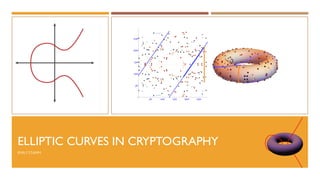
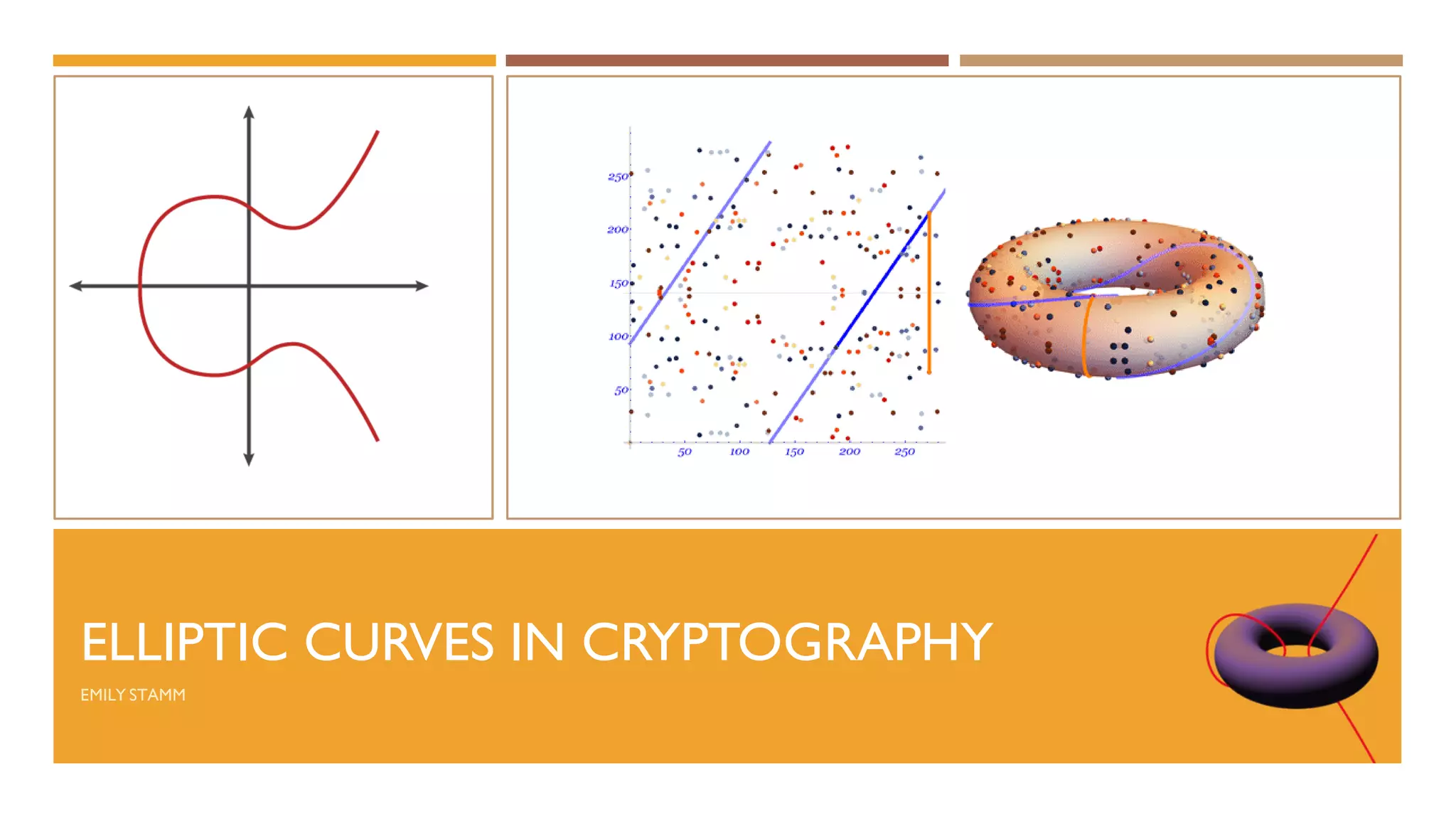
ELLIPTIC CURVES IN CRYPTOGRAPHY
EMILY STAMM
OUTLINE
Cryptography
Elliptic Curves
Elliptic Curve Diffie-Hellman Key Exchange
Quantum Computing
Isogenies
Supersingular Isogeny Diffie-Hellman
INTRODUCTION
WHAT IS
CRYPTOGRAPHY ?
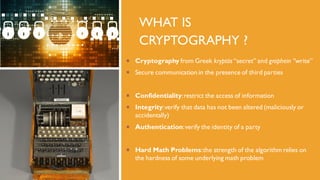
ļ‚” Cryptography from Greek kryptós ā€œsecretā€ and graphein ā€writeā€
ļ‚” Secure communication in the presence of third parties
ļ‚” Confidentiality:restrict the access of information
ļ‚” Integrity:verify that data has not been altered (maliciously or
accidentally)
ļ‚” Authentication:verify the identity of a party
ļ‚” Hard Math Problems:the strength of the algorithm relies on
the hardness of some underlying math problem
WHAT IS GOOD CRYPTOGRAPHY?
Key Secrecy:
secret piece of
information
used to uncover
information
Hard Math
Problems:the strength
of the algorithm relies
on the hardness of
some underlying math
problem
Proper
Implementation:
algorithms must be
correctly implemented
so as not to leak
information
PUBLIC KEY CRYPTOGRAPHY
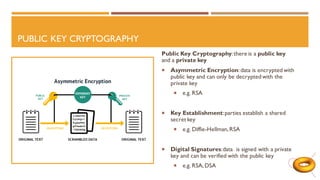
Public Key Cryptography:there is a public key
and a private key
ļ‚” Asymmetric Encryption: data is encrypted with
public key and can only be decrypted with the
private key
ļ‚” e.g. RSA
ļ‚” Key Establishment:parties establish a shared
secret key
ļ‚” e.g. Diffie-Hellman, RSA
ļ‚” Digital Signatures:data is signed with a private
key and can be verified with the public key
ļ‚” e.g. RSA, DSA
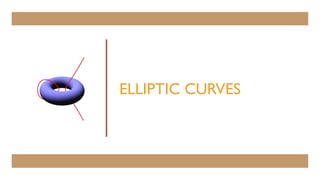
ELLIPTIC CURVES
ELLIPTIC CURVE
ļ‚” An Elliptic Curve E (inWeierstrass form) is a curve consisting of solutions to the equation
y2 = x3 + ax + b
plus a ā€˜point at infinity’ denoted 0E where 4a3 + 27b2 nonzero
ELLIPTIC CURVE ADDITION
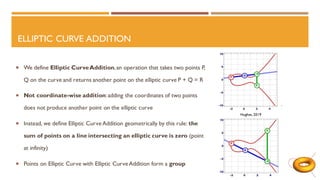
ļ‚” We define Elliptic CurveAddition,an operation that takes two points P,
Q on the curve and returns another point on the elliptic curve P + Q = R
ļ‚” Not coordinate-wise addition:adding the coordinates of two points
does not produce another point on the elliptic curve
ļ‚” Instead, we define Elliptic CurveAddition geometrically by this rule: the
sum of points on a line intersecting an elliptic curve is zero (point
at infinity)
ļ‚” Points on Elliptic Curve with Elliptic CurveAddition form a group
Hughes, 2019
ELLIPTIC CURVE ADDITION
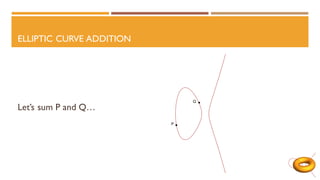
Let’s sum P and Q…
ELLIPTIC CURVE ADDITION
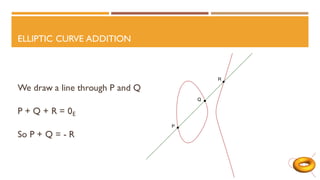
We draw a line through P and Q
P + Q + R = 0E
So P + Q = - R
ELLIPTIC CURVE ADDITION
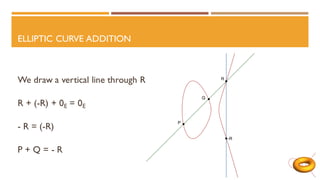
We draw a vertical line through R
R + (-R) + 0E = 0E
- R = (-R)
P + Q = - R
ELLIPTIC CURVE ADDITION
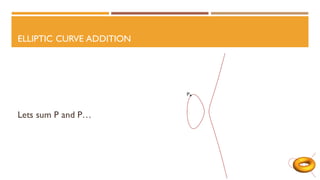
Lets sum P and P…
ELLIPTIC CURVE ADDITION
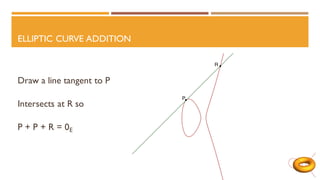
Draw a line tangent to P
Intersects at R so
P + P + R = 0E
ELLIPTIC CURVE ADDITION
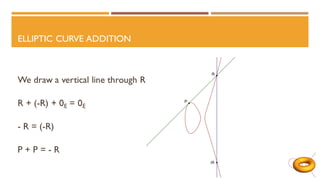
We draw a vertical line through R
R + (-R) + 0E = 0E
- R = (-R)
P + P = - R
ELLIPTIC CURVE MULTIPLICATION
ļ‚” We define elliptic curve multiplication-by-n map that takes a point P and produces a point [n]P = Q on the
elliptic curve by repeatedly adding P to itself
[n]P = P + P + … + P (n times)
Leuven, 2019
ELLIPTIC CURVES OVER FINITE FIELDS
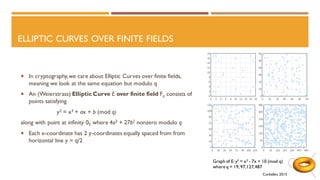
ļ‚” In cryptography,we care about Elliptic Curves over finite fields,
meaning we look at the same equation but modulo q
ļ‚” An (Weierstrass) Elliptic Curve E over finite field Fq consists of
points satisfying
y2 = x3 + ax + b (mod q)
along with point at infinity 0E where 4a3 + 27b2 nonzero modulo q
ļ‚” Each x-coordinate has 2 y-coordinates equally spaced from from
horizontal line y = q/2
Corbellini, 2015
Graph of E:y2
= x3
- 7x + 10 (mod q)
where q = 19,97,127,487
ELLIPTIC CURVES
OVER FINITE FIELDS
TORUS
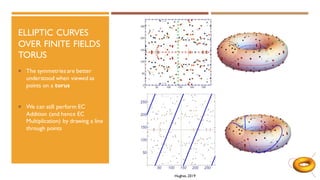
ļ‚” The symmetries are better
understood when viewed as
points on a torus
ļ‚” We can still perform EC
Addition (and hence EC
Multiplication) by drawing a line
through points
Hughes, 2019
ELLIPTIC CURVE
CRYPTOGRAPHY
ELLIPTIC CURVE CRYPTOGRAPHY
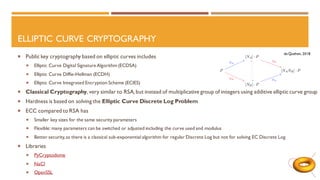
ļ‚” Public key cryptography based on elliptic curves includes
ļ‚” Elliptic Curve Digital Signature Algorithm (ECDSA)
ļ‚” Elliptic Curve Diffie-Hellman (ECDH)
ļ‚” Elliptic Curve Integrated Encryption Scheme (ECIES)
ļ‚” Classical Cryptography,very similar to RSA,but instead of multiplicative group of integers using additive elliptic curve group
ļ‚” Hardness is based on solving the Elliptic Curve Discrete Log Problem
ļ‚” ECC compared to RSA has
ļ‚” Smaller key sizes for the same security parameters
ļ‚” Flexible: many parameters can be switched or adjusted including the curve used and modulus
ļ‚” Better security,as there is a classical sub-exponential algorithm for regular Discrete Log but not for solving EC Discrete Log
ļ‚” Libraries
ļ‚” PyCryptodome
ļ‚” NaCl
ļ‚” OpenSSL
de Quehen, 2018
Alice
Bob
Alice Private Key
Integer a
Bob Private Key
Integer b
A B
K
Bob sends B to Alice
Alice sends A to Bob
Alice compute A = a[G]
Bob compute secret point
K = b[A]
Bob compute B = b[G]
Alice computes secret point
K = a[B]
Eve can only find K if she can solve
Elliptic Curve Discrete Log Problem:
Given A, G, find a such that A = a[G]
Eve
Public Key
• Prime q
• Elliptic Curve E: y2 = x3+ax+b
• Generator G of E(Fq)G
Elliptic Curve Diffie-Hellman
JANUARY 2020 CRITICAL WINDOWSVULNERABILITY
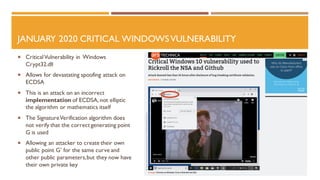
ļ‚” CriticalVulnerability in Windows
Crypt32.dll
ļ‚” Allows for devastating spoofing attack on
ECDSA
ļ‚” This is an attack on an incorrect
implementation of ECDSA, not elliptic
the algorithm or mathematics itself
ļ‚” The SignatureVerification algorithm does
not verify that the correct generating point
G is used
ļ‚” Allowing an attacker to create their own
public point G’ for the same curve and
other public parameters,but they now have
their own private key
QUANTUM COMPUTING
QUANTUM COMPUTING &
CRYPTOGRAPHY
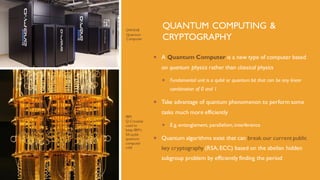
ļ‚” A Quantum Computer is a new type of computer based
on quantum physics rather than classical physics
ļ‚” Fundamental unit is a qubit or quantum bit that can be any linear
combination of 0 and 1
ļ‚” Take advantage of quantum phenomenon to perform some
tasks much more efficiently
ļ‚” E.g. entanglement, parallelism, interference
ļ‚” Quantum algorithms exist that can break our current public
key cryptography (RSA, ECC) based on the abelian hidden
subgroup problem by efficiently finding the period
IBM
Q Cryostat
used to
keep IBM’s
50-qubit
quantum
computer
cold
DWAVE
Quantum
Computer
POST-QUANTUM
CRYPTOGRAPHY
NIST competition to choose new
Public Key Cryptography,
cryptography that runs on our current
computers but is conjectured to be
secure against quantum and classical
attacks
ļ‚” Lattice-Based Cryptography: learning with errors;find
the shortest vector on a lattice
ļ‚” Code-Based Cryptography:error correcting codes
ļ‚” Multivariate Cryptography:equations in multiple variables
ļ‚” Hash-Based Cryptography:hashed functions
ļ‚” Isogeny-Based Cryptography:maps between elliptic
curves
ISOGENIES
MAPS BETWEEN ELLIPTIC CURVES
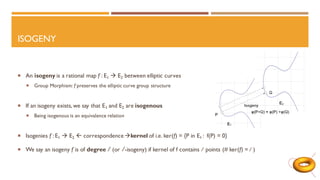
ISOGENY
ļ‚” An isogeny is a rational map f : E1 → E2 between elliptic curves
ļ‚” Group Morphism: f preserves the elliptic curve group structure
ļ‚” If an isogeny exists, we say that E1 and E2 are isogenous
ļ‚” Being isogenous is an equivalence relation
ļ‚” Isogenies f : E1 → E2  correspondence→kernel of i.e. ker(f) = {P in E1 : f(P) = 0}
ļ‚” We say an isogeny f is of degree l (or l -isogeny) if kernel of f contains l points (# ker(f) = l )
ORDINARY AND SUPERSINGULAR
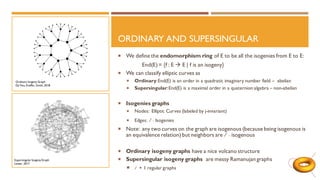
ļ‚” We define the endomorphism ring of E to be all the isogenies from E to E:
End(E) = {f : E → E | f is an isogeny}
ļ‚” We can classify elliptic curves as
ļ‚” Ordinary:End(E) is an order in a quadratic imaginary number field – abelian
ļ‚” Supersingular:End(E) is a maximal order in a quaternion algebra – non-abelian
ļ‚” Isogenies graphs
ļ‚” Nodes: Elliptic Curves (labeled by j-invariant)
ļ‚” Edges: l–Isogenies
ļ‚” Note: any two curves on the graph are isogenous (because being isogenous is
an equivalence relation) but neighbors are l –isogenous
ļ‚” Ordinary isogeny graphs have a nice volcano structure
ļ‚” Supersingular isogeny graphs are messy Ramanujan graphs
ļ‚” l + 1 regular graphs
Supersingular IsogenyGraph
Lauter, 2017
Ordinary Isogeny Graph
De Feo, Kieffer, Smith, 2018
SIDH
SUPERSINGULAR ISOGENY DIFFIE-
HELLAN
ISOGENY-BASED CRYPTOGRAPHY
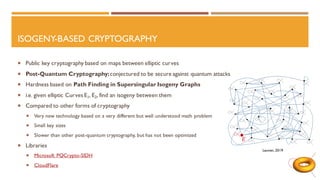
ļ‚” Public key cryptography based on maps between elliptic curves
ļ‚” Post-Quantum Cryptography:conjectured to be secure against quantum attacks
ļ‚” Hardness based on Path Finding in Supersingular Isogeny Graphs
ļ‚” i.e. given elliptic Curves E1, E2, find an isogeny between them
ļ‚” Compared to other forms of cryptography
ļ‚” Very new technology based on a very different but well understood math problem
ļ‚” Small key sizes
ļ‚” Slower than other post-quantum cryptography, but has not been optimized
ļ‚” Libraries
ļ‚” Microsoft PQCrypto-SIDH
ļ‚” CloudFlare
Leuven, 2019
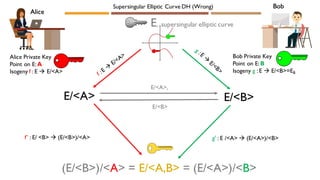
Alice
Bob
Alice Private Key
Point on E: A
Isogeny f : E → E/<A>
Bob Private Key
Point on E: B
Isogeny g : E → E/<B>=EB
E/<A> E/<B>
(E/<B>)/<A> = E/<A,B> = (E/<A>)/<B>
E, supersingular elliptic curve
f’ : E/ <B> → (E/<B>)/<A>
E/<B>
E/<A>,
g' : E /<A> → (E/<A>)/<B>
Supersingular Elliptic Curve DH (Wrong)
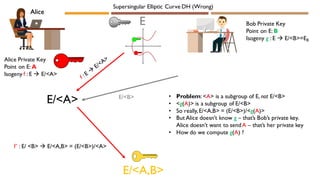
Alice
Alice Private Key
Point on E: A
Isogeny f : E → E/<A>
E/<A>
E/<A,B>
f’ : E/ <B> → E/<A,B> = (E/<B>)/<A>
E/<B> • Problem: <A> is a subgroup of E, not E/<B>
• <g(A)> is a subgroup of E/<B>
• So really,E/<A,B> = (E/<B>)/<g(A)>
• But Alice doesn’t know g – that’s Bob’s private key.
Alice doesn’t want to sendA – that’s her private key
• How do we compute g(A) ?
Bob Private Key
Point on E: B
Isogeny g : E → E/<B>=EB
E
Supersingular Elliptic Curve DH (Wrong)
Alice
Alice Private Key
Integers m and n
Point A = [m]P +[n]Q
Isogeny f : E → E/<A>
E/<A>
E/<A,B>
E
f’ : E/ <B> → E/<A,B> = (E/<B>)/< g( A)>
E/<B>, g(P), g(Q)
• Solution:Create private point A as a secret
linear combination of two public points P, Q
• Now Bob can send Alice g(P), g(Q)
• Which Alice can use to compute g(A) as
follows:
• g(A) = g(mP + nQ) = [m]g(P)+ [n] g(Q)
because g preserves group structure
• Now Alice can get
• E/<A,B> = (E/<B>)/< g( A)>
Bob Private Key
Integers mB, nB
Point B = [mB]PB +[nB]QB
Isogeny g : E → E/<B>
Supersingular Elliptic Curve DH
Alice
Bob
E/<A> E/<B>
Velu’s Formula to get f’
f’ : E/ <B> → (E/<B>)/<g(A)>
E/<B>, PB, QB , g(P), g(Q)
E/<A>, P, Q, f(PB ), f(QB)
g' : E /<A> → (E/<A>)/<f(B)>
Alice Private Key
Integers m and n
Point A = [m]P +[n]Q
Isogeny f : E → E/<A>
Bob Private Key
Integers mB, nB
Point B = [mB]PB +[nB]QB
Isogeny g : E → E/<B>
(E/<B>)/<g(A)> = E/<A,B> = (E/<A>)/<f(B)>
E, supersingular elliptic curve
E/<B> E/<A>
Supersingular Elliptic Curve DH
Alice
Bob
Alice Private Key
Integers mA, nA
Point A = [mA]PA +[nA]QA
Isogeny f : E → E/<A>=EA
Alice sends curve EA and points RA,SA
Bob compute new points on EB
RB = g(PA) and SB= g(QA)
Eve
Supersingular Isogeny Diffie-Hellman
Shared Secret Key K
K = j-invariant of E/<A,B>
Alice compute new isogeny with
kernel = <A,B>
E → EB/ <g(A)> = E/<A,B>
Eve can only find K if she can
compute g(A) or f(B) which she can
get g or f she can find the isogeny
between E and EA or EB
• Primes lA, lB, and p = lA
d lB
e f + 1
• Supersingular Elliptic Curve E over Fq, q = p2
• Points PA, QA (basis for lA
d torsion subgroup)
• Points PB, QB (basis for lB
e torsion subgroup)
Bob Private Key
Integers mB, nB
Point B = [mB]PB +[nB]QB
Isogeny g : E → E/<B>=EB
Alice compute new points on EA
RA = f(PB) and SA= f(QB)
Bob sends curve EB and points RB, SB
Bob compute new isogeny with
kernel = <A,B>
E → EA/ <f(B)> = E/<A,B>
Shared Secret Key K
K = j-invariant of E/<A,B>
Public Key
WHAT DOES
THIS HAVETO
DO WITH PATH
FINDING?
Leuven, 2019
CONCLUSIONS
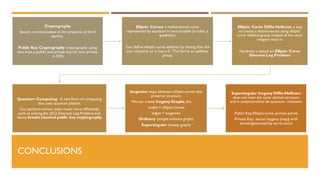
Cryptography:
Secure communication in the presence of third
parties.
Public Key Cryptography: cryptography using
two keys,a public and private key (or two private
in DH)
Elliptic Curves: a mathematical curve
represented by equation in two variable (x cubic, y
quadratic).
Can define elliptic curve addition by stating that the
sum of points on a line is 0. This forms an additive
group.
Elliptic Curve Diffie-Hellman: a way
to create a shared secret using elliptic
curve additive group instead of the usual
integers mod m.
Hardness is based on Elliptic Curve
Discrete Log Problem
Quantum Computing: A new form of computing
that uses quantum physics.
Can perform certain tasks much more efficiently,
such as solving the (EC) Discrete Log Problem and
hence breaks classical public key cryptography.
Isogenies:maps between elliptic curves that
preserve structure.
We can create Isogeny Graphs, the
nodes = elliptic curves
edges = isogenies
Ordinary (simple volcano graph)
Supersingular (messy graph)
Supersingular Isogeny Diffie-Hellman:
does not have the same abelian structure
and is conjectured to be quantum –resistant.
Public Key:Elliptic curve, primes, points
Private Key: secret isogeny (map) with
kernel generated by secret point
THANK YOU
ļ‚” Emily Stamm
ļ‚” Security Researcher at Allstate
ļ‚” CSNPVice President
ļ‚” For more information on
CSNP:
ļ‚” Websitecsnp.org
ļ‚” Instagram: cybersecuritynp
Contact Info
• Email:emily.stamm@cnsp.org
• LinkedIn: linkedin.com/in/emily-stamm/
• Instagram:instagram.com/crypto.emily
REFERENCES
ļ‚” Mark Hughes, How Elliptic Curve CryptographyWorks,2019 https://www.allaboutcircuits.com/technical-
articles/elliptic-curve-cryptography-in-embedded-systems/
ļ‚” Andrea Corbellini, Elliptic Curve Cryptography:finite fields and discrete logarithms, 2015
https://andrea.corbellini.name/2015/05/23/elliptic-curve-cryptography-finite-fields-and-discrete-logarithms/
ļ‚” Ku Leuven,ELLIPTIC CURVESARE QUANTUM DEAD, LONG LIVE ELLIPTIC CURVES, 2019
CURVEShttps://www.esat.kuleuven.be/cosic/elliptic-curves-are-quantum-dead-long-live-elliptic-curves/
ļ‚” Kristen Lauter,ā€œWhere cryptography and quantum computing intersectā€, Microsoft Research Blog, 2017
https://www.microsoft.com/en-us/research/blog/tag/supersingular-isogeny-graphs/
ļ‚” Victoria de Quehen, Security Researcher,ISARA Corporation,2018 https://www.isara.com/isogeny-based-cryptography/
ļ‚” https://arstechnica.com/information-technology/2020/01/researcher-develops-working-exploit-for-critical-
windows-10-vulnerability/

Elliptic Curves in Cryptography

  • 1.
    ELLIPTIC CURVES INCRYPTOGRAPHY EMILY STAMM
  • 2.
    OUTLINE Cryptography Elliptic Curves Elliptic CurveDiffie-Hellman Key Exchange Quantum Computing Isogenies Supersingular Isogeny Diffie-Hellman
  • 3.
  • 4.
    WHAT IS CRYPTOGRAPHY ? ļ‚”Cryptography from Greek kryptós ā€œsecretā€ and graphein ā€writeā€ ļ‚” Secure communication in the presence of third parties ļ‚” Confidentiality:restrict the access of information ļ‚” Integrity:verify that data has not been altered (maliciously or accidentally) ļ‚” Authentication:verify the identity of a party ļ‚” Hard Math Problems:the strength of the algorithm relies on the hardness of some underlying math problem
  • 5.
    WHAT IS GOODCRYPTOGRAPHY? Key Secrecy: secret piece of information used to uncover information Hard Math Problems:the strength of the algorithm relies on the hardness of some underlying math problem Proper Implementation: algorithms must be correctly implemented so as not to leak information
  • 6.
    PUBLIC KEY CRYPTOGRAPHY PublicKey Cryptography:there is a public key and a private key ļ‚” Asymmetric Encryption: data is encrypted with public key and can only be decrypted with the private key ļ‚” e.g. RSA ļ‚” Key Establishment:parties establish a shared secret key ļ‚” e.g. Diffie-Hellman, RSA ļ‚” Digital Signatures:data is signed with a private key and can be verified with the public key ļ‚” e.g. RSA, DSA
  • 7.
  • 8.
    ELLIPTIC CURVE ļ‚” AnElliptic Curve E (inWeierstrass form) is a curve consisting of solutions to the equation y2 = x3 + ax + b plus a ā€˜point at infinity’ denoted 0E where 4a3 + 27b2 nonzero
  • 9.
    ELLIPTIC CURVE ADDITION ļ‚”We define Elliptic CurveAddition,an operation that takes two points P, Q on the curve and returns another point on the elliptic curve P + Q = R ļ‚” Not coordinate-wise addition:adding the coordinates of two points does not produce another point on the elliptic curve ļ‚” Instead, we define Elliptic CurveAddition geometrically by this rule: the sum of points on a line intersecting an elliptic curve is zero (point at infinity) ļ‚” Points on Elliptic Curve with Elliptic CurveAddition form a group Hughes, 2019
  • 10.
  • 11.
    ELLIPTIC CURVE ADDITION Wedraw a line through P and Q P + Q + R = 0E So P + Q = - R
  • 12.
    ELLIPTIC CURVE ADDITION Wedraw a vertical line through R R + (-R) + 0E = 0E - R = (-R) P + Q = - R
  • 13.
  • 14.
    ELLIPTIC CURVE ADDITION Drawa line tangent to P Intersects at R so P + P + R = 0E
  • 15.
    ELLIPTIC CURVE ADDITION Wedraw a vertical line through R R + (-R) + 0E = 0E - R = (-R) P + P = - R
  • 16.
    ELLIPTIC CURVE MULTIPLICATION ļ‚”We define elliptic curve multiplication-by-n map that takes a point P and produces a point [n]P = Q on the elliptic curve by repeatedly adding P to itself [n]P = P + P + … + P (n times) Leuven, 2019
  • 17.
    ELLIPTIC CURVES OVERFINITE FIELDS ļ‚” In cryptography,we care about Elliptic Curves over finite fields, meaning we look at the same equation but modulo q ļ‚” An (Weierstrass) Elliptic Curve E over finite field Fq consists of points satisfying y2 = x3 + ax + b (mod q) along with point at infinity 0E where 4a3 + 27b2 nonzero modulo q ļ‚” Each x-coordinate has 2 y-coordinates equally spaced from from horizontal line y = q/2 Corbellini, 2015 Graph of E:y2 = x3 - 7x + 10 (mod q) where q = 19,97,127,487
  • 18.
    ELLIPTIC CURVES OVER FINITEFIELDS TORUS ļ‚” The symmetries are better understood when viewed as points on a torus ļ‚” We can still perform EC Addition (and hence EC Multiplication) by drawing a line through points Hughes, 2019
  • 19.
  • 20.
    ELLIPTIC CURVE CRYPTOGRAPHY ļ‚”Public key cryptography based on elliptic curves includes ļ‚” Elliptic Curve Digital Signature Algorithm (ECDSA) ļ‚” Elliptic Curve Diffie-Hellman (ECDH) ļ‚” Elliptic Curve Integrated Encryption Scheme (ECIES) ļ‚” Classical Cryptography,very similar to RSA,but instead of multiplicative group of integers using additive elliptic curve group ļ‚” Hardness is based on solving the Elliptic Curve Discrete Log Problem ļ‚” ECC compared to RSA has ļ‚” Smaller key sizes for the same security parameters ļ‚” Flexible: many parameters can be switched or adjusted including the curve used and modulus ļ‚” Better security,as there is a classical sub-exponential algorithm for regular Discrete Log but not for solving EC Discrete Log ļ‚” Libraries ļ‚” PyCryptodome ļ‚” NaCl ļ‚” OpenSSL de Quehen, 2018
  • 21.
    Alice Bob Alice Private Key Integera Bob Private Key Integer b A B K Bob sends B to Alice Alice sends A to Bob Alice compute A = a[G] Bob compute secret point K = b[A] Bob compute B = b[G] Alice computes secret point K = a[B] Eve can only find K if she can solve Elliptic Curve Discrete Log Problem: Given A, G, find a such that A = a[G] Eve Public Key • Prime q • Elliptic Curve E: y2 = x3+ax+b • Generator G of E(Fq)G Elliptic Curve Diffie-Hellman
  • 22.
    JANUARY 2020 CRITICALWINDOWSVULNERABILITY ļ‚” CriticalVulnerability in Windows Crypt32.dll ļ‚” Allows for devastating spoofing attack on ECDSA ļ‚” This is an attack on an incorrect implementation of ECDSA, not elliptic the algorithm or mathematics itself ļ‚” The SignatureVerification algorithm does not verify that the correct generating point G is used ļ‚” Allowing an attacker to create their own public point G’ for the same curve and other public parameters,but they now have their own private key
  • 23.
  • 24.
    QUANTUM COMPUTING & CRYPTOGRAPHY ļ‚”A Quantum Computer is a new type of computer based on quantum physics rather than classical physics ļ‚” Fundamental unit is a qubit or quantum bit that can be any linear combination of 0 and 1 ļ‚” Take advantage of quantum phenomenon to perform some tasks much more efficiently ļ‚” E.g. entanglement, parallelism, interference ļ‚” Quantum algorithms exist that can break our current public key cryptography (RSA, ECC) based on the abelian hidden subgroup problem by efficiently finding the period IBM Q Cryostat used to keep IBM’s 50-qubit quantum computer cold DWAVE Quantum Computer
  • 25.
    POST-QUANTUM CRYPTOGRAPHY NIST competition tochoose new Public Key Cryptography, cryptography that runs on our current computers but is conjectured to be secure against quantum and classical attacks ļ‚” Lattice-Based Cryptography: learning with errors;find the shortest vector on a lattice ļ‚” Code-Based Cryptography:error correcting codes ļ‚” Multivariate Cryptography:equations in multiple variables ļ‚” Hash-Based Cryptography:hashed functions ļ‚” Isogeny-Based Cryptography:maps between elliptic curves
  • 26.
  • 27.
    ISOGENY ļ‚” An isogenyis a rational map f : E1 → E2 between elliptic curves ļ‚” Group Morphism: f preserves the elliptic curve group structure ļ‚” If an isogeny exists, we say that E1 and E2 are isogenous ļ‚” Being isogenous is an equivalence relation ļ‚” Isogenies f : E1 → E2  correspondence→kernel of i.e. ker(f) = {P in E1 : f(P) = 0} ļ‚” We say an isogeny f is of degree l (or l -isogeny) if kernel of f contains l points (# ker(f) = l )
  • 28.
    ORDINARY AND SUPERSINGULAR ļ‚”We define the endomorphism ring of E to be all the isogenies from E to E: End(E) = {f : E → E | f is an isogeny} ļ‚” We can classify elliptic curves as ļ‚” Ordinary:End(E) is an order in a quadratic imaginary number field – abelian ļ‚” Supersingular:End(E) is a maximal order in a quaternion algebra – non-abelian ļ‚” Isogenies graphs ļ‚” Nodes: Elliptic Curves (labeled by j-invariant) ļ‚” Edges: l–Isogenies ļ‚” Note: any two curves on the graph are isogenous (because being isogenous is an equivalence relation) but neighbors are l –isogenous ļ‚” Ordinary isogeny graphs have a nice volcano structure ļ‚” Supersingular isogeny graphs are messy Ramanujan graphs ļ‚” l + 1 regular graphs Supersingular IsogenyGraph Lauter, 2017 Ordinary Isogeny Graph De Feo, Kieffer, Smith, 2018
  • 29.
  • 30.
    ISOGENY-BASED CRYPTOGRAPHY ļ‚” Publickey cryptography based on maps between elliptic curves ļ‚” Post-Quantum Cryptography:conjectured to be secure against quantum attacks ļ‚” Hardness based on Path Finding in Supersingular Isogeny Graphs ļ‚” i.e. given elliptic Curves E1, E2, find an isogeny between them ļ‚” Compared to other forms of cryptography ļ‚” Very new technology based on a very different but well understood math problem ļ‚” Small key sizes ļ‚” Slower than other post-quantum cryptography, but has not been optimized ļ‚” Libraries ļ‚” Microsoft PQCrypto-SIDH ļ‚” CloudFlare Leuven, 2019
  • 31.
    Alice Bob Alice Private Key Pointon E: A Isogeny f : E → E/<A> Bob Private Key Point on E: B Isogeny g : E → E/<B>=EB E/<A> E/<B> (E/<B>)/<A> = E/<A,B> = (E/<A>)/<B> E, supersingular elliptic curve f’ : E/ <B> → (E/<B>)/<A> E/<B> E/<A>, g' : E /<A> → (E/<A>)/<B> Supersingular Elliptic Curve DH (Wrong)
  • 32.
    Alice Alice Private Key Pointon E: A Isogeny f : E → E/<A> E/<A> E/<A,B> f’ : E/ <B> → E/<A,B> = (E/<B>)/<A> E/<B> • Problem: <A> is a subgroup of E, not E/<B> • <g(A)> is a subgroup of E/<B> • So really,E/<A,B> = (E/<B>)/<g(A)> • But Alice doesn’t know g – that’s Bob’s private key. Alice doesn’t want to sendA – that’s her private key • How do we compute g(A) ? Bob Private Key Point on E: B Isogeny g : E → E/<B>=EB E Supersingular Elliptic Curve DH (Wrong)
  • 33.
    Alice Alice Private Key Integersm and n Point A = [m]P +[n]Q Isogeny f : E → E/<A> E/<A> E/<A,B> E f’ : E/ <B> → E/<A,B> = (E/<B>)/< g( A)> E/<B>, g(P), g(Q) • Solution:Create private point A as a secret linear combination of two public points P, Q • Now Bob can send Alice g(P), g(Q) • Which Alice can use to compute g(A) as follows: • g(A) = g(mP + nQ) = [m]g(P)+ [n] g(Q) because g preserves group structure • Now Alice can get • E/<A,B> = (E/<B>)/< g( A)> Bob Private Key Integers mB, nB Point B = [mB]PB +[nB]QB Isogeny g : E → E/<B> Supersingular Elliptic Curve DH
  • 34.
    Alice Bob E/<A> E/<B> Velu’s Formulato get f’ f’ : E/ <B> → (E/<B>)/<g(A)> E/<B>, PB, QB , g(P), g(Q) E/<A>, P, Q, f(PB ), f(QB) g' : E /<A> → (E/<A>)/<f(B)> Alice Private Key Integers m and n Point A = [m]P +[n]Q Isogeny f : E → E/<A> Bob Private Key Integers mB, nB Point B = [mB]PB +[nB]QB Isogeny g : E → E/<B> (E/<B>)/<g(A)> = E/<A,B> = (E/<A>)/<f(B)> E, supersingular elliptic curve E/<B> E/<A> Supersingular Elliptic Curve DH
  • 35.
    Alice Bob Alice Private Key IntegersmA, nA Point A = [mA]PA +[nA]QA Isogeny f : E → E/<A>=EA Alice sends curve EA and points RA,SA Bob compute new points on EB RB = g(PA) and SB= g(QA) Eve Supersingular Isogeny Diffie-Hellman Shared Secret Key K K = j-invariant of E/<A,B> Alice compute new isogeny with kernel = <A,B> E → EB/ <g(A)> = E/<A,B> Eve can only find K if she can compute g(A) or f(B) which she can get g or f she can find the isogeny between E and EA or EB • Primes lA, lB, and p = lA d lB e f + 1 • Supersingular Elliptic Curve E over Fq, q = p2 • Points PA, QA (basis for lA d torsion subgroup) • Points PB, QB (basis for lB e torsion subgroup) Bob Private Key Integers mB, nB Point B = [mB]PB +[nB]QB Isogeny g : E → E/<B>=EB Alice compute new points on EA RA = f(PB) and SA= f(QB) Bob sends curve EB and points RB, SB Bob compute new isogeny with kernel = <A,B> E → EA/ <f(B)> = E/<A,B> Shared Secret Key K K = j-invariant of E/<A,B> Public Key
  • 36.
    WHAT DOES THIS HAVETO DOWITH PATH FINDING? Leuven, 2019
  • 37.
    CONCLUSIONS Cryptography: Secure communication inthe presence of third parties. Public Key Cryptography: cryptography using two keys,a public and private key (or two private in DH) Elliptic Curves: a mathematical curve represented by equation in two variable (x cubic, y quadratic). Can define elliptic curve addition by stating that the sum of points on a line is 0. This forms an additive group. Elliptic Curve Diffie-Hellman: a way to create a shared secret using elliptic curve additive group instead of the usual integers mod m. Hardness is based on Elliptic Curve Discrete Log Problem Quantum Computing: A new form of computing that uses quantum physics. Can perform certain tasks much more efficiently, such as solving the (EC) Discrete Log Problem and hence breaks classical public key cryptography. Isogenies:maps between elliptic curves that preserve structure. We can create Isogeny Graphs, the nodes = elliptic curves edges = isogenies Ordinary (simple volcano graph) Supersingular (messy graph) Supersingular Isogeny Diffie-Hellman: does not have the same abelian structure and is conjectured to be quantum –resistant. Public Key:Elliptic curve, primes, points Private Key: secret isogeny (map) with kernel generated by secret point
  • 38.
    THANK YOU ļ‚” EmilyStamm ļ‚” Security Researcher at Allstate ļ‚” CSNPVice President ļ‚” For more information on CSNP: ļ‚” Websitecsnp.org ļ‚” Instagram: cybersecuritynp Contact Info • Email:emily.stamm@cnsp.org • LinkedIn: linkedin.com/in/emily-stamm/ • Instagram:instagram.com/crypto.emily
  • 39.
    REFERENCES ļ‚” Mark Hughes,How Elliptic Curve CryptographyWorks,2019 https://www.allaboutcircuits.com/technical- articles/elliptic-curve-cryptography-in-embedded-systems/ ļ‚” Andrea Corbellini, Elliptic Curve Cryptography:finite fields and discrete logarithms, 2015 https://andrea.corbellini.name/2015/05/23/elliptic-curve-cryptography-finite-fields-and-discrete-logarithms/ ļ‚” Ku Leuven,ELLIPTIC CURVESARE QUANTUM DEAD, LONG LIVE ELLIPTIC CURVES, 2019 CURVEShttps://www.esat.kuleuven.be/cosic/elliptic-curves-are-quantum-dead-long-live-elliptic-curves/ ļ‚” Kristen Lauter,ā€œWhere cryptography and quantum computing intersectā€, Microsoft Research Blog, 2017 https://www.microsoft.com/en-us/research/blog/tag/supersingular-isogeny-graphs/ ļ‚” Victoria de Quehen, Security Researcher,ISARA Corporation,2018 https://www.isara.com/isogeny-based-cryptography/ ļ‚” https://arstechnica.com/information-technology/2020/01/researcher-develops-working-exploit-for-critical- windows-10-vulnerability/