EVAPORATION
B. Pharmacy (3rd Sem)
Pharmaceutical Engineering
1
Ms. Prajakta Shinde
Asst. Professor(Pharmaceutics), SMBT College of Pharmacy,Nashik.
1
2
lecture outcomes :
At the end of this presentation the students will be able to :
•Understand the importance of evaporation process &
evaporators used in pharmaceutical industries.
•State the factors influencing evaporation .
•Differentiate between evaporation and other heat process
(Boling/Drying)
2
Contents :
 Introduction
 Objectives of Evaporation
 Application of Evaporation
 Differences between evaporation Other heat process
 Factors affecting on Evaporation
 Classification of Evaporators
 References
3
3
Introduction :
Definition - Evaporation is the process of removal of
solvent from the solution by boiling the liquid in a suitable
vessel and withdrawing the vapour, leaving a concentrated
product.
Mechanism :
Objectives:
• To get concentrated product.
• To remove water from aqueous solution.
• To evaporate seawater for developing drinking water.
• To reduce weight & volume that makes the product easy
to store and transport.
4
Application of Evaporation :
• Generally used in pharmaceutical ,chemical industries for
manufacturing of bulk drugs.
• Manufacturing of biological products (Insulin).
• Preparation of blood products (blood plasma and serum).
• Preparations of enzymes ,hormones and antibiotics.
• To get demineralized water for drinking purpose .
• To prepare liquid extract or soft extracts.
5
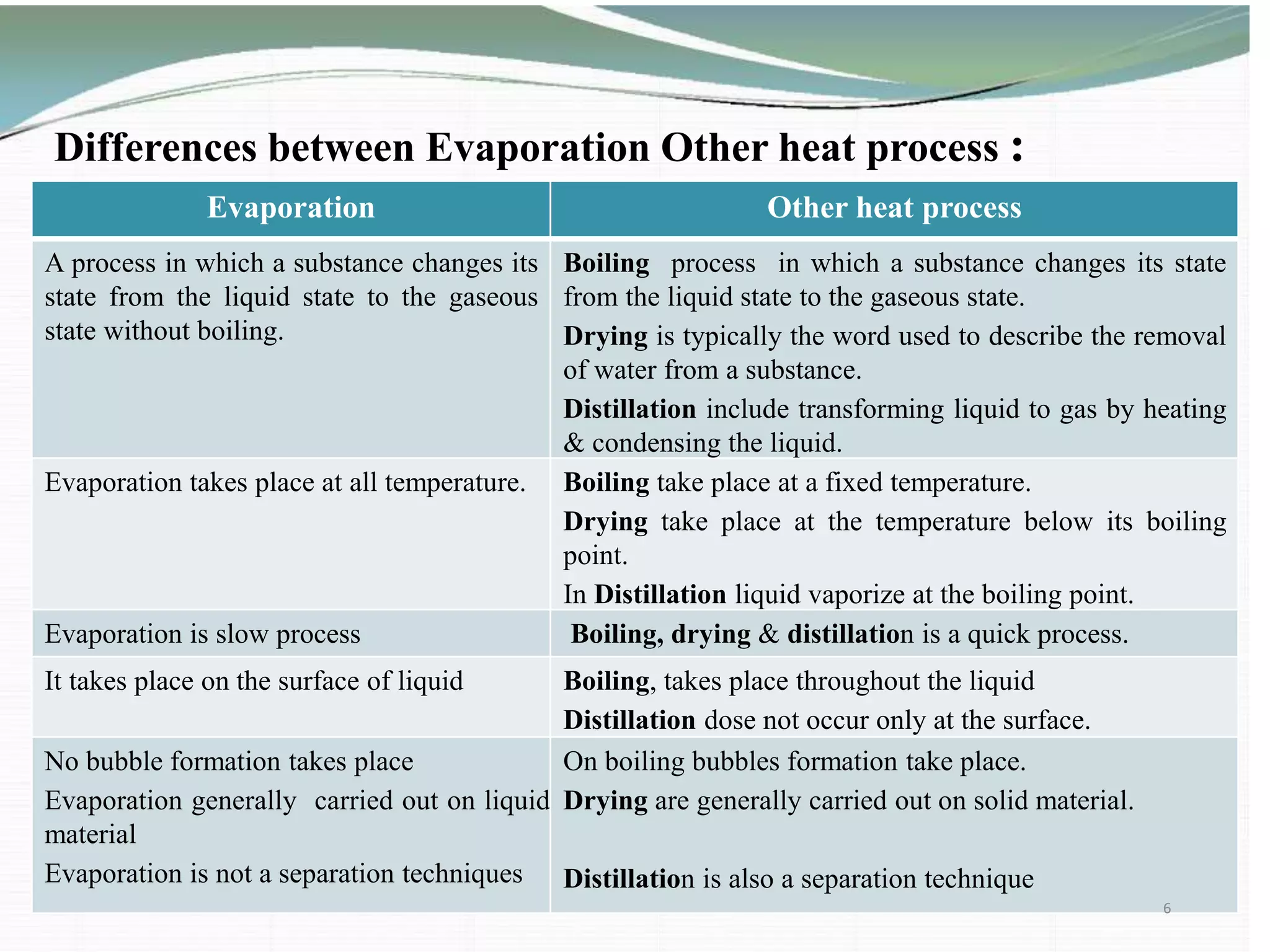
Differences between Evaporation Other heat process :
Evaporation Other heat process
A process in which a substance changes its
state from the liquid state to the gaseous
state without boiling.
Boiling process in which a substance changes its state
from the liquid state to the gaseous state.
Drying is typically the word used to describe the removal
of water from a substance.
Distillation include transforming liquid to gas by heating
& condensing the liquid.
Evaporation takes place at all temperature. Boiling take place at a fixed temperature.
Drying take place at the temperature below its boiling
point.
In Distillation liquid vaporize at the boiling point.
Evaporation is slow process Boiling, drying & distillation is a quick process.
It takes place on the surface of liquid Boiling, takes place throughout the liquid
Distillation dose not occur only at the surface.
No bubble formation takes place
Evaporation generally carried out on liquid
material
Evaporation is not a separation techniques
On boiling bubbles formation take place.
Drying are generally carried out on solid material.
Distillation is also a separation technique
6
Factors Effecting on Evaporation:
• Temperature:
Higher the temperature greater will be the
evaporation.
• Surface area:
Greater the surface area of greater will be the
evaporation.
•Time of evaporation:
Exposure time is longer, more will be the
evaporation.
•Vapor pressure:
Liquids with low boiling point evaporate quickly due to
high vapour pressure.
• Density :
As the density increase ,the rate of evaporation decreases
• Concentration:
Low concentration of the substance, faster the
evaporation.
• Agitation:
Agitation is necessary for evaporation.
• Type of product required:
Open pan produce liquid or dry concentrate, while film evaporator
yields liquid concentrate.
• Economic Factors :
Selecting the method & apparatus the economic factors are
important .Evaporators are designed to give maximum heat transfer to
liquid.
• Moisture Content:
8
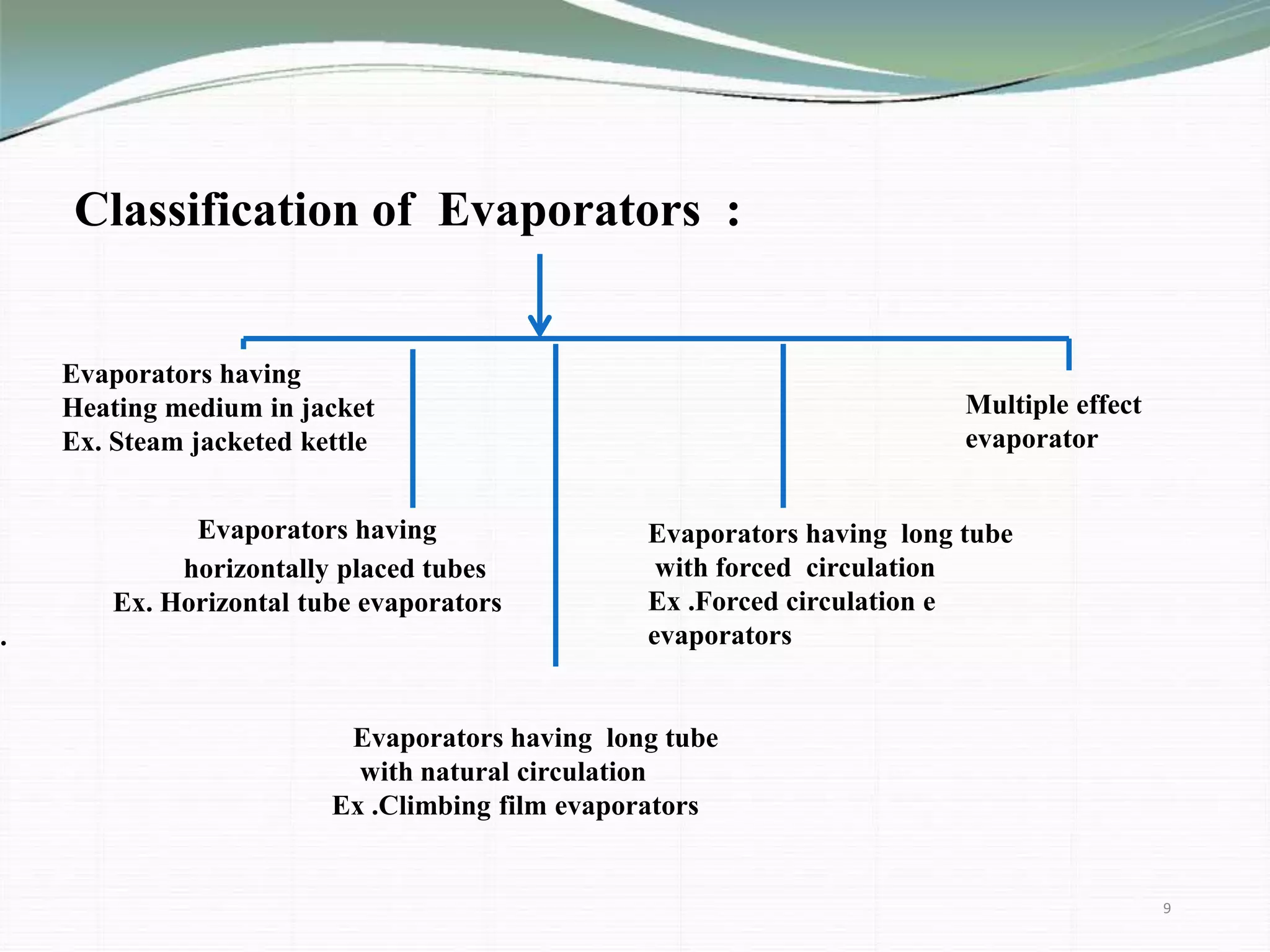
Classification of Evaporators :
Evaporators having
Heating medium in jacket
Ex. Steam jacketed kettle
Evaporators having
horizontally placed tubes
Ex. Horizontal tube evaporators
.
Evaporators having long tube
with natural circulation
Ex .Climbing film evaporators
Evaporators having long tube
with forced circulation
Ex .Forced circulation e
evaporators
Multiple effect
evaporator
9
• Evaporating pan consists of a hemispherical pan made from copper or stainless steel
and surrounded by steam jacket.
• The hemispherical shape provides a large surface area for evaporation.
• The evaporators are mounted in such a way that they can be tilted to remove the
product.
• The evaporating pans are heated by steam which passes through a steam jacket.
Steam Jacketed kettle
10
• Pharmaceutical applications :
 It is suitable for concentrating aqueous liquids.
 It is also suitable for concentrating thermo stable liquors.
• Advantages :
 Simple in construction
 Easy to operate
 Maintenance & installation cost is low
 Product can be easily removed
 Used for small scale & large scale operations.
• Disadvantages :
 Not suitable for heat sensitive products
 Many products produce foam
 Used only for aqueous liquids
Reference : C.V.S.Subrahmanyam ,Pharmaceutical Engineering ,Page No
337.
11
Summary
Theoretically & practically ,evaporation is simply vaporization from the surface of
a liquid. Vaporization of a liquid below its boiling point is called evaporation. Thus
no boiling occurs and the rate of vaporization depends on the diffusion of vapour
through the boundary layers above the liquid .It can be concluded that evaporation is
important for manufacturing of bulk drugs in pharmaceutical as well as chemical
industries.
12
13

Evaporation

  • 1.
    EVAPORATION B. Pharmacy (3rdSem) Pharmaceutical Engineering 1 Ms. Prajakta Shinde Asst. Professor(Pharmaceutics), SMBT College of Pharmacy,Nashik. 1
  • 2.
    2 lecture outcomes : Atthe end of this presentation the students will be able to : •Understand the importance of evaporation process & evaporators used in pharmaceutical industries. •State the factors influencing evaporation . •Differentiate between evaporation and other heat process (Boling/Drying) 2
  • 3.
    Contents :  Introduction Objectives of Evaporation  Application of Evaporation  Differences between evaporation Other heat process  Factors affecting on Evaporation  Classification of Evaporators  References 3 3
  • 4.
    Introduction : Definition -Evaporation is the process of removal of solvent from the solution by boiling the liquid in a suitable vessel and withdrawing the vapour, leaving a concentrated product. Mechanism : Objectives: • To get concentrated product. • To remove water from aqueous solution. • To evaporate seawater for developing drinking water. • To reduce weight & volume that makes the product easy to store and transport. 4
  • 5.
    Application of Evaporation: • Generally used in pharmaceutical ,chemical industries for manufacturing of bulk drugs. • Manufacturing of biological products (Insulin). • Preparation of blood products (blood plasma and serum). • Preparations of enzymes ,hormones and antibiotics. • To get demineralized water for drinking purpose . • To prepare liquid extract or soft extracts. 5
  • 6.
    Differences between EvaporationOther heat process : Evaporation Other heat process A process in which a substance changes its state from the liquid state to the gaseous state without boiling. Boiling process in which a substance changes its state from the liquid state to the gaseous state. Drying is typically the word used to describe the removal of water from a substance. Distillation include transforming liquid to gas by heating & condensing the liquid. Evaporation takes place at all temperature. Boiling take place at a fixed temperature. Drying take place at the temperature below its boiling point. In Distillation liquid vaporize at the boiling point. Evaporation is slow process Boiling, drying & distillation is a quick process. It takes place on the surface of liquid Boiling, takes place throughout the liquid Distillation dose not occur only at the surface. No bubble formation takes place Evaporation generally carried out on liquid material Evaporation is not a separation techniques On boiling bubbles formation take place. Drying are generally carried out on solid material. Distillation is also a separation technique 6
  • 7.
    Factors Effecting onEvaporation: • Temperature: Higher the temperature greater will be the evaporation. • Surface area: Greater the surface area of greater will be the evaporation. •Time of evaporation: Exposure time is longer, more will be the evaporation. •Vapor pressure: Liquids with low boiling point evaporate quickly due to high vapour pressure.
  • 8.
    • Density : Asthe density increase ,the rate of evaporation decreases • Concentration: Low concentration of the substance, faster the evaporation. • Agitation: Agitation is necessary for evaporation. • Type of product required: Open pan produce liquid or dry concentrate, while film evaporator yields liquid concentrate. • Economic Factors : Selecting the method & apparatus the economic factors are important .Evaporators are designed to give maximum heat transfer to liquid. • Moisture Content: 8
  • 9.
    Classification of Evaporators: Evaporators having Heating medium in jacket Ex. Steam jacketed kettle Evaporators having horizontally placed tubes Ex. Horizontal tube evaporators . Evaporators having long tube with natural circulation Ex .Climbing film evaporators Evaporators having long tube with forced circulation Ex .Forced circulation e evaporators Multiple effect evaporator 9
  • 10.
    • Evaporating panconsists of a hemispherical pan made from copper or stainless steel and surrounded by steam jacket. • The hemispherical shape provides a large surface area for evaporation. • The evaporators are mounted in such a way that they can be tilted to remove the product. • The evaporating pans are heated by steam which passes through a steam jacket. Steam Jacketed kettle 10
  • 11.
    • Pharmaceutical applications:  It is suitable for concentrating aqueous liquids.  It is also suitable for concentrating thermo stable liquors. • Advantages :  Simple in construction  Easy to operate  Maintenance & installation cost is low  Product can be easily removed  Used for small scale & large scale operations. • Disadvantages :  Not suitable for heat sensitive products  Many products produce foam  Used only for aqueous liquids Reference : C.V.S.Subrahmanyam ,Pharmaceutical Engineering ,Page No 337. 11
  • 12.
    Summary Theoretically & practically,evaporation is simply vaporization from the surface of a liquid. Vaporization of a liquid below its boiling point is called evaporation. Thus no boiling occurs and the rate of vaporization depends on the diffusion of vapour through the boundary layers above the liquid .It can be concluded that evaporation is important for manufacturing of bulk drugs in pharmaceutical as well as chemical industries. 12
  • 13.