 The importance of mixing
 There are very few pharmaceutical products that contain only one
component
 In the vast majority of cases several ingredients are needed so that
the required dosage form functions as required
 If, for example, a pharmaceutical company wishes to produce a
tablet dosage form:
 containing a drug which is active at a dose of 1 mg, other
components (e.g. diluents, binders, disintegrants and lubricants)
 Mixing will be needed both to enable the product to be
manufactured and for it to be handled by the patient
 Whenever a product contains more than one component a mixing
or blending stage will be required in the manufacturing process
 This may be in order:
 to ensure an even distribution of the active
component(s)
 to ensure an even appearance, or
 to ensure that the dosage form releases the drug at
the correct site and at the desired rate
 The unit operation of mixing is therefore involved at
some stage in the production of practically every
pharmaceutical preparation
 This is illustrated by the list of products that invariably
utilize mixing processes of some kind:
 • Tablets, capsules, sachets and dry powder inhalers
 - mixtures of solid particles (powder mixing)
 • Linctuses - mixtures of miscible liquids
 • Emulsions and creams - mixtures of immiscible liquids
 • Pastes and suspensions - dispersions of solid particles
 Mixing may be defined as:
 a unit operation that aims to treat two or more
components, initially in an unmixed or partially mixed
state:
 so that each unit (particle, molecule etc.) of the
components lies as nearly as possible in contact with a unit
of each of the other components
 If this is achieved it produces a theoretical 'ideal‘
situation, i.e. a perfect mix
 This situation is not normally practicable, is frequently
unnecessary and is sometimes undesirable
 (e.g. mixing of lubricants with tablet granules)
 How closely it is attempted to approach the 'ideal‘
situation depends on:
 1) the product being manufactured and
 2) the objective of the mixing operation
 For example, if a small amount of a potent drug is
being mixed in a powder:
 then the degree of mixing must be of a high order to
ensure a consistent dose
 Similarly, when dispersing two immiscible liquids, or
dispersing a solid in a liquid:
 a well-mixed product is required to ensure product
stability
 In the case of mixing lubricants during tablet production,
however:
 there is a danger of over-mixing and the subsequent
production of a weak tablet with an increased
disintegration time
 Mixtures may be categorized into three types
 Positive mixtures
 Positive mixtures are formed from materials such as gases
or miscible liquids:
 which mix spontaneously and irreversibly by diffusion,
and tend to approach a perfect mix
 There is no input of energy required with positive mixtures
if the time available for mixing is unlimited
 although energy input will shorten the time required to
obtain the desired degree of mixing
 In general materials that mix by positive mixing present no
problems during product manufacture
 Negative mixtures
 With negative mixtures the components will tend to separate out
 If this occurs quickly, then energy must be continuously input to
keep the components adequately dispersed
 e.g. with a suspension formulation, such as calamine lotion, where
there is a dispersion of solids in a liquid of low viscosity
 With other negative mixtures the components tend to separate
very slowly, e.g. emulsions, creams and viscous suspensions
 Negative mixtures are generally more difficult to form and
maintain and require a higher degree of mixing efficiency than do
positive mixtures
 Neutral mixtures
 Neutral mixtures are said to be static in behaviour
 i.e. the components have no tendency to mix spontaneously or
segregate spontaneously once work has been input to mix them
 Examples of this type of mixture include mixed powders, pastes
and ointments
 It should be noted that the type of mixture might change during
processing
 For example, if the viscosity increases the mixture may change
from a negative to a neutral mixture
 Similarly, if the particle size, degree of wetting or liquid surface
tension changes the mixture type may also change
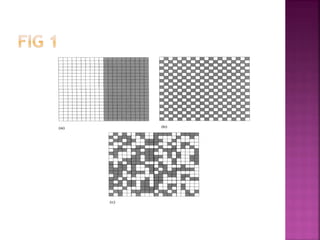
 If the components are represented by coloured
cubes:
 then a two-dimensional representation of the
initial unmixed or
 completely segregated state can be produced,
as shown in (a).
 From the definition of mixing, the ideal situation or
'perfect mix* in this case:
 would be produced when each particle lay adjacent to a
particle of the other component
 (i.e. each particle lies as closely as possible in contact
with a particle of the other component).
 This is shown in (b), where it can be seen that the
components are as evenly distributed as possible

 If this mix were viewed in three dimensions then behind
and in front of each grey particle would be a white
particle, and vice versa
 Powder mixing, however, is a 'chance' process, and
 although the situation shown in Figure (b) could
arise, the odds against it are so great that for
practical purposes it can be considered impossible
 For example, if there are only 200 particles present
the chance of a perfect mix occurring is
approximately 1 in 1060 and
 is similar to the chance of the situation in (a)
occurring after prolonged mixing
 In practice, the best type of mix likely to be obtained
will have the components under consideration
distributed as indicated in Figure (c)
 This is referred to as a random mix:
 which is defined as a mix where the probability of
selecting a particular type of particle is the same at all
positions in the mix, and
 is equal to the proportion of such particles in the total
mix
 If any two adjacent particles are selected from the random
mix shown:
 the chance of picking two grey particles = 1 in 4 (25%)
 the chance of picking two white particles = 1 in 4 (25%)
 and the chance of picking one of each = 2 in 4 (50%).
 If any two adjacent particles are selected from the perfect
mix shown, there will always be one grey and one white
particle.
 Thus if the samples taken from a random mix contain only
two particles:
 then in 25% of cases the sample will contain no white
particles and in 25% it will contain no grey particles
 Often a mixing process produces a large 'bulk' of mixture that is
subsequently subdivided into individual dose units
 e.g. a tablet, capsule or 5 mL spoonful and
 it is important that each dosage unit contains the correct
amount/concentration of active component(s)

 It is the weight/volume of the dosage unit that dictates how
closely the mix must be examined/analysed to ensure it contains
the correct dose/concentration
 This weight/volume is known as the scale of scrutiny and is the
amount of material within which the quality of mixing is important
 For example, if the unit weight of a tablet is 200 mg then:
 a 200 mg sample from the mix needs to be analysed to see if
mixing is adequate; the scale of scrutiny is therefore 200 mg.
 The number of particles in the scale of scrutiny
will depend on:
 the sample weight,
 particle size and
 particle density, and
 will increase as the sample weight increases and
the particle size and density decrease
 This number should be sufficient to ensure minimal
deviation in the required dose in the dosage forms
 Another important factor to consider when carrying out
a mixing process is:
 the proportion of the active component in the dosage
form/scale of scrutiny.
 This is illustrated in Figure 2 and in Table 1,
 the latter also demonstrating the importance of the
number of particles in the scale of scrutiny
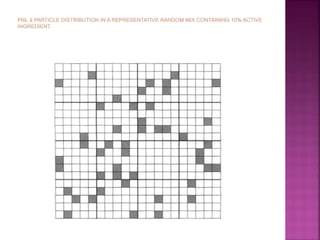
 Figure 2 shows a random mix containing only 10% grey
particles
 If the blocks of 25 particles are examined it can be seen
that the number of grey particles varies from 0 to 8, or 0-
32%
 Thus, the number of grey particles as a percentage of the
theoretical content varies from 0 to 320%
 This is considerably greater than the range of 48-152%
when the proportion of grey particles was 0.5 or 50% (Fig.
1 (c))
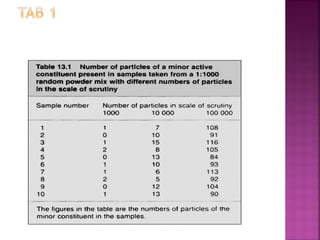
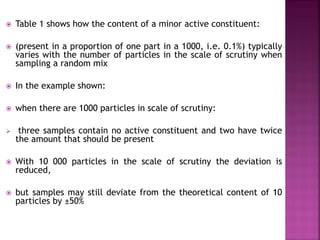
 Table 1 shows how the content of a minor active constituent:
 (present in a proportion of one part in a 1000, i.e. 0.1%) typically
varies with the number of particles in the scale of scrutiny when
sampling a random mix
 In the example shown:
 when there are 1000 particles in scale of scrutiny:
 three samples contain no active constituent and two have twice
the amount that should be present
 With 10 000 particles in the scale of scrutiny the deviation is
reduced,
 but samples may still deviate from the theoretical content of 10
particles by ±50%
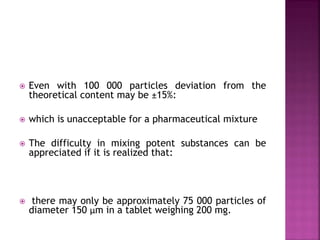
 Even with 100 000 particles deviation from the
theoretical content may be ±15%:
 which is unacceptable for a pharmaceutical mixture
 The difficulty in mixing potent substances can be
appreciated if it is realized that:
 there may only be approximately 75 000 particles of
diameter 150 µm in a tablet weighing 200 mg.
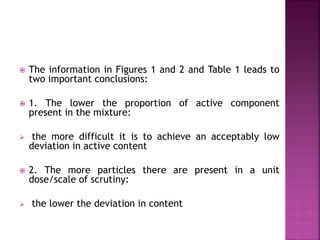
 The information in Figures 1 and 2 and Table 1 leads to
two important conclusions:
 1. The lower the proportion of active component
present in the mixture:
 the more difficult it is to achieve an acceptably low
deviation in active content
 2. The more particles there are present in a unit
dose/scale of scrutiny:
 the lower the deviation in content
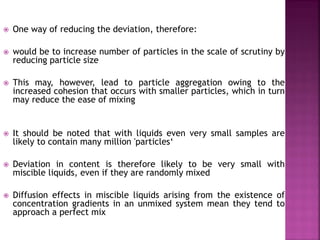
 One way of reducing the deviation, therefore:
 would be to increase number of particles in the scale of scrutiny by
reducing particle size
 This may, however, lead to particle aggregation owing to the
increased cohesion that occurs with smaller particles, which in turn
may reduce the ease of mixing
 It should be noted that with liquids even very small samples are
likely to contain many million 'particles‘
 Deviation in content is therefore likely to be very small with
miscible liquids, even if they are randomly mixed
 Diffusion effects in miscible liquids arising from the existence of
concentration gradients in an unmixed system mean they tend to
approach a perfect mix
 It must be appreciated that there will always be some
variation in the composition of samples taken from a
random mix
 The aim during formulation and processing is to minimize
this variation to acceptable levels by selecting an
appropriate:
 scale of scrutiny
 particle size and
 mixing procedure (choice of mixer, rotation speed etc)
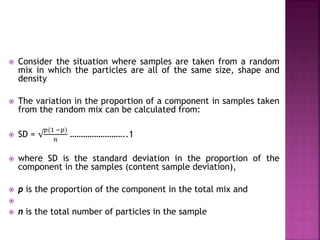
 Consider the situation where samples are taken from a random
mix in which the particles are all of the same size, shape and
density
 The variation in the proportion of a component in samples taken
from the random mix can be calculated from:
 SD = √
𝑝𝑝(1 −𝑝𝑝)
𝑛𝑛
……………………..1
 where SD is the standard deviation in the proportion of the
component in the samples (content sample deviation),
 p is the proportion of the component in the total mix and

 n is the total number of particles in the sample
 Equation 1 shows that:
 as the number of particles present in the sample
increases the content standard deviation decreases
 (i.e. there is less variation in sample content), as
illustrated previously by the data in Figure 2 and Table 1
 The situation with respect to the effect of the proportion
of the active component in the sample is not as clear
from Eqn.1.

 As p is decreased the value of the content standard
deviation decreases:
 which may lead to the incorrect conclusion that it is
beneficial to have a low proportion of the active
component
 A more useful parameter to determine is the
percentage coefficient of variation (%CV):
 which indicates the average deviation as a
percentage of the mean amount of active
component in the samples
 Thus, %CV = (content standard deviation/mean
content) x 100
 The value of %CV will increase as p decreases
 It might be considered that the variation in content could be
reduced by:
 A) increasing the sample size (scale of scrutiny)
 as this would increase the number of particles in each sample
 The dose of a drug will, however, be fixed, and any increase in the
sample size will cause a reduction in the proportion of the active
component
 The consequence of increasing the sample size depends on the
initial proportion of the active component
 If p is relatively high initially, increasing the sample size causes
the %CV in content to increase
 If p is small, increasing the sample size has little effect. Inserting
the appropriate values into Eqn. 1 can substantiate this
 A typical specification for a pharmaceutical
product is that:
 the active component should not deviate by
more than ±5% of the mean or specified content

 i.e. the acceptable deviation = p x (5/100) or p
x 0.05
 Manufacturers require some means of monitoring a
mixing process for a variety of reasons; these could
include:
 • To indicate the degree/extent of mixing
 • To follow a mixing process
 • To indicate when sufficient mixing has occurred
 • To assess the efficiency of a mixer
 • To determine the mixing time required for a
particular process.
 Many evaluation methods involve the generation of a
mixing index:
 which compares the content standard deviation of
samples taken from a mix under investigation (SACT) with
that of samples from a fully random mix (SR)
 Comparison with a random mix is made because this is
theoretically likely to be the best mix that is practically
achievable
 The simplest form of a mixing index (M) can be
calculated as:
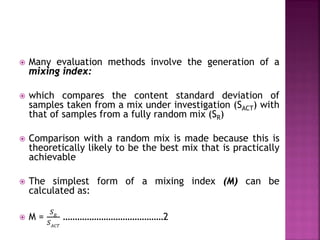
 M =
𝑆𝑆𝑅𝑅
𝑆𝑆𝐴𝐴𝐴𝐴𝐴𝐴
……………………………………2
 At the start of the mixing process the value of
SACT will be high and that for M will be low
 As mixing proceeds SACT will tend to decrease as
the mix approaches a random mix
 If the mix becomes random, SACT = SR and M = 1
 There is typically an exponential decrease in SACT
as the mixing time or number of mixer rotations
increases
 In order to evaluate a mixing process in this way there are two
basic requirements
 1) a sufficient number of samples which are representative of the
mix as a whole must be removed and analysed
 A minimum of 10 samples is usually taken, these being removed
from different depths into the mixer and from the middle and
sides
 Samples are often taken with a 'sampling thief:
 which is a device that can be inserted into the mix and samples
withdrawn with minimum disruption to the powder bed
 2) Second, a suitable analytical technique must be available so
that the value of SACT is a true reflection of the variation in
content in the samples
 and not due to variation arising from the method of analysis
 When mixing formulations where the proportion of
active component is high:
 it is possible to achieve an acceptably low variation in
content without obtaining a random mix
 Thus it may be possible to stop the mixing process
before a random mix is achieved and thereby reduce
manufacturing costs
 Equation 2 can be used to generate an estimated
acceptable standard deviation value (SE) that will allow
the product to meets its specification
 Powders
 In order that powders may be mixed, the powder particles
need to move relative to each other.
 There are three main mechanisms by which powder mixing
occurs, namely convection, shear and diffusion.
 Convective mixing arises when there is the transfer of
relatively large groups of particles from one part of the
powder bed to another:
 as might occur when a mixer blade or paddle moves
through the mix, for example.
 This type of mixing contributes mainly to the
macroscopic mixing of powder mixtures and
 tends to produce a large degree of mixing fairly
quickly (as evidenced by a rapid drop in SACT).
 Mixing does not, however, occur within the group of
particles moving together as a unit,
 and so in order to achieve a random mix an
extended mixing time is required
 Shear mixing occurs when a 'layer' of material moves/flows over
another 'layer'.
 This might be due to the removal of a mass by convective mixing
creating an unstable shear/slip plane, which causes the powder
bed to collapse
 It may also occur in high shear mixers or tumbling mixers, where
the action of the mixer induces velocity gradients within the
powder bed and hence 'shearing' of one layer over another
 In order to achieve a true random mix, movement of individual
particles is required
 This occurs with diffusive mixing
 When a powder bed is forced to move or flow it will 'dilate', i.e.
the volume occupied by the bed will increase
 This is because the powder particles will become less tightly
packed and there is an increase in the air spaces or voids between
them
 Under these circumstances there is the potential for the particles
to fall under gravity, through the voids created
 Mixing of individual particles in this way is referred to as diffusive
mixing
 Diffusive mixing, although having the potential to produce a
random mix, generally results in a low rate of mixing
 All three mixing mechanisms are likely to occur in a
mixing operation
 Which one predominates and the extent to which
each occurs will depend on:
 the mixer type,
 mixing process conditions (mixer load, speed etc.)
and
 the flowability of the powder components
 Liquids
 The three main mechanisms by which liquids are mixed are
bulk transport, turbulent mixing and molecular diffusion
 Bulk transport is analogous to the convective mixing of powders
 and involves the movement of a relatively large amount of
material from one position in the mix to another,
 e.g. due to a mixer paddle.
 It too tends to produce a large degree of mixing fairly quickly,
but leaves the liquid within the moving material unmixed
 Turbulent mixing arises from the haphazard movement of
molecules when forced to move in a turbulent manner
 The constant changes in speed and direction of movement
means that induced turbulence is a highly effective
mechanism for mixing
 Within a turbulent fluid there are, however, small groups of
molecules moving together as a unit, referred to as eddies.
 These eddies tend to reduce in size and eventually break
up, being replaced by new eddies
 Turbulent mixing alone may therefore leave small
unmixed areas within the eddies and in areas near the
container surface which will exhibit streamlined flow
 Mixing of individual molecules in these regions will occur
by the third mechanism:
 which is molecular diffusion (analogous to diffusive
mixing in powders)
 This will occur with miscible fluids wherever a
concentration gradient exists and will eventually produce
a well-mixed product:
 although considerable time may be required if this is the
only mixing mechanism
 In most mixers all three mechanisms will occur:
 bulk transport and turbulence arising from the movement
of a stirrer or mixer paddle set at a suitable speed
 Segregation is the opposite effect to mixing, i.e.
components tend to separate out
 This is very important in the preparation of pharmaceutical
products
 because if it occurs, a mix may change from being random to
being non-random, or a random mix may never be achieved
 Care must be taken to avoid segregation during handling
after powders have been mixed,
 e.g. during transfer to filling machines, or in the hopper of a
tablet/capsule/sachet-filling machine
 Segregation will cause an increase in content variation in
samples taken from the mix and
 may cause a batch to fail a uniformity of content test
 If segregation of granules occurs in the hopper of a filling
machine an unacceptable variation in weight may result
 Segregation arises because powder mixes encountered
practically are not composed of mono-sized spherical
particles:
 but contain particles that differ in size, shape and density.
 These variations mean that particles will tend to behave
differently when forced to move and hence, tend to
separate.
 Particles exhibiting similar properties tend to
congregate together:
 giving regions in the powder bed which have a
higher concentration of a particular component
 Segregation is more likely to occur, or may occur to
a greater extent, if:
 the powder bed is subjected to vibration and when
the particles have greater flowability
 Particle-size effects
 A difference in the particle sizes of components of a formulation
is the main cause of segregation in powder mixes in practice
 Smaller particles tend to fall through the voids between larger
ones and so move to the bottom of the mass

 This is known as percolation segregation
 It may occur in static powder beds if the percolating particles are
so small that they can fall into the void spaces between larger
particles,
 but occurs to a greater extent as the bed 'dilates' on being
disturbed
 Percolation can occur whenever a powder bed containing particles
of different size is disturbed in such a way that particle
rearrangement occurs,
 e.g. during vibration, stirring or pouring
 During mixing, larger particles will tend to have greater kinetic
energy imparted to them (owing to their larger mass) and
 therefore move greater distances than smaller particles before
they come to rest
 This may result in the separation of particles of different size, an
effect referred to as trajectory segregation
 During mixing, or when a material is discharged from a
container:
 very small particles ('dust') in a mix may tend to be
'blown' upwards by turbulent air currents as the mass
tumbles, and remain suspended in the air
 When the mixer is stopped or material discharge is
complete:
 these particles will sediment and subsequently form a
layer on top of the coarser particles
 This is called elutriation segregation and is also
referred to as 'dusting out'
 Particle-density effects
 If components are of different density, the more dense
material will have a tendency to move downwards even if the
particle sizes are similar
 Trajectory segregation may also occur with particles of the
same size but different densities, owing to their difference in
mass
 The effect of density on percolation segregation may be
potentiated if the more dense particles are also smaller
 Alternatively, size and density effects may cancel each other out
if the larger particles are more dense
 Often materials used in pharmaceutical formulations have similar
density values and density effects are not generally too important
 An exception to this is in fluidized beds, where density differences
are often more serious than particle size differences
 Particle-shape effects
 Spherical particles exhibit the greatest
flowability and are therefore more easily
mixed,
 but they also segregate more easily than non-
spherical particles
 Irregularly or needle-shaped particles may
become interlocked, reducing the tendency to
segregate once mixing has occurred
 Non-spherical particles will also have a greater surface area to
weight ratio (specific surface area),
 which will tend to decrease segregation by increasing any cohesive
effects, but will also increase the likelihood of‘ dusting out‘
 It should be remembered that the particle size distribution and
particle shape may change during processing and
 therefore the tendency to segregate may also change.
 Non-segregating mixes will improve with continued
increases in mixing time
 This may not, however, occur for segregating mixes,
where there is often an optimum mixing time
 This is because the factors causing segregation generally
require longer to take effect than the time needed to
produce a reasonable degree of mixing
 During the initial stages of the process the rate of mixing
is greater than the rate of demixing
 After a period of time, however, the rate of demixing may
predominate until eventually an equilibrium situation will
be reached where the two effects are balanced
 if factors exist that might cause segregation, a random mix
will not be achieved and
 there may be both an optimum mixing time and a time
range over which an acceptable mix can be produced
 If segregation is a problem with a formulation there are a
number of approaches that may be attempted to rectify
the situation
 These include:
 • Selection of particular size fractions
 (e.g. by sieving to remove fines or lumps)

 to achieve drug and excipients of the same narrow particle
size range;
 • Milling of components (size reduction) either:
 to reduce the particle size range
 (this may need to be followed by a sieving stage to remove fines)
or
 to ensure that all particles are below approximately 30 µm - at
which size segregation does not tend to cause serious problems
 • Controlled crystallization during production of the
drug/excipients to give components of a particular crystal shape
or size range;
 • Selection of excipients which have a density similar to
the active component (s);
 there is usually a range of excipients that will produce a
product with the required properties;
 • Granulation of the powder mix (size enlargement) so
that large numbers of different particles are evenly
distributed in each segregating 'unit'/granule;
 • Reduce the extent to which the powder mass is
subjected to vibration or movement after mixing;
 • Use filling machine hoppers designed so that powder
residence time is minimized;
 • Use equipment where several operations can be carried
out without transferring the mix,
 e.g. a fluidized-bed drier or a high-speed mixer/
granulator for mixing and granulating;
 • Production of an 'ordered' mix
 It would be expected that a mix comprised of very small
and much larger particles would segregate because of the
size differences
 Sometimes, however, if one powder is sufficiently small
(micronized) it may become adsorbed on to the 'active
sites' on the surface of a larger 'carrier' particle and exhibit
great resistance to being dislodged.
 This has the effect of minimizing segregation while
maintaining good flow properties
 The phenomenon is referred to as ordered mixing, as the particles
are not independent of each other and there is a degree of order
to the mix.
 If a carrier particle is removed then some of the adsorbed smaller
particles will automatically be removed with it.
 Ordered mixing has also been used in the production of dry
antibiotic formulations to which water is added before use to
form a liquid or syrup product.
 In these cases the antibiotic in fine powder form is blended with,
and adsorbed on to, the surface of larger sucrose or sorbitol
particles
 Ordered mixing probably occurs to a certain extent in every
pharmaceutical powder mix:
 owing to interactions and cohesive/adhesive forces between
constituents
 It is most likely to occur when smaller particles exist as these
have a high specific surface area and:
 so the attractive forces holding the particles to the adsorption
site are more likely to be greater than the gravitational forces
trying to separate the components
 Pharmaceutical mixes are therefore likely to be partly ordered
and partly random, the extent of each depending on the
component properties
 With an ordered mix it may be possible to achieve a degree of
mixing which is superior to that of a random mix, which may be
beneficial for potent drugs
 Ordered mixing has been shown to be important in direct
compression formulations in preventing the segregation of
drug from direct compression bases
 Dry powder inhaler formulations also use ordered mixing to
deliver drugs to the lungs
 In this case the drug needs to be in a micronized form in
order to reach its site of action
 By adsorbing the drug on to larger carrier particles (usually
lactose):
 it is possible to manufacture a product that will provide an
even dosage on each inhalation
 Although ordered mixes can reduce or prevent segregation, it
may still occur if:
 1. The carrier particles vary in size
 Different sized particles will have different surface area to
weight ratios and will contain different amounts of adsorbed
material per unit mass
 If the different-sized carrier particles separate
 (e.g. by percolation segregation),
 drug-rich areas where the smaller carrier particles congregate
may result
 This is referred to as ordered unit segregation
 2. There is competition for the active sites on the
carrier particle
 If another component competes for sites on the carrier
it may displace the original adsorbed material,
 which may then segregate owing to its small size
 This is known as displacement segregation,
 and has been shown to occur under certain
circumstances with the addition of the lubricant
magnesium stearate to tablet formulations
 3. There are insufficient carrier particles
 Each carrier particle can only accommodate a certain
amount of adsorbed material on its surface
 If there is any excess small-sized material that is not
adsorbed on to the carrier particles this may quickly
separate
 This is referred to as saturation segregation, and
 may limit the proportion of the active component that can
be used in the formulation
 With an ordered mix particles may be dislodged if the mix is
subjected to excessive vibration
 The extent to which this occurs depends on the forces of
attraction between the components and
 therefore on how tightly the adsorbed particles are attached
to the surface
 The orientation of the particles is also important:
 those protruding from the surface being more likely to be
dislodged than those lying parallel to it
 Practical considerations
 When mixing formulations where there is a relatively low
proportion of active ingredient(s):
 a more even distribution may be obtained by building up the
amount of material in the mixer sequentially
 This may be achieved by initially mixing the active component(s)
with an approximately equal volume of diluent (s)
 Further amounts of diluents, equal to the amount of material in
the mixer, can then be added and mixed,
 It may be more appropriate to pre-blend the active component
with a diluent in a smaller mixer prior to transferring it to the
main mixer
 Care must be taken to ensure that the volume of powder in the
mixer is appropriate
 both over and under-filling may significantly reduce mixing
efficiency.

 In the case of overfilling, for example, sufficient bed dilation
may not take place for diffusive mixing to occur to the required
extent
 or the material may not be able to flow in a way that enables
shear mixing to occur satisfactorily
 Similarly, underfilling may mean the powder bed does not move
in the required manner in the mixer
 or that an increased number of mixing operations may be needed
for a batch of material
 The mixer used should produce the mixing mechanisms
appropriate for the formulation
 The impact or attrition forces generated if too-high shear
forces are used:
 may, however, damage fragile material and so produce fines
 The mixer design should be such that it is dust-tight, can be
easily cleaned, and the product can be fully discharged
 These reduce the risk of cross contamination between batches
and protect the operator from the product
 In order to determine the appropriate mixing time:
 the process should be checked by removing and analysing
representative samples after different mixing intervals
 This may also indicate whether segregation is occurring in the
mixer, and whether problems occur if the mixing time is
extended
 When particles rub past each other as they move within the
mixer, static charges will be produced
 These tend to result in 'clumping' and a reduction in diffusive
mixing, and cause material to adhere to machine or container
surfaces
 To avoid this, mixers should be suitably earthed to dissipate
the static charge and
 the process should be carried out at a relative humidity
greater than approximately 40%.
 Tumbling mixers/blenders
 Tumbling mixers are commonly used for the
mixing/blending of granules or free-flowing powders
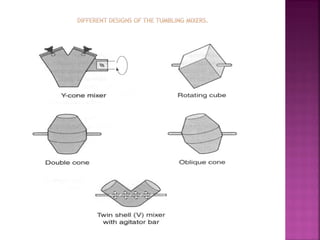
 There are many different designs of tumbling mixer
 e.g. double-cone mixers, twin-shell mixers, cube
mixers, Y-cone mixers and drum mixers
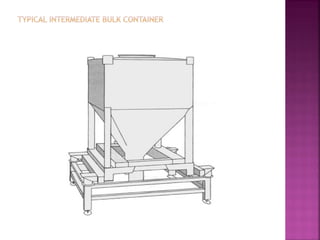
 It is now common to use intermediate bulk
containers (IBCs):
 both as the mixer bowl and to either feed the hopper
of a tablet or capsule machine or as the hopper itself
 Mixing containers are generally mounted so that they can
be rotated about an axis
 When operated at the correct speed, the tumbling action is
achieved.
 Shear mixing will occur as a velocity gradient is produced:
 the top layer moving with the greatest velocity and the
velocity decreasing as the distance from the surface
increases
 When the bed tumbles it dilates, allowing particles to move
downwards under gravity, and so diffusive mixing occurs
 Too high a rotation speed will cause the material to be held
on the mixer walls by centrifugal force,
 and too low a speed will generate insufficient bed
expansion and little shear mixing
 The addition of 'prongs', baffles or rotating bars will also
cause convective mixing,
 for example the V-mixer with agitator bar
 Tumbling mixers are available to mix from approximately 50 g,
 e.g. for laboratory-scale development work, to over 100 kg at
a production scale
 The material typically occupies about a half to two thirds of
the mixer volume.

 The rate at which the product is mixed will depend on mixer
design and rotation speed,
 as these influence the movement of the material in the mixer
 Tumbling mixers are good for free-flowing powders/granules
but poor for cohesive/poorly flowing powders,
 because the shear forces generated are usually insufficient to
break up any aggregates
 Care must also be taken if there are significant differences in
particle size present
 A common use of tumbling mixers is in the blending of
lubricants, glidants or external disintegrants with granules prior
to tableting
 Tumbling mixers can also be used to produce ordered mixes,
 although the process is often slow because of the cohesiveness
of the adsorbing particles
 High-speed mixer-granulators
 In pharmaceutical product manufacture it is often
preferable to use one piece of equipment to carry out more
than one function
 An example of this is the use of a mixer-granulator
 As the name suggests, it can both mix and granulate a
product,
 thereby removing the need to transfer the product
between pieces of equipment and so reducing the
opportunity for segregation to occur
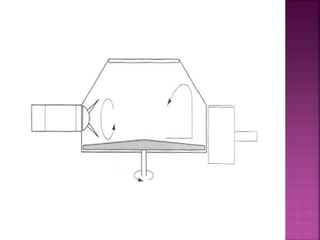
 The centrally mounted impeller blade at the bottom of the mixer
rotates at high speed,
 throwing the material towards the mixer bowl wall by centrifugal
force
 The material is then forced upwards before dropping back down
towards the centre of the mixer
 The particulate movement within the bowl tends to mix the
components quickly owing to:
 A) high shear forces (arising from the high velocity) and
 B) the expansion in bed volume that allows diffusive mixing
 Once mixed, granulating agent can be added and granules formed
in situ using a slower impeller speed and the action of the side-
mounted chopper blade
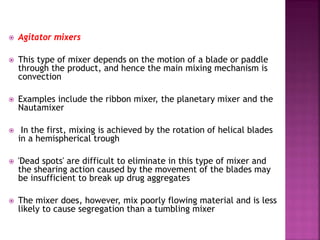
 Agitator mixers
 This type of mixer depends on the motion of a blade or paddle
through the product, and hence the main mixing mechanism is
convection
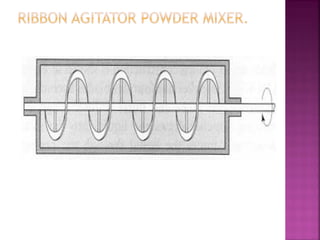
 Examples include the ribbon mixer, the planetary mixer and the
Nautamixer
 In the first, mixing is achieved by the rotation of helical blades
in a hemispherical trough
 'Dead spots' are difficult to eliminate in this type of mixer and
the shearing action caused by the movement of the blades may
be insufficient to break up drug aggregates
 The mixer does, however, mix poorly flowing material and is less
likely to cause segregation than a tumbling mixer
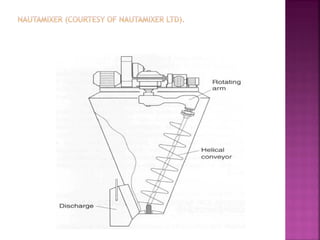
 The Nautamixer consists of a conical vessel fitted at the
base with a rotating screw, which is fastened to the end of
a rotating arm at the upper end
 The screw conveys the material to near the top, where it
cascades back into the mass
 The mixer thus combines convective mixing (as the
material is raised by the helical conveyor) and shear and
diffusive mixing (as the material cascades downwards)
 The extent of mixing achieved at a small laboratory scale during
development work may not necessarily be mirrored when the
same formulation is mixed at a full production scale, even if the
same mixer design is used for both
 Often, mixing efficiency and the extent of mixing is improved
on scale-up owing to increased shear forces
 This is likely to be beneficial in most cases, although when
blending lubricants care is needed to avoid over lubrication,
 which may for example lead to soft tablets and delayed
disintegration and dissolution
 Problems associated with a deficiency of some of the components
of a formulation have been traced to adsorption of a minor
constituents
 (e.g a drug or colourant) on to the mixer wall or mixing blade
 Drug particle characteristics may also change when the drug is
manufactured on a large scale
 This may in turn affect the movement of the particles in the
mixer or
 the interaction with other components, and hence the tendency
to mix and segregate
 The optimum mixing time and conditions should therefore be
established and validated at a production scale,
 so that the appropriate degree of mixing is obtained without
segregation, over lubrication or damage to component
particles
 Minimum and maximum mixing times that give a satisfactory
product should be determined if appropriate,
 So that the 'robustness' of the mixing process is established.
 Propeller mixers
 A common arrangement for medium-scale fluid mixing is
a propeller-type stirrer which may be clamped to the
edge of a vessel
 A propeller has angled blades, which cause the fluid to
circulate in both an axial and a radial direction
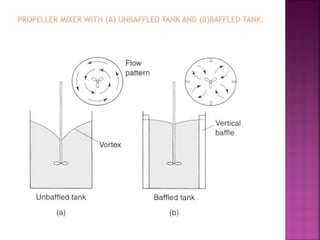
 An off-centre mounting discourages the formation of a
vortex, which may occur when the stirrer is mounted
centrally
 A vortex forms when the centrifugal force imparted to
the liquid by the propeller blades causes it to back up
around the sides of the vessel and create a depression at
the shaft
 As the speed of rotation is increased air may be sucked into the
fluid by the formation of a vortex;
 this can cause frothing and possible oxidation
 Another method of suppressing a vortex is to fit vertical baffles
into the vessel
 These divert the rotating fluid from its circular path into the
centre of the vessel, where the vortex would otherwise form
 The ratio of the diameter of a propeller stirrer to that of
the vessel is commonly 1:10-1:20,
 and it typically operates at speeds of 1-20 rps
 The propeller stirrer depends for its action on a
satisfactory axial and radial flow pattern,
 which will not occur if the fluid is sufficiently viscous
 There must be a fast flow of fluid towards the propeller,
which can only occur if the fluid is mobile
 Turbine mixers
 A turbine mixer may be used for more viscous fluids
 The impeller has four flat blades surrounded by perforated
inner and outer diffuser rings
 The rotating impeller draws the liquid into the mixer 'head'
and
 forces the liquid through the perforations with considerable
radial velocity,
 sufficient to overcome the viscous drag of the bulk of the
fluid.
 One drawback is the absence of an axial component, but a
different head with the perforations pointing upwards can be
fitted if this is desired
 As the liquid is forced through the small orifices of the diffuser
rings at high velocity large shear forces are produced
 When mixing immiscible liquids, if the orifices are sufficiently
small and velocity sufficiently high,
 the shear forces produced enable the generation of droplets of
the dispersed phase which are small enough to produce stable
dispersions (water-in-oil or oil-in-water)
 Turbine mixers of this type are therefore often fitted to vessels
used for the large-scale production of emulsions and creams
 Turbine-type mixes will not cope with liquids of very high
viscosity, as the material will not be drawn into the mixer head
 These liquids are best treated as semisolids and handled in the
same equipment as used for such materials.
 Inline mixers
 As an alternative to mixing fluids in batches in vessels,
 mobile miscible components may be fed through an
'inline' mixer designed to create turbulence in a flowing
fluid stream
 In this case a continuous mixing process is possible
 The problems that arise during the mixing of semisolids
(ointments and pastes):
 stem from the fact that, unlike powders and liquids, semisolids
will not flow easily
 Material that finds its way to 'dead' spots will remain there
 For this reason, suitable mixers must have rotating elements
with narrow clearances between themselves and the mixing
vessel wall

 and they must produce a high degree of shear mixing, as
diffusion and convection cannot occur
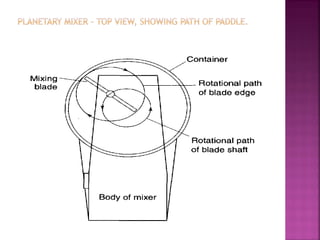
 Planetary mixers
 This type of mixer is commonly found in the domestic kitchen
(e.g. Kenwood-type mixers)
 larger machines which operate on the same principle are used
in industry
 The mixing blade is set off-centre and is carried on a rotating
arm
 It therefore travels round the circumference of the mixing
bowl while simultaneously rotating around its own axis
 A small clearance between the vessel and the paddle gives
shear,
 but 'scraping down' several times is necessary to mix the
contents well as some materials are forced to the top of the
bowl
 Planetary mixers are also sometimes used to mix powders,
 particularly if a wet mass for granulation is required
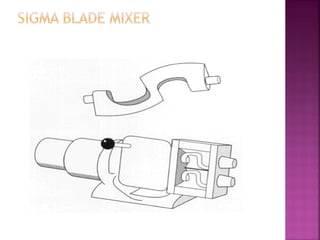
 Sigma-blade mixer
 This robust mixer will deal with stiff pastes
and ointments and depends for its action on:
 the close intermeshing of the two blades
which resemble the Greek letter in shape
 It is very difficult using primary mixers to completely
disperse powder particles in a semisolid base so that they
are invisible to the eye
 The mix is usually subjected to the further action of a roller
mill or colloid mill,
 so as to 'rub out' these particles by the intense shear
generated by rollers or cones set with a very small clearance
between them
 Define the following terms:
[Mixing, separation, difusion, etc]
Respond to the following questions:
Give a detailed account of ………………
Explain in details the process of …………..
Describe in details with examples the…………
With examples, illustrate the pharmaceutical applications of ……………
Group work discussional questions:
Explain in details the process of………
Describe with examples in details the…………..
With examples, illustrate the pharmaceutical applications of…….

15 mixing

  • 3.
     The importanceof mixing  There are very few pharmaceutical products that contain only one component  In the vast majority of cases several ingredients are needed so that the required dosage form functions as required  If, for example, a pharmaceutical company wishes to produce a tablet dosage form:  containing a drug which is active at a dose of 1 mg, other components (e.g. diluents, binders, disintegrants and lubricants)  Mixing will be needed both to enable the product to be manufactured and for it to be handled by the patient  Whenever a product contains more than one component a mixing or blending stage will be required in the manufacturing process
  • 4.
     This maybe in order:  to ensure an even distribution of the active component(s)  to ensure an even appearance, or  to ensure that the dosage form releases the drug at the correct site and at the desired rate  The unit operation of mixing is therefore involved at some stage in the production of practically every pharmaceutical preparation
  • 5.
     This isillustrated by the list of products that invariably utilize mixing processes of some kind:  • Tablets, capsules, sachets and dry powder inhalers  - mixtures of solid particles (powder mixing)  • Linctuses - mixtures of miscible liquids  • Emulsions and creams - mixtures of immiscible liquids  • Pastes and suspensions - dispersions of solid particles
  • 6.
     Mixing maybe defined as:  a unit operation that aims to treat two or more components, initially in an unmixed or partially mixed state:  so that each unit (particle, molecule etc.) of the components lies as nearly as possible in contact with a unit of each of the other components  If this is achieved it produces a theoretical 'ideal‘ situation, i.e. a perfect mix  This situation is not normally practicable, is frequently unnecessary and is sometimes undesirable  (e.g. mixing of lubricants with tablet granules)
  • 7.
     How closelyit is attempted to approach the 'ideal‘ situation depends on:  1) the product being manufactured and  2) the objective of the mixing operation  For example, if a small amount of a potent drug is being mixed in a powder:  then the degree of mixing must be of a high order to ensure a consistent dose
  • 8.
     Similarly, whendispersing two immiscible liquids, or dispersing a solid in a liquid:  a well-mixed product is required to ensure product stability  In the case of mixing lubricants during tablet production, however:  there is a danger of over-mixing and the subsequent production of a weak tablet with an increased disintegration time
  • 9.
     Mixtures maybe categorized into three types  Positive mixtures  Positive mixtures are formed from materials such as gases or miscible liquids:  which mix spontaneously and irreversibly by diffusion, and tend to approach a perfect mix  There is no input of energy required with positive mixtures if the time available for mixing is unlimited  although energy input will shorten the time required to obtain the desired degree of mixing  In general materials that mix by positive mixing present no problems during product manufacture
  • 10.
     Negative mixtures With negative mixtures the components will tend to separate out  If this occurs quickly, then energy must be continuously input to keep the components adequately dispersed  e.g. with a suspension formulation, such as calamine lotion, where there is a dispersion of solids in a liquid of low viscosity  With other negative mixtures the components tend to separate very slowly, e.g. emulsions, creams and viscous suspensions  Negative mixtures are generally more difficult to form and maintain and require a higher degree of mixing efficiency than do positive mixtures
  • 11.
     Neutral mixtures Neutral mixtures are said to be static in behaviour  i.e. the components have no tendency to mix spontaneously or segregate spontaneously once work has been input to mix them  Examples of this type of mixture include mixed powders, pastes and ointments  It should be noted that the type of mixture might change during processing  For example, if the viscosity increases the mixture may change from a negative to a neutral mixture  Similarly, if the particle size, degree of wetting or liquid surface tension changes the mixture type may also change
  • 12.
     If thecomponents are represented by coloured cubes:  then a two-dimensional representation of the initial unmixed or  completely segregated state can be produced, as shown in (a).
  • 14.
     From thedefinition of mixing, the ideal situation or 'perfect mix* in this case:  would be produced when each particle lay adjacent to a particle of the other component  (i.e. each particle lies as closely as possible in contact with a particle of the other component).  This is shown in (b), where it can be seen that the components are as evenly distributed as possible   If this mix were viewed in three dimensions then behind and in front of each grey particle would be a white particle, and vice versa
  • 15.
     Powder mixing,however, is a 'chance' process, and  although the situation shown in Figure (b) could arise, the odds against it are so great that for practical purposes it can be considered impossible  For example, if there are only 200 particles present the chance of a perfect mix occurring is approximately 1 in 1060 and  is similar to the chance of the situation in (a) occurring after prolonged mixing
  • 16.
     In practice,the best type of mix likely to be obtained will have the components under consideration distributed as indicated in Figure (c)  This is referred to as a random mix:  which is defined as a mix where the probability of selecting a particular type of particle is the same at all positions in the mix, and  is equal to the proportion of such particles in the total mix
  • 17.
     If anytwo adjacent particles are selected from the random mix shown:  the chance of picking two grey particles = 1 in 4 (25%)  the chance of picking two white particles = 1 in 4 (25%)  and the chance of picking one of each = 2 in 4 (50%).  If any two adjacent particles are selected from the perfect mix shown, there will always be one grey and one white particle.  Thus if the samples taken from a random mix contain only two particles:  then in 25% of cases the sample will contain no white particles and in 25% it will contain no grey particles
  • 18.
     Often amixing process produces a large 'bulk' of mixture that is subsequently subdivided into individual dose units  e.g. a tablet, capsule or 5 mL spoonful and  it is important that each dosage unit contains the correct amount/concentration of active component(s)   It is the weight/volume of the dosage unit that dictates how closely the mix must be examined/analysed to ensure it contains the correct dose/concentration  This weight/volume is known as the scale of scrutiny and is the amount of material within which the quality of mixing is important  For example, if the unit weight of a tablet is 200 mg then:  a 200 mg sample from the mix needs to be analysed to see if mixing is adequate; the scale of scrutiny is therefore 200 mg.
  • 19.
     The numberof particles in the scale of scrutiny will depend on:  the sample weight,  particle size and  particle density, and  will increase as the sample weight increases and the particle size and density decrease
  • 20.
     This numbershould be sufficient to ensure minimal deviation in the required dose in the dosage forms  Another important factor to consider when carrying out a mixing process is:  the proportion of the active component in the dosage form/scale of scrutiny.  This is illustrated in Figure 2 and in Table 1,  the latter also demonstrating the importance of the number of particles in the scale of scrutiny
  • 22.
     Figure 2shows a random mix containing only 10% grey particles  If the blocks of 25 particles are examined it can be seen that the number of grey particles varies from 0 to 8, or 0- 32%  Thus, the number of grey particles as a percentage of the theoretical content varies from 0 to 320%  This is considerably greater than the range of 48-152% when the proportion of grey particles was 0.5 or 50% (Fig. 1 (c))
  • 24.
     Table 1shows how the content of a minor active constituent:  (present in a proportion of one part in a 1000, i.e. 0.1%) typically varies with the number of particles in the scale of scrutiny when sampling a random mix  In the example shown:  when there are 1000 particles in scale of scrutiny:  three samples contain no active constituent and two have twice the amount that should be present  With 10 000 particles in the scale of scrutiny the deviation is reduced,  but samples may still deviate from the theoretical content of 10 particles by ±50%
  • 25.
     Even with100 000 particles deviation from the theoretical content may be ±15%:  which is unacceptable for a pharmaceutical mixture  The difficulty in mixing potent substances can be appreciated if it is realized that:  there may only be approximately 75 000 particles of diameter 150 µm in a tablet weighing 200 mg.
  • 26.
     The informationin Figures 1 and 2 and Table 1 leads to two important conclusions:  1. The lower the proportion of active component present in the mixture:  the more difficult it is to achieve an acceptably low deviation in active content  2. The more particles there are present in a unit dose/scale of scrutiny:  the lower the deviation in content
  • 27.
     One wayof reducing the deviation, therefore:  would be to increase number of particles in the scale of scrutiny by reducing particle size  This may, however, lead to particle aggregation owing to the increased cohesion that occurs with smaller particles, which in turn may reduce the ease of mixing  It should be noted that with liquids even very small samples are likely to contain many million 'particles‘  Deviation in content is therefore likely to be very small with miscible liquids, even if they are randomly mixed  Diffusion effects in miscible liquids arising from the existence of concentration gradients in an unmixed system mean they tend to approach a perfect mix
  • 28.
     It mustbe appreciated that there will always be some variation in the composition of samples taken from a random mix  The aim during formulation and processing is to minimize this variation to acceptable levels by selecting an appropriate:  scale of scrutiny  particle size and  mixing procedure (choice of mixer, rotation speed etc)
  • 29.
     Consider thesituation where samples are taken from a random mix in which the particles are all of the same size, shape and density  The variation in the proportion of a component in samples taken from the random mix can be calculated from:  SD = √ 𝑝𝑝(1 −𝑝𝑝) 𝑛𝑛 ……………………..1  where SD is the standard deviation in the proportion of the component in the samples (content sample deviation),  p is the proportion of the component in the total mix and   n is the total number of particles in the sample
  • 30.
     Equation 1shows that:  as the number of particles present in the sample increases the content standard deviation decreases  (i.e. there is less variation in sample content), as illustrated previously by the data in Figure 2 and Table 1  The situation with respect to the effect of the proportion of the active component in the sample is not as clear from Eqn.1.   As p is decreased the value of the content standard deviation decreases:  which may lead to the incorrect conclusion that it is beneficial to have a low proportion of the active component
  • 31.
     A moreuseful parameter to determine is the percentage coefficient of variation (%CV):  which indicates the average deviation as a percentage of the mean amount of active component in the samples  Thus, %CV = (content standard deviation/mean content) x 100  The value of %CV will increase as p decreases
  • 32.
     It mightbe considered that the variation in content could be reduced by:  A) increasing the sample size (scale of scrutiny)  as this would increase the number of particles in each sample  The dose of a drug will, however, be fixed, and any increase in the sample size will cause a reduction in the proportion of the active component  The consequence of increasing the sample size depends on the initial proportion of the active component  If p is relatively high initially, increasing the sample size causes the %CV in content to increase  If p is small, increasing the sample size has little effect. Inserting the appropriate values into Eqn. 1 can substantiate this
  • 33.
     A typicalspecification for a pharmaceutical product is that:  the active component should not deviate by more than ±5% of the mean or specified content   i.e. the acceptable deviation = p x (5/100) or p x 0.05
  • 34.
     Manufacturers requiresome means of monitoring a mixing process for a variety of reasons; these could include:  • To indicate the degree/extent of mixing  • To follow a mixing process  • To indicate when sufficient mixing has occurred  • To assess the efficiency of a mixer  • To determine the mixing time required for a particular process.
  • 35.
     Many evaluationmethods involve the generation of a mixing index:  which compares the content standard deviation of samples taken from a mix under investigation (SACT) with that of samples from a fully random mix (SR)  Comparison with a random mix is made because this is theoretically likely to be the best mix that is practically achievable  The simplest form of a mixing index (M) can be calculated as:  M = 𝑆𝑆𝑅𝑅 𝑆𝑆𝐴𝐴𝐴𝐴𝐴𝐴 ……………………………………2
  • 36.
     At thestart of the mixing process the value of SACT will be high and that for M will be low  As mixing proceeds SACT will tend to decrease as the mix approaches a random mix  If the mix becomes random, SACT = SR and M = 1  There is typically an exponential decrease in SACT as the mixing time or number of mixer rotations increases
  • 37.
     In orderto evaluate a mixing process in this way there are two basic requirements  1) a sufficient number of samples which are representative of the mix as a whole must be removed and analysed  A minimum of 10 samples is usually taken, these being removed from different depths into the mixer and from the middle and sides  Samples are often taken with a 'sampling thief:  which is a device that can be inserted into the mix and samples withdrawn with minimum disruption to the powder bed  2) Second, a suitable analytical technique must be available so that the value of SACT is a true reflection of the variation in content in the samples  and not due to variation arising from the method of analysis
  • 38.
     When mixingformulations where the proportion of active component is high:  it is possible to achieve an acceptably low variation in content without obtaining a random mix  Thus it may be possible to stop the mixing process before a random mix is achieved and thereby reduce manufacturing costs  Equation 2 can be used to generate an estimated acceptable standard deviation value (SE) that will allow the product to meets its specification
  • 39.
     Powders  Inorder that powders may be mixed, the powder particles need to move relative to each other.  There are three main mechanisms by which powder mixing occurs, namely convection, shear and diffusion.  Convective mixing arises when there is the transfer of relatively large groups of particles from one part of the powder bed to another:  as might occur when a mixer blade or paddle moves through the mix, for example.
  • 40.
     This typeof mixing contributes mainly to the macroscopic mixing of powder mixtures and  tends to produce a large degree of mixing fairly quickly (as evidenced by a rapid drop in SACT).  Mixing does not, however, occur within the group of particles moving together as a unit,  and so in order to achieve a random mix an extended mixing time is required
  • 41.
     Shear mixingoccurs when a 'layer' of material moves/flows over another 'layer'.  This might be due to the removal of a mass by convective mixing creating an unstable shear/slip plane, which causes the powder bed to collapse  It may also occur in high shear mixers or tumbling mixers, where the action of the mixer induces velocity gradients within the powder bed and hence 'shearing' of one layer over another  In order to achieve a true random mix, movement of individual particles is required  This occurs with diffusive mixing
  • 42.
     When apowder bed is forced to move or flow it will 'dilate', i.e. the volume occupied by the bed will increase  This is because the powder particles will become less tightly packed and there is an increase in the air spaces or voids between them  Under these circumstances there is the potential for the particles to fall under gravity, through the voids created  Mixing of individual particles in this way is referred to as diffusive mixing  Diffusive mixing, although having the potential to produce a random mix, generally results in a low rate of mixing
  • 43.
     All threemixing mechanisms are likely to occur in a mixing operation  Which one predominates and the extent to which each occurs will depend on:  the mixer type,  mixing process conditions (mixer load, speed etc.) and  the flowability of the powder components
  • 44.
     Liquids  Thethree main mechanisms by which liquids are mixed are bulk transport, turbulent mixing and molecular diffusion  Bulk transport is analogous to the convective mixing of powders  and involves the movement of a relatively large amount of material from one position in the mix to another,  e.g. due to a mixer paddle.  It too tends to produce a large degree of mixing fairly quickly, but leaves the liquid within the moving material unmixed
  • 45.
     Turbulent mixingarises from the haphazard movement of molecules when forced to move in a turbulent manner  The constant changes in speed and direction of movement means that induced turbulence is a highly effective mechanism for mixing  Within a turbulent fluid there are, however, small groups of molecules moving together as a unit, referred to as eddies.
  • 46.
     These eddiestend to reduce in size and eventually break up, being replaced by new eddies  Turbulent mixing alone may therefore leave small unmixed areas within the eddies and in areas near the container surface which will exhibit streamlined flow  Mixing of individual molecules in these regions will occur by the third mechanism:  which is molecular diffusion (analogous to diffusive mixing in powders)
  • 47.
     This willoccur with miscible fluids wherever a concentration gradient exists and will eventually produce a well-mixed product:  although considerable time may be required if this is the only mixing mechanism  In most mixers all three mechanisms will occur:  bulk transport and turbulence arising from the movement of a stirrer or mixer paddle set at a suitable speed
  • 48.
     Segregation isthe opposite effect to mixing, i.e. components tend to separate out  This is very important in the preparation of pharmaceutical products  because if it occurs, a mix may change from being random to being non-random, or a random mix may never be achieved  Care must be taken to avoid segregation during handling after powders have been mixed,  e.g. during transfer to filling machines, or in the hopper of a tablet/capsule/sachet-filling machine
  • 49.
     Segregation willcause an increase in content variation in samples taken from the mix and  may cause a batch to fail a uniformity of content test  If segregation of granules occurs in the hopper of a filling machine an unacceptable variation in weight may result  Segregation arises because powder mixes encountered practically are not composed of mono-sized spherical particles:  but contain particles that differ in size, shape and density.  These variations mean that particles will tend to behave differently when forced to move and hence, tend to separate.
  • 50.
     Particles exhibitingsimilar properties tend to congregate together:  giving regions in the powder bed which have a higher concentration of a particular component  Segregation is more likely to occur, or may occur to a greater extent, if:  the powder bed is subjected to vibration and when the particles have greater flowability
  • 51.
     Particle-size effects A difference in the particle sizes of components of a formulation is the main cause of segregation in powder mixes in practice  Smaller particles tend to fall through the voids between larger ones and so move to the bottom of the mass   This is known as percolation segregation  It may occur in static powder beds if the percolating particles are so small that they can fall into the void spaces between larger particles,  but occurs to a greater extent as the bed 'dilates' on being disturbed
  • 52.
     Percolation canoccur whenever a powder bed containing particles of different size is disturbed in such a way that particle rearrangement occurs,  e.g. during vibration, stirring or pouring  During mixing, larger particles will tend to have greater kinetic energy imparted to them (owing to their larger mass) and  therefore move greater distances than smaller particles before they come to rest  This may result in the separation of particles of different size, an effect referred to as trajectory segregation
  • 53.
     During mixing,or when a material is discharged from a container:  very small particles ('dust') in a mix may tend to be 'blown' upwards by turbulent air currents as the mass tumbles, and remain suspended in the air  When the mixer is stopped or material discharge is complete:  these particles will sediment and subsequently form a layer on top of the coarser particles  This is called elutriation segregation and is also referred to as 'dusting out'
  • 54.
     Particle-density effects If components are of different density, the more dense material will have a tendency to move downwards even if the particle sizes are similar  Trajectory segregation may also occur with particles of the same size but different densities, owing to their difference in mass  The effect of density on percolation segregation may be potentiated if the more dense particles are also smaller
  • 55.
     Alternatively, sizeand density effects may cancel each other out if the larger particles are more dense  Often materials used in pharmaceutical formulations have similar density values and density effects are not generally too important  An exception to this is in fluidized beds, where density differences are often more serious than particle size differences
  • 56.
     Particle-shape effects Spherical particles exhibit the greatest flowability and are therefore more easily mixed,  but they also segregate more easily than non- spherical particles  Irregularly or needle-shaped particles may become interlocked, reducing the tendency to segregate once mixing has occurred
  • 57.
     Non-spherical particleswill also have a greater surface area to weight ratio (specific surface area),  which will tend to decrease segregation by increasing any cohesive effects, but will also increase the likelihood of‘ dusting out‘  It should be remembered that the particle size distribution and particle shape may change during processing and  therefore the tendency to segregate may also change.
  • 58.
     Non-segregating mixeswill improve with continued increases in mixing time  This may not, however, occur for segregating mixes, where there is often an optimum mixing time  This is because the factors causing segregation generally require longer to take effect than the time needed to produce a reasonable degree of mixing  During the initial stages of the process the rate of mixing is greater than the rate of demixing
  • 59.
     After aperiod of time, however, the rate of demixing may predominate until eventually an equilibrium situation will be reached where the two effects are balanced  if factors exist that might cause segregation, a random mix will not be achieved and  there may be both an optimum mixing time and a time range over which an acceptable mix can be produced
  • 60.
     If segregationis a problem with a formulation there are a number of approaches that may be attempted to rectify the situation  These include:  • Selection of particular size fractions  (e.g. by sieving to remove fines or lumps)   to achieve drug and excipients of the same narrow particle size range;
  • 61.
     • Millingof components (size reduction) either:  to reduce the particle size range  (this may need to be followed by a sieving stage to remove fines) or  to ensure that all particles are below approximately 30 µm - at which size segregation does not tend to cause serious problems  • Controlled crystallization during production of the drug/excipients to give components of a particular crystal shape or size range;
  • 62.
     • Selectionof excipients which have a density similar to the active component (s);  there is usually a range of excipients that will produce a product with the required properties;  • Granulation of the powder mix (size enlargement) so that large numbers of different particles are evenly distributed in each segregating 'unit'/granule;  • Reduce the extent to which the powder mass is subjected to vibration or movement after mixing;
  • 63.
     • Usefilling machine hoppers designed so that powder residence time is minimized;  • Use equipment where several operations can be carried out without transferring the mix,  e.g. a fluidized-bed drier or a high-speed mixer/ granulator for mixing and granulating;  • Production of an 'ordered' mix
  • 64.
     It wouldbe expected that a mix comprised of very small and much larger particles would segregate because of the size differences  Sometimes, however, if one powder is sufficiently small (micronized) it may become adsorbed on to the 'active sites' on the surface of a larger 'carrier' particle and exhibit great resistance to being dislodged.  This has the effect of minimizing segregation while maintaining good flow properties
  • 65.
     The phenomenonis referred to as ordered mixing, as the particles are not independent of each other and there is a degree of order to the mix.  If a carrier particle is removed then some of the adsorbed smaller particles will automatically be removed with it.  Ordered mixing has also been used in the production of dry antibiotic formulations to which water is added before use to form a liquid or syrup product.  In these cases the antibiotic in fine powder form is blended with, and adsorbed on to, the surface of larger sucrose or sorbitol particles
  • 66.
     Ordered mixingprobably occurs to a certain extent in every pharmaceutical powder mix:  owing to interactions and cohesive/adhesive forces between constituents  It is most likely to occur when smaller particles exist as these have a high specific surface area and:  so the attractive forces holding the particles to the adsorption site are more likely to be greater than the gravitational forces trying to separate the components  Pharmaceutical mixes are therefore likely to be partly ordered and partly random, the extent of each depending on the component properties  With an ordered mix it may be possible to achieve a degree of mixing which is superior to that of a random mix, which may be beneficial for potent drugs
  • 67.
     Ordered mixinghas been shown to be important in direct compression formulations in preventing the segregation of drug from direct compression bases  Dry powder inhaler formulations also use ordered mixing to deliver drugs to the lungs  In this case the drug needs to be in a micronized form in order to reach its site of action  By adsorbing the drug on to larger carrier particles (usually lactose):  it is possible to manufacture a product that will provide an even dosage on each inhalation
  • 68.
     Although orderedmixes can reduce or prevent segregation, it may still occur if:  1. The carrier particles vary in size  Different sized particles will have different surface area to weight ratios and will contain different amounts of adsorbed material per unit mass  If the different-sized carrier particles separate  (e.g. by percolation segregation),  drug-rich areas where the smaller carrier particles congregate may result  This is referred to as ordered unit segregation
  • 69.
     2. Thereis competition for the active sites on the carrier particle  If another component competes for sites on the carrier it may displace the original adsorbed material,  which may then segregate owing to its small size  This is known as displacement segregation,  and has been shown to occur under certain circumstances with the addition of the lubricant magnesium stearate to tablet formulations
  • 70.
     3. Thereare insufficient carrier particles  Each carrier particle can only accommodate a certain amount of adsorbed material on its surface  If there is any excess small-sized material that is not adsorbed on to the carrier particles this may quickly separate  This is referred to as saturation segregation, and  may limit the proportion of the active component that can be used in the formulation
  • 71.
     With anordered mix particles may be dislodged if the mix is subjected to excessive vibration  The extent to which this occurs depends on the forces of attraction between the components and  therefore on how tightly the adsorbed particles are attached to the surface  The orientation of the particles is also important:  those protruding from the surface being more likely to be dislodged than those lying parallel to it
  • 72.
     Practical considerations When mixing formulations where there is a relatively low proportion of active ingredient(s):  a more even distribution may be obtained by building up the amount of material in the mixer sequentially  This may be achieved by initially mixing the active component(s) with an approximately equal volume of diluent (s)  Further amounts of diluents, equal to the amount of material in the mixer, can then be added and mixed,  It may be more appropriate to pre-blend the active component with a diluent in a smaller mixer prior to transferring it to the main mixer
  • 73.
     Care mustbe taken to ensure that the volume of powder in the mixer is appropriate  both over and under-filling may significantly reduce mixing efficiency.   In the case of overfilling, for example, sufficient bed dilation may not take place for diffusive mixing to occur to the required extent  or the material may not be able to flow in a way that enables shear mixing to occur satisfactorily  Similarly, underfilling may mean the powder bed does not move in the required manner in the mixer  or that an increased number of mixing operations may be needed for a batch of material
  • 74.
     The mixerused should produce the mixing mechanisms appropriate for the formulation  The impact or attrition forces generated if too-high shear forces are used:  may, however, damage fragile material and so produce fines  The mixer design should be such that it is dust-tight, can be easily cleaned, and the product can be fully discharged  These reduce the risk of cross contamination between batches and protect the operator from the product
  • 75.
     In orderto determine the appropriate mixing time:  the process should be checked by removing and analysing representative samples after different mixing intervals  This may also indicate whether segregation is occurring in the mixer, and whether problems occur if the mixing time is extended  When particles rub past each other as they move within the mixer, static charges will be produced  These tend to result in 'clumping' and a reduction in diffusive mixing, and cause material to adhere to machine or container surfaces  To avoid this, mixers should be suitably earthed to dissipate the static charge and  the process should be carried out at a relative humidity greater than approximately 40%.
  • 76.
     Tumbling mixers/blenders Tumbling mixers are commonly used for the mixing/blending of granules or free-flowing powders  There are many different designs of tumbling mixer  e.g. double-cone mixers, twin-shell mixers, cube mixers, Y-cone mixers and drum mixers
  • 78.
     It isnow common to use intermediate bulk containers (IBCs):  both as the mixer bowl and to either feed the hopper of a tablet or capsule machine or as the hopper itself
  • 80.
     Mixing containersare generally mounted so that they can be rotated about an axis  When operated at the correct speed, the tumbling action is achieved.  Shear mixing will occur as a velocity gradient is produced:  the top layer moving with the greatest velocity and the velocity decreasing as the distance from the surface increases  When the bed tumbles it dilates, allowing particles to move downwards under gravity, and so diffusive mixing occurs
  • 81.
     Too higha rotation speed will cause the material to be held on the mixer walls by centrifugal force,  and too low a speed will generate insufficient bed expansion and little shear mixing  The addition of 'prongs', baffles or rotating bars will also cause convective mixing,  for example the V-mixer with agitator bar
  • 82.
     Tumbling mixersare available to mix from approximately 50 g,  e.g. for laboratory-scale development work, to over 100 kg at a production scale  The material typically occupies about a half to two thirds of the mixer volume.   The rate at which the product is mixed will depend on mixer design and rotation speed,  as these influence the movement of the material in the mixer  Tumbling mixers are good for free-flowing powders/granules but poor for cohesive/poorly flowing powders,  because the shear forces generated are usually insufficient to break up any aggregates
  • 83.
     Care mustalso be taken if there are significant differences in particle size present  A common use of tumbling mixers is in the blending of lubricants, glidants or external disintegrants with granules prior to tableting  Tumbling mixers can also be used to produce ordered mixes,  although the process is often slow because of the cohesiveness of the adsorbing particles
  • 84.
     High-speed mixer-granulators In pharmaceutical product manufacture it is often preferable to use one piece of equipment to carry out more than one function  An example of this is the use of a mixer-granulator  As the name suggests, it can both mix and granulate a product,  thereby removing the need to transfer the product between pieces of equipment and so reducing the opportunity for segregation to occur
  • 86.
     The centrallymounted impeller blade at the bottom of the mixer rotates at high speed,  throwing the material towards the mixer bowl wall by centrifugal force  The material is then forced upwards before dropping back down towards the centre of the mixer  The particulate movement within the bowl tends to mix the components quickly owing to:  A) high shear forces (arising from the high velocity) and  B) the expansion in bed volume that allows diffusive mixing  Once mixed, granulating agent can be added and granules formed in situ using a slower impeller speed and the action of the side- mounted chopper blade
  • 87.
     Agitator mixers This type of mixer depends on the motion of a blade or paddle through the product, and hence the main mixing mechanism is convection  Examples include the ribbon mixer, the planetary mixer and the Nautamixer  In the first, mixing is achieved by the rotation of helical blades in a hemispherical trough  'Dead spots' are difficult to eliminate in this type of mixer and the shearing action caused by the movement of the blades may be insufficient to break up drug aggregates  The mixer does, however, mix poorly flowing material and is less likely to cause segregation than a tumbling mixer
  • 90.
     The Nautamixerconsists of a conical vessel fitted at the base with a rotating screw, which is fastened to the end of a rotating arm at the upper end  The screw conveys the material to near the top, where it cascades back into the mass  The mixer thus combines convective mixing (as the material is raised by the helical conveyor) and shear and diffusive mixing (as the material cascades downwards)
  • 92.
     The extentof mixing achieved at a small laboratory scale during development work may not necessarily be mirrored when the same formulation is mixed at a full production scale, even if the same mixer design is used for both  Often, mixing efficiency and the extent of mixing is improved on scale-up owing to increased shear forces  This is likely to be beneficial in most cases, although when blending lubricants care is needed to avoid over lubrication,  which may for example lead to soft tablets and delayed disintegration and dissolution
  • 93.
     Problems associatedwith a deficiency of some of the components of a formulation have been traced to adsorption of a minor constituents  (e.g a drug or colourant) on to the mixer wall or mixing blade  Drug particle characteristics may also change when the drug is manufactured on a large scale  This may in turn affect the movement of the particles in the mixer or  the interaction with other components, and hence the tendency to mix and segregate
  • 94.
     The optimummixing time and conditions should therefore be established and validated at a production scale,  so that the appropriate degree of mixing is obtained without segregation, over lubrication or damage to component particles  Minimum and maximum mixing times that give a satisfactory product should be determined if appropriate,  So that the 'robustness' of the mixing process is established.
  • 95.
     Propeller mixers A common arrangement for medium-scale fluid mixing is a propeller-type stirrer which may be clamped to the edge of a vessel  A propeller has angled blades, which cause the fluid to circulate in both an axial and a radial direction  An off-centre mounting discourages the formation of a vortex, which may occur when the stirrer is mounted centrally  A vortex forms when the centrifugal force imparted to the liquid by the propeller blades causes it to back up around the sides of the vessel and create a depression at the shaft
  • 96.
     As thespeed of rotation is increased air may be sucked into the fluid by the formation of a vortex;  this can cause frothing and possible oxidation  Another method of suppressing a vortex is to fit vertical baffles into the vessel  These divert the rotating fluid from its circular path into the centre of the vessel, where the vortex would otherwise form
  • 98.
     The ratioof the diameter of a propeller stirrer to that of the vessel is commonly 1:10-1:20,  and it typically operates at speeds of 1-20 rps  The propeller stirrer depends for its action on a satisfactory axial and radial flow pattern,  which will not occur if the fluid is sufficiently viscous  There must be a fast flow of fluid towards the propeller, which can only occur if the fluid is mobile
  • 99.
     Turbine mixers A turbine mixer may be used for more viscous fluids  The impeller has four flat blades surrounded by perforated inner and outer diffuser rings  The rotating impeller draws the liquid into the mixer 'head' and  forces the liquid through the perforations with considerable radial velocity,  sufficient to overcome the viscous drag of the bulk of the fluid.  One drawback is the absence of an axial component, but a different head with the perforations pointing upwards can be fitted if this is desired
  • 100.
     As theliquid is forced through the small orifices of the diffuser rings at high velocity large shear forces are produced  When mixing immiscible liquids, if the orifices are sufficiently small and velocity sufficiently high,  the shear forces produced enable the generation of droplets of the dispersed phase which are small enough to produce stable dispersions (water-in-oil or oil-in-water)  Turbine mixers of this type are therefore often fitted to vessels used for the large-scale production of emulsions and creams  Turbine-type mixes will not cope with liquids of very high viscosity, as the material will not be drawn into the mixer head  These liquids are best treated as semisolids and handled in the same equipment as used for such materials.
  • 101.
     Inline mixers As an alternative to mixing fluids in batches in vessels,  mobile miscible components may be fed through an 'inline' mixer designed to create turbulence in a flowing fluid stream  In this case a continuous mixing process is possible
  • 102.
     The problemsthat arise during the mixing of semisolids (ointments and pastes):  stem from the fact that, unlike powders and liquids, semisolids will not flow easily  Material that finds its way to 'dead' spots will remain there  For this reason, suitable mixers must have rotating elements with narrow clearances between themselves and the mixing vessel wall   and they must produce a high degree of shear mixing, as diffusion and convection cannot occur
  • 103.
     Planetary mixers This type of mixer is commonly found in the domestic kitchen (e.g. Kenwood-type mixers)  larger machines which operate on the same principle are used in industry  The mixing blade is set off-centre and is carried on a rotating arm  It therefore travels round the circumference of the mixing bowl while simultaneously rotating around its own axis
  • 104.
     A smallclearance between the vessel and the paddle gives shear,  but 'scraping down' several times is necessary to mix the contents well as some materials are forced to the top of the bowl  Planetary mixers are also sometimes used to mix powders,  particularly if a wet mass for granulation is required
  • 105.
     Sigma-blade mixer This robust mixer will deal with stiff pastes and ointments and depends for its action on:  the close intermeshing of the two blades which resemble the Greek letter in shape
  • 107.
     It isvery difficult using primary mixers to completely disperse powder particles in a semisolid base so that they are invisible to the eye  The mix is usually subjected to the further action of a roller mill or colloid mill,  so as to 'rub out' these particles by the intense shear generated by rollers or cones set with a very small clearance between them
  • 110.
     Define thefollowing terms: [Mixing, separation, difusion, etc] Respond to the following questions: Give a detailed account of ……………… Explain in details the process of ………….. Describe in details with examples the………… With examples, illustrate the pharmaceutical applications of ……………
  • 111.
    Group work discussionalquestions: Explain in details the process of……… Describe with examples in details the………….. With examples, illustrate the pharmaceutical applications of…….