T. Reshma
Assistant Professor
Department of Pharmaceutical Quality Assurance
Raghavendra Institute of Pharmaceutical Education and Research
DISTILLATION
ā– Distillation is defined as the separation of the components of a liquid mixture
by a process involving vaporization and subsequent condensation.
Definition:
Applications:
• Separation of volatile oils
• Separation of drugs obtained from plant and animal sources
• Purification of organic solvents
• Purification of drugs obtained from chemical process
• Refining of petroleum products
• Recovery of solvents
Types of Distillation Process
1. Simple Distillation
2. Fractional Distillation
3. Steam Distillation
4. Vacuum Distillation or Distillation under reduced pressure
SIMPLE DISTILLATION
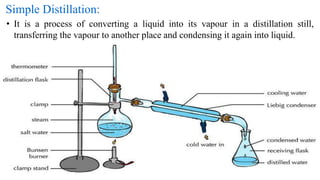
Simple Distillation:
• It is a process of converting a liquid into its vapour in a distillation still,
transferring the vapour to another place and condensing it again into liquid.
Construction:
• It consists of a distillation flask with a side arm sloping downwards.
• Condenser is fitted into the side arm by means of a cork.
• The condenser is usually water condenser, i.e., jacketed for circulation of water.
• The condenser is connected to a receiver flask using an adapter with ground
glass joints.
Working:
• The liquid to be distilled is filled into the flask to one-half to two-third of its
volume. Bumping is avoided by adding small pieces of porcelain before
distillation.
• A thermometer is inserted into the cork and fixed to the flask. The thermometer
bulb must be just below the level of the side arm.
• Water is circulated through the jacket of the condenser. The contents are heated
gradually.
• The liquid begins to boil after some time. The vapour begins to rise up and
passes down the side arm into the condenser.
• The temperature of the distillate is noted down, which is equal to the boiling
point of the liquid. The vapour is condensed and collected into the receiver.
Applications:
• For the preparation of distilled water and water for injection.
• Volatile and aromatic waters are prepared.
• Organic solvents are purified.
• A few official compounds are prepared by distillation.
āž¢ Examples: Spirit of nitrous ether and Aromatic spirit of ammonia.
• Non-volatile solids are separated from volatile liquids.
FRACTIONAL DISTILLATION
Fractional Distillation:
• This method is also known as rectification, because a part of the vapour is
condensed and returned as a liquid.
• This method is used to separate miscible volatile liquids, whose boiling points
are close, by means of a fractionating column.
• In fractional distillation the vapour must pass through a fractionating column
in which partial condensation of vapour is allowed to occur.
• By condensing the vapour and reheating the liquid repeatedly, equilibrium
between liquid and vapour is set up at each stage, which ultimately results in
the separation of a more volatile component.
Applications:
• Fractional distillation is used for the separation of volatile miscible liquids with
near boiling point such as:
āž¢Acetone and water
āž¢Chloroform and benzene
• And also used in the manufacture of Alcohol.
STEAM DISTILLATION
Steam Distillation:
• When two immiscible liquids are heated together, then the mixture boils when
the sum of the vapour pressure equals to the atmospheric pressure.
• The temperatures which the mixture boils remains stationary until one of the
liquids has been completely removed from the still.
Construction:
• Steam generator fitted with a cork having two holes.
• Through one of the holes passes bent tube leading the steam to the flask
containing the non-aqueous liquid and this tube is connected to the bottom of
flask.
• Another long tube which passes through the other hole reaches almost the
bottom of the steam generator and acts as safety tube.
• The delivery tube carrying vapours from the flask is connected to the
condenser to convert it into liquid which gets collected in the receiver.
• The steam and heat is simultaneously produced, process is continued and
distillate in collected in a Florentine where oil and water gets separated.
Applications:
• It is used for the preparation of volatile oils
• It is used to determine the percentage of volatile oil in the drug.
VACUUM DISTILLATION
Vacuum Distillation or Distillation under reduced pressure:
ā– Liquid boils when its vapour pressure is equal to the atmospheric pressure. The
boiling point of the liquid may be lowered to the desired temperature by
reducing the pressure on its surface.
Construction:
• It consists of a double-neck distillation flask known as "Claisen flask’.
• One neck is fitted to thermometer and in the second neck a capillary tube is
fitted which prevents bumping of the heated liquid.
• Thick walled glass apparatus with inter-changeable standard glass joints are
used for vacuum distillation.
• The Claisen flask is connected to a receiver through condenser.
• Vacuum pump is attached to the receiver to attain the desired degree of
vacuum.
Applications:
• It is used for the concentration of extracts containing thermolabile
• It is used for separating substances which undergo decomposition when heated
under normal atmospheric pressure.
VACCUM STILL
Vacuum Still:
• Liquid boils when vapour pressure is equal to the atmospheric pressure, i.e.,
pressure on its surface. If the external pressure is reduced by applying vacuum,
the boiling point of liquid is lowered.
• Therefore, the liquid boils at a lower temperature.
• And it is used in the large scale production.
• A vacuum still is generally made of stainless steel or any other metal which can
withstand a high vacuum.
• vacuum still is filled by attaching a pipe to a tap water in the lower part of the
equipment.
• The other end of the pipe dips into the liquid to be distilled so that it can be
drawn into the still.
• An observation window is very helpful to the operator to see the progress of
distillation and also the level of the content of the liquid to be distilled.
• Two receivers are generally attached to the condenser in order to collect the
distillate without stopping distillation. However, they may be used alternately by
a suitable arrangement of the cocks.
Construction & Working:
Applications:
• Distillation of substances that have a high boiling point at atmospheric pressure.
• Distillation of thermolabile substances that get damaged by a high
temperature.
• Removal of the last traces of a volatile solvent.
Preparation of purified water and water
for injection (WFI)
Purified Water:
• Purified water is the water which is free from volatile and non-volatile
impurities is called as ā€œpurified waterā€.
• It does not contain any added substances.
• It is liable to get contaminated by micro-organisms. Hence, purified water
should not be used in preparations meant for parenteral administration.
Water for Injection (WFI):
• WFI is the water which is free from volatile and non-volatile impurities, micro-
organisms and pyrogens is called as ā€œwater for injectionā€.
• It does not contain added substance.
• It need not to be sterile but it should comply with the test for pyrogen.
• WFI is stored in tightly closed neutral glass container.
Preparation methods as per Indian Pharmacopoeia:
1.Distillation:
2. Reverse Osmosis:
āž¢ Reverse Osmosis is one of the process of water purification technology that
uses a semipermeable membrane to remove ions, molecules and larger
particles from drinking water.
3. Ion-Exchange method:
āž¢ In this microporous exchange resin is used , which is supersaturated.
This is usually done with sulfonated polystyrene beds which
supersaturated with sodium.
āž¢ As water passes through this resin bed, ions attach to the resin beads
releasing the loosely held solution into the water. After a time, the beds
become saturated and the exchange resin must be regenerated.
āž¢ To regenerate, the ion exchange resin is flushed with a salt brine
solution. The sodium ions in the salt brine solution are exchanged with
the ions, which are flushed out with wastewater.
Preparation of purified water and water for injection (WFI)
by Distillation
• The portable water is used for the preparation of purified water. But it contains
āž¢ Dissolved gases such as carbon-dioxide and ammonia.
āž¢Dissolved solids and salts.
• This can be avoided by taking the following precautions:
1. By heating the feed water which removes the dissolved gas. Because the
solubility of gases decreased as the temperature increased and which separated
by the process of filtration.
2. A constant level device is attached to the boiler to avoid excess concentration of
salts.
Distillation unit for preparation:
• It consists of a boiler which is made up of
cast iron.
• This boiler is connected to a condenser and
baffles, these are made up of stainless steel.
• Baffles are used to avoid the mixing of
vapour and water drops, and also avoid the
carry-over of pyrogen and water soluble
materials into the droplets.
• The top of the condenser jacket is open. So
that, the gases from the water can be easily
escaped into the atmosphere.
• And a constant level device is fitted in such
a way that only the heat water free from
gases enters the boiler.
THANK YOU..!

Distillation main

  • 1.
    T. Reshma Assistant Professor Departmentof Pharmaceutical Quality Assurance Raghavendra Institute of Pharmaceutical Education and Research DISTILLATION
  • 2.
    ā– Distillation isdefined as the separation of the components of a liquid mixture by a process involving vaporization and subsequent condensation. Definition: Applications: • Separation of volatile oils • Separation of drugs obtained from plant and animal sources • Purification of organic solvents • Purification of drugs obtained from chemical process • Refining of petroleum products • Recovery of solvents
  • 3.
    Types of DistillationProcess 1. Simple Distillation 2. Fractional Distillation 3. Steam Distillation 4. Vacuum Distillation or Distillation under reduced pressure
  • 4.
  • 5.
    Simple Distillation: • Itis a process of converting a liquid into its vapour in a distillation still, transferring the vapour to another place and condensing it again into liquid.
  • 6.
    Construction: • It consistsof a distillation flask with a side arm sloping downwards. • Condenser is fitted into the side arm by means of a cork. • The condenser is usually water condenser, i.e., jacketed for circulation of water. • The condenser is connected to a receiver flask using an adapter with ground glass joints.
  • 7.
    Working: • The liquidto be distilled is filled into the flask to one-half to two-third of its volume. Bumping is avoided by adding small pieces of porcelain before distillation. • A thermometer is inserted into the cork and fixed to the flask. The thermometer bulb must be just below the level of the side arm. • Water is circulated through the jacket of the condenser. The contents are heated gradually. • The liquid begins to boil after some time. The vapour begins to rise up and passes down the side arm into the condenser. • The temperature of the distillate is noted down, which is equal to the boiling point of the liquid. The vapour is condensed and collected into the receiver.
  • 8.
    Applications: • For thepreparation of distilled water and water for injection. • Volatile and aromatic waters are prepared. • Organic solvents are purified. • A few official compounds are prepared by distillation. āž¢ Examples: Spirit of nitrous ether and Aromatic spirit of ammonia. • Non-volatile solids are separated from volatile liquids.
  • 9.
  • 10.
    Fractional Distillation: • Thismethod is also known as rectification, because a part of the vapour is condensed and returned as a liquid. • This method is used to separate miscible volatile liquids, whose boiling points are close, by means of a fractionating column. • In fractional distillation the vapour must pass through a fractionating column in which partial condensation of vapour is allowed to occur. • By condensing the vapour and reheating the liquid repeatedly, equilibrium between liquid and vapour is set up at each stage, which ultimately results in the separation of a more volatile component.
  • 12.
    Applications: • Fractional distillationis used for the separation of volatile miscible liquids with near boiling point such as: āž¢Acetone and water āž¢Chloroform and benzene • And also used in the manufacture of Alcohol.
  • 13.
  • 14.
    Steam Distillation: • Whentwo immiscible liquids are heated together, then the mixture boils when the sum of the vapour pressure equals to the atmospheric pressure. • The temperatures which the mixture boils remains stationary until one of the liquids has been completely removed from the still.
  • 15.
    Construction: • Steam generatorfitted with a cork having two holes. • Through one of the holes passes bent tube leading the steam to the flask containing the non-aqueous liquid and this tube is connected to the bottom of flask. • Another long tube which passes through the other hole reaches almost the bottom of the steam generator and acts as safety tube. • The delivery tube carrying vapours from the flask is connected to the condenser to convert it into liquid which gets collected in the receiver. • The steam and heat is simultaneously produced, process is continued and distillate in collected in a Florentine where oil and water gets separated.
  • 16.
    Applications: • It isused for the preparation of volatile oils • It is used to determine the percentage of volatile oil in the drug.
  • 17.
  • 18.
    Vacuum Distillation orDistillation under reduced pressure: ā– Liquid boils when its vapour pressure is equal to the atmospheric pressure. The boiling point of the liquid may be lowered to the desired temperature by reducing the pressure on its surface. Construction: • It consists of a double-neck distillation flask known as "Claisen flask’. • One neck is fitted to thermometer and in the second neck a capillary tube is fitted which prevents bumping of the heated liquid. • Thick walled glass apparatus with inter-changeable standard glass joints are used for vacuum distillation. • The Claisen flask is connected to a receiver through condenser. • Vacuum pump is attached to the receiver to attain the desired degree of vacuum.
  • 19.
    Applications: • It isused for the concentration of extracts containing thermolabile • It is used for separating substances which undergo decomposition when heated under normal atmospheric pressure.
  • 20.
  • 21.
    Vacuum Still: • Liquidboils when vapour pressure is equal to the atmospheric pressure, i.e., pressure on its surface. If the external pressure is reduced by applying vacuum, the boiling point of liquid is lowered. • Therefore, the liquid boils at a lower temperature. • And it is used in the large scale production.
  • 22.
    • A vacuumstill is generally made of stainless steel or any other metal which can withstand a high vacuum. • vacuum still is filled by attaching a pipe to a tap water in the lower part of the equipment. • The other end of the pipe dips into the liquid to be distilled so that it can be drawn into the still. • An observation window is very helpful to the operator to see the progress of distillation and also the level of the content of the liquid to be distilled. • Two receivers are generally attached to the condenser in order to collect the distillate without stopping distillation. However, they may be used alternately by a suitable arrangement of the cocks. Construction & Working:
  • 23.
    Applications: • Distillation ofsubstances that have a high boiling point at atmospheric pressure. • Distillation of thermolabile substances that get damaged by a high temperature. • Removal of the last traces of a volatile solvent.
  • 25.
    Preparation of purifiedwater and water for injection (WFI)
  • 26.
    Purified Water: • Purifiedwater is the water which is free from volatile and non-volatile impurities is called as ā€œpurified waterā€. • It does not contain any added substances. • It is liable to get contaminated by micro-organisms. Hence, purified water should not be used in preparations meant for parenteral administration. Water for Injection (WFI): • WFI is the water which is free from volatile and non-volatile impurities, micro- organisms and pyrogens is called as ā€œwater for injectionā€. • It does not contain added substance. • It need not to be sterile but it should comply with the test for pyrogen. • WFI is stored in tightly closed neutral glass container.
  • 27.
    Preparation methods asper Indian Pharmacopoeia: 1.Distillation: 2. Reverse Osmosis: āž¢ Reverse Osmosis is one of the process of water purification technology that uses a semipermeable membrane to remove ions, molecules and larger particles from drinking water. 3. Ion-Exchange method: āž¢ In this microporous exchange resin is used , which is supersaturated. This is usually done with sulfonated polystyrene beds which supersaturated with sodium. āž¢ As water passes through this resin bed, ions attach to the resin beads releasing the loosely held solution into the water. After a time, the beds become saturated and the exchange resin must be regenerated. āž¢ To regenerate, the ion exchange resin is flushed with a salt brine solution. The sodium ions in the salt brine solution are exchanged with the ions, which are flushed out with wastewater.
  • 28.
    Preparation of purifiedwater and water for injection (WFI) by Distillation • The portable water is used for the preparation of purified water. But it contains āž¢ Dissolved gases such as carbon-dioxide and ammonia. āž¢Dissolved solids and salts. • This can be avoided by taking the following precautions: 1. By heating the feed water which removes the dissolved gas. Because the solubility of gases decreased as the temperature increased and which separated by the process of filtration. 2. A constant level device is attached to the boiler to avoid excess concentration of salts.
  • 29.
    Distillation unit forpreparation: • It consists of a boiler which is made up of cast iron. • This boiler is connected to a condenser and baffles, these are made up of stainless steel. • Baffles are used to avoid the mixing of vapour and water drops, and also avoid the carry-over of pyrogen and water soluble materials into the droplets. • The top of the condenser jacket is open. So that, the gases from the water can be easily escaped into the atmosphere. • And a constant level device is fitted in such a way that only the heat water free from gases enters the boiler.
  • 30.