PHARMACEUTICAL ENGINEERING
B. Pharma
3rd Semester
Unit -4
Presented by – Nikita Gupta
( Assistant Professor )
Chapter - 9
Filtration
Syllabus
• Filtration
• Objective
• Application
• Theories
• Factors influencing filtration
• Filter media
Principle , construction , working , uses , merits and
demerits of –
• Plate & frame filter
• Filter leaf
• Rotary drum filter
• Meta filter
• Cartridge filter
• Membrane filters
• Seidtz filter.
It is a solid-liquid separation process in which
the liquid passes through a porous medium to
remove as much fine suspended solids as
possible.
Objective
Separating solids from liquids and gases is the main goal of
filtration.
It also includes:
• To remove contaminant particles from dispersing fluid so that
it can be recovered .
• By removing the dispersing fluid, solid particles can be
recovered.
• Solvents and solids must be of high quality Particulates can be
removed from the air to enable pharmaceutically useful gases
to be purified .
• It is used to sterilize parenteral thermolabile products.
Applications:-
• In water treatment plants, a polishing step to
remove small flocs and other particles that are
not removed in settling.
• During filtration; Water containing suspended
matter is applied to the top of the filter bed.
• As the water filters through the porous medium,
the suspended matter in the fluid is removed by
a variety of mechanisms.
Mechanism
1. Mechanical Straining –
• Simplest action during filtration.
• Suspended particles having size more than that of filter voids are
arrested and removed, when water passes through filter media.
2. Sedimentation –
• Finer particles are arrested by sedimentation.
• All colloids are removed by this action.
3. Biological Action –
• After few days of working of filter, upper grains of sand
layer becomes coated with a reddish brown coloured sticky
deposit.
• It consists of organic matter and Fe, Mg, Al and silica.
• Further after 2-3 weeks, a film consisting of algae and
protozoa etc is developed.
• Organic impurities in water are used as food by this film,
thus removing the organic matter from water.
4. Electrolytic Action
• Particulate matter is removed by electrostatic action.
• Charge on filter medium neutralizes charge on floc particles,
thereby permitting the floc to be removed.
• During back washing the electrostatically removed material
is removed and thus charge on filter material is replaced
Filter media - Filter media are the portion of a
filtering system that separates unwanted particles from
the substance being filtered.
The type of material used as a filter medium is dependant
upon the material being filtered.
Theories of filtration –
• The flow of liquid through a filter follows the basic rules that
flow of any liquid through the medium offering resistance.
• The rate of flow may be expressed as -
Rate = driving force / resistance
• The rate of filtration may be expressed as volume (litres) per
unit time (dv/dt).
• Driving force = pressure upstream – pressure downstream
• Resistance is not constant. It increases with an increase in the
deposition of solids on the filter medium.
• The rate of flow will be greatest at the beginning of filtration process,
since the resistance is minimum. After forming of filter cake, its
surface acts as filter medium
• Powder or granule bed visualized as a bundle of capillaries
Poiseullie's Equation - Poiseullie considered that filtration is similar to
the streamline flow of liquid under pressure through capillaries.
Poiseullie's Equation is-
Where, V = rate of flow,
P= Pressure difference across the filter,
r = radius of capillary in the filter bed,
L = thickness of filter cake (capillary length),
n= viscosity of filtrate
Darcy's Equation –
Where, K = permeability coefficient of cake
A = surface area of porous bed (filter medium)
Kozeny-Carman equation –
Where, έ = porosity of cake (bed)
S= specific surface area of particles comprising the cake
K= Kozeny constant
Factors influencing filtration
• Thickness of filter cake - The thickness of the filter cake
affects the rate of flow of filtrate through it.
• Particle size of solids - Larger particle sizes will generally
increase filtration rate. The filtration rate is high when average
particles are small and the distribution range is narrow.
• Flocculation/dispersion of fine solids - The
flocculation of fine solids in slurries that are poorly
filtered or are dispersed is generally desirable.
• Agitation speed - If possible, the agitation (or
stirring) should be increased to a point where fine
and coarse particles are thoroughly mixed. When the
speed is too high, cake thickness may be limited,
Plate & frame filter
Principle - A surface filtration mechanism is used in
this filter.
As the slurry flows through the filter medium, it
enters the frame under pressure.
Upon entering the outlet, the filtrate collects on the
plates.
It is possible to process large volumes of sludge
simultaneously without or with washing by using
multiple frames and plates to increase surface area.
Filter leaf
The filter leaf is the simplest form of filter, consisting of a
frame that encloses a drainage screen or grooved plate and
the whole unit being covered with a filter cloth.
The outlet for the filtrate connects to the inside of the frame.
The frame used may be circular, square, or rectangular in
shape.
There are two types of filter leaf namely; vertical and
horizontal.
Rotary drum filter
Principle - Continuous slurry and cake processing is a
accomplished using Rotary Vacuum Drum Filters.
A half-submerged drum lies in a tank of slurry.
While the drum rotates, the vacuum pulls the liquid through the
industrial filter, trapping the solids on the surface and creating
the cake.
As the drum moves through the sludge, the cake thickens.
By spraying water, air, and leftover liquor through the
drum section into piping and a vacuum receiver when
it emerges from the slurry tank, spray bars wash the
cake.
The drying zone is entered when the rotating vacuum
drum filter begins to revolve toward the ceiling.
The vacuum in the drum continues to suck air through
the cake, further dewatering it.
Meta filter
Principle - For particle separation, the Meta filter acts as a strainer
(service filtration).
The metal rings are made up of semi-circular projections that are
nested together to form channels on the edges.
This channel resists the passage of solids (it acts as a strainer)
(forced particles).
The transparent liquid is gathered from the top into a receiver.
Cartridge filter
Principle - The main principle of this filter is physical filtration.
These systems work by pushing water from the reservoir into the
cylinder.
A cylinder collects the larger debris, and the secondary filter catches
anything that the first one may have missed.
The water passes through the polyester filters, and dirt gets stuck on
the screen, allowing clean water to pass by.
The liquid to be filtered is imported, and clear liquid flows to the
discharge port.
Membrane filters
Principle - Membrane filters are thin layers of semi-permeable
materials that separate chemicals when they are subjected to a
driving force. The membrane works by separating substances
physically. Biological filters are used to remove bacteria,
microorganisms, particulates, and organic material from water,
producing by-products of disinfection that impart color, odor,
taste, and smell to the water.
Seitz filter –
• The filtering medium consists of a pad of
compressed asbestos.
• To fill the slurry with one upper part.
• A curved section at the bottom receives the
filtrate.
Chapter - 10
Centrifugation
Syllabus
• Centrifugation
• Objectives
• Principle
• Application of centrifugation
• Principles , construction , working , uses ,
merits and demerits of –
• Perforated basket centrifuge
• Non – perforated basket centrifuge ,
• Semi continuous centrifuge
• Super centrifuge
Centrifugation is a technique of separating
substances which involves the application of
centrifugal force.
The particles are separated from a solution
according to their size, shape, density, the
viscosity of the medium and rotor speed.
Principal of centrifugation –
• In a solution, particles whose density is higher than that of
the solvent sink (sediment), and particles that are lighter than
it floats to the top.
• The greater the difference in density, the faster they move.
• If there is no difference in density (isopycnic conditions), the
particles stay steady.
• To take advantage of even tiny differences in density to
separate various particles in a solution, gravity can be
replaced with the much more powerful "centrifugal force"
provided by a centrifuge.
• A centrifuge is a piece of equipment that puts an object in
rotation around a fixed axis (spins it in a circle), applying a
potentially strong force perpendicular to the axis of spin
(outward).
• The centrifuge works using the sedimentation principle,
where the centripetal acceleration causes denser substances
and particles to move outward in the radial direction.
• At the same time, objects that are less dense are displaced
and move to the center.
Applications of Centrifugation-
• To separate two miscible substances.
• To analyze the hydrodynamic properties of macromolecules
• Purification of mammalian cells.
• Fractionation of subcellular organelles (including
membranes/membrane fractions).
• Fractionation of membrane vesicles.
• Separating chalk powder from water Removing fat from milk
to produce skimmed milk.
• Separating particles from an airflow using cyclonic separation
• The clarification and stabilization of wine.
• Separation of urine components and blood components in
forensic and research laboratories.
• Aids in the separation of proteins using purification techniques
such as salting out, e.g. ammonium sulfate
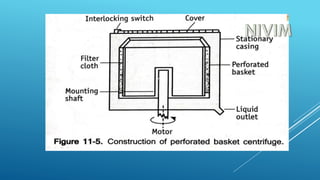
Perforated Basket Centrifuge –
Principle –
• The centrifuge is used for filtration.
• The perforated wall separates solids from liquids based on
the difference in densities.
• In the bowl, there are perforations along the sides.
• The perforated wall allows liquid to pass, while solids are
caught in the bowl during the liquid phase.
• The solid sediment is removed from the centrifuge
sediment after the machine stops.
Non-perforated Basket Centrifuge
Principle –
• There is no perforated or porous medium present in this
sedimentation centrifuge, so separation takes place
according to differences in densities between the samples.
• Solids settle at the side of the basket during centrifugation,
while liquids settle at the top of the basket where they are
collected by a skimming tube.
Semi Continuous Centrifuge –
• Short cycle batch centrifuges are also known as automatic
batch centrifuges.
• Filtration centrifuges are used for filtration.
• A perforated wall achieves separation by using the difference
in densities of solids and liquids.
• A perforated sidewall is present in the bowl.
• As the liquid phase travels through the wall of the bowl
during centrifugation, the solid phase is retained.
• The solid is cut away using blades.
Super Centrifuge –
The sedimentation centrifuge separates liquids based on their
densities when using immiscible liquids.
The centrifuge bowl is used for centrifugation.
In centrifugation, the heavier liquids are thrown against the
walls, while the lighter liquids remain as inner layers.
A modified wier is used to separate the two layers
simultaneously.
Thank You
Stay Connected with NIVIM…

Pharmaceutical Engineering Unit -4.pptx

  • 1.
    PHARMACEUTICAL ENGINEERING B. Pharma 3rdSemester Unit -4 Presented by – Nikita Gupta ( Assistant Professor )
  • 2.
  • 3.
    Syllabus • Filtration • Objective •Application • Theories • Factors influencing filtration • Filter media
  • 4.
    Principle , construction, working , uses , merits and demerits of – • Plate & frame filter • Filter leaf • Rotary drum filter • Meta filter • Cartridge filter • Membrane filters • Seidtz filter.
  • 5.
    It is asolid-liquid separation process in which the liquid passes through a porous medium to remove as much fine suspended solids as possible.
  • 6.
    Objective Separating solids fromliquids and gases is the main goal of filtration. It also includes: • To remove contaminant particles from dispersing fluid so that it can be recovered . • By removing the dispersing fluid, solid particles can be recovered. • Solvents and solids must be of high quality Particulates can be removed from the air to enable pharmaceutically useful gases to be purified . • It is used to sterilize parenteral thermolabile products.
  • 7.
    Applications:- • In watertreatment plants, a polishing step to remove small flocs and other particles that are not removed in settling. • During filtration; Water containing suspended matter is applied to the top of the filter bed. • As the water filters through the porous medium, the suspended matter in the fluid is removed by a variety of mechanisms.
  • 8.
    Mechanism 1. Mechanical Straining– • Simplest action during filtration. • Suspended particles having size more than that of filter voids are arrested and removed, when water passes through filter media. 2. Sedimentation – • Finer particles are arrested by sedimentation. • All colloids are removed by this action.
  • 9.
    3. Biological Action– • After few days of working of filter, upper grains of sand layer becomes coated with a reddish brown coloured sticky deposit. • It consists of organic matter and Fe, Mg, Al and silica. • Further after 2-3 weeks, a film consisting of algae and protozoa etc is developed. • Organic impurities in water are used as food by this film, thus removing the organic matter from water.
  • 10.
    4. Electrolytic Action •Particulate matter is removed by electrostatic action. • Charge on filter medium neutralizes charge on floc particles, thereby permitting the floc to be removed. • During back washing the electrostatically removed material is removed and thus charge on filter material is replaced
  • 11.
    Filter media -Filter media are the portion of a filtering system that separates unwanted particles from the substance being filtered. The type of material used as a filter medium is dependant upon the material being filtered.
  • 12.
    Theories of filtration– • The flow of liquid through a filter follows the basic rules that flow of any liquid through the medium offering resistance. • The rate of flow may be expressed as - Rate = driving force / resistance • The rate of filtration may be expressed as volume (litres) per unit time (dv/dt). • Driving force = pressure upstream – pressure downstream
  • 13.
    • Resistance isnot constant. It increases with an increase in the deposition of solids on the filter medium. • The rate of flow will be greatest at the beginning of filtration process, since the resistance is minimum. After forming of filter cake, its surface acts as filter medium • Powder or granule bed visualized as a bundle of capillaries
  • 14.
    Poiseullie's Equation -Poiseullie considered that filtration is similar to the streamline flow of liquid under pressure through capillaries. Poiseullie's Equation is- Where, V = rate of flow, P= Pressure difference across the filter, r = radius of capillary in the filter bed, L = thickness of filter cake (capillary length), n= viscosity of filtrate
  • 15.
    Darcy's Equation – Where,K = permeability coefficient of cake A = surface area of porous bed (filter medium) Kozeny-Carman equation – Where, έ = porosity of cake (bed) S= specific surface area of particles comprising the cake K= Kozeny constant
  • 16.
    Factors influencing filtration •Thickness of filter cake - The thickness of the filter cake affects the rate of flow of filtrate through it. • Particle size of solids - Larger particle sizes will generally increase filtration rate. The filtration rate is high when average particles are small and the distribution range is narrow.
  • 17.
    • Flocculation/dispersion offine solids - The flocculation of fine solids in slurries that are poorly filtered or are dispersed is generally desirable. • Agitation speed - If possible, the agitation (or stirring) should be increased to a point where fine and coarse particles are thoroughly mixed. When the speed is too high, cake thickness may be limited,
  • 18.
    Plate & framefilter Principle - A surface filtration mechanism is used in this filter. As the slurry flows through the filter medium, it enters the frame under pressure. Upon entering the outlet, the filtrate collects on the plates. It is possible to process large volumes of sludge simultaneously without or with washing by using multiple frames and plates to increase surface area.
  • 20.
    Filter leaf The filterleaf is the simplest form of filter, consisting of a frame that encloses a drainage screen or grooved plate and the whole unit being covered with a filter cloth. The outlet for the filtrate connects to the inside of the frame. The frame used may be circular, square, or rectangular in shape. There are two types of filter leaf namely; vertical and horizontal.
  • 22.
    Rotary drum filter Principle- Continuous slurry and cake processing is a accomplished using Rotary Vacuum Drum Filters. A half-submerged drum lies in a tank of slurry. While the drum rotates, the vacuum pulls the liquid through the industrial filter, trapping the solids on the surface and creating the cake. As the drum moves through the sludge, the cake thickens.
  • 23.
    By spraying water,air, and leftover liquor through the drum section into piping and a vacuum receiver when it emerges from the slurry tank, spray bars wash the cake. The drying zone is entered when the rotating vacuum drum filter begins to revolve toward the ceiling. The vacuum in the drum continues to suck air through the cake, further dewatering it.
  • 25.
    Meta filter Principle -For particle separation, the Meta filter acts as a strainer (service filtration). The metal rings are made up of semi-circular projections that are nested together to form channels on the edges. This channel resists the passage of solids (it acts as a strainer) (forced particles). The transparent liquid is gathered from the top into a receiver.
  • 27.
    Cartridge filter Principle -The main principle of this filter is physical filtration. These systems work by pushing water from the reservoir into the cylinder. A cylinder collects the larger debris, and the secondary filter catches anything that the first one may have missed. The water passes through the polyester filters, and dirt gets stuck on the screen, allowing clean water to pass by. The liquid to be filtered is imported, and clear liquid flows to the discharge port.
  • 29.
    Membrane filters Principle -Membrane filters are thin layers of semi-permeable materials that separate chemicals when they are subjected to a driving force. The membrane works by separating substances physically. Biological filters are used to remove bacteria, microorganisms, particulates, and organic material from water, producing by-products of disinfection that impart color, odor, taste, and smell to the water.
  • 31.
    Seitz filter – •The filtering medium consists of a pad of compressed asbestos. • To fill the slurry with one upper part. • A curved section at the bottom receives the filtrate.
  • 33.
  • 34.
    Syllabus • Centrifugation • Objectives •Principle • Application of centrifugation • Principles , construction , working , uses , merits and demerits of – • Perforated basket centrifuge • Non – perforated basket centrifuge , • Semi continuous centrifuge • Super centrifuge
  • 35.
    Centrifugation is atechnique of separating substances which involves the application of centrifugal force. The particles are separated from a solution according to their size, shape, density, the viscosity of the medium and rotor speed.
  • 36.
    Principal of centrifugation– • In a solution, particles whose density is higher than that of the solvent sink (sediment), and particles that are lighter than it floats to the top. • The greater the difference in density, the faster they move. • If there is no difference in density (isopycnic conditions), the particles stay steady. • To take advantage of even tiny differences in density to separate various particles in a solution, gravity can be replaced with the much more powerful "centrifugal force" provided by a centrifuge.
  • 37.
    • A centrifugeis a piece of equipment that puts an object in rotation around a fixed axis (spins it in a circle), applying a potentially strong force perpendicular to the axis of spin (outward). • The centrifuge works using the sedimentation principle, where the centripetal acceleration causes denser substances and particles to move outward in the radial direction. • At the same time, objects that are less dense are displaced and move to the center.
  • 38.
    Applications of Centrifugation- •To separate two miscible substances. • To analyze the hydrodynamic properties of macromolecules • Purification of mammalian cells. • Fractionation of subcellular organelles (including membranes/membrane fractions). • Fractionation of membrane vesicles. • Separating chalk powder from water Removing fat from milk to produce skimmed milk.
  • 39.
    • Separating particlesfrom an airflow using cyclonic separation • The clarification and stabilization of wine. • Separation of urine components and blood components in forensic and research laboratories. • Aids in the separation of proteins using purification techniques such as salting out, e.g. ammonium sulfate
  • 40.
    Perforated Basket Centrifuge– Principle – • The centrifuge is used for filtration. • The perforated wall separates solids from liquids based on the difference in densities. • In the bowl, there are perforations along the sides. • The perforated wall allows liquid to pass, while solids are caught in the bowl during the liquid phase. • The solid sediment is removed from the centrifuge sediment after the machine stops.
  • 42.
    Non-perforated Basket Centrifuge Principle– • There is no perforated or porous medium present in this sedimentation centrifuge, so separation takes place according to differences in densities between the samples. • Solids settle at the side of the basket during centrifugation, while liquids settle at the top of the basket where they are collected by a skimming tube.
  • 44.
    Semi Continuous Centrifuge– • Short cycle batch centrifuges are also known as automatic batch centrifuges. • Filtration centrifuges are used for filtration. • A perforated wall achieves separation by using the difference in densities of solids and liquids. • A perforated sidewall is present in the bowl. • As the liquid phase travels through the wall of the bowl during centrifugation, the solid phase is retained. • The solid is cut away using blades.
  • 46.
    Super Centrifuge – Thesedimentation centrifuge separates liquids based on their densities when using immiscible liquids. The centrifuge bowl is used for centrifugation. In centrifugation, the heavier liquids are thrown against the walls, while the lighter liquids remain as inner layers. A modified wier is used to separate the two layers simultaneously.
  • 48.