
The document outlines an occupational health and safety policy for DSA Architects International. It commits to ensuring a safe workplace that complies with legislative requirements. It encourages employees to report any unsafe practices or conditions. The policy will be implemented by embracing risk management principles, adopting a consultative approach, and disseminating health and safety information. The accompanying health and safety manual provides guidance on various safety topics like electricity, confined spaces, lifting equipment, and more to prevent accidents and ensure efficiency. Compliance is the responsibility of all site workers.
DSA Architects International emphasizes team responsibility for health and safety, ensuring compliance with all regulations while promoting employee involvement in reporting hazards.
The manual aims to raise awareness of safety practices, emphasizing that a safe workplace enhances efficiency while encouraging employee participation in safety improvement.
Contains key safety topics: general safety rules, PPE, confined spaces, emergency numbers, and site audits, fostering a culture of safety awareness and adherence.
Outlines employee responsibilities for PPE, housekeeping, reporting accidents, and maintaining site safety, ensuring effective communication and compliance with safety norms.
Good housekeeping practices and strict protocols for confined spaces and electricity emphasize minimizing hazards and reinforcing a cooperative safety culture on site.
Focuses on machine guards, first aid procedures, and mandatory PPE usage to mitigate risks and ensure immediate care is available in case of injuries.
Emphasizes the correct use of scaffolding, portable electric tools, and safety measures during tasks, highlighting the importance of training and communication among workers.
Proper safety measures for electric arc welding and ladder usage, ensuring worker protection through specified guidelines for equipment and environment.
Proper handling and care of hand tools and manual lifting techniques are outlined, urging the use of appropriate tools to prevent injuries and promote safety.
Key fire safety measures including awareness of the fire plan, maintaining clear escape routes, and proper handling of flammable materials to prevent incidents.
Stresses the importance of checking lifting gear safety, waste segregation, and proper disposal methods to maintain site cleanliness and safety.
Highlights the significance of maintaining clear work areas to prevent slips and trips, and emphasizes immediate action against hazards to foster safety.
Guidelines for handling compressed air and gas cylinders safely to prevent accidents, including proper storage and awareness of hazards.
Details precautions for safe gas welding practices and managing noise levels on site to ensure compliance with safety standards.
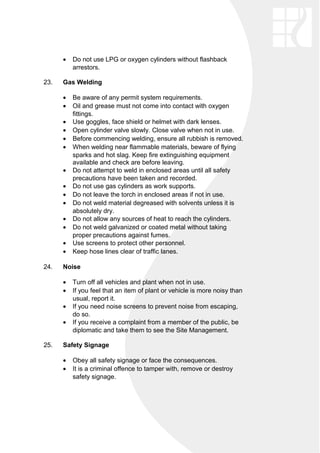
Importance of adhering to safety signage and a summary of PPE do’s and don’ts to maintain a safe working environment.
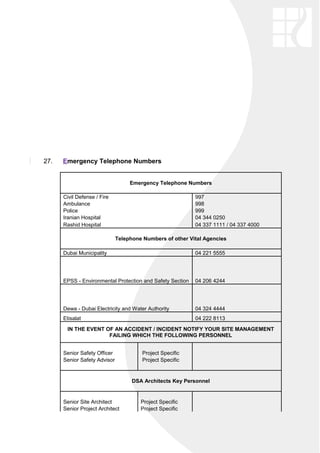
Lists essential emergency contacts and highlights the process of notifying site management in case of accidents, emphasizing quick action and communication.
Provides contact details for key safety personnel and site management, reinforcing the importance of accessible communication.
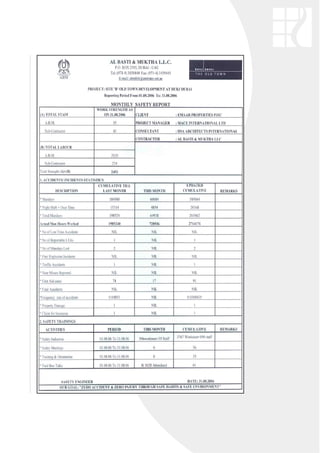
Example mentioned for conducting site safety audits to evaluate compliance with safety regulations and continuous improvement.
- Safety isthe responsibility of everyone who works on site, without exception -
Occupational Health and Safety Policy
DSA Architects International is committed to the health, safety and
welfare of employees and all others who operates under its control.
DSA will ensure the site workplace as safe as practicable, complying with
legislative requirements, codes of practice, relevant standards and
adhering to accepted industry practices as an integral part of management
objectives and targets.
DSA encourages every employee to be alert and report any unsafe or
potentially unsafe work practice or work place (even if there is doubt), to
relevant safety representatives and to immediately raise the matter with
his immediate manager or director if the employee believes it is not being
addressed in a timely manner.
DSA requests and will maintain a high level of occupational health and
safety performance through:
• Developing and reviewing continuous improvement strategies.
• Ensuring that all contractors engaged are able to demonstrate
satisfactory OH&S management system capabilities.
• Review OH&S performance through the conduct of regular audits
• Establishing measurable objectives and targets aimed at
eliminating work related illness, injury and incidents.
The policy will be implemented and maintained by:
• Embracing the principles of OH&S risk management
• Adopting a consultative and cooperative approach with all parties
• Supporting and ensuring effective workplace OH&S practices
• Dissemination of OH&S information.
2.
Health and SafetyManual
Introduction
By creating employer awareness and putting in place a ‘safe system of
work’, we can prevent accidents occurring. Experience has also shown
that over a sustained period a safe operation is always more efficient.
Since safety and health of employees is the prime concern of the DSA
Site Management Team, this manual has been developed to serve as a
reference and guide. Please keep the manual with you and use it to
remind you how to keep safe.
In our continuous improvement process, we would ask you to us in
providing ideas to improve the process or by communicating near misses
in order that we can put in place measures to avoid reoccurrences.
DSA believes the monitor of safety is the entire Site Team’s responsibility
and every effort shall be taken by all to maintain high safety standards and
prevent accidents. This manual is the first step towards ensuring health
and safety on site.
- ACCIDENTS BEGIN WHERE SAFETY ENDS –
3.
This manual containsthe following watch points:
1. General Safety Regulations
2. Housekeeping
3. Confined Spaces
4. Electricity
5. Machine Guarding
6. First Aid
7. Personal Protective Equipment – PPE
8. Scaffolding
9. Portable Electric Tools
10.Electric Arc Welding
11.Ladders
12.Hand Tools
13.Manual Handling
14.Fire
15.Lifting Gear
16.Slings
17.Chains
18.Shackles, Hooks and Eyebolts
19.Waste
20.Slips, Trips and Falls
21.Compressed Air
22.Compressed Gas Cylinders
23.Gas Welding
24.Noise
25.Safety Signage
26.Do’s and Don’ts
27.Emergency Telephone Numbers
28.Site Safety Audit – Contractor’s Example
4.
1. General SafetyRegulations
• The employee is responsible for, and must wear the
appropriate Personal Protective Equipment (PPE) at all time
while visiting / working on site.
• PPE must not be abused and if damaged must be replaced
before proceeding with work.
• Home-made, modified or damaged tools are not permitted
on site.
• There must be safe access / egress to and from all site
workplaces.
• A high standard of housekeeping must be maintained at all
times.
• Waste, redundant material, trip hazards, etc. must be
removed from site immediately.
• The welfare facilities that are provided on site must be
maintained in good order.
• Waste food, drink cans, bottles, etc. must be disposed of in
the appropriate waste containers. Any permitted breaks may
only be taken in permitted areas.
• All accidents, personal injuries, property damage or
dangerous occurrences / near misses must be reported to
the safety department and appropriately logged.
• Smoking is not permitted at anytime on site unless within an
authorized smoking area and only then during official break
periods
• Anyone caught stealing; fighting or causing property damage
should be reported immediately.
• Always follow instructions, do not take chances. If you don’t
know…ask!
• Immediate note and report unsafe conditions.
• Observe and obey all warning signs.
• Fighting or horseplay should not be tolerated and must be
noted.
• The right tools and equipment must be safely used for the
job.
• Only authorized personnel should be permitted to make
electrical repairs.
• The use, possession or being under the influence of illegal
drugs or intoxicants is prohibited on the job site. In all cases
of abuse offenders should be reported to the Local
Authorities.
5.
- TEAMWORK: YOURBEST BET FOR SAFETY AND
QUALITY –
2. Housekeeping
• Good housekeeping is paramount to ensuring safety on site
• The site must remain clean to an acceptable standard. Scrap
and rubbish should be regularly removed. Preferably at the
end of each working day or at least on a weekly basis.
• All stairways, passageways, gangways and exits must be
kept free of materials and debris.
• Spillages of oil and other substances must be cleaned up
immediately.
• Protruding nails in timber must be removed or discarded
from site.
3. Confined Spaces
• A confined space is an area where entry has limited or
restricted means of access and has little or no natural
ventilation.
• A permit to work must be raised and all precautions are
strictly to be followed.
• The space must be tested for explosives and toxic gases
and oxygen deficiency.
• Only authorized and trained persons with breathing
apparatus are allowed to work inside.
• No smoking and no source of ignition near the work area is
permitted.
• Proper communication in life saving systems shall be
established and personnel trained before starting work.
4. Electricity
• Electric shock is a major hazard. It can cause physical injury
and can kill.
• Always assume that cables, plugs etc. are live.
• Switch off and isolate all electrical equipment after use.
• Never work on wet surfaces
• All electrical equipment should be double insulated or
grounded.
• Any electrical connections, alterations and repairs should
only be carried out by a competent electrician.
• Never use aluminium or metal ladders near power lines.
6.
5. Machine Guards
•Moving parts of machines pose a hazard. Guarding
eliminates or controls this probability.
• All belts, shafts, gears, pulleys, flywheels, chains or other
reciprocating, rotating or moving parts of equipment should
be guarded when exposed to contact by personnel.
• Machine guards are not to be removed before or during
operations.
• Machinery must not be in motion when cleaning, oiling,
adjusting or repairing.
• Avoid wearing jewellery, loose clothing and gloves when
working around moving machinery.
6. First Aid
• First aid is the immediate and temporary care rendered to
the victim of an injury or illness.
• First aid cabinets should:
Contain first aid equipment only
Be put where they can be seen and used
• The first person at the scene on an accident should call for
help (and an ambulance if required):
Do not move casualty unless it is necessary to do so
Make them as comfortable as possible
No drinks, no food and no smoking
7. Personal Protective Equipment (PPE)
• All employees visiting or on site must wear an approved type
hard hat.
• Safety-toe boots (safety shoes) must be worn by all,
regardless.
• Use a safety harness and life line while working at a height
exceeding 2m above a safe working platform.
• Approved safety goggles with side shields must be worn
where required.
• Welders should wear a welding hood / hard hat combination
on site.
• Use face shields for special hazards in all operations such
as chipping, grinding, breaking concrete, handling acids or
caustics etc.
• Ear plugs / earmuffs are to be worn for hearing protection as
necessary.
7.
• Any PPEnot listed but necessary for the safe performance
of the job, should be requested from the contractor.
8. Scaffolding
• Do not interfere or remove ties, guardrails, bracing, toe
boards and ladders.
• Note and report scaffold defects to the relevant parties.
• Use the provided ladder access or stairs.
• Do not use makeshift platforms.
• Be aware of the scaffolding loading capacity.
• When stacking materials, always note a passage with at
least 2 boards wide for other people to access.
• Ensure that materials are stacked correctly and cannot fall.
Ensure the use of brick guards or netting where required.
• Do not leave tools or materials lying about on any platform.
9. Portable Electric Tools
• Check that the power supply and tools have the appropriate
sockets.
• Before using a portable electrical tool check that it is properly
earthed, unless it is an approved type that does not require
an earthing.
• Prior to use ensure that the tool casing is undamaged and
refrain from using it if it is damaged.
• Ensure that all cables, plugs and connections are sound and
properly wired up.
• Ensure that switches are working smoothly and freely before
connecting to the supply.
• Ensure that the power cable is long enough to reach the
work place without straining it.
• Ensure that power cables are elevated of the floor where
they might get damaged or cause a trip hazard.
• Never stand in a damp or wet surface when electrical
equipment is used. Keep equipment clean and dry.
• Portable electrical tools should only be used for the designed
purpose.
• Never connect a portable electrical tool to a lighting socket.
• Never use worn, blunt or damaged bits from other
accessories.
• Disconnect tools when not in use.
• Only competent parties should inspect portable electrical
tools on a regular basis.
• Wear eye protection even when drilling downwards.
8.
10. Electric ArcWelding
• Ensure that the shield, helmet or goggles contain the correct
glasses.
• Wear adequate protective clothing including leather gauntlet
gloves and clear goggles for chipping.
• When necessary, use screens to protect neighbouring
workers and passers-by from the arc.
• Ensure that cables and connections are in good condition
and firmly attached.
• Ensure that the welding equipment, bench or work piece is
properly earthed.
• Ensure that the electrode holder is fully insulated and always
placed on an earthed surface when not in use.
• Stand on an insulated mat when the surface is damp.
• Ensure good ventilation in welding areas but do not use
oxygen to ventilate confined spaces.
• Ensure that no welding takes place near flammable
materials.
• No welding in enclosed vessels unless proper precautions
have been taken.
11. Ladders
• Clear varnish to be used for the protection of wooden
ladders as paint may cover any defects.
• Never use an unsound ladder.
• Ensure that the ladder is set on a firm level base.
• Ladders longer than 3M in length should be secured or
footed.
• Ensure that the ladder extends a minimum of 1 meter height
above the landing platform, unless an alternative handhold is
provided.
• The correct position of a ladder is 1 unit out at the base for
every 4 units vertical in height.
• Use the right length ladder for the job. Never lash to short
ladders to make one long one.
• Ensure that no load is carried on ladders. Insist on using a
hoist line.
• Do not lean sideways on a ladder. It is safer to move the
ladder.
• Beware of wet or greasy rungs.
• Ensure that ladders are regularly inspected, even if in
storage.
9.
• Work shouldonly be carried out from a ladder when the job
is of short duration and can be carried out safely.
12. Hand Tools
• Ensure the correct tools are used for the job.
• Chisels and punches should be ground to prevent
mushrooming.
• Ensure that hammerheads are tightly wedged on their
shafts.
• Immediately replace all wooden handles that are split.
• Ensure the cutting edges of tools are sharp.
• Keep hands behind the cutting edges while working.
• Do not use screwdrivers on work held in hands.
• Keep tools in boxes or racks when not in use.
• Protect the sharp edges of tools that are to be stored or
carried.
• Scrap tools that are warn or damaged beyond repair.
• Use the right tools for the right job.
13. Manual Handling
• Where possible gloves should be worn to protect against
cuts, scratches or punctures.
• Wear safety shoes or boots to protect toes from falling loads.
• Ensure that the approximate weight of load is known prior to
lifting.
• Do not attempt to lift alone any load that is too heavy, too
large or too awkward.
• See that there are no obstructions in the direction that you
are going.
• Ensure a secure grip prior to lifting any load.
• When lifting to a height from the floor do it in two stages.
• Avoid twisting the trunk of your body while lifting or carrying
load.
14. Fire
• Ensure you are well versed with the content of the fire plan
and what to do in the event of a fire.
• Ensure you know all the escape routes.
• Ensure fire doors and escape passages are clear and
unobstructed.
• Know the fire points and do not obstruct access for the fire
extinguishers.
10.
• Learn theoperations and limitations of the fire extinguishers
in your area.
• Ensure that paper, oily rags or other rubbish don’t
accumulate.
• Do not smoke.
• Ensure the use of proper containers for flammable liquids.
• Do not use open tins or buckets.
• Ensure that flammable liquids are handled at a safe distance
from possible sources of ignition.
• Check before and after the use of blow lamps, welding and
cutting equipments.
• Bitumen boilers, soldering irons and gas rings must be on a
non-combustible stand.
• Switch off at the mains any electrical equipment not in use.
15. Lifting Gear
• Check the SWL on equipment prior to use.
• Know the weight of the load before lifting.
• Ensure a current testing certificate is available for the
equipment in use.
• Ensure there is no damage to the equipment in use. Reject
any damaged equipment.
• Return all lifting equipment to the store after use.
16. Slings
• Do not use fibre or wire slings for hot loads and keep them
away from welding or burning spots.
• Protect slings from sharp edges.
• Ensure there are no broken ends in wires or chafing on fibre
slings.
• Lower the loads onto suitable battens to prevent damage to
slings.
17. Chains
• Ensure that the chains are not knicked or twisted.
• Do not shorten a chain by knotting it.
• Never lengthen a chain by joining pieces together.
• Do not lubricate chains. Oil can pick up abrasive materials
such as sand and grit.
• Ensure that chains are not exposed to acids and corrosive
substances.
11.
18. Shackles, hooksand eyebolts
• Use the correct type for the job.
• Ensure the pin is free, but not loose, in a tapped hole
• When using a shackle with nut and bolt, the bolt should be
free to rotate when the nut is tight.
• Swivel hooks should rotate freely.
19. Waste
• Always place waste in the correct skip.
• Ensure that the skips are not overfilled.
• Ensure that the areas around the skips are kept tidy.
• Wastes can either be controlled or special:
Controlled waste is any kind of household and
construction waste.
Special waste is usually waste that is dangerous to
your life, eg. acids, chemicals, etc.
• Never mix controlled and special waste in the same skip.
• If there are skips for recycle material, only place the correct
materials in that skip.
• Personal or canteen waste must be placed in specific bins
provided.
20. Slips, Trips and Falls
• Over a third of accidents are caused by slips, trips and falls.
• If there are trip hazards DO NOT ignore them. Remove or
report them.
• Ensure that all work areas are kept tidy. Accidents are nearly
always caused by people tripping over their own tools,
equipment or materials.
• Ensure that working platforms are kept clear. Scaffold
walkways must allow free passage.
• Do not leave uncovered holes or openings.
• Do not trail cables across walkways. Walkways and
passages must be kept clear and not be used for stacking or
storing materials.
• Ensure your shoes and boots are free from mud or other
substances which could cause you to slip, especially when
climbing ladders.
12.
• Always lookfor the most level route when crossing site.
Steep inclines or batters do not afford a safe passage.
• Clear up any spills immediately.
• Do not carry loads single handedly that are too heavy or
obstruct views. Get help.
21. Compressed Air
• Do not use compressed air for any other purpose other than
that for which it is intended.
• Never direct compressed air at yourself to blow dust off
clothes or hair.
• Do not clean down machines and benches with compressed
air. Use a brush or a special vacuum cleaner.
• Horseplay with compressed air is forbidden. This can cause
agonizing injury or death.
• Ensure that the compressed air tool, hose and fittings are
working properly. If not, report the fault and refrain usage.
• Prior to changing tools ensure that the supply line is closed
or has an automatic shut-off valve.
• Always close a hose by the valve. Never kink the hose.
• Ensure that hoses aren’t lying around for others to trip over.
• Always ensure that connecters are fully ‘home’ and safely
latched.
22. Compressed Gas Cylinders
• Treat every cylinder as ‘full’ and handle carefully.
• Always ensure the use of a carrier and secure the cylinder
into it.
• Always secure acetylene cylinders in an upright position,
both in use and storage.
• Store all cylinders so that they cannot fall or roll.
• Keep the cylinders away from the sun, artificial heat,
flammable materials, corrosive chemicals and fumes.
• Avoid damage to valves and fittings. Do not use them for
carrying or lifting.
• Keep valves and fittings of oxygen cylinders free from oil and
grease.
• Always lift cylinders from trucks – do not drop or slide them.
• Keep hose lines clear of traffic lanes.
• In case of fire, call Civil Defense first then cool cylinders with
water spray if safe to do so.
• Always operate within the control or permit system
applicable.
13.
• Do notuse LPG or oxygen cylinders without flashback
arrestors.
23. Gas Welding
• Be aware of any permit system requirements.
• Oil and grease must not come into contact with oxygen
fittings.
• Use goggles, face shield or helmet with dark lenses.
• Open cylinder valve slowly. Close valve when not in use.
• Before commencing welding, ensure all rubbish is removed.
• When welding near flammable materials, beware of flying
sparks and hot slag. Keep fire extinguishing equipment
available and check are before leaving.
• Do not attempt to weld in enclosed areas until all safety
precautions have been taken and recorded.
• Do not use gas cylinders as work supports.
• Do not leave the torch in enclosed areas if not in use.
• Do not weld material degreased with solvents unless it is
absolutely dry.
• Do not allow any sources of heat to reach the cylinders.
• Do not weld galvanized or coated metal without taking
proper precautions against fumes.
• Use screens to protect other personnel.
• Keep hose lines clear of traffic lanes.
24. Noise
• Turn off all vehicles and plant when not in use.
• If you feel that an item of plant or vehicle is more noisy than
usual, report it.
• If you need noise screens to prevent noise from escaping,
do so.
• If you receive a complaint from a member of the public, be
diplomatic and take them to see the Site Management.
25. Safety Signage
• Obey all safety signage or face the consequences.
• It is a criminal offence to tamper with, remove or destroy
safety signage.
14.
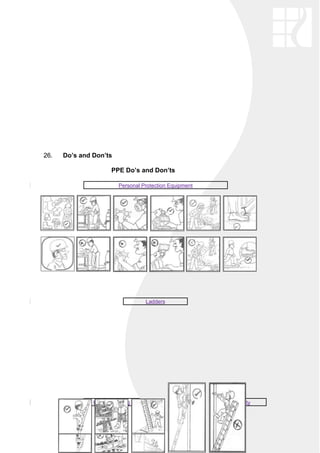
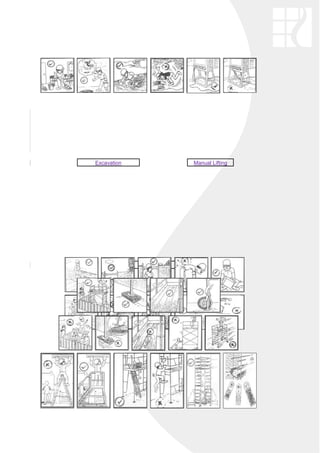
26. Do’s andDon’ts
PPE Do’s and Don’ts
Personal Protection Equipment
Ladders
House Keeping Electricity
27. Emergency TelephoneNumbers
Emergency Telephone Numbers
Civil Defense / Fire 997
Ambulance 998
Police 999
Iranian Hospital 04 344 0250
Rashid Hospital 04 337 1111 / 04 337 4000
Telephone Numbers of other Vital Agencies
Dubai Municipality 04 221 5555
EPSS - Environmental Protection and Safety Section 04 206 4244
Dewa - Dubai Electricity and Water Authority 04 324 4444
Etisalat 04 222 8113
IN THE EVENT OF AN ACCIDENT / INCIDENT NOTIFY YOUR SITE MANAGEMENT
FAILING WHICH THE FOLLOWING PERSONNEL
Senior Safety Officer Project Specific
Senior Safety Advisor Project Specific
DSA Architects Key Personnel
Senior Site Architect Project Specific
Senior Project Architect Project Specific
17.
DSA Head OfficeReception 04 329 2288
Director Joe Agnew 050 346 3863
Director Sam Ramage 050 425 1806
Associate Director Jacques Blaauw 050 553 9419
28. Site Safety Audit – Contractor’s Example