1
Sivasubramaniam Subramanian
ME.OSH Mgt. (UTM)
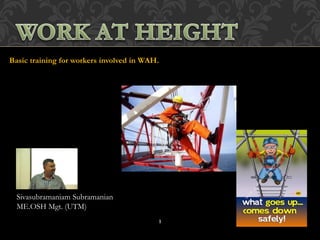
Basic training for workers involved in WAH.
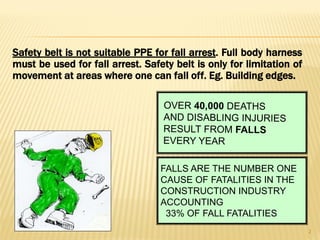
FALLS ARE THE NUMBER ONE
CAUSE OF FATALITIES IN THE
CONSTRUCTION INDUSTRY
ACCOUNTING
33% OF FALL FATALITIES
Safety belt is not suitable PPE for fall arrest. Full body harness
must be used for fall arrest. Safety belt is only for limitation of
movement at areas where one can fall off. Eg. Building edges.
2
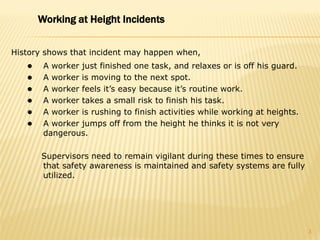
History shows that incident may happen when,
 A worker just finished one task, and relaxes or is off his guard.
 A worker is moving to the next spot.
 A worker feels it’s easy because it’s routine work.
 A worker takes a small risk to finish his task.
 A worker is rushing to finish activities while working at heights.
 A worker jumps off from the height he thinks it is not very
dangerous.
Supervisors need to remain vigilant during these times to ensure
that safety awareness is maintained and safety systems are fully
utilized.
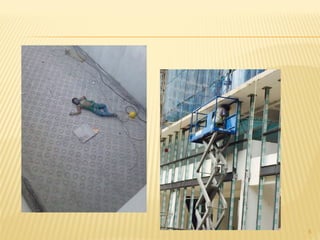
Working at Height Incidents
3
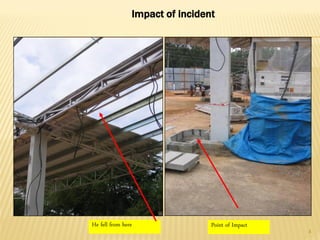
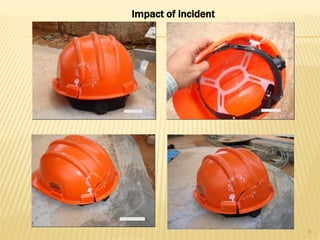
He fell from here Point of Impact
Impact of incident
4
5
Impact of incident
6
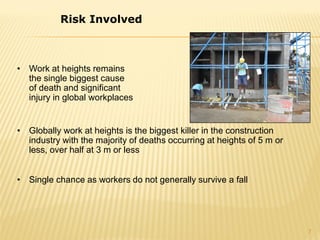
• Work at heights remains
the single biggest cause
of death and significant
injury in global workplaces
• Globally work at heights is the biggest killer in the construction
industry with the majority of deaths occurring at heights of 5 m or
less, over half at 3 m or less
• Single chance as workers do not generally survive a fall
Risk Involved
7
8
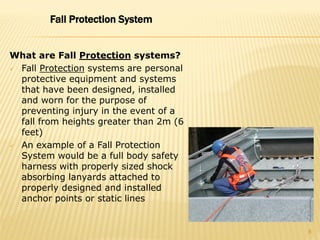
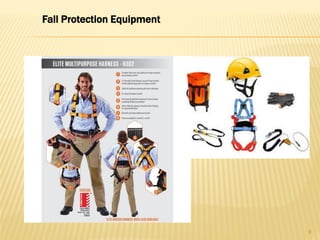
What are Fall Protection systems?
 Fall Protection systems are personal
protective equipment and systems
that have been designed, installed
and worn for the purpose of
preventing injury in the event of a
fall from heights greater than 2m (6
feet)
 An example of a Fall Protection
System would be a full body safety
harness with properly sized shock
absorbing lanyards attached to
properly designed and installed
anchor points or static lines
Fall Protection System
Fall Protection Equipment
9
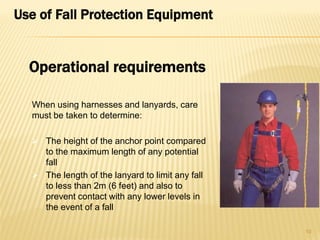
Use of Fall Protection Equipment
When using harnesses and lanyards, care
must be taken to determine:
 The height of the anchor point compared
to the maximum length of any potential
fall
 The length of the lanyard to limit any fall
to less than 2m (6 feet) and also to
prevent contact with any lower levels in
the event of a fall
10
Operational requirements
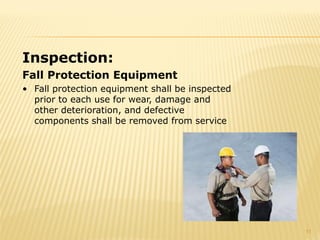
Inspection:
Fall Protection Equipment
• Fall protection equipment shall be inspected
prior to each use for wear, damage and
other deterioration, and defective
components shall be removed from service
11
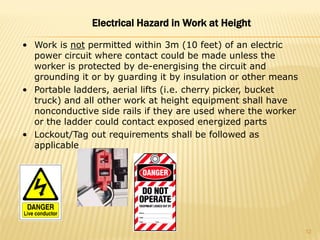
• Work is not permitted within 3m (10 feet) of an electric
power circuit where contact could be made unless the
worker is protected by de-energising the circuit and
grounding it or by guarding it by insulation or other means
• Portable ladders, aerial lifts (i.e. cherry picker, bucket
truck) and all other work at height equipment shall have
nonconductive side rails if they are used where the worker
or the ladder could contact exposed energized parts
• Lockout/Tag out requirements shall be followed as
applicable
Electrical Hazard in Work at Height
12
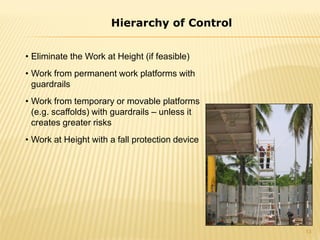
• Eliminate the Work at Height (if feasible)
• Work from permanent work platforms with
guardrails
• Work from temporary or movable platforms
(e.g. scaffolds) with guardrails – unless it
creates greater risks
• Work at Height with a fall protection device
Hierarchy of Control
13
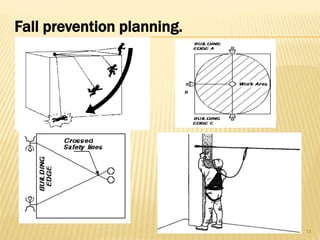
Fall prevention planning.
14
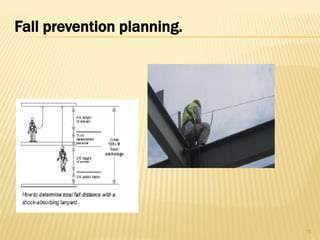
Fall prevention planning.
15
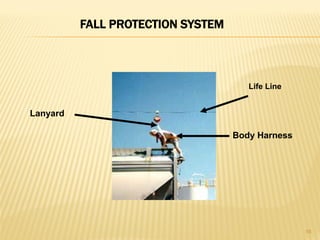
FALL PROTECTION SYSTEM
Life Line
Lanyard
Body Harness
16
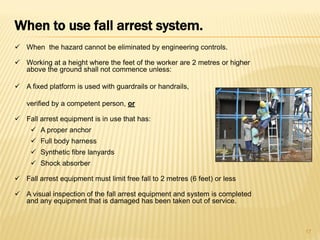
 When the hazard cannot be eliminated by engineering controls.
 Working at a height where the feet of the worker are 2 metres or higher
above the ground shall not commence unless:
 A fixed platform is used with guardrails or handrails,
verified by a competent person, or
 Fall arrest equipment is in use that has:
 A proper anchor
 Full body harness
 Synthetic fibre lanyards
 Shock absorber
 Fall arrest equipment must limit free fall to 2 metres (6 feet) or less
 A visual inspection of the fall arrest equipment and system is completed
and any equipment that is damaged has been taken out of service.
When to use fall arrest system.
17
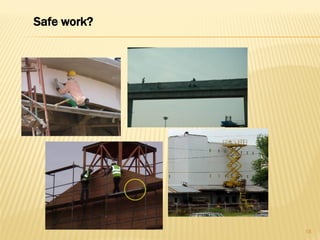
Safe work?
18
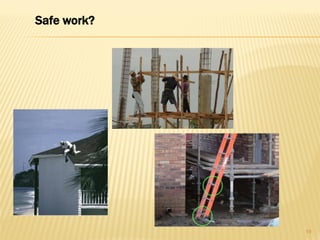
Safe work?
19
 Any works done above 2 meters must have PTW and Work at Height
permit.
 Permit validity is one day(suggested) only or the duration of the job
(not more than 12 hours)
 Exemption only if work is less than 2 meters and not other prevailing
hazards around the work site.
 Work duration is short ( less than 20 mins) and a ladder or suitable
lifting mechanism (less than 2 meters) is used.
 Any exempted task must have a suitable safe work procedure /
method and covered by generic Risk Assessment.
 Work Permits must be displayed at work area.
 All routine jobs ( taking reading on daily basis, inspection on daily
basis) exemption is granted provided the personal is trained and
competent (including health fitness) in work at height activities and a
safe system of work is available.
20
TERIMA KASIH / THANK YOU / NANDRI / SEAH SEAH NII
Sivasubramaniam Subramanian
Email : svre.ehs@gmail.com
Mobile : +60164541978

Work at height. The basic needs.

  • 1.
    1 Sivasubramaniam Subramanian ME.OSH Mgt.(UTM) Basic training for workers involved in WAH.
  • 2.
    FALLS ARE THENUMBER ONE CAUSE OF FATALITIES IN THE CONSTRUCTION INDUSTRY ACCOUNTING 33% OF FALL FATALITIES Safety belt is not suitable PPE for fall arrest. Full body harness must be used for fall arrest. Safety belt is only for limitation of movement at areas where one can fall off. Eg. Building edges. 2
  • 3.
    History shows thatincident may happen when,  A worker just finished one task, and relaxes or is off his guard.  A worker is moving to the next spot.  A worker feels it’s easy because it’s routine work.  A worker takes a small risk to finish his task.  A worker is rushing to finish activities while working at heights.  A worker jumps off from the height he thinks it is not very dangerous. Supervisors need to remain vigilant during these times to ensure that safety awareness is maintained and safety systems are fully utilized. Working at Height Incidents 3
  • 4.
    He fell fromhere Point of Impact Impact of incident 4
  • 5.
  • 6.
  • 7.
    • Work atheights remains the single biggest cause of death and significant injury in global workplaces • Globally work at heights is the biggest killer in the construction industry with the majority of deaths occurring at heights of 5 m or less, over half at 3 m or less • Single chance as workers do not generally survive a fall Risk Involved 7
  • 8.
    8 What are FallProtection systems?  Fall Protection systems are personal protective equipment and systems that have been designed, installed and worn for the purpose of preventing injury in the event of a fall from heights greater than 2m (6 feet)  An example of a Fall Protection System would be a full body safety harness with properly sized shock absorbing lanyards attached to properly designed and installed anchor points or static lines Fall Protection System
  • 9.
  • 10.
    Use of FallProtection Equipment When using harnesses and lanyards, care must be taken to determine:  The height of the anchor point compared to the maximum length of any potential fall  The length of the lanyard to limit any fall to less than 2m (6 feet) and also to prevent contact with any lower levels in the event of a fall 10 Operational requirements
  • 11.
    Inspection: Fall Protection Equipment •Fall protection equipment shall be inspected prior to each use for wear, damage and other deterioration, and defective components shall be removed from service 11
  • 12.
    • Work isnot permitted within 3m (10 feet) of an electric power circuit where contact could be made unless the worker is protected by de-energising the circuit and grounding it or by guarding it by insulation or other means • Portable ladders, aerial lifts (i.e. cherry picker, bucket truck) and all other work at height equipment shall have nonconductive side rails if they are used where the worker or the ladder could contact exposed energized parts • Lockout/Tag out requirements shall be followed as applicable Electrical Hazard in Work at Height 12
  • 13.
    • Eliminate theWork at Height (if feasible) • Work from permanent work platforms with guardrails • Work from temporary or movable platforms (e.g. scaffolds) with guardrails – unless it creates greater risks • Work at Height with a fall protection device Hierarchy of Control 13
  • 14.
  • 15.
  • 16.
    FALL PROTECTION SYSTEM LifeLine Lanyard Body Harness 16
  • 17.
     When thehazard cannot be eliminated by engineering controls.  Working at a height where the feet of the worker are 2 metres or higher above the ground shall not commence unless:  A fixed platform is used with guardrails or handrails, verified by a competent person, or  Fall arrest equipment is in use that has:  A proper anchor  Full body harness  Synthetic fibre lanyards  Shock absorber  Fall arrest equipment must limit free fall to 2 metres (6 feet) or less  A visual inspection of the fall arrest equipment and system is completed and any equipment that is damaged has been taken out of service. When to use fall arrest system. 17
  • 18.
  • 19.
  • 20.
     Any worksdone above 2 meters must have PTW and Work at Height permit.  Permit validity is one day(suggested) only or the duration of the job (not more than 12 hours)  Exemption only if work is less than 2 meters and not other prevailing hazards around the work site.  Work duration is short ( less than 20 mins) and a ladder or suitable lifting mechanism (less than 2 meters) is used.  Any exempted task must have a suitable safe work procedure / method and covered by generic Risk Assessment.  Work Permits must be displayed at work area.  All routine jobs ( taking reading on daily basis, inspection on daily basis) exemption is granted provided the personal is trained and competent (including health fitness) in work at height activities and a safe system of work is available. 20
  • 21.
    TERIMA KASIH /THANK YOU / NANDRI / SEAH SEAH NII Sivasubramaniam Subramanian Email : svre.ehs@gmail.com Mobile : +60164541978