Safety Hazard Identification on
Construction Projects
Gregory Carter1 and Simon D.
Smith2
ASCE, February 2006
Outline
 Introduction
 Hazard and Accident Causation
 Procedure for establishing hazard
identification levels
 Analysis of Results Obtained
 Barrier to improve hazard identifications
 System for Hazard Identification
Improvement
Introduction
 Hazard identification is fundamental to construction safety
management; unidentified hazards present the most
unmanageable hazards.
 Maximum hazard identification levels were found to be 0.899
89.9% for a construction project within the nuclear industry
 the reasons for low hazard identification levels indicates key
barriers. This leads to the presentation of an Information
Technology IT tool for construction project safety management
Total-Safety and, in particular, a module within Total-Safety
designed to help construction personnel develop method
statements with improved levels of hazard identification.
Hazard and Accident
Causation
 This paper presents an investigation of safety hazard identifi-
cation within the U.K. construction industry. Starting with a
discussion of an accident causation model, within the context of
how hazards lead to accidents, it indicates that managing
hazardous events is a fundamental aspect of construction safety
management. Within the construction industry, risk assessment
is the practical means by which hazardous events are managed.
However, unidentified hazards negate the risk assessment
process; risks cannot be assessed and control measures
cannot be developed
 The paper presents a procedure that indicates the level of
hazard identification within method statements via calculation of
minimum and maximum hazard identification indices. A “method
statement” is a carefully
Overview of Hazards and
Accident Causation
Hazards effect
Fatal accident
Severity=max
Accident
Severity>0
Precaution Control Measure
(Limit hazard movement)
Preventive control measure]
(limit hazard entry)
Hazard
Hazard and Accident
Causation(Identified Hazard)
 Precaution Control Measure (Limit hazard movement)
By reducing its probability of occurrence
 Preventive control measure (limit
hazard entry)
By reducing its severity
 Consideration of hazards in terms of their probability of occurrence
and severity of consequence provides the general rationale
for performing all safety risk assessments, which are undertaken
as follows:
1.Estimate the probability of a hazard’s occurrence
2. Evaluate the risk associated with the hazard based upon the
frequency and severity estimations
3. Respond to the hazard by implementing suitable control
measures.
Hazard and Accident Causation
(Unidentified Hazard)
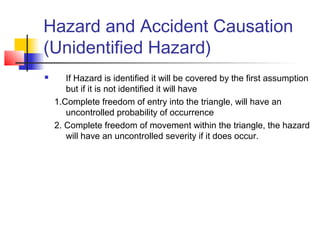
 If Hazard is identified it will be covered by the first assumption
but if it is not identified it will have
1.Complete freedom of entry into the triangle, will have an
uncontrolled probability of occurrence
2. Complete freedom of movement within the triangle, the hazard
will have an uncontrolled severity if it does occur.
Hazard identification in U.k
construction
 Investigation into hazard identification levels have been initially
targeted on three different industry sectors :UK rail, nuclear, and
general construction .
Procedure for establishing
hazard identification levels
Procedure was into five steps
1.Step one (Data collective)
Method statement were collected from the construction projects
and then categorized to concrete work, steel work, earth work,
and brick work
To make bench marking for the above information two main
sources were used
1.Construction Industry Publication
2. Information held by the contractor operating on both
projects, such as project risk logs, the safety section of the
company intranet, and other safety related data held on the
individual projects.
Cont..
 Step two :Method statement preanalysis
 Step three:Eastablishing Hazard scoring system
1. The hazard is identified and assessed—score of “1.0;”
2.The hazard is identified but not assessed—score of “0.5;”
3.The hazard is not identified or assessed—score of “0.0.”
Cont..
Step four: Determination of the reasonably practicable risk
Step five: Determination of hazard identification level
HII = H1/H0
where H0 represents the total number of relevant hazards in a
method statement and H1 represents the combined identification
and assessment status of those hazards. Therefore if the total
number of potential hazards in a construction method were x and
if all had been both identified and assessed thus obtaining a score
of “1” per hazard then H0=H1=x and HII=1, the best possible
rating.
Cont..
 HIImin took account of hazards that were explicitly
included in the method statement; this value
represents the lower limit for the level of hazard
identification in a
 method statement. HIImax took account of those
same hazards plus hazards that were relevant but
not explicitly included
HII MIN/MAX
Analysis of Results Obtained
 1.Qualatative as shown in the table
 2.Quantative: levels for each project were compared to a
“control” project in which a perfect level of hazard identification
was achieved, i.e., for this control project all HIImin and HIImax
values were set to 1.000. The hypothesized mean differences
between HIImin for the control project and Projects A, B, and C
were 0.252, b0.079, and 0.338, respectively. Values for the
corresponding HIImax were 0.209, 0.065, and 0.259. it available
to any individual. This is perhaps the most important
Barrier to improve hazard
identifications
1. Knowledge and information barriers:
• Lack of information sharing across projects;
• Lack of resources on smaller projects, e.g., industry publications,
full-time safety department, etc.;
• Subjective nature of hazard identification and risk assessment;
and
• Reliance upon tacit knowledge.
2. Process and procedures barriers:
• Lack of standardized approach; and
• Undefined structure for tasks and hazards.
System for Hazard
Identification Improvement
 Based on the hypothesis that barriers exist to improve these
levels the work was continued to develop a new system of
hazard and risk management, Total-Safety.
Overview of Total Safety
 Data base management
 Method statement
Method of statement development models
1.Construction methods
The construction method is a discrete list of tasks that describe the
work outlined in the scope of the method statement.
2.Task Based Risk Assessment
A risk assessment is nothing more than a careful examination
of what, in your work, could cause harm to people,
so that you can weigh up whether you have taken enough
Conclusion
 Triangle of accident causation
 Procedure for establishing hazard identification levels
 Barrier to improve hazard identifications
 Overview of Total Safety

Safety hazard-identification-on-construction-projects

  • 1.
    Safety Hazard Identificationon Construction Projects Gregory Carter1 and Simon D. Smith2 ASCE, February 2006
  • 2.
    Outline  Introduction  Hazardand Accident Causation  Procedure for establishing hazard identification levels  Analysis of Results Obtained  Barrier to improve hazard identifications  System for Hazard Identification Improvement
  • 3.
    Introduction  Hazard identificationis fundamental to construction safety management; unidentified hazards present the most unmanageable hazards.  Maximum hazard identification levels were found to be 0.899 89.9% for a construction project within the nuclear industry  the reasons for low hazard identification levels indicates key barriers. This leads to the presentation of an Information Technology IT tool for construction project safety management Total-Safety and, in particular, a module within Total-Safety designed to help construction personnel develop method statements with improved levels of hazard identification.
  • 4.
    Hazard and Accident Causation This paper presents an investigation of safety hazard identifi- cation within the U.K. construction industry. Starting with a discussion of an accident causation model, within the context of how hazards lead to accidents, it indicates that managing hazardous events is a fundamental aspect of construction safety management. Within the construction industry, risk assessment is the practical means by which hazardous events are managed. However, unidentified hazards negate the risk assessment process; risks cannot be assessed and control measures cannot be developed  The paper presents a procedure that indicates the level of hazard identification within method statements via calculation of minimum and maximum hazard identification indices. A “method statement” is a carefully
  • 5.
    Overview of Hazardsand Accident Causation Hazards effect Fatal accident Severity=max Accident Severity>0 Precaution Control Measure (Limit hazard movement) Preventive control measure] (limit hazard entry) Hazard
  • 6.
    Hazard and Accident Causation(IdentifiedHazard)  Precaution Control Measure (Limit hazard movement) By reducing its probability of occurrence  Preventive control measure (limit hazard entry) By reducing its severity  Consideration of hazards in terms of their probability of occurrence and severity of consequence provides the general rationale for performing all safety risk assessments, which are undertaken as follows: 1.Estimate the probability of a hazard’s occurrence 2. Evaluate the risk associated with the hazard based upon the frequency and severity estimations 3. Respond to the hazard by implementing suitable control measures.
  • 7.
    Hazard and AccidentCausation (Unidentified Hazard)  If Hazard is identified it will be covered by the first assumption but if it is not identified it will have 1.Complete freedom of entry into the triangle, will have an uncontrolled probability of occurrence 2. Complete freedom of movement within the triangle, the hazard will have an uncontrolled severity if it does occur.
  • 8.
    Hazard identification inU.k construction  Investigation into hazard identification levels have been initially targeted on three different industry sectors :UK rail, nuclear, and general construction .
  • 9.
    Procedure for establishing hazardidentification levels Procedure was into five steps 1.Step one (Data collective) Method statement were collected from the construction projects and then categorized to concrete work, steel work, earth work, and brick work To make bench marking for the above information two main sources were used 1.Construction Industry Publication 2. Information held by the contractor operating on both projects, such as project risk logs, the safety section of the company intranet, and other safety related data held on the individual projects.
  • 10.
    Cont..  Step two:Method statement preanalysis  Step three:Eastablishing Hazard scoring system 1. The hazard is identified and assessed—score of “1.0;” 2.The hazard is identified but not assessed—score of “0.5;” 3.The hazard is not identified or assessed—score of “0.0.”
  • 11.
    Cont.. Step four: Determinationof the reasonably practicable risk Step five: Determination of hazard identification level HII = H1/H0 where H0 represents the total number of relevant hazards in a method statement and H1 represents the combined identification and assessment status of those hazards. Therefore if the total number of potential hazards in a construction method were x and if all had been both identified and assessed thus obtaining a score of “1” per hazard then H0=H1=x and HII=1, the best possible rating.
  • 12.
    Cont..  HIImin tookaccount of hazards that were explicitly included in the method statement; this value represents the lower limit for the level of hazard identification in a  method statement. HIImax took account of those same hazards plus hazards that were relevant but not explicitly included
  • 13.
  • 14.
    Analysis of ResultsObtained  1.Qualatative as shown in the table  2.Quantative: levels for each project were compared to a “control” project in which a perfect level of hazard identification was achieved, i.e., for this control project all HIImin and HIImax values were set to 1.000. The hypothesized mean differences between HIImin for the control project and Projects A, B, and C were 0.252, b0.079, and 0.338, respectively. Values for the corresponding HIImax were 0.209, 0.065, and 0.259. it available to any individual. This is perhaps the most important
  • 15.
    Barrier to improvehazard identifications 1. Knowledge and information barriers: • Lack of information sharing across projects; • Lack of resources on smaller projects, e.g., industry publications, full-time safety department, etc.; • Subjective nature of hazard identification and risk assessment; and • Reliance upon tacit knowledge. 2. Process and procedures barriers: • Lack of standardized approach; and • Undefined structure for tasks and hazards.
  • 16.
    System for Hazard IdentificationImprovement  Based on the hypothesis that barriers exist to improve these levels the work was continued to develop a new system of hazard and risk management, Total-Safety.
  • 17.
  • 18.
    Overview of TotalSafety  Data base management  Method statement Method of statement development models 1.Construction methods The construction method is a discrete list of tasks that describe the work outlined in the scope of the method statement. 2.Task Based Risk Assessment A risk assessment is nothing more than a careful examination of what, in your work, could cause harm to people, so that you can weigh up whether you have taken enough
  • 19.
    Conclusion  Triangle ofaccident causation  Procedure for establishing hazard identification levels  Barrier to improve hazard identifications  Overview of Total Safety