KNOW SAFETY | NO ACCIDENTS
NO SAFETY | KNOW ACCIDENTS
Construction Safety
Causes of Accidents :
 Direct Cause:
 Unsafe Work Practice or Unsafe Act
 Unsafe Physical Condition
 Combination of Both
Construction Safety
Causes of Accidents :
 Indirect Cause:
 Lack of Knowledge and Skill
 Physiological Unsuitability
 Psychological Unsuitability
Construction Safety
Preventive Techniques :
 Administrative Technique
 Safety Policy
 Safety Education & Training
 Selection & Placement
 Safety Meeting
 Safety Promotional Activities
 Safety Committee
 Motivation, Persuasion & Appeal
 Disciplinary Action
Construction Safety
Preventive Techniques :
 Engineering Technique
 Safe Designing
 Safe Construction
 Improved Physical Work Arrangements
 Isolation and/or enclosure to dangerous
operations/processes
 Substitution of more hazardous material by less
hazardous material
 Controlled operations and process
Construction Safety
Presentation Contents :
 Introduction – A Few facts
 Construction Accidents
 Safe Access On-Site
 Working at Height
 Ladder Safety
 Roof Safety
 Excavation Work
 Crane Safety
 Traffic vehicles & Plant
 Goods Hoist
 Electricity
 Working Near Sewage
 PPE
 Safety Success
Construction Safety
 The first week on each new site is
the most dangerous
 Accidents are more frequent at the
end of the day
 Small building jobs are the most
risky
 Safety helmets, Hi-viz jackets,
safety boots do prevent injury and
death
 Light weight shoes-such as trainers
or runners are not suitable on site
A FEW FACTS :
Construction Safety
Construction Accidents :
Breakdown of fatalities according to type of
accident in construction industry
 56% falls from height
 21% trapped by something collapsing or
overturning
 10% struck by a moving vehicle
 5% contact with electricity or electrical
discharge
 4% struck by a flying/falling object during
machine lifting of materials
 3% contact with moving machinery or material
being machined
 1% exposure to a hot or harmful substance
Construction Safety
Safe Access On Site :
 Everyone can get to their place of work safely
 Edges from which people could fall are
provided with double guard rails or other
suitable edge protection
 Holes are protected with clearly marked and
fixed covers to prevent falls
 Site is tidy
 Good lighting
 Fenced off from public
Construction Safety
• TYPES OF PERMIT
1. Work permits will applied at
construction area
• Hot Work - This permit is required
when using spark or flame producing
equipment and for vehicle entry into a
restricted area.
• Cold Work - This permit is for work
that will not produce sufficient
energy to ignite flammable
atmospheres/materials
• Confined Space Entry
This permit is required for tank
cleaning, tank inspection, work in
sewers or excavations.
• Excavation work permit
EMERGENCY RULES
 EVACUATION SIREN
 ESCAPE ROUTES
 ASSEMBLY POINTS
 PERSONNEL
ACCOUNT BY AREA
COORDINATOR
Height HAZARDS on Construction Sites
Cut-outs in floors, gaps on working platforms, Shafts
and stairwells not adequately covered, barricaded,
fenced off, open floor edges
Working at Height :
 Using ladders or scaffolding without proper fixing is
crazy
 Never use incomplete scaffolding.
 Make sure there are hand rails and toe boards at all
edges
 Things fall on sites, wear your helmet
 Before starting work at heights check for clearance from
any overhead power lines
 Always use fall arrestors & harnesses at the time of
work at height
Construction Safety
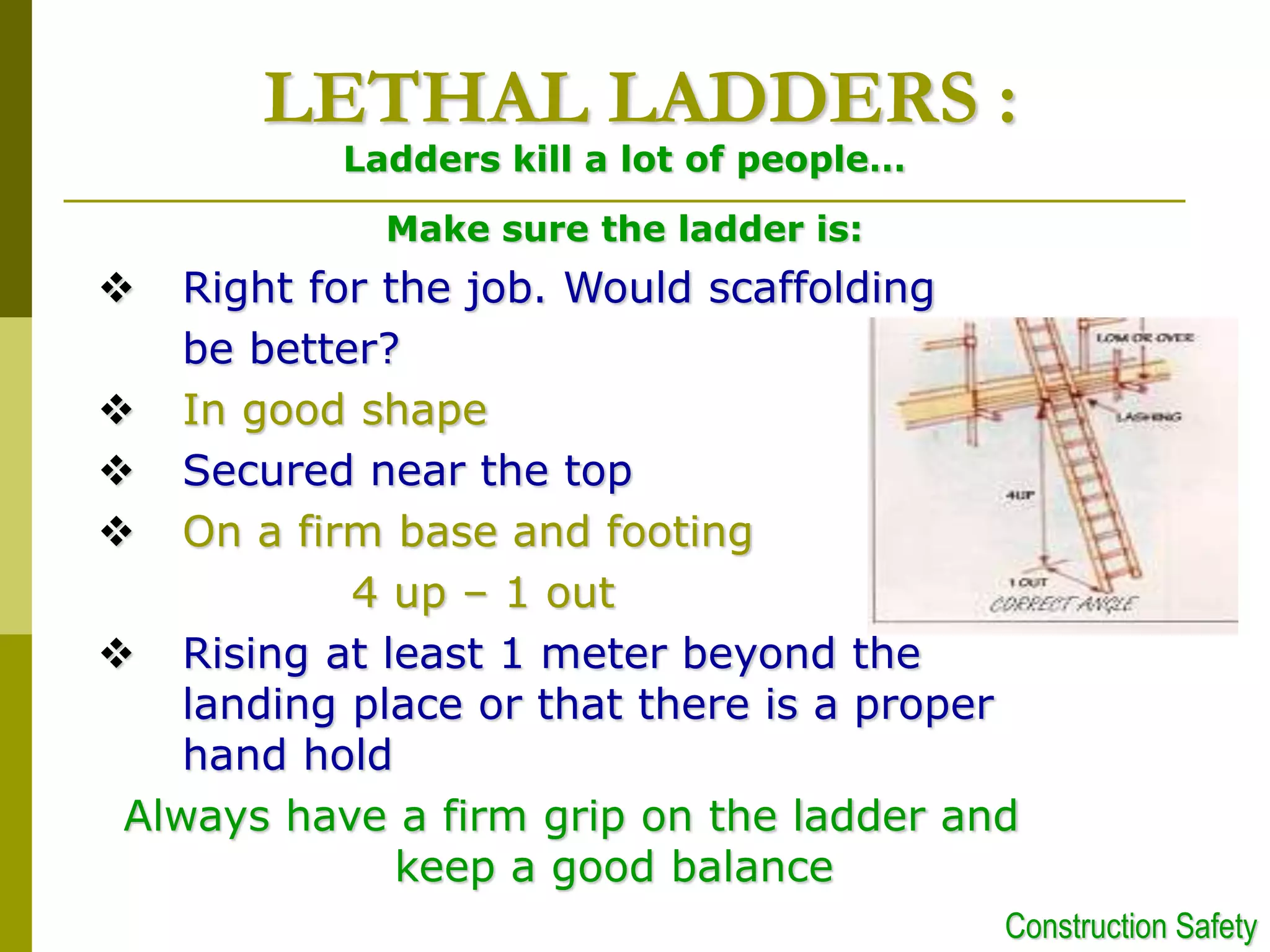
 Right for the job. Would scaffolding
be better?
 In good shape
 Secured near the top
 On a firm base and footing
4 up – 1 out
 Rising at least 1 meter beyond the
landing place or that there is a proper
hand hold
Always have a firm grip on the ladder and
keep a good balance
LETHAL LADDERS :
Ladders kill a lot of people…
Make sure the ladder is:
Construction Safety
Safe Ladders :
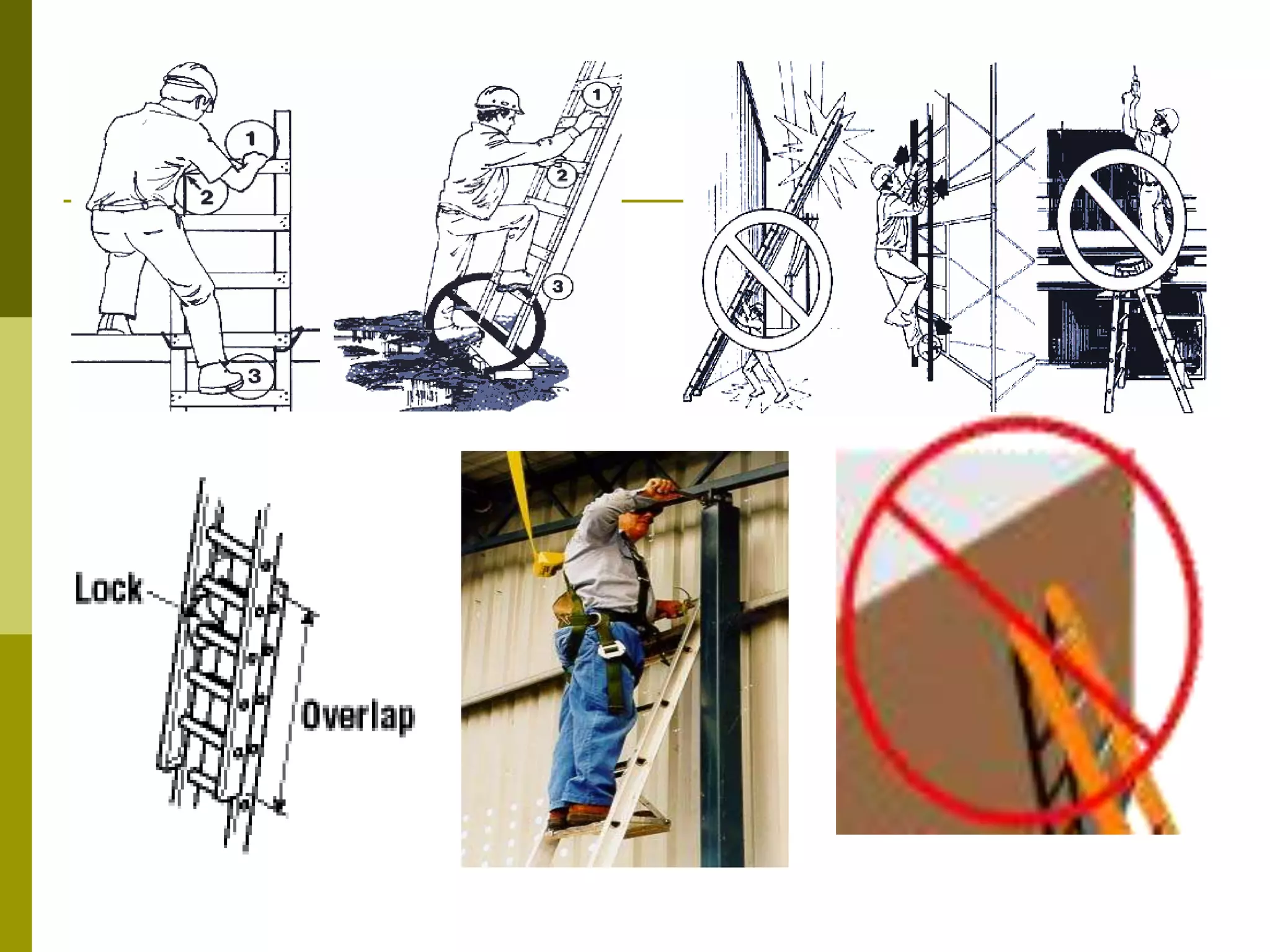
 Never allow more than one person on a ladder
 Use tool belts or hand lines to carry objects.
 Do not lean out from the ladder in any direction
 If you have a fear of heights – don’t climb a
ladder
 Do not allow others to work under a ladder in use
Construction Safety
Do not use the top
or top step of a
stepladder as a
step
PORTABLE LADDERS
SCAFFOLDING
 Any working over than 1.82 meter shall be
done using scaffold
 Scaffolds will be erected, dismantled and
inspected by trained and certified supervisor
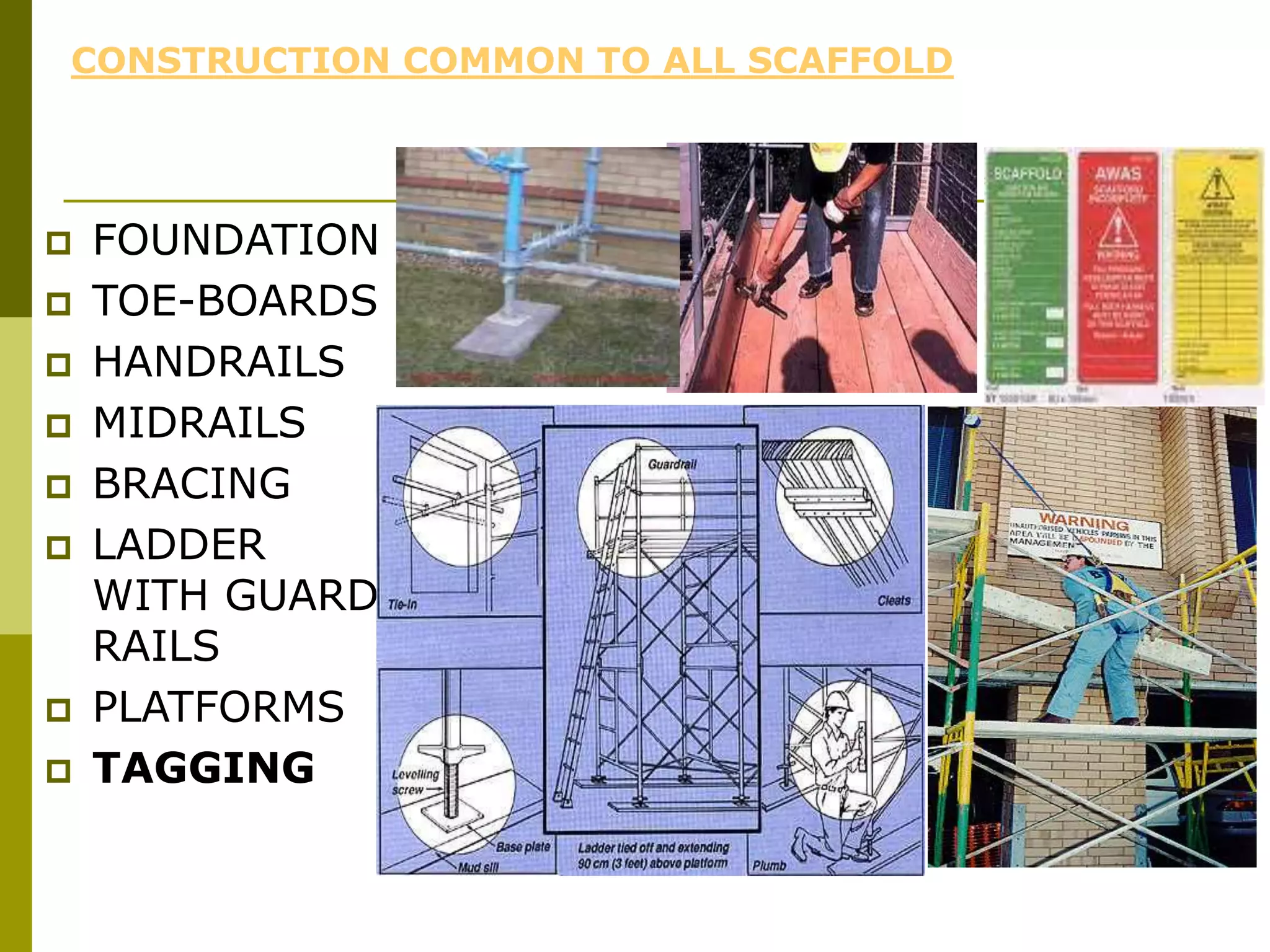
CONSTRUCTION COMMON TO ALL SCAFFOLD
 FOUNDATION
 TOE-BOARDS
 HANDRAILS
 MIDRAILS
 BRACING
 LADDER
WITH GUARD
RAILS
 PLATFORMS
 TAGGING
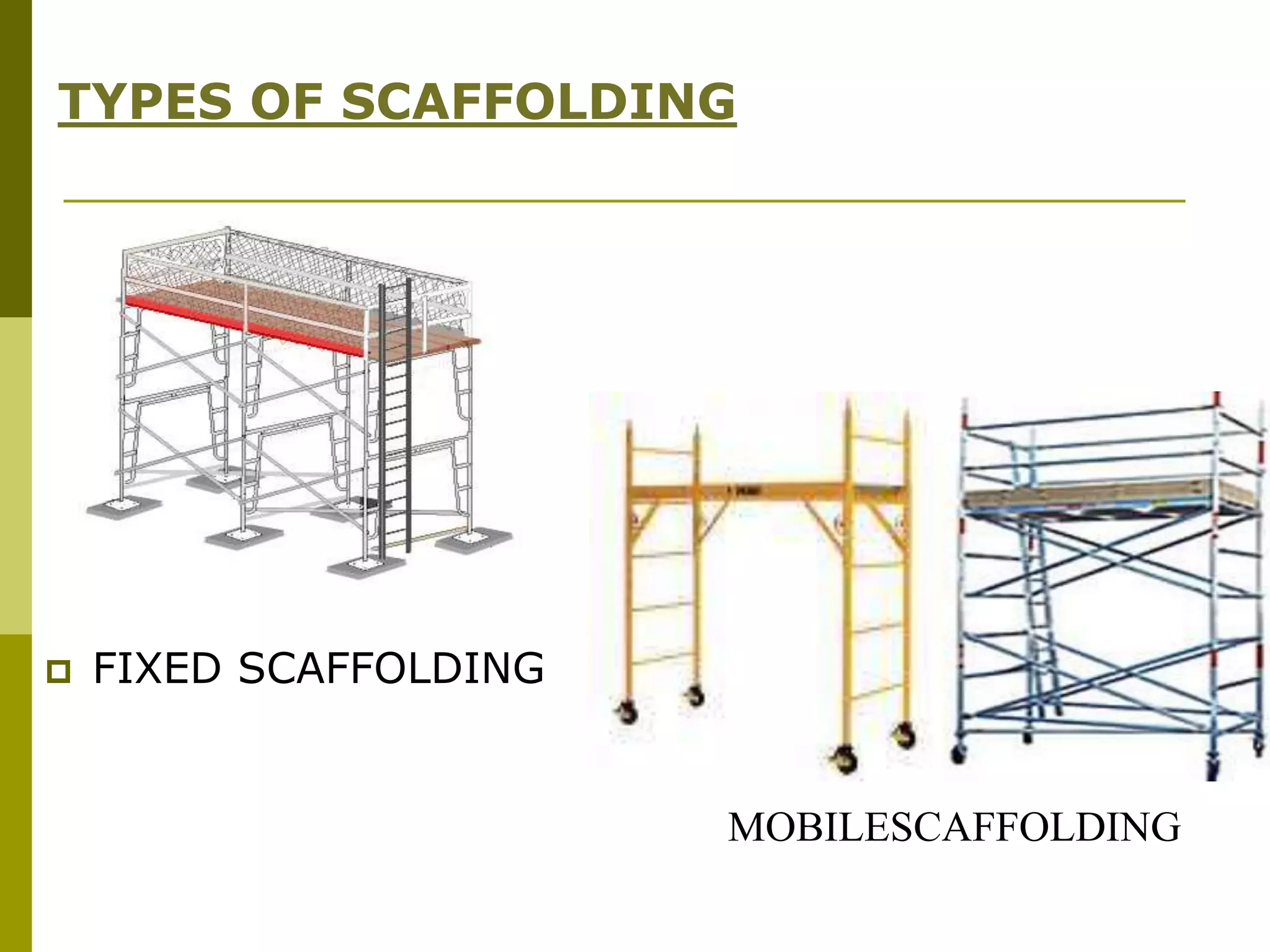
TYPES OF SCAFFOLDING
 FIXED SCAFFOLDING
MOBILESCAFFOLDING
THE ROOF : A RISKY PLACE TO BE . . .
Very Simply :
 Always inspect a roof before you walk
on it
 You must have protection to stop you
from falling off the edge
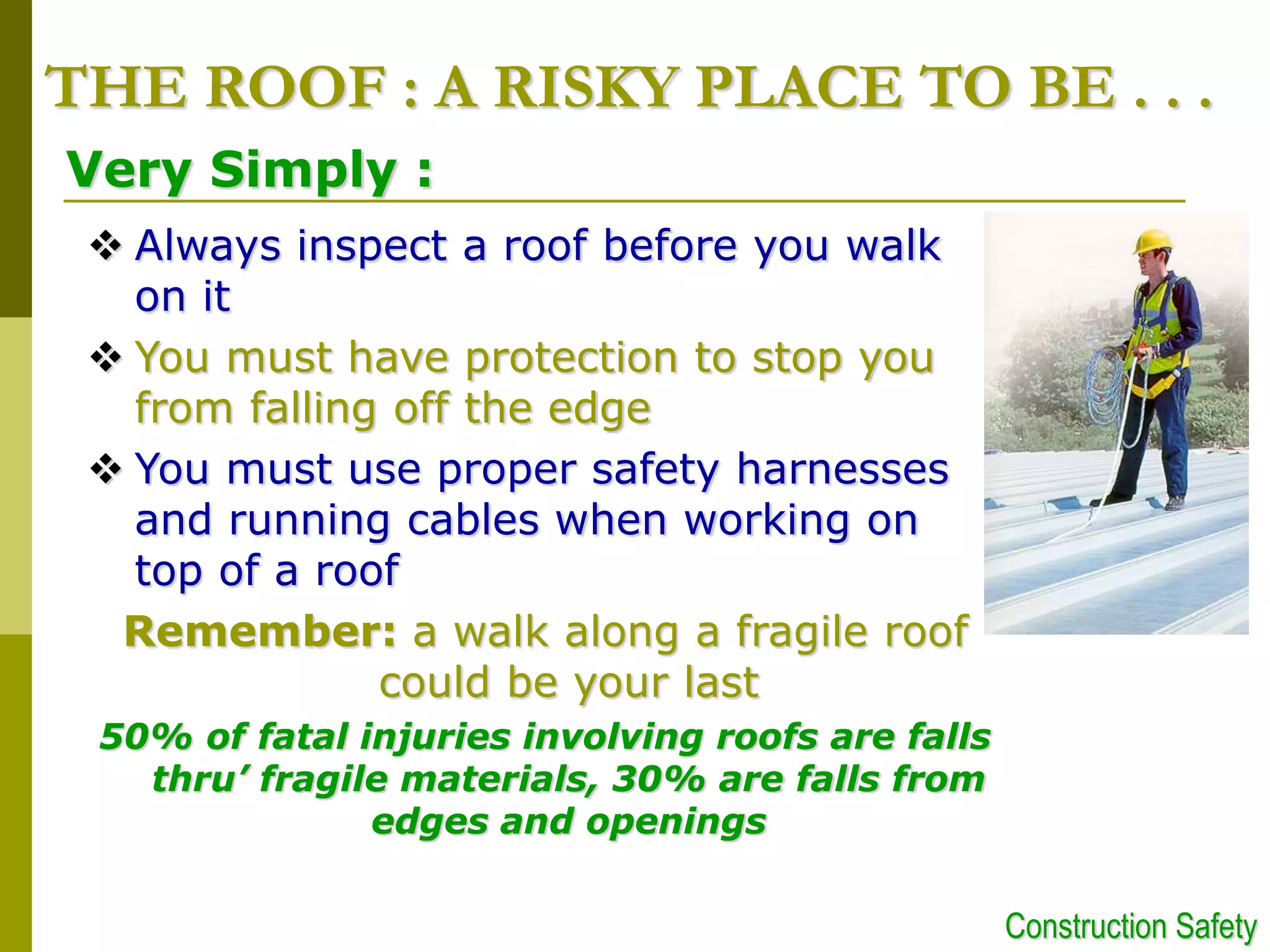
 You must use proper safety harnesses
and running cables when working on
top of a roof
Remember: a walk along a fragile roof
could be your last
50% of fatal injuries involving roofs are falls
thru’ fragile materials, 30% are falls from
edges and openings
Construction Safety
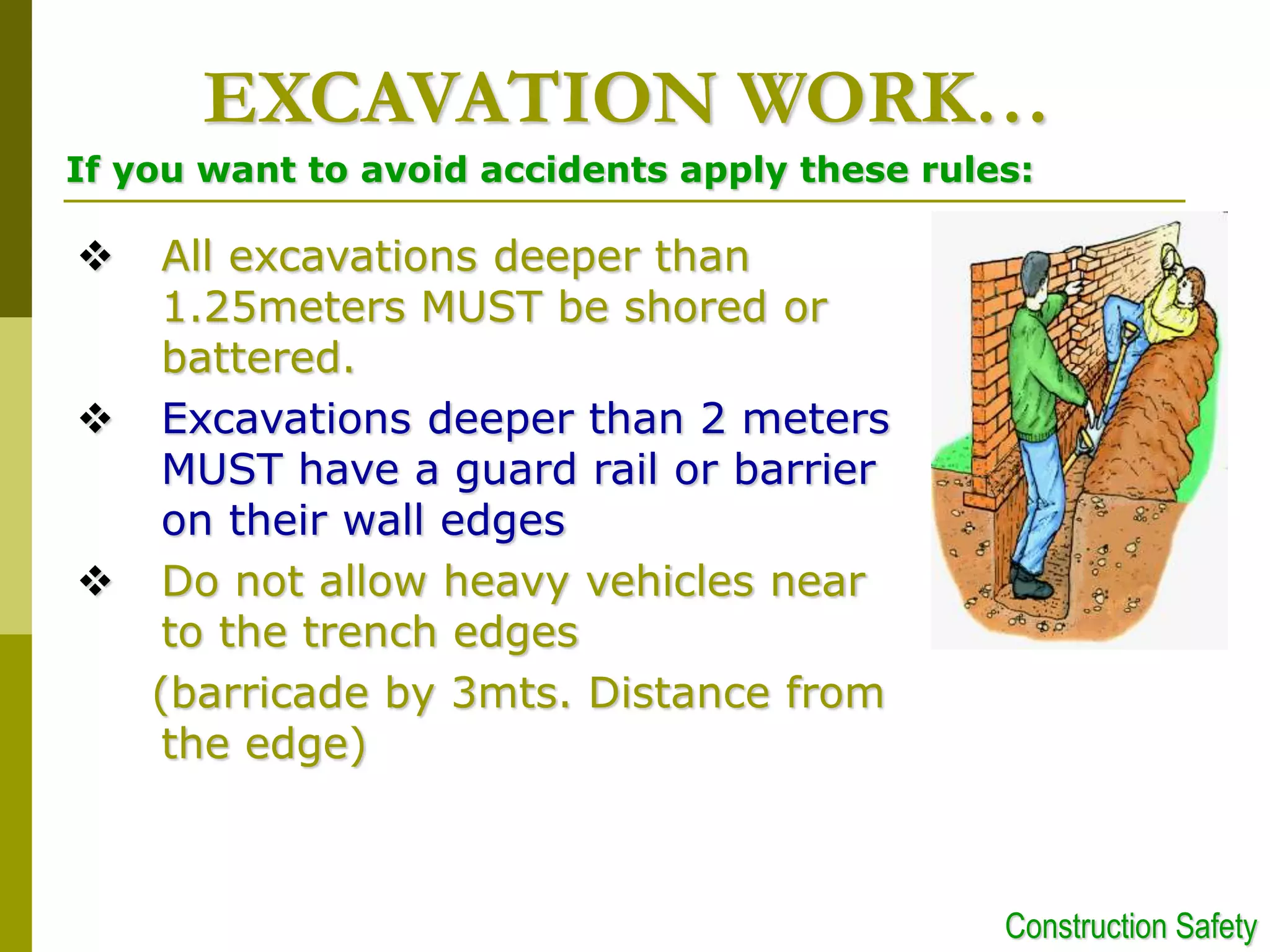
 All excavations deeper than
1.25meters MUST be shored or
battered.
 Excavations deeper than 2 meters
MUST have a guard rail or barrier
on their wall edges
 Do not allow heavy vehicles near
to the trench edges
(barricade by 3mts. Distance from
the edge)
EXCAVATION WORK…
If you want to avoid accidents apply these rules:
Construction Safety
EXCAVATION HAZARDS
 COLLAPSE OF
EARTHWORK
 ASPHYXITION
FROM EXHAUST
GASES
 WORKING
TOOCLOSE
TOGETHER
 EXCAVATED
SAND
 P.P.E
 Make sure the excavation is
inspected daily
 Make sure you know where any
underground pipes and cables
are before you hit them
REMEMBER:
There is no safe ground that “will
Not collapse”
Trench sides can collapse without
any warning
EXCAVATION WORK :
Construction Safety
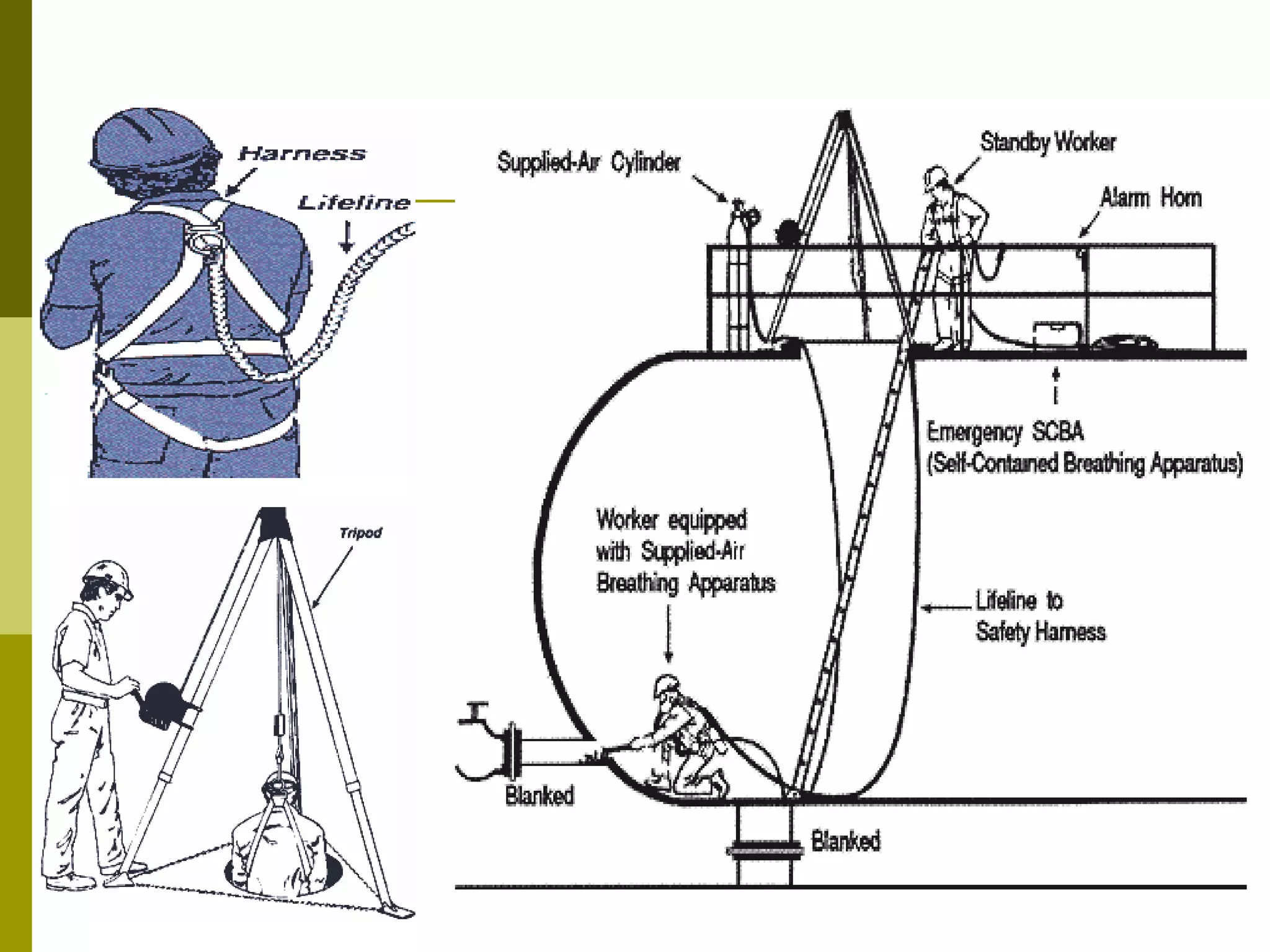
CONFIND SPACE ENTERY
A space that:
 Is large enough and so configured that an employee
can enter bodily and perform work;
 Has limited or restricted means of entry or exit;
 Is not designed for continuous human occupancy.
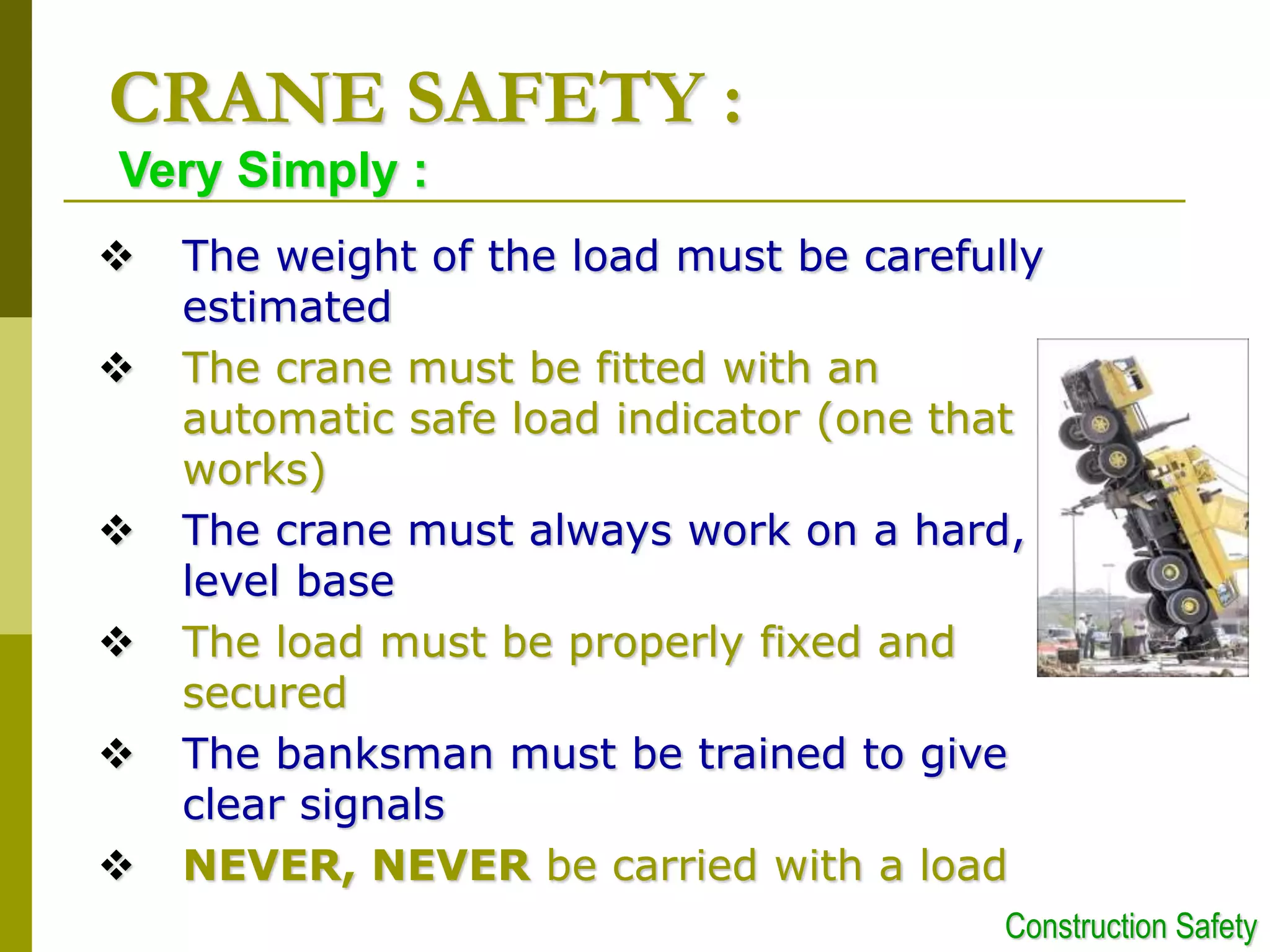
 The weight of the load must be carefully
estimated
 The crane must be fitted with an
automatic safe load indicator (one that
works)
 The crane must always work on a hard,
level base
 The load must be properly fixed and
secured
 The banksman must be trained to give
clear signals
 NEVER, NEVER be carried with a load
CRANE SAFETY :
Very Simply :
Construction Safety
LIFTING OPERATION & CRANE HAZARDS
 Competent Rigger one to be assigned to follow all
lifting operations
 Lifting plan and risk assessment before any lifting
operations
 Lifting area to be barricaded and empty from
unauthorized persons
 Tool box Talk before any lift
 When wind velocities are above 32 km/h lifting
operation to be stopped
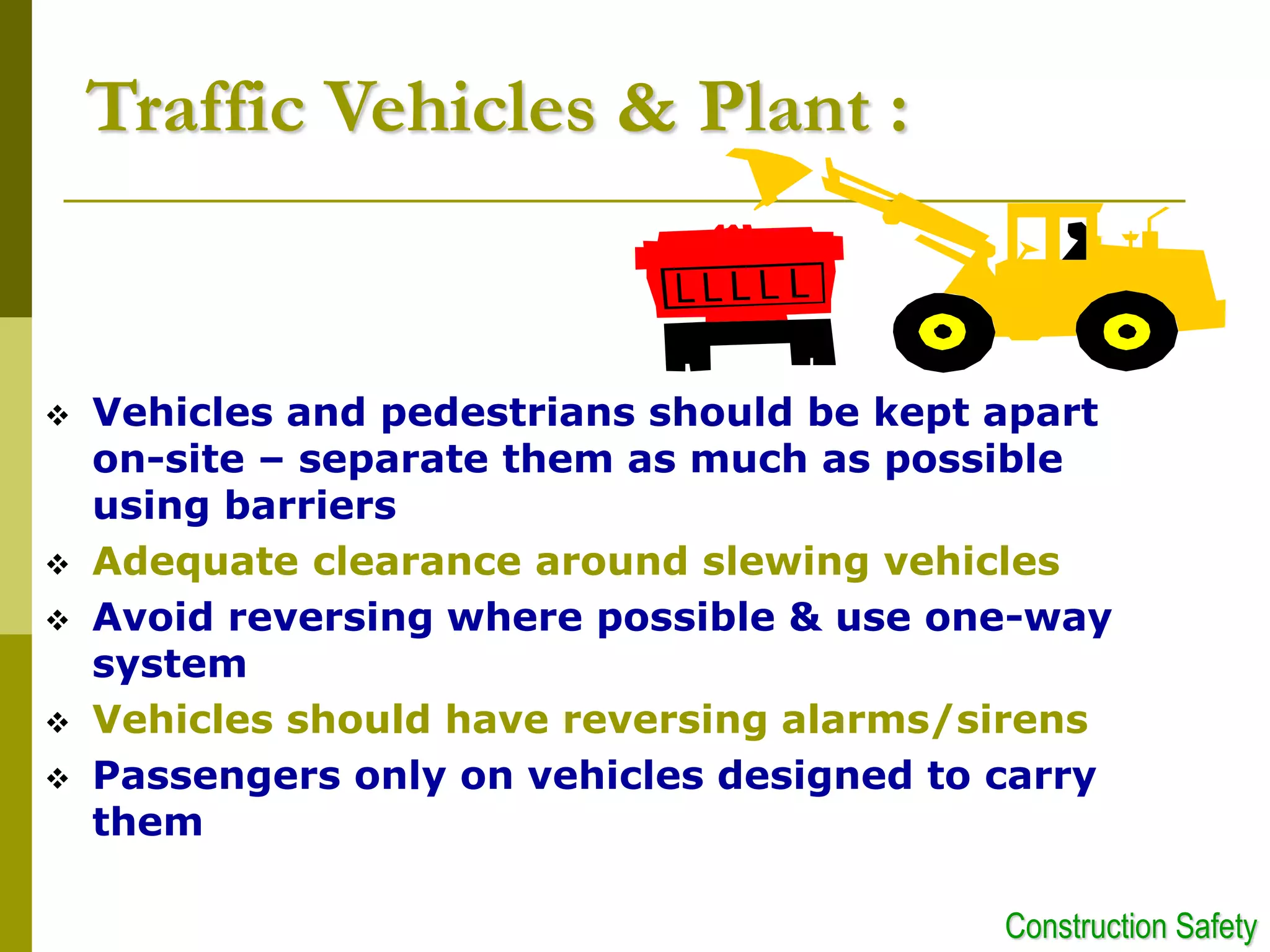
Traffic Vehicles & Plant :
 Vehicles and pedestrians should be kept apart
on-site – separate them as much as possible
using barriers
 Adequate clearance around slewing vehicles
 Avoid reversing where possible & use one-way
system
 Vehicles should have reversing alarms/sirens
 Passengers only on vehicles designed to carry
them
Construction Safety
Hoists :
Good Safety Practice
 Installed by a competent person
 Rated capacity clearly marked
 Current examination and
inspection report
 Suitable base enclosure to
prevent people being struck
by moving part of hoist
 Landing gates kept shut except when platform
is at landing
Construction Safety
 Treat electricity with respect
 Always use proper Circuit Breakers for
any live connections
 Check constantly that cables
are not damaged or worn
 Keep trailing cables off the
ground and away from water
 Never overload or use
makeshift plugs and fuses
ELECTRICITY :
Good practice with electricity on site :
Construction Safety
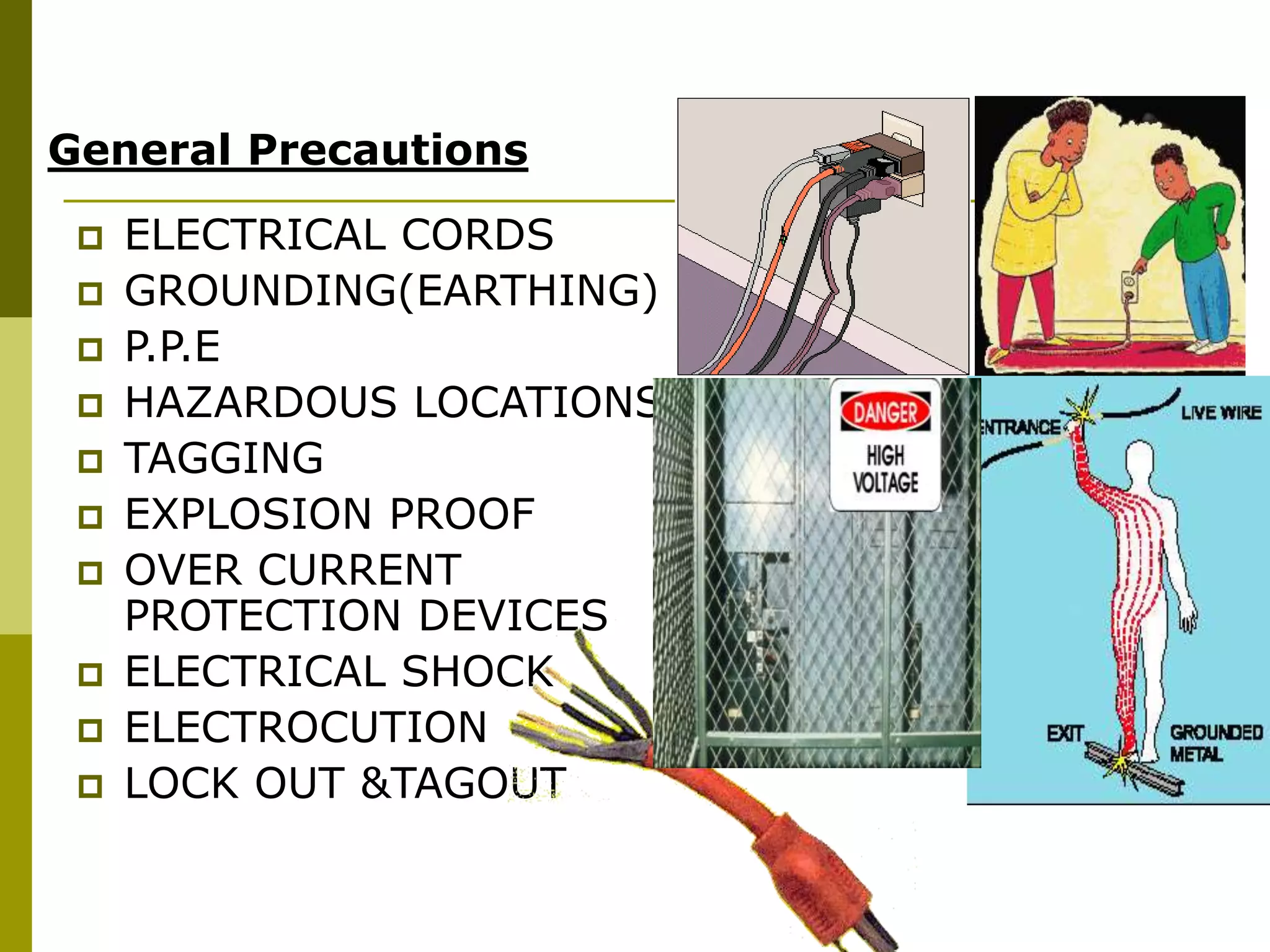
General Precautions
 ELECTRICAL CORDS
 GROUNDING(EARTHING)
 P.P.E
 HAZARDOUS LOCATIONS
 TAGGING
 EXPLOSION PROOF
 OVER CURRENT
PROTECTION DEVICES
 ELECTRICAL SHOCK
 ELECTROCUTION
 LOCK OUT &TAGOUT
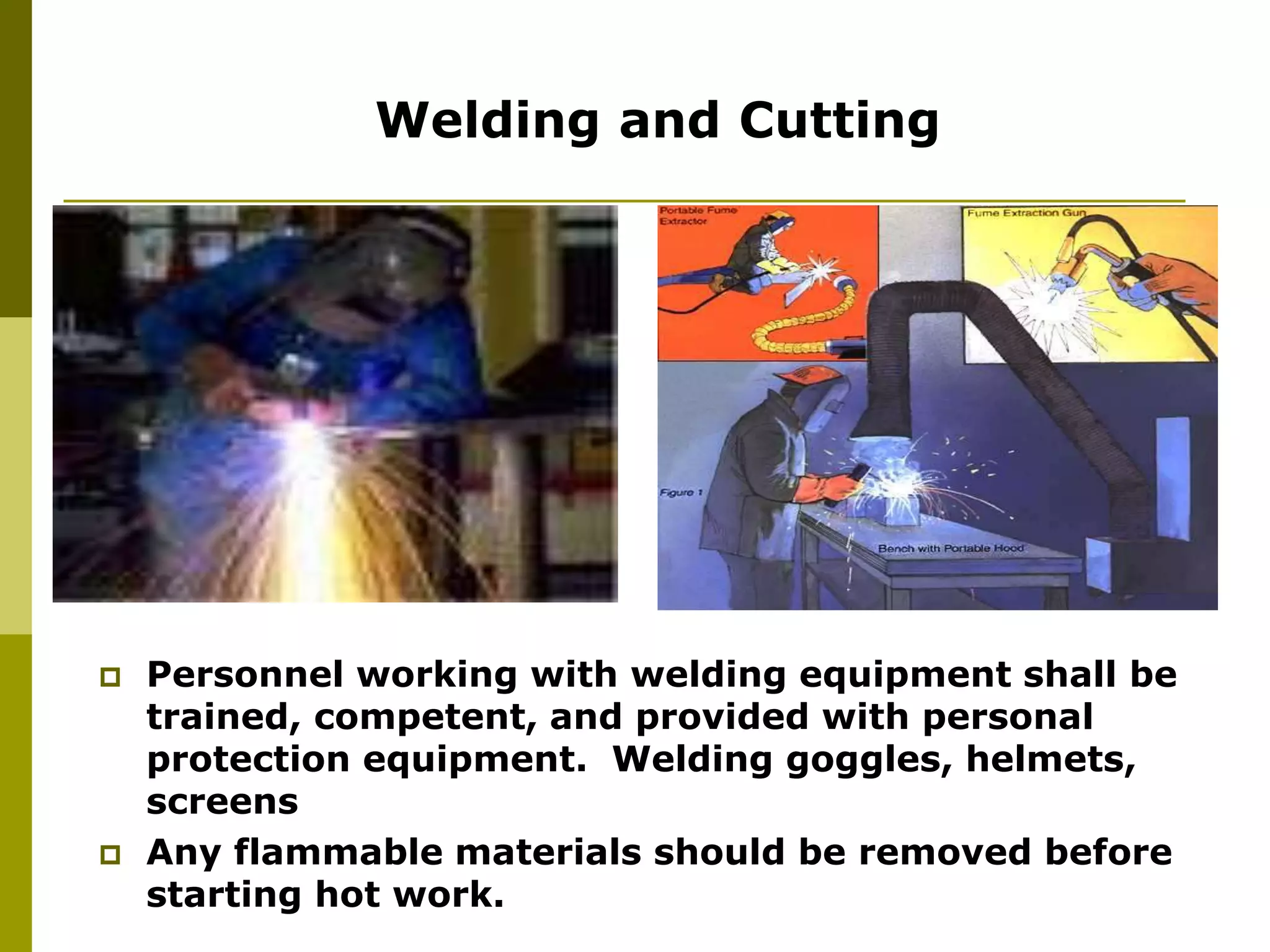
Welding and Cutting
 Personnel working with welding equipment shall be
trained, competent, and provided with personal
protection equipment. Welding goggles, helmets,
screens
 Any flammable materials should be removed before
starting hot work.
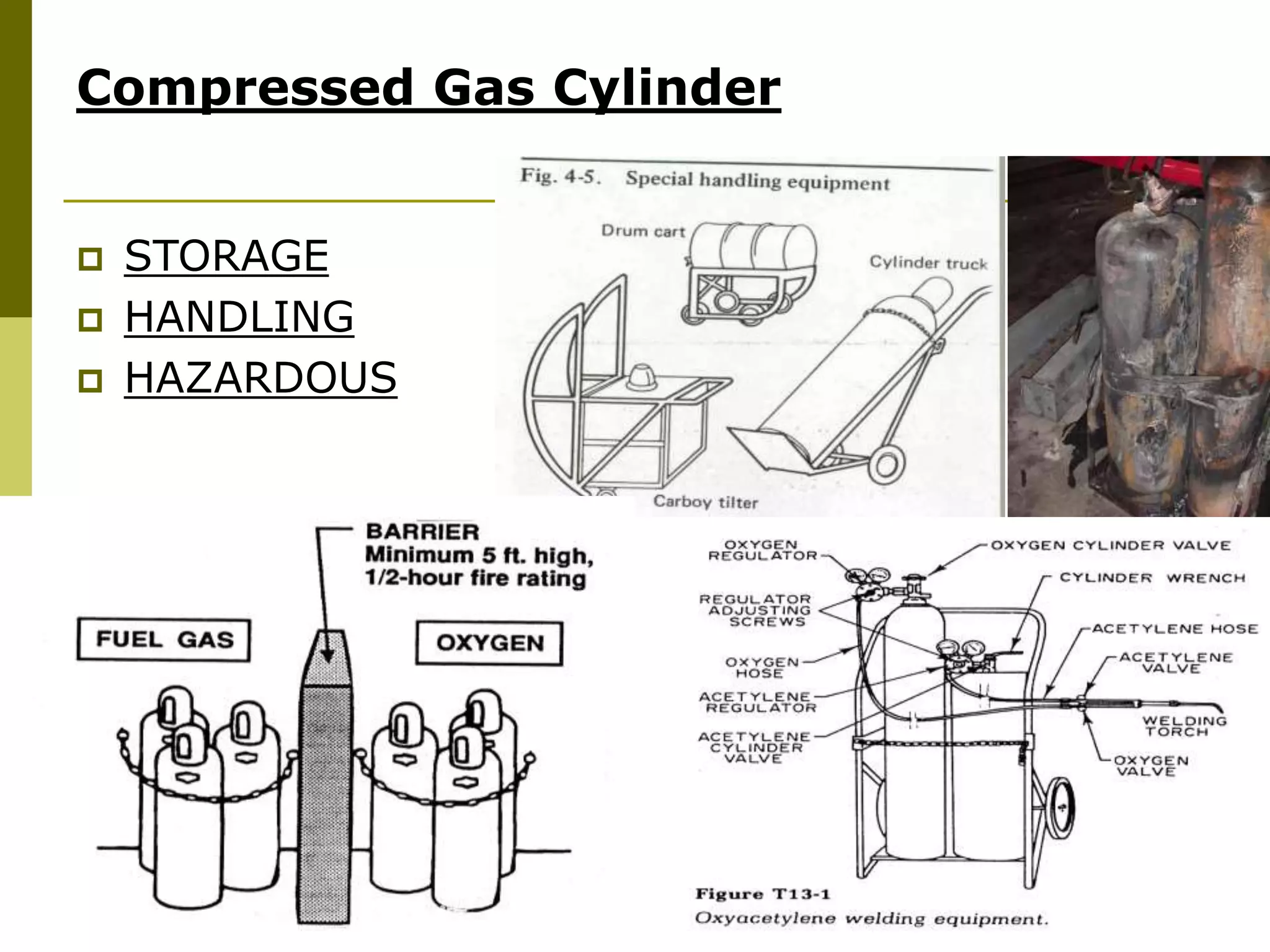
Compressed Gas Cylinder
 STORAGE
 HANDLING
 HAZARDOUS
General Precautions
 Face Shield & welding
Gloves
 Cylinder Hoses
 Grinding Machines
 Grinding Wheel
 Non Return Valves
 Welding Machines
 Regulator
 House Keeping
 Fire Extinguisher
 Welding Electrical Cables
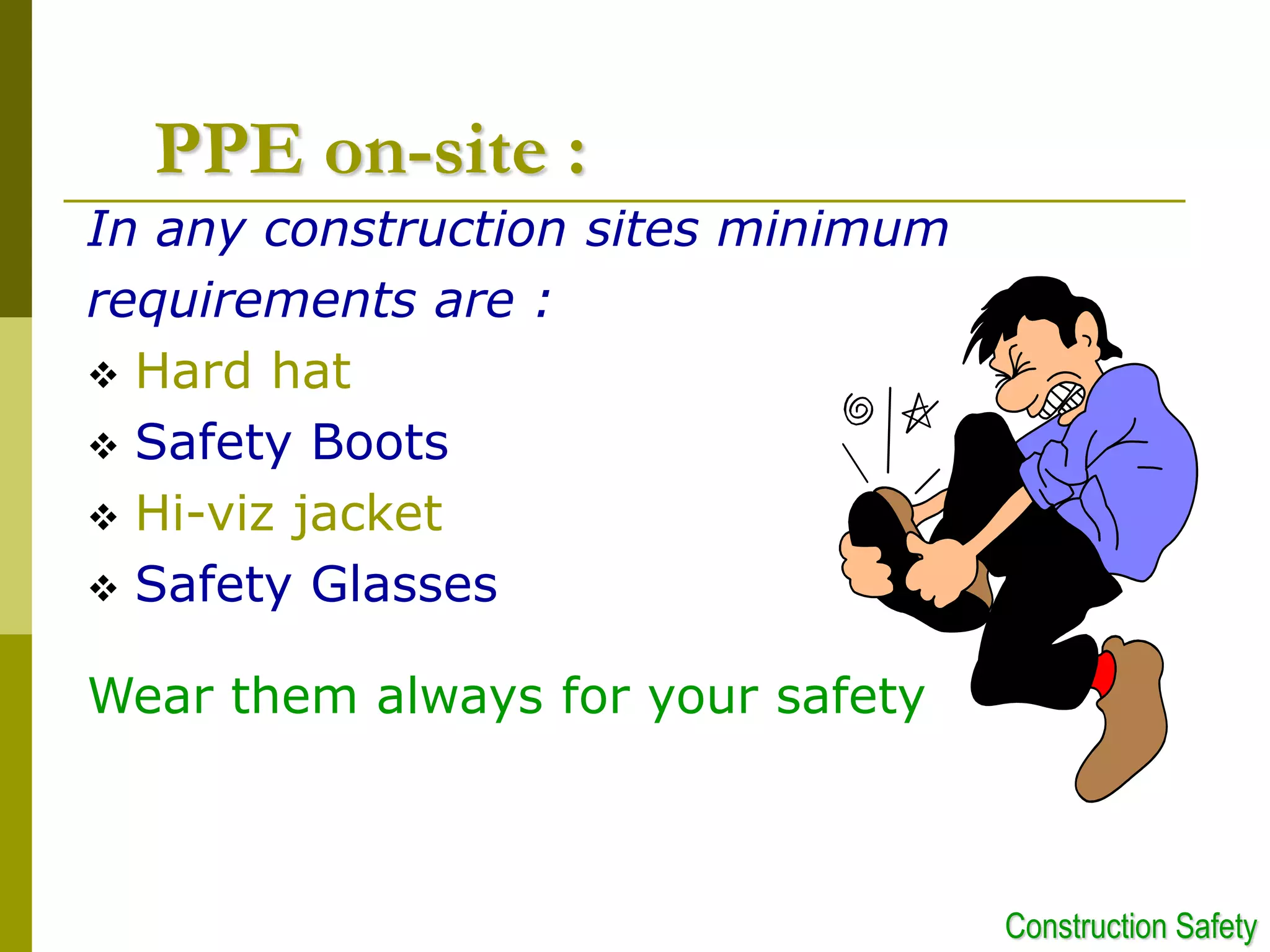
PPE on-site :
In any construction sites minimum
requirements are :
 Hard hat
 Safety Boots
 Hi-viz jacket
 Safety Glasses
Wear them always for your safety
Construction Safety
PERSONNEL PROTECTIVE
EQUIPMENT
 MINIMUM P.P.E
REQUIRED
 SAFETY SHOES
 SAFETY HELMET
 GOGGLES
 High Vest
 OTHERS ACCORDING
TO JOB
 GLOVES
 BREATHING APPARTUS
 FACE SHIELDING
 Safety Harness
 WELDING GLOVES
The Fire Triangle :
Fire Safety, at its most basic, is based upon the
principle of keeping fuel sources and ignition sources
separate.
Construction Safety
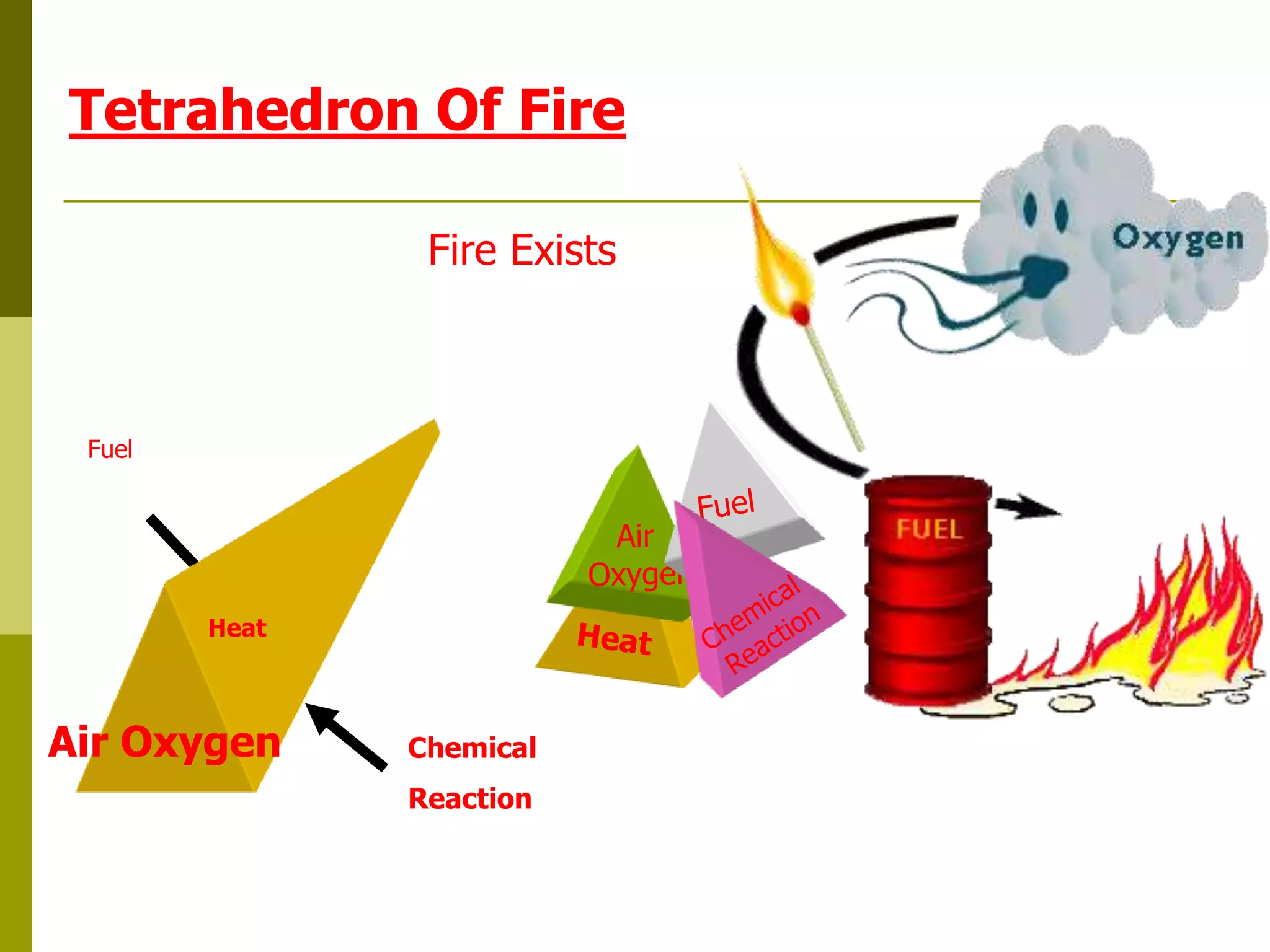
Tetrahedron Of Fire
Fire Exists
Air Oxygen
Heat
Chemical
Reaction
Fuel
The Fire :
 Enough OXYGEN to sustain combustion +
 Enough HEAT to reach ignition temperature +
 Some FUEL or combustible material =
 Together, they produce the CHEMICAL REACTION ,
that is “FIRE”
Three things must be present at the same time to produce fire:
Take away any one of these things and the fire will be
Extinguished
Construction Safety
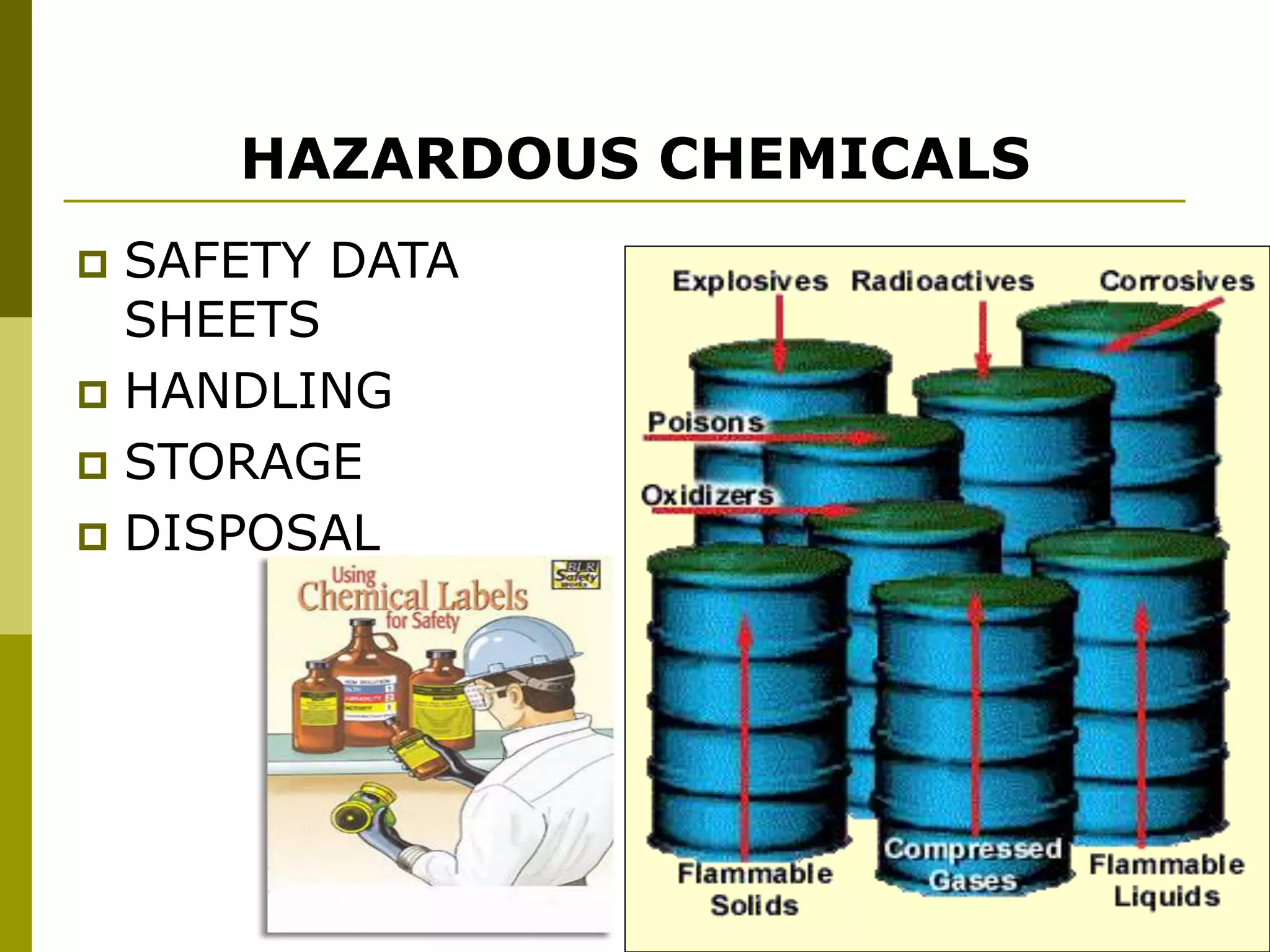
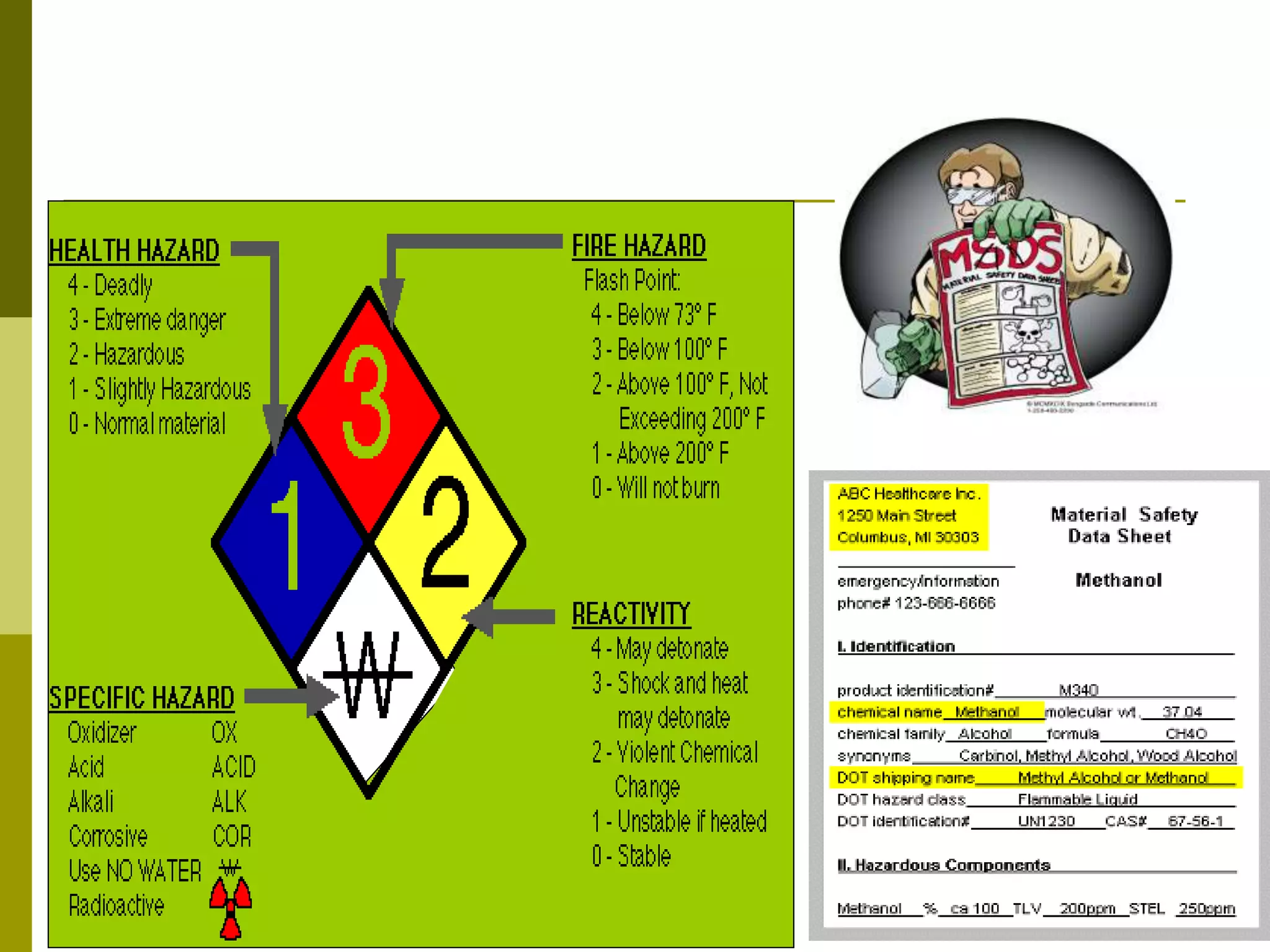
HAZARDOUS CHEMICALS
 SAFETY DATA
SHEETS
 HANDLING
 STORAGE
 DISPOSAL
Class A: Combustible Solids-Wood, paper,
cloth, trash, plastics—solids that are not
metals.
Class B: Flammable liquids—gasoline,
acetone, oil, grease, petrol, etc.
Class C: Flammable Gases-LPG, CNG,
Acetylene & Energized electrical equipments,
as long as it’s “plugged in.”
Class D: Metals—potassium, sodium,
aluminium, magnesium. Requires Special Dry
Powder and other special extinguishing
agents.
Fuel Classifications :
Construction Safety
Types of Fire Extinguishers :
Different types of fire extinguishers are designed to fight
different classes of fire.
The 4 most common types of fire extinguishers are:
1. Water (W/Co2) - For ‘A’ Class
2. Mechanical Foam (AFFF) – For ‘A’ & ‘B’ Class
3. Carbon Dioxide (CO2) – For ‘B’ & ‘C’ Class
4. Dry Chemical (ABC) – For ‘A’, ‘B’ & ‘C’ Class
Dry Chemical (BC) – For ‘B’ & ‘C’ Class
Construction Safety
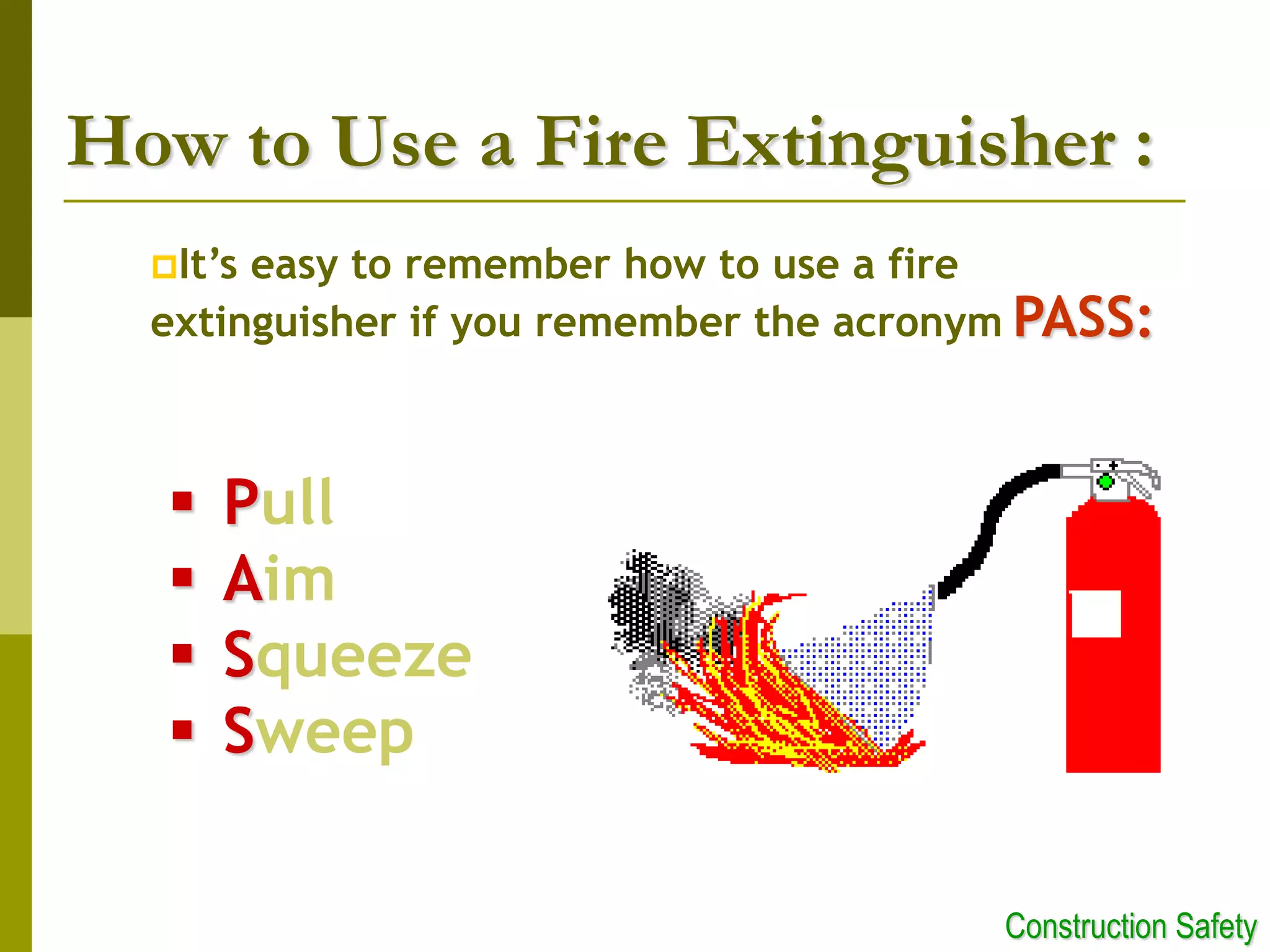
How to Use a Fire Extinguisher :
It’s easy to remember how to use a fire
extinguisher if you remember the acronym PASS:
 Pull
 Aim
 Squeeze
 Sweep
Construction Safety
Pull the pin or safety clip…
This will allow you to
discharge the extinguisher
How to Use a Fire Extinguisher :
Construction Safety
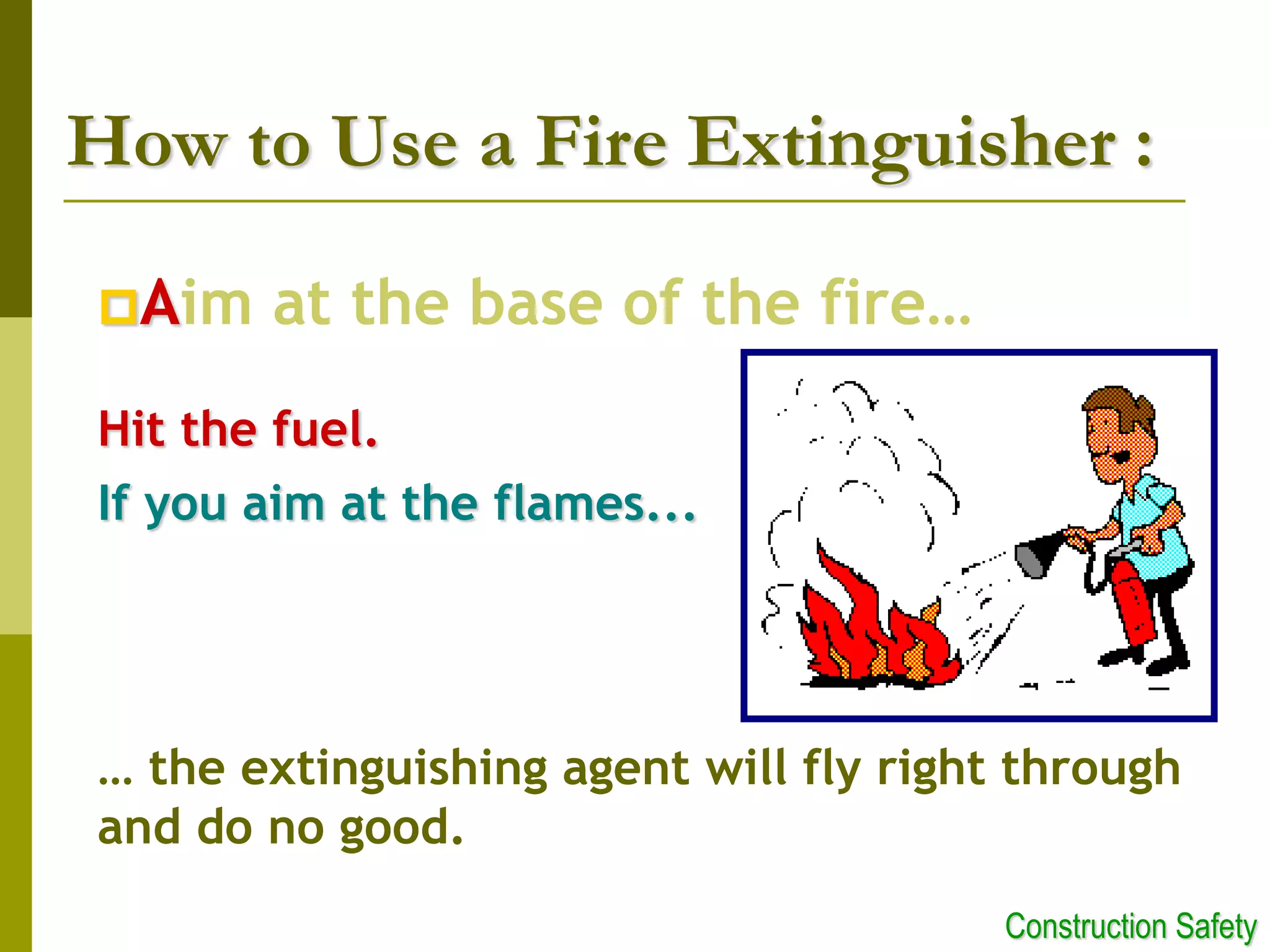
Aim at the base of the fire…
Hit the fuel.
If you aim at the flames...
… the extinguishing agent will fly right through
and do no good.
How to Use a Fire Extinguisher :
Construction Safety
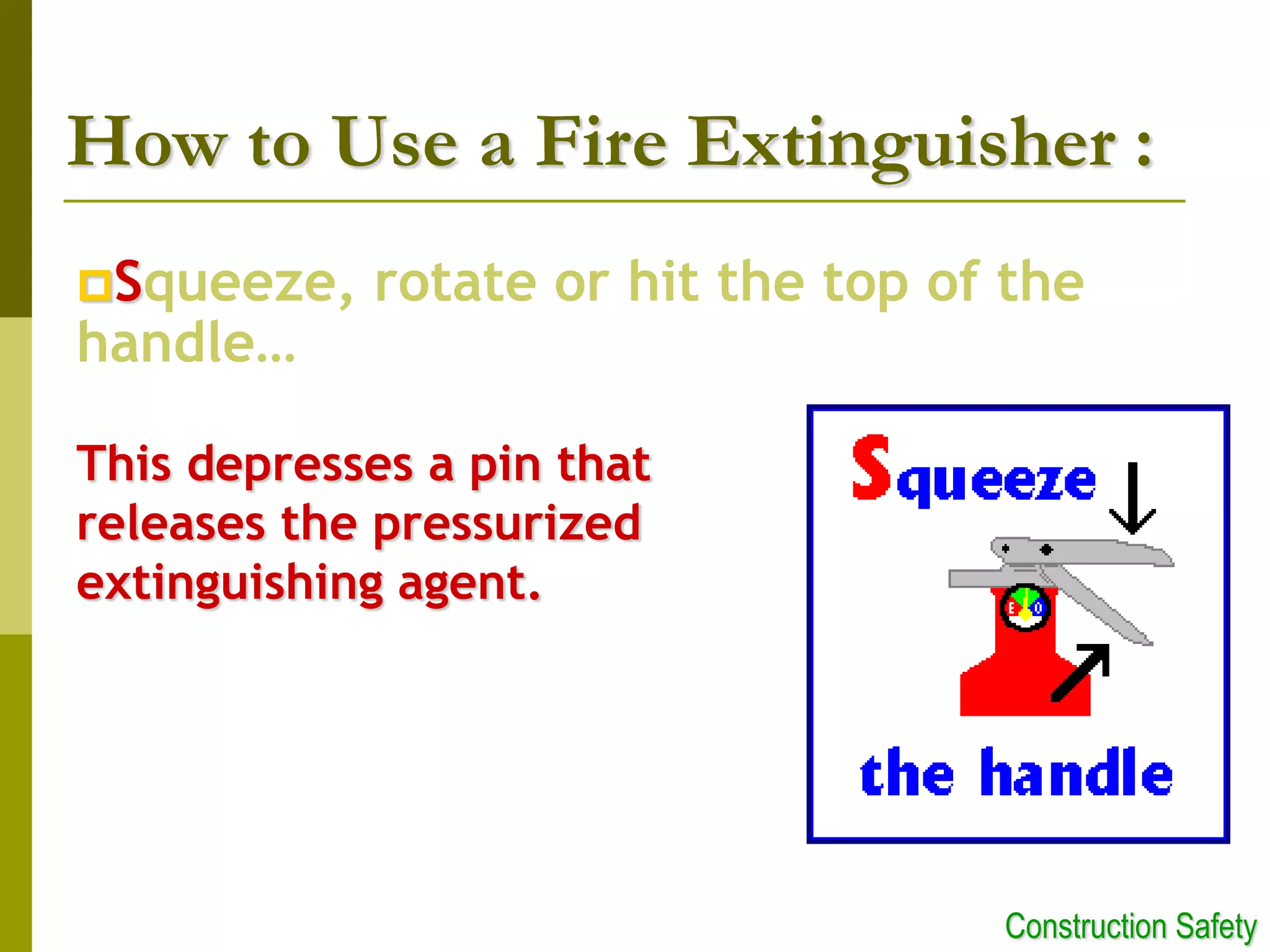
Squeeze, rotate or hit the top of the
handle…
This depresses a pin that
releases the pressurized
extinguishing agent.
How to Use a Fire Extinguisher :
Construction Safety
Sweep from side to side…
.. until the fire is
completely out.
Start using the
extinguisher from a
safe distance away,
then slowly move
forward.
Once the fire is out, keep an eye on the
area in case it re-ignites.
How to Use a Fire Extinguisher :
Construction Safety
BASIC SAFETY PHILOSOPHY FOR
SUCCESS : A New Safety Culture
 All accidents are preventable.
 No job is worth getting hurt for.
 Every job will be done safely.
 Incidents can be managed.
 Safety is everyone’s responsibility.
 Continuous improvement.
 Safety as a “way of life” for 24 hours/day
 All individuals have the responsibility and
accountability to identify eliminate or manage risks
associated with their workplace
 Legal obligations will be the minimum requirements
fro our health & safety standards
 Individual will be trained and equipped to have the
skills and facilities to ensure an accident free
workplace
Construction Safety
No job is so important that it
cannot be done SAFELY
SAFETY FIRST
CONCLUSION :
Construction Safety

Construction safety

  • 1.
    KNOW SAFETY |NO ACCIDENTS NO SAFETY | KNOW ACCIDENTS
  • 2.
  • 3.
    Causes of Accidents:  Direct Cause:  Unsafe Work Practice or Unsafe Act  Unsafe Physical Condition  Combination of Both Construction Safety
  • 4.
    Causes of Accidents:  Indirect Cause:  Lack of Knowledge and Skill  Physiological Unsuitability  Psychological Unsuitability Construction Safety
  • 5.
    Preventive Techniques : Administrative Technique  Safety Policy  Safety Education & Training  Selection & Placement  Safety Meeting  Safety Promotional Activities  Safety Committee  Motivation, Persuasion & Appeal  Disciplinary Action Construction Safety
  • 6.
    Preventive Techniques : Engineering Technique  Safe Designing  Safe Construction  Improved Physical Work Arrangements  Isolation and/or enclosure to dangerous operations/processes  Substitution of more hazardous material by less hazardous material  Controlled operations and process Construction Safety
  • 7.
    Presentation Contents : Introduction – A Few facts  Construction Accidents  Safe Access On-Site  Working at Height  Ladder Safety  Roof Safety  Excavation Work  Crane Safety  Traffic vehicles & Plant  Goods Hoist  Electricity  Working Near Sewage  PPE  Safety Success Construction Safety
  • 8.
     The firstweek on each new site is the most dangerous  Accidents are more frequent at the end of the day  Small building jobs are the most risky  Safety helmets, Hi-viz jackets, safety boots do prevent injury and death  Light weight shoes-such as trainers or runners are not suitable on site A FEW FACTS : Construction Safety
  • 9.
    Construction Accidents : Breakdownof fatalities according to type of accident in construction industry  56% falls from height  21% trapped by something collapsing or overturning  10% struck by a moving vehicle  5% contact with electricity or electrical discharge  4% struck by a flying/falling object during machine lifting of materials  3% contact with moving machinery or material being machined  1% exposure to a hot or harmful substance Construction Safety
  • 10.
    Safe Access OnSite :  Everyone can get to their place of work safely  Edges from which people could fall are provided with double guard rails or other suitable edge protection  Holes are protected with clearly marked and fixed covers to prevent falls  Site is tidy  Good lighting  Fenced off from public Construction Safety
  • 11.
    • TYPES OFPERMIT 1. Work permits will applied at construction area • Hot Work - This permit is required when using spark or flame producing equipment and for vehicle entry into a restricted area. • Cold Work - This permit is for work that will not produce sufficient energy to ignite flammable atmospheres/materials • Confined Space Entry This permit is required for tank cleaning, tank inspection, work in sewers or excavations. • Excavation work permit
  • 12.
    EMERGENCY RULES  EVACUATIONSIREN  ESCAPE ROUTES  ASSEMBLY POINTS  PERSONNEL ACCOUNT BY AREA COORDINATOR
  • 13.
    Height HAZARDS onConstruction Sites Cut-outs in floors, gaps on working platforms, Shafts and stairwells not adequately covered, barricaded, fenced off, open floor edges Working at Height :  Using ladders or scaffolding without proper fixing is crazy  Never use incomplete scaffolding.  Make sure there are hand rails and toe boards at all edges  Things fall on sites, wear your helmet  Before starting work at heights check for clearance from any overhead power lines  Always use fall arrestors & harnesses at the time of work at height Construction Safety
  • 14.
     Right forthe job. Would scaffolding be better?  In good shape  Secured near the top  On a firm base and footing 4 up – 1 out  Rising at least 1 meter beyond the landing place or that there is a proper hand hold Always have a firm grip on the ladder and keep a good balance LETHAL LADDERS : Ladders kill a lot of people… Make sure the ladder is: Construction Safety
  • 15.
    Safe Ladders : Never allow more than one person on a ladder  Use tool belts or hand lines to carry objects.  Do not lean out from the ladder in any direction  If you have a fear of heights – don’t climb a ladder  Do not allow others to work under a ladder in use Construction Safety
  • 16.
    Do not usethe top or top step of a stepladder as a step PORTABLE LADDERS
  • 18.
    SCAFFOLDING  Any workingover than 1.82 meter shall be done using scaffold  Scaffolds will be erected, dismantled and inspected by trained and certified supervisor
  • 19.
    CONSTRUCTION COMMON TOALL SCAFFOLD  FOUNDATION  TOE-BOARDS  HANDRAILS  MIDRAILS  BRACING  LADDER WITH GUARD RAILS  PLATFORMS  TAGGING
  • 20.
    TYPES OF SCAFFOLDING FIXED SCAFFOLDING MOBILESCAFFOLDING
  • 21.
    THE ROOF :A RISKY PLACE TO BE . . . Very Simply :  Always inspect a roof before you walk on it  You must have protection to stop you from falling off the edge  You must use proper safety harnesses and running cables when working on top of a roof Remember: a walk along a fragile roof could be your last 50% of fatal injuries involving roofs are falls thru’ fragile materials, 30% are falls from edges and openings Construction Safety
  • 22.
     All excavationsdeeper than 1.25meters MUST be shored or battered.  Excavations deeper than 2 meters MUST have a guard rail or barrier on their wall edges  Do not allow heavy vehicles near to the trench edges (barricade by 3mts. Distance from the edge) EXCAVATION WORK… If you want to avoid accidents apply these rules: Construction Safety
  • 23.
    EXCAVATION HAZARDS  COLLAPSEOF EARTHWORK  ASPHYXITION FROM EXHAUST GASES  WORKING TOOCLOSE TOGETHER  EXCAVATED SAND  P.P.E
  • 24.
     Make surethe excavation is inspected daily  Make sure you know where any underground pipes and cables are before you hit them REMEMBER: There is no safe ground that “will Not collapse” Trench sides can collapse without any warning EXCAVATION WORK : Construction Safety
  • 25.
    CONFIND SPACE ENTERY Aspace that:  Is large enough and so configured that an employee can enter bodily and perform work;  Has limited or restricted means of entry or exit;  Is not designed for continuous human occupancy.
  • 27.
     The weightof the load must be carefully estimated  The crane must be fitted with an automatic safe load indicator (one that works)  The crane must always work on a hard, level base  The load must be properly fixed and secured  The banksman must be trained to give clear signals  NEVER, NEVER be carried with a load CRANE SAFETY : Very Simply : Construction Safety
  • 28.
    LIFTING OPERATION &CRANE HAZARDS  Competent Rigger one to be assigned to follow all lifting operations  Lifting plan and risk assessment before any lifting operations  Lifting area to be barricaded and empty from unauthorized persons  Tool box Talk before any lift  When wind velocities are above 32 km/h lifting operation to be stopped
  • 29.
    Traffic Vehicles &Plant :  Vehicles and pedestrians should be kept apart on-site – separate them as much as possible using barriers  Adequate clearance around slewing vehicles  Avoid reversing where possible & use one-way system  Vehicles should have reversing alarms/sirens  Passengers only on vehicles designed to carry them Construction Safety
  • 30.
    Hoists : Good SafetyPractice  Installed by a competent person  Rated capacity clearly marked  Current examination and inspection report  Suitable base enclosure to prevent people being struck by moving part of hoist  Landing gates kept shut except when platform is at landing Construction Safety
  • 31.
     Treat electricitywith respect  Always use proper Circuit Breakers for any live connections  Check constantly that cables are not damaged or worn  Keep trailing cables off the ground and away from water  Never overload or use makeshift plugs and fuses ELECTRICITY : Good practice with electricity on site : Construction Safety
  • 32.
    General Precautions  ELECTRICALCORDS  GROUNDING(EARTHING)  P.P.E  HAZARDOUS LOCATIONS  TAGGING  EXPLOSION PROOF  OVER CURRENT PROTECTION DEVICES  ELECTRICAL SHOCK  ELECTROCUTION  LOCK OUT &TAGOUT
  • 33.
    Welding and Cutting Personnel working with welding equipment shall be trained, competent, and provided with personal protection equipment. Welding goggles, helmets, screens  Any flammable materials should be removed before starting hot work.
  • 34.
    Compressed Gas Cylinder STORAGE  HANDLING  HAZARDOUS
  • 35.
    General Precautions  FaceShield & welding Gloves  Cylinder Hoses  Grinding Machines  Grinding Wheel  Non Return Valves  Welding Machines  Regulator  House Keeping  Fire Extinguisher  Welding Electrical Cables
  • 36.
    PPE on-site : Inany construction sites minimum requirements are :  Hard hat  Safety Boots  Hi-viz jacket  Safety Glasses Wear them always for your safety Construction Safety
  • 37.
    PERSONNEL PROTECTIVE EQUIPMENT  MINIMUMP.P.E REQUIRED  SAFETY SHOES  SAFETY HELMET  GOGGLES  High Vest  OTHERS ACCORDING TO JOB  GLOVES  BREATHING APPARTUS  FACE SHIELDING  Safety Harness  WELDING GLOVES
  • 38.
    The Fire Triangle: Fire Safety, at its most basic, is based upon the principle of keeping fuel sources and ignition sources separate. Construction Safety
  • 39.
    Tetrahedron Of Fire FireExists Air Oxygen Heat Chemical Reaction Fuel
  • 40.
    The Fire : Enough OXYGEN to sustain combustion +  Enough HEAT to reach ignition temperature +  Some FUEL or combustible material =  Together, they produce the CHEMICAL REACTION , that is “FIRE” Three things must be present at the same time to produce fire: Take away any one of these things and the fire will be Extinguished Construction Safety
  • 41.
    HAZARDOUS CHEMICALS  SAFETYDATA SHEETS  HANDLING  STORAGE  DISPOSAL
  • 43.
    Class A: CombustibleSolids-Wood, paper, cloth, trash, plastics—solids that are not metals. Class B: Flammable liquids—gasoline, acetone, oil, grease, petrol, etc. Class C: Flammable Gases-LPG, CNG, Acetylene & Energized electrical equipments, as long as it’s “plugged in.” Class D: Metals—potassium, sodium, aluminium, magnesium. Requires Special Dry Powder and other special extinguishing agents. Fuel Classifications : Construction Safety
  • 44.
    Types of FireExtinguishers : Different types of fire extinguishers are designed to fight different classes of fire. The 4 most common types of fire extinguishers are: 1. Water (W/Co2) - For ‘A’ Class 2. Mechanical Foam (AFFF) – For ‘A’ & ‘B’ Class 3. Carbon Dioxide (CO2) – For ‘B’ & ‘C’ Class 4. Dry Chemical (ABC) – For ‘A’, ‘B’ & ‘C’ Class Dry Chemical (BC) – For ‘B’ & ‘C’ Class Construction Safety
  • 45.
    How to Usea Fire Extinguisher : It’s easy to remember how to use a fire extinguisher if you remember the acronym PASS:  Pull  Aim  Squeeze  Sweep Construction Safety
  • 46.
    Pull the pinor safety clip… This will allow you to discharge the extinguisher How to Use a Fire Extinguisher : Construction Safety
  • 47.
    Aim at thebase of the fire… Hit the fuel. If you aim at the flames... … the extinguishing agent will fly right through and do no good. How to Use a Fire Extinguisher : Construction Safety
  • 48.
    Squeeze, rotate orhit the top of the handle… This depresses a pin that releases the pressurized extinguishing agent. How to Use a Fire Extinguisher : Construction Safety
  • 49.
    Sweep from sideto side… .. until the fire is completely out. Start using the extinguisher from a safe distance away, then slowly move forward. Once the fire is out, keep an eye on the area in case it re-ignites. How to Use a Fire Extinguisher : Construction Safety
  • 50.
    BASIC SAFETY PHILOSOPHYFOR SUCCESS : A New Safety Culture  All accidents are preventable.  No job is worth getting hurt for.  Every job will be done safely.  Incidents can be managed.  Safety is everyone’s responsibility.  Continuous improvement.  Safety as a “way of life” for 24 hours/day  All individuals have the responsibility and accountability to identify eliminate or manage risks associated with their workplace  Legal obligations will be the minimum requirements fro our health & safety standards  Individual will be trained and equipped to have the skills and facilities to ensure an accident free workplace Construction Safety
  • 51.
    No job isso important that it cannot be done SAFELY SAFETY FIRST CONCLUSION : Construction Safety