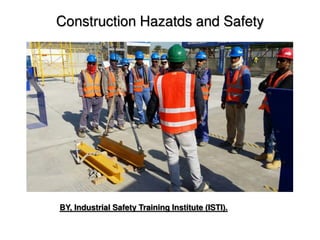
Construction Hazatds and Safety
BY, Industrial Safety Training Institute (ISTI).
Learning outcome
At the end of the lecture, students should be able to:
• Understand the different types of existing hazards on site
• Comprehend the diferent types of accident measurement
approach
• Reflect on the Swedish construction accident records
• Appreciate the importance for improving health & safety
in construction
• Undertake the techniques of improving health & safety in
construction
• Understand the existing legislative framework
• Understand an accident analysis if required.
• Safety is free from risk and danger.
• Accidents is defined as an unexpected and
desirable event resulting in damage or harm.
• Hazards is an unsafe condition or activity, that if
left uncontrolled can contribute to an accident.
• Risk is the assessment of ’probability of loss’
and ’potential amount of loss’.
(concise Oxford Dictionary)
Definitions
Common situation on a construction site
• Construction work is dynamic, diverse, and constantly
changing in nature.
• Constantly changing job site environments and
conditions
• Multiple contractors and subcontractors
• High turnover; unskilled laborers
• Constantly changing relationships with other work
groups
• Diversity of work activities occurring simultaneously
• Construction workers are at risk of exposure to various
hazards and risks that can result in injury, illness,
permanent disability, or even death.
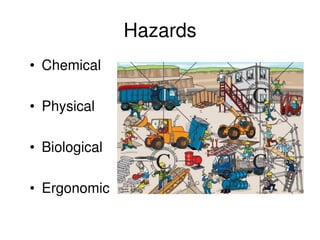
Hazards
• Chemical
• Physical
• Biological
• Ergonomic
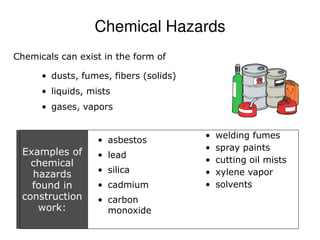
Chemical Hazards
Chemicals can exist in the form of
• dusts, fumes, fibers (solids)
• liquids, mists
• gases, vapors
• welding fumes
• spray paints
• cutting oil mists
• xylene vapor
• solvents
Examples of
chemical
hazards
found in
construction
work:
• asbestos
• lead
• silica
• cadmium
• carbon
monoxide
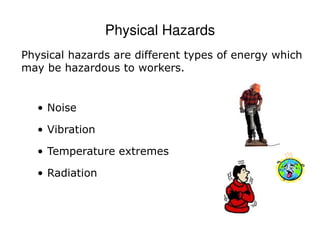
Physical Hazards
• Noise
• Vibration
• Temperature extremes
• Radiation
Physical hazards are different types of energy which
may be hazardous to workers.
Biological Hazards
Exposure may occur during demolition, renovation,
sewer work, work on air handling systems, or other
construction work from contact with contaminated or
disease-carrying
• soil
• water
• insects (mosquitoes, ticks)
• bird, bat droppings
• animals
• structures
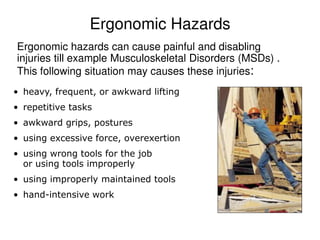
Ergonomic Hazards
Ergonomic hazards can cause painful and disabling
injuries till example Musculoskeletal Disorders (MSDs) .
This following situation may causes these injuries:
• heavy, frequent, or awkward lifting
• repetitive tasks
• awkward grips, postures
• using excessive force, overexertion
• using wrong tools for the job
or using tools improperly
• using improperly maintained tools
• hand-intensive work
Types of accident measurements
• Death
• Fatal injury (broken leg, hips, amputation)
• Non-fatal injury (finger cut)
• Occupational accidents (MSD, hearing loss)
• Absence from work ( >1 day, > 3 days etc)
• Near misses
• Rate per 100 000 – number of injuries or causes
of ill health per 100 000 employees.
• Working days lost – days off work due to
workplace injuries & work-related ill health
Other health hazards
• Living conditions and welfare facilities
– Temporary accomodation
– Food
– Drinking water
– Sanitary conveniences
– Facility for clothing
• Work related mental stresses
– Alcoholism and drug addiction
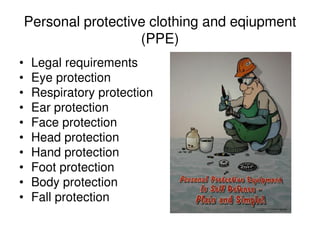
Personal protective clothing and eqiupment
(PPE)
• Legal requirements
• Eye protection
• Respiratory protection
• Ear protection
• Face protection
• Head protection
• Hand protection
• Foot protection
• Body protection
• Fall protection
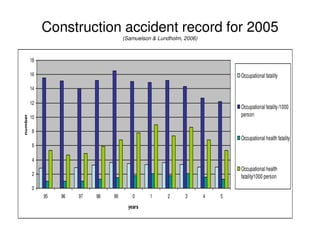
Construction accident record for 2005
(Samuelson & Lundholm, 2006)
0
2
4
6
8
10
12
14
16
18
95 96 97 98 99 0 1 2 3 4 5
years
number
Occupational fatality
Occupational fatality/1000
person
Occupational health fatality
Occupational health
fatality/1000 person
Leackage, flood
1%
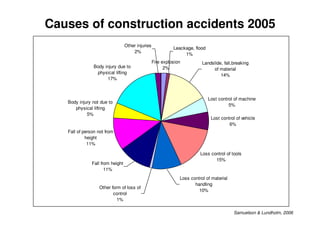
Landslide, fall,breaking
of material
14%
Fire explosion
2%
Other injuries
2%
Body injury due to
physical lifting
17%
Body injury not due to
physical lifting
5%
Fall of person not from
height
11%
Fall from height
11%
Other form of loss of
control
1%
Loss control of material
handling
10%
Loss control of tools
15%
Lost control of vehicle
6%
Lost control of machine
5%
Samuelson & Lundholm, 2006
Causes of construction accidents 2005
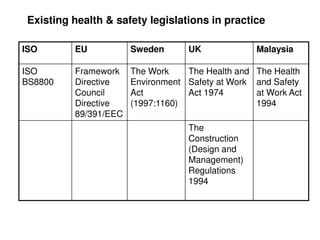
ISO EU Sweden UK Malaysia
ISO
BS8800
Framework
Directive
Council
Directive
89/391/EEC
The Work
Environment
Act
(1997:1160)
The Health and
Safety at Work
Act 1974
The Health
and Safety
at Work Act
1994
The
Construction
(Design and
Management)
Regulations
1994
Existing health & safety legislations in practice
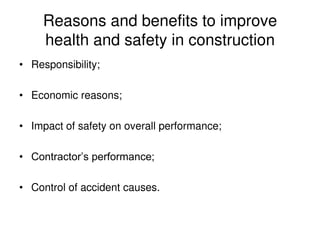
Reasons and benefits to improve
health and safety in construction
• Responsibility;
• Economic reasons;
• Impact of safety on overall performance;
• Contractor’s performance;
• Control of accident causes.
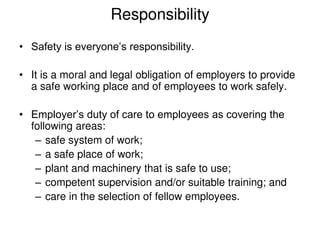
Responsibility
• Safety is everyone’s responsibility.
• It is a moral and legal obligation of employers to provide
a safe working place and of employees to work safely.
• Employer’s duty of care to employees as covering the
following areas:
– safe system of work;
– a safe place of work;
– plant and machinery that is safe to use;
– competent supervision and/or suitable training; and
– care in the selection of fellow employees.
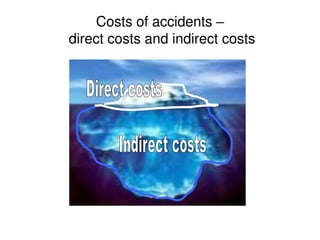
Costs of accidents –
direct costs and indirect costs
Direct costs
The direct costs are insurance. These include medical costs and
others workers’ compensation insurance benefits as well as
liability and property-damage insurance.
Indirect costs
Below are the lists of indirect costs:
Transportation costs – include the cost of emergency
transportation, together with the cost of other personnel that
were necessary to get to the injured worker to proper medical
facilities
Wages paid to injured worker for time not worked – include all the
time in which the worker was not actually doing his or her job
and for the wages paid.
Cost incurred because of delays which resulted from accident –
other crews affected or delayed; equipment idled; duration of
project lengthened; plus all wages, rental fees and indirect
supervision costs that occurred as a result of the accident.
Costs of overtime necessitated by accidents – overtime occurred
because of the accidents
Loss of efficiency of crew – decrease of crew efficiency due to low
morale or reshuffling that might occur to replace an injured
worker.
Cost to break in and/or teach replacement worker – hiring new
worker would include training and orientation
Costs for clean-up, repair or replacement and stand-by costs –
normally accidents involves spillage, cave-ins vehicle damage,
material wastage or site clean-up
Extra wage costs, slower returned worker – normally when a
worker return to the job site and is partially and/or temporarily
disabled, the worker is probably working at a different, less
demanding job or less efficient at the former job.
Costs to reschedule work – include time spent to review and
reschedule the project due to investigations or project being
temporarily suspended by the authorities.
Costs of wages for supervision as a result of the accidents –
include all time spent on the accident and its results: caring for
the worker’s medical treatment, investigation, completing forms,
disseminating information, visiting the worker, planning to
prevent recurrence, appearance in court
Costs for safety and clerical personnel as a result of the accident –
typing, investigating, forwarding forms, time with press, etc.
OSHA and civil fines – paying fines.
Cost of legal assistance – engaging a lawyer to settle the accident
claims.
Other costs – any other cost that were incurred because of the
accidents.
The average ratio of indirect costs to direct costs is 4:1.
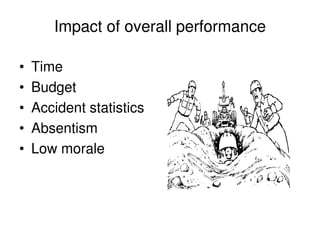
Impact of overall performance
• Time
• Budget
• Accident statistics
• Absentism
• Low morale
Contractor’s performance
• Studies have proved that there is an
adverse effect on a contractor’s reputation
and unfavourable image for the client
when the project suffers high accident
rates.
Control of accident causes
• Safety performance measurement enables behaviours
and conditions to be identified that have the greatest
potential in contributing to an accident.
• It also forms a basis to predict future accident problems
and enables management to control the causes of
accidents on site and establish long-term accident
control.
• These measurement techniques provide continuous
information concerning changes in the safety state within
an organisation in operation.
How to improve health and safety on
construction sites?
• Reactive measures
– Accident recording & reporting
– Accident investigations
• Proactive measures
– H & s safety policy
– H & s safety programme/plan
– H & s safety induction/training
– Tool-box talk
– Others
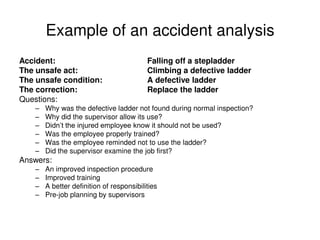
Example of an accident analysis
Accident: Falling off a stepladder
The unsafe act: Climbing a defective ladder
The unsafe condition: A defective ladder
The correction: Replace the ladder
Questions:
– Why was the defective ladder not found during normal inspection?
– Why did the supervisor allow its use?
– Didn’t the injured employee know it should not be used?
– Was the employee properly trained?
– Was the employee reminded not to use the ladder?
– Did the supervisor examine the job first?
Answers:
– An improved inspection procedure
– Improved training
– A better definition of responsibilities
– Pre-job planning by supervisors
References
• Grifitth A & Howarth T. 2000. Construction health & safety management.
Pearson Education Limited.
• Samuelson B & Lundholm L. 2006. Arbetsskador I byggverksamhet 2005.
Byggindustrins
• Kunju Ahmad. 2000. Developing a safety performance measurement tool
(SPMT) for construction sites. Loughborough University thesis. UK.
• Heberle D. 1998. Construction safety manual. McGraw Hill. USA.
• Davies V.J. Tomasin K. 1990. Construction safety handbook. Thomas
Telford, London.
• Brown. 1996. Total integration of safety professional into project
management. Proceedings. of the 1st International Conference of CIB,
Libson, W99. pp 137-144.
Regards, Mr. SYED HAIDER ABBAS
MOB. +92-300-2893683
MBA in progress,
NEBOSH IGC, IOSH, HSRLI, NBCS,GI,FST,FOHSW,ISO 9001, 14001,
'BS OHSAS 18001, SAI 8000, Qualified .
https://www.facebook.com/HseIndustrialSafetyIsti

Construction hazards and_safety_by_isti

  • 1.
    Construction Hazatds andSafety BY, Industrial Safety Training Institute (ISTI).
  • 2.
    Learning outcome At theend of the lecture, students should be able to: • Understand the different types of existing hazards on site • Comprehend the diferent types of accident measurement approach • Reflect on the Swedish construction accident records • Appreciate the importance for improving health & safety in construction • Undertake the techniques of improving health & safety in construction • Understand the existing legislative framework • Understand an accident analysis if required.
  • 3.
    • Safety isfree from risk and danger. • Accidents is defined as an unexpected and desirable event resulting in damage or harm. • Hazards is an unsafe condition or activity, that if left uncontrolled can contribute to an accident. • Risk is the assessment of ’probability of loss’ and ’potential amount of loss’. (concise Oxford Dictionary) Definitions
  • 4.
    Common situation ona construction site • Construction work is dynamic, diverse, and constantly changing in nature. • Constantly changing job site environments and conditions • Multiple contractors and subcontractors • High turnover; unskilled laborers • Constantly changing relationships with other work groups • Diversity of work activities occurring simultaneously • Construction workers are at risk of exposure to various hazards and risks that can result in injury, illness, permanent disability, or even death.
  • 5.
    Hazards • Chemical • Physical •Biological • Ergonomic
  • 6.
    Chemical Hazards Chemicals canexist in the form of • dusts, fumes, fibers (solids) • liquids, mists • gases, vapors • welding fumes • spray paints • cutting oil mists • xylene vapor • solvents Examples of chemical hazards found in construction work: • asbestos • lead • silica • cadmium • carbon monoxide
  • 7.
    Physical Hazards • Noise •Vibration • Temperature extremes • Radiation Physical hazards are different types of energy which may be hazardous to workers.
  • 8.
    Biological Hazards Exposure mayoccur during demolition, renovation, sewer work, work on air handling systems, or other construction work from contact with contaminated or disease-carrying • soil • water • insects (mosquitoes, ticks) • bird, bat droppings • animals • structures
  • 9.
    Ergonomic Hazards Ergonomic hazardscan cause painful and disabling injuries till example Musculoskeletal Disorders (MSDs) . This following situation may causes these injuries: • heavy, frequent, or awkward lifting • repetitive tasks • awkward grips, postures • using excessive force, overexertion • using wrong tools for the job or using tools improperly • using improperly maintained tools • hand-intensive work
  • 10.
    Types of accidentmeasurements • Death • Fatal injury (broken leg, hips, amputation) • Non-fatal injury (finger cut) • Occupational accidents (MSD, hearing loss) • Absence from work ( >1 day, > 3 days etc) • Near misses • Rate per 100 000 – number of injuries or causes of ill health per 100 000 employees. • Working days lost – days off work due to workplace injuries & work-related ill health
  • 11.
    Other health hazards •Living conditions and welfare facilities – Temporary accomodation – Food – Drinking water – Sanitary conveniences – Facility for clothing • Work related mental stresses – Alcoholism and drug addiction
  • 12.
    Personal protective clothingand eqiupment (PPE) • Legal requirements • Eye protection • Respiratory protection • Ear protection • Face protection • Head protection • Hand protection • Foot protection • Body protection • Fall protection
  • 13.
    Construction accident recordfor 2005 (Samuelson & Lundholm, 2006) 0 2 4 6 8 10 12 14 16 18 95 96 97 98 99 0 1 2 3 4 5 years number Occupational fatality Occupational fatality/1000 person Occupational health fatality Occupational health fatality/1000 person
  • 14.
    Leackage, flood 1% Landslide, fall,breaking ofmaterial 14% Fire explosion 2% Other injuries 2% Body injury due to physical lifting 17% Body injury not due to physical lifting 5% Fall of person not from height 11% Fall from height 11% Other form of loss of control 1% Loss control of material handling 10% Loss control of tools 15% Lost control of vehicle 6% Lost control of machine 5% Samuelson & Lundholm, 2006 Causes of construction accidents 2005
  • 15.
    ISO EU SwedenUK Malaysia ISO BS8800 Framework Directive Council Directive 89/391/EEC The Work Environment Act (1997:1160) The Health and Safety at Work Act 1974 The Health and Safety at Work Act 1994 The Construction (Design and Management) Regulations 1994 Existing health & safety legislations in practice
  • 16.
    Reasons and benefitsto improve health and safety in construction • Responsibility; • Economic reasons; • Impact of safety on overall performance; • Contractor’s performance; • Control of accident causes.
  • 17.
    Responsibility • Safety iseveryone’s responsibility. • It is a moral and legal obligation of employers to provide a safe working place and of employees to work safely. • Employer’s duty of care to employees as covering the following areas: – safe system of work; – a safe place of work; – plant and machinery that is safe to use; – competent supervision and/or suitable training; and – care in the selection of fellow employees.
  • 18.
    Costs of accidents– direct costs and indirect costs
  • 19.
    Direct costs The directcosts are insurance. These include medical costs and others workers’ compensation insurance benefits as well as liability and property-damage insurance. Indirect costs Below are the lists of indirect costs: Transportation costs – include the cost of emergency transportation, together with the cost of other personnel that were necessary to get to the injured worker to proper medical facilities Wages paid to injured worker for time not worked – include all the time in which the worker was not actually doing his or her job and for the wages paid.
  • 20.
    Cost incurred becauseof delays which resulted from accident – other crews affected or delayed; equipment idled; duration of project lengthened; plus all wages, rental fees and indirect supervision costs that occurred as a result of the accident. Costs of overtime necessitated by accidents – overtime occurred because of the accidents Loss of efficiency of crew – decrease of crew efficiency due to low morale or reshuffling that might occur to replace an injured worker. Cost to break in and/or teach replacement worker – hiring new worker would include training and orientation Costs for clean-up, repair or replacement and stand-by costs – normally accidents involves spillage, cave-ins vehicle damage, material wastage or site clean-up
  • 21.
    Extra wage costs,slower returned worker – normally when a worker return to the job site and is partially and/or temporarily disabled, the worker is probably working at a different, less demanding job or less efficient at the former job. Costs to reschedule work – include time spent to review and reschedule the project due to investigations or project being temporarily suspended by the authorities. Costs of wages for supervision as a result of the accidents – include all time spent on the accident and its results: caring for the worker’s medical treatment, investigation, completing forms, disseminating information, visiting the worker, planning to prevent recurrence, appearance in court
  • 22.
    Costs for safetyand clerical personnel as a result of the accident – typing, investigating, forwarding forms, time with press, etc. OSHA and civil fines – paying fines. Cost of legal assistance – engaging a lawyer to settle the accident claims. Other costs – any other cost that were incurred because of the accidents. The average ratio of indirect costs to direct costs is 4:1.
  • 23.
    Impact of overallperformance • Time • Budget • Accident statistics • Absentism • Low morale
  • 24.
    Contractor’s performance • Studieshave proved that there is an adverse effect on a contractor’s reputation and unfavourable image for the client when the project suffers high accident rates.
  • 25.
    Control of accidentcauses • Safety performance measurement enables behaviours and conditions to be identified that have the greatest potential in contributing to an accident. • It also forms a basis to predict future accident problems and enables management to control the causes of accidents on site and establish long-term accident control. • These measurement techniques provide continuous information concerning changes in the safety state within an organisation in operation.
  • 26.
    How to improvehealth and safety on construction sites? • Reactive measures – Accident recording & reporting – Accident investigations • Proactive measures – H & s safety policy – H & s safety programme/plan – H & s safety induction/training – Tool-box talk – Others
  • 27.
    Example of anaccident analysis Accident: Falling off a stepladder The unsafe act: Climbing a defective ladder The unsafe condition: A defective ladder The correction: Replace the ladder Questions: – Why was the defective ladder not found during normal inspection? – Why did the supervisor allow its use? – Didn’t the injured employee know it should not be used? – Was the employee properly trained? – Was the employee reminded not to use the ladder? – Did the supervisor examine the job first? Answers: – An improved inspection procedure – Improved training – A better definition of responsibilities – Pre-job planning by supervisors
  • 28.
    References • Grifitth A& Howarth T. 2000. Construction health & safety management. Pearson Education Limited. • Samuelson B & Lundholm L. 2006. Arbetsskador I byggverksamhet 2005. Byggindustrins • Kunju Ahmad. 2000. Developing a safety performance measurement tool (SPMT) for construction sites. Loughborough University thesis. UK. • Heberle D. 1998. Construction safety manual. McGraw Hill. USA. • Davies V.J. Tomasin K. 1990. Construction safety handbook. Thomas Telford, London. • Brown. 1996. Total integration of safety professional into project management. Proceedings. of the 1st International Conference of CIB, Libson, W99. pp 137-144. Regards, Mr. SYED HAIDER ABBAS MOB. +92-300-2893683 MBA in progress, NEBOSH IGC, IOSH, HSRLI, NBCS,GI,FST,FOHSW,ISO 9001, 14001, 'BS OHSAS 18001, SAI 8000, Qualified . https://www.facebook.com/HseIndustrialSafetyIsti