WORKING AT HEIGHT
• “ Working at height is a place from which a
person could be injured by falling from it,
regardless of whether it is above, at or below
ground level’’
• According to OSHA procedure any work being
performed above 1.8 m (6 ft.) from ground is
identify as “Work at Height”
Definition
• Roof /Bridge/Ladder works
• Scaffolding works
• External Window cleaning works
• Construction framing/painting works
• Work of Tower cranes , Man basket work
• MEWP’s (Scissor-lift, man-lift, etc.)
• Others (Top of Lorries, Near deep excavation)
Example of Work at Height
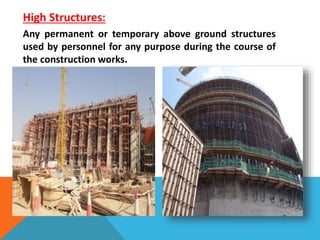
High Structures:
Any permanent or temporary above ground structures
used by personnel for any purpose during the course of
the construction works.
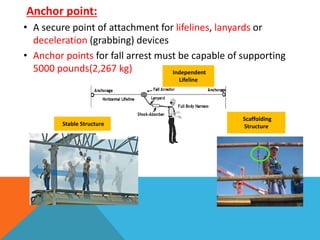
Anchor point:
• A secure point of attachment for lifelines, lanyards or
deceleration (grabbing) devices
• Anchor points for fall arrest must be capable of supporting
5000 pounds(2,267 kg) Independent
Lifeline
Stable Structure
Scaffolding
Structure
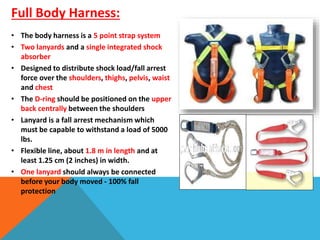
Full Body Harness:
• The body harness is a 5 point strap system
• Two lanyards and a single integrated shock
absorber
• Designed to distribute shock load/fall arrest
force over the shoulders, thighs, pelvis, waist
and chest
• The D-ring should be positioned on the upper
back centrally between the shoulders
• Lanyard is a fall arrest mechanism which
must be capable to withstand a load of 5000
lbs.
• Flexible line, about 1.8 m in length and at
least 1.25 cm (2 inches) in width.
• One lanyard should always be connected
before your body moved - 100% fall
protection
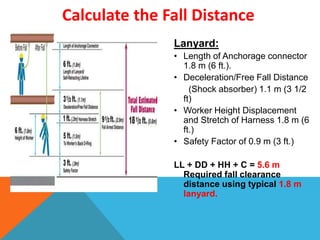
Calculate the Fall Distance
Lanyard:
• Length of Anchorage connector
1.8 m (6 ft.).
• Deceleration/Free Fall Distance
(Shock absorber) 1.1 m (3 1/2
ft)
• Worker Height Displacement
and Stretch of Harness 1.8 m (6
ft.)
• Safety Factor of 0.9 m (3 ft.)
LL + DD + HH + C = 5.6 m
Required fall clearance
distance using typical 1.8 m
lanyard.
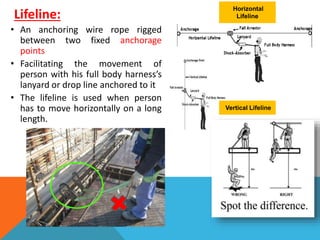
Lifeline:
• An anchoring wire rope rigged
between two fixed anchorage
points
• Facilitating the movement of
person with his full body harness’s
lanyard or drop line anchored to it
• The lifeline is used when person
has to move horizontally on a long
length.
Horizontal
Lifeline
Vertical Lifeline
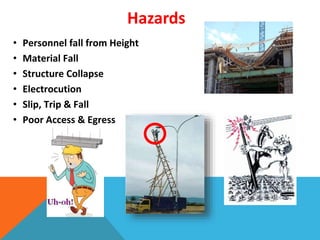
• Personnel fall from Height
• Material Fall
• Structure Collapse
• Electrocution
• Slip, Trip & Fall
• Poor Access & Egress
Hazards
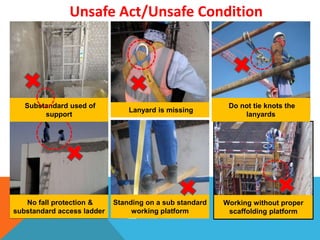
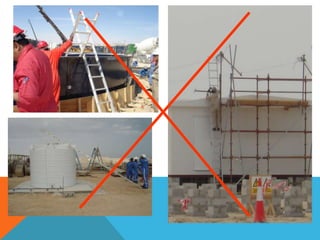
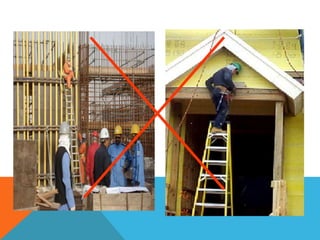
Unsafe Act/Unsafe Condition
No fall protection &
substandard access ladder
Standing on a sub standard
working platform
Working without proper
scaffolding platform
Do not tie knots the
lanyards
Lanyard is missing
Substandard used of
support
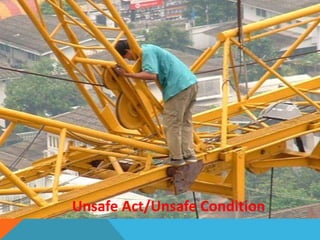
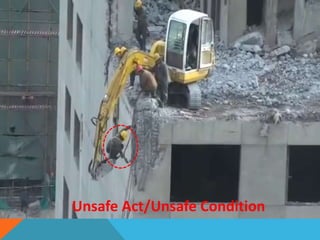
Unsafe Act/Unsafe Condition
.
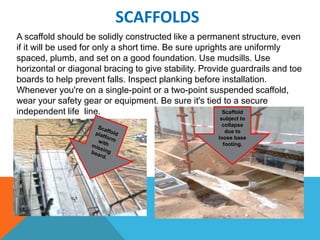
A scaffold should be solidly constructed like a permanent structure, even
if it will be used for only a short time. Be sure uprights are uniformly
spaced, plumb, and set on a good foundation. Use mudsills. Use
horizontal or diagonal bracing to give stability. Provide guardrails and toe
boards to help prevent falls. Inspect planking before installation.
Whenever you're on a single-point or a two-point suspended scaffold,
wear your safety gear or equipment. Be sure it's tied to a secure
independent life line. Scaffold
subject to
collapse
due to
loose base
footing.
SCAFFOLDS
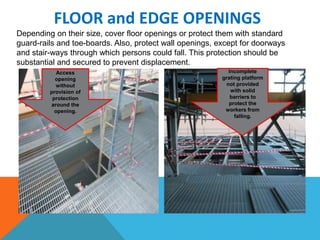
Depending on their size, cover floor openings or protect them with standard
guard-rails and toe-boards. Also, protect wall openings, except for doorways
and stair-ways through which persons could fall. This protection should be
substantial and secured to prevent displacement.
Access
opening
without
provision of
protection
around the
opening.
Incomplete
grating platform
not provided
with solid
barriers to
protect the
workers from
falling.
FLOOR and EDGE OPENINGS
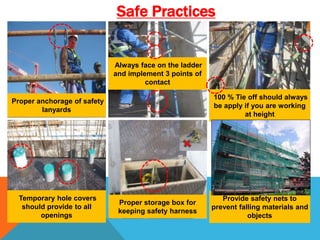
100 % Tie off should always
be apply if you are working
at height
Always face on the ladder
and implement 3 points of
contact
Temporary hole covers
should provide to all
openings
Proper storage box for
keeping safety harness
Provide safety nets to
prevent falling materials and
objects
Proper anchorage of safety
lanyards
Safe Practices
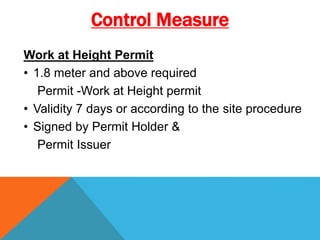
Work at Height Permit
• 1.8 meter and above required
Permit -Work at Height permit
• Validity 7 days or according to the site procedure
• Signed by Permit Holder &
Permit Issuer
Control Measure
Training & Competency:
• All work at height working personnel shall receive training
prior to start work
• Competency to be check prior to do the task
• Training evidence to be provided after completion of the
training
Control Measure
Supervision:
• Supervisor shall present at all time while performing work at
job
• Supervisor shall make sure all personnel involved are
trained and competent
• Conducting Tool Box Talk prior to start the work.
• Shall monitor activity all times
• Provide proper PPE related to work at height
• Ensure valid PTW is in place
Control Measure
Fall Protection/ Edge Protection :
• Ensure working platform or edges
are protected from fall
• Provide hand rail, mid rail & toe board
Control Measure
Hole Protection:
• Cover all opening by steel plate
or hard ply to ensure protection
of personnel, tools or materials
no matter small or big
• 2 square Inch hole or gap to be
protected from material or tools
fall
Control Measure
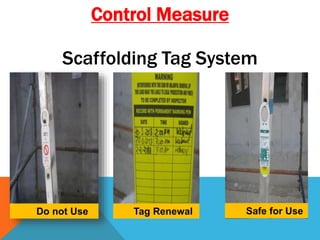
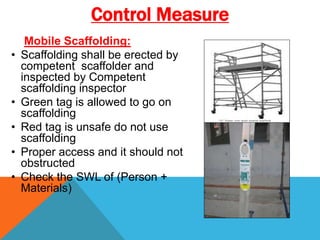
Do not Use Tag Renewal Safe for Use
Scaffolding Tag System
Control Measure
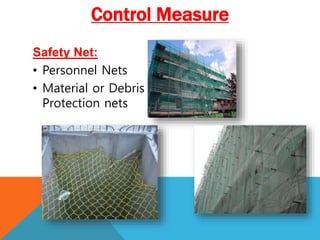
Safety Net:
• Personnel Nets
• Material or Debris
Protection nets
Control Measure
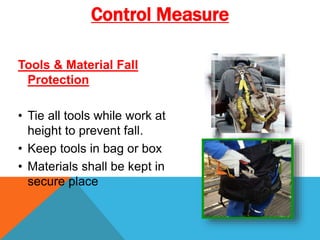
Tools & Material Fall
Protection
• Tie all tools while work at
height to prevent fall.
• Keep tools in bag or box
• Materials shall be kept in
secure place
Control Measure
Mobile Scaffolding:
• Scaffolding shall be erected by
competent scaffolder and
inspected by Competent
scaffolding inspector
• Green tag is allowed to go on
scaffolding
• Red tag is unsafe do not use
scaffolding
• Proper access and it should not
obstructed
• Check the SWL of (Person +
Materials)
Control Measure
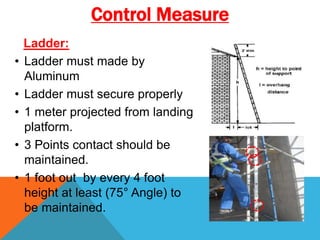
Ladder:
• Ladder must made by
Aluminum
• Ladder must secure properly
• 1 meter projected from landing
platform.
• 3 Points contact should be
maintained.
• 1 foot out by every 4 foot
height at least (75° Angle) to
be maintained.
Control Measure
Equipment (MEWP):
• All MEWP equipment
shall be inspected by
competent person
• Proper ground to avoid
turnover
• Full body harness with
double lanyard
• Barricading and sign
• Inspected Man basket
to be used
Control Measure
Man lift
Scissor Lift
Suspended
Man Basket
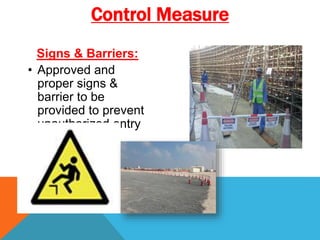
Signs & Barriers:
• Approved and
proper signs &
barrier to be
provided to prevent
unauthorized entry
Control Measure
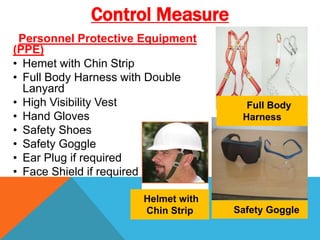
Personnel Protective Equipment
(PPE)
• Hemet with Chin Strip
• Full Body Harness with Double
Lanyard
• High Visibility Vest
• Hand Gloves
• Safety Shoes
• Safety Goggle
• Ear Plug if required
• Face Shield if required
Safety Goggle
Helmet with
Chin Strip
Control Measure
Full Body
Harness
THANKYOU
REMEMBER: The safer the Better
31

TBT on Working at Height.ppt

  • 1.
  • 2.
    • “ Workingat height is a place from which a person could be injured by falling from it, regardless of whether it is above, at or below ground level’’ • According to OSHA procedure any work being performed above 1.8 m (6 ft.) from ground is identify as “Work at Height” Definition
  • 3.
    • Roof /Bridge/Ladderworks • Scaffolding works • External Window cleaning works • Construction framing/painting works • Work of Tower cranes , Man basket work • MEWP’s (Scissor-lift, man-lift, etc.) • Others (Top of Lorries, Near deep excavation) Example of Work at Height
  • 4.
    High Structures: Any permanentor temporary above ground structures used by personnel for any purpose during the course of the construction works.
  • 5.
    Anchor point: • Asecure point of attachment for lifelines, lanyards or deceleration (grabbing) devices • Anchor points for fall arrest must be capable of supporting 5000 pounds(2,267 kg) Independent Lifeline Stable Structure Scaffolding Structure
  • 6.
    Full Body Harness: •The body harness is a 5 point strap system • Two lanyards and a single integrated shock absorber • Designed to distribute shock load/fall arrest force over the shoulders, thighs, pelvis, waist and chest • The D-ring should be positioned on the upper back centrally between the shoulders • Lanyard is a fall arrest mechanism which must be capable to withstand a load of 5000 lbs. • Flexible line, about 1.8 m in length and at least 1.25 cm (2 inches) in width. • One lanyard should always be connected before your body moved - 100% fall protection
  • 7.
    Calculate the FallDistance Lanyard: • Length of Anchorage connector 1.8 m (6 ft.). • Deceleration/Free Fall Distance (Shock absorber) 1.1 m (3 1/2 ft) • Worker Height Displacement and Stretch of Harness 1.8 m (6 ft.) • Safety Factor of 0.9 m (3 ft.) LL + DD + HH + C = 5.6 m Required fall clearance distance using typical 1.8 m lanyard.
  • 8.
    Lifeline: • An anchoringwire rope rigged between two fixed anchorage points • Facilitating the movement of person with his full body harness’s lanyard or drop line anchored to it • The lifeline is used when person has to move horizontally on a long length. Horizontal Lifeline Vertical Lifeline
  • 9.
    • Personnel fallfrom Height • Material Fall • Structure Collapse • Electrocution • Slip, Trip & Fall • Poor Access & Egress Hazards
  • 10.
    Unsafe Act/Unsafe Condition Nofall protection & substandard access ladder Standing on a sub standard working platform Working without proper scaffolding platform Do not tie knots the lanyards Lanyard is missing Substandard used of support
  • 11.
  • 12.
  • 15.
    . A scaffold shouldbe solidly constructed like a permanent structure, even if it will be used for only a short time. Be sure uprights are uniformly spaced, plumb, and set on a good foundation. Use mudsills. Use horizontal or diagonal bracing to give stability. Provide guardrails and toe boards to help prevent falls. Inspect planking before installation. Whenever you're on a single-point or a two-point suspended scaffold, wear your safety gear or equipment. Be sure it's tied to a secure independent life line. Scaffold subject to collapse due to loose base footing. SCAFFOLDS
  • 16.
    Depending on theirsize, cover floor openings or protect them with standard guard-rails and toe-boards. Also, protect wall openings, except for doorways and stair-ways through which persons could fall. This protection should be substantial and secured to prevent displacement. Access opening without provision of protection around the opening. Incomplete grating platform not provided with solid barriers to protect the workers from falling. FLOOR and EDGE OPENINGS
  • 17.
    100 % Tieoff should always be apply if you are working at height Always face on the ladder and implement 3 points of contact Temporary hole covers should provide to all openings Proper storage box for keeping safety harness Provide safety nets to prevent falling materials and objects Proper anchorage of safety lanyards Safe Practices
  • 18.
    Work at HeightPermit • 1.8 meter and above required Permit -Work at Height permit • Validity 7 days or according to the site procedure • Signed by Permit Holder & Permit Issuer Control Measure
  • 19.
    Training & Competency: •All work at height working personnel shall receive training prior to start work • Competency to be check prior to do the task • Training evidence to be provided after completion of the training Control Measure
  • 20.
    Supervision: • Supervisor shallpresent at all time while performing work at job • Supervisor shall make sure all personnel involved are trained and competent • Conducting Tool Box Talk prior to start the work. • Shall monitor activity all times • Provide proper PPE related to work at height • Ensure valid PTW is in place Control Measure
  • 21.
    Fall Protection/ EdgeProtection : • Ensure working platform or edges are protected from fall • Provide hand rail, mid rail & toe board Control Measure
  • 22.
    Hole Protection: • Coverall opening by steel plate or hard ply to ensure protection of personnel, tools or materials no matter small or big • 2 square Inch hole or gap to be protected from material or tools fall Control Measure
  • 23.
    Do not UseTag Renewal Safe for Use Scaffolding Tag System Control Measure
  • 24.
    Safety Net: • PersonnelNets • Material or Debris Protection nets Control Measure
  • 25.
    Tools & MaterialFall Protection • Tie all tools while work at height to prevent fall. • Keep tools in bag or box • Materials shall be kept in secure place Control Measure
  • 26.
    Mobile Scaffolding: • Scaffoldingshall be erected by competent scaffolder and inspected by Competent scaffolding inspector • Green tag is allowed to go on scaffolding • Red tag is unsafe do not use scaffolding • Proper access and it should not obstructed • Check the SWL of (Person + Materials) Control Measure
  • 27.
    Ladder: • Ladder mustmade by Aluminum • Ladder must secure properly • 1 meter projected from landing platform. • 3 Points contact should be maintained. • 1 foot out by every 4 foot height at least (75° Angle) to be maintained. Control Measure
  • 28.
    Equipment (MEWP): • AllMEWP equipment shall be inspected by competent person • Proper ground to avoid turnover • Full body harness with double lanyard • Barricading and sign • Inspected Man basket to be used Control Measure Man lift Scissor Lift Suspended Man Basket
  • 29.
    Signs & Barriers: •Approved and proper signs & barrier to be provided to prevent unauthorized entry Control Measure
  • 30.
    Personnel Protective Equipment (PPE) •Hemet with Chin Strip • Full Body Harness with Double Lanyard • High Visibility Vest • Hand Gloves • Safety Shoes • Safety Goggle • Ear Plug if required • Face Shield if required Safety Goggle Helmet with Chin Strip Control Measure Full Body Harness
  • 31.