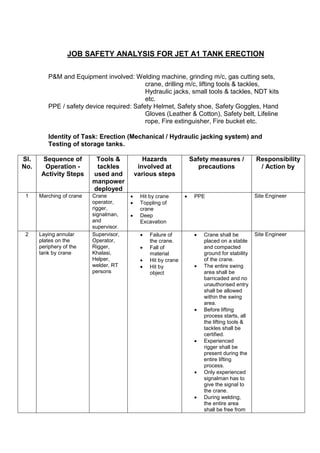
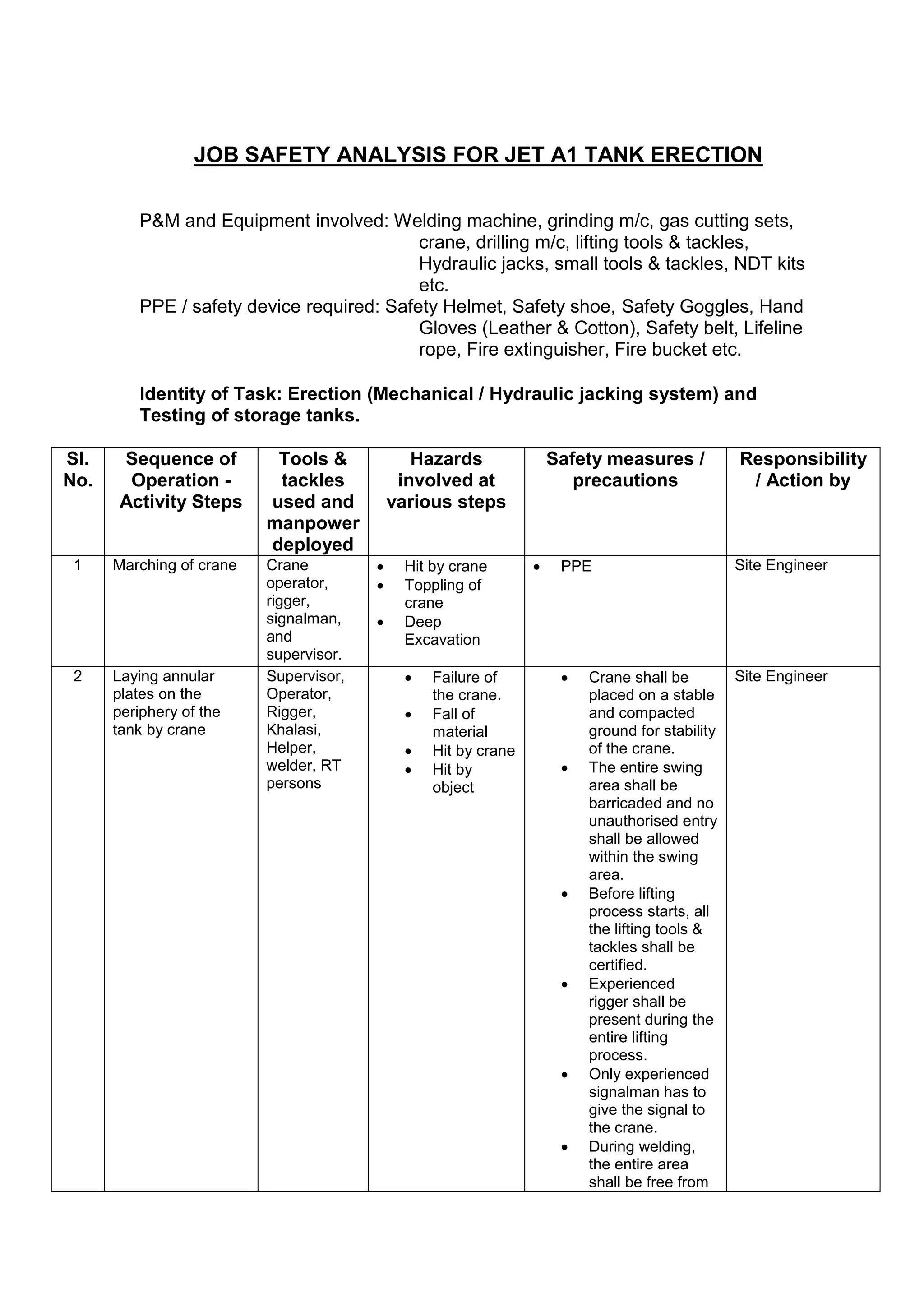
JOB SAFETY ANALYSIS FOR JET A1 TANK ERECTION
P&M and Equipment involved: Welding machine, grinding m/c, gas cutting sets,
crane, drilling m/c, lifting tools & tackles,
Hydraulic jacks, small tools & tackles, NDT kits
etc.
PPE / safety device required: Safety Helmet, Safety shoe, Safety Goggles, Hand
Gloves (Leather & Cotton), Safety belt, Lifeline
rope, Fire extinguisher, Fire bucket etc.
Identity of Task: Erection (Mechanical / Hydraulic jacking system) and
Testing of storage tanks.
Sl.
No.
Sequence of
Operation -
Activity Steps
Tools &
tackles
used and
manpower
deployed
Hazards
involved at
various steps
Safety measures /
precautions
Responsibility
/ Action by
1 Marching of crane Crane
operator,
rigger,
signalman,
and
supervisor.
 Hit by crane
 Toppling of
crane
 Deep
Excavation
 PPE Site Engineer
2 Laying annular
plates on the
periphery of the
tank by crane
Supervisor,
Operator,
Rigger,
Khalasi,
Helper,
welder, RT
persons
 Failure of
the crane.
 Fall of
material
 Hit by crane
 Hit by
object
 Crane shall be
placed on a stable
and compacted
ground for stability
of the crane.
 The entire swing
area shall be
barricaded and no
unauthorised entry
shall be allowed
within the swing
area.
 Before lifting
process starts, all
the lifting tools &
tackles shall be
certified.
 Experienced
rigger shall be
present during the
entire lifting
process.
 Only experienced
signalman has to
give the signal to
the crane.
 During welding,
the entire area
shall be free from
Site Engineer
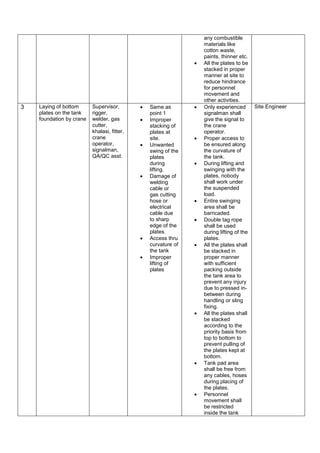
any combustible
materials like
cotton waste,
paints, thinner etc.
 All the plates to be
stacked in proper
manner at site to
reduce hindrance
for personnel
movement and
other activities.
3 Laying of bottom
plates on the tank
foundation by crane
Supervisor,
rigger,
welder, gas
cutter,
khalasi, fitter,
crane
operator,
signalman,
QA/QC asst.
 Same as
point 1
 Improper
stacking of
plates at
site.
 Unwanted
swing of the
plates
during
lifting.
 Damage of
welding
cable or
gas cutting
hose or
electrical
cable due
to sharp
edge of the
plates.
 Access thru
curvature of
the tank
 Improper
lifting of
plates
 Only experienced
signalman shall
give the signal to
the crane
operator.
 Proper access to
be ensured along
the curvature of
the tank.
 During lifting and
swinging with the
plates, nobody
shall work under
the suspended
load.
 Entire swinging
area shall be
barricaded.
 Double tag rope
shall be used
during lifting of the
plates.
 All the plates shall
be stacked in
proper manner
with sufficient
packing outside
the tank area to
prevent any injury
due to pressed in-
between during
handling or sling
fixing.
 All the plates shall
be stacked
according to the
priority basis from
top to bottom to
prevent pulling of
the plates kept at
bottom.
 Tank pad area
shall be free from
any cables, hoses
during placing of
the plates.
 Personnel
movement shall
be restricted
inside the tank
Site Engineer
area to prevent
any trip injury as
well as burn injury
due to hot metal.
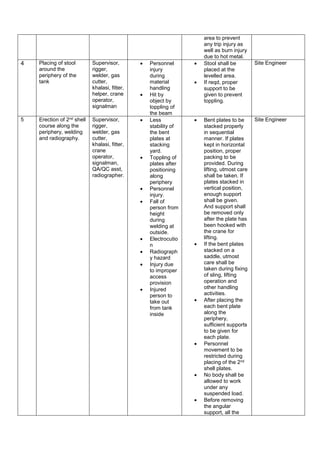
4 Placing of stool
around the
periphery of the
tank
Supervisor,
rigger,
welder, gas
cutter,
khalasi, fitter,
helper, crane
operator,
signalman
 Personnel
injury
during
material
handling
 Hit by
object by
toppling of
the beam
 Stool shall be
placed at the
levelled area.
 If reqd, proper
support to be
given to prevent
toppling.
Site Engineer
5 Erection of 2nd shell
course along the
periphery, welding
and radiography.
Supervisor,
rigger,
welder, gas
cutter,
khalasi, fitter,
crane
operator,
signalman,
QA/QC asst,
radiographer.
 Less
stability of
the bent
plates at
stacking
yard.
 Toppling of
plates after
positioning
along
periphery
 Personnel
injury.
 Fall of
person from
height
during
welding at
outside.
 Electrocutio
n
 Radiograph
y hazard
 Injury due
to improper
access
provision
 Injured
person to
take out
from tank
inside
 Bent plates to be
stacked properly
in sequential
manner. If plates
kept in horizontal
position, proper
packing to be
provided. During
lifting, utmost care
shall be taken. If
plates stacked in
vertical position,
enough support
shall be given.
And support shall
be removed only
after the plate has
been hooked with
the crane for
lifting.
 If the bent plates
stacked on a
saddle, utmost
care shall be
taken during fixing
of sling, lifting
operation and
other handling
activities.
 After placing the
each bent plate
along the
periphery,
sufficient supports
to be given for
each plate.
 Personnel
movement to be
restricted during
placing of the 2nd
shell plates.
 No body shall be
allowed to work
under any
suspended load.
 Before removing
the angular
support, all the
Site Engineer
vertical joints in
between the
plates shall be
fully welded.
 Suitable access to
be ensured to take
out injured person,
in case of
emergency.
 SAFETY DURING
RADIOGRAPHY
BEING
DISCUSSED IN
POINT NO 17.
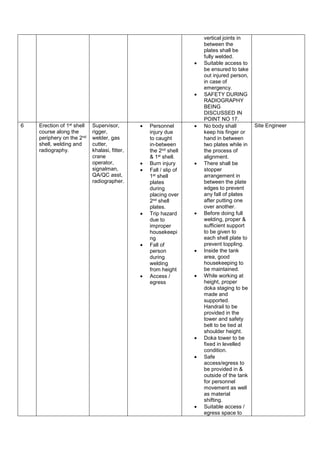
6 Erection of 1st shell
course along the
periphery on the 2nd
shell, welding and
radiography.
Supervisor,
rigger,
welder, gas
cutter,
khalasi, fitter,
crane
operator,
signalman,
QA/QC asst,
radiographer.
 Personnel
injury due
to caught
in-between
the 2nd shell
& 1st shell.
 Burn injury
 Fall / slip of
1st shell
plates
during
placing over
2nd shell
plates.
 Trip hazard
due to
improper
housekeepi
ng
 Fall of
person
during
welding
from height
 Access /
egress
 No body shall
keep his finger or
hand in between
two plates while in
the process of
alignment.
 There shall be
stopper
arrangement in
between the plate
edges to prevent
any fall of plates
after putting one
over another.
 Before doing full
welding, proper &
sufficient support
to be given to
each shell plate to
prevent toppling.
 Inside the tank
area, good
housekeeping to
be maintained.
 While working at
height, proper
doka staging to be
made and
supported.
Handrail to be
provided in the
tower and safety
belt to be tied at
shoulder height.
 Doka tower to be
fixed in levelled
condition.
 Safe
access/egress to
be provided in &
outside of the tank
for personnel
movement as well
as material
shifting.
 Suitable access /
egress space to
Site Engineer
be ensured.
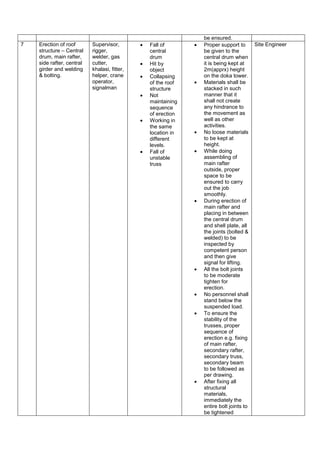
7 Erection of roof
structure – Central
drum, main rafter,
side rafter, central
girder and welding
& bolting.
Supervisor,
rigger,
welder, gas
cutter,
khalasi, fitter,
helper, crane
operator,
signalman
 Fall of
central
drum
 Hit by
object
 Collapsing
of the roof
structure
 Not
maintaining
sequence
of erection
 Working in
the same
location in
different
levels.
 Fall of
unstable
truss
 Proper support to
be given to the
central drum when
it is being kept at
2m(apprx) height
on the doka tower.
 Materials shall be
stacked in such
manner that it
shall not create
any hindrance to
the movement as
well as other
activities.
 No loose materials
to be kept at
height.
 While doing
assembling of
main rafter
outside, proper
space to be
ensured to carry
out the job
smoothly.
 During erection of
main rafter and
placing in between
the central drum
and shell plate, all
the joints (bolted &
welded) to be
inspected by
competent person
and then give
signal for lifting.
 All the bolt joints
to be moderate
tighten for
erection.
 No personnel shall
stand below the
suspended load.
 To ensure the
stability of the
trusses, proper
sequence of
erection e.g. fixing
of main rafter,
secondary rafter,
secondary truss,
secondary beam
to be followed as
per drawing.
 After fixing all
structural
materials,
immediately the
entire bolt joints to
be tightened
Site Engineer
moderately to
withstand its self-
load.
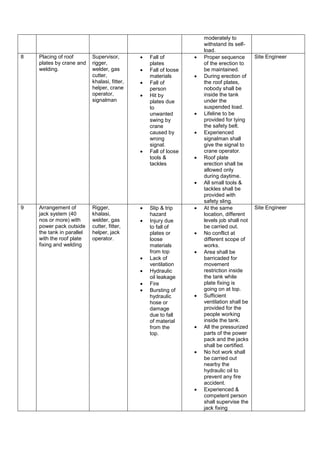
8 Placing of roof
plates by crane and
welding.
Supervisor,
rigger,
welder, gas
cutter,
khalasi, fitter,
helper, crane
operator,
signalman
 Fall of
plates
 Fall of loose
materials
 Fall of
person
 Hit by
plates due
to
unwanted
swing by
crane
caused by
wrong
signal.
 Fall of loose
tools &
tackles
 Proper sequence
of the erection to
be maintained.
 During erection of
the roof plates,
nobody shall be
inside the tank
under the
suspended load.
 Lifeline to be
provided for tying
the safety belt.
 Experienced
signalman shall
give the signal to
crane operator.
 Roof plate
erection shall be
allowed only
during daytime.
 All small tools &
tackles shall be
provided with
safety sling.
Site Engineer
9 Arrangement of
jack system (40
nos or more) with
power pack outside
the tank in parallel
with the roof plate
fixing and welding
Rigger,
khalasi,
welder, gas
cutter, fitter,
helper, jack
operator.
 Slip & trip
hazard
 Injury due
to fall of
plates or
loose
materials
from top
 Lack of
ventilation
 Hydraulic
oil leakage
 Fire
 Bursting of
hydraulic
hose or
damage
due to fall
of material
from the
top.
 At the same
location, different
levels job shall not
be carried out.
 No conflict at
different scope of
works.
 Area shall be
barricaded for
movement
restriction inside
the tank while
plate fixing is
going on at top.
 Sufficient
ventilation shall be
provided for the
people working
inside the tank.
 All the pressurized
parts of the power
pack and the jacks
shall be certified.
 No hot work shall
be carried out
nearby the
hydraulic oil to
prevent any fire
accident.
 Experienced &
competent person
shall supervise the
jack fixing
Site Engineer
arrangement.
 If any leakage of
hydraulic oil
occurs,
immediately it is to
be cleaned.
 Sufficient
illumination shall
be provided inside
the tank area.
 Activity at the top
shall be restricted
while hydraulic
hose being fixed
at the bottom.
 Hydraulic oil shall
not be kept in a
loose container
and it shall be
away from the hot
job.
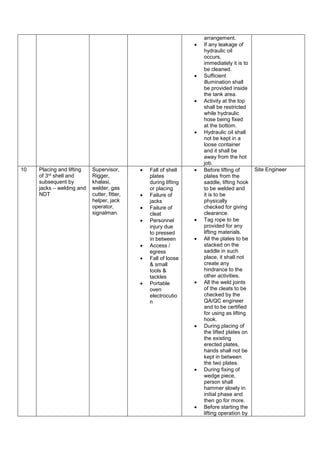
10 Placing and lifting
of 3rd shell and
subsequent by
jacks – welding and
NDT
Supervisor,
Rigger,
khalasi,
welder, gas
cutter, fitter,
helper, jack
operator,
signalman.
 Fall of shell
plates
during lifting
or placing
 Failure of
jacks
 Failure of
cleat
 Personnel
injury due
to pressed
in between
 Access /
egress
 Fall of loose
& small
tools &
tackles
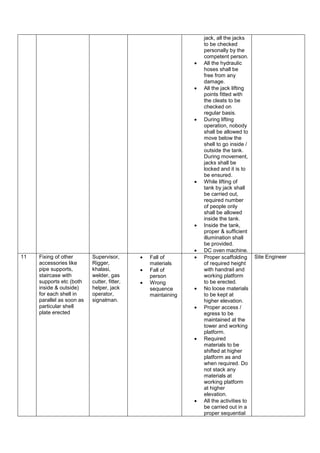
 Portable
oven
electrocutio
n
 Before lifting of
plates from the
saddle, lifting hook
to be welded and
it is to be
physically
checked for giving
clearance.
 Tag rope to be
provided for any
lifting materials.
 All the plates to be
stacked on the
saddle in such
place, it shall not
create any
hindrance to the
other activities.
 All the weld joints
of the cleats to be
checked by the
QA/QC engineer
and to be certified
for using as lifting
hook.
 During placing of
the lifted plates on
the existing
erected plates,
hands shall not be
kept in between
the two plates.
 During fixing of
wedge piece,
person shall
hammer slowly in
initial phase and
then go for more.
 Before starting the
lifting operation by
Site Engineer
jack, all the jacks
to be checked
personally by the
competent person.
 All the hydraulic
hoses shall be
free from any
damage.
 All the jack lifting
points fitted with
the cleats to be
checked on
regular basis.
 During lifting
operation, nobody
shall be allowed to
move below the
shell to go inside /
outside the tank.
During movement,
jacks shall be
locked and it is to
be ensured.
 While lifting of
tank by jack shall
be carried out,
required number
of people only
shall be allowed
inside the tank.
 Inside the tank,
proper & sufficient
illumination shall
be provided.
 DC oven machine.
11 Fixing of other
accessories like
pipe supports,
staircase with
supports etc (both
inside & outside)
for each shell in
parallel as soon as
particular shell
plate erected
Supervisor,
Rigger,
khalasi,
welder, gas
cutter, fitter,
helper, jack
operator,
signalman.
 Fall of
materials
 Fall of
person
 Wrong
sequence
maintaining
 Proper scaffolding
of required height
with handrail and
working platform
to be erected.
 No loose materials
to be kept at
higher elevation.
 Proper access /
egress to be
maintained at the
tower and working
platform.
 Required
materials to be
shifted at higher
platform as and
when required. Do
not stack any
materials at
working platform
at higher
elevation.
 All the activities to
be carried out in a
proper sequential
Site Engineer
manner.
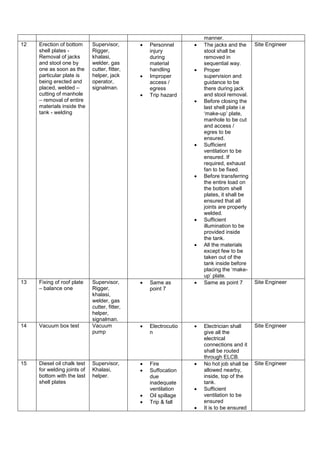
12 Erection of bottom
shell plates -
Removal of jacks
and stool one by
one as soon as the
particular plate is
being erected and
placed, welded –
cutting of manhole
– removal of entire
materials inside the
tank - welding
Supervisor,
Rigger,
khalasi,
welder, gas
cutter, fitter,
helper, jack
operator,
signalman.
 Personnel
injury
during
material
handling
 Improper
access /
egress
 Trip hazard
 The jacks and the
stool shall be
removed in
sequential way.
 Proper
supervision and
guidance to be
there during jack
and stool removal.
 Before closing the
last shell plate i.e
‘make-up’ plate,
manhole to be cut
and access /
egres to be
ensured.
 Sufficient
ventilation to be
ensured. If
required, exhaust
fan to be fixed.
 Before transferring
the entire load on
the bottom shell
plates, it shall be
ensured that all
joints are properly
welded.
 Sufficient
illumination to be
provided inside
the tank.
 All the materials
except few to be
taken out of the
tank inside before
placing the ‘make-
up’ plate.
Site Engineer
13 Fixing of roof plate
– balance one
Supervisor,
Rigger,
khalasi,
welder, gas
cutter, fitter,
helper,
signalman.
 Same as
point 7
 Same as point 7 Site Engineer
14 Vacuum box test Vacuum
pump
 Electrocutio
n
 Electrician shall
give all the
electrical
connections and it
shall be routed
through ELCB.
Site Engineer
15 Diesel oil chalk test
for welding joints of
bottom with the last
shell plates
Supervisor,
Khalasi,
helper.
 Fire
 Suffocation
due
inadequate
ventilation
 Oil spillage
 Trip & fall
 No hot job shall be
allowed nearby,
inside, top of the
tank.
 Sufficient
ventilation to be
ensured
 It is to be ensured
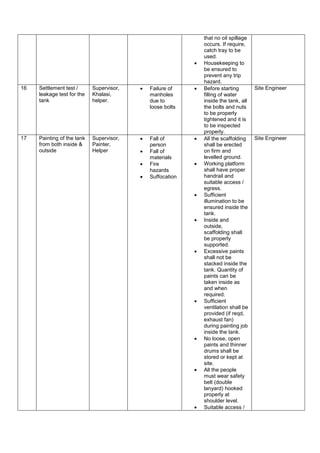
Site Engineer
that no oil spillage
occurs. If require,
catch tray to be
used.
 Housekeeping to
be ensured to
prevent any trip
hazard.
16 Settlement test /
leakage test for the
tank
Supervisor,
Khalasi,
helper.
 Failure of
manholes
due to
loose bolts
 Before starting
filling of water
inside the tank, all
the bolts and nuts
to be properly
tightened and it is
to be inspected
properly.
Site Engineer
17 Painting of the tank
from both inside &
outside
Supervisor,
Painter,
Helper
 Fall of
person
 Fall of
materials
 Fire
hazards
 Suffocation
 All the scaffolding
shall be erected
on firm and
levelled ground.
 Working platform
shall have proper
handrail and
suitable access /
egress.
 Sufficient
illumination to be
ensured inside the
tank.
 Inside and
outside,
scaffolding shall
be properly
supported.
 Excessive paints
shall not be
stacked inside the
tank. Quantity of
paints can be
taken inside as
and when
required.
 Sufficient
ventilation shall be
provided (if reqd,
exhaust fan)
during painting job
inside the tank.
 No loose, open
paints and thinner
drums shall be
stored or kept at
site.
 All the people
must wear safety
belt (double
lanyard) hooked
properly at
shoulder level.
 Suitable access /
Site Engineer
egress to be
ensured going
inside the tank.
 While going to the
height of the
scaffolding,
person shall not
carry the paint
container along
with him.
 Spillage of paints
to be controlled
and area shall be
cleared off any
spillage.
 No hot job shall be
allowed in and
around the
painting area.
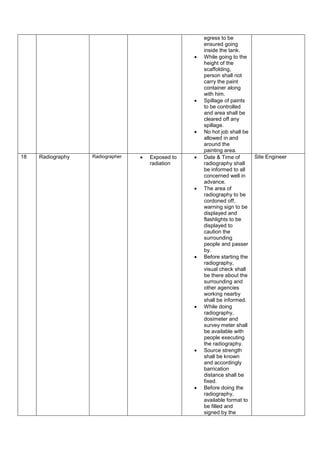
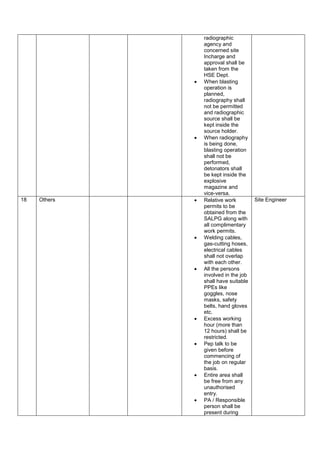
18 Radiography Radiographer  Exposed to
radiation
 Date & Time of
radiography shall
be informed to all
concerned well in
advance.
 The area of
radiography to be
cordoned off,
warning sign to be
displayed and
flashlights to be
displayed to
caution the
surrounding
people and passer
by.
 Before starting the
radiography,
visual check shall
be there about the
surrounding and
other agencies
working nearby
shall be informed.
 While doing
radiography,
dosimeter and
survey meter shall
be available with
people executing
the radiography.
 Source strength
shall be known
and accordingly
barrication
distance shall be
fixed.
 Before doing the
radiography,
available format to
be filled and
signed by the
Site Engineer
radiographic
agency and
concerned site
Incharge and
approval shall be
taken from the
HSE Dept.
 When blasting
operation is
planned,
radiography shall
not be permitted
and radiographic
source shall be
kept inside the
source holder.
 When radiography
is being done,
blasting operation
shall not be
performed,
detonators shall
be kept inside the
explosive
magazine and
vice-versa.
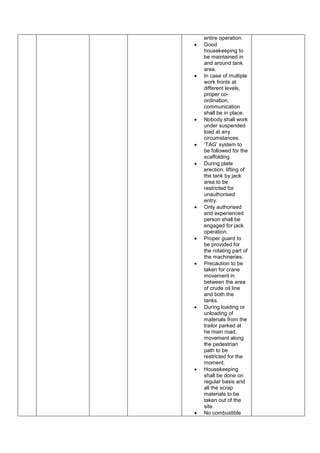
18 Others  Relative work
permits to be
obtained from the
SALPG along with
all complimentary
work permits.
 Welding cables,
gas-cutting hoses,
electrical cables
shall not overlap
with each other.
 All the persons
involved in the job
shall have suitable
PPEs like
goggles, nose
masks, safety
belts, hand gloves
etc.
 Excess working
hour (more than
12 hours) shall be
restricted.
 Pep talk to be
given before
commencing of
the job on regular
basis.
 Entire area shall
be free from any
unauthorised
entry.
 PA / Responsible
person shall be
present during
Site Engineer
entire operation.
 Good
housekeeping to
be maintained in
and around tank
area.
 In case of multiple
work fronts at
different levels,
proper co-
ordination,
communication
shall be in place.
 Nobody shall work
under suspended
load at any
circumstances.
 ‘TAG’ system to
be followed for the
scaffolding.
 During plate
erection, lifting of
the tank by jack
area to be
restricted for
unauthorised
entry.
 Only authorised
and experienced
person shall be
engaged for jack
operation.
 Proper guard to
be provided for
the rotating part of
the machineries.
 Precaution to be
taken for crane
movement in
between the area
of crude oil line
and both the
tanks.
 During loading or
unloading of
materials from the
trailor parked at
he main road,
movement along
the pedestrian
path to be
restricted for the
moment.
 Housekeeping
shall be done on
regular basis and
all the scrap
materials to be
taken out of the
site.
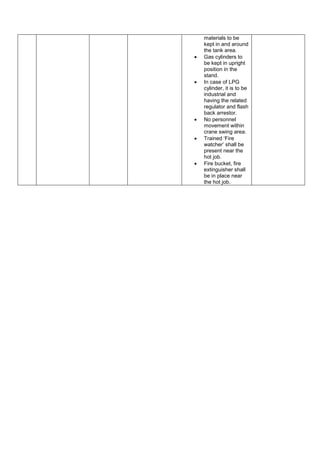
 No combustible
materials to be
kept in and around
the tank area.
 Gas cylinders to
be kept in upright
position in the
stand.
 In case of LPG
cylinder, it is to be
industrial and
having the related
regulator and flash
back arrestor.
 No personnel
movement within
crane swing area.
 Trained ‘Fire
watcher’ shall be
present near the
hot job.
 Fire bucket, fire
extinguisher shall
be in place near
the hot job.

Job safety Analysis

  • 1.
    JOB SAFETY ANALYSISFOR JET A1 TANK ERECTION P&M and Equipment involved: Welding machine, grinding m/c, gas cutting sets, crane, drilling m/c, lifting tools & tackles, Hydraulic jacks, small tools & tackles, NDT kits etc. PPE / safety device required: Safety Helmet, Safety shoe, Safety Goggles, Hand Gloves (Leather & Cotton), Safety belt, Lifeline rope, Fire extinguisher, Fire bucket etc. Identity of Task: Erection (Mechanical / Hydraulic jacking system) and Testing of storage tanks. Sl. No. Sequence of Operation - Activity Steps Tools & tackles used and manpower deployed Hazards involved at various steps Safety measures / precautions Responsibility / Action by 1 Marching of crane Crane operator, rigger, signalman, and supervisor.  Hit by crane  Toppling of crane  Deep Excavation  PPE Site Engineer 2 Laying annular plates on the periphery of the tank by crane Supervisor, Operator, Rigger, Khalasi, Helper, welder, RT persons  Failure of the crane.  Fall of material  Hit by crane  Hit by object  Crane shall be placed on a stable and compacted ground for stability of the crane.  The entire swing area shall be barricaded and no unauthorised entry shall be allowed within the swing area.  Before lifting process starts, all the lifting tools & tackles shall be certified.  Experienced rigger shall be present during the entire lifting process.  Only experienced signalman has to give the signal to the crane.  During welding, the entire area shall be free from Site Engineer
  • 2.
    any combustible materials like cottonwaste, paints, thinner etc.  All the plates to be stacked in proper manner at site to reduce hindrance for personnel movement and other activities. 3 Laying of bottom plates on the tank foundation by crane Supervisor, rigger, welder, gas cutter, khalasi, fitter, crane operator, signalman, QA/QC asst.  Same as point 1  Improper stacking of plates at site.  Unwanted swing of the plates during lifting.  Damage of welding cable or gas cutting hose or electrical cable due to sharp edge of the plates.  Access thru curvature of the tank  Improper lifting of plates  Only experienced signalman shall give the signal to the crane operator.  Proper access to be ensured along the curvature of the tank.  During lifting and swinging with the plates, nobody shall work under the suspended load.  Entire swinging area shall be barricaded.  Double tag rope shall be used during lifting of the plates.  All the plates shall be stacked in proper manner with sufficient packing outside the tank area to prevent any injury due to pressed in- between during handling or sling fixing.  All the plates shall be stacked according to the priority basis from top to bottom to prevent pulling of the plates kept at bottom.  Tank pad area shall be free from any cables, hoses during placing of the plates.  Personnel movement shall be restricted inside the tank Site Engineer
  • 3.
    area to prevent anytrip injury as well as burn injury due to hot metal. 4 Placing of stool around the periphery of the tank Supervisor, rigger, welder, gas cutter, khalasi, fitter, helper, crane operator, signalman  Personnel injury during material handling  Hit by object by toppling of the beam  Stool shall be placed at the levelled area.  If reqd, proper support to be given to prevent toppling. Site Engineer 5 Erection of 2nd shell course along the periphery, welding and radiography. Supervisor, rigger, welder, gas cutter, khalasi, fitter, crane operator, signalman, QA/QC asst, radiographer.  Less stability of the bent plates at stacking yard.  Toppling of plates after positioning along periphery  Personnel injury.  Fall of person from height during welding at outside.  Electrocutio n  Radiograph y hazard  Injury due to improper access provision  Injured person to take out from tank inside  Bent plates to be stacked properly in sequential manner. If plates kept in horizontal position, proper packing to be provided. During lifting, utmost care shall be taken. If plates stacked in vertical position, enough support shall be given. And support shall be removed only after the plate has been hooked with the crane for lifting.  If the bent plates stacked on a saddle, utmost care shall be taken during fixing of sling, lifting operation and other handling activities.  After placing the each bent plate along the periphery, sufficient supports to be given for each plate.  Personnel movement to be restricted during placing of the 2nd shell plates.  No body shall be allowed to work under any suspended load.  Before removing the angular support, all the Site Engineer
  • 4.
    vertical joints in betweenthe plates shall be fully welded.  Suitable access to be ensured to take out injured person, in case of emergency.  SAFETY DURING RADIOGRAPHY BEING DISCUSSED IN POINT NO 17. 6 Erection of 1st shell course along the periphery on the 2nd shell, welding and radiography. Supervisor, rigger, welder, gas cutter, khalasi, fitter, crane operator, signalman, QA/QC asst, radiographer.  Personnel injury due to caught in-between the 2nd shell & 1st shell.  Burn injury  Fall / slip of 1st shell plates during placing over 2nd shell plates.  Trip hazard due to improper housekeepi ng  Fall of person during welding from height  Access / egress  No body shall keep his finger or hand in between two plates while in the process of alignment.  There shall be stopper arrangement in between the plate edges to prevent any fall of plates after putting one over another.  Before doing full welding, proper & sufficient support to be given to each shell plate to prevent toppling.  Inside the tank area, good housekeeping to be maintained.  While working at height, proper doka staging to be made and supported. Handrail to be provided in the tower and safety belt to be tied at shoulder height.  Doka tower to be fixed in levelled condition.  Safe access/egress to be provided in & outside of the tank for personnel movement as well as material shifting.  Suitable access / egress space to Site Engineer
  • 5.
    be ensured. 7 Erectionof roof structure – Central drum, main rafter, side rafter, central girder and welding & bolting. Supervisor, rigger, welder, gas cutter, khalasi, fitter, helper, crane operator, signalman  Fall of central drum  Hit by object  Collapsing of the roof structure  Not maintaining sequence of erection  Working in the same location in different levels.  Fall of unstable truss  Proper support to be given to the central drum when it is being kept at 2m(apprx) height on the doka tower.  Materials shall be stacked in such manner that it shall not create any hindrance to the movement as well as other activities.  No loose materials to be kept at height.  While doing assembling of main rafter outside, proper space to be ensured to carry out the job smoothly.  During erection of main rafter and placing in between the central drum and shell plate, all the joints (bolted & welded) to be inspected by competent person and then give signal for lifting.  All the bolt joints to be moderate tighten for erection.  No personnel shall stand below the suspended load.  To ensure the stability of the trusses, proper sequence of erection e.g. fixing of main rafter, secondary rafter, secondary truss, secondary beam to be followed as per drawing.  After fixing all structural materials, immediately the entire bolt joints to be tightened Site Engineer
  • 6.
    moderately to withstand itsself- load. 8 Placing of roof plates by crane and welding. Supervisor, rigger, welder, gas cutter, khalasi, fitter, helper, crane operator, signalman  Fall of plates  Fall of loose materials  Fall of person  Hit by plates due to unwanted swing by crane caused by wrong signal.  Fall of loose tools & tackles  Proper sequence of the erection to be maintained.  During erection of the roof plates, nobody shall be inside the tank under the suspended load.  Lifeline to be provided for tying the safety belt.  Experienced signalman shall give the signal to crane operator.  Roof plate erection shall be allowed only during daytime.  All small tools & tackles shall be provided with safety sling. Site Engineer 9 Arrangement of jack system (40 nos or more) with power pack outside the tank in parallel with the roof plate fixing and welding Rigger, khalasi, welder, gas cutter, fitter, helper, jack operator.  Slip & trip hazard  Injury due to fall of plates or loose materials from top  Lack of ventilation  Hydraulic oil leakage  Fire  Bursting of hydraulic hose or damage due to fall of material from the top.  At the same location, different levels job shall not be carried out.  No conflict at different scope of works.  Area shall be barricaded for movement restriction inside the tank while plate fixing is going on at top.  Sufficient ventilation shall be provided for the people working inside the tank.  All the pressurized parts of the power pack and the jacks shall be certified.  No hot work shall be carried out nearby the hydraulic oil to prevent any fire accident.  Experienced & competent person shall supervise the jack fixing Site Engineer
  • 7.
    arrangement.  If anyleakage of hydraulic oil occurs, immediately it is to be cleaned.  Sufficient illumination shall be provided inside the tank area.  Activity at the top shall be restricted while hydraulic hose being fixed at the bottom.  Hydraulic oil shall not be kept in a loose container and it shall be away from the hot job. 10 Placing and lifting of 3rd shell and subsequent by jacks – welding and NDT Supervisor, Rigger, khalasi, welder, gas cutter, fitter, helper, jack operator, signalman.  Fall of shell plates during lifting or placing  Failure of jacks  Failure of cleat  Personnel injury due to pressed in between  Access / egress  Fall of loose & small tools & tackles  Portable oven electrocutio n  Before lifting of plates from the saddle, lifting hook to be welded and it is to be physically checked for giving clearance.  Tag rope to be provided for any lifting materials.  All the plates to be stacked on the saddle in such place, it shall not create any hindrance to the other activities.  All the weld joints of the cleats to be checked by the QA/QC engineer and to be certified for using as lifting hook.  During placing of the lifted plates on the existing erected plates, hands shall not be kept in between the two plates.  During fixing of wedge piece, person shall hammer slowly in initial phase and then go for more.  Before starting the lifting operation by Site Engineer
  • 8.
    jack, all thejacks to be checked personally by the competent person.  All the hydraulic hoses shall be free from any damage.  All the jack lifting points fitted with the cleats to be checked on regular basis.  During lifting operation, nobody shall be allowed to move below the shell to go inside / outside the tank. During movement, jacks shall be locked and it is to be ensured.  While lifting of tank by jack shall be carried out, required number of people only shall be allowed inside the tank.  Inside the tank, proper & sufficient illumination shall be provided.  DC oven machine. 11 Fixing of other accessories like pipe supports, staircase with supports etc (both inside & outside) for each shell in parallel as soon as particular shell plate erected Supervisor, Rigger, khalasi, welder, gas cutter, fitter, helper, jack operator, signalman.  Fall of materials  Fall of person  Wrong sequence maintaining  Proper scaffolding of required height with handrail and working platform to be erected.  No loose materials to be kept at higher elevation.  Proper access / egress to be maintained at the tower and working platform.  Required materials to be shifted at higher platform as and when required. Do not stack any materials at working platform at higher elevation.  All the activities to be carried out in a proper sequential Site Engineer
  • 9.
    manner. 12 Erection ofbottom shell plates - Removal of jacks and stool one by one as soon as the particular plate is being erected and placed, welded – cutting of manhole – removal of entire materials inside the tank - welding Supervisor, Rigger, khalasi, welder, gas cutter, fitter, helper, jack operator, signalman.  Personnel injury during material handling  Improper access / egress  Trip hazard  The jacks and the stool shall be removed in sequential way.  Proper supervision and guidance to be there during jack and stool removal.  Before closing the last shell plate i.e ‘make-up’ plate, manhole to be cut and access / egres to be ensured.  Sufficient ventilation to be ensured. If required, exhaust fan to be fixed.  Before transferring the entire load on the bottom shell plates, it shall be ensured that all joints are properly welded.  Sufficient illumination to be provided inside the tank.  All the materials except few to be taken out of the tank inside before placing the ‘make- up’ plate. Site Engineer 13 Fixing of roof plate – balance one Supervisor, Rigger, khalasi, welder, gas cutter, fitter, helper, signalman.  Same as point 7  Same as point 7 Site Engineer 14 Vacuum box test Vacuum pump  Electrocutio n  Electrician shall give all the electrical connections and it shall be routed through ELCB. Site Engineer 15 Diesel oil chalk test for welding joints of bottom with the last shell plates Supervisor, Khalasi, helper.  Fire  Suffocation due inadequate ventilation  Oil spillage  Trip & fall  No hot job shall be allowed nearby, inside, top of the tank.  Sufficient ventilation to be ensured  It is to be ensured Site Engineer
  • 10.
    that no oilspillage occurs. If require, catch tray to be used.  Housekeeping to be ensured to prevent any trip hazard. 16 Settlement test / leakage test for the tank Supervisor, Khalasi, helper.  Failure of manholes due to loose bolts  Before starting filling of water inside the tank, all the bolts and nuts to be properly tightened and it is to be inspected properly. Site Engineer 17 Painting of the tank from both inside & outside Supervisor, Painter, Helper  Fall of person  Fall of materials  Fire hazards  Suffocation  All the scaffolding shall be erected on firm and levelled ground.  Working platform shall have proper handrail and suitable access / egress.  Sufficient illumination to be ensured inside the tank.  Inside and outside, scaffolding shall be properly supported.  Excessive paints shall not be stacked inside the tank. Quantity of paints can be taken inside as and when required.  Sufficient ventilation shall be provided (if reqd, exhaust fan) during painting job inside the tank.  No loose, open paints and thinner drums shall be stored or kept at site.  All the people must wear safety belt (double lanyard) hooked properly at shoulder level.  Suitable access / Site Engineer
  • 11.
    egress to be ensuredgoing inside the tank.  While going to the height of the scaffolding, person shall not carry the paint container along with him.  Spillage of paints to be controlled and area shall be cleared off any spillage.  No hot job shall be allowed in and around the painting area. 18 Radiography Radiographer  Exposed to radiation  Date & Time of radiography shall be informed to all concerned well in advance.  The area of radiography to be cordoned off, warning sign to be displayed and flashlights to be displayed to caution the surrounding people and passer by.  Before starting the radiography, visual check shall be there about the surrounding and other agencies working nearby shall be informed.  While doing radiography, dosimeter and survey meter shall be available with people executing the radiography.  Source strength shall be known and accordingly barrication distance shall be fixed.  Before doing the radiography, available format to be filled and signed by the Site Engineer
  • 12.
    radiographic agency and concerned site Inchargeand approval shall be taken from the HSE Dept.  When blasting operation is planned, radiography shall not be permitted and radiographic source shall be kept inside the source holder.  When radiography is being done, blasting operation shall not be performed, detonators shall be kept inside the explosive magazine and vice-versa. 18 Others  Relative work permits to be obtained from the SALPG along with all complimentary work permits.  Welding cables, gas-cutting hoses, electrical cables shall not overlap with each other.  All the persons involved in the job shall have suitable PPEs like goggles, nose masks, safety belts, hand gloves etc.  Excess working hour (more than 12 hours) shall be restricted.  Pep talk to be given before commencing of the job on regular basis.  Entire area shall be free from any unauthorised entry.  PA / Responsible person shall be present during Site Engineer
  • 13.
    entire operation.  Good housekeepingto be maintained in and around tank area.  In case of multiple work fronts at different levels, proper co- ordination, communication shall be in place.  Nobody shall work under suspended load at any circumstances.  ‘TAG’ system to be followed for the scaffolding.  During plate erection, lifting of the tank by jack area to be restricted for unauthorised entry.  Only authorised and experienced person shall be engaged for jack operation.  Proper guard to be provided for the rotating part of the machineries.  Precaution to be taken for crane movement in between the area of crude oil line and both the tanks.  During loading or unloading of materials from the trailor parked at he main road, movement along the pedestrian path to be restricted for the moment.  Housekeeping shall be done on regular basis and all the scrap materials to be taken out of the site.  No combustible
  • 14.
    materials to be keptin and around the tank area.  Gas cylinders to be kept in upright position in the stand.  In case of LPG cylinder, it is to be industrial and having the related regulator and flash back arrestor.  No personnel movement within crane swing area.  Trained ‘Fire watcher’ shall be present near the hot job.  Fire bucket, fire extinguisher shall be in place near the hot job.