Lifting Equipments and Procedure Compiled by Safety Trainees PECL 15   January 2011.
2. Factories Act-Section 28 (1):Hoists and Lifts (a) In a factory hoists and lifts      should be of :  (i) - good mechanical construction -  sound  material -  adequate strength ©   SWL  to be distinguishly marked and  no  load  greater than  this be lifted or carried.
Sec 29. LIFTING MACHINES, CHAINS, ROPES AND LIFTING TACKLES
The Factories Act, 1948 Sec:2(ca): Competent  Person Means:  A person or an institution recognised as such by CIF  for  carrying  out  tests,  examination  and  inspections  required  to  be  done  in  a  factory under provisions of this Act regarding: qualifications and experience of person and facilities available at his disposal; (ii) qualifications  and  experience  of  persons employed in such institution and facilities a/v therein, with regard to conduct of such tests, examinations  and  inspections, and more than one  person  or  institution  can  be recognised as a competent person in relation to a factory.
The Factories Act, 1948 Sec:2(j): Machinery Includes prime movers, transmission machinery and other appliances whereby power is generated, transformed,  transmitted or applied.
Lifting Equipments: Hydra’s CRANES: limit switches Fork lifts  Magnetic lift crane Mobile cranes: wheel ,crawler EOT Gantry Chain pully:spur gear,worm wheel Winch machine
Lifting tackle :  Slings Ropes Shackles Swivel Rings Couplers Sockets, Eyebolts. Frames & spreaders Plate lifting clamps Tailor-made tackles.
Overview Terms & definitions  Planning the lift The lift Landing the load Do’s & Don’ts Case study Slinging methods Safe slinging practice
Terms & Definitions  Competent person :  A person who has acquired, through a combination of qualifications, training or experience, the knowledge and skill to perform the task required. Grommet :  Endless wire rope sling. MBL :  Minimum breaking load of the lifting tackle. SWL :  Safe working load.
Definitions  Tag line :  A rope of suitable strength, construction and length attached with an appropriate recognised bend or hitch to the load, used to control the load during lifting or positioning. Test certificate :  A certificate issued by an authorized person
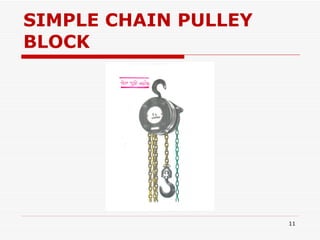
SIMPLE CHAIN PULLEY BLOCK
Planning the lift  Planning the lifting operation is essential  to ensure that the lift is carried out  safely and efficiently
Planning the lift  Absence of planning leads to  Short cuts, using unsafe procedure, equipment & It may cause  An ACCIDENT OR DELAY
Planning the lift  The following points must be considered during planning: Where the load is to be picked up from Where the load is to be placed What areas to be passed over Any obstructions in the way How the load is to be slung How the slings are to be removed and access to them
Planning the lift  For complex lifts, following points may have to be considered: Special lifting accessories such as spreader beams to ensure that the load is safely lifted and without damage to the product (large machineries, generators, etc.)  Special connectors to connect special built in connecting points. The operations may involve: Turning loads over or standing them upright Using more than one crane to lift a load.
The lift Are the slings undamaged and properly attached to the load? Is the crane hoist rope vertical?  Is the load free i.e not attached to any thing else? Are the legs of multi legged sling equally loaded? Are all spare all spare legs of the sling are hooked up to the master link on the lifting hook? After slinging but before lifting, the  following must be considered
The lift Are all personnel clear of the load? Is the landing site prepared to take the load? If required, is hand/tag lines attached to the load? After slinging but before lifting, the  following must be considered
Check Before Lifting Now lift the load a short distance above the ground and check that: The load is balanced and stable. The legs of the slings are at correct angles. Any packing pieces used, are in place and sound. The load itself is not stressed, especially when lifting packing cases, timber etc, which can fail under the loads applied due to lifting.
Landing the load Before landing the load check that: The landing area will take the weight of the load. There is sufficient space for the load. There are strips of timber or similar on which to land the load such that the slings can be easily removed by hand. The load should be landed gently to ensure that it is not damaged and that the crane does not receive any shock loading .
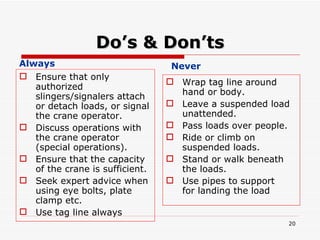
Do’s & Don’ts Ensure that only authorized slingers/signalers attach or detach loads, or signal the crane operator. Discuss operations with the crane operator (special operations). Ensure that the capacity of the crane is sufficient. Seek expert advice when using eye bolts, plate clamp etc.  Use tag line always  Wrap tag line around hand or body. Leave a suspended load unattended. Pass loads over people. Ride or climb on suspended loads. Stand or walk beneath the loads. Use pipes to support  for landing the load  Always  Never
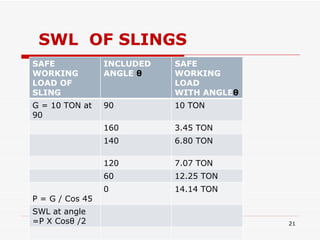
SWL  OF SLINGS SAFE WORKING LOAD OF SLING INCLUDED ANGLE  θ   SAFE WORKING LOAD WITH ANGLE θ   G = 10 TON at 90 90 10 TON 160 3.45 TON 140 6.80 TON 120 7.07 TON 60 12.25 TON P = G / Cos 45 0 14.14 TON SWL at angle =P X Cos θ  /2
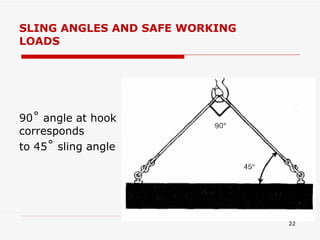
SLING ANGLES AND SAFE WORKING LOADS 90˚ angle at hook corresponds to 45˚ sling angle
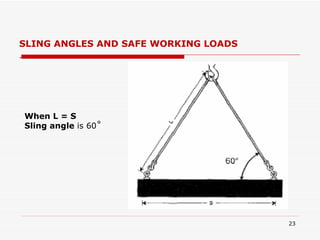
SLING ANGLES AND SAFE WORKING LOADS . When L = S Sling angle  is 60˚
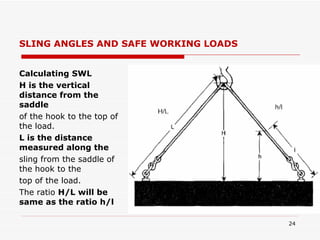
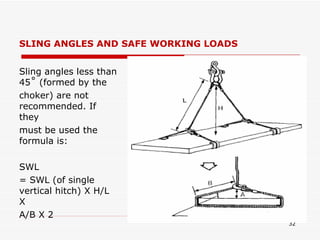
SLING ANGLES AND SAFE WORKING LOADS Calculating SWL H is the vertical distance from the saddle of the hook to the top of the load. L is the distance measured along the sling from the saddle of the hook to the top of the load. The ratio  H/L will be same as the ratio h/l
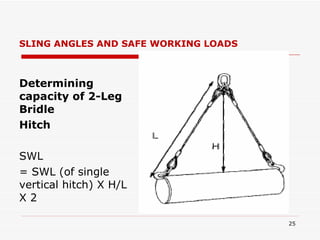
SLING ANGLES AND SAFE WORKING LOADS Determining capacity of 2-Leg Bridle Hitch SWL = SWL (of single vertical hitch) X H/L X 2
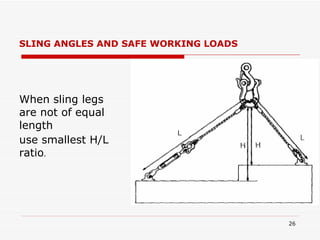
SLING ANGLES AND SAFE WORKING LOADS When sling legs are not of equal length use smallest H/L ratio .
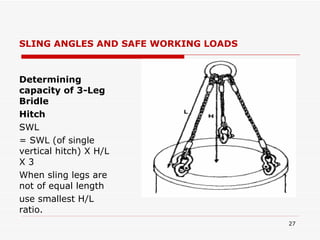
SLING ANGLES AND SAFE WORKING LOADS Determining capacity of 3-Leg Bridle Hitch SWL = SWL (of single vertical hitch) X H/L X 3 When sling legs are not of equal length use smallest H/L ratio.
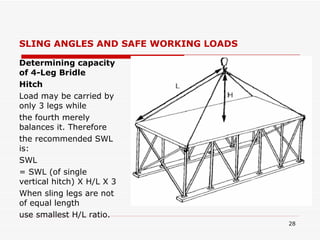
SLING ANGLES AND SAFE WORKING LOADS Determining capacity of 4-Leg Bridle Hitch Load may be carried by only 3 legs while the fourth merely balances it. Therefore the recommended SWL is: SWL = SWL (of single vertical hitch) X H/L X 3 When sling legs are not of equal length use smallest H/L ratio.
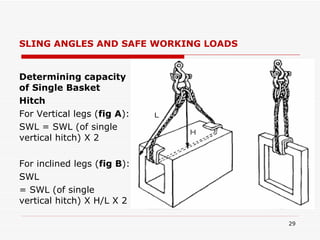
SLING ANGLES AND SAFE WORKING LOADS Determining capacity of Single Basket Hitch For Vertical legs ( fig A ): SWL = SWL (of single vertical hitch) X 2 For inclined legs ( fig B ): SWL = SWL (of single vertical hitch) X H/L X 2
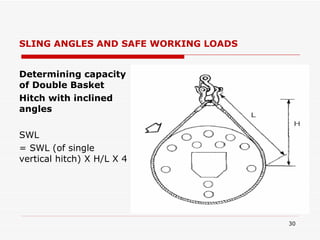
SLING ANGLES AND SAFE WORKING LOADS Determining capacity of Double Basket Hitch with inclined angles SWL = SWL (of single vertical hitch) X H/L X 4
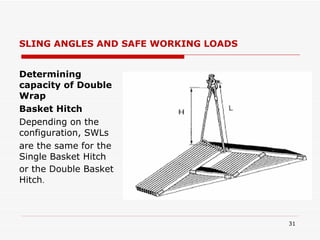
SLING ANGLES AND SAFE WORKING LOADS Determining capacity of Double Wrap Basket Hitch Depending on the configuration, SWLs are the same for the Single Basket Hitch or the Double Basket Hitch .
SLING ANGLES AND SAFE WORKING LOADS Sling angles less than 45˚ (formed by the choker) are not recommended. If they must be used the formula is: SWL = SWL (of single vertical hitch) X H/L X A/B X 2
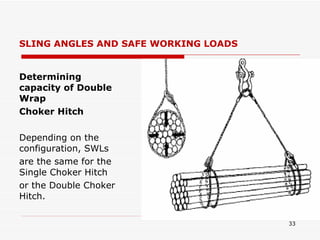
SLING ANGLES AND SAFE WORKING LOADS Determining capacity of Double Wrap Choker Hitch Depending on the configuration, SWLs are the same for the Single Choker Hitch or the Double Choker Hitch.
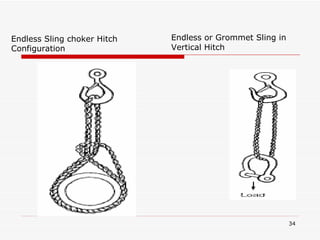
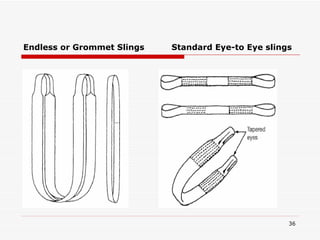
Endless or Grommet Sling in Vertical Hitch Endless Sling choker Hitch Configuration
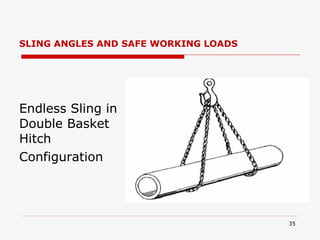
SLING ANGLES AND SAFE WORKING LOADS Endless Sling in Double Basket Hitch Configuration
Endless or Grommet Slings  Standard Eye-to Eye slings
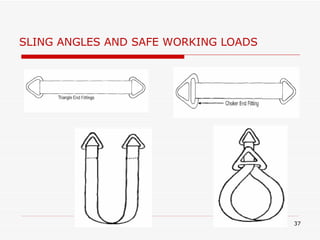
SLING ANGLES AND SAFE WORKING LOADS
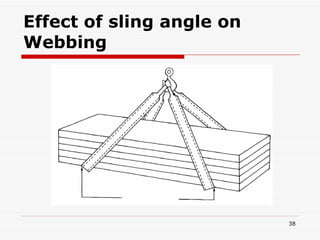
Effect of sling angle on Webbing
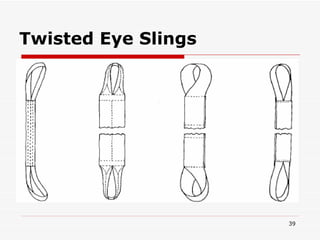
Twisted Eye Slings
What can happen, if, adequate safety is not observed?
A case study 1 The incident: In June 2003, a tragic incident occurred at one of the  oil and gas development site in Algeria, resulting in one fatality and two injuries. The incident occurred during the assembly of an onshore drilling rig. A large section of the rig was being lifted when a lifting chain failed.
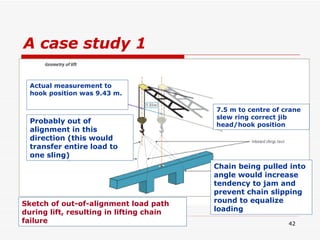
A case study 1 Actual measurement to hook position was 9.43 m.  7.5 m to centre of crane slew ring correct jib head/hook position Probably out of alignment in this direction (this would transfer entire load to one sling) Chain being pulled into angle would increase tendency to jam and prevent chain slipping round to equalize loading Sketch of out-of-alignment load path during lift, resulting in lifting chain failure
A case study 1 The causes, as established by an investing team: Use of an underrated chain sling. Incorrect slinging and lifting techniques.  The crane hook was positioned off-centre, resulting in the load path being out of alignment.  Combined with a hinged load, this prevented the sling from equalizing on all chain legs when raised.  Consequently, the entire load of  23.1  tonnes was placed on one chain leg that had a breaking load of  18.9  tonnes resulting in failure of chain
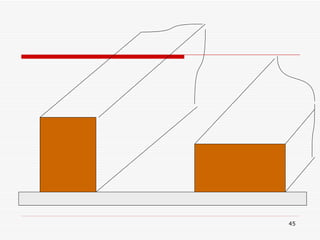
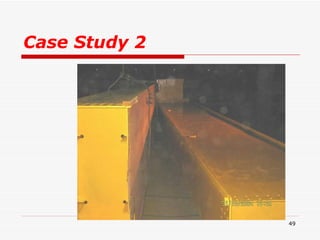
Case Study 2 Job : erection of gantry crane beams Description of Accident :  Two beams of 11.5m X 1.5m X 0.75m weighing about 6 tones were lying on concrete sleepers. Out of two beams one beam was lying on sleeper in horizontal position. The other beam was in vertical position and was to be positioned to make alignment with the first beam.
Case Study 2 Job : erection of gantry crane beams Description of Accident :  Slings were placed around the vertical beam. Mr. XYZ went up the beam to adjust the sling. He adjusted the sling and stood in between the two beams.  In the meantime someone gave signal to lift the beam.  Crane operator lifted the beam by about 4 mm up its position.
Case Study 2 Job : erection of gantry crane beams Description of Accident :  During that operation beam swayed towards the first beam and Mr. XYZ was caught between the two beams. On hearing the scream, crane driver placed the beam back on its original position.
Case Study 2 Job : erection of gantry crane beams Description of Accident :  Mr. XYZ got up and tried to get out of two beams but he stumbled and fell down on sleepers, got injury near left eyebrow.  He was taken to hospital, but was declared as dead .
Case Study 2
Case Study 2 -  Investigation 1.  No hand rope (tag line) was used to avoid swinging of the job. 2   Both the lifting rope used are having N no. of kinks on it., naturally these kinks will have tendency to swing the job.  No lifting hole or lugs were made to the beam to rotate it. Crane operator does not know who gave him signal for lifting the job.
Learning from the incidents  Apart from lifting machine, it is also necessary to take care of lifting tackles and lifting procedure
Safe Slinging Practice
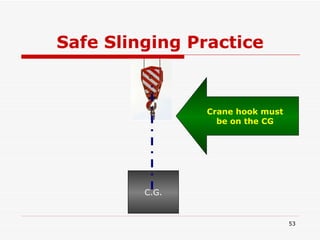
Safe Slinging Practice C.G. Crane hook must be on the CG
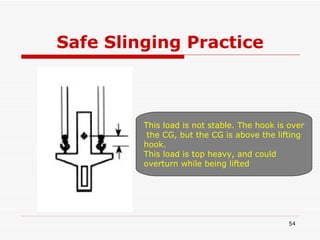
Safe Slinging Practice This load is not stable. The hook is over the CG, but the CG is above the lifting hook. This load is top heavy, and could  overturn while being lifted
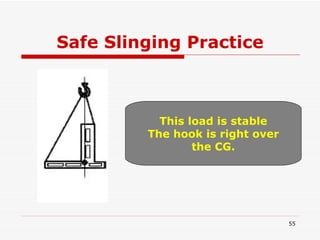
Safe Slinging Practice This load is stable The hook is right over the CG.
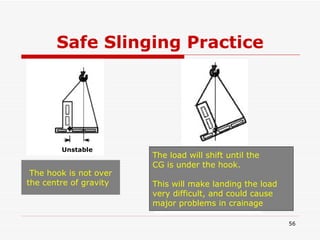
Safe Slinging Practice The hook is not over the centre of gravity  The load will shift until the CG is under the hook. This will make landing the load  very difficult, and could cause  major problems in crainage Unstable
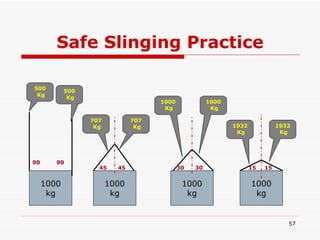
Safe Slinging Practice 1000 kg 1000 kg 1000 kg 1000 kg 45 90 90 45 30 30 15 15 707 Kg 500 Kg 500 Kg 707 Kg 1000 Kg 1000 Kg 1932 Kg 1932 Kg
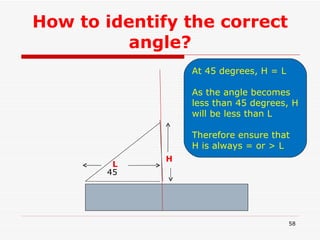
How to identify the correct angle? 45 H L At 45 degrees, H = L As the angle becomes less than 45 degrees, H will be less than L Therefore ensure that H is always = or > L
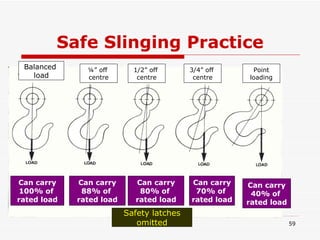
Safe Slinging Practice Can carry 88% of  rated load Can carry 100% of  rated load Can carry 80% of  rated load Can carry 70% of  rated load Can carry 40% of  rated load Balanced  load ¼” off  centre 1/2” off  centre 3/4” off  centre Point loading Safety latches omitted
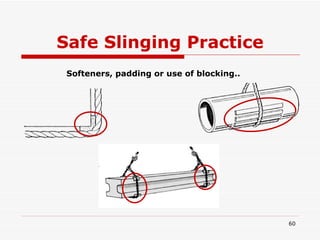
Safe Slinging Practice Softeners, padding or use of blocking..
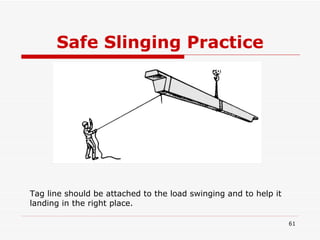
Safe Slinging Practice Tag line should be attached to the load swinging and to help it landing in the right place.
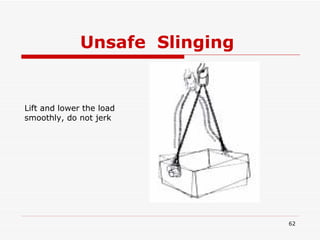
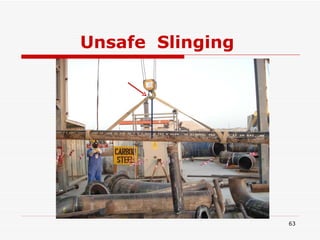
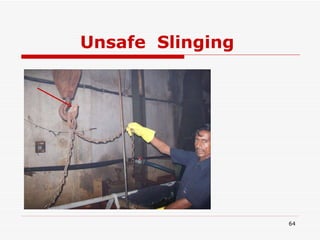
Unsafe  Slinging  Lift and lower the load smoothly, do not jerk
Unsafe  Slinging
Unsafe  Slinging
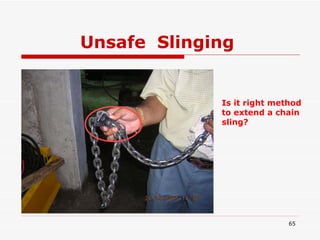
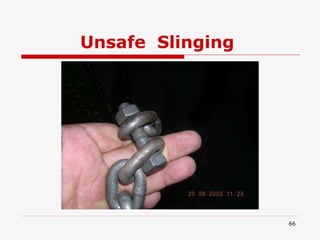
Unsafe  Slinging  Is it right method to extend a chain sling?
Unsafe  Slinging
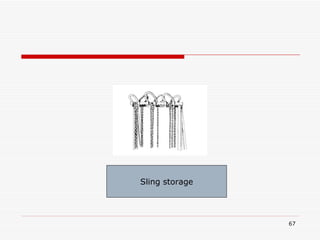
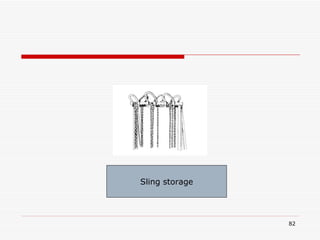
Sling storage
Hand Signals When should the crane operator follow hand signals?   A crane operator should always move loads according to the established code of signals, and use a signaler.  Hand signals are preferred and commonly used.
Hand Signals Who can give the hand signals?  a person qualified to give crane signals to the operator, there should be only one designated signaler at a time, a crane operator should move loads only on signals from one signaler,
Responsibility of the signaler The signaler must:  be in clear view of the crane operator, have a clear view of the load and the equipment, keep persons outside the crane's operating area, never direct a load over a person.
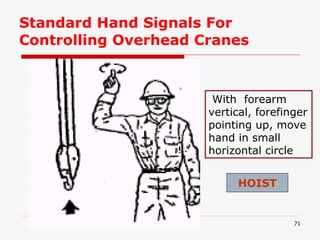
Standard Hand Signals For Controlling Overhead Cranes With  forearm vertical, forefinger pointing up, move hand in small horizontal circle HOIST
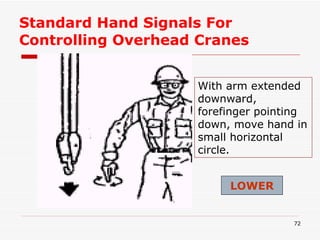
Standard Hand Signals For Controlling Overhead Cranes With arm extended downward, forefinger pointing down, move hand in small horizontal circle. LOWER
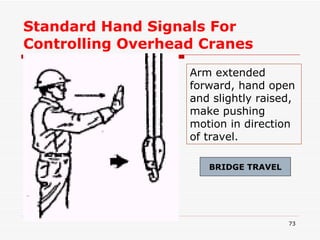
Standard Hand Signals For Controlling Overhead Cranes Arm extended forward, hand open and slightly raised, make pushing motion in direction of travel. BRIDGE TRAVEL
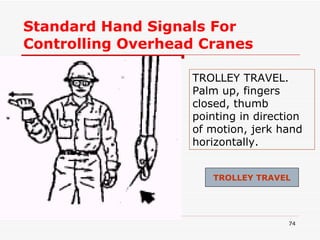
Standard Hand Signals For Controlling Overhead Cranes TROLLEY TRAVEL.  Palm up, fingers closed, thumb pointing in direction of motion, jerk hand horizontally. TROLLEY TRAVEL
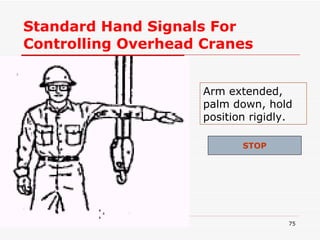
Standard Hand Signals For Controlling Overhead Cranes Arm extended, palm down, hold position rigidly. STOP
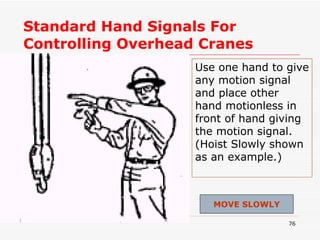
Standard Hand Signals For Controlling Overhead Cranes Use one hand to give any motion signal and place other hand motionless in front of hand giving the motion signal.  (Hoist Slowly shown as an example.) MOVE SLOWLY
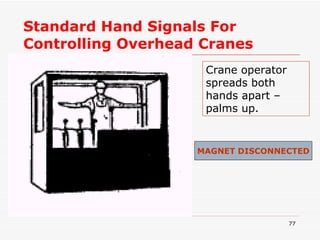
Standard Hand Signals For Controlling Overhead Cranes Crane operator spreads both hands apart – palms up. MAGNET DISCONNECTED
Finally, we must remember….
Objective Of Good Slinging The sling and its method of use should be suitable for the load. The method of attachment of the sling to the load and the sling to the lifting appliance should be secure. No part of the sling should be overloaded either by the weight of the load or by the method of slinging.
Objective Of Good Slinging The slinging method should ensure that the load is secure and that the load will not fall from the sling. The load should be balanced and stable and should not violently change its attitude when lifted. The load must not be damaged by, or cause damage to, the sling.
If we remember & achieve this Objective…..  The probability of accident will be minimum
Sling storage
THANK YOU

Lifting & procedure

  • 1.
    Lifting Equipments andProcedure Compiled by Safety Trainees PECL 15 January 2011.
  • 2.
    2. Factories Act-Section28 (1):Hoists and Lifts (a) In a factory hoists and lifts should be of : (i) - good mechanical construction - sound material - adequate strength © SWL to be distinguishly marked and no load greater than this be lifted or carried.
  • 3.
    Sec 29. LIFTINGMACHINES, CHAINS, ROPES AND LIFTING TACKLES
  • 4.
    The Factories Act,1948 Sec:2(ca): Competent Person Means: A person or an institution recognised as such by CIF for carrying out tests, examination and inspections required to be done in a factory under provisions of this Act regarding: qualifications and experience of person and facilities available at his disposal; (ii) qualifications and experience of persons employed in such institution and facilities a/v therein, with regard to conduct of such tests, examinations and inspections, and more than one person or institution can be recognised as a competent person in relation to a factory.
  • 5.
    The Factories Act,1948 Sec:2(j): Machinery Includes prime movers, transmission machinery and other appliances whereby power is generated, transformed, transmitted or applied.
  • 6.
    Lifting Equipments: Hydra’sCRANES: limit switches Fork lifts Magnetic lift crane Mobile cranes: wheel ,crawler EOT Gantry Chain pully:spur gear,worm wheel Winch machine
  • 7.
    Lifting tackle : Slings Ropes Shackles Swivel Rings Couplers Sockets, Eyebolts. Frames & spreaders Plate lifting clamps Tailor-made tackles.
  • 8.
    Overview Terms &definitions Planning the lift The lift Landing the load Do’s & Don’ts Case study Slinging methods Safe slinging practice
  • 9.
    Terms & Definitions Competent person : A person who has acquired, through a combination of qualifications, training or experience, the knowledge and skill to perform the task required. Grommet : Endless wire rope sling. MBL : Minimum breaking load of the lifting tackle. SWL : Safe working load.
  • 10.
    Definitions Tagline : A rope of suitable strength, construction and length attached with an appropriate recognised bend or hitch to the load, used to control the load during lifting or positioning. Test certificate : A certificate issued by an authorized person
  • 11.
  • 12.
    Planning the lift Planning the lifting operation is essential to ensure that the lift is carried out safely and efficiently
  • 13.
    Planning the lift Absence of planning leads to Short cuts, using unsafe procedure, equipment & It may cause An ACCIDENT OR DELAY
  • 14.
    Planning the lift The following points must be considered during planning: Where the load is to be picked up from Where the load is to be placed What areas to be passed over Any obstructions in the way How the load is to be slung How the slings are to be removed and access to them
  • 15.
    Planning the lift For complex lifts, following points may have to be considered: Special lifting accessories such as spreader beams to ensure that the load is safely lifted and without damage to the product (large machineries, generators, etc.) Special connectors to connect special built in connecting points. The operations may involve: Turning loads over or standing them upright Using more than one crane to lift a load.
  • 16.
    The lift Arethe slings undamaged and properly attached to the load? Is the crane hoist rope vertical? Is the load free i.e not attached to any thing else? Are the legs of multi legged sling equally loaded? Are all spare all spare legs of the sling are hooked up to the master link on the lifting hook? After slinging but before lifting, the following must be considered
  • 17.
    The lift Areall personnel clear of the load? Is the landing site prepared to take the load? If required, is hand/tag lines attached to the load? After slinging but before lifting, the following must be considered
  • 18.
    Check Before LiftingNow lift the load a short distance above the ground and check that: The load is balanced and stable. The legs of the slings are at correct angles. Any packing pieces used, are in place and sound. The load itself is not stressed, especially when lifting packing cases, timber etc, which can fail under the loads applied due to lifting.
  • 19.
    Landing the loadBefore landing the load check that: The landing area will take the weight of the load. There is sufficient space for the load. There are strips of timber or similar on which to land the load such that the slings can be easily removed by hand. The load should be landed gently to ensure that it is not damaged and that the crane does not receive any shock loading .
  • 20.
    Do’s & Don’tsEnsure that only authorized slingers/signalers attach or detach loads, or signal the crane operator. Discuss operations with the crane operator (special operations). Ensure that the capacity of the crane is sufficient. Seek expert advice when using eye bolts, plate clamp etc. Use tag line always Wrap tag line around hand or body. Leave a suspended load unattended. Pass loads over people. Ride or climb on suspended loads. Stand or walk beneath the loads. Use pipes to support for landing the load Always Never
  • 21.
    SWL OFSLINGS SAFE WORKING LOAD OF SLING INCLUDED ANGLE θ SAFE WORKING LOAD WITH ANGLE θ G = 10 TON at 90 90 10 TON 160 3.45 TON 140 6.80 TON 120 7.07 TON 60 12.25 TON P = G / Cos 45 0 14.14 TON SWL at angle =P X Cos θ /2
  • 22.
    SLING ANGLES ANDSAFE WORKING LOADS 90˚ angle at hook corresponds to 45˚ sling angle
  • 23.
    SLING ANGLES ANDSAFE WORKING LOADS . When L = S Sling angle is 60˚
  • 24.
    SLING ANGLES ANDSAFE WORKING LOADS Calculating SWL H is the vertical distance from the saddle of the hook to the top of the load. L is the distance measured along the sling from the saddle of the hook to the top of the load. The ratio H/L will be same as the ratio h/l
  • 25.
    SLING ANGLES ANDSAFE WORKING LOADS Determining capacity of 2-Leg Bridle Hitch SWL = SWL (of single vertical hitch) X H/L X 2
  • 26.
    SLING ANGLES ANDSAFE WORKING LOADS When sling legs are not of equal length use smallest H/L ratio .
  • 27.
    SLING ANGLES ANDSAFE WORKING LOADS Determining capacity of 3-Leg Bridle Hitch SWL = SWL (of single vertical hitch) X H/L X 3 When sling legs are not of equal length use smallest H/L ratio.
  • 28.
    SLING ANGLES ANDSAFE WORKING LOADS Determining capacity of 4-Leg Bridle Hitch Load may be carried by only 3 legs while the fourth merely balances it. Therefore the recommended SWL is: SWL = SWL (of single vertical hitch) X H/L X 3 When sling legs are not of equal length use smallest H/L ratio.
  • 29.
    SLING ANGLES ANDSAFE WORKING LOADS Determining capacity of Single Basket Hitch For Vertical legs ( fig A ): SWL = SWL (of single vertical hitch) X 2 For inclined legs ( fig B ): SWL = SWL (of single vertical hitch) X H/L X 2
  • 30.
    SLING ANGLES ANDSAFE WORKING LOADS Determining capacity of Double Basket Hitch with inclined angles SWL = SWL (of single vertical hitch) X H/L X 4
  • 31.
    SLING ANGLES ANDSAFE WORKING LOADS Determining capacity of Double Wrap Basket Hitch Depending on the configuration, SWLs are the same for the Single Basket Hitch or the Double Basket Hitch .
  • 32.
    SLING ANGLES ANDSAFE WORKING LOADS Sling angles less than 45˚ (formed by the choker) are not recommended. If they must be used the formula is: SWL = SWL (of single vertical hitch) X H/L X A/B X 2
  • 33.
    SLING ANGLES ANDSAFE WORKING LOADS Determining capacity of Double Wrap Choker Hitch Depending on the configuration, SWLs are the same for the Single Choker Hitch or the Double Choker Hitch.
  • 34.
    Endless or GrommetSling in Vertical Hitch Endless Sling choker Hitch Configuration
  • 35.
    SLING ANGLES ANDSAFE WORKING LOADS Endless Sling in Double Basket Hitch Configuration
  • 36.
    Endless or GrommetSlings Standard Eye-to Eye slings
  • 37.
    SLING ANGLES ANDSAFE WORKING LOADS
  • 38.
    Effect of slingangle on Webbing
  • 39.
  • 40.
    What can happen,if, adequate safety is not observed?
  • 41.
    A case study1 The incident: In June 2003, a tragic incident occurred at one of the oil and gas development site in Algeria, resulting in one fatality and two injuries. The incident occurred during the assembly of an onshore drilling rig. A large section of the rig was being lifted when a lifting chain failed.
  • 42.
    A case study1 Actual measurement to hook position was 9.43 m. 7.5 m to centre of crane slew ring correct jib head/hook position Probably out of alignment in this direction (this would transfer entire load to one sling) Chain being pulled into angle would increase tendency to jam and prevent chain slipping round to equalize loading Sketch of out-of-alignment load path during lift, resulting in lifting chain failure
  • 43.
    A case study1 The causes, as established by an investing team: Use of an underrated chain sling. Incorrect slinging and lifting techniques. The crane hook was positioned off-centre, resulting in the load path being out of alignment. Combined with a hinged load, this prevented the sling from equalizing on all chain legs when raised. Consequently, the entire load of 23.1 tonnes was placed on one chain leg that had a breaking load of 18.9 tonnes resulting in failure of chain
  • 44.
    Case Study 2Job : erection of gantry crane beams Description of Accident : Two beams of 11.5m X 1.5m X 0.75m weighing about 6 tones were lying on concrete sleepers. Out of two beams one beam was lying on sleeper in horizontal position. The other beam was in vertical position and was to be positioned to make alignment with the first beam.
  • 46.
    Case Study 2Job : erection of gantry crane beams Description of Accident : Slings were placed around the vertical beam. Mr. XYZ went up the beam to adjust the sling. He adjusted the sling and stood in between the two beams. In the meantime someone gave signal to lift the beam. Crane operator lifted the beam by about 4 mm up its position.
  • 47.
    Case Study 2Job : erection of gantry crane beams Description of Accident : During that operation beam swayed towards the first beam and Mr. XYZ was caught between the two beams. On hearing the scream, crane driver placed the beam back on its original position.
  • 48.
    Case Study 2Job : erection of gantry crane beams Description of Accident : Mr. XYZ got up and tried to get out of two beams but he stumbled and fell down on sleepers, got injury near left eyebrow. He was taken to hospital, but was declared as dead .
  • 49.
  • 50.
    Case Study 2- Investigation 1.  No hand rope (tag line) was used to avoid swinging of the job. 2   Both the lifting rope used are having N no. of kinks on it., naturally these kinks will have tendency to swing the job. No lifting hole or lugs were made to the beam to rotate it. Crane operator does not know who gave him signal for lifting the job.
  • 51.
    Learning from theincidents Apart from lifting machine, it is also necessary to take care of lifting tackles and lifting procedure
  • 52.
  • 53.
    Safe Slinging PracticeC.G. Crane hook must be on the CG
  • 54.
    Safe Slinging PracticeThis load is not stable. The hook is over the CG, but the CG is above the lifting hook. This load is top heavy, and could overturn while being lifted
  • 55.
    Safe Slinging PracticeThis load is stable The hook is right over the CG.
  • 56.
    Safe Slinging PracticeThe hook is not over the centre of gravity The load will shift until the CG is under the hook. This will make landing the load very difficult, and could cause major problems in crainage Unstable
  • 57.
    Safe Slinging Practice1000 kg 1000 kg 1000 kg 1000 kg 45 90 90 45 30 30 15 15 707 Kg 500 Kg 500 Kg 707 Kg 1000 Kg 1000 Kg 1932 Kg 1932 Kg
  • 58.
    How to identifythe correct angle? 45 H L At 45 degrees, H = L As the angle becomes less than 45 degrees, H will be less than L Therefore ensure that H is always = or > L
  • 59.
    Safe Slinging PracticeCan carry 88% of rated load Can carry 100% of rated load Can carry 80% of rated load Can carry 70% of rated load Can carry 40% of rated load Balanced load ¼” off centre 1/2” off centre 3/4” off centre Point loading Safety latches omitted
  • 60.
    Safe Slinging PracticeSofteners, padding or use of blocking..
  • 61.
    Safe Slinging PracticeTag line should be attached to the load swinging and to help it landing in the right place.
  • 62.
    Unsafe Slinging Lift and lower the load smoothly, do not jerk
  • 63.
  • 64.
  • 65.
    Unsafe Slinging Is it right method to extend a chain sling?
  • 66.
  • 67.
  • 68.
    Hand Signals Whenshould the crane operator follow hand signals? A crane operator should always move loads according to the established code of signals, and use a signaler. Hand signals are preferred and commonly used.
  • 69.
    Hand Signals Whocan give the hand signals? a person qualified to give crane signals to the operator, there should be only one designated signaler at a time, a crane operator should move loads only on signals from one signaler,
  • 70.
    Responsibility of thesignaler The signaler must: be in clear view of the crane operator, have a clear view of the load and the equipment, keep persons outside the crane's operating area, never direct a load over a person.
  • 71.
    Standard Hand SignalsFor Controlling Overhead Cranes With forearm vertical, forefinger pointing up, move hand in small horizontal circle HOIST
  • 72.
    Standard Hand SignalsFor Controlling Overhead Cranes With arm extended downward, forefinger pointing down, move hand in small horizontal circle. LOWER
  • 73.
    Standard Hand SignalsFor Controlling Overhead Cranes Arm extended forward, hand open and slightly raised, make pushing motion in direction of travel. BRIDGE TRAVEL
  • 74.
    Standard Hand SignalsFor Controlling Overhead Cranes TROLLEY TRAVEL. Palm up, fingers closed, thumb pointing in direction of motion, jerk hand horizontally. TROLLEY TRAVEL
  • 75.
    Standard Hand SignalsFor Controlling Overhead Cranes Arm extended, palm down, hold position rigidly. STOP
  • 76.
    Standard Hand SignalsFor Controlling Overhead Cranes Use one hand to give any motion signal and place other hand motionless in front of hand giving the motion signal. (Hoist Slowly shown as an example.) MOVE SLOWLY
  • 77.
    Standard Hand SignalsFor Controlling Overhead Cranes Crane operator spreads both hands apart – palms up. MAGNET DISCONNECTED
  • 78.
    Finally, we mustremember….
  • 79.
    Objective Of GoodSlinging The sling and its method of use should be suitable for the load. The method of attachment of the sling to the load and the sling to the lifting appliance should be secure. No part of the sling should be overloaded either by the weight of the load or by the method of slinging.
  • 80.
    Objective Of GoodSlinging The slinging method should ensure that the load is secure and that the load will not fall from the sling. The load should be balanced and stable and should not violently change its attitude when lifted. The load must not be damaged by, or cause damage to, the sling.
  • 81.
    If we remember& achieve this Objective….. The probability of accident will be minimum
  • 82.
  • 83.