SOCIAL SCIENCE III
   MIDDLE AGES
     FEUDALISM
     CHIVALRY
     THE CHURCH as a powerful institution
      ▪ REFORMS AND CRUSADES
   THE RENAISSANCE
   THE REFORMATION
   INTELLECTUAL REVOLUTION *
   CAF SEGREGATION PROJECT, as usual.


   A surprise project which will be formally
    introduced in class after the long break.
   Middle Ages              Vassal
     Franks                 Knight
     Monastery              Serf
     Secular                Manor
     Carolingian Dynasty    Tithe
     Charlemage             Chivalry
     Lord                   Tournament
     Fief                   troubadour
   This period of history in Europe succeeded the
    fall of the great Roman Empire.

   Medieval Europe – new institutions emerged
    to replace those of the fallen Roman Empire.
     They were fragmented unlike the civilizations in
     China and Southwest Asia.
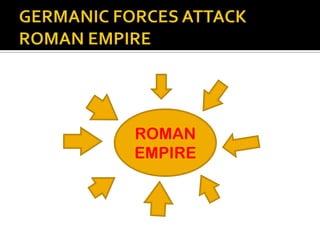
ROMAN
EMPIRE
BROUGHT WITH                           THEM

   DISRUPTION OF TRADE                   DECLINE OF LEARNING
     Business collapsed as a result        Germanic invaders: NO
      of recurring invasions.                READ, NO WRITE.
   DOWNFALL OF CITIES
     Romans abandoned cities as          LOSS OF A COMMON
      centers of administration.           LANGUAGE
   POPULATION SHIFTS                       Latin began to be fragmented
     From city to countryside               ▪ FRENCH
      (URBAN to RURAL)                       ▪ SPANISH
                                             ▪ Other Roman based
                                               languages
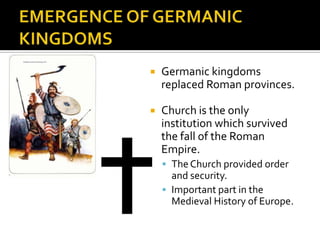
   Germanic kingdoms
    replaced Roman provinces.

   Church is the only
    institution which survived
    the fall of the Roman
    Empire.
     The Church provided order
      and security.
     Important part in the
      Medieval History of Europe.
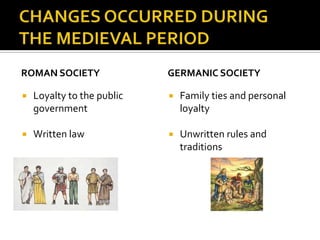
ROMAN SOCIETY               GERMANIC SOCIETY

   Loyalty to the public      Family ties and personal
    government                  loyalty

   Written law                Unwritten rules and
                                traditions
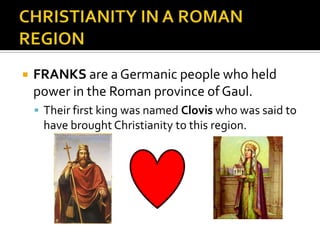
   FRANKS are a Germanic people who held
    power in the Roman province of Gaul.
     Their first king was named Clovis who was said to
     have brought Christianity to this region.
   The Church in Rome welcomed Clovis’s
    conversion and supported his military
    campaigns against other Germanic peoples.
     This marked the beginning of an alliance between
     two powerful forces/ institutions, the Kingdom
     and the Church.
   POLITICS
     Church and King converted many Germanic
     people.

   MISSIONARIES – borders of the Roman
    Empire

   FEAR OF COASTAL ATTACKS BY MUSLIMS
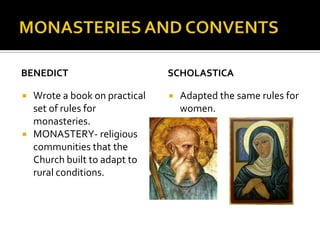
BENEDICT                        SCHOLASTICA

   Wrote a book on practical      Adapted the same rules for
    set of rules for                women.
    monasteries.
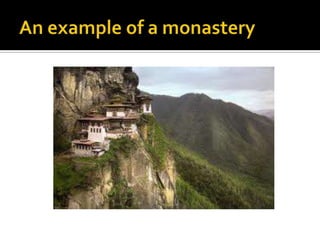
   MONASTERY- religious
    communities that the
    Church built to adapt to
    rural conditions.
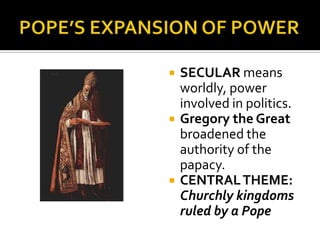
   SECULAR means
    worldly, power
    involved in politics.
   Gregory the Great
    broadened the
    authority of the
    papacy.
   CENTRAL THEME:
    Churchly kingdoms
    ruled by a Pope
A
SECULARIZED
POPE

                 POPE’S PALACE- center of the
                  Roman government.
CHANGES IN
                 Church revenues for raising
THE POWER         armies, repairing roads, helping
                  the poor.
OF THE POPE
                 Negotiating peace treaties with
                  invaders (ex. Lombards)
                 Pope being the Mayor of Rome
   Roman Empire was                   Major Domo= mayors
    divided.                            of the palace.
     England = seven tiny               Became the most
      kingdoms.                           powerful person in the
     Franks = controlled                 kingdom.
      Gaul, the largest and              In charge of the royal
      strongest of Europe’s               households and estates
      kingdoms.                           (official responsibility)
     Clovis- first king of Gaul.        Commanded armies and
      ▪ Started and strengthened          made policies.
        the Merovingian Dynasty.
CHARLES MARTEL                    PEPIN THE SHORT

   Extended Franks’ reign to        Succeeded Charles Martel.
    the North, South, and East
    of Gaul.                         Supported the Church in
                                      their fight against the
   Also defeated a Muslim            Lombards (invading
    raiding party from Spain at       Central Italy).
    the Battle of Tours.
                                     “King by the Grace of God.”
                                     Started the Carolingian
                                      Dynasty.
   Pepin the Short left two successors, Carloman
    and Charles.
   CHARLES- would eventually be known as
    Charlemagne.
     A tall, bold man who stood 6’4”
     Einhard says he was “the most potent prince with the
        greatest skill and success in different countries during
        the forty-seven years of his reign.”
       Doubled the area of his father’s reign
       His conquests helped spread Christianity
       Is the first German “Roman Emperor”.
       WHY WAS IT HISTORIC?
   Limited the authority  Encouraged learning
    of the nobles            English, German, Italian
                                , and Spanish scholars
   Regularly visited every    Opened a palace school
    part of his kingdom.        for the children at the
                                court.
   Judged cases, settled      Monasteries opened
    disputes, rewarded          schools that trained
                                monks and priests
    followers.
   Louis the Pious – devoutly a religious man

                           Lothair

                     Charles the Bald

                     Louis the German

   TREATY OF VERDUN- divided Charlemagne’s
            empire into 3 kingdoms.
   FAMILIARIZE YOURSELF WITH THE MAP OF
    CHARLEMAGNE’S EMPIRE.
   WHAT IS FEUDALISM? WHERE DOES
    FEUDALISM BASE ITS POWER? DESCRIBE THE
    SOCIAL STRUCTURE PRESENT IN THIS
    PERIOD.
   COMPARE AND CONTRAST THE FEUDALISM
    THAT EXISTED IN JAPAN AND CHINA WITH THE
    ONE THAT EXISTED IN EUROPE.
   DRAW THE TYPICAL MANOR THAT EXISTED
    DURING THIS ERA.

Medieval period

  • 1.
  • 2.
    MIDDLE AGES  FEUDALISM  CHIVALRY  THE CHURCH as a powerful institution ▪ REFORMS AND CRUSADES  THE RENAISSANCE  THE REFORMATION  INTELLECTUAL REVOLUTION *
  • 3.
    CAF SEGREGATION PROJECT, as usual.  A surprise project which will be formally introduced in class after the long break.
  • 6.
    Middle Ages  Vassal  Franks  Knight  Monastery  Serf  Secular  Manor  Carolingian Dynasty  Tithe  Charlemage  Chivalry  Lord  Tournament  Fief  troubadour
  • 7.
    This period of history in Europe succeeded the fall of the great Roman Empire.  Medieval Europe – new institutions emerged to replace those of the fallen Roman Empire.  They were fragmented unlike the civilizations in China and Southwest Asia.
  • 9.
  • 10.
    BROUGHT WITH THEM  DISRUPTION OF TRADE  DECLINE OF LEARNING  Business collapsed as a result  Germanic invaders: NO of recurring invasions. READ, NO WRITE.  DOWNFALL OF CITIES  Romans abandoned cities as  LOSS OF A COMMON centers of administration. LANGUAGE  POPULATION SHIFTS  Latin began to be fragmented  From city to countryside ▪ FRENCH (URBAN to RURAL) ▪ SPANISH ▪ Other Roman based languages
  • 11.
    Germanic kingdoms replaced Roman provinces.  Church is the only institution which survived the fall of the Roman Empire.  The Church provided order and security.  Important part in the Medieval History of Europe.
  • 12.
    ROMAN SOCIETY GERMANIC SOCIETY  Loyalty to the public  Family ties and personal government loyalty  Written law  Unwritten rules and traditions
  • 13.
    FRANKS are a Germanic people who held power in the Roman province of Gaul.  Their first king was named Clovis who was said to have brought Christianity to this region.
  • 14.
    The Church in Rome welcomed Clovis’s conversion and supported his military campaigns against other Germanic peoples.  This marked the beginning of an alliance between two powerful forces/ institutions, the Kingdom and the Church.
  • 15.
    POLITICS  Church and King converted many Germanic people.  MISSIONARIES – borders of the Roman Empire  FEAR OF COASTAL ATTACKS BY MUSLIMS
  • 16.
    BENEDICT SCHOLASTICA  Wrote a book on practical  Adapted the same rules for set of rules for women. monasteries.  MONASTERY- religious communities that the Church built to adapt to rural conditions.
  • 18.
    SECULAR means worldly, power involved in politics.  Gregory the Great broadened the authority of the papacy.  CENTRAL THEME: Churchly kingdoms ruled by a Pope
  • 19.
    A SECULARIZED POPE  POPE’S PALACE- center of the Roman government. CHANGES IN  Church revenues for raising THE POWER armies, repairing roads, helping the poor. OF THE POPE  Negotiating peace treaties with invaders (ex. Lombards)  Pope being the Mayor of Rome
  • 20.
    Roman Empire was  Major Domo= mayors divided. of the palace.  England = seven tiny  Became the most kingdoms. powerful person in the  Franks = controlled kingdom. Gaul, the largest and  In charge of the royal strongest of Europe’s households and estates kingdoms. (official responsibility)  Clovis- first king of Gaul.  Commanded armies and ▪ Started and strengthened made policies. the Merovingian Dynasty.
  • 21.
    CHARLES MARTEL PEPIN THE SHORT  Extended Franks’ reign to  Succeeded Charles Martel. the North, South, and East of Gaul.  Supported the Church in their fight against the  Also defeated a Muslim Lombards (invading raiding party from Spain at Central Italy). the Battle of Tours.  “King by the Grace of God.”  Started the Carolingian Dynasty.
  • 22.
    Pepin the Short left two successors, Carloman and Charles.  CHARLES- would eventually be known as Charlemagne.  A tall, bold man who stood 6’4”  Einhard says he was “the most potent prince with the greatest skill and success in different countries during the forty-seven years of his reign.”  Doubled the area of his father’s reign  His conquests helped spread Christianity  Is the first German “Roman Emperor”.  WHY WAS IT HISTORIC?
  • 23.
    Limited the authority  Encouraged learning of the nobles  English, German, Italian , and Spanish scholars  Regularly visited every  Opened a palace school part of his kingdom. for the children at the court.  Judged cases, settled  Monasteries opened disputes, rewarded schools that trained monks and priests followers.
  • 24.
    Louis the Pious – devoutly a religious man  Lothair  Charles the Bald  Louis the German  TREATY OF VERDUN- divided Charlemagne’s empire into 3 kingdoms.
  • 25.
    FAMILIARIZE YOURSELF WITH THE MAP OF CHARLEMAGNE’S EMPIRE.
  • 26.
    WHAT IS FEUDALISM? WHERE DOES FEUDALISM BASE ITS POWER? DESCRIBE THE SOCIAL STRUCTURE PRESENT IN THIS PERIOD.  COMPARE AND CONTRAST THE FEUDALISM THAT EXISTED IN JAPAN AND CHINA WITH THE ONE THAT EXISTED IN EUROPE.  DRAW THE TYPICAL MANOR THAT EXISTED DURING THIS ERA.