CHAPTER 7 – THE RISE OF
EUROPE
500 AD – 1500 AD
New Germanic Kingdoms
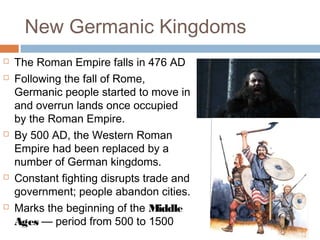
 The Roman Empire falls in 476 AD
 Following the fall of Rome,
Germanic people started to move in
and overrun lands once occupied
by the Roman Empire.
 By 500 AD, the Western Roman
Empire had been replaced by a
number of German kingdoms.
 Constant fighting disrupts trade and
government; people abandon cities.
 Marks the beginning of the Middle
Ages — period from 500 to 1500
The Decline of Learning
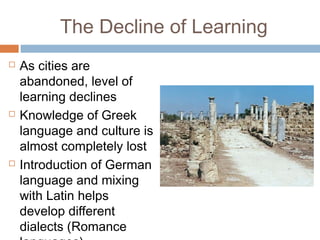
 As cities are
abandoned, level of
learning declines
 Knowledge of Greek
language and culture is
almost completely lost
 Introduction of German
language and mixing
with Latin helps
develop different
dialects (Romance
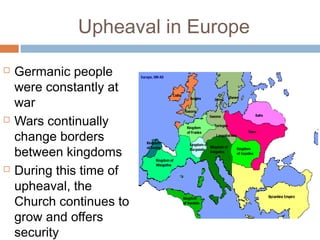
Upheaval in Europe
 Germanic people
were constantly at
war
 Wars continually
change borders
between kingdoms
 During this time of
upheaval, the
Church continues to
grow and offers
security
The Dark Ages
 The Middle Ages are often times referred to as
“the Dark Ages”.
 Can you explain why this time period got this
nickname?
Kingdom of the Franks
 Only one Germanic kingdom proved to be a
lasting one – the kingdom of the Franks.
 The kingdom was established by Clovis, a strong
military leader around 500AD.
 Clovis was able to unite the Franks as well as
other Germanic tribes into one kingdom.
 Clovis was also the first Germanic ruler to convert
to Christianity.
 His conversion gained him the support of a small,
yet growing sect, the Roman Catholic Church,
who was eager to have the friendship of a
Clovis’ Conversion to
Christianity
 What is so important about Clovis converting
to Christianity? Discuss.
 Compare this to politicians nowadays.
 What did his conversion do for the Catholic
church?
Kingdom of the Franks
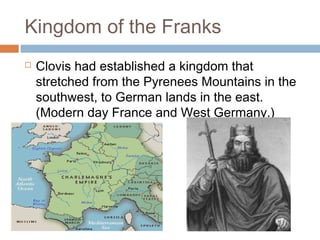
 Clovis had established a kingdom that
stretched from the Pyrenees Mountains in the
southwest, to German lands in the east.
(Modern day France and West Germany.)
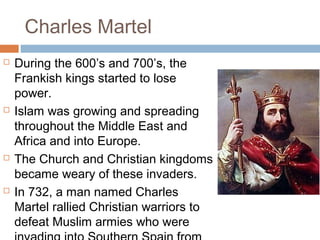
Charles Martel
 During the 600’s and 700’s, the
Frankish kings started to lose
power.
 Islam was growing and spreading
throughout the Middle East and
Africa and into Europe.
 The Church and Christian kingdoms
became weary of these invaders.
 In 732, a man named Charles
Martel rallied Christian warriors to
defeat Muslim armies who were
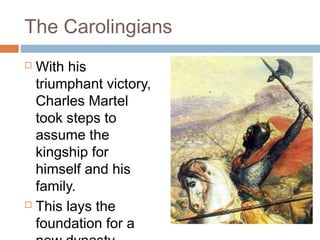
The Carolingians
 With his
triumphant victory,
Charles Martel
took steps to
assume the
kingship for
himself and his
family.
 This lays the
foundation for a
Europe in Turmoil
 When Charles Martel, king of the
Frank’s dies, Europe is thrust into
turmoil.
 At this time the Franks were
falling back into barbarian ways,
neglecting their education and
religion.
 Many people were still pagans.
 The Church was also having its
own struggles.
 In 771, Martel’s grandson,
Charlemagne
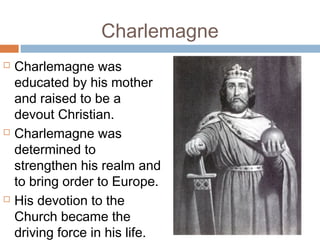
 Charlemagne was raised
to be a devout Christian.
 Charlemagne was
determined to
strengthen his realm and
to bring order to Europe.
 His devotion to the
Church became the
driving force in his life.
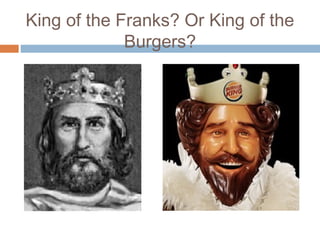
King of the Franks? Or King of the
Burgers?
Charlemagne the Warrior
 In 772, he launched a military
campaign that would last more
than 30 years and included
more than 50 military
expeditions.
 At 6’4, Charlemagne was a tall
and a powerful warrior and
often accompanied and fight
along side his troops during
these campaigns.
 Charlemagne was an
ambitious king, aggressive and
ruthless.  He had the ability to
Charlemagne Brings Order to
Europe
 By 800 Charlemagne was the
undisputed ruler of Western Europe.
 What had once been unified territory of
the Roman Empire was once again
under a new central authority, that of
Charlemagne.
 His vast realm encompassed what are now
France, Switzerland, Belgium, and The
Netherlands and included half of present-day
Italy and Germany, and parts of Austria and
Spain.
 By establishing a central government
over Western Europe, Charlemagne
Did you know?
 Despite his great military
record and being the king
of such as vast territory,
Charlemagne was very
uneducated in his
younger years.
 In fact, he was illiterate
and could not read or
write.
 This did not stop him, he
tried his best to learn
himself and encouraged
Here, can you read
this?
Looks like Chinese or
something to me…
Charlemagne and the Church
 Devoutly Christian,
Charlemagne would not only
conquer his territories, he
would convert the people as
well. Sometimes, at the tip of
a sword.
 The Church also relied on
Charlemagne for protection
and leadership.
 Charlemagne ruled and
protected the Christian
Kingdom, and since the
Church was in Rome, it could
be said that he had the
Charlemagne’s Coronation
 On Christmas Day in 800, while
Charlemagne knelt in prayer in
Saint Peter's in Rome, Pope Leo
III placed a golden crown on the
bowed head of the king, crowning
him the first Holy Roman
Emperor, the divinely appointed
leader of the earthly Christian
world.
 His head was anointed with holy
oil, and the Pope renamed
Charlemagne as Emperor and
Augustus.
 Germanic power, the Church,
 How important is Charlemagne to Europe?
Discuss.
 How did he help strengthen his realm?
 How did he help the spread of Christianity?
Charlemagne’s Legacy
 Charlemagne unites western
Europe and spreads
Christianity.
 He encourages learning and
orders monasteries to open
schools
 Germanic power, Church,
heritage of Roman Empire now
joined together as one
 Because of his actions as a
ruler, Charlemagne is
Following Charlemagne
 Charlemagne dies in
814; his son, Louis,
rules poorly
 Charlemagne’s three
grandsons fight for
control of empire
 In 843 they divide
empire into three
kingdoms
 Europe once again,
becomes unstable.
The European Middle Ages

The European Middle Ages

  • 1.
    CHAPTER 7 –THE RISE OF EUROPE 500 AD – 1500 AD
  • 2.
    New Germanic Kingdoms The Roman Empire falls in 476 AD  Following the fall of Rome, Germanic people started to move in and overrun lands once occupied by the Roman Empire.  By 500 AD, the Western Roman Empire had been replaced by a number of German kingdoms.  Constant fighting disrupts trade and government; people abandon cities.  Marks the beginning of the Middle Ages — period from 500 to 1500
  • 3.
    The Decline ofLearning  As cities are abandoned, level of learning declines  Knowledge of Greek language and culture is almost completely lost  Introduction of German language and mixing with Latin helps develop different dialects (Romance
  • 4.
    Upheaval in Europe Germanic people were constantly at war  Wars continually change borders between kingdoms  During this time of upheaval, the Church continues to grow and offers security
  • 5.
    The Dark Ages The Middle Ages are often times referred to as “the Dark Ages”.  Can you explain why this time period got this nickname?
  • 7.
    Kingdom of theFranks  Only one Germanic kingdom proved to be a lasting one – the kingdom of the Franks.  The kingdom was established by Clovis, a strong military leader around 500AD.  Clovis was able to unite the Franks as well as other Germanic tribes into one kingdom.  Clovis was also the first Germanic ruler to convert to Christianity.  His conversion gained him the support of a small, yet growing sect, the Roman Catholic Church, who was eager to have the friendship of a
  • 8.
    Clovis’ Conversion to Christianity What is so important about Clovis converting to Christianity? Discuss.  Compare this to politicians nowadays.  What did his conversion do for the Catholic church?
  • 9.
    Kingdom of theFranks  Clovis had established a kingdom that stretched from the Pyrenees Mountains in the southwest, to German lands in the east. (Modern day France and West Germany.)
  • 11.
    Charles Martel  Duringthe 600’s and 700’s, the Frankish kings started to lose power.  Islam was growing and spreading throughout the Middle East and Africa and into Europe.  The Church and Christian kingdoms became weary of these invaders.  In 732, a man named Charles Martel rallied Christian warriors to defeat Muslim armies who were
  • 12.
    The Carolingians  Withhis triumphant victory, Charles Martel took steps to assume the kingship for himself and his family.  This lays the foundation for a
  • 13.
    Europe in Turmoil When Charles Martel, king of the Frank’s dies, Europe is thrust into turmoil.  At this time the Franks were falling back into barbarian ways, neglecting their education and religion.  Many people were still pagans.  The Church was also having its own struggles.  In 771, Martel’s grandson,
  • 14.
    Charlemagne  Charlemagne wasraised to be a devout Christian.  Charlemagne was determined to strengthen his realm and to bring order to Europe.  His devotion to the Church became the driving force in his life.
  • 15.
    King of theFranks? Or King of the Burgers?
  • 16.
    Charlemagne the Warrior In 772, he launched a military campaign that would last more than 30 years and included more than 50 military expeditions.  At 6’4, Charlemagne was a tall and a powerful warrior and often accompanied and fight along side his troops during these campaigns.  Charlemagne was an ambitious king, aggressive and ruthless.  He had the ability to
  • 17.
    Charlemagne Brings Orderto Europe  By 800 Charlemagne was the undisputed ruler of Western Europe.  What had once been unified territory of the Roman Empire was once again under a new central authority, that of Charlemagne.  His vast realm encompassed what are now France, Switzerland, Belgium, and The Netherlands and included half of present-day Italy and Germany, and parts of Austria and Spain.  By establishing a central government over Western Europe, Charlemagne
  • 19.
    Did you know? Despite his great military record and being the king of such as vast territory, Charlemagne was very uneducated in his younger years.  In fact, he was illiterate and could not read or write.  This did not stop him, he tried his best to learn himself and encouraged Here, can you read this? Looks like Chinese or something to me…
  • 20.
    Charlemagne and theChurch  Devoutly Christian, Charlemagne would not only conquer his territories, he would convert the people as well. Sometimes, at the tip of a sword.  The Church also relied on Charlemagne for protection and leadership.  Charlemagne ruled and protected the Christian Kingdom, and since the Church was in Rome, it could be said that he had the
  • 21.
    Charlemagne’s Coronation  OnChristmas Day in 800, while Charlemagne knelt in prayer in Saint Peter's in Rome, Pope Leo III placed a golden crown on the bowed head of the king, crowning him the first Holy Roman Emperor, the divinely appointed leader of the earthly Christian world.  His head was anointed with holy oil, and the Pope renamed Charlemagne as Emperor and Augustus.  Germanic power, the Church,
  • 22.
     How importantis Charlemagne to Europe? Discuss.  How did he help strengthen his realm?  How did he help the spread of Christianity?
  • 23.
    Charlemagne’s Legacy  Charlemagneunites western Europe and spreads Christianity.  He encourages learning and orders monasteries to open schools  Germanic power, Church, heritage of Roman Empire now joined together as one  Because of his actions as a ruler, Charlemagne is
  • 24.
    Following Charlemagne  Charlemagnedies in 814; his son, Louis, rules poorly  Charlemagne’s three grandsons fight for control of empire  In 843 they divide empire into three kingdoms  Europe once again, becomes unstable.