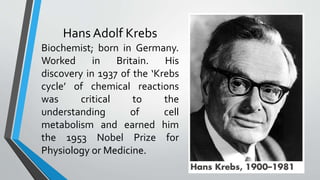
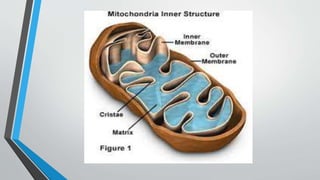
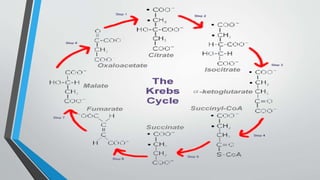
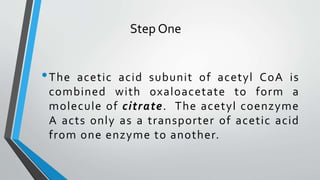
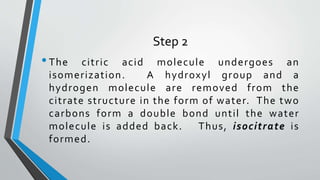
Hans Adolf Krebs discovered the Krebs cycle in 1937. The Krebs cycle is a series of chemical reactions that produce carbon dioxide, ATP, and electron carriers to be used in cellular respiration. It occurs in the mitochondria of cells and consists of eight steps where molecules like citrate, isocitrate, and oxaloacetate undergo oxidation reactions, producing molecules like alpha-ketoglutarate, succinyl-CoA, fumarate, and malate. The cycle generates molecules like NADH, FADH2, and one ATP that supply energy to the electron transport chain.






![Learning to live 2 [smallpdf.com]](https://cdn.slidesharecdn.com/ss_thumbnails/learningtolive2smallpdf-150128004635-conversion-gate02-thumbnail.jpg?width=640&height=640&fit=bounds)


