Writing Objectives
Teach what you mean to teach
Presented by: Heather Dowd
Audience Behavior Condition Degree
Your Lesson
1.Think of a lesson you teach.
2.Write 2 – 5 things you want
students to be able to do when
they leave this one lesson.
Audience Behavior Condition Degree
Today’s Objective
Using their own lesson plans,
instructors will write 2-5 objectives
that include all four parts of the
ABCD method of writing objectives.
Audience Behavior Condition Degree
Why is writing good objectives
important?
Audience Behavior Condition Degree
What an objective is NOT
Audience Behavior Condition Degree
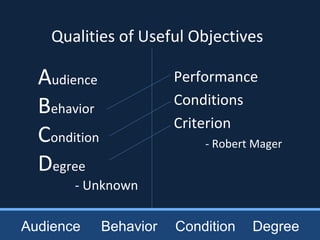
Qualities of Useful Objectives
Audience
Behavior
Condition
Degree
- Unknown
Performance
Conditions
Criterion
- Robert Mager
Audience Behavior Condition Degree
Audience
Audience Behavior Condition Degree
Who are your learners?
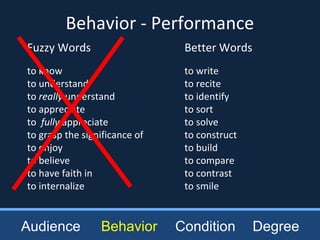
Behavior - Performance
Fuzzy Words
to know
to understand
to really understand
to appreciate
to fully appreciate
to grasp the significance of
to enjoy
to believe
to have faith in
to internalize
Better Words
to write
to recite
to identify
to sort
to solve
to construct
to build
to compare
to contrast
to smile
Audience Behavior Condition Degree
Behavior - Performance
Audience Behavior Condition Degree
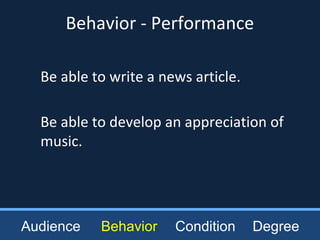
Be able to write a news article.
Be able to develop an appreciation of
music.
Behavior - Performance
Audience Behavior Condition Degree
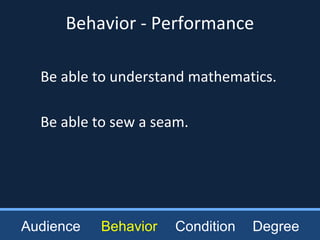
Be able to understand mathematics.
Be able to sew a seam.
Behavior - Performance
Audience Behavior Condition Degree
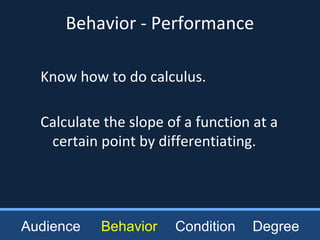
Know how to do calculus.
Calculate the slope of a function at a
certain point by differentiating.
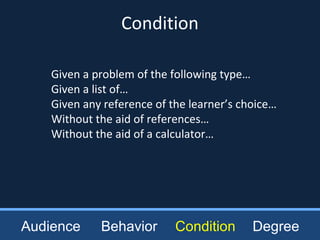
Given a problem of the following type…
Given a list of…
Given any reference of the learner’s choice…
Without the aid of references…
Without the aid of a calculator…
Audience Behavior Condition Degree
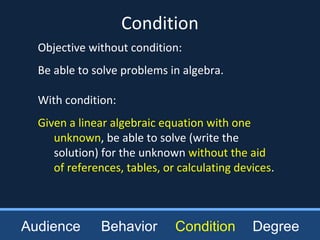
Condition
Objective without condition:
Be able to solve problems in algebra.
With condition:
Given a linear algebraic equation with one
unknown, be able to solve (write the
solution) for the unknown without the aid
of references, tables, or calculating devices.
Condition
Audience Behavior Condition Degree
Questions to ask yourself
Condition
Audience Behavior Condition Degree
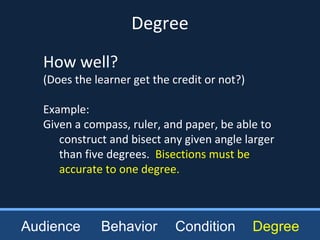
How well?
(Does the learner get the credit or not?)
Example:
Given a compass, ruler, and paper, be able to
construct and bisect any given angle larger
than five degrees. Bisections must be
accurate to one degree.
Degree
Audience Behavior Condition Degree
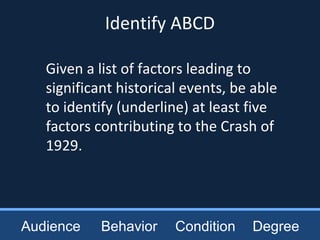
Given a list of factors leading to
significant historical events, be able
to identify (underline) at least five
factors contributing to the Crash of
1929.
Identify ABCD
Using their own lesson plan,
instructors will write 2-5 objectives
that include all four parts of the
ABCD method of writing objectives.
Audience Behavior Condition Degree
Identify ABCD
Audience Behavior Condition Degree
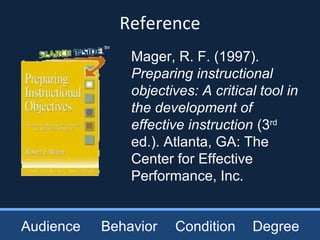
Reference
Mager, R. F. (1997).
Preparing instructional
objectives: A critical tool in
the development of
effective instruction (3rd
ed.). Atlanta, GA: The
Center for Effective
Performance, Inc.
Audience Behavior Condition Degree
Re-write your lesson’s objectives
using all four parts of the ABCD
method of writing objectives.
Pay special attention to using
concrete words for the behavior.
Your Turn

Writing objectives

  • 1.
    Writing Objectives Teach whatyou mean to teach Presented by: Heather Dowd Audience Behavior Condition Degree
  • 2.
    Your Lesson 1.Think ofa lesson you teach. 2.Write 2 – 5 things you want students to be able to do when they leave this one lesson. Audience Behavior Condition Degree
  • 3.
    Today’s Objective Using theirown lesson plans, instructors will write 2-5 objectives that include all four parts of the ABCD method of writing objectives. Audience Behavior Condition Degree
  • 4.
    Why is writinggood objectives important? Audience Behavior Condition Degree
  • 5.
    What an objectiveis NOT Audience Behavior Condition Degree
  • 6.
    Qualities of UsefulObjectives Audience Behavior Condition Degree - Unknown Performance Conditions Criterion - Robert Mager Audience Behavior Condition Degree
  • 7.
    Audience Audience Behavior ConditionDegree Who are your learners?
  • 8.
    Behavior - Performance FuzzyWords to know to understand to really understand to appreciate to fully appreciate to grasp the significance of to enjoy to believe to have faith in to internalize Better Words to write to recite to identify to sort to solve to construct to build to compare to contrast to smile Audience Behavior Condition Degree
  • 9.
    Behavior - Performance AudienceBehavior Condition Degree Be able to write a news article. Be able to develop an appreciation of music.
  • 10.
    Behavior - Performance AudienceBehavior Condition Degree Be able to understand mathematics. Be able to sew a seam.
  • 11.
    Behavior - Performance AudienceBehavior Condition Degree Know how to do calculus. Calculate the slope of a function at a certain point by differentiating.
  • 12.
    Given a problemof the following type… Given a list of… Given any reference of the learner’s choice… Without the aid of references… Without the aid of a calculator… Audience Behavior Condition Degree Condition
  • 13.
    Objective without condition: Beable to solve problems in algebra. With condition: Given a linear algebraic equation with one unknown, be able to solve (write the solution) for the unknown without the aid of references, tables, or calculating devices. Condition Audience Behavior Condition Degree
  • 14.
    Questions to askyourself Condition Audience Behavior Condition Degree
  • 15.
    How well? (Does thelearner get the credit or not?) Example: Given a compass, ruler, and paper, be able to construct and bisect any given angle larger than five degrees. Bisections must be accurate to one degree. Degree Audience Behavior Condition Degree
  • 16.
    Audience Behavior ConditionDegree Given a list of factors leading to significant historical events, be able to identify (underline) at least five factors contributing to the Crash of 1929. Identify ABCD
  • 17.
    Using their ownlesson plan, instructors will write 2-5 objectives that include all four parts of the ABCD method of writing objectives. Audience Behavior Condition Degree Identify ABCD
  • 18.
    Audience Behavior ConditionDegree Reference Mager, R. F. (1997). Preparing instructional objectives: A critical tool in the development of effective instruction (3rd ed.). Atlanta, GA: The Center for Effective Performance, Inc.
  • 19.
    Audience Behavior ConditionDegree Re-write your lesson’s objectives using all four parts of the ABCD method of writing objectives. Pay special attention to using concrete words for the behavior. Your Turn

Editor's Notes

  • #5 No objective means you have no basis to select materials, content, or methods. If you don’t know where you are going, how do you know how to get there. Tests and other assessments are far more effective when test items have been designed with objectives in mind. Objectives provide a way for student to organize their own thoughts and efforts towards reaching the objective. Writing objectives causes the teacher to think seriously and deeply about what is worth teaching.
  • #6 Objectives are outcomes, NOT procedures or processes. Objectives are the results, not how to achieve those results. Many teachers should be able to teach from well written objectives using different ways of achieving them.
  • #7 You want your objective to communicate what you want students to learn. Objectives should be clear and not subject to many interpretations. If another teacher reads your objectives and teaches students to perform in a way that is consistent with what you wanted, then your objective is clear and communicates what you want it to. Click to show qualities Define terms – audience can be left out after first one. What should the learner be able to do? Under what conditions do you want the learner to do it? How well must it be done?
  • #8 Can be omitted once it is assumed that everyone knows who the learners are.
  • #9 Fuzzy words – open to many interpretations - avoid Better words are open to fewer interpretations - This is the most difficult part in my opinion.
  • #10 Fuzzy words – open to many interpretations - avoid Better words are open to fewer interpretations - This is the most difficult part in my opinion.
  • #11 Fuzzy words – open to many interpretations - avoid Better words are open to fewer interpretations - This is the most difficult part in my opinion.
  • #12 Fuzzy words – open to many interpretations - avoid Better words are open to fewer interpretations - This is the most difficult part in my opinion.
  • #14 Can leave this out sometimes if already stated somewhere else or understood implicitly. Optional
  • #15 Questions to ask yourself…
  • #16 p. 73 run….but how fast? how well? etc. depends on situation….how well can someone cut open a box vs how well can a surgeon do an incision?