
Presentation Slides to Accompany Organizational Behavior   10 th  Edition Don Hellriegel and John W. Slocum, Jr. Chapter 2 —Understanding Individual Differences
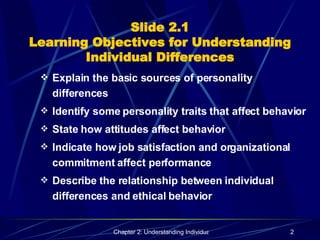
Slide 2.1 Learning Objectives for Understanding Individual Differences Explain the basic sources of personality differences Identify some personality traits that affect behavior State how attitudes affect behavior Indicate how job satisfaction and organizational commitment affect performance Describe the relationship between individual differences and ethical behavior
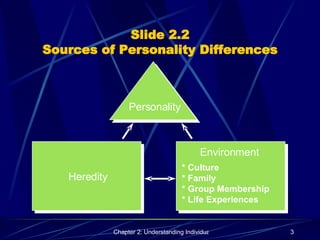
Slide 2.2 Sources of Personality Differences Environment * Culture * Family * Group Membership * Life Experiences Heredity Personality
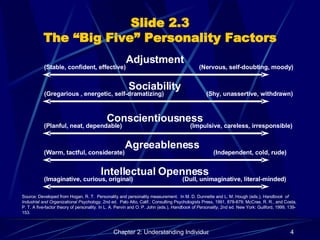
Slide 2.3 The “Big Five” Personality Factors Agreeableness Adjustment (Stable, confident, effective)  (Nervous, self-doubting, moody) Sociability (Gregarious , energetic, self-dramatizing)  (Shy, unassertive, withdrawn) Conscientiousness (Planful, neat, dependable)  (Impulsive, careless, irresponsible) (Warm, tactful, considerate)  (Independent, cold, rude) Intellectual Openness (Imaginative, curious, original)  (Dull, unimaginative, literal-minded) Source: Developed from Hogan, R. T.  Personality and personality measurement.  In M. D. Dunnette and L. M. Hough (eds.),  Handbook  of Industrial and Organizational Psychology , 2nd ed.  Palo Alto, Calif.: Consulting Psychologists Press, 1991, 878-879; McCrae, R. R., and Costa, P. T. A five-factor theory of personality. In L. A. Pervin and O. P. John (eds.),  Handbook of Personality , 2nd ed. New York: Guilford, 1999, 139-153.
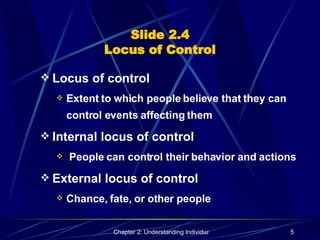
Slide 2.4 Locus of Control Locus of control Extent to which people believe that they can control events affecting them Internal locus of control People can control their behavior and actions External locus of control Chance, fate, or other people
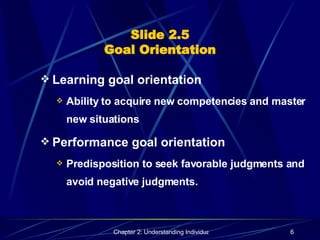
Slide 2.5 Goal Orientation Learning goal orientation Ability to acquire new competencies and master new situations Performance goal orientation Predisposition to seek favorable judgments and avoid negative judgments.
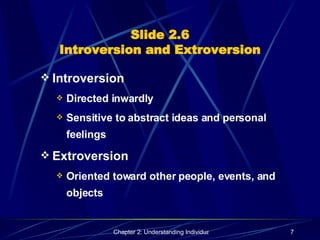
Slide 2.6 Introversion and Extroversion Introversion Directed inwardly Sensitive to abstract ideas and personal feelings Extroversion Oriented toward other people, events, and objects
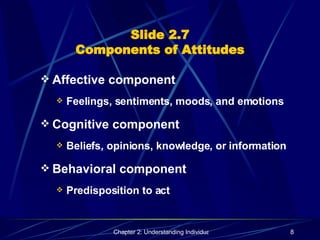
Slide 2.7 Components of Attitudes Affective component Feelings, sentiments, moods, and emotions Cognitive component Beliefs, opinions, knowledge, or information  Behavioral component Predisposition to act
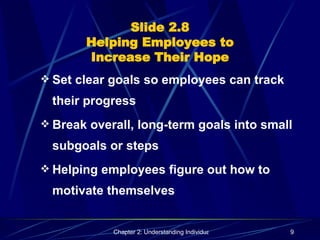
Slide 2.8 Helping Employees to Increase Their Hope Set clear goals so employees can track their progress Break overall, long-term goals into small subgoals or steps Helping employees figure out how to motivate themselves
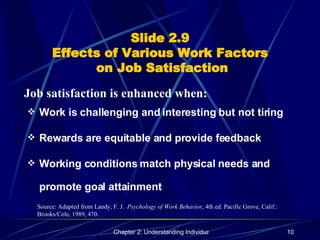
Slide 2.9 Effects of Various Work Factors  on Job Satisfaction Work is challenging and interesting but not tiring Rewards are equitable and provide feedback Working conditions match physical needs and promote goal attainment Job satisfaction is enhanced when: Source: Adapted from Landy, F. J.  Psychology of Work Behavior , 4th ed. Pacific Grove, Calif.:  Brooks/Cole, 1989, 470.
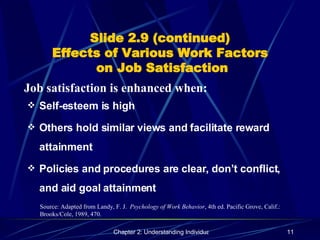
Slide 2.9 (continued) Effects of Various Work Factors  on Job Satisfaction Self-esteem is high Others hold similar views and facilitate reward attainment Policies and procedures are clear, don’t conflict, and aid goal attainment Job satisfaction is enhanced when: Source: Adapted from Landy, F. J.  Psychology of Work Behavior , 4th ed. Pacific Grove, Calif.:  Brooks/Cole, 1989, 470.
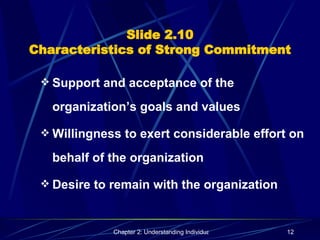
Slide 2.10 Characteristics of Strong Commitment S upport and acceptance of the organization’s goals and values Willingness to exert considerable effort on behalf of the organization Desire to remain with the organization
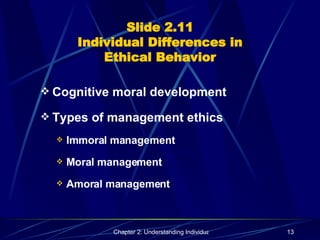
Slide 2.11 Individual Differences in Ethical Behavior Cognitive moral development Types of management ethics Immoral management Moral management Amoral management
Slide 2.12 Managerial Actions to Promote Ethical Attitudes Identifying and developing ethical attitudes that are crucial for organizational operations Selecting employees with desired ethical attitudes Incorporating ethics into the performance evaluation process Establishing a culture that reinforces ethical attitudes

Ch02

  • 1.
    Presentation Slides toAccompany Organizational Behavior 10 th Edition Don Hellriegel and John W. Slocum, Jr. Chapter 2 —Understanding Individual Differences
  • 2.
    Slide 2.1 LearningObjectives for Understanding Individual Differences Explain the basic sources of personality differences Identify some personality traits that affect behavior State how attitudes affect behavior Indicate how job satisfaction and organizational commitment affect performance Describe the relationship between individual differences and ethical behavior
  • 3.
    Slide 2.2 Sourcesof Personality Differences Environment * Culture * Family * Group Membership * Life Experiences Heredity Personality
  • 4.
    Slide 2.3 The“Big Five” Personality Factors Agreeableness Adjustment (Stable, confident, effective) (Nervous, self-doubting, moody) Sociability (Gregarious , energetic, self-dramatizing) (Shy, unassertive, withdrawn) Conscientiousness (Planful, neat, dependable) (Impulsive, careless, irresponsible) (Warm, tactful, considerate) (Independent, cold, rude) Intellectual Openness (Imaginative, curious, original) (Dull, unimaginative, literal-minded) Source: Developed from Hogan, R. T. Personality and personality measurement. In M. D. Dunnette and L. M. Hough (eds.), Handbook of Industrial and Organizational Psychology , 2nd ed. Palo Alto, Calif.: Consulting Psychologists Press, 1991, 878-879; McCrae, R. R., and Costa, P. T. A five-factor theory of personality. In L. A. Pervin and O. P. John (eds.), Handbook of Personality , 2nd ed. New York: Guilford, 1999, 139-153.
  • 5.
    Slide 2.4 Locusof Control Locus of control Extent to which people believe that they can control events affecting them Internal locus of control People can control their behavior and actions External locus of control Chance, fate, or other people
  • 6.
    Slide 2.5 GoalOrientation Learning goal orientation Ability to acquire new competencies and master new situations Performance goal orientation Predisposition to seek favorable judgments and avoid negative judgments.
  • 7.
    Slide 2.6 Introversionand Extroversion Introversion Directed inwardly Sensitive to abstract ideas and personal feelings Extroversion Oriented toward other people, events, and objects
  • 8.
    Slide 2.7 Componentsof Attitudes Affective component Feelings, sentiments, moods, and emotions Cognitive component Beliefs, opinions, knowledge, or information Behavioral component Predisposition to act
  • 9.
    Slide 2.8 HelpingEmployees to Increase Their Hope Set clear goals so employees can track their progress Break overall, long-term goals into small subgoals or steps Helping employees figure out how to motivate themselves
  • 10.
    Slide 2.9 Effectsof Various Work Factors on Job Satisfaction Work is challenging and interesting but not tiring Rewards are equitable and provide feedback Working conditions match physical needs and promote goal attainment Job satisfaction is enhanced when: Source: Adapted from Landy, F. J. Psychology of Work Behavior , 4th ed. Pacific Grove, Calif.: Brooks/Cole, 1989, 470.
  • 11.
    Slide 2.9 (continued)Effects of Various Work Factors on Job Satisfaction Self-esteem is high Others hold similar views and facilitate reward attainment Policies and procedures are clear, don’t conflict, and aid goal attainment Job satisfaction is enhanced when: Source: Adapted from Landy, F. J. Psychology of Work Behavior , 4th ed. Pacific Grove, Calif.: Brooks/Cole, 1989, 470.
  • 12.
    Slide 2.10 Characteristicsof Strong Commitment S upport and acceptance of the organization’s goals and values Willingness to exert considerable effort on behalf of the organization Desire to remain with the organization
  • 13.
    Slide 2.11 IndividualDifferences in Ethical Behavior Cognitive moral development Types of management ethics Immoral management Moral management Amoral management
  • 14.
    Slide 2.12 ManagerialActions to Promote Ethical Attitudes Identifying and developing ethical attitudes that are crucial for organizational operations Selecting employees with desired ethical attitudes Incorporating ethics into the performance evaluation process Establishing a culture that reinforces ethical attitudes