©BIVEE PROJECT 2013 WP8 Update Geoff Ward March 2013 1
Innovating Enterprise Innovation
Michele Missikoff
1
Università Politecnica delle Marche
and CNR Lab for Enterprise Knowledge and Systems
Alpen Adria University, Klagenfurt, 15th May 2014
This work has been partially supported by the BIVEE European Project, Grant n. 285746
©BIVEE PROJECT 2013 WP8 Update Geoff Ward March 2013 2
Objectives of this talk
Do not convince you that
Innovation is important
Innovation is difficult, risky, often costly
Show that we need to change the way we
carry on Innovation
Provide some clues where to go ...
Target: Complex organizations
Networked SMEs
Large, distributed enterprises
Articulated Public Institutions
Vision
To overcome the crisis, EU enterprises need a
deep change
Introducing continuous improvement and
innovation to remain competitive in the
globalised economy
Sustainable Innovation rather than expansive
innovation
We need to put Knowledge in the center, to
guarantee
Continuous alignment of Business needs and
Enterprise Software Applications in ever changing
enterprises
3
©BIVEE PROJECT 2013 WP8 Update Geoff Ward March 2013 4
What is Innovation?
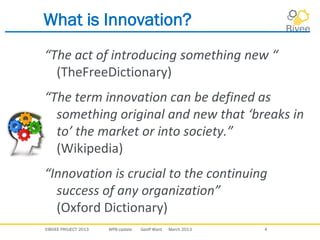
“The act of introducing something new “
(TheFreeDictionary)
“The term innovation can be defined as
something original and new that ‘breaks in
to’ the market or into society.”
(Wikipedia)
“Innovation is crucial to the continuing
success of any organization”
(Oxford Dictionary)
©BIVEE PROJECT 2013 WP8 Update Geoff Ward March 2013 5
Some quotations ...
Innovation is a knowledge intensive
endeavour (BIVEE)
Knowledge is the fuel, but it achieves the
miracle! The more you use it the more you
have it!! (BIVEE)
If I had 20 days to solve a problem, I would
spend the first 19 to define it. (A. Einstein)
Summarising ... few key questions
Questions are more important than answers...
What are the key needs for manufacturing /
service innovation today?
What are the main boosters / hindrances?
What is the interplay between human intelligence
and supporting technologies?
Where is the border between open knowledge and
new ideas protection?
What can we measure about innovation? Cost?
Expected benefits? Chances of success?
What are the methods/tools already adopted
today? What do you see in the future? 6
What is Business Innovation?
Business Innovation is a designed, managed
sustainable transformation of some
aspects of the enterprise (or the society, the
city, etc.) aimed at a substantial change of:
• The nature/quality of delivery products
(goods, services), improving customer
satisfaction
• Production processes and workers
satisfaction
• Cost reduction and/or revenue raise
• The Marketing Strategies / Scope
7
Business Innovation: Where?
• Products (goods / services)
• Production / Admin processes
• HR competencies, skills, capabilities
• Organization models, with new delegation patterns
• Enterprise information organization and flow
• Markets and marketing styles
• Customer relationships
• Suppliers and partners strategies and management
• Technology adoption, deployment, renewal
strategies and practice
• Financial and control styles, methods, and tools
• Quality of working life and ambient
• Relationships with the territories, the people, the
environment, local cultures
8
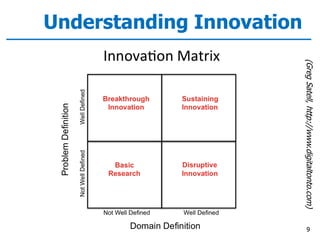
Understanding Innovation
9
(GregSatell,http://www.digitaltonto.com)
Business Innovation: How?
push-mode and technology driven, when
generated on the supply side;
pull-mode and demand driven, when requested by
the market/demand side;
co-creation, when all the stakeholders cooperate
together to generate product or process
innovation.
Endogenous, when ideas come from within the
Ecosystems
Exogenous, when ideas come from the rest of the
World
10
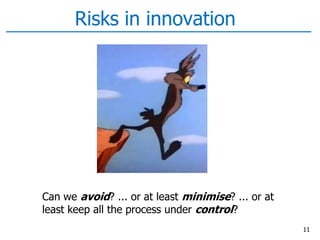
Risks in innovation
11
Can we avoid? ... or at least minimise? ... or at
least keep all the process under control?
Enabling Business Innovation
• Create the right environment, working conditions
• Grassroots innovation (beyond Toyotism ...)
• Open innovation (but controlled), with systematic and
ad-hoc relationships with
• universities , research centres, partners, suppliers and
customers
• Facilitate info / knowledge / ideas circulation within
and outside the enterprise
• Culture of cooperation (tools & rewarding system)
• Scouting
Technology
Market
Excellence centres
• Observatories on opportunities, problems, threats, ...
12
Innovation New Knowledge
Knowledge about
• New ideas, reserch results, patents, ...
• enterprise and its organization
• competencies, skills, and capabilities
• problems and improvement opportunities
• products and services
• production processes, methods
• Technologies, systems, and resources
• Markets, clients, partners and competitors
13
©BIVEE PROJECT 2013 WP8 Update Geoff Ward March 2013 14
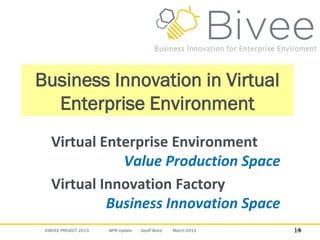
Business Innovation in Virtual
Enterprise Environment
Virtual Enterprise Environment
Value Production Space
Virtual Innovation Factory
Business Innovation Space
14
Innovating Innovation
Towards Open Innovation
A systematic approach to Innovation, nurturing
creativity and ideas generation
Innovation as intangible goods
‘Manufacturing’ approach to Innovation
The need of new production/organization
models
Manage the full Knowledge Cycle (including
Tacit Knowledge, see Nonaka)
Virtual Innovation Factory (VIF), operating
in the Innovation space
15
BIVEE Philosophy
Consolidating BIVEE Framework specifications
• Key elements: people, ideas, communication,
collaboration, social behaviour, communities
• Full Value Chain: from innovation to production
improvement
• Innovation as an iterative, goal-oriented, venture
based on 4 Waves: Creativity, Feasibility,
Prototyping, Engineering
• Monitoring & Assessment: integrated formal (KPIs)
and informal (social & crowdsourcing) approaches
• Integration of Human (informal, document-based) &
Computer (formal, semantics-based) Knowledge
16
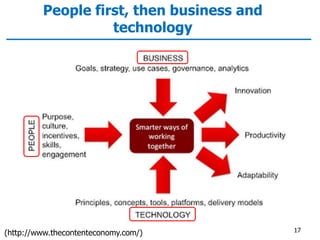
People first, then business and
technology
(http://www.thecontenteconomy.com/) 17
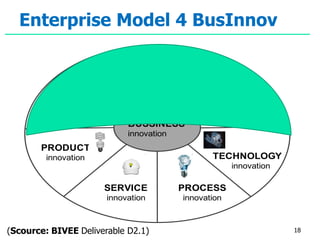
Enterprise Model 4 BusInnov
18
BUSSINESS
innovation
STRATEGY
innovation
MARKETING
innovation
PRODUCT
innovation
SERVICE
innovation
PROCESS
innovation
TECHNOLOGY
innovation
ORGANIZATIONAL
innovation
(Scource: BIVEE Deliverable D2.1)
©BIVEE PROJECT 2012 WP8 Update Geoff Ward 10 – 13 July 2012 19
Innovating Innovation
Business Innovation Reference Framework (BIRF): the
principles for Virtual Innovation Factory operations
Innovation as a new form of ubiquitous Semantic nurturing,
rather than ‘Knowledge Management’
Waves (rather than processes):
Creativity, Feasibility, Prototyping, Engineering
Innovation Monitoring Framework: I-KPIs & W4+ semantics:
What, Why, Who, When, Where, (How)
Focused Innovation Targets:
Goods, Services, Processes, Technologies
Goal oriented approach, instantiated in Documents
Semantically enriched Documents for knowledge sharing
Innovation-oriented Ontologies
BIVEE Tech Solutions
• A Virtual Enterprise Environment, to be integrated
with existing Enterprise Software Applications (ESA)
• Distributed, collaborative, knowledge-intensive
framework
• A Platform for networked, interoperable virtual/real
enterprises
• To be used directly by Business Experts, pushing for
disintermediation (wrt techies) in innovation KM
• Shared Semantic Whiteboard, to guarantee a single
‘ideas shopping’ point.
• Proactive subject-driven knowledge provisioning
• Innovation Observatory to push Open Innovation,
Crowdsourcing, …
20
Virtual Innovation Factory
• Virtual Innovation Factory set up
– Definition of objectives:
a) Problem-driven, e.g., proposed by a customer
b) product-driven, e.g., proposed by staff experts
c) tech-driven, e.g., proposed by staff / external
player
– Create a VIF with its Manager
– Create the Innovation teams: composition,
organization, competencies & roles, etc.
– Acquire the material and financial resources
– Start the ad-hoc Collabrative Innovation
Plan
21
©BIVEE PROJECT 2013 WP8 Update Geoff Ward March 2013 22
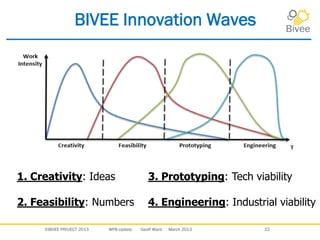
BIVEE Innovation Waves
1. Creativity: Ideas
2. Feasibility: Numbers
3. Prototyping: Tech viability
4. Engineering: Industrial viability
©BIVEE PROJECT 2013 WP8 Update Geoff Ward March 2013 23
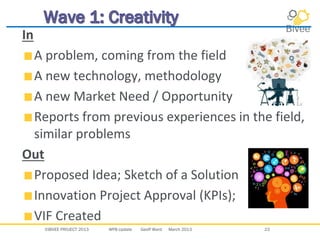
In
A problem, coming from the field
A new technology, methodology
A new Market Need / Opportunity
Reports from previous experiences in the field,
similar problems
Out
Proposed Idea; Sketch of a Solution
Innovation Project Approval (KPIs);
VIF Created
©BIVEE PROJECT 2013 WP8 Update Geoff Ward March 2013 24
VIF Start to work
Analysis of previous experiences
Enrich the sketch of solution
Technical and commercial feasibility
Feasibility KPI analysis
Preliminary tech design
Assessment and Go/NoGo decision
Needed resources and Budget consolidation
©BIVEE PROJECT 2013 WP8 Update Geoff Ward March 2013 25
Engineering team consults with
suppliers and acquires the new
components
alternatives are tested, searching also
tests performed in other laboratories
The final prototype specs are
produced
Prepare blue print & Test reports
KPI analyse for Go/NoGo decision
©BIVEE PROJECT 2013 WP8 Update Geoff Ward March 2013 26
Analyse prototype specs and test
results
Perform cost analysis of part
replacement
Production plans
Bill of Material
Business / Production Processes
Final Industrial Blueprint
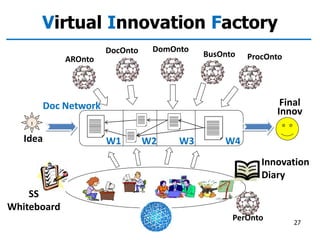
Virtual Innovation Factory
27
SS
Whiteboard
Innovation
Diary
Doc Network
W1 W2 W3 W4
DocOnto DomOnto
BusOnto
PerOnto
!
Idea
AROnto ProcOnto
Final
Innov
Conclusions
The main ideas on a new approach for
Innovation have been presented
Future innovation needs to be addressed as a
Knowledge Management venture
But traditional KM is not suited for the purpose
We need to revisiting the existing KM
solutions
Ontologies and Semantic Wikis are
promising tools, together with social media
and cooperation tools (in Open Innovation)
But human intelligence and creativity
remains the key pillar
28
©BIVEE PROJECT 2013 WP8 Update Geoff Ward March 2013 29
Engineering (It)
BIBA (De)
BOC (At)
ATOS (Es)
CNR (It)
UnivPM (It)
TAL (UK)
SRDC (Tr)
AIDIMA (Es)
Loccioni - GI (It)
Credits
• Large part of the content of this talk has been
elaborated within the European Project BIVEE:
Business Innovation in Virtual Enterprise
Environments.
• BIVEE is a 3 years project (ends Dec 2014) with 4.3
M€ budget and 10 partners :
Proceedings: http://ceur-ws.org/Vol-864/
©BIVEE PROJECT 2013 WP8 Update Geoff Ward March 2013 30
Questions ?
Comments?

Innovating Enterprise Innovation

  • 1.
    ©BIVEE PROJECT 2013WP8 Update Geoff Ward March 2013 1 Innovating Enterprise Innovation Michele Missikoff 1 Università Politecnica delle Marche and CNR Lab for Enterprise Knowledge and Systems Alpen Adria University, Klagenfurt, 15th May 2014 This work has been partially supported by the BIVEE European Project, Grant n. 285746
  • 2.
    ©BIVEE PROJECT 2013WP8 Update Geoff Ward March 2013 2 Objectives of this talk Do not convince you that Innovation is important Innovation is difficult, risky, often costly Show that we need to change the way we carry on Innovation Provide some clues where to go ... Target: Complex organizations Networked SMEs Large, distributed enterprises Articulated Public Institutions
  • 3.
    Vision To overcome thecrisis, EU enterprises need a deep change Introducing continuous improvement and innovation to remain competitive in the globalised economy Sustainable Innovation rather than expansive innovation We need to put Knowledge in the center, to guarantee Continuous alignment of Business needs and Enterprise Software Applications in ever changing enterprises 3
  • 4.
    ©BIVEE PROJECT 2013WP8 Update Geoff Ward March 2013 4 What is Innovation? “The act of introducing something new “ (TheFreeDictionary) “The term innovation can be defined as something original and new that ‘breaks in to’ the market or into society.” (Wikipedia) “Innovation is crucial to the continuing success of any organization” (Oxford Dictionary)
  • 5.
    ©BIVEE PROJECT 2013WP8 Update Geoff Ward March 2013 5 Some quotations ... Innovation is a knowledge intensive endeavour (BIVEE) Knowledge is the fuel, but it achieves the miracle! The more you use it the more you have it!! (BIVEE) If I had 20 days to solve a problem, I would spend the first 19 to define it. (A. Einstein)
  • 6.
    Summarising ... fewkey questions Questions are more important than answers... What are the key needs for manufacturing / service innovation today? What are the main boosters / hindrances? What is the interplay between human intelligence and supporting technologies? Where is the border between open knowledge and new ideas protection? What can we measure about innovation? Cost? Expected benefits? Chances of success? What are the methods/tools already adopted today? What do you see in the future? 6
  • 7.
    What is BusinessInnovation? Business Innovation is a designed, managed sustainable transformation of some aspects of the enterprise (or the society, the city, etc.) aimed at a substantial change of: • The nature/quality of delivery products (goods, services), improving customer satisfaction • Production processes and workers satisfaction • Cost reduction and/or revenue raise • The Marketing Strategies / Scope 7
  • 8.
    Business Innovation: Where? •Products (goods / services) • Production / Admin processes • HR competencies, skills, capabilities • Organization models, with new delegation patterns • Enterprise information organization and flow • Markets and marketing styles • Customer relationships • Suppliers and partners strategies and management • Technology adoption, deployment, renewal strategies and practice • Financial and control styles, methods, and tools • Quality of working life and ambient • Relationships with the territories, the people, the environment, local cultures 8
  • 9.
  • 10.
    Business Innovation: How? push-modeand technology driven, when generated on the supply side; pull-mode and demand driven, when requested by the market/demand side; co-creation, when all the stakeholders cooperate together to generate product or process innovation. Endogenous, when ideas come from within the Ecosystems Exogenous, when ideas come from the rest of the World 10
  • 11.
    Risks in innovation 11 Canwe avoid? ... or at least minimise? ... or at least keep all the process under control?
  • 12.
    Enabling Business Innovation •Create the right environment, working conditions • Grassroots innovation (beyond Toyotism ...) • Open innovation (but controlled), with systematic and ad-hoc relationships with • universities , research centres, partners, suppliers and customers • Facilitate info / knowledge / ideas circulation within and outside the enterprise • Culture of cooperation (tools & rewarding system) • Scouting Technology Market Excellence centres • Observatories on opportunities, problems, threats, ... 12
  • 13.
    Innovation New Knowledge Knowledgeabout • New ideas, reserch results, patents, ... • enterprise and its organization • competencies, skills, and capabilities • problems and improvement opportunities • products and services • production processes, methods • Technologies, systems, and resources • Markets, clients, partners and competitors 13
  • 14.
    ©BIVEE PROJECT 2013WP8 Update Geoff Ward March 2013 14 Business Innovation in Virtual Enterprise Environment Virtual Enterprise Environment Value Production Space Virtual Innovation Factory Business Innovation Space 14
  • 15.
    Innovating Innovation Towards OpenInnovation A systematic approach to Innovation, nurturing creativity and ideas generation Innovation as intangible goods ‘Manufacturing’ approach to Innovation The need of new production/organization models Manage the full Knowledge Cycle (including Tacit Knowledge, see Nonaka) Virtual Innovation Factory (VIF), operating in the Innovation space 15
  • 16.
    BIVEE Philosophy Consolidating BIVEEFramework specifications • Key elements: people, ideas, communication, collaboration, social behaviour, communities • Full Value Chain: from innovation to production improvement • Innovation as an iterative, goal-oriented, venture based on 4 Waves: Creativity, Feasibility, Prototyping, Engineering • Monitoring & Assessment: integrated formal (KPIs) and informal (social & crowdsourcing) approaches • Integration of Human (informal, document-based) & Computer (formal, semantics-based) Knowledge 16
  • 17.
    People first, thenbusiness and technology (http://www.thecontenteconomy.com/) 17
  • 18.
    Enterprise Model 4BusInnov 18 BUSSINESS innovation STRATEGY innovation MARKETING innovation PRODUCT innovation SERVICE innovation PROCESS innovation TECHNOLOGY innovation ORGANIZATIONAL innovation (Scource: BIVEE Deliverable D2.1)
  • 19.
    ©BIVEE PROJECT 2012WP8 Update Geoff Ward 10 – 13 July 2012 19 Innovating Innovation Business Innovation Reference Framework (BIRF): the principles for Virtual Innovation Factory operations Innovation as a new form of ubiquitous Semantic nurturing, rather than ‘Knowledge Management’ Waves (rather than processes): Creativity, Feasibility, Prototyping, Engineering Innovation Monitoring Framework: I-KPIs & W4+ semantics: What, Why, Who, When, Where, (How) Focused Innovation Targets: Goods, Services, Processes, Technologies Goal oriented approach, instantiated in Documents Semantically enriched Documents for knowledge sharing Innovation-oriented Ontologies
  • 20.
    BIVEE Tech Solutions •A Virtual Enterprise Environment, to be integrated with existing Enterprise Software Applications (ESA) • Distributed, collaborative, knowledge-intensive framework • A Platform for networked, interoperable virtual/real enterprises • To be used directly by Business Experts, pushing for disintermediation (wrt techies) in innovation KM • Shared Semantic Whiteboard, to guarantee a single ‘ideas shopping’ point. • Proactive subject-driven knowledge provisioning • Innovation Observatory to push Open Innovation, Crowdsourcing, … 20
  • 21.
    Virtual Innovation Factory •Virtual Innovation Factory set up – Definition of objectives: a) Problem-driven, e.g., proposed by a customer b) product-driven, e.g., proposed by staff experts c) tech-driven, e.g., proposed by staff / external player – Create a VIF with its Manager – Create the Innovation teams: composition, organization, competencies & roles, etc. – Acquire the material and financial resources – Start the ad-hoc Collabrative Innovation Plan 21
  • 22.
    ©BIVEE PROJECT 2013WP8 Update Geoff Ward March 2013 22 BIVEE Innovation Waves 1. Creativity: Ideas 2. Feasibility: Numbers 3. Prototyping: Tech viability 4. Engineering: Industrial viability
  • 23.
    ©BIVEE PROJECT 2013WP8 Update Geoff Ward March 2013 23 In A problem, coming from the field A new technology, methodology A new Market Need / Opportunity Reports from previous experiences in the field, similar problems Out Proposed Idea; Sketch of a Solution Innovation Project Approval (KPIs); VIF Created
  • 24.
    ©BIVEE PROJECT 2013WP8 Update Geoff Ward March 2013 24 VIF Start to work Analysis of previous experiences Enrich the sketch of solution Technical and commercial feasibility Feasibility KPI analysis Preliminary tech design Assessment and Go/NoGo decision Needed resources and Budget consolidation
  • 25.
    ©BIVEE PROJECT 2013WP8 Update Geoff Ward March 2013 25 Engineering team consults with suppliers and acquires the new components alternatives are tested, searching also tests performed in other laboratories The final prototype specs are produced Prepare blue print & Test reports KPI analyse for Go/NoGo decision
  • 26.
    ©BIVEE PROJECT 2013WP8 Update Geoff Ward March 2013 26 Analyse prototype specs and test results Perform cost analysis of part replacement Production plans Bill of Material Business / Production Processes Final Industrial Blueprint
  • 27.
    Virtual Innovation Factory 27 SS Whiteboard Innovation Diary DocNetwork W1 W2 W3 W4 DocOnto DomOnto BusOnto PerOnto ! Idea AROnto ProcOnto Final Innov
  • 28.
    Conclusions The main ideason a new approach for Innovation have been presented Future innovation needs to be addressed as a Knowledge Management venture But traditional KM is not suited for the purpose We need to revisiting the existing KM solutions Ontologies and Semantic Wikis are promising tools, together with social media and cooperation tools (in Open Innovation) But human intelligence and creativity remains the key pillar 28
  • 29.
    ©BIVEE PROJECT 2013WP8 Update Geoff Ward March 2013 29 Engineering (It) BIBA (De) BOC (At) ATOS (Es) CNR (It) UnivPM (It) TAL (UK) SRDC (Tr) AIDIMA (Es) Loccioni - GI (It) Credits • Large part of the content of this talk has been elaborated within the European Project BIVEE: Business Innovation in Virtual Enterprise Environments. • BIVEE is a 3 years project (ends Dec 2014) with 4.3 M€ budget and 10 partners : Proceedings: http://ceur-ws.org/Vol-864/
  • 30.
    ©BIVEE PROJECT 2013WP8 Update Geoff Ward March 2013 30 Questions ? Comments?