Innovation for Start-ups


                                      Rishikesha T. Krishnan
November 10, 2012   Professor & Area Chair, Corporate Strategy & Policy, IIM Bangalore
2   What is Innovation?
What is Innovation?
3


    Innovation     =    Invention    +   Application


                  The Traditional View
What is Innovation?
4


    Problem      +   Idea      +   Execution   +   Benefit

    Challenge?       Novelty                        Utility


                 Application of new ideas to
                 solve problems resulting in
                      benefits to users
Solving Problems…
5


                                How do you provide clean
                                drinking water at low cost?


                        How do you convert an existing
                              car into a hybrid?
What are the different types of
6
    innovation?
Innovation could be…
7


    New to the    New to the
     company       country


    New to the    New to the
     industry       world
Prominent Innovations
8


                       Petroleum            Long-distance
      I C Engine
                        Refinery              telephony


                      Electric arc            Information
        Nylon
                        furnace               Technology


                     Semiconductor
    Microprocessor                               Internet
                        foundry

                                     Do you see a pattern here?....
Prominent Innovations
9
        Product          Process        “Enabling”

                       Petroleum     Long-distance
      I C Engine
                        Refinery       telephony


                      Electric arc    Information
        Nylon
                        furnace       Technology


                     Semiconductor
    Microprocessor                      Internet
                        foundry
Prominent Innovations
10


       Joint Stock Company

                             What’s
                             special
         Multi-divisional
                              about
          Organization
                              these?


        Global Delivery
        Model (Software)
11   What are the other types of innovation?
Innovation Typology
12


                      Product /
                      Offering


           Business     Types of
            Model     innovations   Process


                      Customer
                      Experience
The Six Levers of Innovation
 13


                         Value            Product &
                      Proposition         Services


Business                                                Technology
                         Supply            Process
 Model
                          Chain          Technologies


                        Target             Enabling
                       Customer          Technologies

Source: Davila, Epstein &Shelton, 2006
Incremental vs. Radical Innovation
14


              Incremental
                                          Radical Innovation
               Innovation
                                        • Requires new knowledge &
       • Builds upon existing
                                           resources
           knowledge & resources
                                        • Existing competence loses
       • Competence-enhancing
                                           value?
       • Relatively small changes
                                        • Step changes in
           in performance / utility
                                            performance
       • The lifeblood of innovation?
                                        • Relatively rare
The Power of Incremental Innovation
15


      “There is no genius in our company. We
      just do whatever we believe is right, trying
      every day to improve every little bit and
      piece. But when 70 years of very small
      improvements accumulate, they become a
      revolution”
                                From Interview with Katsuaki Watanabe
                                in HBR, July-Aug 2007
Existing companies are good at sustaining
Innovation, but newcomers are better at
disruptive innovation
17   Why is innovation critical for start-ups?
What is the advantage of a start-up
     vis-à-vis a large company?
18


                      As organizations mature over time


       Bias towards            Balance creativity           Focus on
         creativity             & value capture           value capture


                Challenge for                    Challenge for
             startup companies                 mature companies

Innovation is the critical differentiator for a start-up
But start-ups in India…
19


        Tend to fall in “no-man’s land”
          No breakthrough technological innovation
          Lack clear understanding of customer domain /
           application
        Even if they come up with one good innovation,
         struggle to come up with another!
THE RAW MATERIAL FOR
INNOVATION….
The Raw Material of Innovation
21


                     Ideas

                 Experiments

               Customer Insights
IDEAS
WHERE DO YOU LOOK FOR
GOOD IDEAS?
24


     Gandhiji was asked:

     What have been the most creative
     experiences of your life?
7 June 1893, Maritzburg railway station


25
26


                  “Why is so much steam getting wasted?”


     James Watt, 1765


                           “Are you serious? It means
                            computing will be free”

      Bill Gates, 1971, at age 16 to Allen on hearing “Moore’s law”
3 sources of itch
27


     Pain        Wave           Waste
The Four Lenses of Innovation
28


     1.   Challenging Orthodoxies
             Question dogmas about what drives success
     2.   Harnessing Discontinuities
             Spot trends that could change the game
     3.   Leveraging Competencies & Strategic Assets
             Think of organisation as a portfolio of skills and
              assets, not in terms of products and markets
     4.   Understanding Unarticulated Needs
             Learn to live inside the customer’s skin


                                                Source: Skarynski & Gibson, 2008
Buyer Utility Map
            Stage Purchase Delivery        Use        Supple-     Maint-     Disposal
29
     Utlility                                         ments       enance

     Customer
     productivity

     Simplicity


     Conven-
     ience

     Risk


     Fun &
     Image

     Envir
     friendli.

     Another source of ideas is to look for blank spaces on the buyer utility map
EXPERIMENTATION
31


          What is an experiment?


     Activity that validates assumptions
32


     What kinds of assumptions does an
            experiment validate?
Improve the Idea Velocity
33


     Experiment with Low Cost at High Speed
34
                               Feb 2004

     Sep     Nov                                    Apr 2004
     2003    2003
                                                    impact
                                    demo
                  idea
      itch


                  Feasibility Loop Viability Loop

       2 months          3 months    2 months
Will people use Internet?

                          Need


Can we                  4 types of                Do we have the
           Commerci-
monetize    lization
                       assumptions
                                     Technology
                                                  technology
                         of every                 to create Internet
this?          risk
                            idea
                                                  apps?
                       Production


                  Can we scale this?
Iterate on the Business Model
36
Google’s search sandbox
37


       Guess how many experiments were
              carried out in 2010?

                                     20,000!

        How many went live?                                 500


     Source: “How Google makes improvements to its search algorithm?”, YouTube video
Create a Climate for
38
     Experimentation
        Have a high trial rate: fail fast, learn fast
        Can you do the “last” experiment first?
        Failure plays a critical role in innovation
          Post-It Notes & failed adhesives
          Nylon: a lab experiment that went wrong

          TVS Spectra failed, but Victor succeeded
Avoid the “Failure Fallacy”
39
CUSTOMER INTIMACY
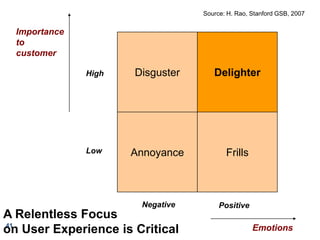
Source: H. Rao, Stanford GSB, 2007


  Importance
  to
  customer

               High   Disguster      Delighter


               Low    Annoyance          Frills


                       Negative        Positive
A Relentless Focus
41
on User Experience is Critical                    Emotions
42


    Big Bazaar: India’s Largest Hypermarket Chain
        Part of the Future Group (Kishore Biyani)
    Philosophy: Rewrite rules, retain values
    India: Confidence & Change → Consumption
        But consumers here demand ideas and solutions that are uniquely Indian
    Inspired by Saravana Stores, Chennai
       Low margin, high turnover model

       Possible to operate on multiple floors

       Has to be located in the city, near transport points

       People come shopping in families – meet needs of entire
        family
HOW DO YOU MAKE SURE
YOU “APPROPRIATE” THE
VALUE OF INNOVATION?
The Problem
44


        Google created a powerful search engine, but
         couldn’t monetise it until it created its advertising
         model…
        Mobile VAS applications is a popular area for
         start-ups in India, but its difficult to squeeze money
         out of mobile operators (remember Porter’s 5-
         forces?)…
        In financial services, innovations can be copied
         almost overnight…
Innovation Value Appropriation

                               How do you
                               appropriate
                                 value?


     Product-Market              Continual              Legal (IP)
        Actions                 Innovation              Strategy


     Standards               Continual Improvement   Patents
     Barriers to Imitation   Cannibalization         Copyright
     Collaborative           Product Platform        Trade Secret
       Agreements            Radical Innovation      Trademarks
45
                                                        Adapted from Grant
Inimitability/Complementary Assets Framework

                                                        Holder of
                                                     complementary
                           High   Difficult to
                                                     resources makes
                                  make money
                                                         Money
     Ease of Imitation                                    (Coke)

                                                         Party with
                           Low
                                    Inventor          Innov .+ Compl.
                                     makes           resources makes
                                     money                Money
                                                     (Pixar vs Disney)

                                  Freely available       Tightly held
                                  or unimportant        and important
46                                            Complementary Assets
     Source: Afuah, 2004
WHEN DOES BEING “FIRST-
MOVER” HELP?
FIRST MOVER
ADVANTAGES
Being first succeeds when…
49


     1.   Pioneering helps build a firm’s reputation and
          image with buyers
     2.   Early commitments to new technologies, channels,
          etc. can produce an absolute cost advantage
     3.   First-time consumers remain strongly loyal to
          pioneering firms in making repeat purchases
     4.   Moving first constitutes a pre-emptive strike
          making imitation more difficult
FIRST-MOVER
DISADVANTAGES
Late movers benefit when…
51


     1.   Pioneering leadership is more costly than imitating
          followership and only negligible experience
          benefits accrue to the leader
     2.   Products of the pioneer do not live up to buyer
          expectations so that a follower can win customers
          away from the pioneer
     3.   Technology is advancing rapidly so that followers
          can leapfrog pioneers with second or third
          generation products
LIMITATIONS OF
PATENT STRATEGY
Robert Kearns & the Intermittent Wiper
53


      Kearns invented first intermittent wind-
     shield wiper for cars in the early 1960s
      Filed patent application in 1964

      Tried to license his technology to

     auto majors but, no one took a licence
      Majors introduced their own wipers 5 years later

      Kearns filed patent suits against Ford, Chrysler

      Won suits only in early 1990s…divorced…almost

       went mad
      See 2008 movie Flash of Genius
8 Steps to Innovation Excellence:
Building a Systematic Innovation Capability
                                           3   Improve
                                               Batting Avg
   1

Build a
pipeline


           2   Improve idea velocity
                           Forthcoming book by
                  Vinay Dabholkar & Rishikesha T. Krishnan
http://jugaadtoinnovation.blogspot.in


55
THANK YOU
rishi@iimb.ernet.in +91 98450 22710

Innovation for Start-ups

  • 1.
    Innovation for Start-ups Rishikesha T. Krishnan November 10, 2012 Professor & Area Chair, Corporate Strategy & Policy, IIM Bangalore
  • 2.
    2 What is Innovation?
  • 3.
    What is Innovation? 3 Innovation = Invention + Application The Traditional View
  • 4.
    What is Innovation? 4 Problem + Idea + Execution + Benefit Challenge? Novelty Utility Application of new ideas to solve problems resulting in benefits to users
  • 5.
    Solving Problems… 5 How do you provide clean drinking water at low cost? How do you convert an existing car into a hybrid?
  • 6.
    What are thedifferent types of 6 innovation?
  • 7.
    Innovation could be… 7 New to the New to the company country New to the New to the industry world
  • 8.
    Prominent Innovations 8 Petroleum Long-distance I C Engine Refinery telephony Electric arc Information Nylon furnace Technology Semiconductor Microprocessor Internet foundry Do you see a pattern here?....
  • 9.
    Prominent Innovations 9 Product Process “Enabling” Petroleum Long-distance I C Engine Refinery telephony Electric arc Information Nylon furnace Technology Semiconductor Microprocessor Internet foundry
  • 10.
    Prominent Innovations 10 Joint Stock Company What’s special Multi-divisional about Organization these? Global Delivery Model (Software)
  • 11.
    11 What are the other types of innovation?
  • 12.
    Innovation Typology 12 Product / Offering Business Types of Model innovations Process Customer Experience
  • 13.
    The Six Leversof Innovation 13 Value Product & Proposition Services Business Technology Supply Process Model Chain Technologies Target Enabling Customer Technologies Source: Davila, Epstein &Shelton, 2006
  • 14.
    Incremental vs. RadicalInnovation 14 Incremental Radical Innovation Innovation • Requires new knowledge & • Builds upon existing resources knowledge & resources • Existing competence loses • Competence-enhancing value? • Relatively small changes • Step changes in in performance / utility performance • The lifeblood of innovation? • Relatively rare
  • 15.
    The Power ofIncremental Innovation 15 “There is no genius in our company. We just do whatever we believe is right, trying every day to improve every little bit and piece. But when 70 years of very small improvements accumulate, they become a revolution” From Interview with Katsuaki Watanabe in HBR, July-Aug 2007
  • 16.
    Existing companies aregood at sustaining Innovation, but newcomers are better at disruptive innovation
  • 17.
    17 Why is innovation critical for start-ups?
  • 18.
    What is theadvantage of a start-up vis-à-vis a large company? 18 As organizations mature over time Bias towards Balance creativity Focus on creativity & value capture value capture Challenge for Challenge for startup companies mature companies Innovation is the critical differentiator for a start-up
  • 19.
    But start-ups inIndia… 19  Tend to fall in “no-man’s land”  No breakthrough technological innovation  Lack clear understanding of customer domain / application  Even if they come up with one good innovation, struggle to come up with another!
  • 20.
    THE RAW MATERIALFOR INNOVATION….
  • 21.
    The Raw Materialof Innovation 21 Ideas Experiments Customer Insights
  • 22.
  • 23.
    WHERE DO YOULOOK FOR GOOD IDEAS?
  • 24.
    24 Gandhiji was asked: What have been the most creative experiences of your life?
  • 25.
    7 June 1893,Maritzburg railway station 25
  • 26.
    26 “Why is so much steam getting wasted?” James Watt, 1765 “Are you serious? It means computing will be free” Bill Gates, 1971, at age 16 to Allen on hearing “Moore’s law”
  • 27.
    3 sources ofitch 27 Pain Wave Waste
  • 28.
    The Four Lensesof Innovation 28 1. Challenging Orthodoxies  Question dogmas about what drives success 2. Harnessing Discontinuities  Spot trends that could change the game 3. Leveraging Competencies & Strategic Assets  Think of organisation as a portfolio of skills and assets, not in terms of products and markets 4. Understanding Unarticulated Needs  Learn to live inside the customer’s skin Source: Skarynski & Gibson, 2008
  • 29.
    Buyer Utility Map Stage Purchase Delivery Use Supple- Maint- Disposal 29 Utlility ments enance Customer productivity Simplicity Conven- ience Risk Fun & Image Envir friendli. Another source of ideas is to look for blank spaces on the buyer utility map
  • 30.
  • 31.
    31 What is an experiment? Activity that validates assumptions
  • 32.
    32 What kinds of assumptions does an experiment validate?
  • 33.
    Improve the IdeaVelocity 33 Experiment with Low Cost at High Speed
  • 34.
    34 Feb 2004 Sep Nov Apr 2004 2003 2003 impact demo idea itch Feasibility Loop Viability Loop 2 months 3 months 2 months
  • 35.
    Will people useInternet? Need Can we 4 types of Do we have the Commerci- monetize lization assumptions Technology technology of every to create Internet this? risk idea apps? Production Can we scale this?
  • 36.
    Iterate on theBusiness Model 36
  • 37.
    Google’s search sandbox 37 Guess how many experiments were carried out in 2010? 20,000! How many went live? 500 Source: “How Google makes improvements to its search algorithm?”, YouTube video
  • 38.
    Create a Climatefor 38 Experimentation  Have a high trial rate: fail fast, learn fast  Can you do the “last” experiment first?  Failure plays a critical role in innovation  Post-It Notes & failed adhesives  Nylon: a lab experiment that went wrong  TVS Spectra failed, but Victor succeeded
  • 39.
    Avoid the “FailureFallacy” 39
  • 40.
  • 41.
    Source: H. Rao,Stanford GSB, 2007 Importance to customer High Disguster Delighter Low Annoyance Frills Negative Positive A Relentless Focus 41 on User Experience is Critical Emotions
  • 42.
    42  Big Bazaar: India’s Largest Hypermarket Chain  Part of the Future Group (Kishore Biyani)  Philosophy: Rewrite rules, retain values  India: Confidence & Change → Consumption  But consumers here demand ideas and solutions that are uniquely Indian  Inspired by Saravana Stores, Chennai  Low margin, high turnover model  Possible to operate on multiple floors  Has to be located in the city, near transport points  People come shopping in families – meet needs of entire family
  • 43.
    HOW DO YOUMAKE SURE YOU “APPROPRIATE” THE VALUE OF INNOVATION?
  • 44.
    The Problem 44  Google created a powerful search engine, but couldn’t monetise it until it created its advertising model…  Mobile VAS applications is a popular area for start-ups in India, but its difficult to squeeze money out of mobile operators (remember Porter’s 5- forces?)…  In financial services, innovations can be copied almost overnight…
  • 45.
    Innovation Value Appropriation How do you appropriate value? Product-Market Continual Legal (IP) Actions Innovation Strategy Standards Continual Improvement Patents Barriers to Imitation Cannibalization Copyright Collaborative Product Platform Trade Secret Agreements Radical Innovation Trademarks 45 Adapted from Grant
  • 46.
    Inimitability/Complementary Assets Framework Holder of complementary High Difficult to resources makes make money Money Ease of Imitation (Coke) Party with Low Inventor Innov .+ Compl. makes resources makes money Money (Pixar vs Disney) Freely available Tightly held or unimportant and important 46 Complementary Assets Source: Afuah, 2004
  • 47.
    WHEN DOES BEING“FIRST- MOVER” HELP?
  • 48.
  • 49.
    Being first succeedswhen… 49 1. Pioneering helps build a firm’s reputation and image with buyers 2. Early commitments to new technologies, channels, etc. can produce an absolute cost advantage 3. First-time consumers remain strongly loyal to pioneering firms in making repeat purchases 4. Moving first constitutes a pre-emptive strike making imitation more difficult
  • 50.
  • 51.
    Late movers benefitwhen… 51 1. Pioneering leadership is more costly than imitating followership and only negligible experience benefits accrue to the leader 2. Products of the pioneer do not live up to buyer expectations so that a follower can win customers away from the pioneer 3. Technology is advancing rapidly so that followers can leapfrog pioneers with second or third generation products
  • 52.
  • 53.
    Robert Kearns &the Intermittent Wiper 53  Kearns invented first intermittent wind- shield wiper for cars in the early 1960s  Filed patent application in 1964  Tried to license his technology to auto majors but, no one took a licence  Majors introduced their own wipers 5 years later  Kearns filed patent suits against Ford, Chrysler  Won suits only in early 1990s…divorced…almost went mad  See 2008 movie Flash of Genius
  • 54.
    8 Steps toInnovation Excellence: Building a Systematic Innovation Capability 3 Improve Batting Avg 1 Build a pipeline 2 Improve idea velocity Forthcoming book by Vinay Dabholkar & Rishikesha T. Krishnan
  • 55.
  • 56.