Limit Proofs
A Resource for WGU Calculus III

      By Gideon Weinstein
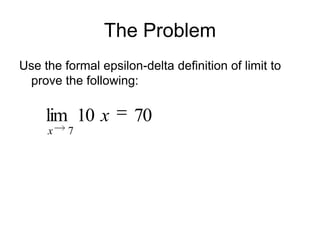
The Problem
Use the formal epsilon-delta definition of limit to
 prove the following:

     lim 10 x         70
     x   7
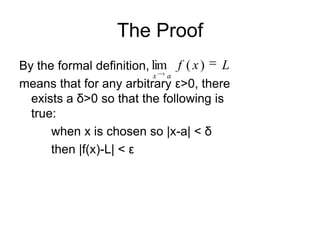
The Proof
By the formal definition, lim f ( x ) L
                           x a
means that for any arbitrary ε>0, there
  exists a δ>0 so that the following is
  true:
      when x is chosen so |x-a| < δ
      then |f(x)-L| < ε
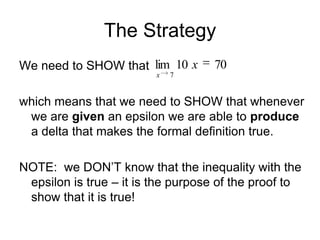
The Strategy
We need to SHOW that lim 10 x      70
                         x   7


which means that we need to SHOW that whenever
 we are given an epsilon we are able to produce
 a delta that makes the formal definition true.

NOTE: we DON’T know that the inequality with the
 epsilon is true – it is the purpose of the proof to
 show that it is true!
The Given
Informally
• We want x to approach 7.
• We need to show that 10x approaches 70.

Formally
• We’re given an arbitrary epsilon > 0
[that is it; nothing else!]
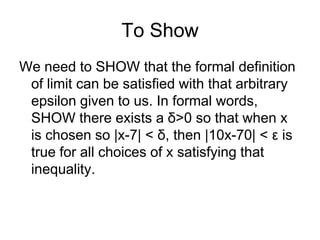
To Show
We need to SHOW that the formal definition
 of limit can be satisfied with that arbitrary
 epsilon given to us. In formal words,
 SHOW there exists a δ>0 so that when x
 is chosen so |x-7| < δ, then |10x-70| < ε is
 true for all choices of x satisfying that
 inequality.
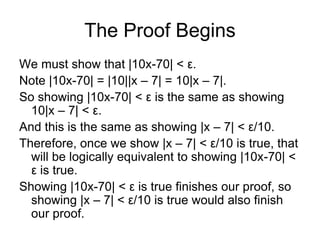
The Proof Begins
We must show that |10x-70| < ε.
Note |10x-70| = |10||x – 7| = 10|x – 7|.
So showing |10x-70| < ε is the same as showing
  10|x – 7| < ε.
And this is the same as showing |x – 7| < ε/10.
Therefore, once we show |x – 7| < ε/10 is true, that
  will be logically equivalent to showing |10x-70| <
  ε is true.
Showing |10x-70| < ε is true finishes our proof, so
  showing |x – 7| < ε/10 is true would also finish
  our proof.
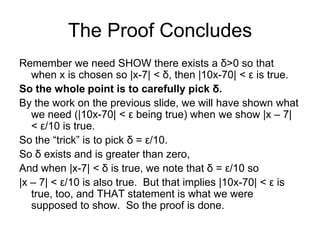
The Proof Concludes
Remember we need SHOW there exists a δ>0 so that
   when x is chosen so |x-7| < δ, then |10x-70| < ε is true.
So the whole point is to carefully pick δ.
By the work on the previous slide, we will have shown what
   we need (|10x-70| < ε being true) when we show |x – 7|
   < ε/10 is true.
So the “trick” is to pick δ = ε/10.
So δ exists and is greater than zero,
And when |x-7| < δ is true, we note that δ = ε/10 so
|x – 7| < ε/10 is also true. But that implies |10x-70| < ε is
   true, too, and THAT statement is what we were
   supposed to show. So the proof is done.
A Formal Proof
A formal proof would present the algebraic
  arguments, with justifications, of the work
  presented on the previous two slides. It
  would be more condensed and show the
  outcome of all that thinking – it would not
  necessarily go through all the explanatory
  material. It would still include explanations
  of what algebraic steps were done, but
  perhaps a lot less on why.
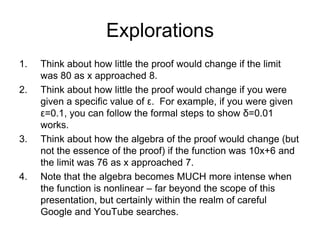
Explorations
1.   Think about how little the proof would change if the limit
     was 80 as x approached 8.
2.   Think about how little the proof would change if you were
     given a specific value of ε. For example, if you were given
     ε=0.1, you can follow the formal steps to show δ=0.01
     works.
3.   Think about how the algebra of the proof would change (but
     not the essence of the proof) if the function was 10x+6 and
     the limit was 76 as x approached 7.
4.   Note that the algebra becomes MUCH more intense when
     the function is nonlinear – far beyond the scope of this
     presentation, but certainly within the realm of careful
     Google and YouTube searches.

Limit proofs

  • 1.
    Limit Proofs A Resourcefor WGU Calculus III By Gideon Weinstein
  • 2.
    The Problem Use theformal epsilon-delta definition of limit to prove the following: lim 10 x 70 x 7
  • 3.
    The Proof By theformal definition, lim f ( x ) L x a means that for any arbitrary ε>0, there exists a δ>0 so that the following is true: when x is chosen so |x-a| < δ then |f(x)-L| < ε
  • 4.
    The Strategy We needto SHOW that lim 10 x 70 x 7 which means that we need to SHOW that whenever we are given an epsilon we are able to produce a delta that makes the formal definition true. NOTE: we DON’T know that the inequality with the epsilon is true – it is the purpose of the proof to show that it is true!
  • 5.
    The Given Informally • Wewant x to approach 7. • We need to show that 10x approaches 70. Formally • We’re given an arbitrary epsilon > 0 [that is it; nothing else!]
  • 6.
    To Show We needto SHOW that the formal definition of limit can be satisfied with that arbitrary epsilon given to us. In formal words, SHOW there exists a δ>0 so that when x is chosen so |x-7| < δ, then |10x-70| < ε is true for all choices of x satisfying that inequality.
  • 7.
    The Proof Begins Wemust show that |10x-70| < ε. Note |10x-70| = |10||x – 7| = 10|x – 7|. So showing |10x-70| < ε is the same as showing 10|x – 7| < ε. And this is the same as showing |x – 7| < ε/10. Therefore, once we show |x – 7| < ε/10 is true, that will be logically equivalent to showing |10x-70| < ε is true. Showing |10x-70| < ε is true finishes our proof, so showing |x – 7| < ε/10 is true would also finish our proof.
  • 8.
    The Proof Concludes Rememberwe need SHOW there exists a δ>0 so that when x is chosen so |x-7| < δ, then |10x-70| < ε is true. So the whole point is to carefully pick δ. By the work on the previous slide, we will have shown what we need (|10x-70| < ε being true) when we show |x – 7| < ε/10 is true. So the “trick” is to pick δ = ε/10. So δ exists and is greater than zero, And when |x-7| < δ is true, we note that δ = ε/10 so |x – 7| < ε/10 is also true. But that implies |10x-70| < ε is true, too, and THAT statement is what we were supposed to show. So the proof is done.
  • 9.
    A Formal Proof Aformal proof would present the algebraic arguments, with justifications, of the work presented on the previous two slides. It would be more condensed and show the outcome of all that thinking – it would not necessarily go through all the explanatory material. It would still include explanations of what algebraic steps were done, but perhaps a lot less on why.
  • 10.
    Explorations 1. Think about how little the proof would change if the limit was 80 as x approached 8. 2. Think about how little the proof would change if you were given a specific value of ε. For example, if you were given ε=0.1, you can follow the formal steps to show δ=0.01 works. 3. Think about how the algebra of the proof would change (but not the essence of the proof) if the function was 10x+6 and the limit was 76 as x approached 7. 4. Note that the algebra becomes MUCH more intense when the function is nonlinear – far beyond the scope of this presentation, but certainly within the realm of careful Google and YouTube searches.