


Traffic Sign Recognition
Date: 12 March 2019
IEC College Of Engineering And Technology,Greater Noida
Dr. A. P. J. Abdul Kalam Technical University
Uttar Pradesh
M. Tech Thesis Presentation
Supervisor
ASSISTANT PROF. RAJNESH SINGH
Presented by
ANUJ KUMAR RAGHAV
1609010501
(M.TECH CSE)
Abstract
Traffic Sign Recognition (TSR) is an important part of the driver support functions needed to make
intelligent vehicles. The automatic system for classification of traffic signs is a critical task of an
Advanced Driver Assistance Systems (ADAS) and a fundamental technique utilized as integral part
to the various vehicles. The recognizable features of a traffic image are utilized for their
classification. Traffic signs are designed in such a way that they contain specific shapes and colors,
with some text and some symbols with high contrast to the background. In this project, we
proposed hybrid approach for classification of traffic signs by SIFT for image feature extraction and
SVM for classification. The proposed work is divided into different phases like Feature Extraction
and Classification Phase. MATLAB is used for the implementation purpose of proposed framework
and classification is carried out by utilizing real traffic sign images.
Outline
 Introduction
 Literature Review
 Objective
 Methodology
 Experiments & Data
 Result
 Enhancement and Future Work
 References
Introduction
 Traffic Sign
Traffic signs or road signs are signs erected at the side of or above roads to give instructions or
provide information to road users.
Signs are treaty signed in 1968 which has been able to standardize traffic signs across different
countries.
There are some examples of traffic signs.
 Warning signs: Warning signs are to warn of hazards or a hazardous condition.
Continued….
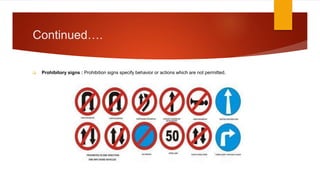
 Prohibitory signs : Prohibition signs specify behavior or actions which are not permitted.
Continued….
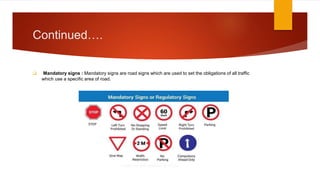
 Mandatory signs : Mandatory signs are road signs which are used to set the obligations of all traffic
which use a specific area of road.
Traffic Sign Recognition
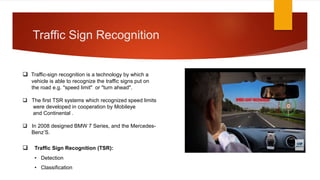
 Traffic-sign recognition is a technology by which a
vehicle is able to recognize the traffic signs put on
the road e.g. "speed limit" or "turn ahead".
 The first TSR systems which recognized speed limits
were developed in cooperation by Mobileye
and Continental .
 In 2008 designed BMW 7 Series, and the Mercedes-
Benz’S.
 Traffic Sign Recognition (TSR):
• Detection
• Classification
Literature Review
 The existence of dirt on the faces of traffic signs has effects on sign readability. Issues with
traffic sign readability can lead to an increase in unsafe driving behaviours. However,
cleaning traffic signs is very expensive and can potentially lead to safety issues for workers,
and traffic delays for road users. Thus, it is important to identify traffic signs.
 The goal of this study was to reveal the effects of sign attributes and location observations
on the number of dirty traffic signs.
 According to study , SURF Technologies use for recognition of traffic signs but something
stuck on blur images , breakable images , Color images.
Objective
 The main objective of the Traffic Sign recognition project is to identify a traffic sign from a
plate and digital photograph.
 The sign may be viewed from various angles and in many diverse background situations.
 Traffic sign will then be highlighted after identification and classify signs with a high
accuracy rate. All image processing algorithm will be done in MATLAB.
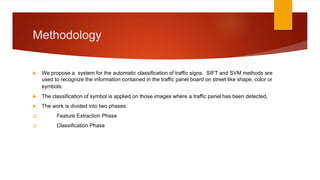
Methodology
 We propose a system for the automatic classification of traffic signs. SIFT and SVM methods are
used to recognize the information contained in the traffic panel board on street like shape, color or
symbols.
 The classification of symbol is applied on those images where a traffic panel has been detected,
 The work is divided into two phases.
 Feature Extraction Phase
 Classification Phase
Feature Extraction Phase
SIFT(Scale Invariant Feature Transform) for
image feature extraction.
Lets take one example…
Continued……
Continued……
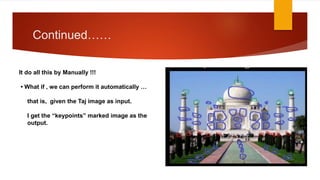
It do all this by Manually !!!
• What if , we can perform it automatically …
that is, given the Taj image as input.
I get the “keypoints” marked image as the
output.
Continued…
 SIFT does exactly this! created by David Lowe (1999).
 SIFT is a method to detect distinctive, invariant image feature points, which can be matched
between images to perform tasks such as object detection and recognition, or to compute
geometrical transformations between images.
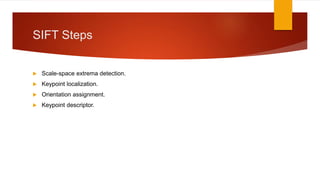
SIFT Steps
 Scale-space extrema detection.
 Keypoint localization.
 Orientation assignment.
 Keypoint descriptor.
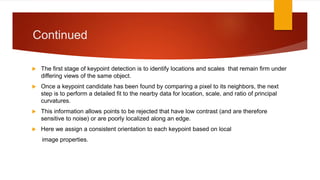
Continued
 The first stage of keypoint detection is to identify locations and scales that remain firm under
differing views of the same object.
 Once a keypoint candidate has been found by comparing a pixel to its neighbors, the next
step is to perform a detailed fit to the nearby data for location, scale, and ratio of principal
curvatures.
 This information allows points to be rejected that have low contrast (and are therefore
sensitive to noise) or are poorly localized along an edge.
 Here we assign a consistent orientation to each keypoint based on local
image properties.
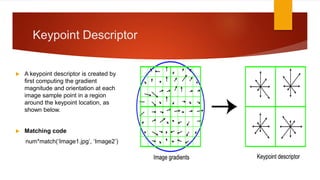
Keypoint Descriptor
 A keypoint descriptor is created by
first computing the gradient
magnitude and orientation at each
image sample point in a region
around the keypoint location, as
shown below.
 Matching code
num*match(‘Image1.jpg’, ‘Image2’)
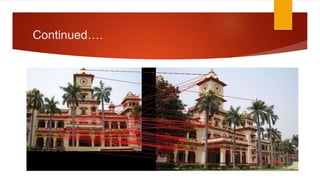
Continued….
Image content is transformed into local feature coordinates that are invariant to translation,
rotation, scale, and other imaging parameters
Continued….
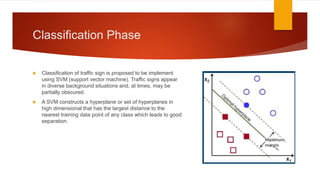
Classification Phase
 Classification of traffic sign is proposed to be implement
using SVM (support vector machine). Traffic signs appear
in diverse background situations and, at times, may be
partially obscured.
 A SVM constructs a hyperplane or set of hyperplanes in
high dimensional that has the largest distance to the
nearest training data point of any class which leads to good
separation.
Continued….
 Support Vector Machine is a part of Machine Learning concept. SVM has the
ability to classify and recognize images.
 Support Vector Machine to perform the classification process by calculating
similarity between features.
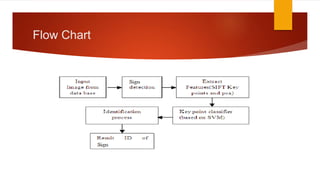
Flow Chart
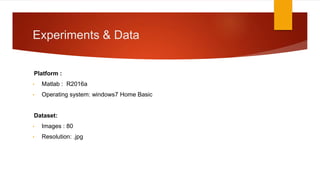
Experiments & Data
Platform :
• Matlab : R2016a
• Operating system: windows7 Home Basic
Dataset:
• Images : 80
• Resolution: .jpg
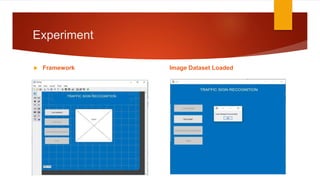
Experiment
 Framework Image Dataset Loaded
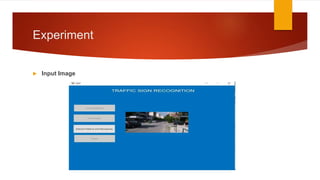
Experiment
 Input Image
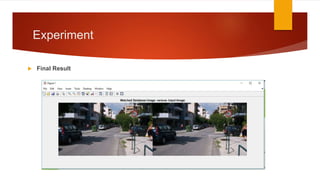
Experiment
 Final Result
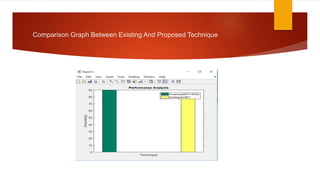
Comparison Graph Between Existing And Proposed Technique
Future Work
 Fully Autonomous Vehicles
 Google’s self-driving car project
 Advanced Driver Assistant Systems
 Mobileye
 Fully Autonomous Vehicles
 Tom Tom‘s Highly Automated driving car
project .
References
 Dilip Singh Solanki, Dr. Gireesh Dixit, “Traffic Sign Detection Using Feature Based Method” , In an International Journal of
Advanced Research in Computer Science and Software Engineering, Volume 5, Issue 2, February 2015, ISSN: 2277 128X
 Tong Guofeng, Chen Huairong, Li Yong, Zheng Kai, “Traffic sign recognition based on SVM and convolutional neural network”,
An Industrial Electronics and Applications (ICIEA), 2017 12th IEEE Conference, ISSN: 2158-2297, 08 February 2018, DOI:
10.1109/ICIEA.2017.8283178
 Emrah ONAT, Ömer ÖZDİL, “TRAFFIC SIGN CLASSIFICATION USING HOUGH TRANSFORM AND SVM”, The Signal
Processing and Communications Applications Conference (SIU), 2015 23th, 22 June 2015, ISSN: 2165-0608, DOI:
10.1109/SIU.2015.7130301
 MrinalHaloi, “Traffic Sign Classification Using Deep Inception Based Convolutional Networks”, arXiv:1511.02992v2 [cs.CV] 17
Jul 2016
 Jack Greenhalgh and MajidMirmehdi, “Real-Time Detection and Recognition of Road Traffic Signs”, IEEE Transactions on
Intelligent Transportation Systems ( Volume: 13, Issue: 4, Dec. 2012 ) Page(s): 1498 – 1506, ISSN: 1524-9050, DOI:
10.1109/TITS.2012.2208909
 M Swathi, K. V. Suresh, “Automatic traffic sign detection and recognition: A review”, The Algorithms, the Methodology, Models
and the Applications in Emerging Technologies (ICAMMAET), 2017 International Conference,14 December 2017, 978-1-5090-
3379-9, DOI: 10.1109/ICAMMAET.2017.8186650
Continued…..
 Yi Yang, HengliangLuo, HuarongXu, and FuchaoWu, “Towards Real-Time Traffic Sign Detection and
Classification”, In IEEE Transactions on Intelligent Transportation Systems ( Volume: 17, Issue: 7, July 2016 )
Page(s): 2022 – 2031, ISSN: 1524-9050, DOI: 10.1109/TITS.2015.2482461
 https://www.researchgate.net/publication/224255280_Real-time_traffic_sign_recognition_system
 https://www.ijsr.net/archive/v5i5/NOV163967.pdf
 www.google.com
 http://ieeexplore.ieee.org/document/1248701/?reload=true
 https://www.youtube.com/watch?v=esDzWBVHx5
Publication
Thank You
Anuj Kumar Raghav 1609010501 M.tech CSE
IEC College Of Engineering And Technology,Greater Noida
Dr. A. P. J. Abdul Kalam Technical University
Uttar Pradesh

Traffic sign recognition

  • 1.
    Traffic Sign Recognition Date:12 March 2019 IEC College Of Engineering And Technology,Greater Noida Dr. A. P. J. Abdul Kalam Technical University Uttar Pradesh M. Tech Thesis Presentation Supervisor ASSISTANT PROF. RAJNESH SINGH Presented by ANUJ KUMAR RAGHAV 1609010501 (M.TECH CSE)
  • 2.
    Abstract Traffic Sign Recognition(TSR) is an important part of the driver support functions needed to make intelligent vehicles. The automatic system for classification of traffic signs is a critical task of an Advanced Driver Assistance Systems (ADAS) and a fundamental technique utilized as integral part to the various vehicles. The recognizable features of a traffic image are utilized for their classification. Traffic signs are designed in such a way that they contain specific shapes and colors, with some text and some symbols with high contrast to the background. In this project, we proposed hybrid approach for classification of traffic signs by SIFT for image feature extraction and SVM for classification. The proposed work is divided into different phases like Feature Extraction and Classification Phase. MATLAB is used for the implementation purpose of proposed framework and classification is carried out by utilizing real traffic sign images.
  • 3.
    Outline  Introduction  LiteratureReview  Objective  Methodology  Experiments & Data  Result  Enhancement and Future Work  References
  • 4.
    Introduction  Traffic Sign Trafficsigns or road signs are signs erected at the side of or above roads to give instructions or provide information to road users. Signs are treaty signed in 1968 which has been able to standardize traffic signs across different countries. There are some examples of traffic signs.  Warning signs: Warning signs are to warn of hazards or a hazardous condition.
  • 5.
    Continued….  Prohibitory signs: Prohibition signs specify behavior or actions which are not permitted.
  • 6.
    Continued….  Mandatory signs: Mandatory signs are road signs which are used to set the obligations of all traffic which use a specific area of road.
  • 7.
    Traffic Sign Recognition Traffic-sign recognition is a technology by which a vehicle is able to recognize the traffic signs put on the road e.g. "speed limit" or "turn ahead".  The first TSR systems which recognized speed limits were developed in cooperation by Mobileye and Continental .  In 2008 designed BMW 7 Series, and the Mercedes- Benz’S.  Traffic Sign Recognition (TSR): • Detection • Classification
  • 8.
    Literature Review  Theexistence of dirt on the faces of traffic signs has effects on sign readability. Issues with traffic sign readability can lead to an increase in unsafe driving behaviours. However, cleaning traffic signs is very expensive and can potentially lead to safety issues for workers, and traffic delays for road users. Thus, it is important to identify traffic signs.  The goal of this study was to reveal the effects of sign attributes and location observations on the number of dirty traffic signs.  According to study , SURF Technologies use for recognition of traffic signs but something stuck on blur images , breakable images , Color images.
  • 9.
    Objective  The mainobjective of the Traffic Sign recognition project is to identify a traffic sign from a plate and digital photograph.  The sign may be viewed from various angles and in many diverse background situations.  Traffic sign will then be highlighted after identification and classify signs with a high accuracy rate. All image processing algorithm will be done in MATLAB.
  • 10.
    Methodology  We proposea system for the automatic classification of traffic signs. SIFT and SVM methods are used to recognize the information contained in the traffic panel board on street like shape, color or symbols.  The classification of symbol is applied on those images where a traffic panel has been detected,  The work is divided into two phases.  Feature Extraction Phase  Classification Phase
  • 11.
    Feature Extraction Phase SIFT(ScaleInvariant Feature Transform) for image feature extraction. Lets take one example…
  • 12.
  • 13.
    Continued…… It do allthis by Manually !!! • What if , we can perform it automatically … that is, given the Taj image as input. I get the “keypoints” marked image as the output.
  • 14.
    Continued…  SIFT doesexactly this! created by David Lowe (1999).  SIFT is a method to detect distinctive, invariant image feature points, which can be matched between images to perform tasks such as object detection and recognition, or to compute geometrical transformations between images.
  • 15.
    SIFT Steps  Scale-spaceextrema detection.  Keypoint localization.  Orientation assignment.  Keypoint descriptor.
  • 16.
    Continued  The firststage of keypoint detection is to identify locations and scales that remain firm under differing views of the same object.  Once a keypoint candidate has been found by comparing a pixel to its neighbors, the next step is to perform a detailed fit to the nearby data for location, scale, and ratio of principal curvatures.  This information allows points to be rejected that have low contrast (and are therefore sensitive to noise) or are poorly localized along an edge.  Here we assign a consistent orientation to each keypoint based on local image properties.
  • 17.
    Keypoint Descriptor  Akeypoint descriptor is created by first computing the gradient magnitude and orientation at each image sample point in a region around the keypoint location, as shown below.  Matching code num*match(‘Image1.jpg’, ‘Image2’)
  • 18.
    Continued…. Image content istransformed into local feature coordinates that are invariant to translation, rotation, scale, and other imaging parameters
  • 19.
  • 20.
    Classification Phase  Classificationof traffic sign is proposed to be implement using SVM (support vector machine). Traffic signs appear in diverse background situations and, at times, may be partially obscured.  A SVM constructs a hyperplane or set of hyperplanes in high dimensional that has the largest distance to the nearest training data point of any class which leads to good separation.
  • 21.
    Continued….  Support VectorMachine is a part of Machine Learning concept. SVM has the ability to classify and recognize images.  Support Vector Machine to perform the classification process by calculating similarity between features.
  • 22.
  • 23.
    Experiments & Data Platform: • Matlab : R2016a • Operating system: windows7 Home Basic Dataset: • Images : 80 • Resolution: .jpg
  • 24.
  • 25.
  • 26.
  • 27.
    Comparison Graph BetweenExisting And Proposed Technique
  • 28.
    Future Work  FullyAutonomous Vehicles  Google’s self-driving car project  Advanced Driver Assistant Systems  Mobileye  Fully Autonomous Vehicles  Tom Tom‘s Highly Automated driving car project .
  • 29.
    References  Dilip SinghSolanki, Dr. Gireesh Dixit, “Traffic Sign Detection Using Feature Based Method” , In an International Journal of Advanced Research in Computer Science and Software Engineering, Volume 5, Issue 2, February 2015, ISSN: 2277 128X  Tong Guofeng, Chen Huairong, Li Yong, Zheng Kai, “Traffic sign recognition based on SVM and convolutional neural network”, An Industrial Electronics and Applications (ICIEA), 2017 12th IEEE Conference, ISSN: 2158-2297, 08 February 2018, DOI: 10.1109/ICIEA.2017.8283178  Emrah ONAT, Ömer ÖZDİL, “TRAFFIC SIGN CLASSIFICATION USING HOUGH TRANSFORM AND SVM”, The Signal Processing and Communications Applications Conference (SIU), 2015 23th, 22 June 2015, ISSN: 2165-0608, DOI: 10.1109/SIU.2015.7130301  MrinalHaloi, “Traffic Sign Classification Using Deep Inception Based Convolutional Networks”, arXiv:1511.02992v2 [cs.CV] 17 Jul 2016  Jack Greenhalgh and MajidMirmehdi, “Real-Time Detection and Recognition of Road Traffic Signs”, IEEE Transactions on Intelligent Transportation Systems ( Volume: 13, Issue: 4, Dec. 2012 ) Page(s): 1498 – 1506, ISSN: 1524-9050, DOI: 10.1109/TITS.2012.2208909  M Swathi, K. V. Suresh, “Automatic traffic sign detection and recognition: A review”, The Algorithms, the Methodology, Models and the Applications in Emerging Technologies (ICAMMAET), 2017 International Conference,14 December 2017, 978-1-5090- 3379-9, DOI: 10.1109/ICAMMAET.2017.8186650
  • 30.
    Continued…..  Yi Yang,HengliangLuo, HuarongXu, and FuchaoWu, “Towards Real-Time Traffic Sign Detection and Classification”, In IEEE Transactions on Intelligent Transportation Systems ( Volume: 17, Issue: 7, July 2016 ) Page(s): 2022 – 2031, ISSN: 1524-9050, DOI: 10.1109/TITS.2015.2482461  https://www.researchgate.net/publication/224255280_Real-time_traffic_sign_recognition_system  https://www.ijsr.net/archive/v5i5/NOV163967.pdf  www.google.com  http://ieeexplore.ieee.org/document/1248701/?reload=true  https://www.youtube.com/watch?v=esDzWBVHx5
  • 31.
  • 33.
    Thank You Anuj KumarRaghav 1609010501 M.tech CSE IEC College Of Engineering And Technology,Greater Noida Dr. A. P. J. Abdul Kalam Technical University Uttar Pradesh