DEEPFAKE
TECHNOLOGY
NAGARJUNA COLLEGE OF ENGINEERING AND TECHNOLOGY
An Autonomous College under VTU, Belagavi
PRESENTATION ON
INTRODUCTION
► Deepfakes are synthetic media in which a person in an existing
image or video is replaced by someone's else likeness.
► It is a term used to describe a type of artificial intelligence
technology that can be used to create realistic fake videos or
images.
► The term "deepfake" is a combination of "deep learning" and
"fake“.
HISTORY
Photo manipulation was developed in the 19th century and soon
applied to motion pictures. Technology steadily improved during the
20th century, and more quickly with the advent of digital video.
Deepfake technology has been developed by researchers at academic
institutions beginning in the 1990s, and later by amateurs in online
communities. More recently the methods have been adopted by
industry.
In recent time, Deepfake technology has been used to impersonate
notable personalities like former U.S. Presidents Barack Obama and
Donald Trump, India's Prime Minister Narendra Modi, etc.
HOW IT WORKS?
Deepfakes are created by training a machine learning model on
large amounts of data, such as photos or videos of a person's face
or voice. The model then learns to generate realistic media of the
person, even though the media may be entirely fabricated.
In the given fig we can observe the
accuracy of deepfake technology.
AIM & OBJECTIVES
The aim of deepfake technology is to create realistic digital content that
can be used for various purposes, including entertainment, education,
and etc., Objectives include:
• Entertainment-Deepfakes can be used to create realistic special effects
in movies, TV Shows, and video games.
• Education-Deepfakes can be used to create realistic simulations for
training purposes, such as medical procedures or military exercises.
• Social media content-Deepfakes can be used to create humorous or
satirical videos for social media platforms.
ADVANTAGES
1.Low-Cost Video Campaigns:
Marketers using deepfakes can save money on the budgets for their
video campaigns using because you don’t need an in-person actor.
Instead of using an in-person actor, a marketer can purchase a license
for an actor’s identity.
2. Professional training:
Deepfake technology can be used to create AI Avatars for used in
training videos . Startups like London-based Synthesia have been
getting more attention from the corporate world during the COVID
pandemic since lockdowns and health concerns have made video
shoots involving real people much more difficult to pull off.
3.Art:
You can bring back a decedent actor or actress. In many movies to make
a digital creation of an dead person it is used.
4.Financial Saving:
Others point out that generative technology could potentially
democratize a number of industries. By allowing the cheap creation of
everything from videos, to advertisement and games, generative
technology could allow individuals and companies to enter these fields
with less investment.
DISADVANTAGES
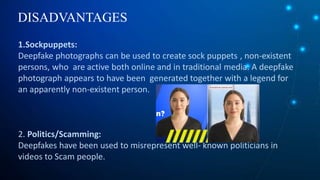
1.Sockpuppets:
Deepfake photographs can be used to create sock puppets , non-existent
persons, who are active both online and in traditional media. A deepfake
photograph appears to have been generated together with a legend for
an apparently non-existent person.
2. Politics/Scamming:
Deepfakes have been used to misrepresent well- known politicians in
videos to Scam people.
3.Blackmail:
Deepfakes can be used to generate blackmail materials that
falsely incriminate a victim. It is possible to repurpose commodity
cryptocurrency mining hardware with a small software program to
generate this blackmail content for any number of subjects in
huge quantities, driving up the supply of fake blackmail content
limitlessly and in highly scalable fashion.
4.Lack of authenticity:
Using deepfakes in marketing campaigns could make it seem like
you are not being authentic. People might not trust your brand if
you are using fake technology to mislead them.
Real time examples for usage of Deepfake technology
1.Captain America: Civil War (Robert Downey Jr)
2.Avengers: Endgame (Michael Douglas, John Slattery)
3.James (Punit Rajkumar)
4.Fast & Furious 7 (Paul Walker)
5.US President Campaigns (Mr. Barack Obama)
CONCLUSION
In conclusion, deepfakes have the potential to be used for good or bad,
and it is up to us to determine how we use this technology.
We must be aware of its potential benefits and drawbacks, and take
steps to regulate its use to ensure that it is used ethically and
responsibly.
At the same time, we must continue to invest in technology that can
detect deepfakes and prevent them from spreading false information or
causing harm.
THANK YOU

Deepfake.pptx

  • 1.
    DEEPFAKE TECHNOLOGY NAGARJUNA COLLEGE OFENGINEERING AND TECHNOLOGY An Autonomous College under VTU, Belagavi PRESENTATION ON
  • 2.
    INTRODUCTION ► Deepfakes aresynthetic media in which a person in an existing image or video is replaced by someone's else likeness. ► It is a term used to describe a type of artificial intelligence technology that can be used to create realistic fake videos or images. ► The term "deepfake" is a combination of "deep learning" and "fake“.
  • 3.
    HISTORY Photo manipulation wasdeveloped in the 19th century and soon applied to motion pictures. Technology steadily improved during the 20th century, and more quickly with the advent of digital video. Deepfake technology has been developed by researchers at academic institutions beginning in the 1990s, and later by amateurs in online communities. More recently the methods have been adopted by industry. In recent time, Deepfake technology has been used to impersonate notable personalities like former U.S. Presidents Barack Obama and Donald Trump, India's Prime Minister Narendra Modi, etc.
  • 4.
    HOW IT WORKS? Deepfakesare created by training a machine learning model on large amounts of data, such as photos or videos of a person's face or voice. The model then learns to generate realistic media of the person, even though the media may be entirely fabricated. In the given fig we can observe the accuracy of deepfake technology.
  • 5.
    AIM & OBJECTIVES Theaim of deepfake technology is to create realistic digital content that can be used for various purposes, including entertainment, education, and etc., Objectives include: • Entertainment-Deepfakes can be used to create realistic special effects in movies, TV Shows, and video games. • Education-Deepfakes can be used to create realistic simulations for training purposes, such as medical procedures or military exercises. • Social media content-Deepfakes can be used to create humorous or satirical videos for social media platforms.
  • 6.
    ADVANTAGES 1.Low-Cost Video Campaigns: Marketersusing deepfakes can save money on the budgets for their video campaigns using because you don’t need an in-person actor. Instead of using an in-person actor, a marketer can purchase a license for an actor’s identity. 2. Professional training: Deepfake technology can be used to create AI Avatars for used in training videos . Startups like London-based Synthesia have been getting more attention from the corporate world during the COVID pandemic since lockdowns and health concerns have made video shoots involving real people much more difficult to pull off.
  • 7.
    3.Art: You can bringback a decedent actor or actress. In many movies to make a digital creation of an dead person it is used. 4.Financial Saving: Others point out that generative technology could potentially democratize a number of industries. By allowing the cheap creation of everything from videos, to advertisement and games, generative technology could allow individuals and companies to enter these fields with less investment.
  • 8.
    DISADVANTAGES 1.Sockpuppets: Deepfake photographs canbe used to create sock puppets , non-existent persons, who are active both online and in traditional media. A deepfake photograph appears to have been generated together with a legend for an apparently non-existent person. 2. Politics/Scamming: Deepfakes have been used to misrepresent well- known politicians in videos to Scam people.
  • 9.
    3.Blackmail: Deepfakes can beused to generate blackmail materials that falsely incriminate a victim. It is possible to repurpose commodity cryptocurrency mining hardware with a small software program to generate this blackmail content for any number of subjects in huge quantities, driving up the supply of fake blackmail content limitlessly and in highly scalable fashion. 4.Lack of authenticity: Using deepfakes in marketing campaigns could make it seem like you are not being authentic. People might not trust your brand if you are using fake technology to mislead them.
  • 10.
    Real time examplesfor usage of Deepfake technology 1.Captain America: Civil War (Robert Downey Jr) 2.Avengers: Endgame (Michael Douglas, John Slattery) 3.James (Punit Rajkumar) 4.Fast & Furious 7 (Paul Walker) 5.US President Campaigns (Mr. Barack Obama)
  • 11.
    CONCLUSION In conclusion, deepfakeshave the potential to be used for good or bad, and it is up to us to determine how we use this technology. We must be aware of its potential benefits and drawbacks, and take steps to regulate its use to ensure that it is used ethically and responsibly. At the same time, we must continue to invest in technology that can detect deepfakes and prevent them from spreading false information or causing harm.
  • 12.