
INTRODUCTION TO ANIMATION
COMPUTER GRAPHICS
UNIT VI
-BY MS. ARTI GAVAS
INTRODUCTION
• The objective of this chapter is
▫ To understand the concepts of computer animation.
▫ To understand Morphing.
The main goal of computer animation is to synthesize the
desired motion effect which is a mixing of natural
phenomena, perception and imagination. The animator
designs the object's dynamic behavior with his mental
representation of causality.
KEY-FRAME ANIMATION
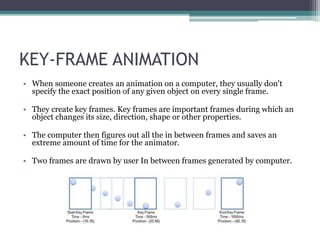
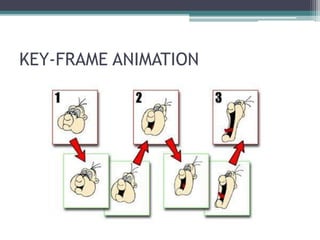
• When someone creates an animation on a computer, they usually don't
specify the exact position of any given object on every single frame.
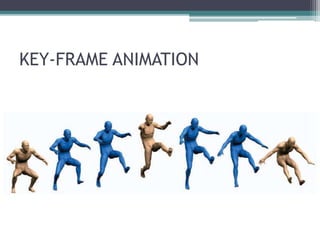
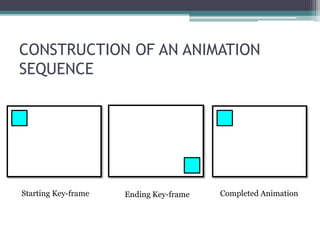
• They create key frames. Key frames are important frames during which an
object changes its size, direction, shape or other properties.
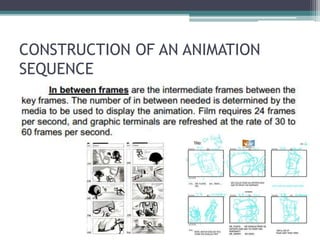
• The computer then figures out all the in between frames and saves an
extreme amount of time for the animator.
• Two frames are drawn by user In between frames generated by computer.
KEY-FRAME ANIMATION
KEY-FRAME ANIMATION
CONSTRUCTION OF AN ANIMATION
SEQUENCE
CONSTRUCTION OF AN ANIMATION SEQUENCE
CONSTRUCTION OF AN ANIMATION
SEQUENCE
Starting Key-frame Ending Key-frame Completed Animation
CONSTRUCTION OF AN ANIMATION
SEQUENCE
MOTION CONTROL METHODS
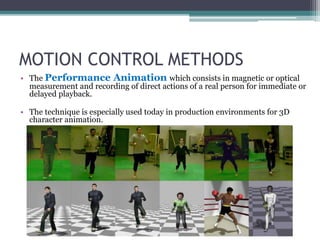
• The Performance Animation which consists in magnetic or optical
measurement and recording of direct actions of a real person for immediate or
delayed playback.
• The technique is especially used today in production environments for 3D
character animation.
MOTION CONTROL METHODS
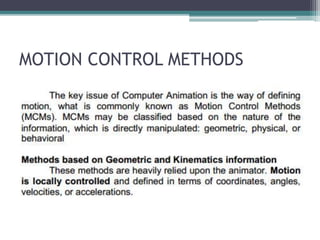
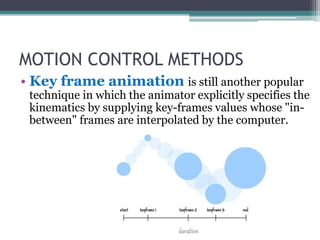
• Key frame animation is still another popular
technique in which the animator explicitly specifies the
kinematics by supplying key-frames values whose "in-
between" frames are interpolated by the computer.
MOTION CONTROL METHODS
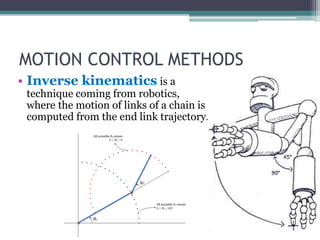
• Inverse kinematics is a
technique coming from robotics,
where the motion of links of a chain is
computed from the end link trajectory.
MOTION CONTROL METHODS
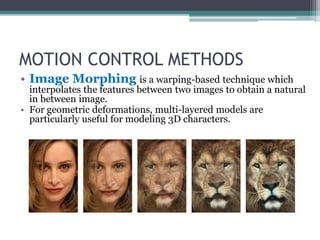
• Image Morphing is a warping-based technique which
interpolates the features between two images to obtain a natural
in between image.
• For geometric deformations, multi-layered models are
particularly useful for modeling 3D characters.
MOTION CONTROL METHODS
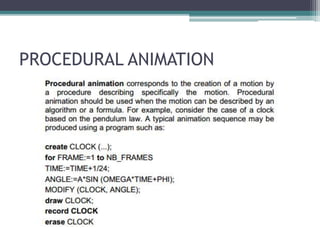
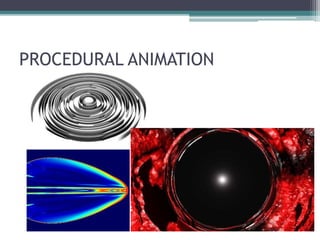
PROCEDURAL ANIMATION
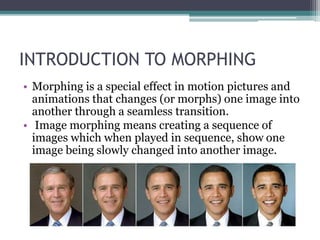
INTRODUCTION TO MORPHING
• Morphing is a special effect in motion pictures and
animations that changes (or morphs) one image into
another through a seamless transition.
• Image morphing means creating a sequence of
images which when played in sequence, show one
image being slowly changed into another image.
THREE-DIMENSIONAL MORPHING
• Image morphing, the construction of an image
sequence depicting a gradual transition between
two images, has been extensively investigated.
• For images generated from 3D models, there is
an alternative to morphing the images
themselves.
• 3D morphing generates intermediate 3D models,
the morphs, directly from the given models; the
morphs are then rendered to produce an image
sequence depicting the transformation.
THREE-DIMENSIONAL MORPHING
• 3D morphing overcomes the following shortcomings of 2D
morphing as applied to images generated from 3D models:
▫ In 3D morphing, creating the morphs is independent of the viewing and
lighting parameters. Hence, we can create a morph sequence once, and
then experiment with various camera angles and lighting conditions
during rendering.
▫ In 2D morphing, a new morph must be recomputed every time we wish
to alter our viewpoint or the illumination of the 3D model.
▫ 2D techniques, lacking information on the model's spatial configuration,
are unable to correctly handle changes in illumination and visibility.
▫ Two examples of this type of artifact are:
 (i) Shadows and highlights fail to match shape changes occurring in the morph.
 (ii) When a feature of the 3D object is not visible in the original 2D image, this
feature cannot be made to appear during the morph; for example, when the
singing actor needs to open her mouth during the morph, pulling her lips apart
thickens the lips instead of revealing her teeth.
THANK YOU!

Introduction to animation

  • 1.
    INTRODUCTION TO ANIMATION COMPUTERGRAPHICS UNIT VI -BY MS. ARTI GAVAS
  • 2.
    INTRODUCTION • The objectiveof this chapter is ▫ To understand the concepts of computer animation. ▫ To understand Morphing. The main goal of computer animation is to synthesize the desired motion effect which is a mixing of natural phenomena, perception and imagination. The animator designs the object's dynamic behavior with his mental representation of causality.
  • 3.
    KEY-FRAME ANIMATION • Whensomeone creates an animation on a computer, they usually don't specify the exact position of any given object on every single frame. • They create key frames. Key frames are important frames during which an object changes its size, direction, shape or other properties. • The computer then figures out all the in between frames and saves an extreme amount of time for the animator. • Two frames are drawn by user In between frames generated by computer.
  • 4.
  • 5.
  • 6.
    CONSTRUCTION OF ANANIMATION SEQUENCE
  • 7.
    CONSTRUCTION OF ANANIMATION SEQUENCE
  • 8.
    CONSTRUCTION OF ANANIMATION SEQUENCE Starting Key-frame Ending Key-frame Completed Animation
  • 9.
    CONSTRUCTION OF ANANIMATION SEQUENCE
  • 10.
  • 11.
    MOTION CONTROL METHODS •The Performance Animation which consists in magnetic or optical measurement and recording of direct actions of a real person for immediate or delayed playback. • The technique is especially used today in production environments for 3D character animation.
  • 12.
    MOTION CONTROL METHODS •Key frame animation is still another popular technique in which the animator explicitly specifies the kinematics by supplying key-frames values whose "in- between" frames are interpolated by the computer.
  • 13.
    MOTION CONTROL METHODS •Inverse kinematics is a technique coming from robotics, where the motion of links of a chain is computed from the end link trajectory.
  • 14.
    MOTION CONTROL METHODS •Image Morphing is a warping-based technique which interpolates the features between two images to obtain a natural in between image. • For geometric deformations, multi-layered models are particularly useful for modeling 3D characters.
  • 15.
  • 16.
  • 17.
  • 18.
    INTRODUCTION TO MORPHING •Morphing is a special effect in motion pictures and animations that changes (or morphs) one image into another through a seamless transition. • Image morphing means creating a sequence of images which when played in sequence, show one image being slowly changed into another image.
  • 19.
    THREE-DIMENSIONAL MORPHING • Imagemorphing, the construction of an image sequence depicting a gradual transition between two images, has been extensively investigated. • For images generated from 3D models, there is an alternative to morphing the images themselves. • 3D morphing generates intermediate 3D models, the morphs, directly from the given models; the morphs are then rendered to produce an image sequence depicting the transformation.
  • 20.
    THREE-DIMENSIONAL MORPHING • 3Dmorphing overcomes the following shortcomings of 2D morphing as applied to images generated from 3D models: ▫ In 3D morphing, creating the morphs is independent of the viewing and lighting parameters. Hence, we can create a morph sequence once, and then experiment with various camera angles and lighting conditions during rendering. ▫ In 2D morphing, a new morph must be recomputed every time we wish to alter our viewpoint or the illumination of the 3D model. ▫ 2D techniques, lacking information on the model's spatial configuration, are unable to correctly handle changes in illumination and visibility. ▫ Two examples of this type of artifact are:  (i) Shadows and highlights fail to match shape changes occurring in the morph.  (ii) When a feature of the 3D object is not visible in the original 2D image, this feature cannot be made to appear during the morph; for example, when the singing actor needs to open her mouth during the morph, pulling her lips apart thickens the lips instead of revealing her teeth.
  • 21.