MM HASAN,LECTURER,AIE,HSTU
• Terracing is a practice to reduce runoff, soil erosion, and
sediment delivery from upland areas by constructing broad
channels across the slope of rolling land.
Reasons for constructing terace
If surface runoff is allowed to flow unimpeded down the slope of
arable land these is a danger that its volume or velocity or
both may build up to the points where it is not only carries
the soil dislodged by the splash erosion but also has a
scouring action of its own.
various names given to this techniques are:
 terraces (U.S.A).
 ridge or bund (common wealth countries).
To decrease the length of the hillside slope , thereby
reducing sheet and rill erosion.
Preventing formation of gullies and retaining runoff in
areas of inadequate precipitation.
In dry regions such conservation of moisture is
important in the control of wind erosion
Classification by Alignment
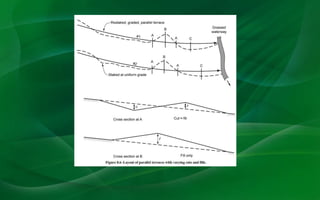
Terrace alignment can either be non-parallel or parallel.
Non-parallel terraces follow the contour of the land
regardless of alignment.
Parallel terraces are preferred for row crop farming
operations.
.
Classification by Cross Section
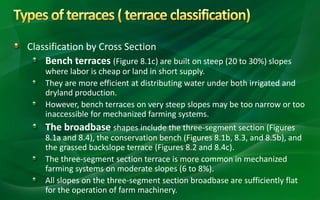
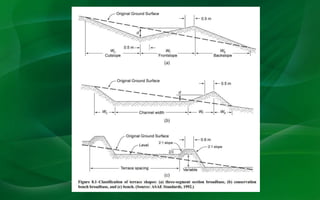
Bench terraces (Figure 8.1c) are built on steep (20 to 30%) slopes
where labor is cheap or land in short supply.
They are more efficient at distributing water under both irrigated and
dryland production.
However, bench terraces on very steep slopes may be too narrow or too
inaccessible for mechanized farming systems.
The broadbase shapes include the three-segment section (Figures
8.1a and 8.4), the conservation bench (Figures 8.1b, 8.3, and 8.5b), and
the grassed backslope terrace (Figures 8.2 and 8.4c).
The three-segment section terrace is more common in mechanized
farming systems on moderate slopes (6 to 8%).
All slopes on the three-segment section broadbase are sufficiently flat
for the operation of farm machinery.
Classification by Grade
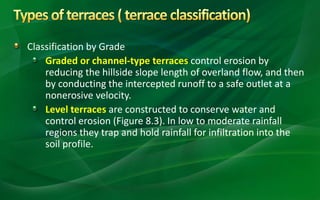
Graded or channel-type terraces control erosion by
reducing the hillside slope length of overland flow, and then
by conducting the intercepted runoff to a safe outlet at a
nonerosive velocity.
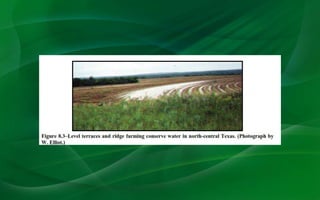
Level terraces are constructed to conserve water and
control erosion (Figure 8.3). In low to moderate rainfall
regions they trap and hold rainfall for infiltration into the
soil profile.
Classification by Outlet
Terrace outlets may be classified as
blocked (all water infiltrates in the terrace channel),
permanently vegetated (grassed waterway or a vegetated
area), or
piped (water is removed through subsurface pipe drains).
Combinations of outlets may be employed to meet
specific conditions.
Selection of Outlets:
• or disposal area:
•  vegetated outlets ( preferable)
• Outlet types include
• natural drainage ways,
• constructed channels,
• permanent pasture or meadow,
• stable road ditches,
• waste land,
• concrete or stabilized channels,
• pipe drains, and
• stabilized gullies.
Terrace location :
Factors that influence terrace location include
(1) land slope;
(2) soil conditions, such as degree and extent of erosion;
(3) proposed land use;
(4) boulders, trees, gullies, and other impediments to construction or
cultivation;
(5) roads and boundaries;
(6) fences;
(7) row layout;
(8) type of terrace; and
(9) outlet.
Minimum maintenance, ease of farming, and adequate control
of erosion are the criteria for good terrace location.
• The design of a terrace system includes
• specifying the proper spacing and location of terraces,
• the design of a channel with adequate capacity, and
• the development of a stable and sometimes farmable cross section.
• For the graded terrace, runoff must be removed at nonerosive
velocities in both the channel and the outlet.
• Soil characteristics, cropping and soil management practices,
and climatic conditions are the most important considerations in
terrace design.
• Spacing is expressed as the vertical distance
between the channels of successive terraces.
• For the top terrace, the spacing is the vertical
distance from the top of the hill to the bottom
of the channel.
• This vertical distance is commonly known as the
vertical interval or VI.
• The horizontal interval, HI, is found by dividing
VI by the slope (m/m).
• Graded
• The graded terrace VI is often expressed as a function of land
slope by the empirical formula
• VI = Xs + Y (8.1)
• where VI = vertical interval between corresponding points on
consecutive terraces or from the top of the slope to the bottom of the
first terrace in m,
• X = constant for geographical location (Figure 8.8),
• Y = constant for soil erodibility and cover conditions during critical
erosion periods, or = 0.3, 0.6, 0.9, or 1.2, with the low value for highly
erodible soils with no surface residue and the high value for erosion
resistant soils with conservation tillage (ASAE Standards, 1992),
• s = average land slope above the terrace in percent.
Level
The horizontal interval for level terraces is a function of channel
infiltration and runoff; however, in more humid areas, where
erosion control is important, the slope length may limit the
spacing.
The storage capacity of the terrace should be adequate to
prevent overtopping from upslope runoff, and the infiltration
rate in the channel should be sufficiently high to prevent serious
damage to crops.
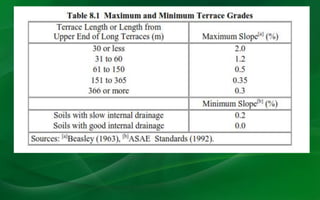
The gradient in the channel must be sufficient to provide
adequate drainage while removing the runoff at nonerosive
velocities.
The minimum slope is desirable from the standpoint of soil loss.
Grades may be uniform or variable.
In the uniform-graded terrace, the slope remains constant
throughout its entire length.
A grade of 0.4% is common in many regions; however, grades
may range from 0.1 to 0.6%, depending on soil and climatic
factors.
Generally, the steeper grades are recommended for impervious
soils and short terraces.
The variable-graded terrace is more effective
because the capacity increases toward the
outlet with a corresponding increase in runoff.
The grade usually varies from a minimum at the
upper portion to a maximum at the outlet end.
Size and shape of the field, outlet possibilities, rate of runoff as
affected by rainfall and soil infiltration, and channel capacity are
factors that influence terrace length.
The number of outlets should be a minimum consistent with
good layout and design.
The length should be such that erosive velocities and large cross
sections are not required.
The maximum length for graded terraces generally ranges from
about 300 to 500 m, depending on local conditions
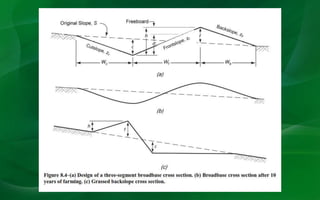
The cross section of a broadbase terrace can be
considered a triangular channel as shown in
Figure 8.4a.
The flow depth d is the height h to the top of
the ridge minus about 0.08 m for freeboard.
After smoothing, the ridge and bottom widths
will be about 1 m, which will give a cross section
that approximates the shape of a terrace after
10 years of farming (Figure 8.4b).
In designing the cross section, the frontslope width Wf is
specified to be equal to the machinery width ordinarily used for
farming operations.
The depth of flow is determined from the runoff rate for a 10-
year return period storm or for the required runoff volume for
storage-type terraces.
When the side slope widths are equal (Wc = Wf = Wb= W), cuts
and fills from the geometry are
c + f = h + s × W (8.2)
where c = cut (L),
f = fill (L),
h = depth of channel including freeboard (L),
s = original land slope (L/L),
W = width of side slope (L).
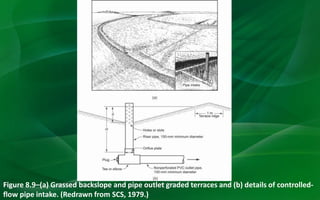
Pipe outlets allow straightening the terrace at natural channels
with an earth fill, so it is easier to make terraces parallel.
The pipe outlet as shown in Figure 8.9b has an orifice plate to
restrict the outflow.
This restriction ensures that the subsurface drains are not
overloaded, and that sediment in the runoff has time to settle in
the terrace channel, improving the quality of the runoff water.
The outlet pipe should not be perforated, and should be able to
withstand static soil loads and dynamic construction and farm
machinery loads.
Figure 8.9–(a) Grassed backslope and pipe outlet graded terraces and (b) details of controlled-
flow pipe intake. (Redrawn from SCS, 1979.)
With graded terraces, the rate of runoff is more important than
total runoff, whereas both rate and total runoff influence the
design of level, pipe outlet, and conservation bench terraces.
Graded terraces are designed as drainage channels or
waterways, and level terraces function as storage reservoirs.
The maximum design velocity will vary with the erodibility of the
soil but should rarely exceed 0.6 m/s for soil devoid of
vegetation.
The design peak runoff rate should be based on a 24-h, 10-yr
storm.
The 24-hr design storm will be removed in 24 hours for most
crops or within 48 hours for flood-tolerant crops like corn
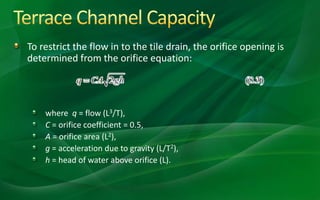
To restrict the flow in to the tile drain, the orifice opening is
determined from the orifice equation:
where q = flow (L3/T),
C = orifice coefficient = 0.5,
A = orifice area (L2),
g = acceleration due to gravity (L/T2),
h = head of water above orifice (L).
When available, topographic maps or high resolution
digital elevation models (DEMs) are used to develop an
initial plan.
The plan should specify the approximate locations of
terraces, drainage structures, and other important
features.
After the plan is developed, a surveying level and chain
or tape are used to set out the terrace location.
Field modifications to the plan may be necessary to
address topographic features not shown on the
contour map.
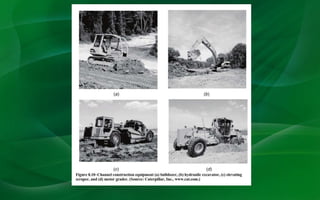
• Construction Equipment
• A variety of equipment is available for terrace construction,
including bulldozers, scrapers, motor graders, and hydraulic
excavators (Figure 8.10).
• Smaller equipment, such as moldboard and disk plows, is
suitable for slopes of less than about 8%, but the rate of
construction is much slower than with heavier machines.
• Soil and crop conditions are likely to be most suitable for
construction in the spring and fall.
• Settlement of Terrace Ridges
• The amount of settlement in a newly constructed
terrace ridge depends largely on
• soil and water conditions,
• type of equipment,
• construction procedure, and
• amount of vegetation or crop residue.
• The settlement based on unsettled height will vary
from 5% or less for a motor grader to 10 to 20% for a
bulldozer.
Proper maintenance is as important as the original construction
of the terrace.
However, it need not be expensive since normal farming
operations will usually suffice.
Any breakovers should be repaired as soon as possible.
The terrace should be watched more carefully during the first
year after construction, and any excessive set-tlement, failures,
or cracking repaired.
Channels may occasionally need to be cleared of deposited
sediment or ridges rebuilt.
MM HASAN,LECTURER,AIE,HSTU
Tillage Practices
In a terraced field, all farming operations should be carried out
as nearly parallel to the terrace as possible (Figures 8.2 and 8.3).
The most evident effect of tillage operations after several years
is the increase in the base width of the terrace.
Reversible plows can be used to increase ridge heights or to
redistribute soil that has accumulated in the channel.
MM HASAN,LECTURER,AIE,HSTU

Terraces:Soil Water Conservation structure

  • 1.
  • 2.
    • Terracing isa practice to reduce runoff, soil erosion, and sediment delivery from upland areas by constructing broad channels across the slope of rolling land. Reasons for constructing terace If surface runoff is allowed to flow unimpeded down the slope of arable land these is a danger that its volume or velocity or both may build up to the points where it is not only carries the soil dislodged by the splash erosion but also has a scouring action of its own. various names given to this techniques are:  terraces (U.S.A).  ridge or bund (common wealth countries).
  • 3.
    To decrease thelength of the hillside slope , thereby reducing sheet and rill erosion. Preventing formation of gullies and retaining runoff in areas of inadequate precipitation. In dry regions such conservation of moisture is important in the control of wind erosion
  • 4.
    Classification by Alignment Terracealignment can either be non-parallel or parallel. Non-parallel terraces follow the contour of the land regardless of alignment. Parallel terraces are preferred for row crop farming operations. .
  • 6.
    Classification by CrossSection Bench terraces (Figure 8.1c) are built on steep (20 to 30%) slopes where labor is cheap or land in short supply. They are more efficient at distributing water under both irrigated and dryland production. However, bench terraces on very steep slopes may be too narrow or too inaccessible for mechanized farming systems. The broadbase shapes include the three-segment section (Figures 8.1a and 8.4), the conservation bench (Figures 8.1b, 8.3, and 8.5b), and the grassed backslope terrace (Figures 8.2 and 8.4c). The three-segment section terrace is more common in mechanized farming systems on moderate slopes (6 to 8%). All slopes on the three-segment section broadbase are sufficiently flat for the operation of farm machinery.
  • 9.
    Classification by Grade Gradedor channel-type terraces control erosion by reducing the hillside slope length of overland flow, and then by conducting the intercepted runoff to a safe outlet at a nonerosive velocity. Level terraces are constructed to conserve water and control erosion (Figure 8.3). In low to moderate rainfall regions they trap and hold rainfall for infiltration into the soil profile.
  • 11.
    Classification by Outlet Terraceoutlets may be classified as blocked (all water infiltrates in the terrace channel), permanently vegetated (grassed waterway or a vegetated area), or piped (water is removed through subsurface pipe drains). Combinations of outlets may be employed to meet specific conditions.
  • 12.
    Selection of Outlets: •or disposal area: •  vegetated outlets ( preferable) • Outlet types include • natural drainage ways, • constructed channels, • permanent pasture or meadow, • stable road ditches, • waste land, • concrete or stabilized channels, • pipe drains, and • stabilized gullies.
  • 13.
    Terrace location : Factorsthat influence terrace location include (1) land slope; (2) soil conditions, such as degree and extent of erosion; (3) proposed land use; (4) boulders, trees, gullies, and other impediments to construction or cultivation; (5) roads and boundaries; (6) fences; (7) row layout; (8) type of terrace; and (9) outlet. Minimum maintenance, ease of farming, and adequate control of erosion are the criteria for good terrace location.
  • 14.
    • The designof a terrace system includes • specifying the proper spacing and location of terraces, • the design of a channel with adequate capacity, and • the development of a stable and sometimes farmable cross section. • For the graded terrace, runoff must be removed at nonerosive velocities in both the channel and the outlet. • Soil characteristics, cropping and soil management practices, and climatic conditions are the most important considerations in terrace design.
  • 15.
    • Spacing isexpressed as the vertical distance between the channels of successive terraces. • For the top terrace, the spacing is the vertical distance from the top of the hill to the bottom of the channel. • This vertical distance is commonly known as the vertical interval or VI. • The horizontal interval, HI, is found by dividing VI by the slope (m/m).
  • 16.
    • Graded • Thegraded terrace VI is often expressed as a function of land slope by the empirical formula • VI = Xs + Y (8.1) • where VI = vertical interval between corresponding points on consecutive terraces or from the top of the slope to the bottom of the first terrace in m, • X = constant for geographical location (Figure 8.8), • Y = constant for soil erodibility and cover conditions during critical erosion periods, or = 0.3, 0.6, 0.9, or 1.2, with the low value for highly erodible soils with no surface residue and the high value for erosion resistant soils with conservation tillage (ASAE Standards, 1992), • s = average land slope above the terrace in percent.
  • 17.
    Level The horizontal intervalfor level terraces is a function of channel infiltration and runoff; however, in more humid areas, where erosion control is important, the slope length may limit the spacing. The storage capacity of the terrace should be adequate to prevent overtopping from upslope runoff, and the infiltration rate in the channel should be sufficiently high to prevent serious damage to crops.
  • 18.
    The gradient inthe channel must be sufficient to provide adequate drainage while removing the runoff at nonerosive velocities. The minimum slope is desirable from the standpoint of soil loss. Grades may be uniform or variable. In the uniform-graded terrace, the slope remains constant throughout its entire length. A grade of 0.4% is common in many regions; however, grades may range from 0.1 to 0.6%, depending on soil and climatic factors. Generally, the steeper grades are recommended for impervious soils and short terraces.
  • 19.
    The variable-graded terraceis more effective because the capacity increases toward the outlet with a corresponding increase in runoff. The grade usually varies from a minimum at the upper portion to a maximum at the outlet end.
  • 21.
    Size and shapeof the field, outlet possibilities, rate of runoff as affected by rainfall and soil infiltration, and channel capacity are factors that influence terrace length. The number of outlets should be a minimum consistent with good layout and design. The length should be such that erosive velocities and large cross sections are not required. The maximum length for graded terraces generally ranges from about 300 to 500 m, depending on local conditions
  • 22.
    The cross sectionof a broadbase terrace can be considered a triangular channel as shown in Figure 8.4a. The flow depth d is the height h to the top of the ridge minus about 0.08 m for freeboard. After smoothing, the ridge and bottom widths will be about 1 m, which will give a cross section that approximates the shape of a terrace after 10 years of farming (Figure 8.4b).
  • 23.
    In designing thecross section, the frontslope width Wf is specified to be equal to the machinery width ordinarily used for farming operations. The depth of flow is determined from the runoff rate for a 10- year return period storm or for the required runoff volume for storage-type terraces. When the side slope widths are equal (Wc = Wf = Wb= W), cuts and fills from the geometry are c + f = h + s × W (8.2) where c = cut (L), f = fill (L), h = depth of channel including freeboard (L), s = original land slope (L/L), W = width of side slope (L).
  • 24.
    Pipe outlets allowstraightening the terrace at natural channels with an earth fill, so it is easier to make terraces parallel. The pipe outlet as shown in Figure 8.9b has an orifice plate to restrict the outflow. This restriction ensures that the subsurface drains are not overloaded, and that sediment in the runoff has time to settle in the terrace channel, improving the quality of the runoff water. The outlet pipe should not be perforated, and should be able to withstand static soil loads and dynamic construction and farm machinery loads.
  • 25.
    Figure 8.9–(a) Grassedbackslope and pipe outlet graded terraces and (b) details of controlled- flow pipe intake. (Redrawn from SCS, 1979.)
  • 26.
    With graded terraces,the rate of runoff is more important than total runoff, whereas both rate and total runoff influence the design of level, pipe outlet, and conservation bench terraces. Graded terraces are designed as drainage channels or waterways, and level terraces function as storage reservoirs. The maximum design velocity will vary with the erodibility of the soil but should rarely exceed 0.6 m/s for soil devoid of vegetation. The design peak runoff rate should be based on a 24-h, 10-yr storm. The 24-hr design storm will be removed in 24 hours for most crops or within 48 hours for flood-tolerant crops like corn
  • 27.
    To restrict theflow in to the tile drain, the orifice opening is determined from the orifice equation: where q = flow (L3/T), C = orifice coefficient = 0.5, A = orifice area (L2), g = acceleration due to gravity (L/T2), h = head of water above orifice (L).
  • 28.
    When available, topographicmaps or high resolution digital elevation models (DEMs) are used to develop an initial plan. The plan should specify the approximate locations of terraces, drainage structures, and other important features. After the plan is developed, a surveying level and chain or tape are used to set out the terrace location. Field modifications to the plan may be necessary to address topographic features not shown on the contour map.
  • 29.
    • Construction Equipment •A variety of equipment is available for terrace construction, including bulldozers, scrapers, motor graders, and hydraulic excavators (Figure 8.10). • Smaller equipment, such as moldboard and disk plows, is suitable for slopes of less than about 8%, but the rate of construction is much slower than with heavier machines. • Soil and crop conditions are likely to be most suitable for construction in the spring and fall.
  • 31.
    • Settlement ofTerrace Ridges • The amount of settlement in a newly constructed terrace ridge depends largely on • soil and water conditions, • type of equipment, • construction procedure, and • amount of vegetation or crop residue. • The settlement based on unsettled height will vary from 5% or less for a motor grader to 10 to 20% for a bulldozer.
  • 32.
    Proper maintenance isas important as the original construction of the terrace. However, it need not be expensive since normal farming operations will usually suffice. Any breakovers should be repaired as soon as possible. The terrace should be watched more carefully during the first year after construction, and any excessive set-tlement, failures, or cracking repaired. Channels may occasionally need to be cleared of deposited sediment or ridges rebuilt. MM HASAN,LECTURER,AIE,HSTU
  • 33.
    Tillage Practices In aterraced field, all farming operations should be carried out as nearly parallel to the terrace as possible (Figures 8.2 and 8.3). The most evident effect of tillage operations after several years is the increase in the base width of the terrace. Reversible plows can be used to increase ridge heights or to redistribute soil that has accumulated in the channel. MM HASAN,LECTURER,AIE,HSTU