
OZONE DEPLECTION
By Sujeet Tambe
MMS 2nd Year
INTRODUCTION
 What do you mean by OZONE ?
 Is OZONE beneficial or harmful to us ?
 How is OZONE harmful to us ?
 How is OZONE beneficial to us ?
HOW IS OZONE LAYER BENEFICIAL TO US ?
High up in the atmosphere in a region known as the
stratosphere, ozone filters out incoming radiation
from the Sun in the cell-damaging ultraviolet (UV)
part of the spectrum. Without this ozone layer, life
on earth would not have evolved in the way it has.
Concentrations of ozone in the stratosphere
fluctuate naturally in response to variations in
weather conditions and amounts of energy being
released from the Sun, and to major volcanic
eruptions.
OZONE HOLE
In 1985 evidence of a large "ozone hole" was
discovered above the continent of Antarctica during
the springtime. This has reappeared annually,
generally growing larger and deeper each year.
More recently, fears have emerged about significant
ozone depletion over the Arctic, closer to the more
populous regions of the Northern Hemisphere.
There is no actual "hole" exists. And only a slight
thinning occurs over the rest of the world. So no
matter where you stand, you won't find a true
"hole".
ULTRAVIOLET RADIATION
 Protecting the ozone layer is essential.
 Ultraviolet radiation from the Sun can cause a
variety of health problems in humans, including skin
cancers, eye cataracts and a reduction in the
body's immunity to disease.
 Ultraviolet radiation can be damaging to
microscopic life in the surface oceans which forms
the basis of the world’s marine food chain, certain
varieties of crops.
 A loss of ozone in the stratosphere may even affect
the global climate.
WHY OZONE LAYER DECREASE ?
During the 1970s it was realized that man-made
emissions of CFCs and other chemicals used in
refrigeration, aerosols and cleansing agents may cause
a significant destruction of ozone in the stratosphere,
thereby letting through more of the harmful ultraviolet
radiation.
The subsequent measures against the use of
chlorofluorocarbons (CFCs), halons, and other ozone
depleting chemicals made their production and emission
drop significantly. As a result, the total concentration of
chlorine in the lower atmosphere peaked in 1994. The
long life of those substances in the atmosphere means
that full recovery of the ozone layer is unlikely before
2050.
ABOUT CFC
It was first suggested by Dr. M. Molina and S.
Rowland in 1974 that a man-made group of
compounds known as the chlorofluorocarbons
(CFCs) were likely to be the main source of ozone
depletion. However, this idea was not taken
seriously until the discovery of the ozone hole over
Antarctica in 1985 by the British Antarctic Survey.
Chlorofluorocarbons are not "washed" back to
Earth by rain or destroyed in reactions with other
chemicals. They simply do not break down in the
lower atmosphere and they can remain in the
atmosphere from 20 to 120 years or more.
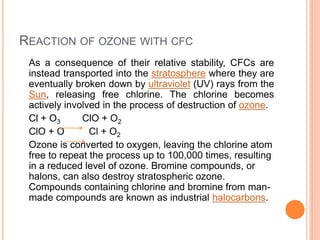
REACTION OF OZONE WITH CFC
As a consequence of their relative stability, CFCs are
instead transported into the stratosphere where they are
eventually broken down by ultraviolet (UV) rays from the
Sun, releasing free chlorine. The chlorine becomes
actively involved in the process of destruction of ozone.
Cl + O3 ClO + O2
ClO + O Cl + O2
Ozone is converted to oxygen, leaving the chlorine atom
free to repeat the process up to 100,000 times, resulting
in a reduced level of ozone. Bromine compounds, or
halons, can also destroy stratospheric ozone.
Compounds containing chlorine and bromine from man-
made compounds are known as industrial halocarbons.
EFFECT OF OZONE DEPLETION ON HUMAN HEALTH
 Effect on skin,
 Effect on eye,
 On crops,
 Reduction in terrestrial plants,
 Global worming,
 Effect on climate,
 Disturbance in ecological life cycle.
Effect of ozone depletion on plants
Photosynthisis process
Burning of plants
PRECAUTIONS
Can do to both protect the ozone layer. These
include proper disposal of old refrigerators, the use
of halons-free fire extinguishers and the recycling of
foam and other non-disposable packaging. Finally,
we should all be aware that whilst emissions of
ozone depletes are now being controlled, the ozone
layer is not likely to fully repair itself for several
decades. Consequently, we should take
precautions when exposing ourselves to the Sun.
AWARENESS
 Emissions of CFCs have accounted for roughly
80% of total stratospheric ozone depletion.
Thankfully, the developed world has phased out the
use of CFCs in response to international
agreements to protect the ozone layer.
 The remaining policy challenges for European
countries are to tighten control measures, to reduce
the production and use of HCFCs and methyl
bromide, to manage banks of existing ozone-
depleting substances, and to support developing
countries in their reduction of the use of ozone-
depleting substances.
CONCLUSION
Ozone is both beneficial and harmful to us. Ozone Deflection
can cause a variety of health problems in humans, including skin
cancers, eye cataracts and a reduction in the ability to fight off
disease. Ozone forming as a result of chemical reactions involving
traffic pollution and sunlight may cause a number of respiratory
problems, particularly for young children Therefore Ozone Deflection
is very big problem.
The ozone layer is not likely to fully repair itself for several
decades. Consequently, we should take precautions when exposing
ourselves to the Sun.
The air pollution is main cause of Ozone Deflection. Therefore
we can stop the air pollution. We can stop the air pollution by
minimum use of vehicles and the plantation of trees.
THANKING
YOU

Ozone deplection

  • 1.
    OZONE DEPLECTION By SujeetTambe MMS 2nd Year
  • 2.
    INTRODUCTION  What doyou mean by OZONE ?  Is OZONE beneficial or harmful to us ?  How is OZONE harmful to us ?  How is OZONE beneficial to us ?
  • 3.
    HOW IS OZONELAYER BENEFICIAL TO US ? High up in the atmosphere in a region known as the stratosphere, ozone filters out incoming radiation from the Sun in the cell-damaging ultraviolet (UV) part of the spectrum. Without this ozone layer, life on earth would not have evolved in the way it has. Concentrations of ozone in the stratosphere fluctuate naturally in response to variations in weather conditions and amounts of energy being released from the Sun, and to major volcanic eruptions.
  • 4.
    OZONE HOLE In 1985evidence of a large "ozone hole" was discovered above the continent of Antarctica during the springtime. This has reappeared annually, generally growing larger and deeper each year. More recently, fears have emerged about significant ozone depletion over the Arctic, closer to the more populous regions of the Northern Hemisphere. There is no actual "hole" exists. And only a slight thinning occurs over the rest of the world. So no matter where you stand, you won't find a true "hole".
  • 5.
    ULTRAVIOLET RADIATION  Protectingthe ozone layer is essential.  Ultraviolet radiation from the Sun can cause a variety of health problems in humans, including skin cancers, eye cataracts and a reduction in the body's immunity to disease.  Ultraviolet radiation can be damaging to microscopic life in the surface oceans which forms the basis of the world’s marine food chain, certain varieties of crops.  A loss of ozone in the stratosphere may even affect the global climate.
  • 6.
    WHY OZONE LAYERDECREASE ? During the 1970s it was realized that man-made emissions of CFCs and other chemicals used in refrigeration, aerosols and cleansing agents may cause a significant destruction of ozone in the stratosphere, thereby letting through more of the harmful ultraviolet radiation. The subsequent measures against the use of chlorofluorocarbons (CFCs), halons, and other ozone depleting chemicals made their production and emission drop significantly. As a result, the total concentration of chlorine in the lower atmosphere peaked in 1994. The long life of those substances in the atmosphere means that full recovery of the ozone layer is unlikely before 2050.
  • 7.
    ABOUT CFC It wasfirst suggested by Dr. M. Molina and S. Rowland in 1974 that a man-made group of compounds known as the chlorofluorocarbons (CFCs) were likely to be the main source of ozone depletion. However, this idea was not taken seriously until the discovery of the ozone hole over Antarctica in 1985 by the British Antarctic Survey. Chlorofluorocarbons are not "washed" back to Earth by rain or destroyed in reactions with other chemicals. They simply do not break down in the lower atmosphere and they can remain in the atmosphere from 20 to 120 years or more.
  • 8.
    REACTION OF OZONEWITH CFC As a consequence of their relative stability, CFCs are instead transported into the stratosphere where they are eventually broken down by ultraviolet (UV) rays from the Sun, releasing free chlorine. The chlorine becomes actively involved in the process of destruction of ozone. Cl + O3 ClO + O2 ClO + O Cl + O2 Ozone is converted to oxygen, leaving the chlorine atom free to repeat the process up to 100,000 times, resulting in a reduced level of ozone. Bromine compounds, or halons, can also destroy stratospheric ozone. Compounds containing chlorine and bromine from man- made compounds are known as industrial halocarbons.
  • 9.
    EFFECT OF OZONEDEPLETION ON HUMAN HEALTH  Effect on skin,  Effect on eye,  On crops,  Reduction in terrestrial plants,  Global worming,  Effect on climate,  Disturbance in ecological life cycle. Effect of ozone depletion on plants Photosynthisis process Burning of plants
  • 10.
    PRECAUTIONS Can do toboth protect the ozone layer. These include proper disposal of old refrigerators, the use of halons-free fire extinguishers and the recycling of foam and other non-disposable packaging. Finally, we should all be aware that whilst emissions of ozone depletes are now being controlled, the ozone layer is not likely to fully repair itself for several decades. Consequently, we should take precautions when exposing ourselves to the Sun.
  • 11.
    AWARENESS  Emissions ofCFCs have accounted for roughly 80% of total stratospheric ozone depletion. Thankfully, the developed world has phased out the use of CFCs in response to international agreements to protect the ozone layer.  The remaining policy challenges for European countries are to tighten control measures, to reduce the production and use of HCFCs and methyl bromide, to manage banks of existing ozone- depleting substances, and to support developing countries in their reduction of the use of ozone- depleting substances.
  • 12.
    CONCLUSION Ozone is bothbeneficial and harmful to us. Ozone Deflection can cause a variety of health problems in humans, including skin cancers, eye cataracts and a reduction in the ability to fight off disease. Ozone forming as a result of chemical reactions involving traffic pollution and sunlight may cause a number of respiratory problems, particularly for young children Therefore Ozone Deflection is very big problem. The ozone layer is not likely to fully repair itself for several decades. Consequently, we should take precautions when exposing ourselves to the Sun. The air pollution is main cause of Ozone Deflection. Therefore we can stop the air pollution. We can stop the air pollution by minimum use of vehicles and the plantation of trees.
  • 13.