Interbasin Water Transfers and Possible
Conflicts: PCJ River Basins Case Study
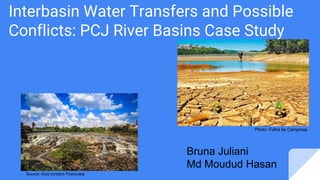
Photo: Folha de Campinas
Source: Guia turístico Piracicaba
Bruna Juliani
Md Moudud Hasan
Contents
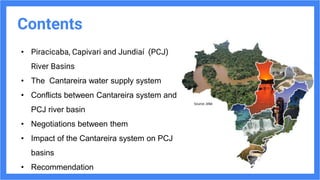
• Piracicaba, Capivari and Jundiaí (PCJ)
River Basins
• The Cantareira water supply system
• Conflicts between Cantareira system and
PCJ river basin
• Negotiations between them
• Impact of the Cantareira system on PCJ
basins
• Recommendation
INTERUNIVERSITY PROGRAMME IN WATER
RESOURCE ENGINEERING
Background
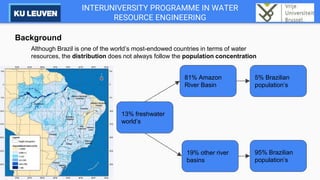
Although Brazil is one of the world’s most-endowed countries in terms of water
resources, the distribution does not always follow the population concentration
13% freshwater
world’s
5% Brazilian
population’s
19% other river
basins
81% Amazon
River Basin
95% Brazilian
population’s
INTERUNIVERSITY PROGRAMME IN WATER
RESOURCE ENGINEERING
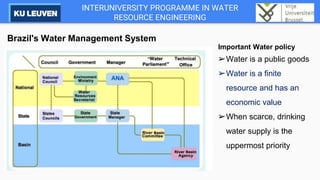
Brazil's Water Management System
Important Water policy
➢Water is a public goods
➢Water is a finite
resource and has an
economic value
➢When scarce, drinking
water supply is the
uppermost priority
INTERUNIVERSITY PROGRAMME IN WATER
RESOURCE ENGINEERING
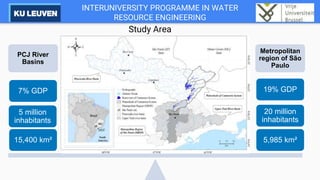
Study Area
PCJ River
Basins
Metropolitan
region of São
Paulo
5,985 km²
20 million
inhabitants
19% GDP
15,400 km²
5 million
inhabitants
7% GDP
INTERUNIVERSITY PROGRAMME IN WATER
RESOURCE ENGINEERING
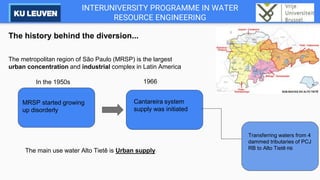
The history behind the diversion...
The metropolitan region of São Paulo (MRSP) is the largest
urban concentration and industrial complex in Latin America
In the 1950s
MRSP started growing
up disorderly
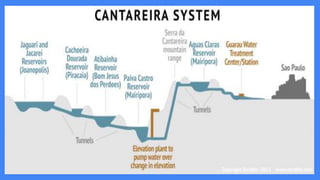
Cantareira system
supply was initiated
1966
Transferring waters from 4
dammed tributaries of PCJ
RB to Alto Tietê RB
The main use water Alto Tietê is Urban supply
INTERUNIVERSITY PROGRAMME IN WATER
RESOURCE ENGINEERING
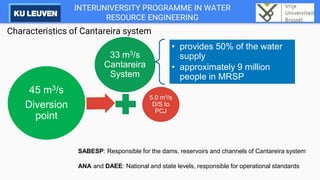
Characteristics of Cantareira system
33 m3/s
Cantareira
System
5.0 m3/s
D/S to
PCJ
45 m3/s
Diversion
point
• provides 50% of the water
supply
• approximately 9 million
people in MRSP
SABESP: Responsible for the dams, reservoirs and channels of Cantareira system
ANA and DAEE: National and state levels, responsible for operational standards
INTERUNIVERSITY PROGRAMME IN WATER
RESOURCE ENGINEERING
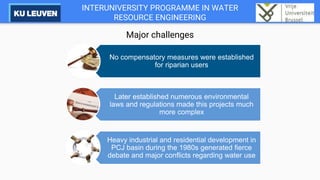
Major challenges
No compensatory measures were established
for riparian users
Later established numerous environmental
laws and regulations made this projects much
more complex
Heavy industrial and residential development in
PCJ basin during the 1980s generated fierce
debate and major conflicts regarding water use
INTERUNIVERSITY PROGRAMME IN WATER
RESOURCE ENGINEERING
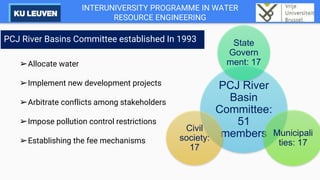
PCJ River Basins Committee established In 1993
➢Allocate water
➢Implement new development projects
➢Arbitrate conflicts among stakeholders
➢Impose pollution control restrictions
➢Establishing the fee mechanisms
PCJ River
Basin
Committee:
51
members
State
Govern
ment: 17
Municipali
ties: 17
Civil
society:
17
INTERUNIVERSITY PROGRAMME IN WATER
RESOURCE ENGINEERING
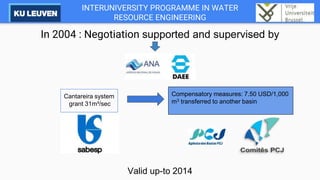
In 2004 : Negotiation supported and supervised by
Valid up-to 2014
Compensatory measures: 7.50 USD/1,000
m3 transferred to another basin
Cantareira system
grant 31m³/sec
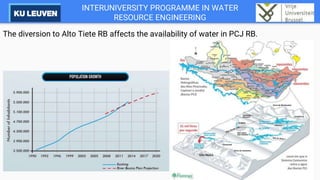
The diversion to Alto Tiete RB affects the availability of water in PCJ RB.
INTERUNIVERSITY PROGRAMME IN WATER
RESOURCE ENGINEERING
INTERUNIVERSITY PROGRAMME IN WATER
RESOURCE ENGINEERING
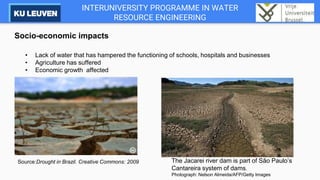
Socio-economic impacts
• Lack of water that has hampered the functioning of schools, hospitals and businesses
• Agriculture has suffered
• Economic growth affected
Source:Drought in Brazil. Creative Commons: 2009 The Jacarei river dam is part of São Paulo’s
Cantareira system of dams.
Photograph: Nelson Almeida/AFP/Getty Images
INTERUNIVERSITY PROGRAMME IN WATER
RESOURCE ENGINEERING
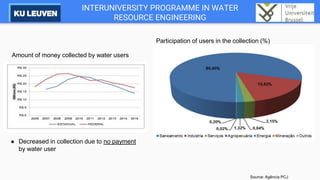
Source: Agência PCJ
Amount of money collected by water users
● Decreased in collection due to no payment
by water user
Participation of users in the collection (%)
INTERUNIVERSITY PROGRAMME IN WATER
RESOURCE ENGINEERING
Environmental Impacts
➢Environmental problems such as the lack, and low quality of the
water
➢Degradation of the aquatic resources.
➢Increase in the amount of pollution by organic material from
domestic and industrial sewage
INTERUNIVERSITY PROGRAMME IN WATER
RESOURCE ENGINEERING
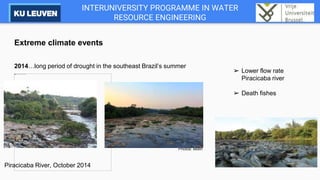
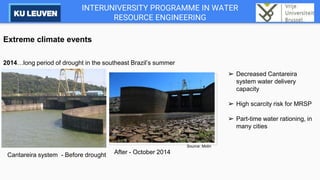
Extreme climate events
2014…long period of drought in the southeast Brazil’s summer
Piracicaba River, October 2014
➢ Lower flow rate
Piracicaba river
➢ Death fishes
Photos: Molin
INTERUNIVERSITY PROGRAMME IN WATER
RESOURCE ENGINEERING
Extreme climate events
2014…long period of drought in the southeast Brazil’s summer
After - October 2014
➢ Decreased Cantareira
system water delivery
capacity
➢ High scarcity risk for MRSP
➢ Part-time water rationing, in
many cities
Cantareira system - Before drought
Source: Molin
INTERUNIVERSITY PROGRAMME IN WATER
RESOURCE ENGINEERING
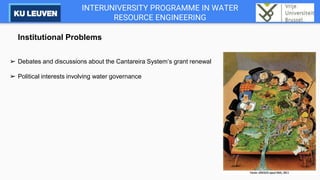
Institutional Problems
➢ Debates and discussions about the Cantareira System’s grant renewal
➢ Political interests involving water governance
INTERUNIVERSITY PROGRAMME IN WATER
RESOURCE ENGINEERING
Conclusions and recommendations
➢It would be very difficult to expand the water supply system in the
MRSP because further water transfers from neighboring basins
would impose large political and social costs.
➢Interbasins coordination is necessary to minimize the problem
➢Creation of new financial mechanisms to encourage proper use
➢Brazil needs to reduce the water demand by minimizing water
losses
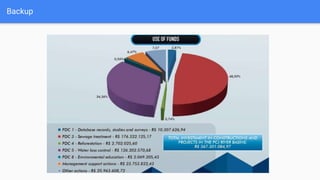
Backup

PCJ river basins

  • 1.
    Interbasin Water Transfersand Possible Conflicts: PCJ River Basins Case Study Photo: Folha de Campinas Source: Guia turístico Piracicaba Bruna Juliani Md Moudud Hasan
  • 2.
    Contents • Piracicaba, Capivariand Jundiaí (PCJ) River Basins • The Cantareira water supply system • Conflicts between Cantareira system and PCJ river basin • Negotiations between them • Impact of the Cantareira system on PCJ basins • Recommendation
  • 3.
    INTERUNIVERSITY PROGRAMME INWATER RESOURCE ENGINEERING Background Although Brazil is one of the world’s most-endowed countries in terms of water resources, the distribution does not always follow the population concentration 13% freshwater world’s 5% Brazilian population’s 19% other river basins 81% Amazon River Basin 95% Brazilian population’s
  • 4.
    INTERUNIVERSITY PROGRAMME INWATER RESOURCE ENGINEERING Brazil's Water Management System Important Water policy ➢Water is a public goods ➢Water is a finite resource and has an economic value ➢When scarce, drinking water supply is the uppermost priority
  • 5.
    INTERUNIVERSITY PROGRAMME INWATER RESOURCE ENGINEERING Study Area PCJ River Basins Metropolitan region of São Paulo 5,985 km² 20 million inhabitants 19% GDP 15,400 km² 5 million inhabitants 7% GDP
  • 6.
    INTERUNIVERSITY PROGRAMME INWATER RESOURCE ENGINEERING The history behind the diversion... The metropolitan region of São Paulo (MRSP) is the largest urban concentration and industrial complex in Latin America In the 1950s MRSP started growing up disorderly Cantareira system supply was initiated 1966 Transferring waters from 4 dammed tributaries of PCJ RB to Alto Tietê RB The main use water Alto Tietê is Urban supply
  • 8.
    INTERUNIVERSITY PROGRAMME INWATER RESOURCE ENGINEERING Characteristics of Cantareira system 33 m3/s Cantareira System 5.0 m3/s D/S to PCJ 45 m3/s Diversion point • provides 50% of the water supply • approximately 9 million people in MRSP SABESP: Responsible for the dams, reservoirs and channels of Cantareira system ANA and DAEE: National and state levels, responsible for operational standards
  • 9.
    INTERUNIVERSITY PROGRAMME INWATER RESOURCE ENGINEERING Major challenges No compensatory measures were established for riparian users Later established numerous environmental laws and regulations made this projects much more complex Heavy industrial and residential development in PCJ basin during the 1980s generated fierce debate and major conflicts regarding water use
  • 10.
    INTERUNIVERSITY PROGRAMME INWATER RESOURCE ENGINEERING PCJ River Basins Committee established In 1993 ➢Allocate water ➢Implement new development projects ➢Arbitrate conflicts among stakeholders ➢Impose pollution control restrictions ➢Establishing the fee mechanisms PCJ River Basin Committee: 51 members State Govern ment: 17 Municipali ties: 17 Civil society: 17
  • 11.
    INTERUNIVERSITY PROGRAMME INWATER RESOURCE ENGINEERING In 2004 : Negotiation supported and supervised by Valid up-to 2014 Compensatory measures: 7.50 USD/1,000 m3 transferred to another basin Cantareira system grant 31m³/sec
  • 12.
    The diversion toAlto Tiete RB affects the availability of water in PCJ RB. INTERUNIVERSITY PROGRAMME IN WATER RESOURCE ENGINEERING
  • 13.
    INTERUNIVERSITY PROGRAMME INWATER RESOURCE ENGINEERING Socio-economic impacts • Lack of water that has hampered the functioning of schools, hospitals and businesses • Agriculture has suffered • Economic growth affected Source:Drought in Brazil. Creative Commons: 2009 The Jacarei river dam is part of São Paulo’s Cantareira system of dams. Photograph: Nelson Almeida/AFP/Getty Images
  • 14.
    INTERUNIVERSITY PROGRAMME INWATER RESOURCE ENGINEERING Source: Agência PCJ Amount of money collected by water users ● Decreased in collection due to no payment by water user Participation of users in the collection (%)
  • 15.
    INTERUNIVERSITY PROGRAMME INWATER RESOURCE ENGINEERING Environmental Impacts ➢Environmental problems such as the lack, and low quality of the water ➢Degradation of the aquatic resources. ➢Increase in the amount of pollution by organic material from domestic and industrial sewage
  • 16.
    INTERUNIVERSITY PROGRAMME INWATER RESOURCE ENGINEERING Extreme climate events 2014…long period of drought in the southeast Brazil’s summer Piracicaba River, October 2014 ➢ Lower flow rate Piracicaba river ➢ Death fishes Photos: Molin
  • 17.
    INTERUNIVERSITY PROGRAMME INWATER RESOURCE ENGINEERING Extreme climate events 2014…long period of drought in the southeast Brazil’s summer After - October 2014 ➢ Decreased Cantareira system water delivery capacity ➢ High scarcity risk for MRSP ➢ Part-time water rationing, in many cities Cantareira system - Before drought Source: Molin
  • 18.
    INTERUNIVERSITY PROGRAMME INWATER RESOURCE ENGINEERING Institutional Problems ➢ Debates and discussions about the Cantareira System’s grant renewal ➢ Political interests involving water governance
  • 19.
    INTERUNIVERSITY PROGRAMME INWATER RESOURCE ENGINEERING Conclusions and recommendations ➢It would be very difficult to expand the water supply system in the MRSP because further water transfers from neighboring basins would impose large political and social costs. ➢Interbasins coordination is necessary to minimize the problem ➢Creation of new financial mechanisms to encourage proper use ➢Brazil needs to reduce the water demand by minimizing water losses
  • 21.