LECTURE 6
1
AssociateProf.DaliaEl-Badan
OZONE LAYER
DEPLETION
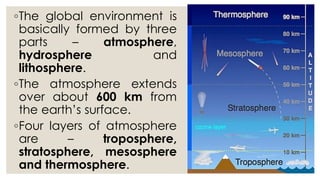
◦The global environment is
basically formed by three
parts – atmosphere,
hydrosphere and
lithosphere.
◦The atmosphere extends
over about 600 km from
the earth’s surface.
◦Four layers of atmosphere
are – troposphere,
stratosphere, mesosphere
and thermosphere. 2
We live in the troposphere and most of our weather
comes from this layer of the atmosphere.
The next layer up is the stratosphere , which is where
the ozone layer is found and where planes flying long
distances tend to fly. It comprises of high
concentration of ozone about 18-26 km above in the
stratosphere. As per estimates, 90% of the total
atmospheric ozone is present in this region
3
The mesosphere is directly above the stratosphere
and below the thermosphere.
It extends from about 50 to 85 km above our planet.
Temperature decreases with height throughout the
mesosphere. The coldest temperatures in Earth's
atmosphere, about -90° C (-130° F), are found near
the top of this layer.
4
The thermosphere is the layer in the Earth's
atmosphere directly above the mesosphere
and below the exosphere. Within this layer of
the atmosphere, ultraviolet radiation causes
photoionization/photodissociation of molecules,
creating ions.
It extends from about 90 km to between 500
and 1,000 km above Earth's surface.
5
The final layer is the exosphere. is the uppermost
layer, where the atmosphere thins out and merges
with outer space
The exosphere's air is very thin and mainly composed
of helium and hydrogen.
Not all scientists agree that the exosphere is really a
part of the atmosphere. Some scientists consider the
thermosphere the uppermost part of Earth's
atmosphere, and think that the exosphere is really
just part of space. However, other
scientists do consider the exosphere part of our
planet's atmosphere.
6
◦ Main layers of the
atmosphere. These are
shown between solid
lines. The vertical wavy
line depicts temperature
variation with increasing
height.
7
Formation of ozone:
◦ Ozone is a form of oxygen.
◦ Ozone (O3) is a molecule formed by three atoms of
oxygen.
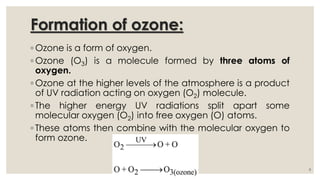
◦ Ozone at the higher levels of the atmosphere is a product
of UV radiation acting on oxygen (O2) molecule.
◦ The higher energy UV radiations split apart some
molecular oxygen (O2) into free oxygen (O) atoms.
◦ These atoms then combine with the molecular oxygen to
form ozone.
8
Function of ozone:
◦The thickness of this ozonosphere (Stratosphere)
averages 5 km.
◦The ozone layer acts as an ozone shield and
absorbs the harmful UV-radiations of the sunlight
so protects the earth's biota from the harmful
effects of strong UV-radiations.
◦So this layer is very important for the survival and
existence of life on earth.
9
OZONE LAYER DEPLETION:
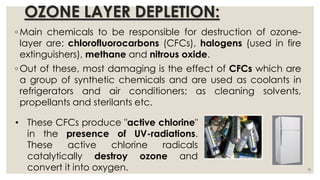
◦ Main chemicals to be responsible for destruction of ozone-
layer are: chlorofluorocarbons (CFCs), halogens (used in fire
extinguishers), methane and nitrous oxide.
◦ Out of these, most damaging is the effect of CFCs which are
a group of synthetic chemicals and are used as coolants in
refrigerators and air conditioners; as cleaning solvents,
propellants and sterilants etc.
10
• These CFCs produce "active chlorine"
in the presence of UV-radiations.
These active chlorine radicals
catalytically destroy ozone and
convert it into oxygen.
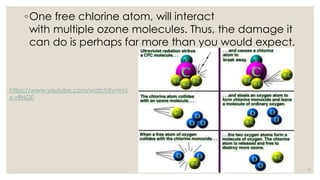
◦One free chlorine atom, will interact
with multiple ozone molecules. Thus, the damage it
can do is perhaps far more than you would expect.
11
https://www.youtube.com/watch?v=IniJ
x-vRHG0
Ozone Layer Depletion Reaction
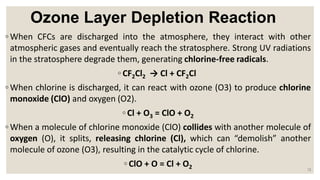
◦ When CFCs are discharged into the atmosphere, they interact with other
atmospheric gases and eventually reach the stratosphere. Strong UV radiations
in the stratosphere degrade them, generating chlorine-free radicals.
◦ CF2Cl2 → Cl + CF2Cl
◦ When chlorine is discharged, it can react with ozone (O3) to produce chlorine
monoxide (ClO) and oxygen (O2).
◦ Cl + O3 = ClO + O2
◦ When a molecule of chlorine monoxide (ClO) collides with another molecule of
oxygen (O), it splits, releasing chlorine (Cl), which can “demolish” another
molecule of ozone (O3), resulting in the catalytic cycle of chlorine.
◦ ClO + O = Cl + O2 12
◦How Did the Ozone Hole Come About?
◦Chlorofluorocarbon (CFC) is a gaseous compound
made of three elements, carbon, chlorine and fluorine
(and sometimes hydrogen).
◦Manufacturers have used this compound to make
cleaning solvents, refrigerants, and aerosol propellants,
in some cases, even plastic foams.
◦A few common products include Freon and other
refrigerants. However, in recent years, fewer
manufacturers are using these compounds as some
environmentalists believe it is a major cause of the
ozone’s depletion and damage.
13
The History of CFC
◦ Early refrigeration products from the late 19th century to
the early 20th century used toxic gases like ammonia
(NH3), methyl chloride (CH3CI), and sulfur dioxide (SO2).
◦ This sometimes caused fatalities from leakage of these
products. This is the reason many people placed their
refrigerator in the back yard.
◦ It was then that large refrigeration brands like Frigidaire,
General Motors and DuPont began looking for a less
dangerous refrigerant compound.
14
◦In 1928, two inventors, Thomas Midgley and
Charles Frankling invented Freon.
◦This refrigerant was made with a few types of
chlorofluorocarbons or CFCs.
◦Freons are colorless, nonflammable, have no
odor and offer a non-corrosive gas or liquid. They
are a mix of aliphatic compounds with halogens,
fluorine, and carbon.
◦They represent a very stable product that could
be placed in a spray container and was
commercialized under the name of Freon.
15
◦This invention came about as a safer
alternative to an earlier sulfur dioxide and
ammonia refrigerant that could easily
become dangerous and flammable. The
use of CFCs became very popular during
the World War II era and was used by most
car manufacturers and appliance makers.
16
◦Chlorofluorocarbons are not toxic and not harmful
to human beings.
◦Despite the nontoxic qualities of CFCs and its
extremely low-risk factors towards human beings,
these compounds do pose a serious threat to the
environment.
◦Studies conducted in the 1970s found that CFCs
when released into the atmosphere ( a common
occurrence in cars, and refrigerant equipment),
they caused a significant deterioration of the
ozone layer in the atmosphere.
17
◦CFC components have a life cycle in the
atmosphere of up to 100 years.
◦So one free chlorine atom coming from a CFC
molecule can cause a huge amount of damage
and destroy ozone molecules for many years.
◦CFC emissions in developed nations have virtually
stopped due to regulations, however the damage
caused to the atmosphere by prior use will
continue.
18
Effects of Ozone Layer Depletion :
◦ The thinning of ozone layer results in increase in the UV
radiations (in the range of 290 - 320 nm) reaching the
earth's surface.
◦ It is estimated that 5 percent loss of ozone results in 10 per
cent increase in UV - radiations. These UV - radiations can:
(i) Increase in incidences of cataract and skin cancer.
(ii) Decrease in the functioning of immune system.
(iii) Inhibit photosynthesis in most of phytoptanktons so
adversely affecting the food chains of aquatic ecosystems.
(iv) Damage nucleic acids of the living organisms.
19
Montreal Protocol
◦ The Montreal Protocol on Substances that Deplete the
Ozone Layer is considered the world’s most successful
international environmental treaty.
◦ The Montreal Protocol is a part of the 1985 Vienna
Convention for the Protection of the Ozone Layer, which
commits its 197 parties to protect human health and
environment against “adverse effects” of human-induced
changes to the ozone layer.
◦ The Montreal Protocol, which was adopted in 1987 and
entered into force in 1989, limits the consumption and
production of ozone-depleting substances.
20
◦Recent evidence shows that the ozone hole over
Antarctica is beginning to repair itself because of
efforts under the Protocol to reduce ozone-
depleting substances.
21
Thank You
22

Ozone layer depletion-chloroflorocarbon CFC

  • 1.
  • 2.
    ◦The global environmentis basically formed by three parts – atmosphere, hydrosphere and lithosphere. ◦The atmosphere extends over about 600 km from the earth’s surface. ◦Four layers of atmosphere are – troposphere, stratosphere, mesosphere and thermosphere. 2
  • 3.
    We live inthe troposphere and most of our weather comes from this layer of the atmosphere. The next layer up is the stratosphere , which is where the ozone layer is found and where planes flying long distances tend to fly. It comprises of high concentration of ozone about 18-26 km above in the stratosphere. As per estimates, 90% of the total atmospheric ozone is present in this region 3
  • 4.
    The mesosphere isdirectly above the stratosphere and below the thermosphere. It extends from about 50 to 85 km above our planet. Temperature decreases with height throughout the mesosphere. The coldest temperatures in Earth's atmosphere, about -90° C (-130° F), are found near the top of this layer. 4
  • 5.
    The thermosphere isthe layer in the Earth's atmosphere directly above the mesosphere and below the exosphere. Within this layer of the atmosphere, ultraviolet radiation causes photoionization/photodissociation of molecules, creating ions. It extends from about 90 km to between 500 and 1,000 km above Earth's surface. 5
  • 6.
    The final layeris the exosphere. is the uppermost layer, where the atmosphere thins out and merges with outer space The exosphere's air is very thin and mainly composed of helium and hydrogen. Not all scientists agree that the exosphere is really a part of the atmosphere. Some scientists consider the thermosphere the uppermost part of Earth's atmosphere, and think that the exosphere is really just part of space. However, other scientists do consider the exosphere part of our planet's atmosphere. 6
  • 7.
    ◦ Main layersof the atmosphere. These are shown between solid lines. The vertical wavy line depicts temperature variation with increasing height. 7
  • 8.
    Formation of ozone: ◦Ozone is a form of oxygen. ◦ Ozone (O3) is a molecule formed by three atoms of oxygen. ◦ Ozone at the higher levels of the atmosphere is a product of UV radiation acting on oxygen (O2) molecule. ◦ The higher energy UV radiations split apart some molecular oxygen (O2) into free oxygen (O) atoms. ◦ These atoms then combine with the molecular oxygen to form ozone. 8
  • 9.
    Function of ozone: ◦Thethickness of this ozonosphere (Stratosphere) averages 5 km. ◦The ozone layer acts as an ozone shield and absorbs the harmful UV-radiations of the sunlight so protects the earth's biota from the harmful effects of strong UV-radiations. ◦So this layer is very important for the survival and existence of life on earth. 9
  • 10.
    OZONE LAYER DEPLETION: ◦Main chemicals to be responsible for destruction of ozone- layer are: chlorofluorocarbons (CFCs), halogens (used in fire extinguishers), methane and nitrous oxide. ◦ Out of these, most damaging is the effect of CFCs which are a group of synthetic chemicals and are used as coolants in refrigerators and air conditioners; as cleaning solvents, propellants and sterilants etc. 10 • These CFCs produce "active chlorine" in the presence of UV-radiations. These active chlorine radicals catalytically destroy ozone and convert it into oxygen.
  • 11.
    ◦One free chlorineatom, will interact with multiple ozone molecules. Thus, the damage it can do is perhaps far more than you would expect. 11 https://www.youtube.com/watch?v=IniJ x-vRHG0
  • 12.
    Ozone Layer DepletionReaction ◦ When CFCs are discharged into the atmosphere, they interact with other atmospheric gases and eventually reach the stratosphere. Strong UV radiations in the stratosphere degrade them, generating chlorine-free radicals. ◦ CF2Cl2 → Cl + CF2Cl ◦ When chlorine is discharged, it can react with ozone (O3) to produce chlorine monoxide (ClO) and oxygen (O2). ◦ Cl + O3 = ClO + O2 ◦ When a molecule of chlorine monoxide (ClO) collides with another molecule of oxygen (O), it splits, releasing chlorine (Cl), which can “demolish” another molecule of ozone (O3), resulting in the catalytic cycle of chlorine. ◦ ClO + O = Cl + O2 12
  • 13.
    ◦How Did theOzone Hole Come About? ◦Chlorofluorocarbon (CFC) is a gaseous compound made of three elements, carbon, chlorine and fluorine (and sometimes hydrogen). ◦Manufacturers have used this compound to make cleaning solvents, refrigerants, and aerosol propellants, in some cases, even plastic foams. ◦A few common products include Freon and other refrigerants. However, in recent years, fewer manufacturers are using these compounds as some environmentalists believe it is a major cause of the ozone’s depletion and damage. 13
  • 14.
    The History ofCFC ◦ Early refrigeration products from the late 19th century to the early 20th century used toxic gases like ammonia (NH3), methyl chloride (CH3CI), and sulfur dioxide (SO2). ◦ This sometimes caused fatalities from leakage of these products. This is the reason many people placed their refrigerator in the back yard. ◦ It was then that large refrigeration brands like Frigidaire, General Motors and DuPont began looking for a less dangerous refrigerant compound. 14
  • 15.
    ◦In 1928, twoinventors, Thomas Midgley and Charles Frankling invented Freon. ◦This refrigerant was made with a few types of chlorofluorocarbons or CFCs. ◦Freons are colorless, nonflammable, have no odor and offer a non-corrosive gas or liquid. They are a mix of aliphatic compounds with halogens, fluorine, and carbon. ◦They represent a very stable product that could be placed in a spray container and was commercialized under the name of Freon. 15
  • 16.
    ◦This invention cameabout as a safer alternative to an earlier sulfur dioxide and ammonia refrigerant that could easily become dangerous and flammable. The use of CFCs became very popular during the World War II era and was used by most car manufacturers and appliance makers. 16
  • 17.
    ◦Chlorofluorocarbons are nottoxic and not harmful to human beings. ◦Despite the nontoxic qualities of CFCs and its extremely low-risk factors towards human beings, these compounds do pose a serious threat to the environment. ◦Studies conducted in the 1970s found that CFCs when released into the atmosphere ( a common occurrence in cars, and refrigerant equipment), they caused a significant deterioration of the ozone layer in the atmosphere. 17
  • 18.
    ◦CFC components havea life cycle in the atmosphere of up to 100 years. ◦So one free chlorine atom coming from a CFC molecule can cause a huge amount of damage and destroy ozone molecules for many years. ◦CFC emissions in developed nations have virtually stopped due to regulations, however the damage caused to the atmosphere by prior use will continue. 18
  • 19.
    Effects of OzoneLayer Depletion : ◦ The thinning of ozone layer results in increase in the UV radiations (in the range of 290 - 320 nm) reaching the earth's surface. ◦ It is estimated that 5 percent loss of ozone results in 10 per cent increase in UV - radiations. These UV - radiations can: (i) Increase in incidences of cataract and skin cancer. (ii) Decrease in the functioning of immune system. (iii) Inhibit photosynthesis in most of phytoptanktons so adversely affecting the food chains of aquatic ecosystems. (iv) Damage nucleic acids of the living organisms. 19
  • 20.
    Montreal Protocol ◦ TheMontreal Protocol on Substances that Deplete the Ozone Layer is considered the world’s most successful international environmental treaty. ◦ The Montreal Protocol is a part of the 1985 Vienna Convention for the Protection of the Ozone Layer, which commits its 197 parties to protect human health and environment against “adverse effects” of human-induced changes to the ozone layer. ◦ The Montreal Protocol, which was adopted in 1987 and entered into force in 1989, limits the consumption and production of ozone-depleting substances. 20
  • 21.
    ◦Recent evidence showsthat the ozone hole over Antarctica is beginning to repair itself because of efforts under the Protocol to reduce ozone- depleting substances. 21
  • 22.