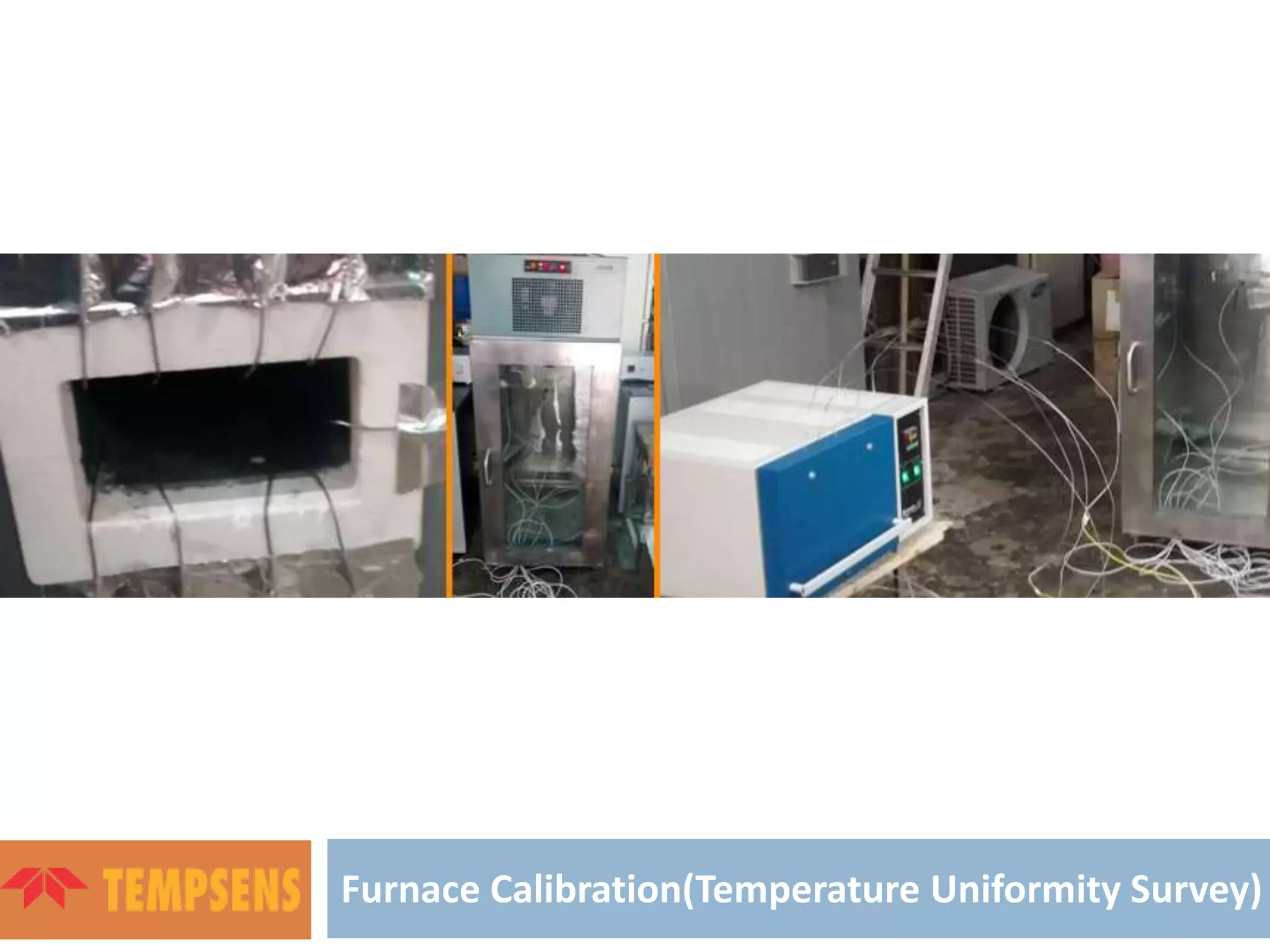
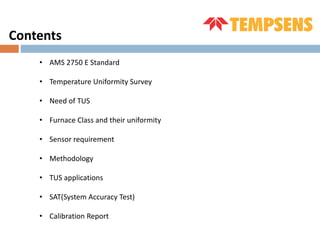
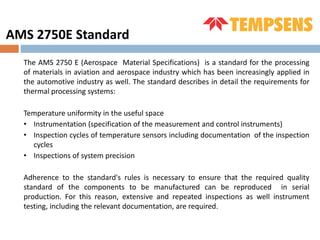
Furnace Calibration(Temperature Uniformity Survey)
Contents
• AMS 2750 E Standard
• Temperature Uniformity Survey
• Need of TUS
• Furnace Class and their uniformity
• Sensor requirement
• Methodology
• TUS applications
• SAT(System Accuracy Test)
• Calibration Report
The AMS 2750 E (Aerospace Material Specifications) is a standard for the processing
of materials in aviation and aerospace industry which has been increasingly applied in
the automotive industry as well. The standard describes in detail the requirements for
thermal processing systems:
Temperature uniformity in the useful space
• Instrumentation (specification of the measurement and control instruments)
• Inspection cycles of temperature sensors including documentation of the inspection
cycles
• Inspections of system precision
Adherence to the standard's rules is necessary to ensure that the required quality
standard of the components to be manufactured can be reproduced in serial
production. For this reason, extensive and repeated inspections as well instrument
testing, including the relevant documentation, are required.
AMS 2750E Standard
The standard defines the way heat treatment must be performed and more
precisely:
The use of furnaces, sensors and other instruments:
• Different furnace classes
• Different types of authorized sensors
• Different levels of instrumentation (number of sensors)
• Different types of calibration instruments
The test and control means:
Two regular and frequent obligatory tests:
TUS - Temperature Uniformity Survey
SAT - System Accuracy Test
The frequency of SAT and TUS is defined according to the furnace class and the level
of instrumentation
Temperature Uniformity Survey
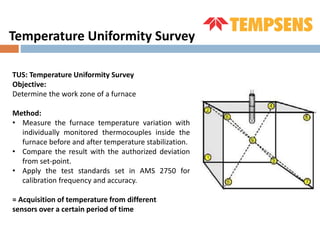
TUS: Temperature Uniformity Survey
Objective:
Determine the work zone of a furnace
Method:
• Measure the furnace temperature variation with
individually monitored thermocouples inside the
furnace before and after temperature stabilization.
• Compare the result with the authorized deviation
from set-point.
• Apply the test standards set in AMS 2750 for
calibration frequency and accuracy.
= Acquisition of temperature from different
sensors over a certain period of time
Need of TUS
• The purpose of the uniformity survey is to determine the range of
temperatures present at different locations in the furnace under
normal operating conditions standards.
• It will cater the needs for uniform heating inside the furnace to
match the product quality as well as process parameters.
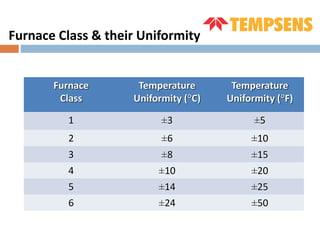
Furnace Class & their Uniformity
Furnace
Class
Temperature
Uniformity (°C)
Temperature
Uniformity (°F)
1 ±3 ±5
2 ±6 ±10
3 ±8 ±15
4 ±10 ±20
5 ±14 ±25
6 ±24 ±50
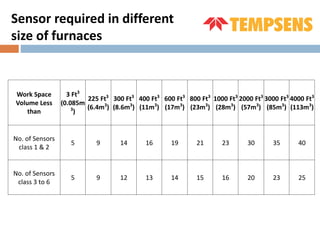
Sensor required in different
size of furnaces
Work Space
Volume Less
than
3 Ft3
(0.085m
3
)
225 Ft3
(6.4m3
)
300 Ft3
(8.6m3
)
400 Ft3
(11m3
)
600 Ft3
(17m3
)
800 Ft3
(23m3
)
1000 Ft3
(28m3
)
2000 Ft3
(57m3
)
3000 Ft3
(85m3
)
4000 Ft3
(113m3
)
No. of Sensors
class 1 & 2
5 9 14 16 19 21 23 30 35 40
No. of Sensors
class 3 to 6
5 9 12 13 14 15 16 20 23 25
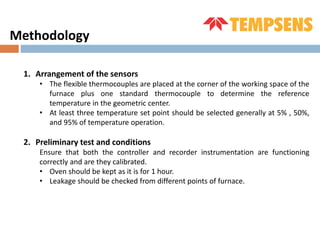
1. Arrangement of the sensors
• The flexible thermocouples are placed at the corner of the working space of the
furnace plus one standard thermocouple to determine the reference
temperature in the geometric center.
• At least three temperature set point should be selected generally at 5% , 50%,
and 95% of temperature operation.
2. Preliminary test and conditions
Ensure that both the controller and recorder instrumentation are functioning
correctly and are they calibrated.
• Oven should be kept as it is for 1 hour.
• Leakage should be checked from different points of furnace.
Methodology
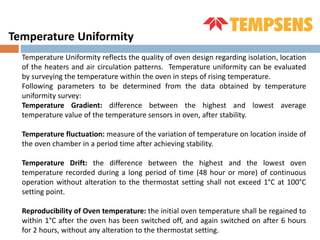
Temperature Uniformity reflects the quality of oven design regarding isolation, location
of the heaters and air circulation patterns. Temperature uniformity can be evaluated
by surveying the temperature within the oven in steps of rising temperature.
Following parameters to be determined from the data obtained by temperature
uniformity survey:
Temperature Gradient: difference between the highest and lowest average
temperature value of the temperature sensors in oven, after stability.
Temperature fluctuation: measure of the variation of temperature on location inside of
the oven chamber in a period time after achieving stability.
Temperature Drift: the difference between the highest and the lowest oven
temperature recorded during a long period of time (48 hour or more) of continuous
operation without alteration to the thermostat setting shall not exceed 1°C at 100°C
setting point.
Reproducibility of Oven temperature: the initial oven temperature shall be regained to
within 1°C after the oven has been switched off, and again switched on after 6 hours
for 2 hours, without any alteration to the thermostat setting.
Temperature Uniformity
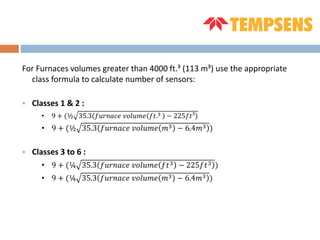
For Furnaces volumes greater than 4000 ft.³ (113 m³) use the appropriate
class formula to calculate number of sensors:
• Classes 1 & 2 :
• 9 + (½ 35.3 𝑓𝑢𝑟𝑛𝑎𝑐𝑒 𝑣𝑜𝑙𝑢𝑚𝑒 𝑓𝑡.3 − 225𝑓𝑡³
• 9 + (½ 35.3 𝑓𝑢𝑟𝑛𝑎𝑐𝑒 𝑣𝑜𝑙𝑢𝑚𝑒 𝑚3 − 6.4𝑚3 )
• Classes 3 to 6 :
• 9 + (¼ 35.3 𝑓𝑢𝑟𝑛𝑎𝑐𝑒 𝑣𝑜𝑙𝑢𝑚𝑒 𝑓𝑡3 − 225𝑓𝑡3 )
• 9 + (¼ 35.3 𝑓𝑢𝑟𝑛𝑎𝑐𝑒 𝑣𝑜𝑙𝑢𝑚𝑒 𝑚3 − 6.4𝑚3 )
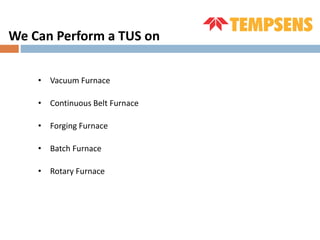
• Vacuum Furnace
• Continuous Belt Furnace
• Forging Furnace
• Batch Furnace
• Rotary Furnace
We Can Perform a TUS on
• System Accuracy Test, commonly referred to as an SAT, is another critically
important and often required test.
• System Accuracy Tests are performed to determine the error within the
temperature control system (temperature control device/lead
wire/thermocouple).
• Regardless of the application, knowing the error that exists in your temperature
control system allows for more consistent control of quality.
Objective:
• Control and certification of the accuracy of data acquisition and control of the
system over time.
Method:
• Comparison in situ of data recorded with data read on the calibration
instrument in order to define temperature gradients and check if they are
acceptable.
= Localized test of accuracy
System Accuracy Test (SAT)
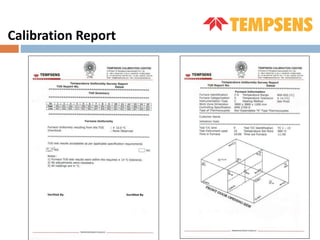
Calibration Report
THANK YOU!
Tempsens Instruments (I) Pvt. Ltd.
B-188 A, Road No. 5, MIA, Madri
Udaipur - 313 003 (Rajasthan) INDIA
Phone : +91-294-3057700
Fax : +91-294-3057750
E-mail : info@tempsens.com
Website : www.tempsens.com
Temperature Sensing, Heating & Cables

Furnace calibration - temperature uniformity survey

  • 1.
  • 2.
    Contents • AMS 2750E Standard • Temperature Uniformity Survey • Need of TUS • Furnace Class and their uniformity • Sensor requirement • Methodology • TUS applications • SAT(System Accuracy Test) • Calibration Report
  • 3.
    The AMS 2750E (Aerospace Material Specifications) is a standard for the processing of materials in aviation and aerospace industry which has been increasingly applied in the automotive industry as well. The standard describes in detail the requirements for thermal processing systems: Temperature uniformity in the useful space • Instrumentation (specification of the measurement and control instruments) • Inspection cycles of temperature sensors including documentation of the inspection cycles • Inspections of system precision Adherence to the standard's rules is necessary to ensure that the required quality standard of the components to be manufactured can be reproduced in serial production. For this reason, extensive and repeated inspections as well instrument testing, including the relevant documentation, are required. AMS 2750E Standard
  • 4.
    The standard definesthe way heat treatment must be performed and more precisely: The use of furnaces, sensors and other instruments: • Different furnace classes • Different types of authorized sensors • Different levels of instrumentation (number of sensors) • Different types of calibration instruments The test and control means: Two regular and frequent obligatory tests: TUS - Temperature Uniformity Survey SAT - System Accuracy Test The frequency of SAT and TUS is defined according to the furnace class and the level of instrumentation
  • 5.
    Temperature Uniformity Survey TUS:Temperature Uniformity Survey Objective: Determine the work zone of a furnace Method: • Measure the furnace temperature variation with individually monitored thermocouples inside the furnace before and after temperature stabilization. • Compare the result with the authorized deviation from set-point. • Apply the test standards set in AMS 2750 for calibration frequency and accuracy. = Acquisition of temperature from different sensors over a certain period of time
  • 6.
    Need of TUS •The purpose of the uniformity survey is to determine the range of temperatures present at different locations in the furnace under normal operating conditions standards. • It will cater the needs for uniform heating inside the furnace to match the product quality as well as process parameters.
  • 7.
    Furnace Class &their Uniformity Furnace Class Temperature Uniformity (°C) Temperature Uniformity (°F) 1 ±3 ±5 2 ±6 ±10 3 ±8 ±15 4 ±10 ±20 5 ±14 ±25 6 ±24 ±50
  • 8.
    Sensor required indifferent size of furnaces Work Space Volume Less than 3 Ft3 (0.085m 3 ) 225 Ft3 (6.4m3 ) 300 Ft3 (8.6m3 ) 400 Ft3 (11m3 ) 600 Ft3 (17m3 ) 800 Ft3 (23m3 ) 1000 Ft3 (28m3 ) 2000 Ft3 (57m3 ) 3000 Ft3 (85m3 ) 4000 Ft3 (113m3 ) No. of Sensors class 1 & 2 5 9 14 16 19 21 23 30 35 40 No. of Sensors class 3 to 6 5 9 12 13 14 15 16 20 23 25
  • 9.
    1. Arrangement ofthe sensors • The flexible thermocouples are placed at the corner of the working space of the furnace plus one standard thermocouple to determine the reference temperature in the geometric center. • At least three temperature set point should be selected generally at 5% , 50%, and 95% of temperature operation. 2. Preliminary test and conditions Ensure that both the controller and recorder instrumentation are functioning correctly and are they calibrated. • Oven should be kept as it is for 1 hour. • Leakage should be checked from different points of furnace. Methodology
  • 10.
    Temperature Uniformity reflectsthe quality of oven design regarding isolation, location of the heaters and air circulation patterns. Temperature uniformity can be evaluated by surveying the temperature within the oven in steps of rising temperature. Following parameters to be determined from the data obtained by temperature uniformity survey: Temperature Gradient: difference between the highest and lowest average temperature value of the temperature sensors in oven, after stability. Temperature fluctuation: measure of the variation of temperature on location inside of the oven chamber in a period time after achieving stability. Temperature Drift: the difference between the highest and the lowest oven temperature recorded during a long period of time (48 hour or more) of continuous operation without alteration to the thermostat setting shall not exceed 1°C at 100°C setting point. Reproducibility of Oven temperature: the initial oven temperature shall be regained to within 1°C after the oven has been switched off, and again switched on after 6 hours for 2 hours, without any alteration to the thermostat setting. Temperature Uniformity
  • 11.
    For Furnaces volumesgreater than 4000 ft.³ (113 m³) use the appropriate class formula to calculate number of sensors: • Classes 1 & 2 : • 9 + (½ 35.3 𝑓𝑢𝑟𝑛𝑎𝑐𝑒 𝑣𝑜𝑙𝑢𝑚𝑒 𝑓𝑡.3 − 225𝑓𝑡³ • 9 + (½ 35.3 𝑓𝑢𝑟𝑛𝑎𝑐𝑒 𝑣𝑜𝑙𝑢𝑚𝑒 𝑚3 − 6.4𝑚3 ) • Classes 3 to 6 : • 9 + (¼ 35.3 𝑓𝑢𝑟𝑛𝑎𝑐𝑒 𝑣𝑜𝑙𝑢𝑚𝑒 𝑓𝑡3 − 225𝑓𝑡3 ) • 9 + (¼ 35.3 𝑓𝑢𝑟𝑛𝑎𝑐𝑒 𝑣𝑜𝑙𝑢𝑚𝑒 𝑚3 − 6.4𝑚3 )
  • 12.
    • Vacuum Furnace •Continuous Belt Furnace • Forging Furnace • Batch Furnace • Rotary Furnace We Can Perform a TUS on
  • 13.
    • System AccuracyTest, commonly referred to as an SAT, is another critically important and often required test. • System Accuracy Tests are performed to determine the error within the temperature control system (temperature control device/lead wire/thermocouple). • Regardless of the application, knowing the error that exists in your temperature control system allows for more consistent control of quality. Objective: • Control and certification of the accuracy of data acquisition and control of the system over time. Method: • Comparison in situ of data recorded with data read on the calibration instrument in order to define temperature gradients and check if they are acceptable. = Localized test of accuracy System Accuracy Test (SAT)
  • 14.
  • 15.
    THANK YOU! Tempsens Instruments(I) Pvt. Ltd. B-188 A, Road No. 5, MIA, Madri Udaipur - 313 003 (Rajasthan) INDIA Phone : +91-294-3057700 Fax : +91-294-3057750 E-mail : info@tempsens.com Website : www.tempsens.com Temperature Sensing, Heating & Cables