CDI Revision Notes
Term 1 (2017 – 2018)
Grade 11 Advanced
Unit 1 – Materials and Unit 2 – Fundamentals of Electronics
STUDENT INSTRUCTIONS –
• Student must attempt all questions.
• For this examination, you must have:
(a) An ink pen – blue.
(b) A pencil.
(c) A ruler.
(d) A calculator (if required).
• Electronic devices are not allowed.
Examination Specifications
Domain Marks Time
Section 1 - 5 Multiple Choice Questions 5 Marks 3 - 4 minutes
Section 2 - 5 True or False Statements 5 Marks 3 - 4 minutes
Section 3 - 2 Short answer Questions
2 Diagram Questions
1 Matching Task
10 Marks (2 x 5)
20 Marks (2 x 10)
10 Marks
8 - 10 minutes
10 – 12 minutes
3 – 5 minutes
Total – 50 Marks Total – 35 minutes
(5 minutes reading)
UNIT 1 - MATERIALS
SECTION 1 – MECHANICAL PROPERTIES
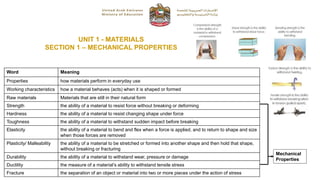
Word Meaning
Properties how materials perform in everyday use
Working characteristics how a material behaves (acts) when it is shaped or formed
Raw materials Materials that are still in their natural form
Strength the ability of a material to resist force without breaking or deforming
Hardness the ability of a material to resist changing shape under force
Toughness the ability of a material to withstand sudden impact before breaking
Elasticity the ability of a material to bend and flex when a force is applied, and to return to shape and size
when those forces are removed
Plasticity/ Malleability the ability of a material to be stretched or formed into another shape and then hold that shape,
without breaking or fracturing
Durability the ability of a material to withstand wear, pressure or damage
Ductility the measure of a material’s ability to withstand tensile stress
Fracture the separation of an object or material into two or more pieces under the action of stress
Mechanical
Properties
SECTION 2 – PHYSICAL PROPERTIES
Word Meaning
Physical
properties
how a material reacts to an external
force that is not mechanical
Thermal
Conductivity
how heat travels through a material
Electrical
Conductivity
how a material resists an electric
current being passed through it
Conductor an object, or type of material that
allows the flow of an electric current
in one or more directions
Insulator a material, or an object that does not
easily allow heat, electricity, light or
sound to pass through it
Magnetic
Properties
the ability to attract or repel certain
other materials
Acoustic
Properties
how a material reacts to sound
Optical
Properties
how a material reacts to light
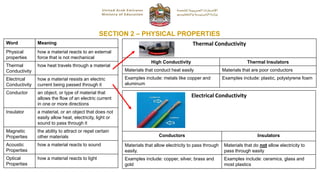
Thermal Conductivity
High Conductivity Thermal Insulators
Materials that conduct heat easily Materials that are poor conductors
Examples include: metals like copper and
aluminum
Examples include: plastic, polystyrene foam
Electrical Conductivity
Conductors Insulators
Materials that allow electricity to pass through
easily.
Materials that do not allow electricity to
pass through easily
Examples include: copper, silver, brass and
gold
Examples include: ceramics, glass and
most plastics
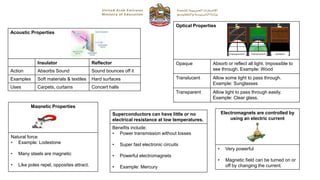
Magnetic Properties
Natural force
• Example: Lodestone
• Many steels are magnetic
• Like poles repel, opposites attract.
Electromagnets are controlled by
using an electric current
• Very powerful
• Magnetic field can be turned on or
off by changing the current.
Superconductors can have little or no
electrical resistance at low temperatures.
Benefits include:
• Power transmission without losses
• Super fast electronic circuits
• Powerful electromagnets
• Example: Mercury
Acoustic Properties
Insulator Reflector
Action Absorbs Sound Sound bounces off it
Examples Soft materials & textiles Hard surfaces
Uses Carpets, curtains Concert halls
Optical Properties
Opaque Absorb or reflect all light. Impossible to
see through. Example: Wood
Translucent Allow some light to pass through.
Example: Sunglasses
Transparent Allow light to pass through easily.
Example: Clear glass.
UNIT 1 - MATERIALS
SECTION 3 – METALS AND TREATMENTS
Word Meaning
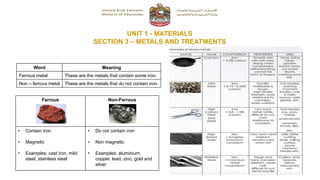
Ferrous metal These are the metals that contain some iron.
Non – ferrous metal These are the metals that do not contain iron.
Ferrous Non-Ferrous
• Contain Iron
• Magnetic
• Examples: cast iron, mild
steel, stainless steel
• Do not contain iron
• Non magnetic
• Examples: aluminium,
copper, lead, zinc, gold and
silver
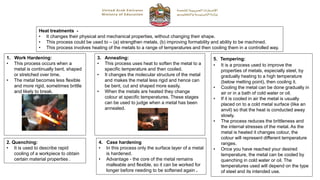
Heat treatments -
• It changes their physical and mechanical properties, without changing their shape.
• This process could be used to – (a) strengthen metals, (b) improving formability and ability to be machined.
• This process involves heating of the metals to a range of temperatures and then cooling them in a controlled way.
1. Work Hardening:
• This process occurs when a
metal is continually bent, shaped
or stretched over time.
• The metal becomes less flexible
and more rigid, sometimes brittle
and likely to break.
2. Quenching:
• It is used to describe rapid
cooling of a workpiece to obtain
certain material properties .
3. Annealing:
• This process uses heat to soften the metal to a
specific temperature and then cooled.
• It changes the molecular structure of the metal
and makes the metal less rigid and hence can
be bent, cut and shaped more easily.
• When the metals are heated they change
colour at specific temperatures. These stages
can be used to judge when a metal has been
annealed.
5. Tempering:
• It is a process used to improve the
properties of metals, especially steel, by
gradually heating to a high temperature
(below melting point), then cooling it.
• Cooling the metal can be done gradually in
air or in a bath of cold water or oil.
• If it is cooled in air the metal is usually
placed on to a cold metal surface (like an
anvil) so that the heat is conducted away
slowly.
• The process reduces the brittleness and
the internal stresses of the metal. As the
metal is heated it changes colour, the
colour will represent different temperature
ranges.
• Once you have reached your desired
temperature, the metal can be cooled by
quenching in cold water or oil. The
temperatures used will depend on the type
of steel and its intended use.
4. Case hardening
• In this process only the surface layer of a metal
is hardened.
• Advantage - the core of the metal remains
malleable and flexible, so it can be worked for
longer before needing to be softened again .
UNIT 2 – FUNDAMENTAL OF ELECTRONICS
SECTION 1 – ELECTRICAL CIRCUITS
Word Meaning Image
Electrical Circuit A closed path for electrons to move through electrical components, connected by a conductive wire.
Schematic Diagram A graphical representation of an electrical circuit that uses symbols.
Voltage The charge difference between two points.
Current The rate at which electric charge flows through a certain point .
Resistance A material’s tendency to resist (oppose) the flow of charge (current) .
DC An electric current that flows in one direction and has a constant voltage level; used in devices that use
batteries or USB cables for power
AC An electric current that periodically changes its direction; the voltage level also reverses with the current;
used to deliver power to houses, office buildings, etc.
Battery An electrical DC power source
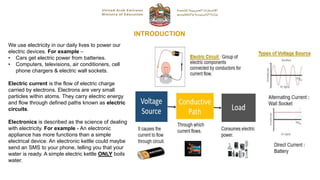
INTRODUCTION
We use electricity in our daily lives to power our
electric devices. For example –
• Cars get electric power from batteries.
• Computers, televisions, air conditioners, cell
phone chargers & electric wall sockets.
Electric current is the flow of electric charge
carried by electrons. Electrons are very small
particles within atoms. They carry electric energy
and flow through defined paths known as electric
circuits.
Electronics is described as the science of dealing
with electricity. For example - An electronic
appliance has more functions than a simple
electrical device. An electronic kettle could maybe
send an SMS to your phone, telling you that your
water is ready. A simple electric kettle ONLY boils
water.
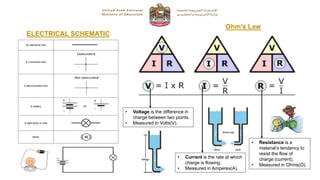
ELECTRICAL SCHEMATIC
Ohm’s Law
• Voltage is the difference in
charge between two points.
• Measured in Volts(V).
• Resistance is a
material’s tendency to
resist the flow of
charge (current).
• Measured in Ohms(Ω).
• Current is the rate at which
charge is flowing.
• Measured in Amperes(A).
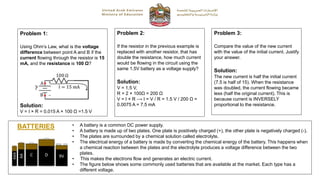
Problem 1:
Using Ohm’s Law, what is the voltage
difference between point A and B if the
current flowing through the resistor is 15
mA, and the resistance is 100 Ω?
Solution:
V = I × R = 0.015 A × 100 Ω =1.5 V
Problem 2:
If the resistor in the previous example is
replaced with another resistor, that has
double the resistance, how much current
would be flowing in the circuit using the
same 1.5V battery as a voltage supply?
Solution:
V = 1.5 V,
R = 2 × 100Ω = 200 Ω
V = I × R ⟶ I = V / R = 1.5 V / 200 Ω =
0.0075 A = 7.5 mA
Problem 3:
Compare the value of the new current
with the value of the initial current. Justify
your answer.
Solution:
The new current is half the initial current
(7.5 is half of 15). When the resistance
was doubled, the current flowing became
less (half the original current). This is
because current is INVERSELY
proportional to the resistance.
BATTERIES • A battery is a common DC power supply.
• A battery is made up of two plates. One plate is positively charged (+), the other plate is negatively charged (-).
• The plates are surrounded by a chemical solution called electrolyte.
• The electrical energy of a battery is made by converting the chemical energy of the battery. This happens when
a chemical reaction between the plates and the electrolyte produces a voltage difference between the two
plates.
• This makes the electrons flow and generates an electric current.
• The figure below shows some commonly used batteries that are available at the market. Each type has a
different voltage.
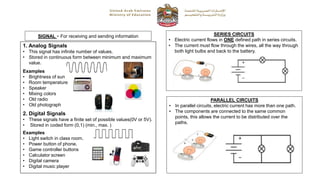
SIGNAL - For receiving and sending information
1. Analog Signals
• This signal has infinite number of values.
• Stored in continuous form between minimum and maximum
value.
Examples
• Brightness of sun
• Room temperature
• Speaker
• Mixing colors
• Old radio
• Old photograph
2. Digital Signals
• These signals have a finite set of possible values(0V or 5V).
• Stored in coded form (0,1) (min., max. )
Examples
• Light switch in class room.
• Power button of phone.
• Game controller buttons
• Calculator screen
• Digital camera
• Digital music player
SERIES CIRCUITS
• Electric current flows in ONE defined path in series circuits.
• The current must flow through the wires, all the way through
both light bulbs and back to the battery.
PARALLEL CIRCUITS
• In parallel circuits, electric current has more than one path.
• The components are connected to the same common
points, this allows the current to be distributed over the
paths.
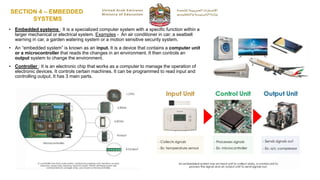
• Embedded systems : It is a specialized computer system with a specific function within a
larger mechanical or electrical system. Examples - An air conditioner in car; a seatbelt
warning in car, a garden watering system or a motion sensitive security system.
• An “embedded system” is known as an input. It is a device that contains a computer unit
or a microcontroller that reads the changes in an environment. It then controls an
output system to change the environment.
• Controller : It is an electronic chip that works as a computer to manage the operation of
electronic devices. It controls certain machines. It can be programmed to read input and
controlling output. It has 3 main parts.
SECTION 4 – EMBEDDED
SYSTEMS
SECTION 5A – ELECTRONIC COMPONENTS
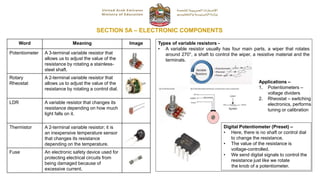
Word Meaning Image
Potentiometer A 3-terminal variable resistor that
allows us to adjust the value of the
resistance by rotating a stainless-
steel shaft.
Rotary
Rheostat
A 2-terminal variable resistor that
allows us to adjust the value of the
resistance by rotating a control dial.
LDR A variable resistor that changes its
resistance depending on how much
light falls on it.
Thermistor A 2-terminal variable resistor; it is
an inexpensive temperature sensor
that changes its resistance
depending on the temperature.
Fuse An electronic safety device used for
protecting electrical circuits from
being damaged because of
excessive current.
Types of variable resistors -
• A variable resistor usually has four main parts, a wiper that rotates
around 270°, a shaft to control the wiper, a resistive material and the
terminals.
Applications –
1. Potentiometers –
voltage dividers
2. Rheostat – switching
electronics, performs
tuning or calibration
Digital Potentiometer (Preset) –
• Here, there is no shaft or control dial
to change the resistance.
• The value of the resistance is
voltage-controlled.
• We send digital signals to control the
resistance just like we rotate
the knob of a potentiometer.
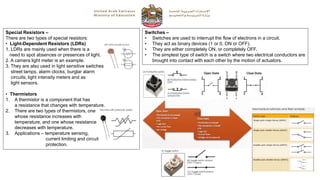
Special Resistors –
There are two types of special resistors:
• Light-Dependent Resistors (LDRs)
1. LDRs are mainly used when there is a
need to spot absences or presences of light.
2. A camera light meter is an example.
3. They are also used in light sensitive switches,
street lamps, alarm clocks, burglar alarm
circuits, light intensity meters and as
light sensors.
• Thermistors
1. A thermistor is a component that has
a resistance that changes with temperature.
2. There are two types of thermistors, one
whose resistance increases with
temperature, and one whose resistance
decreases with temperature.
3. Applications – temperature sensing,
current limiting and circuit
protection.
Switches –
• Switches are used to interrupt the flow of electrons in a circuit.
• They act as binary devices (1 or 0, ON or OFF).
• They are either completely ON, or completely OFF.
• The simplest type of switch is a switch where two electrical conductors are
brought into contact with each other by the motion of actuators.
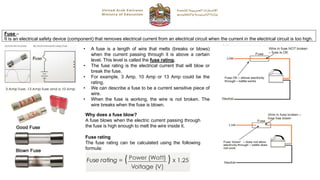
Fuse –
It is an electrical safety device (component) that removes electrical current from an electrical circuit when the current in the electrical circuit is too high.
• A fuse is a length of wire that melts (breaks or blows)
when the current passing through it is above a certain
level. This level is called the fuse rating.
• The fuse rating is the electrical current that will blow or
break the fuse.
• For example, 3 Amp, 10 Amp or 13 Amp could be the
rating.
• We can describe a fuse to be a current sensitive piece of
wire.
• When the fuse is working, the wire is not broken. The
wire breaks when the fuse is blown.
Why does a fuse blow?
A fuse blows when the electric current passing through
the fuse is high enough to melt the wire inside it.
Fuse rating
The fuse rating can be calculated using the following
formula:
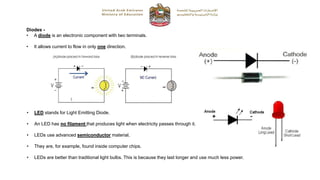
Diodes -
• A diode is an electronic component with two terminals.
• It allows current to flow in only one direction.
• LED stands for Light Emitting Diode.
• An LED has no filament that produces light when electricity passes through it.
• LEDs use advanced semiconductor material.
• They are, for example, found inside computer chips.
• LEDs are better than traditional light bulbs. This is because they last longer and use much less power.
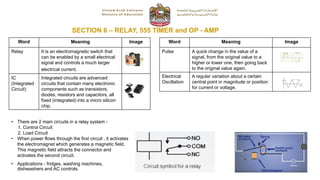
SECTION 6 – RELAY, 555 TIMER and OP - AMP
Word Meaning Image
Relay It is an electromagnetic switch that
can be enabled by a small electrical
signal and controls a much larger
electrical current.
IC
(Integrated
Circuit)
Integrated circuits are advanced
circuits that contain many electronic
components such as transistors,
diodes, resistors and capacitors, all
fixed (integrated) into a micro silicon
chip.
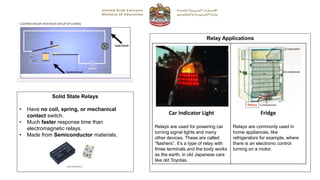
• There are 2 main circuits in a relay system -
1. Control Circuit
2. Load Circuit
• When power flows through the first circuit , it activates
the electromagnet which generates a magnetic field.
This magnetic field attracts the connector and
activates the second circuit.
• Applications - fridges, washing machines,
dishwashers and AC controls.
Word Meaning Image
Pulse A quick change in the value of a
signal, from the original value to a
higher or lower one, then going back
to the original value again.
Electrical
Oscillation
A regular variation about a certain
central point in magnitude or position
for current or voltage.
Solid State Relays
• Have no coil, spring, or mechanical
contact switch.
• Much faster response time than
electromagnetic relays.
• Made from Semiconductor materials.
Relay Applications
Car Indicator Light
Relays are used for powering car
turning signal lights and many
other devices. These are called
“flashers”. It’s a type of relay with
three terminals and the body works
as the earth, in old Japanese cars
like old Toyotas.
Fridge
Relays are commonly used in
home appliances, like
refrigerators for example, where
there is an electronic control
turning on a motor..
OP - AMPS
• Amplifiers are devices that take a weak signal as an input
and produce a much stronger signal as an output.
• The operational amplifier (Op-amp) is a special kind of
amplifier.
• Applications - stereos, medical cardiographs (which amplify
the heart beat) and comparator.
• Op-amps are integrated circuits that combine many
transistors, resistors and capacitors into a small silicon chip.
We can represent them in circuit diagrams as shown in the
following figure.
An op-amp has two different inputs:
• The inverting input - Signals going into the inverting input will be
1) amplified and 2) inverted (flipped).
• The non – inverting input - Signals going into the non-inverting input will
be just amplified.
I/O of Inverting Op-amp
I/O of Non - Inverting Op-amp
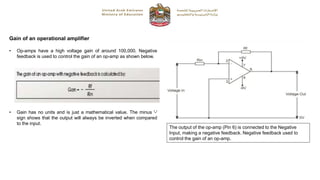
Gain of an operational amplifier
• Op-amps have a high voltage gain of around 100,000. Negative
feedback is used to control the gain of an op-amp as shown below.
The output of the op-amp (Pin 6) is connected to the Negative
Input, making a negative feedback. Negative feedback used to
control the gain of an op-amp.
• Gain has no units and is just a mathematical value. The minus '-'
sign shows that the output will always be inverted when compared
to the input.
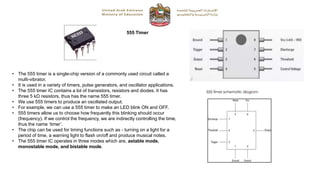
555 Timer
• The 555 timer is a single-chip version of a commonly used circuit called a
multi-vibrator.
• It is used in a variety of timers, pulse generators, and oscillator applications.
• The 555 timer IC contains a lot of transistors, resistors and diodes. It has
three 5 kΩ resistors, thus has the name 555 timer.
• We use 555 timers to produce an oscillated output.
• For example, we can use a 555 timer to make an LED blink ON and OFF.
• 555 timers allow us to choose how frequently this blinking should occur
(frequency). If we control the frequency, we are indirectly controlling the time,
thus the name ‘timer’.
• The chip can be used for timing functions such as - turning on a light for a
period of time, a warning light to flash on/off and produce musical notes.
• The 555 timer IC operates in three modes which are, astable mode,
monostable mode, and bistable mode.

Cdi t1 11_adv_unit1&2_revision_notes_eot

  • 1.
    CDI Revision Notes Term1 (2017 – 2018) Grade 11 Advanced Unit 1 – Materials and Unit 2 – Fundamentals of Electronics STUDENT INSTRUCTIONS – • Student must attempt all questions. • For this examination, you must have: (a) An ink pen – blue. (b) A pencil. (c) A ruler. (d) A calculator (if required). • Electronic devices are not allowed. Examination Specifications Domain Marks Time Section 1 - 5 Multiple Choice Questions 5 Marks 3 - 4 minutes Section 2 - 5 True or False Statements 5 Marks 3 - 4 minutes Section 3 - 2 Short answer Questions 2 Diagram Questions 1 Matching Task 10 Marks (2 x 5) 20 Marks (2 x 10) 10 Marks 8 - 10 minutes 10 – 12 minutes 3 – 5 minutes Total – 50 Marks Total – 35 minutes (5 minutes reading)
  • 2.
    UNIT 1 -MATERIALS SECTION 1 – MECHANICAL PROPERTIES Word Meaning Properties how materials perform in everyday use Working characteristics how a material behaves (acts) when it is shaped or formed Raw materials Materials that are still in their natural form Strength the ability of a material to resist force without breaking or deforming Hardness the ability of a material to resist changing shape under force Toughness the ability of a material to withstand sudden impact before breaking Elasticity the ability of a material to bend and flex when a force is applied, and to return to shape and size when those forces are removed Plasticity/ Malleability the ability of a material to be stretched or formed into another shape and then hold that shape, without breaking or fracturing Durability the ability of a material to withstand wear, pressure or damage Ductility the measure of a material’s ability to withstand tensile stress Fracture the separation of an object or material into two or more pieces under the action of stress Mechanical Properties
  • 3.
    SECTION 2 –PHYSICAL PROPERTIES Word Meaning Physical properties how a material reacts to an external force that is not mechanical Thermal Conductivity how heat travels through a material Electrical Conductivity how a material resists an electric current being passed through it Conductor an object, or type of material that allows the flow of an electric current in one or more directions Insulator a material, or an object that does not easily allow heat, electricity, light or sound to pass through it Magnetic Properties the ability to attract or repel certain other materials Acoustic Properties how a material reacts to sound Optical Properties how a material reacts to light Thermal Conductivity High Conductivity Thermal Insulators Materials that conduct heat easily Materials that are poor conductors Examples include: metals like copper and aluminum Examples include: plastic, polystyrene foam Electrical Conductivity Conductors Insulators Materials that allow electricity to pass through easily. Materials that do not allow electricity to pass through easily Examples include: copper, silver, brass and gold Examples include: ceramics, glass and most plastics
  • 4.
    Magnetic Properties Natural force •Example: Lodestone • Many steels are magnetic • Like poles repel, opposites attract. Electromagnets are controlled by using an electric current • Very powerful • Magnetic field can be turned on or off by changing the current. Superconductors can have little or no electrical resistance at low temperatures. Benefits include: • Power transmission without losses • Super fast electronic circuits • Powerful electromagnets • Example: Mercury Acoustic Properties Insulator Reflector Action Absorbs Sound Sound bounces off it Examples Soft materials & textiles Hard surfaces Uses Carpets, curtains Concert halls Optical Properties Opaque Absorb or reflect all light. Impossible to see through. Example: Wood Translucent Allow some light to pass through. Example: Sunglasses Transparent Allow light to pass through easily. Example: Clear glass.
  • 5.
    UNIT 1 -MATERIALS SECTION 3 – METALS AND TREATMENTS Word Meaning Ferrous metal These are the metals that contain some iron. Non – ferrous metal These are the metals that do not contain iron. Ferrous Non-Ferrous • Contain Iron • Magnetic • Examples: cast iron, mild steel, stainless steel • Do not contain iron • Non magnetic • Examples: aluminium, copper, lead, zinc, gold and silver
  • 7.
    Heat treatments - •It changes their physical and mechanical properties, without changing their shape. • This process could be used to – (a) strengthen metals, (b) improving formability and ability to be machined. • This process involves heating of the metals to a range of temperatures and then cooling them in a controlled way. 1. Work Hardening: • This process occurs when a metal is continually bent, shaped or stretched over time. • The metal becomes less flexible and more rigid, sometimes brittle and likely to break. 2. Quenching: • It is used to describe rapid cooling of a workpiece to obtain certain material properties . 3. Annealing: • This process uses heat to soften the metal to a specific temperature and then cooled. • It changes the molecular structure of the metal and makes the metal less rigid and hence can be bent, cut and shaped more easily. • When the metals are heated they change colour at specific temperatures. These stages can be used to judge when a metal has been annealed. 5. Tempering: • It is a process used to improve the properties of metals, especially steel, by gradually heating to a high temperature (below melting point), then cooling it. • Cooling the metal can be done gradually in air or in a bath of cold water or oil. • If it is cooled in air the metal is usually placed on to a cold metal surface (like an anvil) so that the heat is conducted away slowly. • The process reduces the brittleness and the internal stresses of the metal. As the metal is heated it changes colour, the colour will represent different temperature ranges. • Once you have reached your desired temperature, the metal can be cooled by quenching in cold water or oil. The temperatures used will depend on the type of steel and its intended use. 4. Case hardening • In this process only the surface layer of a metal is hardened. • Advantage - the core of the metal remains malleable and flexible, so it can be worked for longer before needing to be softened again .
  • 8.
    UNIT 2 –FUNDAMENTAL OF ELECTRONICS SECTION 1 – ELECTRICAL CIRCUITS Word Meaning Image Electrical Circuit A closed path for electrons to move through electrical components, connected by a conductive wire. Schematic Diagram A graphical representation of an electrical circuit that uses symbols. Voltage The charge difference between two points. Current The rate at which electric charge flows through a certain point . Resistance A material’s tendency to resist (oppose) the flow of charge (current) . DC An electric current that flows in one direction and has a constant voltage level; used in devices that use batteries or USB cables for power AC An electric current that periodically changes its direction; the voltage level also reverses with the current; used to deliver power to houses, office buildings, etc. Battery An electrical DC power source
  • 9.
    INTRODUCTION We use electricityin our daily lives to power our electric devices. For example – • Cars get electric power from batteries. • Computers, televisions, air conditioners, cell phone chargers & electric wall sockets. Electric current is the flow of electric charge carried by electrons. Electrons are very small particles within atoms. They carry electric energy and flow through defined paths known as electric circuits. Electronics is described as the science of dealing with electricity. For example - An electronic appliance has more functions than a simple electrical device. An electronic kettle could maybe send an SMS to your phone, telling you that your water is ready. A simple electric kettle ONLY boils water.
  • 10.
    ELECTRICAL SCHEMATIC Ohm’s Law •Voltage is the difference in charge between two points. • Measured in Volts(V). • Resistance is a material’s tendency to resist the flow of charge (current). • Measured in Ohms(Ω). • Current is the rate at which charge is flowing. • Measured in Amperes(A).
  • 11.
    Problem 1: Using Ohm’sLaw, what is the voltage difference between point A and B if the current flowing through the resistor is 15 mA, and the resistance is 100 Ω? Solution: V = I × R = 0.015 A × 100 Ω =1.5 V Problem 2: If the resistor in the previous example is replaced with another resistor, that has double the resistance, how much current would be flowing in the circuit using the same 1.5V battery as a voltage supply? Solution: V = 1.5 V, R = 2 × 100Ω = 200 Ω V = I × R ⟶ I = V / R = 1.5 V / 200 Ω = 0.0075 A = 7.5 mA Problem 3: Compare the value of the new current with the value of the initial current. Justify your answer. Solution: The new current is half the initial current (7.5 is half of 15). When the resistance was doubled, the current flowing became less (half the original current). This is because current is INVERSELY proportional to the resistance. BATTERIES • A battery is a common DC power supply. • A battery is made up of two plates. One plate is positively charged (+), the other plate is negatively charged (-). • The plates are surrounded by a chemical solution called electrolyte. • The electrical energy of a battery is made by converting the chemical energy of the battery. This happens when a chemical reaction between the plates and the electrolyte produces a voltage difference between the two plates. • This makes the electrons flow and generates an electric current. • The figure below shows some commonly used batteries that are available at the market. Each type has a different voltage.
  • 12.
    SIGNAL - Forreceiving and sending information 1. Analog Signals • This signal has infinite number of values. • Stored in continuous form between minimum and maximum value. Examples • Brightness of sun • Room temperature • Speaker • Mixing colors • Old radio • Old photograph 2. Digital Signals • These signals have a finite set of possible values(0V or 5V). • Stored in coded form (0,1) (min., max. ) Examples • Light switch in class room. • Power button of phone. • Game controller buttons • Calculator screen • Digital camera • Digital music player SERIES CIRCUITS • Electric current flows in ONE defined path in series circuits. • The current must flow through the wires, all the way through both light bulbs and back to the battery. PARALLEL CIRCUITS • In parallel circuits, electric current has more than one path. • The components are connected to the same common points, this allows the current to be distributed over the paths.
  • 13.
    • Embedded systems: It is a specialized computer system with a specific function within a larger mechanical or electrical system. Examples - An air conditioner in car; a seatbelt warning in car, a garden watering system or a motion sensitive security system. • An “embedded system” is known as an input. It is a device that contains a computer unit or a microcontroller that reads the changes in an environment. It then controls an output system to change the environment. • Controller : It is an electronic chip that works as a computer to manage the operation of electronic devices. It controls certain machines. It can be programmed to read input and controlling output. It has 3 main parts. SECTION 4 – EMBEDDED SYSTEMS
  • 14.
    SECTION 5A –ELECTRONIC COMPONENTS Word Meaning Image Potentiometer A 3-terminal variable resistor that allows us to adjust the value of the resistance by rotating a stainless- steel shaft. Rotary Rheostat A 2-terminal variable resistor that allows us to adjust the value of the resistance by rotating a control dial. LDR A variable resistor that changes its resistance depending on how much light falls on it. Thermistor A 2-terminal variable resistor; it is an inexpensive temperature sensor that changes its resistance depending on the temperature. Fuse An electronic safety device used for protecting electrical circuits from being damaged because of excessive current. Types of variable resistors - • A variable resistor usually has four main parts, a wiper that rotates around 270°, a shaft to control the wiper, a resistive material and the terminals. Applications – 1. Potentiometers – voltage dividers 2. Rheostat – switching electronics, performs tuning or calibration Digital Potentiometer (Preset) – • Here, there is no shaft or control dial to change the resistance. • The value of the resistance is voltage-controlled. • We send digital signals to control the resistance just like we rotate the knob of a potentiometer.
  • 15.
    Special Resistors – Thereare two types of special resistors: • Light-Dependent Resistors (LDRs) 1. LDRs are mainly used when there is a need to spot absences or presences of light. 2. A camera light meter is an example. 3. They are also used in light sensitive switches, street lamps, alarm clocks, burglar alarm circuits, light intensity meters and as light sensors. • Thermistors 1. A thermistor is a component that has a resistance that changes with temperature. 2. There are two types of thermistors, one whose resistance increases with temperature, and one whose resistance decreases with temperature. 3. Applications – temperature sensing, current limiting and circuit protection. Switches – • Switches are used to interrupt the flow of electrons in a circuit. • They act as binary devices (1 or 0, ON or OFF). • They are either completely ON, or completely OFF. • The simplest type of switch is a switch where two electrical conductors are brought into contact with each other by the motion of actuators.
  • 16.
    Fuse – It isan electrical safety device (component) that removes electrical current from an electrical circuit when the current in the electrical circuit is too high. • A fuse is a length of wire that melts (breaks or blows) when the current passing through it is above a certain level. This level is called the fuse rating. • The fuse rating is the electrical current that will blow or break the fuse. • For example, 3 Amp, 10 Amp or 13 Amp could be the rating. • We can describe a fuse to be a current sensitive piece of wire. • When the fuse is working, the wire is not broken. The wire breaks when the fuse is blown. Why does a fuse blow? A fuse blows when the electric current passing through the fuse is high enough to melt the wire inside it. Fuse rating The fuse rating can be calculated using the following formula:
  • 17.
    Diodes - • Adiode is an electronic component with two terminals. • It allows current to flow in only one direction. • LED stands for Light Emitting Diode. • An LED has no filament that produces light when electricity passes through it. • LEDs use advanced semiconductor material. • They are, for example, found inside computer chips. • LEDs are better than traditional light bulbs. This is because they last longer and use much less power.
  • 18.
    SECTION 6 –RELAY, 555 TIMER and OP - AMP Word Meaning Image Relay It is an electromagnetic switch that can be enabled by a small electrical signal and controls a much larger electrical current. IC (Integrated Circuit) Integrated circuits are advanced circuits that contain many electronic components such as transistors, diodes, resistors and capacitors, all fixed (integrated) into a micro silicon chip. • There are 2 main circuits in a relay system - 1. Control Circuit 2. Load Circuit • When power flows through the first circuit , it activates the electromagnet which generates a magnetic field. This magnetic field attracts the connector and activates the second circuit. • Applications - fridges, washing machines, dishwashers and AC controls. Word Meaning Image Pulse A quick change in the value of a signal, from the original value to a higher or lower one, then going back to the original value again. Electrical Oscillation A regular variation about a certain central point in magnitude or position for current or voltage.
  • 19.
    Solid State Relays •Have no coil, spring, or mechanical contact switch. • Much faster response time than electromagnetic relays. • Made from Semiconductor materials. Relay Applications Car Indicator Light Relays are used for powering car turning signal lights and many other devices. These are called “flashers”. It’s a type of relay with three terminals and the body works as the earth, in old Japanese cars like old Toyotas. Fridge Relays are commonly used in home appliances, like refrigerators for example, where there is an electronic control turning on a motor..
  • 20.
    OP - AMPS •Amplifiers are devices that take a weak signal as an input and produce a much stronger signal as an output. • The operational amplifier (Op-amp) is a special kind of amplifier. • Applications - stereos, medical cardiographs (which amplify the heart beat) and comparator. • Op-amps are integrated circuits that combine many transistors, resistors and capacitors into a small silicon chip. We can represent them in circuit diagrams as shown in the following figure. An op-amp has two different inputs: • The inverting input - Signals going into the inverting input will be 1) amplified and 2) inverted (flipped). • The non – inverting input - Signals going into the non-inverting input will be just amplified. I/O of Inverting Op-amp I/O of Non - Inverting Op-amp
  • 21.
    Gain of anoperational amplifier • Op-amps have a high voltage gain of around 100,000. Negative feedback is used to control the gain of an op-amp as shown below. The output of the op-amp (Pin 6) is connected to the Negative Input, making a negative feedback. Negative feedback used to control the gain of an op-amp. • Gain has no units and is just a mathematical value. The minus '-' sign shows that the output will always be inverted when compared to the input.
  • 22.
    555 Timer • The555 timer is a single-chip version of a commonly used circuit called a multi-vibrator. • It is used in a variety of timers, pulse generators, and oscillator applications. • The 555 timer IC contains a lot of transistors, resistors and diodes. It has three 5 kΩ resistors, thus has the name 555 timer. • We use 555 timers to produce an oscillated output. • For example, we can use a 555 timer to make an LED blink ON and OFF. • 555 timers allow us to choose how frequently this blinking should occur (frequency). If we control the frequency, we are indirectly controlling the time, thus the name ‘timer’. • The chip can be used for timing functions such as - turning on a light for a period of time, a warning light to flash on/off and produce musical notes. • The 555 timer IC operates in three modes which are, astable mode, monostable mode, and bistable mode.