Sets and Set Operations
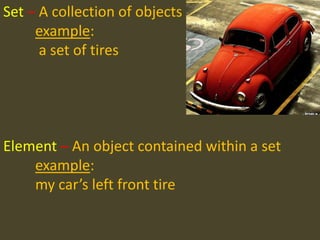
Set – A collection of objects
     example:
      a set of tires


Element – An object contained within a set
    example:
    my car’s left front tire
Finite set – Contains a
                        countable number of
                        objects

                        Example: The car has 4
                                  tires

Infinite set- Contains an unlimited number of
objects
      Example: The counting numbers {1, 2, 3, …}
Cardinal Number –
                          Used to count the
                          objects in a set

                          Example: There are 26
                          letters in the alphabet

Ordinal Number – Used to describe the position
of an element in a set
     Example: The letter D is the 4th letter of the
               alphabet
Equal sets – Sets that contain exactly the same
elements (in any order)

  {A, R, T, S} = {S, T, A, R}


Notation: A = B means set A equals set B
Equivalent sets – Sets that
              contain the same number
              of elements (elements do
              not have to be the same)

                   {C, A, T} ~ {d, o, g}


Notation: A ~ B means set A is equivalent
          to set B
Empty Set – A set that
 contains no elements

 Notation: { } or


                  Universal Set – A set that
                  contains all of the elements
                  being considered

                  Notation:   U
Complement of a set – A set that contains all of
the elements of the universal set that are not in
a given set


Notation:   B   means the complement of B
A = {2, 4, 6, 8}                B = {1, 2, 3, 4, …}
C = {1, 2, 3, 4, 5}             D={}
E = {Al, Ben, Carl, Doug}       F = { 5, 4, 3, 2, 1}
G = {x | x < 6 and x is a counting number}
     Set Builder Notation {1, 2, 3, 4, 5}

Which sets are finite?          n(E) = 4
  A, C, D, E, F, G              n(G) = 5

Which sets are equal to set C? F, G

Which sets are equivalent to set A? E
U = {1, 2, 3, 4, 5, 6, 7}

M = {2, 4, 6}

What is M ?
 {1, 3, 5, 7}
Is { } the same as     ? Yes


Is {   } the same as     ? No
Set B is a subset of set A if every element of
set B is also an element of set A.
     Notation: B A

W = {1, 2, 3, 4, 5}            X = {1, 3, 5}
Y = {2, 4, 6}                  Z = {4, 2, 1, 5, 3}

True or False:
     X W True
     Y W False
     Z W True              The empty set is a
          W True           subset of every set
Set B is a proper subset of set A if every
element of set B is also an element of set A
AND B is not equal to A.
     Notation: B A

W = {1, 2, 3, 4, 5}           X = {1, 3, 5}
Y = {2, 4, 6}                 Z = {4, 2, 1, 5, 3}

True or False:
     X W True
     Y W False
     Z W False
How many subsets can a set have?
               Number of                          Number of
   Set         Elements          Subsets           Subsets
    {a}           1          {a},{ }                 2
  {a, b}          2        {a},{b},{a,b},{ }         4
 {a, b, c}        3        {a},{b},{c},{a,b},
                           {a,c},{b,c},{a,b,c},      8
                            { }
{a, b, c, d}    4                           16
                n                            2n
    If a set has n elements, it has 2n subsets
How many proper subsets can a set have?
                                        Number of
               Number of                 Proper
   Set         Elements
                         Proper Subsets
                                         Subsets
    {a}           1        X
                          {a},{ }              1
  {a, b}          2               X
                        {a},{b},{a,b},{ }      3
 {a, b, c}        3     {a},{b},{c},{a,b},
                                       X
                        {a,c},{b,c},{a,b,c},   7
                         { }
{a, b, c, d}    4                            15
                n                          2n – 1
   If a set has n elements, it has 2n – 1 proper
                      subsets
W = {a, b, c, d, e, f}

How many subsets does set W have?
    26 = 64

How many proper subsets does set W have?
    26 – 1 = 64 – 1 = 63
A Venn Diagram allows us to organize the
elements of a set according to their
attributes.
U = {1, 2, 3, 4, 5, 6.5}


even                   1    odd
        4

                    3
            2        5
 6.5
                       prime
small                               blue


                                     triangle


National Library of Virtual Manipulatives Attribute Blocks
Set Operations

The intersection of sets A and B is the set of all
elements in both sets A and B
               notation: A B
The union of sets A and B is the set of all
elements in either one or both of sets A and B
               notation: A B
The union of sets A and B is the set of all
elements in either one or both of sets A and B
               notation: A B
The union of sets A and B is the set of all
elements in either one or both of sets A and B
               notation: A B
A = {1, 2, 3, 4, 5}   B = {2, 4, 6}   C = {3, 5, 7}

A    B = {2, 4}                  A – B = {1, 3, 5}

A    B = {1, 2, 3, 4, 5, 6}      C – A = {7}

C    B = {2, 3, 4, 5, 6, 7)

C    B= { }
The set complement X – Y is the set of all
elements of X that are not in Y
Representing sets with Venn diagrams


      A                 B              A                       B
                                           1       2       3
           1   2    3
                                                   5
                                               4       6
                        4
                                                   7
                                                               8
     Two attributes                                    C
     22 or 4 regions
                                       Three attributes
                                       23 or 8 regions
A       B   A       B


    A           A
A         B     A               B


    AUB                 A   B
      A             B


              A B
A         B   A           B


    AUB           A   B
A             B


          C

(A U B)       C
A=   {1, 2, 4, 5}            A                       B
B=   {2, 3, 5, 6}                1       2       3
C=   {4, 5, 6, 7}                        5
                                     4       6
C=   {1, 2, 3, 8}
                                         7
                                                     8
A U B = {1, 2, 3, 4, 5, 6}                   C

(A U B)    C = {1, 2, 3}     (A U B)                 C
A = {3, 6, 7, 8}                 A                       B
B = {2, 3, 5, 6}                     1       2       3
C = {4, 5, 6, 7}                         4
                                             5
                                                 6
                                             7
B   C = {5, 6}                                           8
                                                 C
A U (B    C) = {3, 5, 6, 7, 8}

                                 A U (B              C)
A                        B
                1              3
                         2


                                         4

How many stars are in:
    Circle A      3          Either A or B        7
    Circle B      5          Exactly one circle   6
    Only Circle A 2          Neither circle       2
    Both A and B 1           Total stars =        9
20
                      Out of 20 students:
 B                F       8 play baseball
                          7 play football
      5   3   4           3 play both sports

                  8
How many play neither sport? 8

How many play only baseball? 5

How many play exactly one sport? 5 + 4 = 9
30                    Out of 30 people surveyed:
                             20 like Blue
  B                P         20 like Pink
       4     4 5             15 like Green
            10               14 like Blue and Pink
           2 1
                             11 like Pink and Green
             2               12 like Blue and Green
   2          G              10 like all 3 colors

How many people like only Pink? 5
How many like Blue and Green but not Pink? 2
How many like none of the 3 colors? 2
How many like exactly two of the colors? 4 + 2 + 1 =7

1150 day 2

  • 1.
    Sets and SetOperations
  • 2.
    Set – Acollection of objects example: a set of tires Element – An object contained within a set example: my car’s left front tire
  • 3.
    Finite set –Contains a countable number of objects Example: The car has 4 tires Infinite set- Contains an unlimited number of objects Example: The counting numbers {1, 2, 3, …}
  • 4.
    Cardinal Number – Used to count the objects in a set Example: There are 26 letters in the alphabet Ordinal Number – Used to describe the position of an element in a set Example: The letter D is the 4th letter of the alphabet
  • 5.
    Equal sets –Sets that contain exactly the same elements (in any order) {A, R, T, S} = {S, T, A, R} Notation: A = B means set A equals set B
  • 6.
    Equivalent sets –Sets that contain the same number of elements (elements do not have to be the same) {C, A, T} ~ {d, o, g} Notation: A ~ B means set A is equivalent to set B
  • 7.
    Empty Set –A set that contains no elements Notation: { } or Universal Set – A set that contains all of the elements being considered Notation: U
  • 8.
    Complement of aset – A set that contains all of the elements of the universal set that are not in a given set Notation: B means the complement of B
  • 9.
    A = {2,4, 6, 8} B = {1, 2, 3, 4, …} C = {1, 2, 3, 4, 5} D={} E = {Al, Ben, Carl, Doug} F = { 5, 4, 3, 2, 1} G = {x | x < 6 and x is a counting number} Set Builder Notation {1, 2, 3, 4, 5} Which sets are finite? n(E) = 4 A, C, D, E, F, G n(G) = 5 Which sets are equal to set C? F, G Which sets are equivalent to set A? E
  • 10.
    U = {1,2, 3, 4, 5, 6, 7} M = {2, 4, 6} What is M ? {1, 3, 5, 7}
  • 11.
    Is { }the same as ? Yes Is { } the same as ? No
  • 12.
    Set B isa subset of set A if every element of set B is also an element of set A. Notation: B A W = {1, 2, 3, 4, 5} X = {1, 3, 5} Y = {2, 4, 6} Z = {4, 2, 1, 5, 3} True or False: X W True Y W False Z W True The empty set is a W True subset of every set
  • 13.
    Set B isa proper subset of set A if every element of set B is also an element of set A AND B is not equal to A. Notation: B A W = {1, 2, 3, 4, 5} X = {1, 3, 5} Y = {2, 4, 6} Z = {4, 2, 1, 5, 3} True or False: X W True Y W False Z W False
  • 14.
    How many subsetscan a set have? Number of Number of Set Elements Subsets Subsets {a} 1 {a},{ } 2 {a, b} 2 {a},{b},{a,b},{ } 4 {a, b, c} 3 {a},{b},{c},{a,b}, {a,c},{b,c},{a,b,c}, 8 { } {a, b, c, d} 4 16 n 2n If a set has n elements, it has 2n subsets
  • 15.
    How many propersubsets can a set have? Number of Number of Proper Set Elements Proper Subsets Subsets {a} 1 X {a},{ } 1 {a, b} 2 X {a},{b},{a,b},{ } 3 {a, b, c} 3 {a},{b},{c},{a,b}, X {a,c},{b,c},{a,b,c}, 7 { } {a, b, c, d} 4 15 n 2n – 1 If a set has n elements, it has 2n – 1 proper subsets
  • 16.
    W = {a,b, c, d, e, f} How many subsets does set W have? 26 = 64 How many proper subsets does set W have? 26 – 1 = 64 – 1 = 63
  • 18.
    A Venn Diagramallows us to organize the elements of a set according to their attributes.
  • 20.
    U = {1,2, 3, 4, 5, 6.5} even 1 odd 4 3 2 5 6.5 prime
  • 21.
    small blue triangle National Library of Virtual Manipulatives Attribute Blocks
  • 22.
    Set Operations The intersectionof sets A and B is the set of all elements in both sets A and B notation: A B
  • 23.
    The union ofsets A and B is the set of all elements in either one or both of sets A and B notation: A B
  • 24.
    The union ofsets A and B is the set of all elements in either one or both of sets A and B notation: A B
  • 25.
    The union ofsets A and B is the set of all elements in either one or both of sets A and B notation: A B
  • 27.
    A = {1,2, 3, 4, 5} B = {2, 4, 6} C = {3, 5, 7} A B = {2, 4} A – B = {1, 3, 5} A B = {1, 2, 3, 4, 5, 6} C – A = {7} C B = {2, 3, 4, 5, 6, 7) C B= { } The set complement X – Y is the set of all elements of X that are not in Y
  • 28.
    Representing sets withVenn diagrams A B A B 1 2 3 1 2 3 5 4 6 4 7 8 Two attributes C 22 or 4 regions Three attributes 23 or 8 regions
  • 29.
    A B A B A A
  • 30.
    A B A B AUB A B A B A B
  • 31.
    A B A B AUB A B
  • 32.
    A B C (A U B) C
  • 33.
    A= {1, 2, 4, 5} A B B= {2, 3, 5, 6} 1 2 3 C= {4, 5, 6, 7} 5 4 6 C= {1, 2, 3, 8} 7 8 A U B = {1, 2, 3, 4, 5, 6} C (A U B) C = {1, 2, 3} (A U B) C
  • 34.
    A = {3,6, 7, 8} A B B = {2, 3, 5, 6} 1 2 3 C = {4, 5, 6, 7} 4 5 6 7 B C = {5, 6} 8 C A U (B C) = {3, 5, 6, 7, 8} A U (B C)
  • 35.
    A B 1 3 2 4 How many stars are in: Circle A 3 Either A or B 7 Circle B 5 Exactly one circle 6 Only Circle A 2 Neither circle 2 Both A and B 1 Total stars = 9
  • 36.
    20 Out of 20 students: B F 8 play baseball 7 play football 5 3 4 3 play both sports 8 How many play neither sport? 8 How many play only baseball? 5 How many play exactly one sport? 5 + 4 = 9
  • 37.
    30 Out of 30 people surveyed: 20 like Blue B P 20 like Pink 4 4 5 15 like Green 10 14 like Blue and Pink 2 1 11 like Pink and Green 2 12 like Blue and Green 2 G 10 like all 3 colors How many people like only Pink? 5 How many like Blue and Green but not Pink? 2 How many like none of the 3 colors? 2 How many like exactly two of the colors? 4 + 2 + 1 =7