Math 1150
Summer 2012
Problem Solving and
Number Patterns
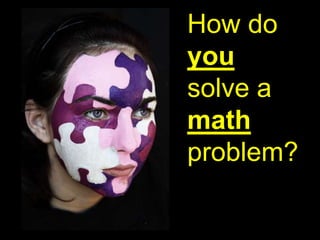
How do you solve a
problem?
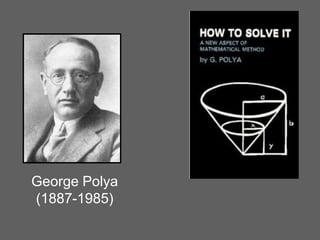
George Polya
(1887-1985)
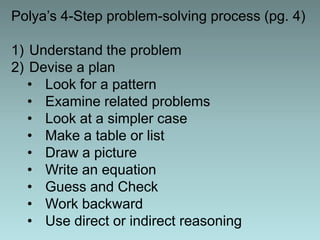
Polya’s 4-Step problem-solving process (pg. 4)

1) Understand the problem
2) Devise a plan
   • Look for a pattern
   • Examine related problems
   • Look at a simpler case
   • Make a table or list
   • Draw a picture
   • Write an equation
   • Guess and Check
   • Work backward
   • Use direct or indirect reasoning
3) Carry out the plan
4) Look back
   • Does your answer make sense?
   • Did you answer the question that was
     asked?
   • Is there another way to find the solution?
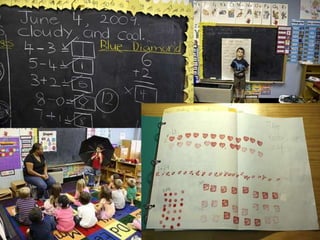
How do
you
solve a
math
problem?
4th grade - 1959
4th grade - 2008
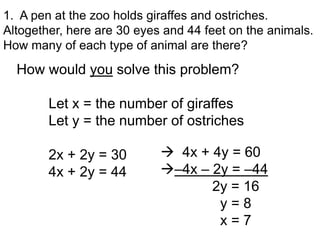
1. A pen at the zoo holds giraffes and ostriches.
Altogether, here are 30 eyes and 44 feet on the animals.
How many of each type of animal are there?
  How would you solve this problem?

        Let x = the number of giraffes
        Let y = the number of ostriches

        2x + 2y = 30         4x + 4y = 60
        4x + 2y = 44        –4x – 2y = –44
                                   2y = 16
                                    y=8
                                    x=7
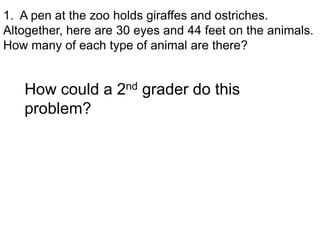
1. A pen at the zoo holds giraffes and ostriches.
Altogether, here are 30 eyes and 44 feet on the animals.
How many of each type of animal are there?


   How could a 2nd grader do this
   problem?
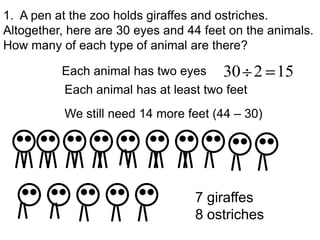
1. A pen at the zoo holds giraffes and ostriches.
Altogether, here are 30 eyes and 44 feet on the animals.
How many of each type of animal are there?

          Each animal has two eyes     30 2 15
           Each animal has at least two feet
           We still need 14 more feet (44 – 30)


                                  7 giraffes
                                  8 ostriches
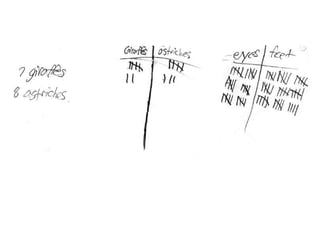
1. A pen at the zoo holds giraffes and ostriches.
Altogether, here are 30 eyes and 44 feet on the animals.
How many of each type of animal are there?


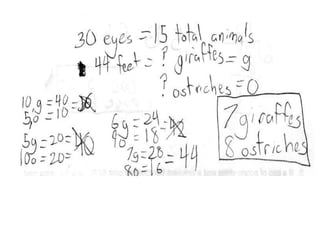
   How did a 7th grader do this problem?
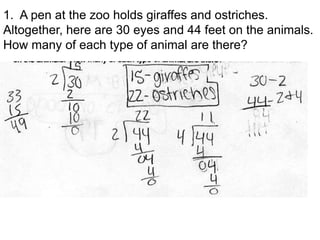
1. A pen at the zoo holds giraffes and ostriches.
Altogether, here are 30 eyes and 44 feet on the animals.
How many of each type of animal are there?
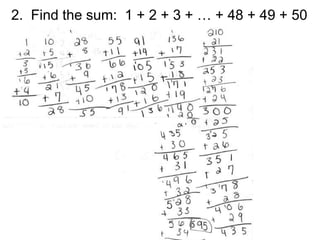
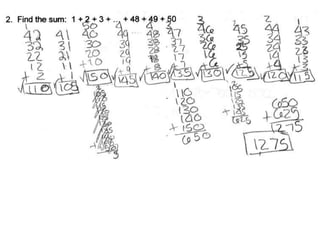
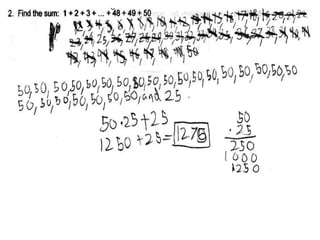
2. Find the sum: 1 + 2 + 3 + … + 48 + 49 + 50
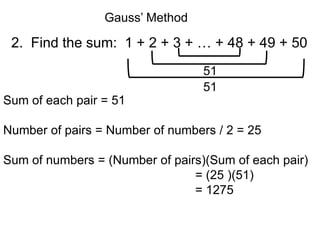
Gauss’ Method

 2. Find the sum: 1 + 2 + 3 + … + 48 + 49 + 50
                                  51
                                  51
Sum of each pair = 51

Number of pairs = Number of numbers / 2 = 25

Sum of numbers = (Number of pairs)(Sum of each pair)
                                = (25 )(51)
                                = 1275
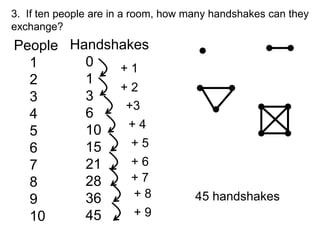
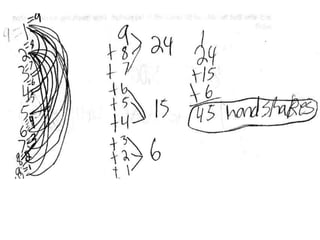
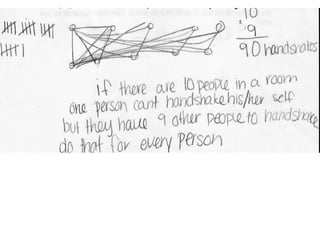
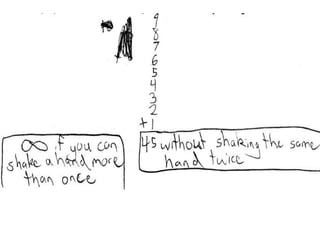
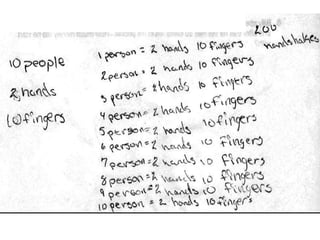
3. If ten people are in a room, how many handshakes can they
exchange?
People Handshakes
  1      0   +1
  2      1
             +2
  3      3
              +3
  4      6
              +4
  5      10
  6      15    +5
  7      21    +6
  8      28    +7
  9      36    +8                    45 handshakes
  10     45    +9
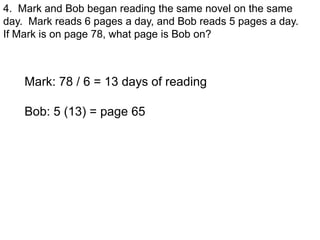
4. Mark and Bob began reading the same novel on the same
day. Mark reads 6 pages a day, and Bob reads 5 pages a day.
If Mark is on page 78, what page is Bob on?


    Mark: 78 / 6 = 13 days of reading

    Bob: 5 (13) = page 65
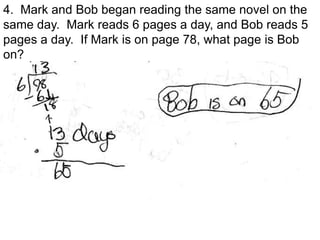
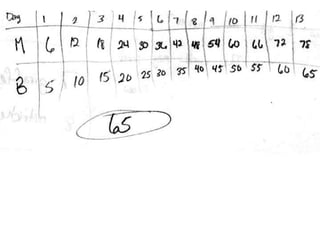
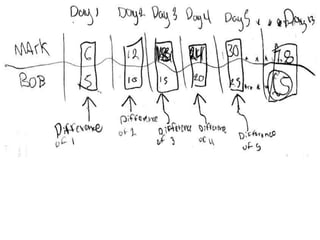
4. Mark and Bob began reading the same novel on the
same day. Mark reads 6 pages a day, and Bob reads 5
pages a day. If Mark is on page 78, what page is Bob
on?
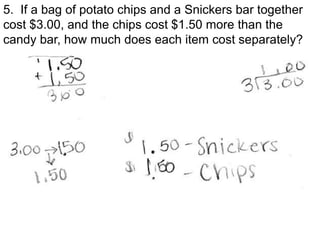
5. If a bag of potato chips and a Snickers bar together
cost $3.00, and the chips cost $1.50 more than the
candy bar, how much does each item cost separately?
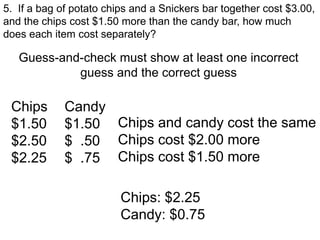
5. If a bag of potato chips and a Snickers bar together cost $3.00,
and the chips cost $1.50 more than the candy bar, how much
does each item cost separately?

   Guess-and-check must show at least one incorrect
            guess and the correct guess

 Chips       Candy
 $1.50       $1.50 Chips and candy cost the same
 $2.50       $ .50 Chips cost $2.00 more
 $2.25       $ .75 Chips cost $1.50 more

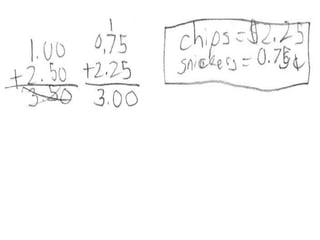
                         Chips: $2.25
                         Candy: $0.75
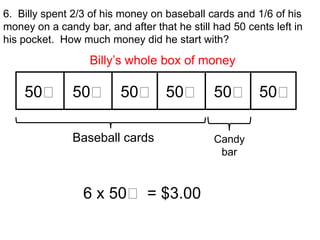
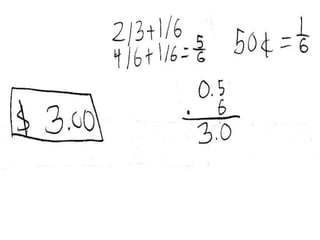
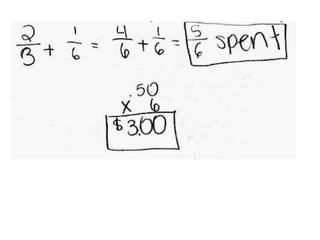
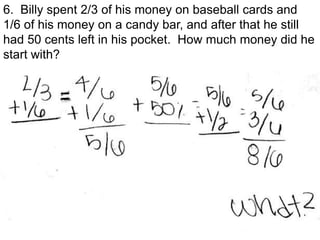
6. Billy spent 2/3 of his money on baseball cards and 1/6 of his
money on a candy bar, and after that he still had 50 cents left in
his pocket. How much money did he start with?

                   Billy’s whole box of money

    50₵ 50₵ 50₵ 50₵ 50₵ 50₵

               Baseball cards                 Candy
                                               bar


                 6 x 50₵ = $3.00
6. Billy spent 2/3 of his money on baseball cards and
1/6 of his money on a candy bar, and after that he still
had 50 cents left in his pocket. How much money did he
start with?
Number
Patterns
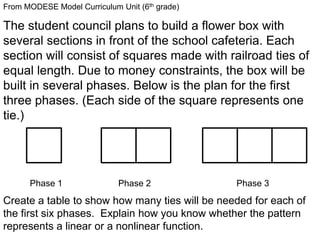
From MODESE Model Curriculum Unit (6th grade)

The student council plans to build a flower box with
several sections in front of the school cafeteria. Each
section will consist of squares made with railroad ties of
equal length. Due to money constraints, the box will be
built in several phases. Below is the plan for the first
three phases. (Each side of the square represents one
tie.)


      Phase 1                Phase 2            Phase 3
Create a table to show how many ties will be needed for each of
the first six phases. Explain how you know whether the pattern
represents a linear or a nonlinear function.
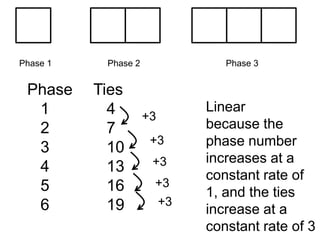
Phase 1    Phase 2                Phase 3


 Phase    Ties
  1         4                  Linear
                     +3
  2         7                  because the
  3         10
                      +3       phase number
                      +3       increases at a
  4         13
                               constant rate of
  5         16        +3
                               1, and the ties
  6         19            +3
                               increase at a
                               constant rate of 3
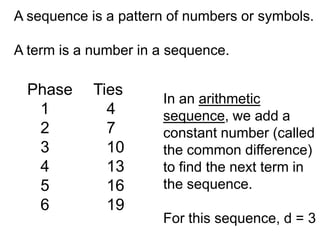
A sequence is a pattern of numbers or symbols.

A term is a number in a sequence.

  Phase     Ties
                      In an arithmetic
   1          4       sequence, we add a
   2          7       constant number (called
   3          10      the common difference)
   4          13      to find the next term in
   5          16      the sequence.
   6          19
                      For this sequence, d = 3
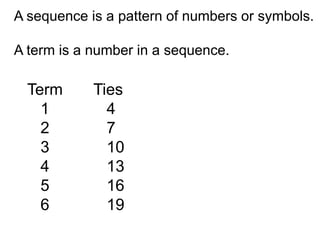
A sequence is a pattern of numbers or symbols.

A term is a number in a sequence.

  Term      Ties
    1         4
    2         7
    3         10
    4         13
    5         16
    6         19
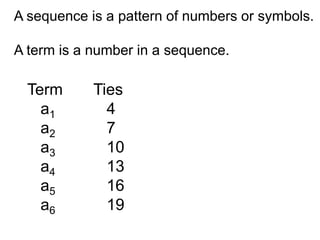
A sequence is a pattern of numbers or symbols.

A term is a number in a sequence.

  Term      Ties
    a1        4
    a2        7
    a3        10
    a4        13
    a5        16
    a6        19
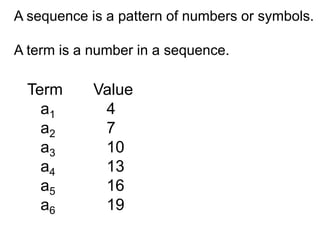
A sequence is a pattern of numbers or symbols.

A term is a number in a sequence.

  Term      Value
    a1       4
    a2       7
    a3       10
    a4       13
    a5       16
    a6       19
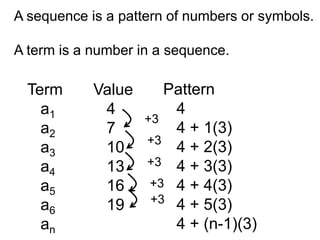
A sequence is a pattern of numbers or symbols.

A term is a number in a sequence.

  Term      Value      Pattern
    a1       4          4
                    +3
    a2       7          4 + 1(3)
                    +3
    a3       10         4 + 2(3)
    a4       13     +3 4 + 3(3)
    a5       16      +3 4 + 4(3)
                     +3
    a6       19         4 + 5(3)
    an                  4 + (n-1)(3)
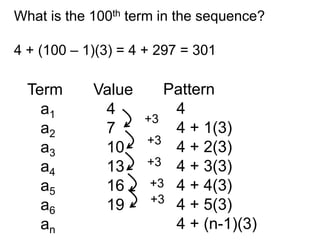
What is the 100th term in the sequence?

4 + (100 – 1)(3) = 4 + 297 = 301

  Term      Value      Pattern
    a1       4          4
                    +3
    a2       7          4 + 1(3)
                    +3
    a3       10         4 + 2(3)
    a4       13     +3 4 + 3(3)
    a5       16      +3 4 + 4(3)
                     +3
    a6       19         4 + 5(3)
    an                  4 + (n-1)(3)
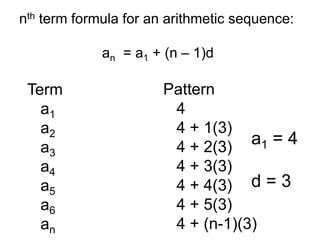
nth term formula for an arithmetic sequence:

             an = a1 + (n – 1)d

 Term                  Pattern
   a1                   4
   a2                   4 + 1(3)
   a3                   4 + 2(3)   a1 = 4
   a4                   4 + 3(3)
   a5                   4 + 4(3) d = 3
   a6                   4 + 5(3)
   an                   4 + (n-1)(3)
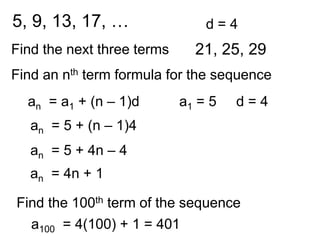
5, 9, 13, 17, …                 d=4
Find the next three terms     21, 25, 29
Find an nth term formula for the sequence
  an = a1 + (n – 1)d        a1 = 5   d=4
   an = 5 + (n – 1)4
   an = 5 + 4n – 4
   an = 4n + 1

Find the 100th term of the sequence
  a100 = 4(100) + 1 = 401
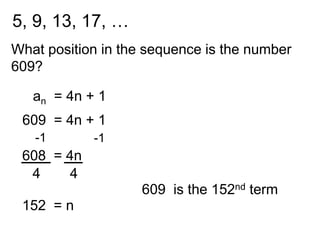
5, 9, 13, 17, …
What position in the sequence is the number
609?

   an = 4n + 1
 609 = 4n + 1
   -1       -1
 608 = 4n
  4    4
                    609 is the 152nd term
 152 = n
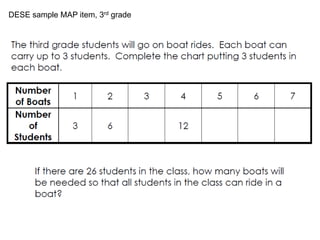
DESE sample MAP item, 3rd grade
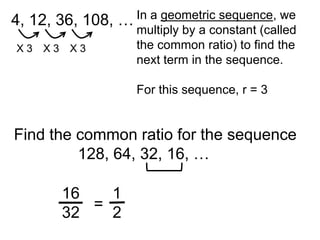
4, 12, 36, 108,   … In a geometric sequence, we
                    multiply by a constant (called
X3   X3   X3        the common ratio) to find the
                    next term in the sequence.

                     For this sequence, r = 3


Find the common ratio for the sequence
         128, 64, 32, 16, …

          16   1
             =
          32   2
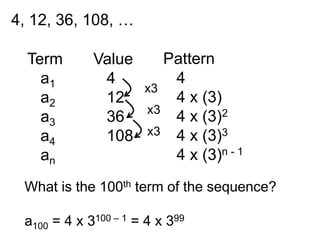
4, 12, 36, 108, …

  Term       Value       Pattern
    a1        4           4
                      x3
    a2        12          4 x (3)
                      x3
    a3        36          4 x (3)2
    a4        108     x3 4 x (3)3
    an                    4 x (3)n - 1
 What is the 100th term of the sequence?

 a100 = 4 x 3100 – 1 = 4 x 399
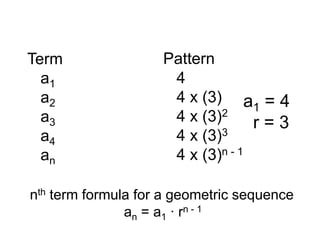
Term                Pattern
  a1                 4
  a2                 4 x (3) a = 4
                             2
                                  1
  a3                 4 x (3)      r=3
  a4                 4 x (3)3
  an                 4 x (3)n - 1

nth term formula for a geometric sequence
               an = a1 · rn - 1
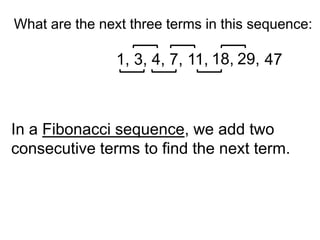
What are the next three terms in this sequence:

                1, 3, 4, 7, 11, 18, 29, 47


In a Fibonacci sequence, we add two
consecutive terms to find the next term.
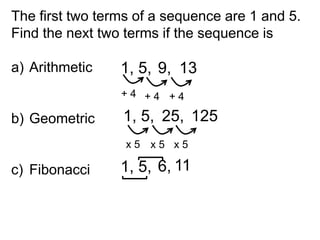
The first two terms of a sequence are 1 and 5.
Find the next two terms if the sequence is

a) Arithmetic    1, 5, 9, 13
                 +4 +4 +4

b) Geometric     1, 5, 25, 125
                  x5 x5 x5

c) Fibonacci     1, 5, 6, 11
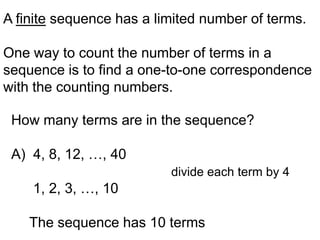
A finite sequence has a limited number of terms.

One way to count the number of terms in a
sequence is to find a one-to-one correspondence
with the counting numbers.

 How many terms are in the sequence?

 A) 4, 8, 12, …, 40
                          divide each term by 4
    1, 2, 3, …, 10

    The sequence has 10 terms
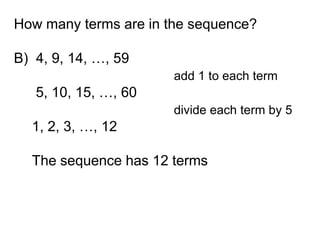
How many terms are in the sequence?

B) 4, 9, 14, …, 59
                       add 1 to each term
   5, 10, 15, …, 60
                       divide each term by 5
  1, 2, 3, …, 12

  The sequence has 12 terms
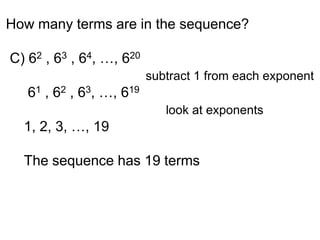
How many terms are in the sequence?

C) 62 , 63 , 64, …, 620
                          subtract 1 from each exponent
   61 , 62 , 63, …, 619
                             look at exponents
  1, 2, 3, …, 19

  The sequence has 19 terms
1150 day 1

  • 1.
  • 13.
  • 14.
    How do yousolve a problem?
  • 15.
  • 16.
    Polya’s 4-Step problem-solvingprocess (pg. 4) 1) Understand the problem 2) Devise a plan • Look for a pattern • Examine related problems • Look at a simpler case • Make a table or list • Draw a picture • Write an equation • Guess and Check • Work backward • Use direct or indirect reasoning
  • 17.
    3) Carry outthe plan 4) Look back • Does your answer make sense? • Did you answer the question that was asked? • Is there another way to find the solution?
  • 18.
  • 21.
  • 22.
  • 23.
    1. A penat the zoo holds giraffes and ostriches. Altogether, here are 30 eyes and 44 feet on the animals. How many of each type of animal are there? How would you solve this problem? Let x = the number of giraffes Let y = the number of ostriches 2x + 2y = 30  4x + 4y = 60 4x + 2y = 44 –4x – 2y = –44 2y = 16 y=8 x=7
  • 24.
    1. A penat the zoo holds giraffes and ostriches. Altogether, here are 30 eyes and 44 feet on the animals. How many of each type of animal are there? How could a 2nd grader do this problem?
  • 25.
    1. A penat the zoo holds giraffes and ostriches. Altogether, here are 30 eyes and 44 feet on the animals. How many of each type of animal are there? Each animal has two eyes 30 2 15 Each animal has at least two feet We still need 14 more feet (44 – 30) 7 giraffes 8 ostriches
  • 26.
    1. A penat the zoo holds giraffes and ostriches. Altogether, here are 30 eyes and 44 feet on the animals. How many of each type of animal are there? How did a 7th grader do this problem?
  • 27.
    1. A penat the zoo holds giraffes and ostriches. Altogether, here are 30 eyes and 44 feet on the animals. How many of each type of animal are there?
  • 30.
    2. Find thesum: 1 + 2 + 3 + … + 48 + 49 + 50
  • 31.
    Gauss’ Method 2.Find the sum: 1 + 2 + 3 + … + 48 + 49 + 50 51 51 Sum of each pair = 51 Number of pairs = Number of numbers / 2 = 25 Sum of numbers = (Number of pairs)(Sum of each pair) = (25 )(51) = 1275
  • 34.
    3. If tenpeople are in a room, how many handshakes can they exchange? People Handshakes 1 0 +1 2 1 +2 3 3 +3 4 6 +4 5 10 6 15 +5 7 21 +6 8 28 +7 9 36 +8 45 handshakes 10 45 +9
  • 39.
    4. Mark andBob began reading the same novel on the same day. Mark reads 6 pages a day, and Bob reads 5 pages a day. If Mark is on page 78, what page is Bob on? Mark: 78 / 6 = 13 days of reading Bob: 5 (13) = page 65
  • 40.
    4. Mark andBob began reading the same novel on the same day. Mark reads 6 pages a day, and Bob reads 5 pages a day. If Mark is on page 78, what page is Bob on?
  • 43.
    5. If abag of potato chips and a Snickers bar together cost $3.00, and the chips cost $1.50 more than the candy bar, how much does each item cost separately?
  • 44.
    5. If abag of potato chips and a Snickers bar together cost $3.00, and the chips cost $1.50 more than the candy bar, how much does each item cost separately? Guess-and-check must show at least one incorrect guess and the correct guess Chips Candy $1.50 $1.50 Chips and candy cost the same $2.50 $ .50 Chips cost $2.00 more $2.25 $ .75 Chips cost $1.50 more Chips: $2.25 Candy: $0.75
  • 46.
    6. Billy spent2/3 of his money on baseball cards and 1/6 of his money on a candy bar, and after that he still had 50 cents left in his pocket. How much money did he start with? Billy’s whole box of money 50₵ 50₵ 50₵ 50₵ 50₵ 50₵ Baseball cards Candy bar 6 x 50₵ = $3.00
  • 49.
    6. Billy spent2/3 of his money on baseball cards and 1/6 of his money on a candy bar, and after that he still had 50 cents left in his pocket. How much money did he start with?
  • 51.
  • 55.
    From MODESE ModelCurriculum Unit (6th grade) The student council plans to build a flower box with several sections in front of the school cafeteria. Each section will consist of squares made with railroad ties of equal length. Due to money constraints, the box will be built in several phases. Below is the plan for the first three phases. (Each side of the square represents one tie.) Phase 1 Phase 2 Phase 3 Create a table to show how many ties will be needed for each of the first six phases. Explain how you know whether the pattern represents a linear or a nonlinear function.
  • 56.
    Phase 1 Phase 2 Phase 3 Phase Ties 1 4 Linear +3 2 7 because the 3 10 +3 phase number +3 increases at a 4 13 constant rate of 5 16 +3 1, and the ties 6 19 +3 increase at a constant rate of 3
  • 57.
    A sequence isa pattern of numbers or symbols. A term is a number in a sequence. Phase Ties In an arithmetic 1 4 sequence, we add a 2 7 constant number (called 3 10 the common difference) 4 13 to find the next term in 5 16 the sequence. 6 19 For this sequence, d = 3
  • 58.
    A sequence isa pattern of numbers or symbols. A term is a number in a sequence. Term Ties 1 4 2 7 3 10 4 13 5 16 6 19
  • 59.
    A sequence isa pattern of numbers or symbols. A term is a number in a sequence. Term Ties a1 4 a2 7 a3 10 a4 13 a5 16 a6 19
  • 60.
    A sequence isa pattern of numbers or symbols. A term is a number in a sequence. Term Value a1 4 a2 7 a3 10 a4 13 a5 16 a6 19
  • 61.
    A sequence isa pattern of numbers or symbols. A term is a number in a sequence. Term Value Pattern a1 4 4 +3 a2 7 4 + 1(3) +3 a3 10 4 + 2(3) a4 13 +3 4 + 3(3) a5 16 +3 4 + 4(3) +3 a6 19 4 + 5(3) an 4 + (n-1)(3)
  • 62.
    What is the100th term in the sequence? 4 + (100 – 1)(3) = 4 + 297 = 301 Term Value Pattern a1 4 4 +3 a2 7 4 + 1(3) +3 a3 10 4 + 2(3) a4 13 +3 4 + 3(3) a5 16 +3 4 + 4(3) +3 a6 19 4 + 5(3) an 4 + (n-1)(3)
  • 63.
    nth term formulafor an arithmetic sequence: an = a1 + (n – 1)d Term Pattern a1 4 a2 4 + 1(3) a3 4 + 2(3) a1 = 4 a4 4 + 3(3) a5 4 + 4(3) d = 3 a6 4 + 5(3) an 4 + (n-1)(3)
  • 64.
    5, 9, 13,17, … d=4 Find the next three terms 21, 25, 29 Find an nth term formula for the sequence an = a1 + (n – 1)d a1 = 5 d=4 an = 5 + (n – 1)4 an = 5 + 4n – 4 an = 4n + 1 Find the 100th term of the sequence a100 = 4(100) + 1 = 401
  • 65.
    5, 9, 13,17, … What position in the sequence is the number 609? an = 4n + 1 609 = 4n + 1 -1 -1 608 = 4n 4 4 609 is the 152nd term 152 = n
  • 66.
    DESE sample MAPitem, 3rd grade
  • 67.
    4, 12, 36,108, … In a geometric sequence, we multiply by a constant (called X3 X3 X3 the common ratio) to find the next term in the sequence. For this sequence, r = 3 Find the common ratio for the sequence 128, 64, 32, 16, … 16 1 = 32 2
  • 68.
    4, 12, 36,108, … Term Value Pattern a1 4 4 x3 a2 12 4 x (3) x3 a3 36 4 x (3)2 a4 108 x3 4 x (3)3 an 4 x (3)n - 1 What is the 100th term of the sequence? a100 = 4 x 3100 – 1 = 4 x 399
  • 69.
    Term Pattern a1 4 a2 4 x (3) a = 4 2 1 a3 4 x (3) r=3 a4 4 x (3)3 an 4 x (3)n - 1 nth term formula for a geometric sequence an = a1 · rn - 1
  • 70.
    What are thenext three terms in this sequence: 1, 3, 4, 7, 11, 18, 29, 47 In a Fibonacci sequence, we add two consecutive terms to find the next term.
  • 71.
    The first twoterms of a sequence are 1 and 5. Find the next two terms if the sequence is a) Arithmetic 1, 5, 9, 13 +4 +4 +4 b) Geometric 1, 5, 25, 125 x5 x5 x5 c) Fibonacci 1, 5, 6, 11
  • 72.
    A finite sequencehas a limited number of terms. One way to count the number of terms in a sequence is to find a one-to-one correspondence with the counting numbers. How many terms are in the sequence? A) 4, 8, 12, …, 40 divide each term by 4 1, 2, 3, …, 10 The sequence has 10 terms
  • 73.
    How many termsare in the sequence? B) 4, 9, 14, …, 59 add 1 to each term 5, 10, 15, …, 60 divide each term by 5 1, 2, 3, …, 12 The sequence has 12 terms
  • 74.
    How many termsare in the sequence? C) 62 , 63 , 64, …, 620 subtract 1 from each exponent 61 , 62 , 63, …, 619 look at exponents 1, 2, 3, …, 19 The sequence has 19 terms