Part 1 Module 2 
Set operations, Venn diagrams
Set operations 
Let U = {x|x is an English-language film} 
Set A below contains the five best films according to 
the American Film Institute. 
Set B below contains the five best films according to 
TV Guide. 
Set C below contains the five most passionate films 
according to the American Film Institute.
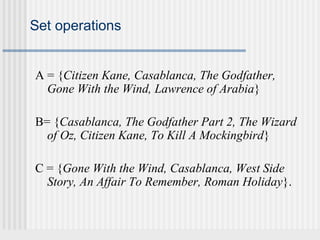
Set operations 
A = {Citizen Kane, Casablanca, The Godfather, 
Gone With the Wind, Lawrence of Arabia} 
B= {Casablanca, The Godfather Part 2, The Wizard 
of Oz, Citizen Kane, To Kill A Mockingbird} 
C = {Gone With the Wind, Casablanca, West Side 
Story, An Affair To Remember, Roman Holiday}.
Set operations 
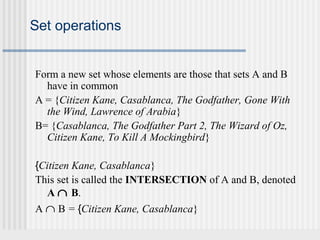
Form a new set whose elements are those that sets A and B 
have in common 
A = {Citizen Kane, Casablanca, The Godfather, Gone With 
the Wind, Lawrence of Arabia} 
B= {Casablanca, The Godfather Part 2, The Wizard of Oz, 
Citizen Kane, To Kill A Mockingbird} 
{Citizen Kane, Casablanca} 
This set is called the INTERSECTION of A and B, denoted 
A Ç B. 
A Ç B = {Citizen Kane, Casablanca}
Set operations 
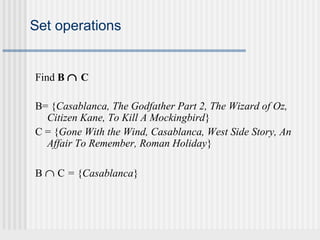
Find B Ç C 
B= {Casablanca, The Godfather Part 2, The Wizard of Oz, 
Citizen Kane, To Kill A Mockingbird} 
C = {Gone With the Wind, Casablanca, West Side Story, An 
Affair To Remember, Roman Holiday} 
B Ç C = {Casablanca}
Set operations 
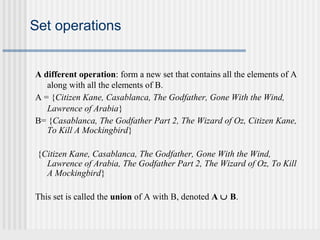
A different operation: form a new set that contains all the elements of A 
along with all the elements of B. 
A = {Citizen Kane, Casablanca, The Godfather, Gone With the Wind, 
Lawrence of Arabia} 
B= {Casablanca, The Godfather Part 2, The Wizard of Oz, Citizen Kane, 
To Kill A Mockingbird} 
{Citizen Kane, Casablanca, The Godfather, Gone With the Wind, 
Lawrence of Arabia, The Godfather Part 2, The Wizard of Oz, To Kill 
A Mockingbird} 
This set is called the union of A with B, denoted A È B.
Set operations 
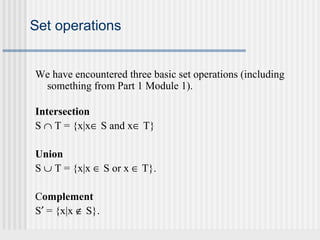
We have encountered three basic set operations (including 
something from Part 1 Module 1). 
Intersection 
S Ç T = {x|xÎ S and xÎ T} 
Union 
S È T = {x|x Î S or x Î T}. 
Complement 
S¢ = {x|x Ï S}.
Venn Diagrams 
A Venn diagram is a drawing in which sets are 
represented by geometric figures such as 
circles and rectangles. 
Venn diagrams can be used to illustrate the 
relationships between sets, and the effects of 
set operations. 
Venn diagrams are also used in other areas of 
mathematics, such as counting, probability and 
logic.
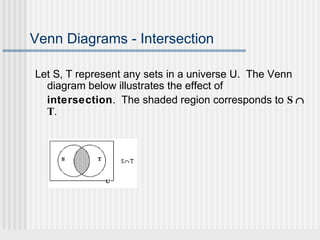
Venn Diagrams - Intersection 
Let S, T represent any sets in a universe U. The Venn 
diagram below illustrates the effect of 
intersection. The shaded region corresponds to S Ç 
T.
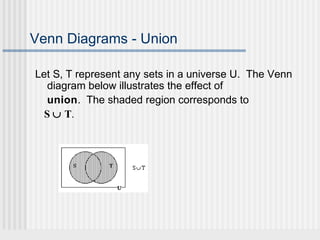
Venn Diagrams - Union 
Let S, T represent any sets in a universe U. The Venn 
diagram below illustrates the effect of 
union. The shaded region corresponds to 
S È T.
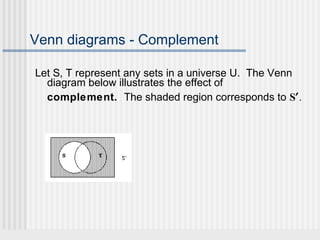
Venn diagrams - Complement 
Let S, T represent any sets in a universe U. The Venn 
diagram below illustrates the effect of 
complement. The shaded region corresponds to S¢.
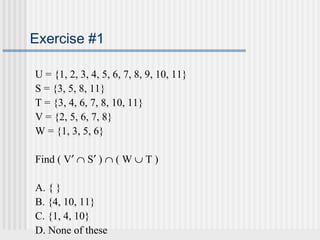
Exercise #1 
U = {1, 2, 3, 4, 5, 6, 7, 8, 9, 10, 11} 
S = {3, 5, 8, 11} 
T = {3, 4, 6, 7, 8, 10, 11} 
V = {2, 5, 6, 7, 8} 
W = {1, 3, 5, 6} 
Find ( V¢ Ç S¢ ) Ç ( W È T ) 
A. { } 
B. {4, 10, 11} 
C. {1, 4, 10} 
D. None of these
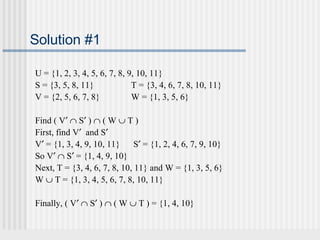
Solution #1 
U = {1, 2, 3, 4, 5, 6, 7, 8, 9, 10, 11} 
S = {3, 5, 8, 11} T = {3, 4, 6, 7, 8, 10, 11} 
V = {2, 5, 6, 7, 8} W = {1, 3, 5, 6} 
Find ( V¢ Ç S¢ ) Ç ( W È T ) 
First, find V¢ and S¢ 
V¢ = {1, 3, 4, 9, 10, 11} S¢ = {1, 2, 4, 6, 7, 9, 10} 
So V¢ Ç S¢ = {1, 4, 9, 10} 
Next, T = {3, 4, 6, 7, 8, 10, 11} and W = {1, 3, 5, 6} 
W È T = {1, 3, 4, 5, 6, 7, 8, 10, 11} 
Finally, ( V¢ Ç S¢ ) Ç ( W È T ) = {1, 4, 10}
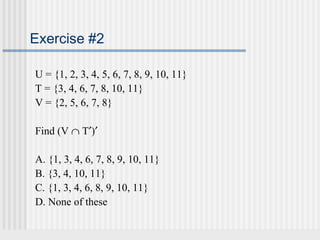
Exercise #2 
U = {1, 2, 3, 4, 5, 6, 7, 8, 9, 10, 11} 
T = {3, 4, 6, 7, 8, 10, 11} 
V = {2, 5, 6, 7, 8} 
Find (V Ç T¢)¢ 
A. {1, 3, 4, 6, 7, 8, 9, 10, 11} 
B. {3, 4, 10, 11} 
C. {1, 3, 4, 6, 8, 9, 10, 11} 
D. None of these
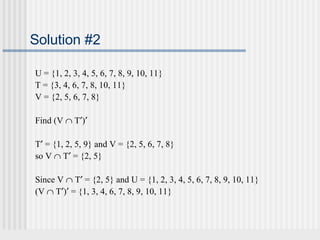
Solution #2 
U = {1, 2, 3, 4, 5, 6, 7, 8, 9, 10, 11} 
T = {3, 4, 6, 7, 8, 10, 11} 
V = {2, 5, 6, 7, 8} 
Find (V Ç T¢)¢ 
T¢ = {1, 2, 5, 9} and V = {2, 5, 6, 7, 8} 
so V Ç T¢ = {2, 5} 
Since V Ç T¢ = {2, 5} and U = {1, 2, 3, 4, 5, 6, 7, 8, 9, 10, 11} 
(V Ç T¢)¢ = {1, 3, 4, 6, 7, 8, 9, 10, 11}
EXAMPLE 1.2.1 Venn diagrams 
From your text: 
EXAMPLE 1.2.1 #13 
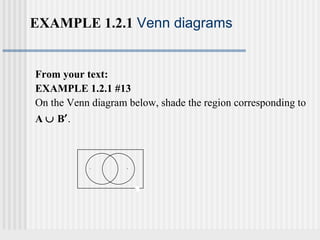
On the Venn diagram below, shade the region corresponding to 
A È B¢. 
A B 
U
Solution 
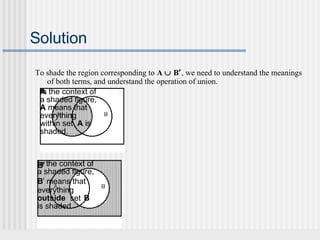
To shade the region corresponding to A È B¢, we need to understand the meanings 
of both terms, and understand the operation of union. 
AIn the context of 
a shaded figure, 
A means that 
everything 
within set A is 
shaded. 
IBn¢ the context of 
a shaded figure, 
B′ means that 
everything 
outside set B 
is shaded.
Solution, page 2 
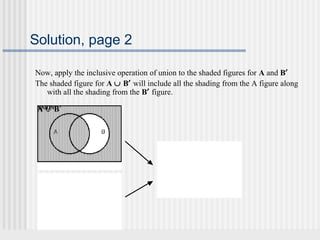
Now, apply the inclusive operation of union to the shaded figures for A and B¢ 
The shaded figure for A È B¢ will include all the shading from the A figure along 
with all the shading from the B¢ figure. 
UABN¢ I∪ON B′
Exercise #3 
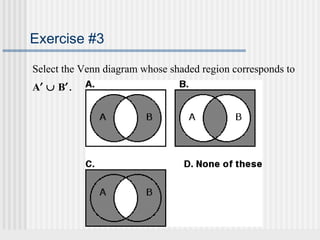
Select the Venn diagram whose shaded region corresponds to 
A¢ È B¢.
Solution #3 
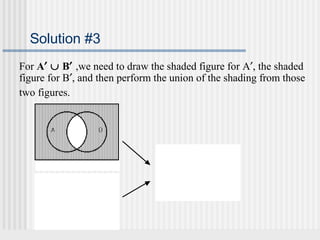
For A¢ È B¢ ,we need to draw the shaded figure for A¢, the shaded 
figure for B¢, and then perform the union of the shading from those 
two figures. 
UBAN¢¢ION A′ ∪ B′
Exercise #4 
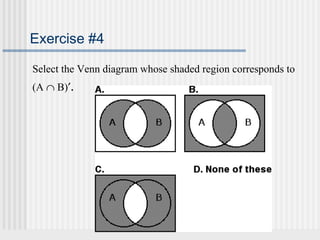
Select the Venn diagram whose shaded region corresponds to 
(A Ç B)¢.
Solution #4 
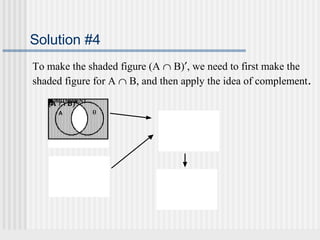
To make the shaded figure (A Ç B)¢, we need to first make the 
shaded figure for A Ç B, and then apply the idea of complement. 
I(CBANAOT MÇE ÇRP SLB BECM)T¢EINOTN
DeMorgan’s Laws 
In the previous two exercises we saw that the shaded figure for 
(A Ç B)¢ is identical to the shaded figure for A¢ È B¢. This 
means that A¢ È B¢ and (A Ç B)¢ are equivalent operations. 
This confirms one of the following general facts, which are 
known as DeMorgan’s Laws for Set Mathematics. 
For any sets S, T 
( S È T)¢ = S¢ Ç T¢ 
( S Ç T)¢ = S¢ È T¢ 
“The complement of a union is the intersection of 
the complements; the complement of an 
intersection is the union of the complements”
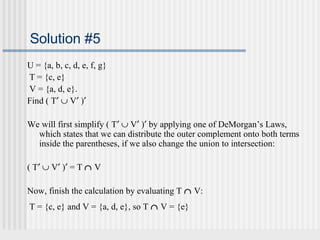
Exercise #5, DeMorgan’s Laws 
Let U = {a, b, c, d, e, f, g} 
T = {c, e} 
V = {a, d, e} 
Find ( T¢ È V¢ )¢ 
A. {e} 
B. {a, c, d, e} 
C. {b, f, g} 
D. None of these
Solution #5 
U = {a, b, c, d, e, f, g} 
T = {c, e} 
V = {a, d, e}. 
Find ( T¢ È V¢ )¢ 
We will first simplify ( T¢ È V¢ )¢ by applying one of DeMorgan’s Laws, 
which states that we can distribute the outer complement onto both terms 
inside the parentheses, if we also change the union to intersection: 
( T¢ È V¢ )¢ = T Ç V 
Now, finish the calculation by evaluating T Ç V: 
T = {c, e} and V = {a, d, e}, so T Ç V = {e}
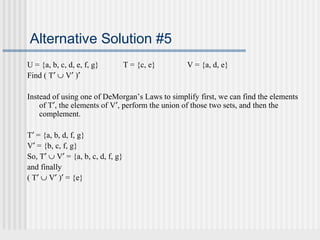
Alternative Solution #5 
U = {a, b, c, d, e, f, g} T = {c, e} V = {a, d, e} 
Find ( T¢ È V¢ )¢ 
Instead of using one of DeMorgan’s Laws to simplify first, we can find the elements 
of T¢, the elements of V¢, perform the union of those two sets, and then the 
complement. 
T¢ = {a, b, d, f, g} 
V¢ = {b, c, f, g} 
So, T¢ È V¢ = {a, b, c, d, f, g} 
and finally 
( T¢ È V¢ )¢ = {e}
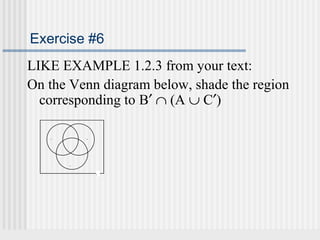
Exercise #6 
LIKE EXAMPLE 1.2.3 from your text: 
On the Venn diagram below, shade the region 
corresponding to B¢ Ç (A È C¢) 
A B 
U 
C
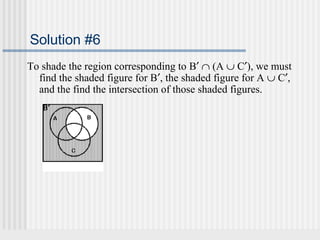
Solution #6 
To shade the region corresponding to B¢ Ç (A È C¢), we must 
find the shaded figure for B¢, the shaded figure for A È C¢, 
and the find the intersection of those shaded figures. 
B¢ 
B¢ means that  
we shade  
everything  
outside of set B.
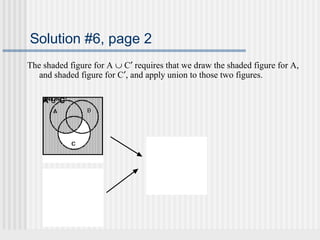
Solution #6, page 2 
The shaded figure for A È C¢ requires that we draw the shaded figure for A, 
and shaded figure for C¢, and apply union to those two figures. 
UACN ¢I∪ON C′
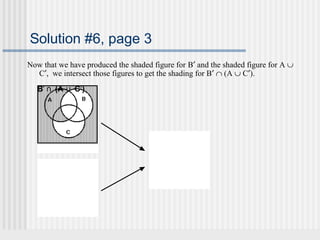
Solution #6, page 3 
Now that we have produced the shaded figure for B¢ and the shaded figure for A È 
C¢, we intersect those figures to get the shading for B¢ Ç (A È C¢). 
IBABNT′¢ ∪E∩R SC(EA′C T∪IO NC′)
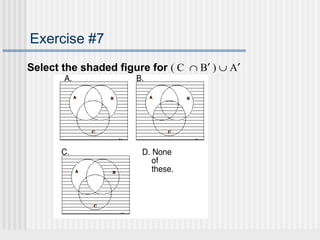
Exercise #7 
Select the shaded figure for ( C Ç B¢ ) È A¢

sets and venn diagrams

  • 1.
    Part 1 Module2 Set operations, Venn diagrams
  • 2.
    Set operations LetU = {x|x is an English-language film} Set A below contains the five best films according to the American Film Institute. Set B below contains the five best films according to TV Guide. Set C below contains the five most passionate films according to the American Film Institute.
  • 3.
    Set operations A= {Citizen Kane, Casablanca, The Godfather, Gone With the Wind, Lawrence of Arabia} B= {Casablanca, The Godfather Part 2, The Wizard of Oz, Citizen Kane, To Kill A Mockingbird} C = {Gone With the Wind, Casablanca, West Side Story, An Affair To Remember, Roman Holiday}.
  • 4.
    Set operations Forma new set whose elements are those that sets A and B have in common A = {Citizen Kane, Casablanca, The Godfather, Gone With the Wind, Lawrence of Arabia} B= {Casablanca, The Godfather Part 2, The Wizard of Oz, Citizen Kane, To Kill A Mockingbird} {Citizen Kane, Casablanca} This set is called the INTERSECTION of A and B, denoted A Ç B. A Ç B = {Citizen Kane, Casablanca}
  • 5.
    Set operations FindB Ç C B= {Casablanca, The Godfather Part 2, The Wizard of Oz, Citizen Kane, To Kill A Mockingbird} C = {Gone With the Wind, Casablanca, West Side Story, An Affair To Remember, Roman Holiday} B Ç C = {Casablanca}
  • 6.
    Set operations Adifferent operation: form a new set that contains all the elements of A along with all the elements of B. A = {Citizen Kane, Casablanca, The Godfather, Gone With the Wind, Lawrence of Arabia} B= {Casablanca, The Godfather Part 2, The Wizard of Oz, Citizen Kane, To Kill A Mockingbird} {Citizen Kane, Casablanca, The Godfather, Gone With the Wind, Lawrence of Arabia, The Godfather Part 2, The Wizard of Oz, To Kill A Mockingbird} This set is called the union of A with B, denoted A È B.
  • 7.
    Set operations Wehave encountered three basic set operations (including something from Part 1 Module 1). Intersection S Ç T = {x|xÎ S and xÎ T} Union S È T = {x|x Î S or x Î T}. Complement S¢ = {x|x Ï S}.
  • 8.
    Venn Diagrams AVenn diagram is a drawing in which sets are represented by geometric figures such as circles and rectangles. Venn diagrams can be used to illustrate the relationships between sets, and the effects of set operations. Venn diagrams are also used in other areas of mathematics, such as counting, probability and logic.
  • 9.
    Venn Diagrams -Intersection Let S, T represent any sets in a universe U. The Venn diagram below illustrates the effect of intersection. The shaded region corresponds to S Ç T.
  • 10.
    Venn Diagrams -Union Let S, T represent any sets in a universe U. The Venn diagram below illustrates the effect of union. The shaded region corresponds to S È T.
  • 11.
    Venn diagrams -Complement Let S, T represent any sets in a universe U. The Venn diagram below illustrates the effect of complement. The shaded region corresponds to S¢.
  • 12.
    Exercise #1 U= {1, 2, 3, 4, 5, 6, 7, 8, 9, 10, 11} S = {3, 5, 8, 11} T = {3, 4, 6, 7, 8, 10, 11} V = {2, 5, 6, 7, 8} W = {1, 3, 5, 6} Find ( V¢ Ç S¢ ) Ç ( W È T ) A. { } B. {4, 10, 11} C. {1, 4, 10} D. None of these
  • 13.
    Solution #1 U= {1, 2, 3, 4, 5, 6, 7, 8, 9, 10, 11} S = {3, 5, 8, 11} T = {3, 4, 6, 7, 8, 10, 11} V = {2, 5, 6, 7, 8} W = {1, 3, 5, 6} Find ( V¢ Ç S¢ ) Ç ( W È T ) First, find V¢ and S¢ V¢ = {1, 3, 4, 9, 10, 11} S¢ = {1, 2, 4, 6, 7, 9, 10} So V¢ Ç S¢ = {1, 4, 9, 10} Next, T = {3, 4, 6, 7, 8, 10, 11} and W = {1, 3, 5, 6} W È T = {1, 3, 4, 5, 6, 7, 8, 10, 11} Finally, ( V¢ Ç S¢ ) Ç ( W È T ) = {1, 4, 10}
  • 14.
    Exercise #2 U= {1, 2, 3, 4, 5, 6, 7, 8, 9, 10, 11} T = {3, 4, 6, 7, 8, 10, 11} V = {2, 5, 6, 7, 8} Find (V Ç T¢)¢ A. {1, 3, 4, 6, 7, 8, 9, 10, 11} B. {3, 4, 10, 11} C. {1, 3, 4, 6, 8, 9, 10, 11} D. None of these
  • 15.
    Solution #2 U= {1, 2, 3, 4, 5, 6, 7, 8, 9, 10, 11} T = {3, 4, 6, 7, 8, 10, 11} V = {2, 5, 6, 7, 8} Find (V Ç T¢)¢ T¢ = {1, 2, 5, 9} and V = {2, 5, 6, 7, 8} so V Ç T¢ = {2, 5} Since V Ç T¢ = {2, 5} and U = {1, 2, 3, 4, 5, 6, 7, 8, 9, 10, 11} (V Ç T¢)¢ = {1, 3, 4, 6, 7, 8, 9, 10, 11}
  • 16.
    EXAMPLE 1.2.1 Venndiagrams From your text: EXAMPLE 1.2.1 #13 On the Venn diagram below, shade the region corresponding to A È B¢. A B U
  • 17.
    Solution To shadethe region corresponding to A È B¢, we need to understand the meanings of both terms, and understand the operation of union. AIn the context of a shaded figure, A means that everything within set A is shaded. IBn¢ the context of a shaded figure, B′ means that everything outside set B is shaded.
  • 18.
    Solution, page 2 Now, apply the inclusive operation of union to the shaded figures for A and B¢ The shaded figure for A È B¢ will include all the shading from the A figure along with all the shading from the B¢ figure. UABN¢ I∪ON B′
  • 19.
    Exercise #3 Selectthe Venn diagram whose shaded region corresponds to A¢ È B¢.
  • 20.
    Solution #3 ForA¢ È B¢ ,we need to draw the shaded figure for A¢, the shaded figure for B¢, and then perform the union of the shading from those two figures. UBAN¢¢ION A′ ∪ B′
  • 21.
    Exercise #4 Selectthe Venn diagram whose shaded region corresponds to (A Ç B)¢.
  • 22.
    Solution #4 Tomake the shaded figure (A Ç B)¢, we need to first make the shaded figure for A Ç B, and then apply the idea of complement. I(CBANAOT MÇE ÇRP SLB BECM)T¢EINOTN
  • 23.
    DeMorgan’s Laws Inthe previous two exercises we saw that the shaded figure for (A Ç B)¢ is identical to the shaded figure for A¢ È B¢. This means that A¢ È B¢ and (A Ç B)¢ are equivalent operations. This confirms one of the following general facts, which are known as DeMorgan’s Laws for Set Mathematics. For any sets S, T ( S È T)¢ = S¢ Ç T¢ ( S Ç T)¢ = S¢ È T¢ “The complement of a union is the intersection of the complements; the complement of an intersection is the union of the complements”
  • 24.
    Exercise #5, DeMorgan’sLaws Let U = {a, b, c, d, e, f, g} T = {c, e} V = {a, d, e} Find ( T¢ È V¢ )¢ A. {e} B. {a, c, d, e} C. {b, f, g} D. None of these
  • 25.
    Solution #5 U= {a, b, c, d, e, f, g} T = {c, e} V = {a, d, e}. Find ( T¢ È V¢ )¢ We will first simplify ( T¢ È V¢ )¢ by applying one of DeMorgan’s Laws, which states that we can distribute the outer complement onto both terms inside the parentheses, if we also change the union to intersection: ( T¢ È V¢ )¢ = T Ç V Now, finish the calculation by evaluating T Ç V: T = {c, e} and V = {a, d, e}, so T Ç V = {e}
  • 26.
    Alternative Solution #5 U = {a, b, c, d, e, f, g} T = {c, e} V = {a, d, e} Find ( T¢ È V¢ )¢ Instead of using one of DeMorgan’s Laws to simplify first, we can find the elements of T¢, the elements of V¢, perform the union of those two sets, and then the complement. T¢ = {a, b, d, f, g} V¢ = {b, c, f, g} So, T¢ È V¢ = {a, b, c, d, f, g} and finally ( T¢ È V¢ )¢ = {e}
  • 27.
    Exercise #6 LIKEEXAMPLE 1.2.3 from your text: On the Venn diagram below, shade the region corresponding to B¢ Ç (A È C¢) A B U C
  • 28.
    Solution #6 Toshade the region corresponding to B¢ Ç (A È C¢), we must find the shaded figure for B¢, the shaded figure for A È C¢, and the find the intersection of those shaded figures. B¢ B¢ means that we shade everything outside of set B.
  • 29.
    Solution #6, page2 The shaded figure for A È C¢ requires that we draw the shaded figure for A, and shaded figure for C¢, and apply union to those two figures. UACN ¢I∪ON C′
  • 30.
    Solution #6, page3 Now that we have produced the shaded figure for B¢ and the shaded figure for A È C¢, we intersect those figures to get the shading for B¢ Ç (A È C¢). IBABNT′¢ ∪E∩R SC(EA′C T∪IO NC′)
  • 31.
    Exercise #7 Selectthe shaded figure for ( C Ç B¢ ) È A¢