Grade 7 – Mathematics
Quarter I
OPERATIONS ON SETS
•define and describe the union and
intersection of sets;
•illustrate difference of two sets and
complement of a set; and
•use Venn Diagram to represent set
operations.
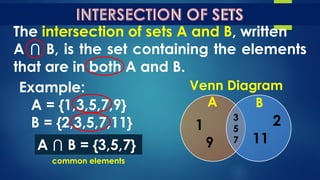
The intersection of sets A and B, written
A ⋂ B, is the set containing the elements
that are in both A and B.
Example:
A = {1,3,5,7,9}
B = {2,3,5,7,11}
A ⋂ B = {3,5,7}
Venn Diagram
A B
3
5
7
1
9
2
11
common elements
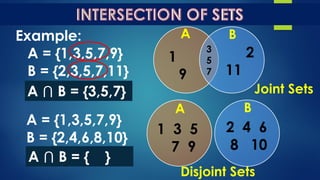
Example:
A = {1,3,5,7,9}
B = {2,3,5,7,11}
A ⋂ B = {3,5,7}
A B
3
5
7
1
9
2
11
Joint Sets
A = {1,3,5,7,9}
B = {2,4,6,8,10}
A ⋂ B = { }
A B
1 3 5
7 9
2 4 6
8 10
Disjoint Sets
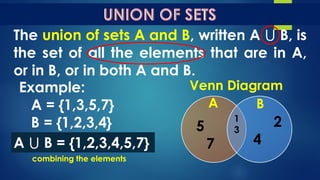
The union of sets A and B, written A ⋃ B, is
the set of all the elements that are in A,
or in B, or in both A and B.
Example:
A = {1,3,5,7}
B = {1,2,3,4}
A ⋃ B = {1,2,3,4,5,7}
Venn Diagram
combining the elements
A B
1
35
7
2
4
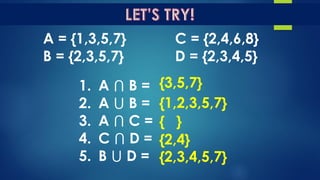
A = {1,3,5,7} C = {2,4,6,8}
B = {2,3,5,7} D = {2,3,4,5}
1. A ⋂ B =
2. A ⋃ B =
3. A ⋂ C =
4. C ⋂ D =
5. B ⋃ D =
{3,5,7}
{1,2,3,5,7}
{ }
{2,4}
{2,3,4,5,7}
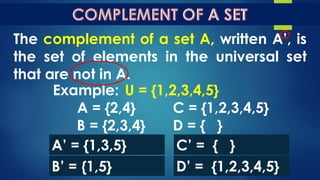
The complement of a set A, written A’, is
the set of elements in the universal set
that are not in A.
Example: U = {1,2,3,4,5}
A = {2,4} C = {1,2,3,4,5}
B = {2,3,4} D = { }
A’ = {1,3,5}
B’ = {1,5}
C’ = { }
D’ = {1,2,3,4,5}
A’ =
B’ =
C’ =
D’ =
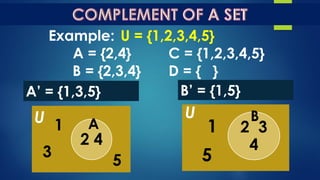
Example: U = {1,2,3,4,5}
A = {2,4} C = {1,2,3,4,5}
B = {2,3,4} D = { }
A’ = {1,3,5} B’ = {1,5}
2 4
U 1
3
5
A 2 3
4
U
1
5
B
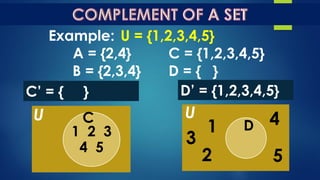
Example: U = {1,2,3,4,5}
A = {2,4} C = {1,2,3,4,5}
B = {2,3,4} D = { }
C’ = { } D’ = {1,2,3,4,5}
U
1
2
3
4
5
D1 2 3
4 5
U C
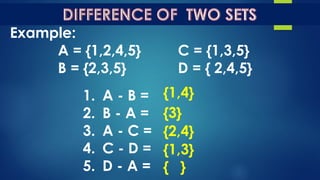
Example:
A = {1,2,4,5} C = {1,3,5}
B = {2,3,5} D = { 2,4,5}
1. A - B =
2. B - A =
3. A - C =
4. C - D =
5. D - A =
{1,4}
{3}
{2,4}
{1,3}
{ }

Operations on Sets

  • 1.
    Grade 7 –Mathematics Quarter I OPERATIONS ON SETS
  • 2.
    •define and describethe union and intersection of sets; •illustrate difference of two sets and complement of a set; and •use Venn Diagram to represent set operations.
  • 3.
    The intersection ofsets A and B, written A ⋂ B, is the set containing the elements that are in both A and B. Example: A = {1,3,5,7,9} B = {2,3,5,7,11} A ⋂ B = {3,5,7} Venn Diagram A B 3 5 7 1 9 2 11 common elements
  • 4.
    Example: A = {1,3,5,7,9} B= {2,3,5,7,11} A ⋂ B = {3,5,7} A B 3 5 7 1 9 2 11 Joint Sets A = {1,3,5,7,9} B = {2,4,6,8,10} A ⋂ B = { } A B 1 3 5 7 9 2 4 6 8 10 Disjoint Sets
  • 5.
    The union ofsets A and B, written A ⋃ B, is the set of all the elements that are in A, or in B, or in both A and B. Example: A = {1,3,5,7} B = {1,2,3,4} A ⋃ B = {1,2,3,4,5,7} Venn Diagram combining the elements A B 1 35 7 2 4
  • 6.
    A = {1,3,5,7}C = {2,4,6,8} B = {2,3,5,7} D = {2,3,4,5} 1. A ⋂ B = 2. A ⋃ B = 3. A ⋂ C = 4. C ⋂ D = 5. B ⋃ D = {3,5,7} {1,2,3,5,7} { } {2,4} {2,3,4,5,7}
  • 7.
    The complement ofa set A, written A’, is the set of elements in the universal set that are not in A. Example: U = {1,2,3,4,5} A = {2,4} C = {1,2,3,4,5} B = {2,3,4} D = { } A’ = {1,3,5} B’ = {1,5} C’ = { } D’ = {1,2,3,4,5} A’ = B’ = C’ = D’ =
  • 8.
    Example: U ={1,2,3,4,5} A = {2,4} C = {1,2,3,4,5} B = {2,3,4} D = { } A’ = {1,3,5} B’ = {1,5} 2 4 U 1 3 5 A 2 3 4 U 1 5 B
  • 9.
    Example: U ={1,2,3,4,5} A = {2,4} C = {1,2,3,4,5} B = {2,3,4} D = { } C’ = { } D’ = {1,2,3,4,5} U 1 2 3 4 5 D1 2 3 4 5 U C
  • 10.
    Example: A = {1,2,4,5}C = {1,3,5} B = {2,3,5} D = { 2,4,5} 1. A - B = 2. B - A = 3. A - C = 4. C - D = 5. D - A = {1,4} {3} {2,4} {1,3} { }