The document provides information about sets including:
1) Sets can be finite, infinite, empty, or singleton and are represented using curly brackets. Common set operations are union, intersection, and complement.
2) A set's cardinality refers to the number of elements it contains. Subsets are sets contained within other sets.
3) Examples are given of representing sets using roster and set-builder methods and performing set operations like union, intersection, and complement on sample sets.
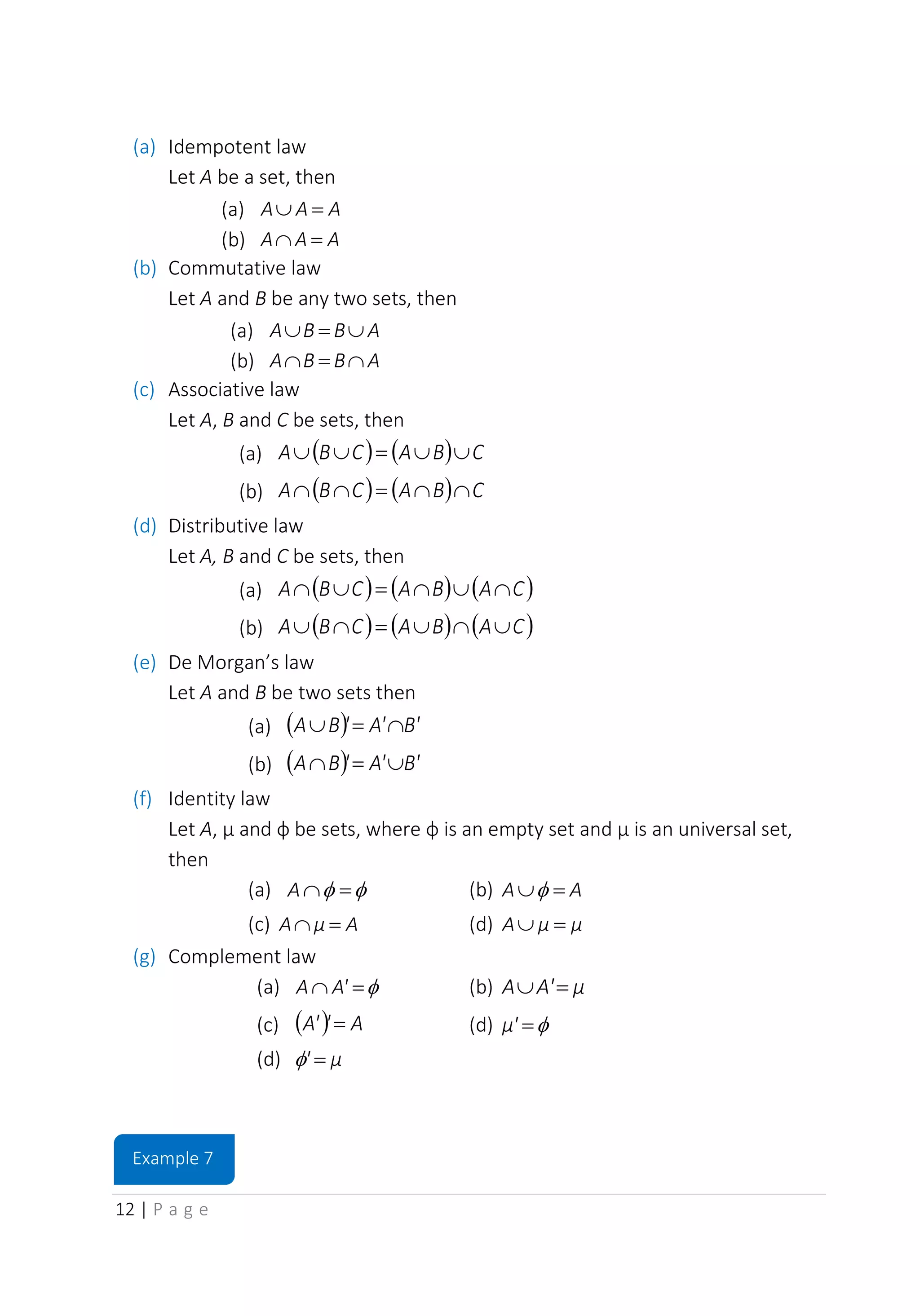
4) Basic properties of sets like idempotent, commutative, and associative laws for simplifying set expressions are outlined.



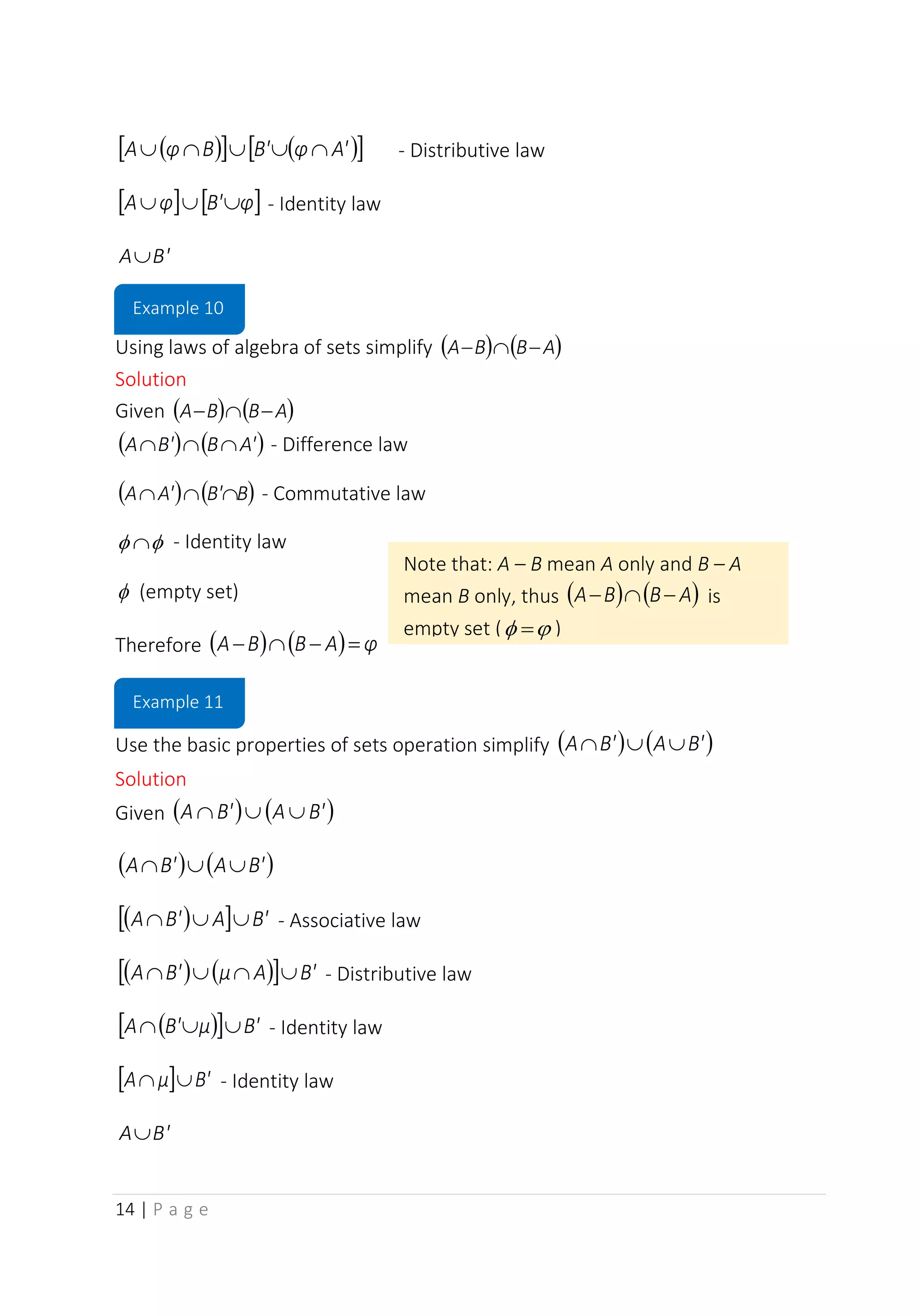
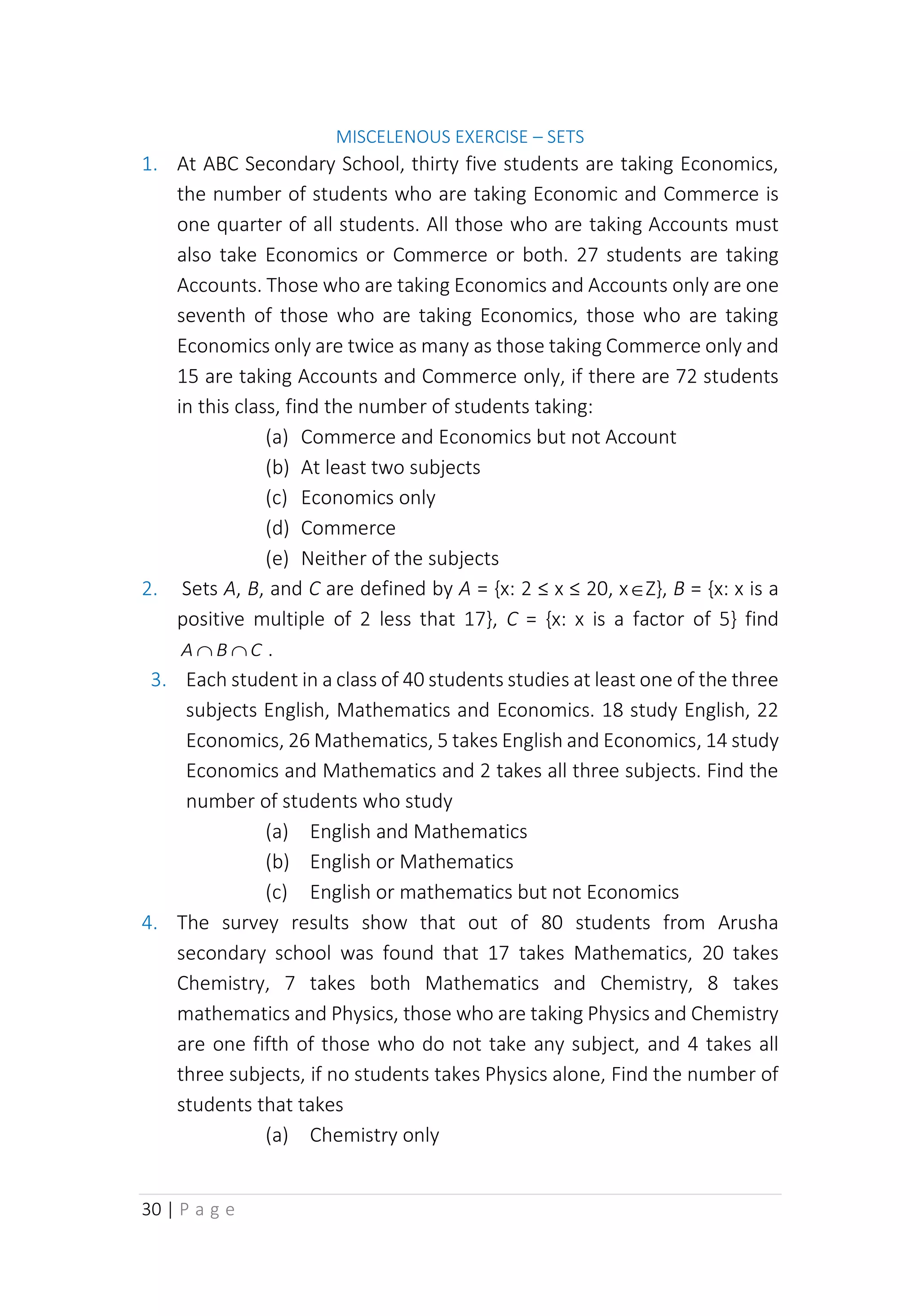
![8 | P a g e
(c) A and B share elements, but neither is a subset of the other
(d) A and B have no common elements, thus disjoint sets.
Theorems of subsets
(a) The empty set is a subset of any set
(b) Every set is a subset of itself
(c) Number of subsets of a set is given by the formula, n
S 2
= where n is the
cardinality of a set.
List all subsets of set A = {a, b, c}
Solution
First, determine how many subsets are in set A by using the formula n
S 2
=
Subsets 8
23
=
= , therefore there are 8 subsets in set A. When listing we start with
empty set and we end with the set itself (refer the theorems above)
S = { }, {a}, {b}, {c}, {a, b}, {a, c}, {b, c}, {a, b, c}.
How many subsets are in set B = { 3, 4, 6, 7, 9}
Solution
Number of subsets is given by n
S 2
=
Number of subsets in set B is 32
25
=
=
S subsets
BASIC OPERATION OF SETS
1. UNION OF SETS [ B
A
B
or
A
= ]
Let consider sets A and B, the union of two or more sets is denoted by . The
union of set A and B is written as B
A .
Definition
The union of two or more sets is a new set formed by putting together all elements,
which are in individual sets without repeating elements.
Example 2
Example 3](https://image.slidesharecdn.com/sets-220622091858-dd7c7ca6/75/mathematical-sets-pdf-8-2048.jpg)
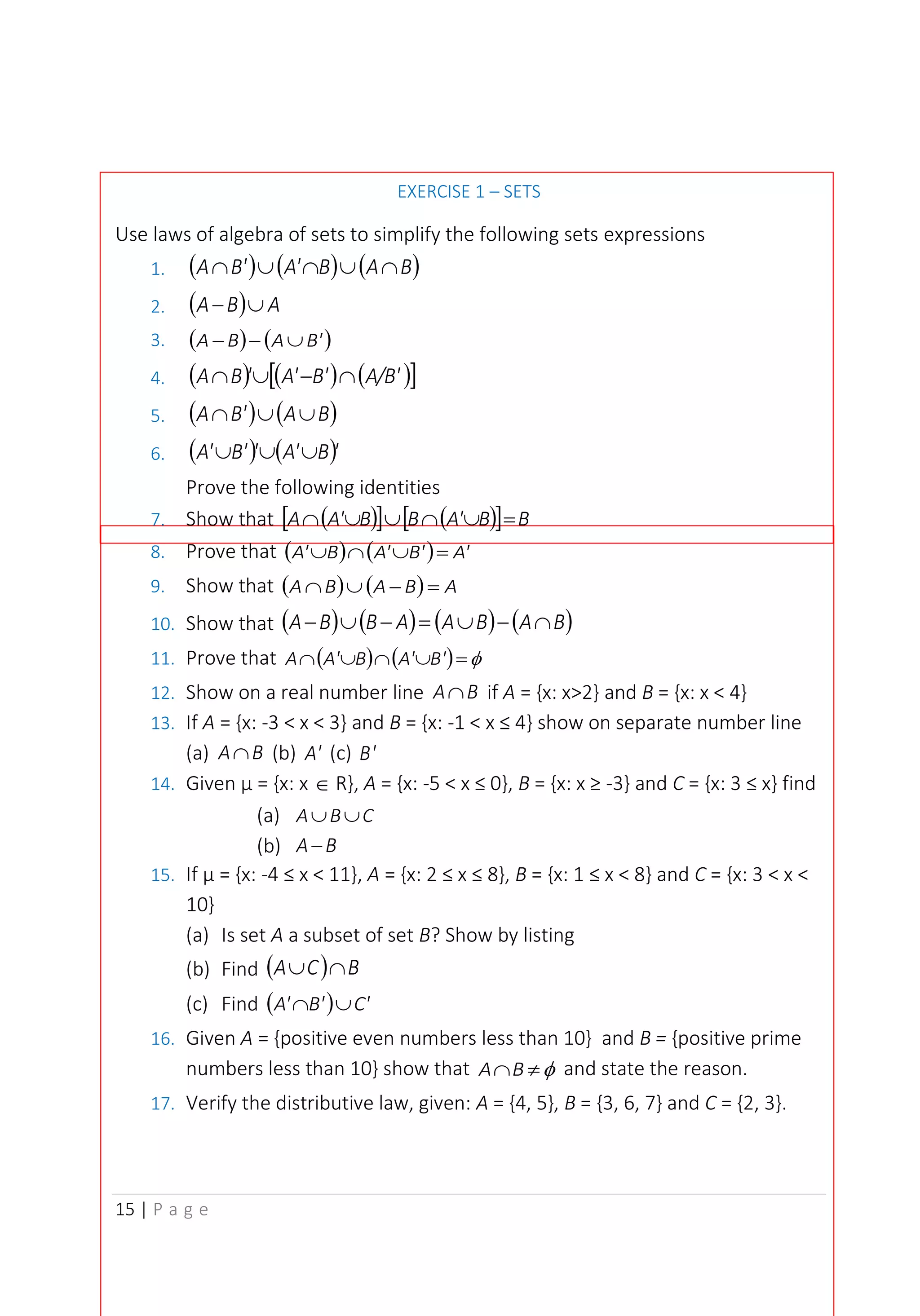
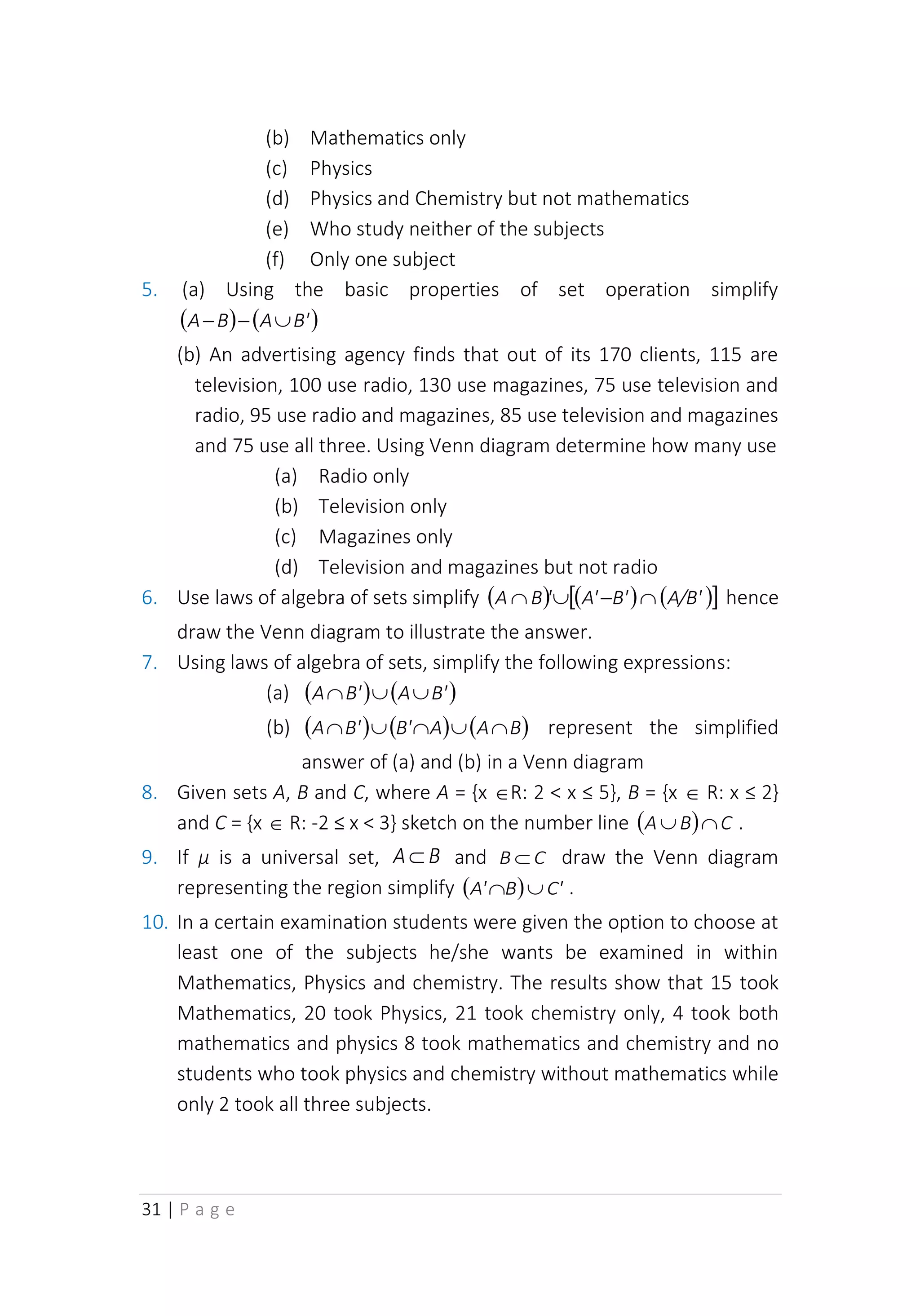
![9 | P a g e
Suppose, A = {2, 3, 5, 6, 8, 9} and B = {1, 3, 5, 7, 8} then B
A = { 1, 2, 3, 5, 6, 7,
8, 9}.
2. INTERSECTION OF SETS [ B
A
B
A
=
and ]
The intersection is denoted by . The intersection of set A and B is written as
B
A .
Definition
The intersection of two or more sets is a new set formed by using the common
elements of sets without repetition.
Suppose, A = {2, 3, 5, 6, 8, 9, 13} and B = {1, 3, 5, 7, 8}, then B
A = {3, 5, 8}
3. COMPLEMENT OF SETS [ A'
A
not = ]
Consider the universal set μ , and set A. Set A complement is written as A' or
c
A
which is defined as the set of all elements which are in universal set, μ , but there
are not in set A.
Consider sets µ = {x : x is an integer, and 1 ≤ x ≤ 12}, A = {2, 4, 6, 8, 10, 12} and B =
{1, 2, 4, 6, 7, 9}
Find
(a) B
A (b) B
A (c) B'
A (d) B'
A'
(e) B'
A' (f) Verify that ( ) B'
A'
'
B
A
=
Solution
Given µ = {x : x is an integer, and 1 ≤ x ≤ 12}, A = {2, 4, 6, 8, 10, 12} and B = {1, 2,
4, 6, 7, 9}
(a) B
A = {2, 4, 6}.
(b) B
A = { 1, 2, 4, 6, 7, 8, 9, 10, 12}.
(c) Find first B' this is B' = { 3, 5, 8, 10, 11, 12, 13} therefore,
B'
A = {2, 3, 4, 5, 6, 8, 10, 11, 12, 13}.
(d) A' = {1, 3, 5, 7, 9, 11, 13} therefore, B'
A' = {3, 5, 11, 13}
(e) Using the above data, B'
A' = { 1, 3, 5, 7, 8, 9, 10, 11, 12, 13}
(f) From (e) above B'
A' = { 1, 3, 5, 7, 8, 9, 10, 11, 12, 13} and
Example 4](https://image.slidesharecdn.com/sets-220622091858-dd7c7ca6/75/mathematical-sets-pdf-9-2048.jpg)
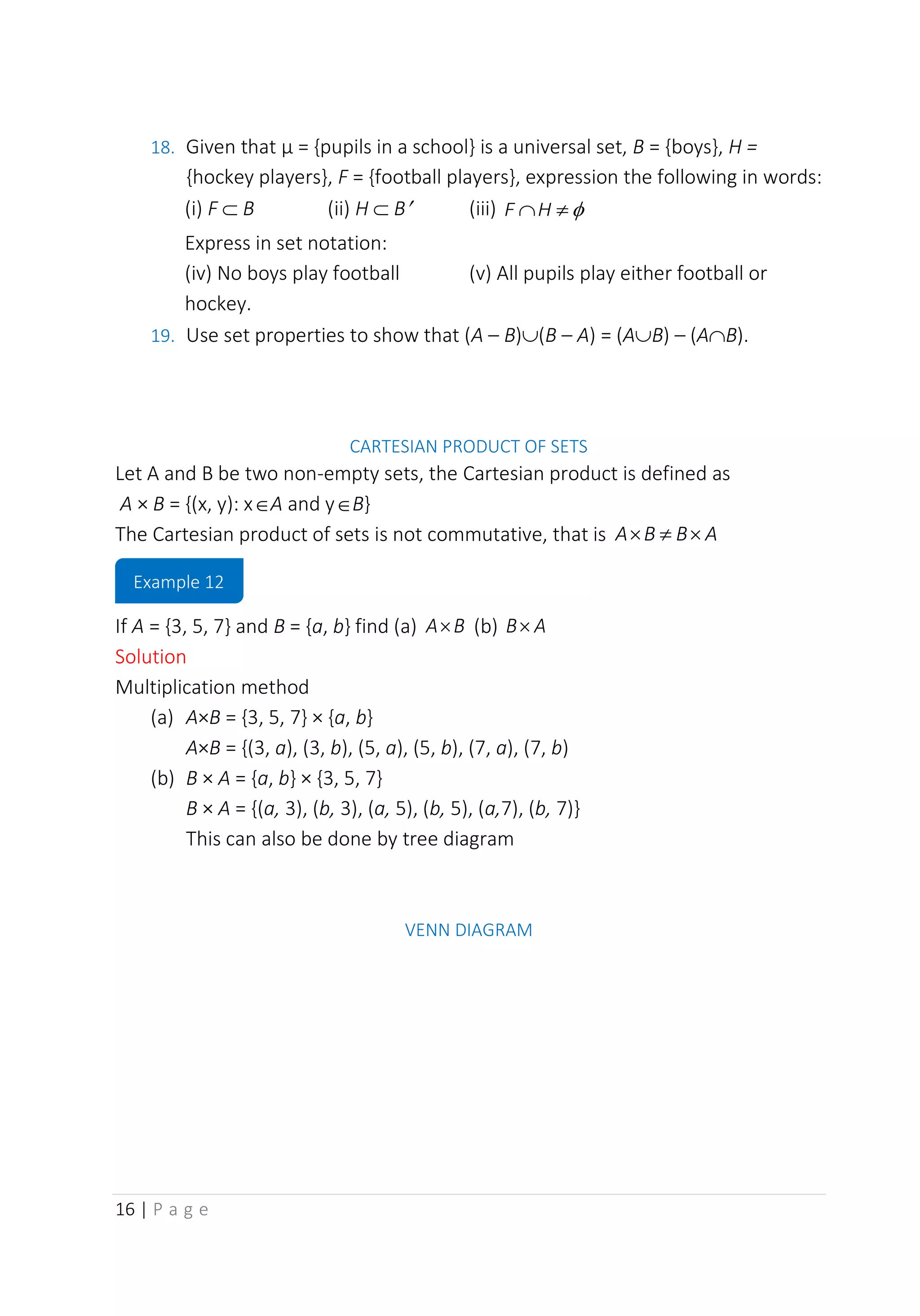
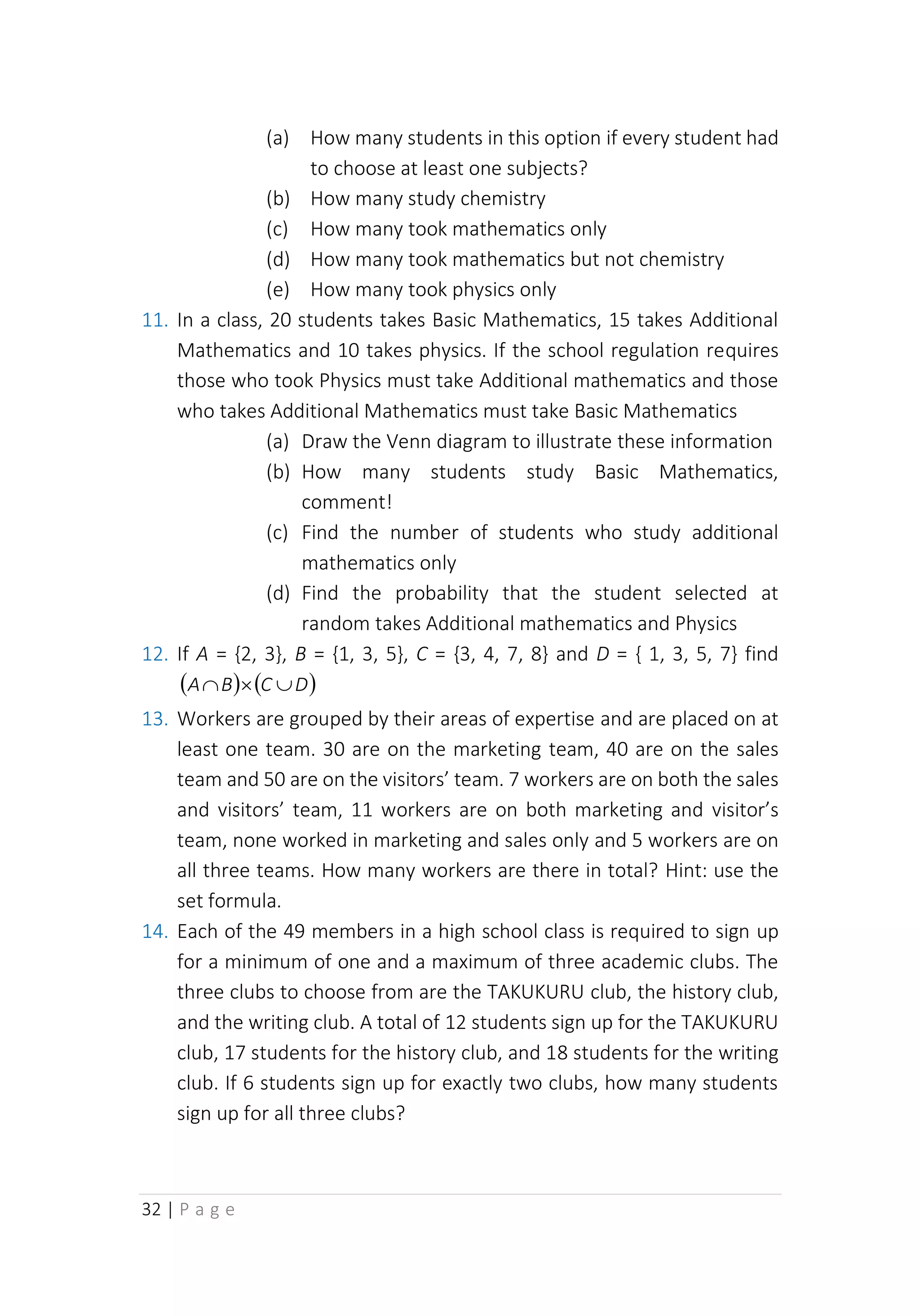
![10 | P a g e
( )'
B
A = {1, 3, 5, 7, 8, 9, 10, 11, 12, 13}, therefore ( )'
B
A
B'
A'
=
verified.
Given that A = {(x,y): 2x + y = 5} and B = {(x,y): x + 3y = 5} find B
A
Solution
It is clear that both sets A and B are linear lines, therefore to get the intersection
of these lines we need to solve the lines simultaneously, (by elimination method)
10
6
2
5
2
5
3
5
2
2
1
=
+
=
+
−
=
+
=
+
y
x
y
x
y
x
y
x
5
5 −
=
− y 1
=
y , using equation (ii) 5
3 =
+ y
x 2
3
5 =
−
=
x
x therefore
B
A = {(x,y): x = 2 and y = 1}.
INEQUALITY PROBLEMS IN SETS
Inequalities in sets may have finite or infinite solution(s). The sign < or > are called
exclusive signs which means the values/numbers pointed by these signs are not
includes in a set/relation, these points are shown by an open small circle like, o .
Using brackets the signs < or > is denoted by ( ). The signs ≤ or ≥ are called inclusive
signs which means the values/numbers pointed by these signs are included points
in a set/relation and they are denoted by a full shaded small circle like, • . Using
brackets the signs ≤ or ≥ is denoted as [ ].
Brackets representation of inequality signs
(a) The round brackets shows open intervals (exclusive points), thus
( ) b
x
a
b
a,
=
(b) The square brackets shows the closed intervals (included points), thus
b
x
a
b
a,
=
b
x
a
a b
b
x
a
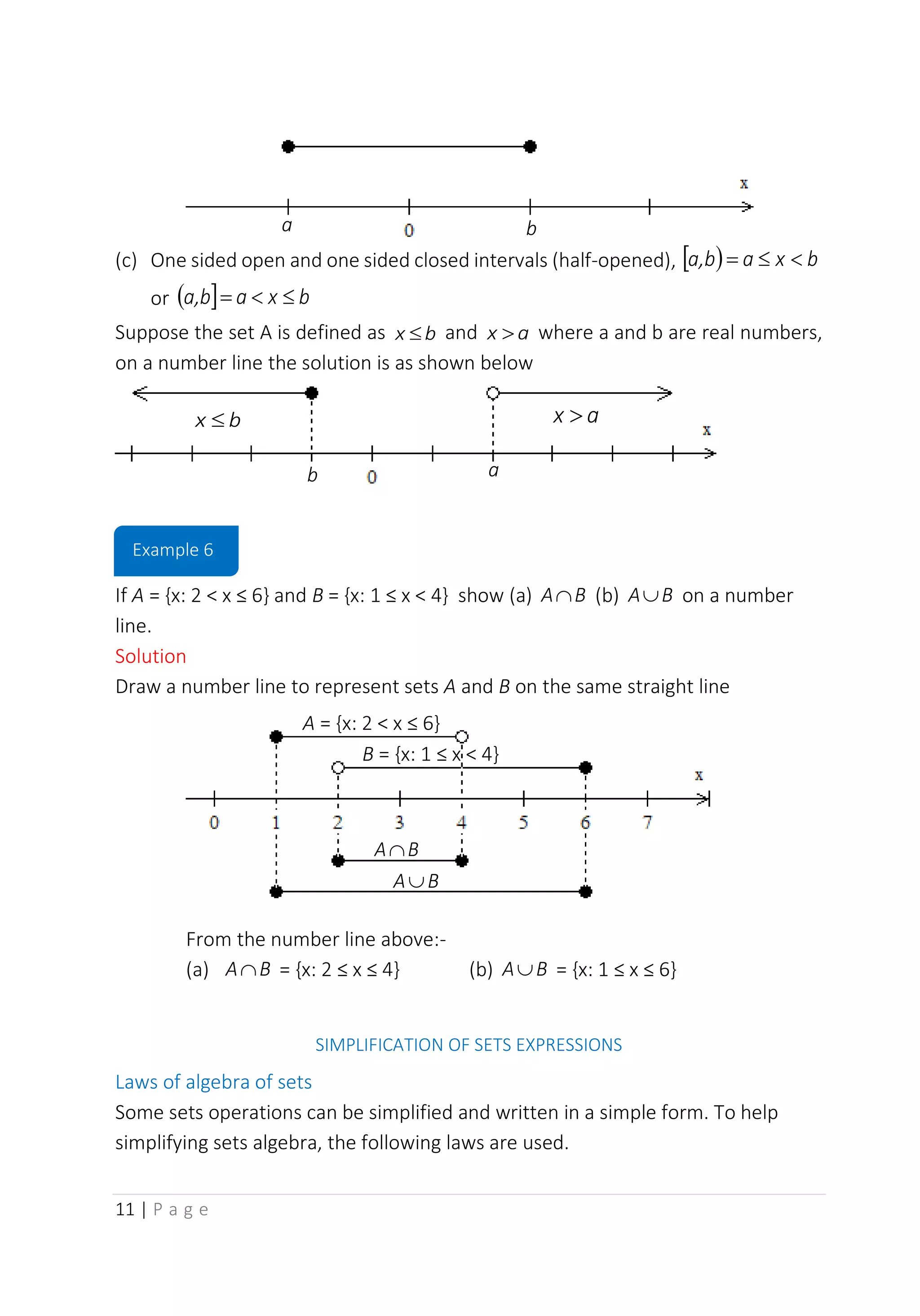
Example 5](https://image.slidesharecdn.com/sets-220622091858-dd7c7ca6/75/mathematical-sets-pdf-10-2048.jpg)
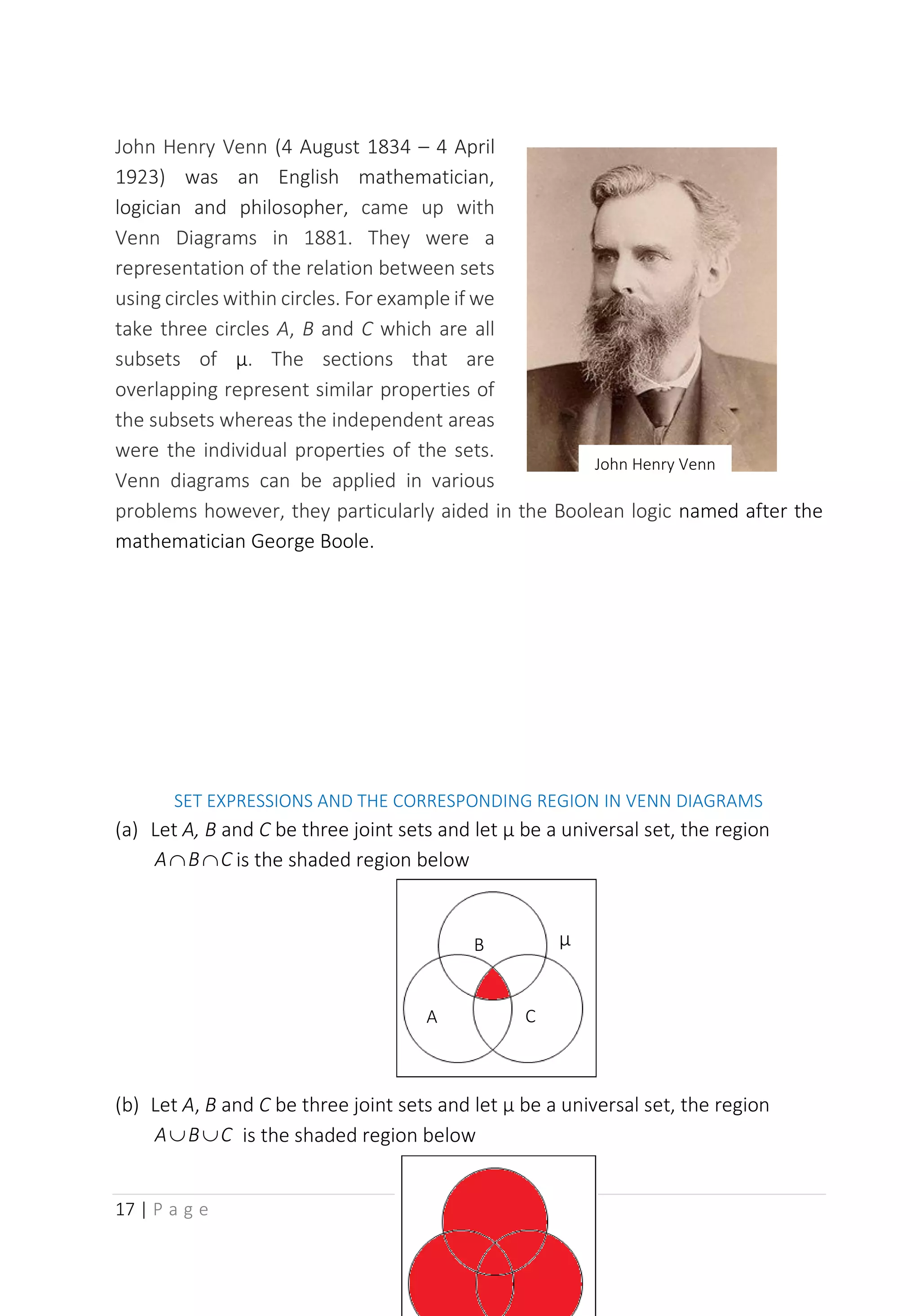
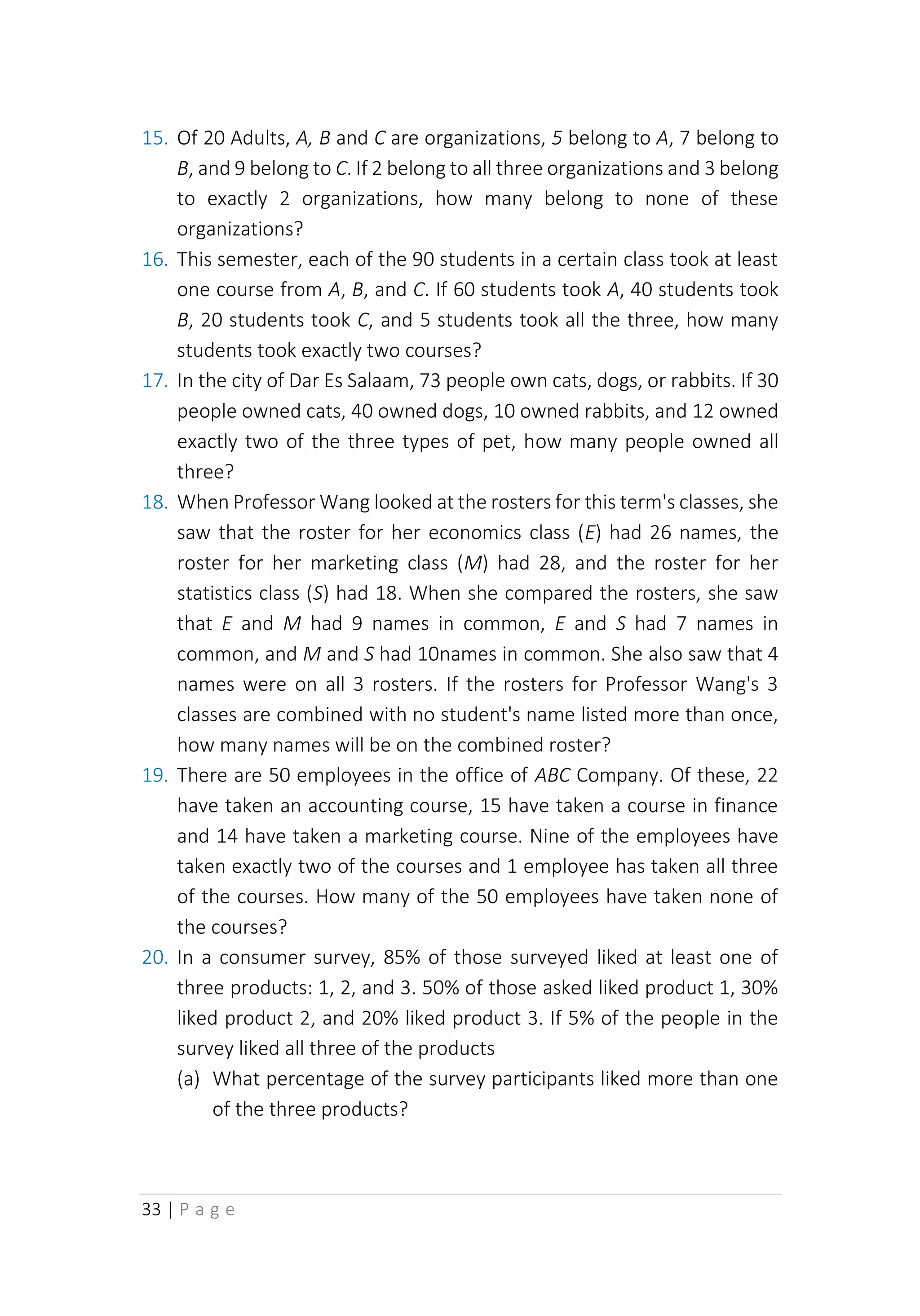
![13 | P a g e
Prove that ( ) ( ) ( )
C
B
B
A
C
B
A
=
Solution
Given ( ) ( ) ( )
C
B
B
A
C
B
A
=
Let ( ) ( )
A
x
C
B
A
x
and ( )
C
B
x
( )
A
x
and [ B
x or C
x ]
[xA and xB] or [xA and xB]
(x(A and B) or x(A and C)
x(A B) or x(A C)
This proof can also be done using Venn diagram
Simplify using laws of algebra of sets ( )
( )
'
B
A
B
B
A'
A
Solution
Given ( )
( )
'
B
A
B
B
A'
A
( ) ( )
( ) ( )
B'
B
A
B
B
A
A'
A
- Distributive law
( )
( )
φ
B
A
B
A
φ
- Identity law
B
A
B
A
- Idempotent law
B
A
Simplify the following using set properties ( )
( )
B'
A'
B'
B
A
A
Solution
Given ( )
( )
B'
A'
B'
B
A
A
( ) ( )
( ) ( )
B'
A'
φ
B'
B
A
φ
A
- Identity law
Example 8
Example 9](https://image.slidesharecdn.com/sets-220622091858-dd7c7ca6/75/mathematical-sets-pdf-13-2048.jpg)