SETS
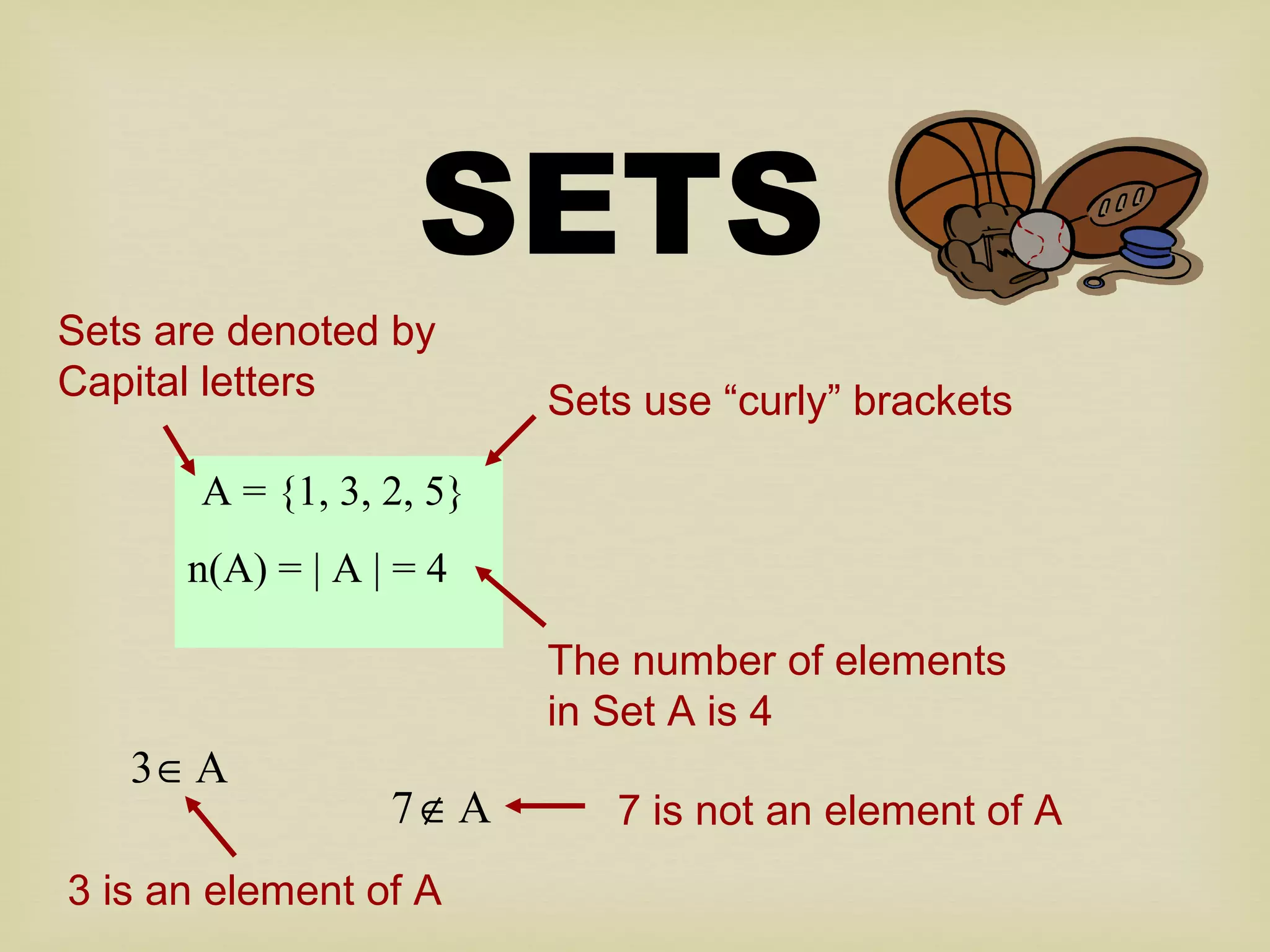
A = {1, 3, 2, 5}
n(A) = | A | = 4
Sets use “curly” brackets
The number of elements
in Set A is 4
Sets are denoted by
Capital letters
A3∈
A7∉
3 is an element of A
7 is not an element of A
A set is a distinct collection of objects. The objects are
called elements.
{1, 2, 3, 4} = {2, 3, 1, 4}
Order does not matter. If a set
contains the same elements as
another set, the sets are equal.
{1, 3, 2, 3, 5, 2} We never repeat elements in a set.{1, 3, 2, 5}
This symbol means "is a subset of"
This is read "A is a subset of B".A ⊂ B
A = {1, 2, 3} B = {1, 2, 3, 4, 5}
{1, 2, 3, 5} In ascending order
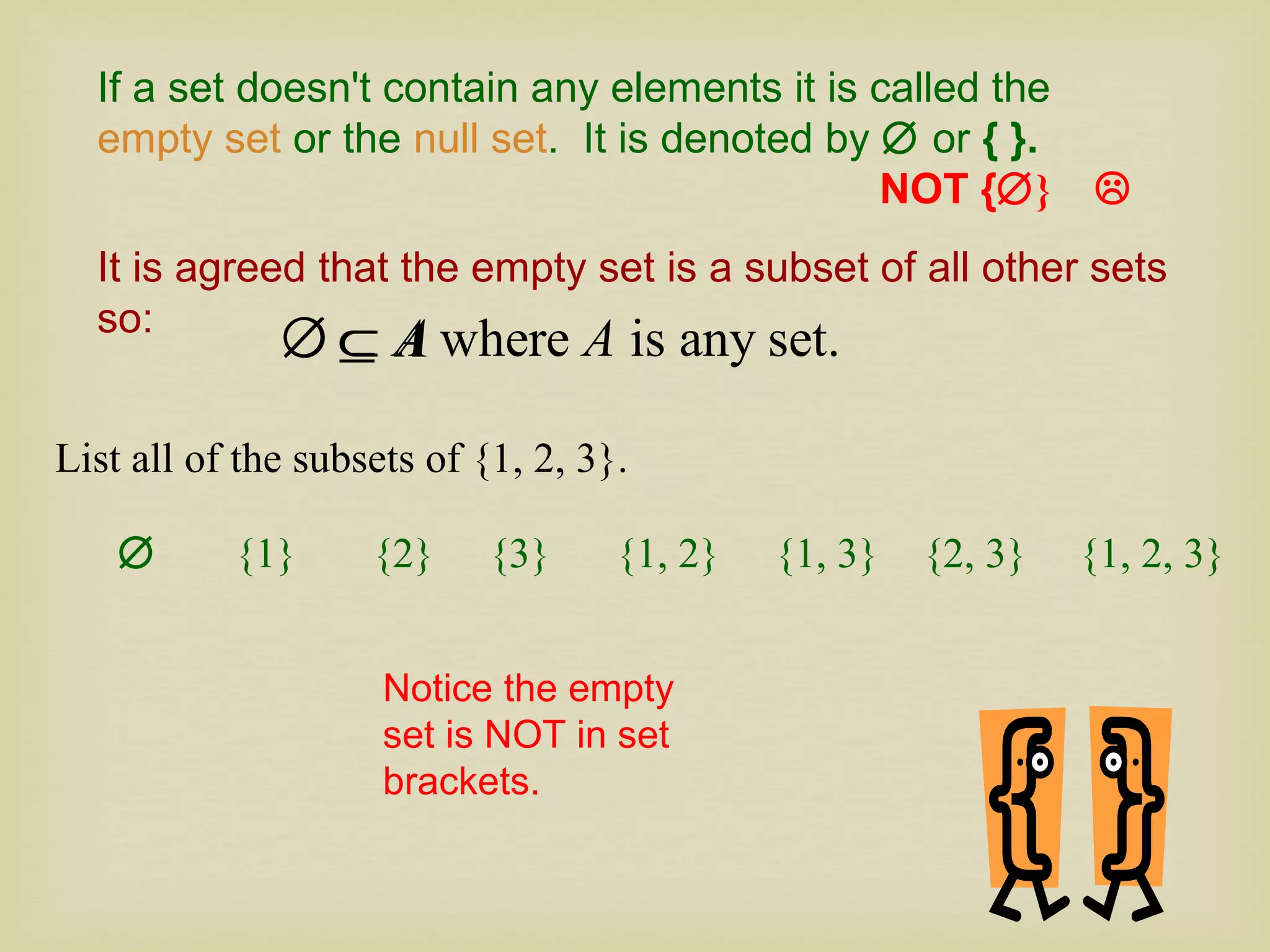
If a set doesn't contain any elements it is called the
empty set or the null set. It is denoted by ∅ or { }.
NOT {∅} 
It is agreed that the empty set is a subset of all other sets
so:
where is any set.A A∅ ⊆
List all of the subsets of {1, 2, 3}.
∅
Notice the empty
set is NOT in set
brackets.
{1} {2} {3} {1, 2} {1, 3} {2, 3} {1, 2, 3}
A⊂∅
?
Number of
Elements in Set
Possible Subsets Total Number of
Possible Subsets
1. {A} {A} ∅ 2
2. {A , B} {A , B} {A} {B} ∅ 4
3. {A , B , C} {A , B , C} {A , B} {A , C}
{B , C} {A} {B} {C}
∅
8
4. {A , B , C, D} {A , B , C , D} {A , B , C}
{A , B , D} {A , C , D}
{B , C , D} {A , B} {A , C}
{A , D} {A , B} …… {D} ∅
16
The number of possible subsets of a set of size n is ?2n
A ∪ B
This is the union symbol. It means the set that consists of all
elements of set A and all elements of set B.
= {1, 2, 3, 4, 5, 7, 9}
Remember we do
not list elements
more than once.
A ∩ B
This is the intersect symbol. It means the set
containing all elements that are in both A and B.
= {1, 3, 5}
A = {1, 2, 3, 4, 5} B = {1, 3, 5, 7,
9}
These sets can be visualized with circles in what is called a
Venn Diagram.
A ∪ B
A B
Everything that is in
A or B.
A B
A ∩ B
Everything that is in
A AND B.
A B
Often will have a set that contains all elements that we
wish to consider. This is called the universal set. All other
sets are subsets of this set.
Universal Set
A B
A ∩ B = ∅
There are no
elements in
both A and B.
When this is
the case they
are called
disjoint sets.
A
This means the complement of A, and
means the set of all elements in the
universal set that are not in A.
A A
100 people were surveyed. 52 people in a survey owned a
cat. 36 people owned a dog. 24 did not own a dog or cat.
Draw a Venn diagram.
universal set is 100 people surveyed
C D
Set C is the cat owners and Set D is the dog
owners. The sets are NOT disjoint. Some
people could own both a dog and a cat.
24
Since 24
did not own
a dog or
cat, there
must be 76
that do.
n(C ∪ D) = 76
This n means the
number of elements
in the set
52 + 36 = 88 so
there must be
88 - 76 = 12
people that own
both a dog and
a cat.
12
40 24
Counting Formula:
n(A ∪ B) = n(A) + n(B) - n(A ∩ B)
Sets
Sets

Sets

  • 1.
    SETS A = {1,3, 2, 5} n(A) = | A | = 4 Sets use “curly” brackets The number of elements in Set A is 4 Sets are denoted by Capital letters A3∈ A7∉ 3 is an element of A 7 is not an element of A
  • 2.
    A set isa distinct collection of objects. The objects are called elements. {1, 2, 3, 4} = {2, 3, 1, 4} Order does not matter. If a set contains the same elements as another set, the sets are equal. {1, 3, 2, 3, 5, 2} We never repeat elements in a set.{1, 3, 2, 5} This symbol means "is a subset of" This is read "A is a subset of B".A ⊂ B A = {1, 2, 3} B = {1, 2, 3, 4, 5} {1, 2, 3, 5} In ascending order
  • 3.
    If a setdoesn't contain any elements it is called the empty set or the null set. It is denoted by ∅ or { }. NOT {∅}  It is agreed that the empty set is a subset of all other sets so: where is any set.A A∅ ⊆ List all of the subsets of {1, 2, 3}. ∅ Notice the empty set is NOT in set brackets. {1} {2} {3} {1, 2} {1, 3} {2, 3} {1, 2, 3} A⊂∅
  • 4.
    ? Number of Elements inSet Possible Subsets Total Number of Possible Subsets 1. {A} {A} ∅ 2 2. {A , B} {A , B} {A} {B} ∅ 4 3. {A , B , C} {A , B , C} {A , B} {A , C} {B , C} {A} {B} {C} ∅ 8 4. {A , B , C, D} {A , B , C , D} {A , B , C} {A , B , D} {A , C , D} {B , C , D} {A , B} {A , C} {A , D} {A , B} …… {D} ∅ 16 The number of possible subsets of a set of size n is ?2n
  • 5.
    A ∪ B Thisis the union symbol. It means the set that consists of all elements of set A and all elements of set B. = {1, 2, 3, 4, 5, 7, 9} Remember we do not list elements more than once. A ∩ B This is the intersect symbol. It means the set containing all elements that are in both A and B. = {1, 3, 5} A = {1, 2, 3, 4, 5} B = {1, 3, 5, 7, 9}
  • 6.
    These sets canbe visualized with circles in what is called a Venn Diagram. A ∪ B A B Everything that is in A or B. A B A ∩ B Everything that is in A AND B. A B
  • 7.
    Often will havea set that contains all elements that we wish to consider. This is called the universal set. All other sets are subsets of this set. Universal Set A B A ∩ B = ∅ There are no elements in both A and B. When this is the case they are called disjoint sets. A This means the complement of A, and means the set of all elements in the universal set that are not in A. A A
  • 8.
    100 people weresurveyed. 52 people in a survey owned a cat. 36 people owned a dog. 24 did not own a dog or cat. Draw a Venn diagram. universal set is 100 people surveyed C D Set C is the cat owners and Set D is the dog owners. The sets are NOT disjoint. Some people could own both a dog and a cat. 24 Since 24 did not own a dog or cat, there must be 76 that do. n(C ∪ D) = 76 This n means the number of elements in the set 52 + 36 = 88 so there must be 88 - 76 = 12 people that own both a dog and a cat. 12 40 24 Counting Formula: n(A ∪ B) = n(A) + n(B) - n(A ∩ B)