Set Theory Professor Orr CPT120 ~ Quantitative Analysis I
Why Study Set Theory? Understanding set theory helps people to … see things in terms of systems organize things into groups begin to understand logic
Key Mathematicians These mathematicians influenced the development of set theory and logic: Georg Cantor John Venn George Boole Augustus DeMorgan
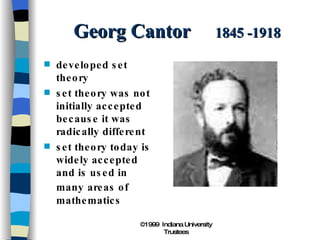
Georg Cantor  1845 -1918 developed set theory set theory was not initially accepted because it was radically different set theory today is widely accepted and is used in many   areas of mathematics
…Cantor the concept of infinity was expanded by Cantor’s set theory Cantor proved there are “levels of infinity” an infinitude of integers initially ending with    or  an infinitude of real numbers exist between 1 and 2; there are  more  real numbers than there are integers…
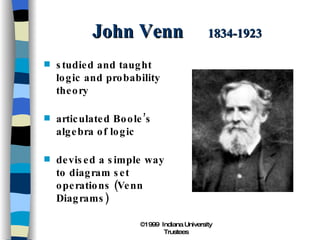
John Venn  1834-1923 studied and taught logic and probability theory articulated Boole’s algebra of logic devised a simple way to diagram set operations (Venn Diagrams)
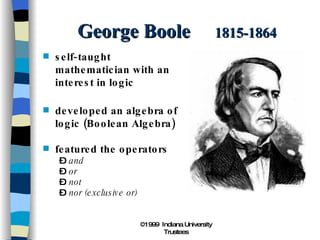
George Boole  1815-1864 self‑taught mathematician with an interest in logic developed an algebra of logic (Boolean Algebra) featured the operators and or not nor (exclusive or)
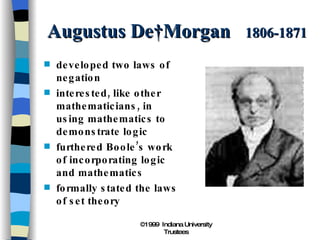
Augustus De Morgan  1806-1871 developed two laws of negation interested, like other mathematicians, in using mathematics to demonstrate logic furthered Boole’s work of incorporating logic and mathematics formally stated the laws of set theory
Basic Set Theory Definitions A  set  is a collection of elements An  element  is an object contained in a set If every element of Set  A  is also contained in Set  B , then Set  A  is a  subset  of Set  B A is a  proper subset  of B if B has more elements than A does The  universal set  contains all of the elements relevant to a given discussion
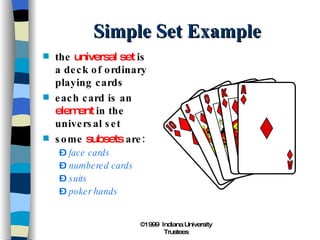
Simple Set Example the  universal set  is  a deck of ordinary  playing cards each card is an  element  in the universal set some  subsets  are: face cards numbered cards suits poker hands
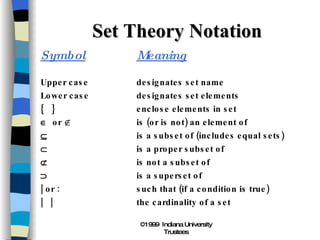
Set Theory Notation Symbol Meaning Upper case designates set name Lower case designates set elements {  } enclose elements in set    or  is (or is not) an element of  is a subset of (includes equal sets)  is a proper subset of  is not a subset of  is a superset of | or : such that (if a condition is true) |  | the cardinality of a set
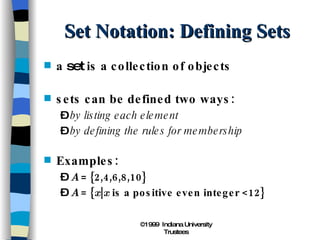
Set Notation: Defining Sets a  set  is a collection of objects sets can be defined two ways: by listing each element by defining the rules for membership Examples: A  = {2,4,6,8,10} A  = { x | x  is a positive even integer <12}
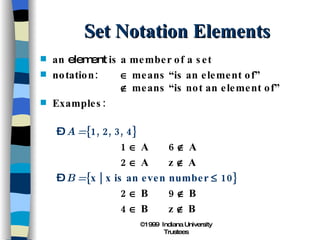
Set Notation Elements an  element  is a member of a set notation:   means “is an element of”   means “is not an element of” Examples: A =  {1, 2, 3, 4}   1    A 6    A   2    A z    A B =  {x | x is an even number    10}   2    B 9    B   4    B z    B
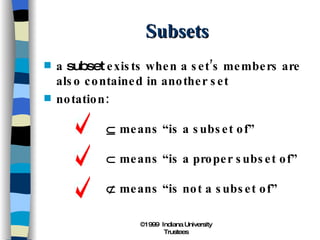
Subsets a  subset  exists when a set’s members are also contained in another set notation:   means “is a subset of”   means “is a proper subset of”   means “is not a subset of”
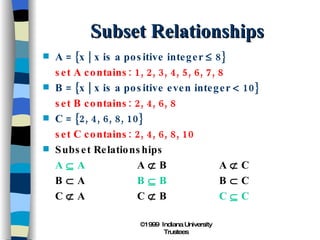
Subset Relationships A = {x | x is a positive integer    8} set A contains: 1, 2, 3, 4, 5, 6, 7, 8 B = {x | x is a positive even integer    10} set B contains: 2, 4, 6, 8 C = {2, 4, 6, 8, 10} set C contains: 2, 4, 6, 8, 10 Subset Relationships A    A A    B A    C B    A B    B B    C C    A C    B C    C
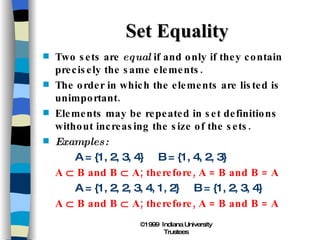
Set Equality Two sets are  equal  if and only if they contain precisely the same elements. The order in which the elements are listed is unimportant. Elements may be repeated in set definitions without increasing the size of the sets. Examples: A = {1, 2, 3, 4}  B = {1, 4, 2, 3} A    B and B    A; therefore, A = B and B = A A = {1, 2, 2, 3, 4, 1, 2}  B = {1, 2, 3, 4} A    B and B    A; therefore, A = B and B = A
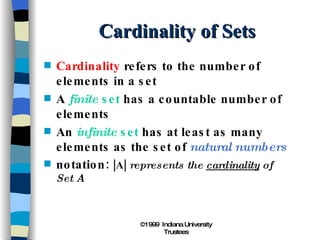
Cardinality of Sets Cardinality  refers to the number of elements in a set A  finite  set  has a countable number of elements An  infinite  set  has at least as many elements as the set of  natural numbers notation:  |A|  represents the  cardinality  of Set A
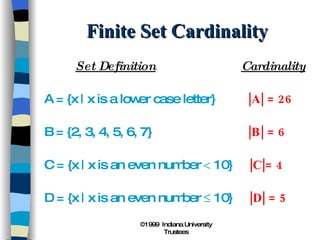
Finite Set Cardinality Set Definition   Cardinality A = {x | x is a lower case letter}   |A| = 26 B = {2, 3, 4, 5, 6, 7}   |B| = 6 C = {x | x is an even number    10}   |C|= 4 D = {x | x is an even number    10}   |D| = 5
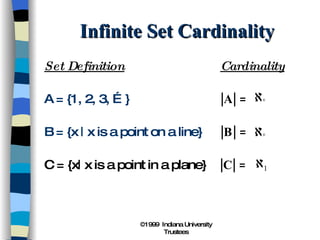
Infinite Set Cardinality Set Definition Cardinality A = {1, 2, 3, …} |A| =  B = {x | x is a point on a line} |B| =  C = {x| x is a point in a plane}  |C| =
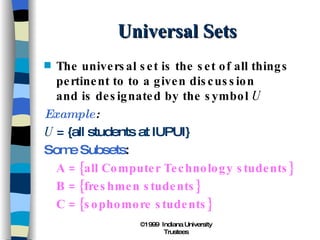
Universal Sets The universal set is the set of all things pertinent to to a given discussion and is designated by the symbol  U Example : U  = {all students at IUPUI} Some Subsets : A = {all Computer Technology students} B = {freshmen students} C = {sophomore students}
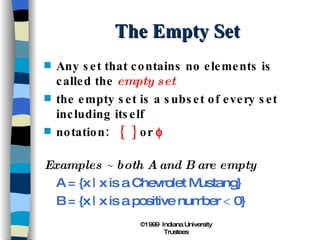
The Empty Set Any set that contains no elements is called the  empty set the empty set is a subset of every set including itself notation:  {  }  or    Examples ~ both A and B are empty A = {x | x is a Chevrolet Mustang} B = {x | x is a positive number    0}
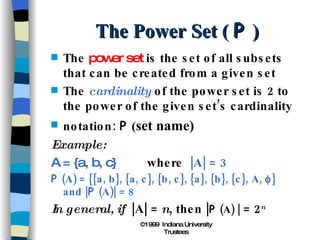
The Power Set (  P  ) The  power set  is the set of all subsets that can be created from a given set The  cardinality  of the power set is 2 to the power of the given set’s cardinality notation:  P  ( set name) Example: A = {a, b, c} where  |A| = 3 P  (A) = {{a, b}, {a, c}, {b, c}, {a}, {b}, {c}, A,   } and | P  (A)| = 8 In general, if  |A| =  n , then | P  (A) |  = 2 n
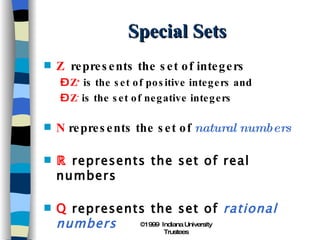
Special Sets Z   represents the set of integers  Z +  is the set of positive integers and Z -  is the set of negative integers   N  represents the set of  natural numbers ℝ  represents the set of real numbers Q  represents the set of  rational numbers
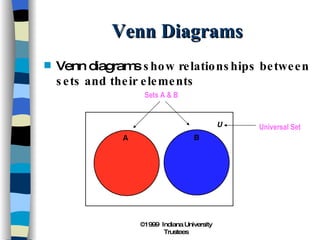
Venn Diagrams Venn diagrams  show relationships between sets and their elements Universal Set Sets A & B
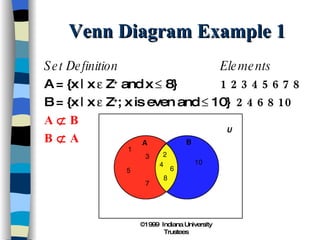
Venn Diagram Example 1 Set Definition Elements A = {x | x    Z +  and x    8} 1 2 3 4 5 6 7 8 B = {x | x    Z + ; x is even and    10} 2 4 6 8 10 A    B B    A
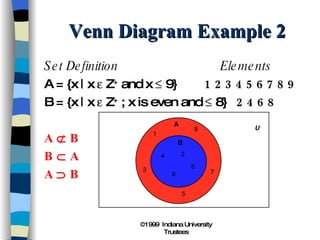
Venn Diagram Example 2 Set Definition Elements A = {x | x    Z +  and x    9}   1 2 3 4 5 6 7 8 9 B = {x | x    Z +  ; x is even and    8} 2 4 6 8 A    B B    A A    B
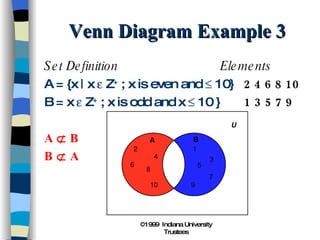
Venn Diagram Example 3 Set Definition Elements A = {x | x    Z +  ; x is even and    10}  2 4 6 8 10 B = x    Z +  ; x is odd and x    10 }  1 3 5 7 9 A    B B    A
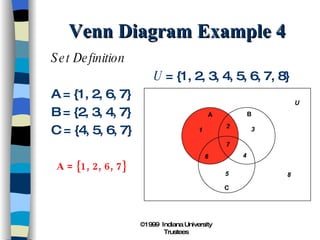
Venn Diagram Example 4 Set Definition   U  = {1, 2, 3, 4, 5, 6, 7, 8} A = {1, 2, 6, 7} B = {2, 3, 4, 7} C = {4, 5, 6, 7} A = {1, 2, 6, 7}
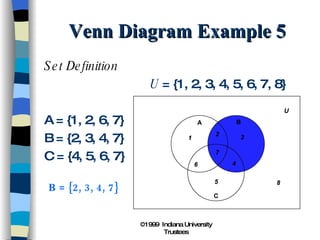
Venn Diagram Example 5 Set Definition   U  = {1, 2, 3, 4, 5, 6, 7, 8} A = {1, 2, 6, 7} B = {2, 3, 4, 7} C = {4, 5, 6, 7} B = {2, 3, 4, 7}
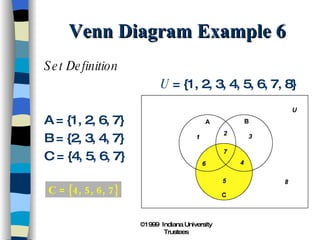
Venn Diagram Example 6 Set Definition   U  = {1, 2, 3, 4, 5, 6, 7, 8} A = {1, 2, 6, 7} B = {2, 3, 4, 7} C = {4, 5, 6, 7} C = {4, 5, 6, 7}

Set Concepts

  • 1.
    Set Theory ProfessorOrr CPT120 ~ Quantitative Analysis I
  • 2.
    Why Study SetTheory? Understanding set theory helps people to … see things in terms of systems organize things into groups begin to understand logic
  • 3.
    Key Mathematicians Thesemathematicians influenced the development of set theory and logic: Georg Cantor John Venn George Boole Augustus DeMorgan
  • 4.
    Georg Cantor 1845 -1918 developed set theory set theory was not initially accepted because it was radically different set theory today is widely accepted and is used in many areas of mathematics
  • 5.
    …Cantor the conceptof infinity was expanded by Cantor’s set theory Cantor proved there are “levels of infinity” an infinitude of integers initially ending with  or an infinitude of real numbers exist between 1 and 2; there are more real numbers than there are integers…
  • 6.
    John Venn 1834-1923 studied and taught logic and probability theory articulated Boole’s algebra of logic devised a simple way to diagram set operations (Venn Diagrams)
  • 7.
    George Boole 1815-1864 self‑taught mathematician with an interest in logic developed an algebra of logic (Boolean Algebra) featured the operators and or not nor (exclusive or)
  • 8.
    Augustus De Morgan 1806-1871 developed two laws of negation interested, like other mathematicians, in using mathematics to demonstrate logic furthered Boole’s work of incorporating logic and mathematics formally stated the laws of set theory
  • 9.
    Basic Set TheoryDefinitions A set is a collection of elements An element is an object contained in a set If every element of Set A is also contained in Set B , then Set A is a subset of Set B A is a proper subset of B if B has more elements than A does The universal set contains all of the elements relevant to a given discussion
  • 10.
    Simple Set Examplethe universal set is a deck of ordinary playing cards each card is an element in the universal set some subsets are: face cards numbered cards suits poker hands
  • 11.
    Set Theory NotationSymbol Meaning Upper case designates set name Lower case designates set elements { } enclose elements in set  or is (or is not) an element of  is a subset of (includes equal sets)  is a proper subset of  is not a subset of  is a superset of | or : such that (if a condition is true) | | the cardinality of a set
  • 12.
    Set Notation: DefiningSets a set is a collection of objects sets can be defined two ways: by listing each element by defining the rules for membership Examples: A = {2,4,6,8,10} A = { x | x is a positive even integer <12}
  • 13.
    Set Notation Elementsan element is a member of a set notation:  means “is an element of”  means “is not an element of” Examples: A = {1, 2, 3, 4} 1  A 6  A 2  A z  A B = {x | x is an even number  10} 2  B 9  B 4  B z  B
  • 14.
    Subsets a subset exists when a set’s members are also contained in another set notation:  means “is a subset of”  means “is a proper subset of”  means “is not a subset of”
  • 15.
    Subset Relationships A= {x | x is a positive integer  8} set A contains: 1, 2, 3, 4, 5, 6, 7, 8 B = {x | x is a positive even integer  10} set B contains: 2, 4, 6, 8 C = {2, 4, 6, 8, 10} set C contains: 2, 4, 6, 8, 10 Subset Relationships A  A A  B A  C B  A B  B B  C C  A C  B C  C
  • 16.
    Set Equality Twosets are equal if and only if they contain precisely the same elements. The order in which the elements are listed is unimportant. Elements may be repeated in set definitions without increasing the size of the sets. Examples: A = {1, 2, 3, 4} B = {1, 4, 2, 3} A  B and B  A; therefore, A = B and B = A A = {1, 2, 2, 3, 4, 1, 2} B = {1, 2, 3, 4} A  B and B  A; therefore, A = B and B = A
  • 17.
    Cardinality of SetsCardinality refers to the number of elements in a set A finite set has a countable number of elements An infinite set has at least as many elements as the set of natural numbers notation: |A| represents the cardinality of Set A
  • 18.
    Finite Set CardinalitySet Definition Cardinality A = {x | x is a lower case letter} |A| = 26 B = {2, 3, 4, 5, 6, 7} |B| = 6 C = {x | x is an even number  10} |C|= 4 D = {x | x is an even number  10} |D| = 5
  • 19.
    Infinite Set CardinalitySet Definition Cardinality A = {1, 2, 3, …} |A| = B = {x | x is a point on a line} |B| = C = {x| x is a point in a plane} |C| =
  • 20.
    Universal Sets Theuniversal set is the set of all things pertinent to to a given discussion and is designated by the symbol U Example : U = {all students at IUPUI} Some Subsets : A = {all Computer Technology students} B = {freshmen students} C = {sophomore students}
  • 21.
    The Empty SetAny set that contains no elements is called the empty set the empty set is a subset of every set including itself notation: { } or  Examples ~ both A and B are empty A = {x | x is a Chevrolet Mustang} B = {x | x is a positive number  0}
  • 22.
    The Power Set( P ) The power set is the set of all subsets that can be created from a given set The cardinality of the power set is 2 to the power of the given set’s cardinality notation: P ( set name) Example: A = {a, b, c} where |A| = 3 P (A) = {{a, b}, {a, c}, {b, c}, {a}, {b}, {c}, A,  } and | P (A)| = 8 In general, if |A| = n , then | P (A) | = 2 n
  • 23.
    Special Sets Z represents the set of integers Z + is the set of positive integers and Z - is the set of negative integers N represents the set of natural numbers ℝ represents the set of real numbers Q represents the set of rational numbers
  • 24.
    Venn Diagrams Venndiagrams show relationships between sets and their elements Universal Set Sets A & B
  • 25.
    Venn Diagram Example1 Set Definition Elements A = {x | x  Z + and x  8} 1 2 3 4 5 6 7 8 B = {x | x  Z + ; x is even and  10} 2 4 6 8 10 A  B B  A
  • 26.
    Venn Diagram Example2 Set Definition Elements A = {x | x  Z + and x  9} 1 2 3 4 5 6 7 8 9 B = {x | x  Z + ; x is even and  8} 2 4 6 8 A  B B  A A  B
  • 27.
    Venn Diagram Example3 Set Definition Elements A = {x | x  Z + ; x is even and  10} 2 4 6 8 10 B = x  Z + ; x is odd and x  10 } 1 3 5 7 9 A  B B  A
  • 28.
    Venn Diagram Example4 Set Definition U = {1, 2, 3, 4, 5, 6, 7, 8} A = {1, 2, 6, 7} B = {2, 3, 4, 7} C = {4, 5, 6, 7} A = {1, 2, 6, 7}
  • 29.
    Venn Diagram Example5 Set Definition U = {1, 2, 3, 4, 5, 6, 7, 8} A = {1, 2, 6, 7} B = {2, 3, 4, 7} C = {4, 5, 6, 7} B = {2, 3, 4, 7}
  • 30.
    Venn Diagram Example6 Set Definition U = {1, 2, 3, 4, 5, 6, 7, 8} A = {1, 2, 6, 7} B = {2, 3, 4, 7} C = {4, 5, 6, 7} C = {4, 5, 6, 7}