Issues
      in


Medium of Instruction
      -Rebat Kumar Dhakal
         28 Sept. 2010
      Kathmandu University
• Medium of instruction as an issue
• Arguments for MT
• Arguments for national / international
  language
• How it has been addressed (SSRP)
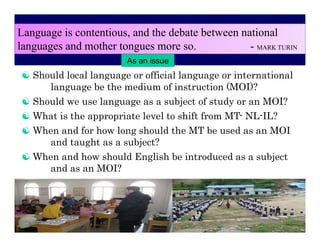
Language is contentious, and the debate between national
languages and mother tongues more soso.           - MARK TURIN
                        As an issue
☯ Should local language or official language or international
.
     language be the medium of instruction (MOI)?
☯ Should we use language as a subject of study or an MOI?
.


☯ What is the appropriate level to shift from MT- NL-IL?
.


☯ When and for how long should the MT be used as an MOI
.
     and taught as a subject?
        d      h        bj ?
☯ When and how should English be introduced as a subject
     and as an MOI?
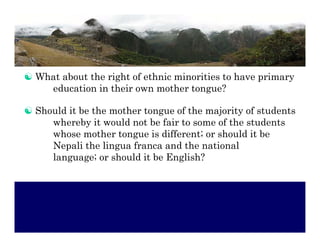
☯ What about the right of ethnic minorities to have primary
    education in their own mother tongue?
.


☯ Sh ld it be th mother t
  Should b the      th tongue of th majority of students
                                  f the   j it f t d t
     whereby it would not be fair to some of the students
     whose mother tongue is different; or should it be
                       g
     Nepali the lingua franca and the national
     language; or should it be English?
@)^% ;fnsf]] P]]g
िशक्षा tyf v]n]ns''b ;DaGwL s]]xL g]]kfn P]]g ;++zf]]wg ug{ ag]sf] P]g
-^_ bkmf & sf] pkbkmf -@_ sf] v08 -s_ sf] ;66f b]xfosf] v08 -s_
/flvPsf] 5M æcfwf/et tx;Ddsf] िशक्षा dft efiffdf lbg ;lsg5 . (k]h #)
/flvPsf æcfwf/e"t tx;Ddsf                dft[                ;lsg]5 (kh
   A trilingual model for Nepali primary education:
   1. Mother tongue
   2. Nepali as the national or second language of education
   3. English as the international language.
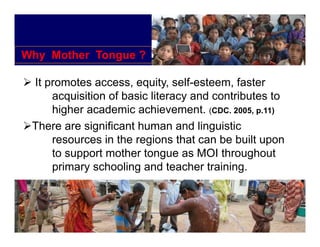
Why Mother Tongue ?

 It promotes access, equity, self-esteem, faster
     acquisition of basic literacy and contributes to
     higher academic achievement (CDC 2005, p.11)
                       achievement. (CDC. 2005 11)
 There are significant human and linguistic
     resources in the regions that can be built upon
     to support mother tongue as MOI throughout
     primary schooling and teacher training.
Why International Language ?


Can
C MT educated students compete in the
         d   t d t d t      t i th
  global market?
Can MT education be equivalent to
  International language education?
                   g g
  <coverage, competitiveness and ………>
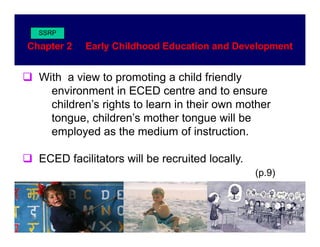
SSRP

Chapter 2   Early Childhood Education and Development


  With a view to promoting a child friendly
    environment in ECED centre and to ensure
    children s
    children’s rights to learn in their own mother
    tongue, children’s mother tongue will be
    employed as the medium of instruction.

  ECED facilitators will be recruited locally.
                                                 (p.9)
                                                 ( 9)
SSRP

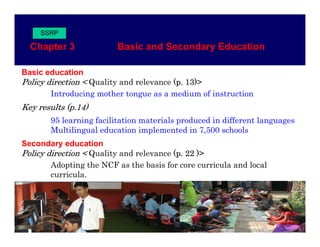
  Chapter 3               Basic and Secondary Education

Basic education
Policy direction < Quality and relevance (p. 13)>
       Introducing mother tongue as a medium of instruction
Key results (p.14)
            (p 14)
       95 learning facilitation materials produced in different languages
       Multilingual education implemented in 7,500 schools
Secondary education
Policy direction < Quality and relevance (p. 22 )>
        Adopting the NCF as the basis for core curricula and local
        curricula.
SSRP

  Chapter 4    Literacy and Lifelong Learning


Implementation arrangement <Delivery mechanism ( 31)>
                                               (p. )
      Mother tongue medium literacy programmes
      will be emphasized.
              emphasized

Implementation matrix<Activity (what?) (p. 32)>
      Introduce and expand mother tongue literacy
      courses in local languages.
SSRP

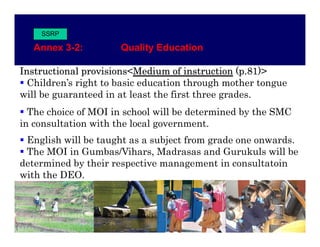
   Annex 3-2:
   Anne 3 2           Quality Ed cation
                      Q alit Education

Instructional provisions<Medium of instruction (p.81)>
  Children’s right to basic education through mother tongue
will be guaranteed in at least the first three grades.
  The choice of MOI in school will be determined by the SMC
in consultation with the local government.
 English will be taught as a subject from grade one onwards
                                                    onwards.
 The MOI in Gumbas/Vihars, Madrasas and Gurukuls will be
determined by their respective management in consultatoin
with the DEO.
SSRP

Annex 3-2:
Anne 3 2           Instructional pro isions
                   Instr ctional provisions

To ensure that children learn in their MT at least in the
   early grades up to three, SMC can determine the
   language(s) of instruction in consultation with the
   local body. Grades four and five can follow a
         body
   transition from the mother tongue MOI to Nepali.
From grade six to eight, the MOI can be fully in Nepali.
     g              g ,                     y      p
English will be taught as a subject from grade one
   onwards.                                      (p. 82)
NCF


• Provision of mother tongues as a medium of instruction and
       learning from grade 1 to 5 and language transition at grade
       6. (p. 42)
• C i l
  Curriculum will give opportunity t l
                 ill i         t it to learn i mother l
                                             in    th language i in
       early grades in line with the child-development approach
       to learning, the language of instruction will be the Mother
                   g       g g
       tongue in early grades i.e. Pre-primary to grade 5. There
       will be provision for language transition from the mother
       tongue to Nepali and/or English from grade 4 (p 22)
                                                      4. (p.
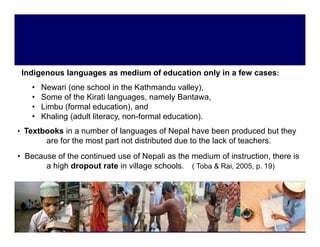
Indigenous languages as medium of education only in a few cases:
     g         g g                              y
    •   Newari (one school in the Kathmandu valley),
    •   Some of the Kirati languages, namely Bantawa,
    •   Limbu (formal education) and
                       education),
    •   Khaling (adult literacy, non-formal education).
• Textbooks in a number of languages of Nepal have been produced but they
         are f the most part not distributed due to the lack of teachers.
             for th   t    t t di t ib t d d t th l k f t           h
• Because of the continued use of Nepali as the medium of instruction, there is
       a high dropout rate in village schools. ( Toba & Rai, 2005, p. 19)
           g                       g
4 M d l of Education
                        Models f Ed   ti
• Theassimilation model: Starting in the mother tongue, and continuing to
        national language immersion
• The pluralistic model: Recognises the importance of the language
        spoken at home; thus, first language teaching is not restricted only
         p               ;    ,        g g            g                    y
        to the early grades
• The immersion model: Initial instruction is given in the national language
        with oral discussion and instruction permitted in the local language
                                             p                         g g
• The national language model: Sole instruction in the national language,
        with no teaching in the mother tongue
                                       (UNESCO,
                                       (UNESCO Bankok 2007 p 63)
                                                      2007,p.
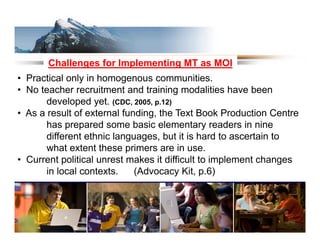
Challenges for Implementing MT as MOI
• Practical only in homogenous communities
                                  communities.
• No teacher recruitment and training modalities have been
       developed yet. (CDC, 2005, p.12)
• As a result of external funding, the Text Book Production Centre
       has prepared some basic elementary readers in nine
       different ethnic languages, but it is hard to ascertain to
       what extent these primers are in use.
• Current political unrest makes it difficult to implement changes
       in local contexts
                contexts.    (Advocacy Kit, p 6)
                                         Kit p.6)
References
Advocacy kit for promoting multilingual education: Including the excluded. Language in
         Education P li and P ti i A i and th P ifi R t i
         Ed      ti Policy d Practice in Asia d the Pacific. Retrieved f  d from
         http://www2.unescobkk.org/elib/publications/110/Booklet%202%20-
         %20Language%20and%20Education%20Policies.pdf
CDC. 2005. National curriculum framework for school education (pre-primary-12) in Nepal.
                                                              (p p       y )        p
        Bhaktapur: Author.
Toba, S.I. & Rai, N.K. (2005). Diversity and endangerment of languages in Nepal. UNESCO
           Kathmandu Series of Monographs and Working Papers, 7. Kathmandu: UNESCO.
UNESCO. 2005. First language first: Community-based literacy programmes for
       minority language contexts in Asia. Bangkok. Retrieved from
       http://unesdoc.unesco.org/images/0014/001402/140280e.pdf
2065 salko ain Retrieved from http://planipolis iiep unesco org/upload/Nepal/
           ain.               http://planipolis.iiep.unesco.org/upload/Nepal/
         Nepal_%20Education_law_2065_Draft.pdf
Unceasing Debate

                   ’

Medium of instruction: an unceasing debate

  • 1.
    Issues in Medium of Instruction -Rebat Kumar Dhakal 28 Sept. 2010 Kathmandu University
  • 2.
    • Medium ofinstruction as an issue • Arguments for MT • Arguments for national / international language • How it has been addressed (SSRP)
  • 3.
    Language is contentious,and the debate between national languages and mother tongues more soso. - MARK TURIN As an issue ☯ Should local language or official language or international . language be the medium of instruction (MOI)? ☯ Should we use language as a subject of study or an MOI? . ☯ What is the appropriate level to shift from MT- NL-IL? . ☯ When and for how long should the MT be used as an MOI . and taught as a subject? d h bj ? ☯ When and how should English be introduced as a subject and as an MOI?
  • 4.
    ☯ What aboutthe right of ethnic minorities to have primary education in their own mother tongue? . ☯ Sh ld it be th mother t Should b the th tongue of th majority of students f the j it f t d t whereby it would not be fair to some of the students whose mother tongue is different; or should it be g Nepali the lingua franca and the national language; or should it be English?
  • 5.
    @)^% ;fnsf]] P]]g िशक्षाtyf v]n]ns''b ;DaGwL s]]xL g]]kfn P]]g ;++zf]]wg ug{ ag]sf] P]g -^_ bkmf & sf] pkbkmf -@_ sf] v08 -s_ sf] ;66f b]xfosf] v08 -s_ /flvPsf] 5M æcfwf/et tx;Ddsf] िशक्षा dft efiffdf lbg ;lsg5 . (k]h #) /flvPsf æcfwf/e"t tx;Ddsf dft[ ;lsg]5 (kh A trilingual model for Nepali primary education: 1. Mother tongue 2. Nepali as the national or second language of education 3. English as the international language.
  • 6.
    Why Mother Tongue? It promotes access, equity, self-esteem, faster acquisition of basic literacy and contributes to higher academic achievement (CDC 2005, p.11) achievement. (CDC. 2005 11) There are significant human and linguistic resources in the regions that can be built upon to support mother tongue as MOI throughout primary schooling and teacher training.
  • 7.
    Why International Language? Can C MT educated students compete in the d t d t d t t i th global market? Can MT education be equivalent to International language education? g g <coverage, competitiveness and ………>
  • 8.
    SSRP Chapter 2 Early Childhood Education and Development With a view to promoting a child friendly environment in ECED centre and to ensure children s children’s rights to learn in their own mother tongue, children’s mother tongue will be employed as the medium of instruction. ECED facilitators will be recruited locally. (p.9) ( 9)
  • 9.
    SSRP Chapter3 Basic and Secondary Education Basic education Policy direction < Quality and relevance (p. 13)> Introducing mother tongue as a medium of instruction Key results (p.14) (p 14) 95 learning facilitation materials produced in different languages Multilingual education implemented in 7,500 schools Secondary education Policy direction < Quality and relevance (p. 22 )> Adopting the NCF as the basis for core curricula and local curricula.
  • 10.
    SSRP Chapter4 Literacy and Lifelong Learning Implementation arrangement <Delivery mechanism ( 31)> (p. ) Mother tongue medium literacy programmes will be emphasized. emphasized Implementation matrix<Activity (what?) (p. 32)> Introduce and expand mother tongue literacy courses in local languages.
  • 11.
    SSRP Annex 3-2: Anne 3 2 Quality Ed cation Q alit Education Instructional provisions<Medium of instruction (p.81)> Children’s right to basic education through mother tongue will be guaranteed in at least the first three grades. The choice of MOI in school will be determined by the SMC in consultation with the local government. English will be taught as a subject from grade one onwards onwards. The MOI in Gumbas/Vihars, Madrasas and Gurukuls will be determined by their respective management in consultatoin with the DEO.
  • 12.
    SSRP Annex 3-2: Anne 32 Instructional pro isions Instr ctional provisions To ensure that children learn in their MT at least in the early grades up to three, SMC can determine the language(s) of instruction in consultation with the local body. Grades four and five can follow a body transition from the mother tongue MOI to Nepali. From grade six to eight, the MOI can be fully in Nepali. g g , y p English will be taught as a subject from grade one onwards. (p. 82)
  • 13.
    NCF • Provision ofmother tongues as a medium of instruction and learning from grade 1 to 5 and language transition at grade 6. (p. 42) • C i l Curriculum will give opportunity t l ill i t it to learn i mother l in th language i in early grades in line with the child-development approach to learning, the language of instruction will be the Mother g g g tongue in early grades i.e. Pre-primary to grade 5. There will be provision for language transition from the mother tongue to Nepali and/or English from grade 4 (p 22) 4. (p.
  • 14.
    Indigenous languages asmedium of education only in a few cases: g g g y • Newari (one school in the Kathmandu valley), • Some of the Kirati languages, namely Bantawa, • Limbu (formal education) and education), • Khaling (adult literacy, non-formal education). • Textbooks in a number of languages of Nepal have been produced but they are f the most part not distributed due to the lack of teachers. for th t t t di t ib t d d t th l k f t h • Because of the continued use of Nepali as the medium of instruction, there is a high dropout rate in village schools. ( Toba & Rai, 2005, p. 19) g g
  • 15.
    4 M dl of Education Models f Ed ti • Theassimilation model: Starting in the mother tongue, and continuing to national language immersion • The pluralistic model: Recognises the importance of the language spoken at home; thus, first language teaching is not restricted only p ; , g g g y to the early grades • The immersion model: Initial instruction is given in the national language with oral discussion and instruction permitted in the local language p g g • The national language model: Sole instruction in the national language, with no teaching in the mother tongue (UNESCO, (UNESCO Bankok 2007 p 63) 2007,p.
  • 16.
    Challenges for ImplementingMT as MOI • Practical only in homogenous communities communities. • No teacher recruitment and training modalities have been developed yet. (CDC, 2005, p.12) • As a result of external funding, the Text Book Production Centre has prepared some basic elementary readers in nine different ethnic languages, but it is hard to ascertain to what extent these primers are in use. • Current political unrest makes it difficult to implement changes in local contexts contexts. (Advocacy Kit, p 6) Kit p.6)
  • 18.
    References Advocacy kit forpromoting multilingual education: Including the excluded. Language in Education P li and P ti i A i and th P ifi R t i Ed ti Policy d Practice in Asia d the Pacific. Retrieved f d from http://www2.unescobkk.org/elib/publications/110/Booklet%202%20- %20Language%20and%20Education%20Policies.pdf CDC. 2005. National curriculum framework for school education (pre-primary-12) in Nepal. (p p y ) p Bhaktapur: Author. Toba, S.I. & Rai, N.K. (2005). Diversity and endangerment of languages in Nepal. UNESCO Kathmandu Series of Monographs and Working Papers, 7. Kathmandu: UNESCO. UNESCO. 2005. First language first: Community-based literacy programmes for minority language contexts in Asia. Bangkok. Retrieved from http://unesdoc.unesco.org/images/0014/001402/140280e.pdf 2065 salko ain Retrieved from http://planipolis iiep unesco org/upload/Nepal/ ain. http://planipolis.iiep.unesco.org/upload/Nepal/ Nepal_%20Education_law_2065_Draft.pdf
  • 19.