Association Rule Mining 1
Association Rule Mining
Association Rule Mining 2
Generating Association Rules from
Frequent Itemsets
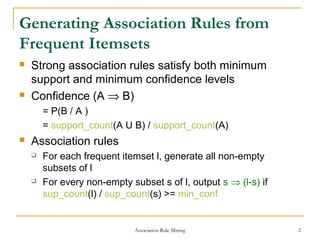
 Strong association rules satisfy both minimum
support and minimum confidence levels
 Confidence (A ⇒ B)
= P(B / A )
= support_count(A U B) / support_count(A)
 Association rules
 For each frequent itemset l, generate all non-empty
subsets of l
 For every non-empty subset s of l, output s ⇒ (l-s) if
sup_count(l) / sup_count(s) >= min_conf
Association Rule Mining 3
Example
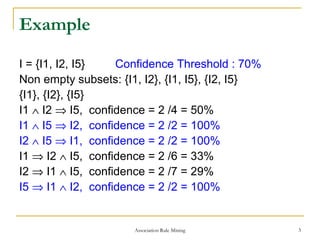
I = {I1, I2, I5} Confidence Threshold : 70%
Non empty subsets: {I1, I2}, {I1, I5}, {I2, I5}
{I1}, {I2}, {I5}
I1 ∧ I2 ⇒ I5, confidence = 2 /4 = 50%
I1 ∧ I5 ⇒ I2, confidence = 2 /2 = 100%
I2 ∧ I5 ⇒ I1, confidence = 2 /2 = 100%
I1 ⇒ I2 ∧ I5, confidence = 2 /6 = 33%
I2 ⇒ I1 ∧ I5, confidence = 2 /7 = 29%
I5 ⇒ I1 ∧ I2, confidence = 2 /2 = 100%
Association Rule Mining 4
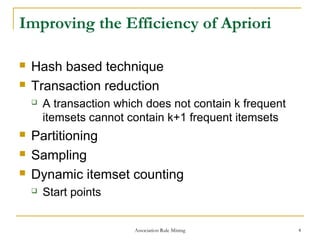
Improving the Efficiency of Apriori
 Hash based technique
 Transaction reduction
 A transaction which does not contain k frequent
itemsets cannot contain k+1 frequent itemsets
 Partitioning
 Sampling
 Dynamic itemset counting
 Start points
Association Rule Mining 5
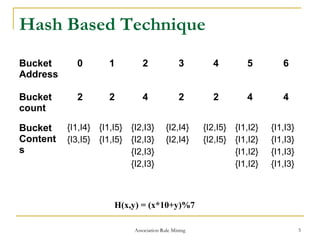
Hash Based Technique
Bucket
Address
0 1 2 3 4 5 6
Bucket
count
2 2 4 2 2 4 4
Bucket
Content
s
{I1,I4}
{I3,I5}
{I1,I5}
{I1,I5}
{I2,I3}
{I2,I3}
{I2,I3}
{I2,I3}
{I2,I4}
{I2,I4}
{I2,I5}
{I2,I5}
{I1,I2}
{I1,I2}
{I1,I2}
{I1,I2}
{I1,I3}
{I1,I3}
{I1,I3}
{I1,I3}
H(x,y) = (x*10+y)%7
Association Rule Mining 6
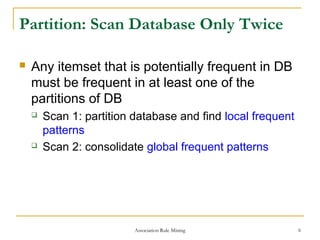
Partition: Scan Database Only Twice
 Any itemset that is potentially frequent in DB
must be frequent in at least one of the
partitions of DB
 Scan 1: partition database and find local frequent
patterns
 Scan 2: consolidate global frequent patterns
Association Rule Mining 7
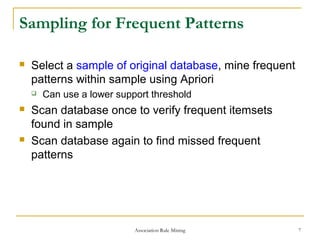
Sampling for Frequent Patterns
 Select a sample of original database, mine frequent
patterns within sample using Apriori
 Can use a lower support threshold
 Scan database once to verify frequent itemsets
found in sample
 Scan database again to find missed frequent
patterns
Association Rule Mining 8
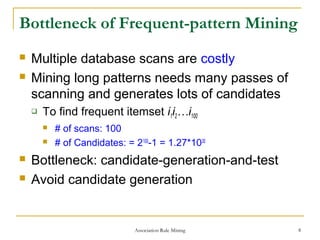
Bottleneck of Frequent-pattern Mining
 Multiple database scans are costly
 Mining long patterns needs many passes of
scanning and generates lots of candidates
 To find frequent itemset i1i2…i100
 # of scans: 100
 # of Candidates: = 2100
-1 = 1.27*1030
 Bottleneck: candidate-generation-and-test
 Avoid candidate generation
Association Rule Mining 9
Mining Frequent Patterns Without
Candidate Generation
 FP Growth
 Divide and Conquer technique
 FP-Tree
 Grow long patterns from short ones using local
frequent items
Association Rule Mining 10
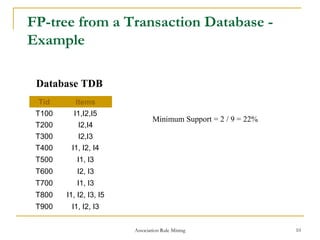
FP-tree from a Transaction Database -
Example
Database TDB
Tid Items
T100 I1,I2,I5
T200 I2,I4
T300 I2,I3
T400 I1, I2, I4
T500 I1, I3
T600 I2, I3
T700 I1, I3
T800 I1, I2, I3, I5
T900 I1, I2, I3
Minimum Support = 2 / 9 = 22%
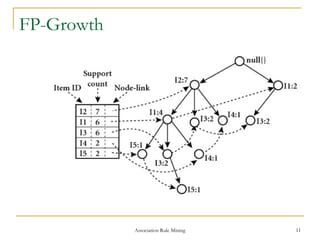
FP-Growth
Association Rule Mining 11
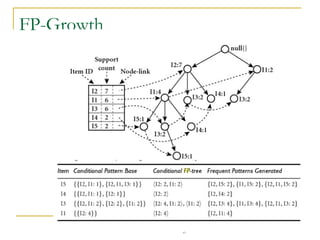
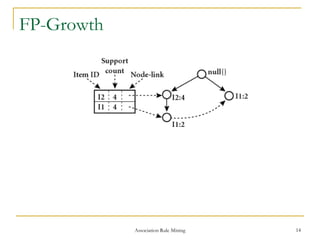
FP-Growth
 For each frequent length-1 pattern(Suffix
pattern):
 Construct conditional pattern base (Sub-database
consisting of set of prefix paths co-occurring with
suffix)
 Construct conditional FP-tree and mine
recursively
 Generate all combinations of frequent patterns by
combing with suffix
Association Rule Mining 12
FP-Growth
Association Rule Mining 13
FP-Growth
Association Rule Mining 14
Association Rule Mining 15
Algorithm
Input: A transaction db D; min_sup
Output: Frequent patterns
Construction of FP-Tree
1. Scan database, collect frequent items F and sort in descending
order of support
2. Create root of FP-tree labeled null
For each Trans, sort in descending order [p|P]
Insert_tree([p|P],T)
If T has a child N = p, increment count
else create new node with count 1 and set parent and node
links
If P is non-empty call insert_tree(P,N) recursively
Association Rule Mining 16
Algorithm
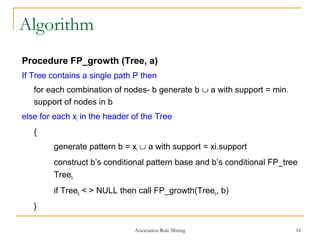
Procedure FP_growth (Tree, a)
If Tree contains a single path P then
for each combination of nodes- b generate b ∪ a with support = min.
support of nodes in b
else for each xi in the header of the Tree
{
generate pattern b = xi ∪ a with support = xi.support
construct b’s conditional pattern base and b’s conditional FP_tree
Treeb
if Treeb < > NULL then call FP_growth(Treeb, b)
}
Association Rule Mining 17
Features
 Finds long frequent patterns by looking for shorter
ones recursively
 Items in frequency descending order: the more
frequently occurring, the more likely to be shared
 Main-memory based FP-tree
 Efficient and scalable
 Faster than Apriori

1.10.association mining 2

  • 1.
    Association Rule Mining1 Association Rule Mining
  • 2.
    Association Rule Mining2 Generating Association Rules from Frequent Itemsets  Strong association rules satisfy both minimum support and minimum confidence levels  Confidence (A ⇒ B) = P(B / A ) = support_count(A U B) / support_count(A)  Association rules  For each frequent itemset l, generate all non-empty subsets of l  For every non-empty subset s of l, output s ⇒ (l-s) if sup_count(l) / sup_count(s) >= min_conf
  • 3.
    Association Rule Mining3 Example I = {I1, I2, I5} Confidence Threshold : 70% Non empty subsets: {I1, I2}, {I1, I5}, {I2, I5} {I1}, {I2}, {I5} I1 ∧ I2 ⇒ I5, confidence = 2 /4 = 50% I1 ∧ I5 ⇒ I2, confidence = 2 /2 = 100% I2 ∧ I5 ⇒ I1, confidence = 2 /2 = 100% I1 ⇒ I2 ∧ I5, confidence = 2 /6 = 33% I2 ⇒ I1 ∧ I5, confidence = 2 /7 = 29% I5 ⇒ I1 ∧ I2, confidence = 2 /2 = 100%
  • 4.
    Association Rule Mining4 Improving the Efficiency of Apriori  Hash based technique  Transaction reduction  A transaction which does not contain k frequent itemsets cannot contain k+1 frequent itemsets  Partitioning  Sampling  Dynamic itemset counting  Start points
  • 5.
    Association Rule Mining5 Hash Based Technique Bucket Address 0 1 2 3 4 5 6 Bucket count 2 2 4 2 2 4 4 Bucket Content s {I1,I4} {I3,I5} {I1,I5} {I1,I5} {I2,I3} {I2,I3} {I2,I3} {I2,I3} {I2,I4} {I2,I4} {I2,I5} {I2,I5} {I1,I2} {I1,I2} {I1,I2} {I1,I2} {I1,I3} {I1,I3} {I1,I3} {I1,I3} H(x,y) = (x*10+y)%7
  • 6.
    Association Rule Mining6 Partition: Scan Database Only Twice  Any itemset that is potentially frequent in DB must be frequent in at least one of the partitions of DB  Scan 1: partition database and find local frequent patterns  Scan 2: consolidate global frequent patterns
  • 7.
    Association Rule Mining7 Sampling for Frequent Patterns  Select a sample of original database, mine frequent patterns within sample using Apriori  Can use a lower support threshold  Scan database once to verify frequent itemsets found in sample  Scan database again to find missed frequent patterns
  • 8.
    Association Rule Mining8 Bottleneck of Frequent-pattern Mining  Multiple database scans are costly  Mining long patterns needs many passes of scanning and generates lots of candidates  To find frequent itemset i1i2…i100  # of scans: 100  # of Candidates: = 2100 -1 = 1.27*1030  Bottleneck: candidate-generation-and-test  Avoid candidate generation
  • 9.
    Association Rule Mining9 Mining Frequent Patterns Without Candidate Generation  FP Growth  Divide and Conquer technique  FP-Tree  Grow long patterns from short ones using local frequent items
  • 10.
    Association Rule Mining10 FP-tree from a Transaction Database - Example Database TDB Tid Items T100 I1,I2,I5 T200 I2,I4 T300 I2,I3 T400 I1, I2, I4 T500 I1, I3 T600 I2, I3 T700 I1, I3 T800 I1, I2, I3, I5 T900 I1, I2, I3 Minimum Support = 2 / 9 = 22%
  • 11.
  • 12.
    FP-Growth  For eachfrequent length-1 pattern(Suffix pattern):  Construct conditional pattern base (Sub-database consisting of set of prefix paths co-occurring with suffix)  Construct conditional FP-tree and mine recursively  Generate all combinations of frequent patterns by combing with suffix Association Rule Mining 12
  • 13.
  • 14.
  • 15.
    Association Rule Mining15 Algorithm Input: A transaction db D; min_sup Output: Frequent patterns Construction of FP-Tree 1. Scan database, collect frequent items F and sort in descending order of support 2. Create root of FP-tree labeled null For each Trans, sort in descending order [p|P] Insert_tree([p|P],T) If T has a child N = p, increment count else create new node with count 1 and set parent and node links If P is non-empty call insert_tree(P,N) recursively
  • 16.
    Association Rule Mining16 Algorithm Procedure FP_growth (Tree, a) If Tree contains a single path P then for each combination of nodes- b generate b ∪ a with support = min. support of nodes in b else for each xi in the header of the Tree { generate pattern b = xi ∪ a with support = xi.support construct b’s conditional pattern base and b’s conditional FP_tree Treeb if Treeb < > NULL then call FP_growth(Treeb, b) }
  • 17.
    Association Rule Mining17 Features  Finds long frequent patterns by looking for shorter ones recursively  Items in frequency descending order: the more frequently occurring, the more likely to be shared  Main-memory based FP-tree  Efficient and scalable  Faster than Apriori