Design and Analysis of Algorithms
Quicksort
Haidong Xue
Summer 2012, at GSU
Review of insertion sort and merge sort
• Insertion sort
– Algorithm
– Worst case number of comparisons = O(?)
• Merge sort
– Algorithm
– Worst case number of comparisons = O(?)
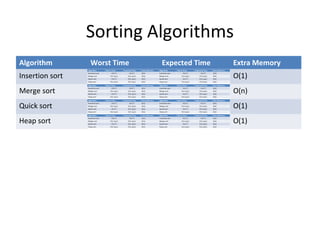
Sorting Algorithms
Algorithm Worst Time Expected Time Extra Memory
Insertion sort O(1)
Merge sort O(n)
Quick sort O(1)
Heap sort O(1)
Algorithm Worst Time Expected Time Extra Memory
Insertion sort O(1)
Merge sort O(n)
Quick sort O(1)
Heap sort O(1)
Quicksort Algorithm
• Input: A[1, …, n]
• Output: A[1, .., n], where A[1]<=A[2]…<=A[n]
• Quicksort:
1. if(n<=1) return;
2. Choose the pivot p = A[n]
3. Put all elements less than p on the left; put all elements lager
than p on the right; put p at the middle. (Partition)
4. Quicksort(the array on the left of p)
5. Quicksort(the array on the right of p)
Quicksort Algorithm
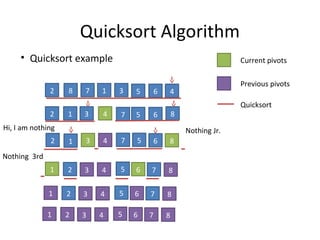
• Quicksort example
2 8 7 1 3 5 6 4
2 871 3 5 64
2 871 3 5 64
Current pivots
Previous pivots
Quicksort
Hi, I am nothing Nothing Jr.
Nothing 3rd
2 871 3 5 64
2 871 3 5 64
2 871 3 5 64
Quicksort Algorithm
• More detail about partition
• Input: A[1, …, n] (p=A[n])
• Output: A[1,…k-1, k, k+1, … n], where A[1, …, k-1]<A[k] and A[k+1, … n] >
A[k], A[k]=p
• Partition:
1. t = the tail of smaller array
2. from i= 1 to n-1{
3. if(A[i]<p) {
4. exchange A[t+1] with A[i];
5. update t to the new tail;
6. }
7. exchange A[t+1] with A[n];
Quicksort Algorithm
• Partition example
2 8 7 1 3 5 6 4
2 8 7 1 3 5 6 4
2 8 7 1 3 5 6 4
tail
2 8 7 1 3 5 6 4
tail
tail
tail
Exchange 2 with A[tail+1]
Do nothing
Do nothing
Quicksort Algorithm
• Partition example
2 8 7 1 3 5 6 4
2 871 3 5 6 4
2 8 71 3 5 6 4
tail
tail
Exchange 1 with A[tail+1]
tail
Exchange 3 with A[tail+1]
Do nothing
2 8 71 3 5 6 4
tail
Do nothing
2 871 3 5 64 Final step: exchange A[n]
with A[tail+1]
Quicksort Algorithm
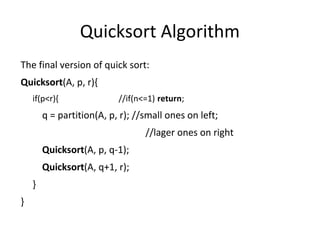
The final version of quick sort:
Quicksort(A, p, r){
if(p<r){ //if(n<=1) return;
q = partition(A, p, r); //small ones on left;
//lager ones on right
Quicksort(A, p, q-1);
Quicksort(A, q+1, r);
}
}
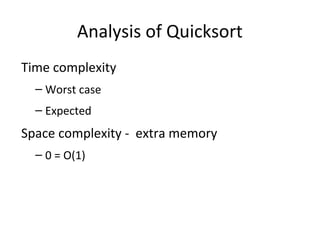
Analysis of Quicksort
Time complexity
– Worst case
– Expected
Space complexity - extra memory
– 0 = O(1)
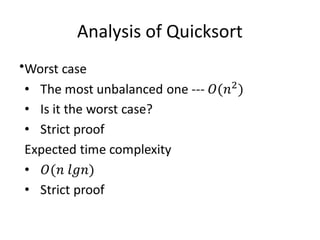
Analysis of Quicksort
Worst case
• The most unbalanced one ---
• Is it the worst case?
• Strict proof
Expected time complexity
• Strict proof
•
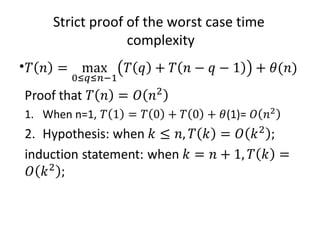
Strict proof of the worst case time
complexity
Proof that
1. When n=1, (1)=
2. Hypothesis: when
induction statement: when
•
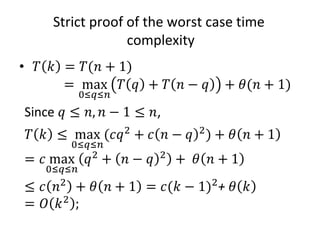
Strict proof of the worst case time
complexity
Since ,
+
•
Strict proof of the expected time complexity
• Given A[1, …, n], after sorting them to , the
chance for 2 elements, A[i] and A[j], to be
compared is .
• The total comparison is calculated as:
•
Java implementation of Quicksort
• Professional programmers DO NOT implement sorting
algorithms by themselves
• We do it for practicing algorithm implementation
techniques and understanding those algorithms
• Code quicksort
– Sort.java // the abstract class
– Quicksort_Haydon.java // my quicksort implementation
– SortingTester.java // correctness tester

3.8 quicksort

  • 1.
    Design and Analysisof Algorithms Quicksort Haidong Xue Summer 2012, at GSU
  • 2.
    Review of insertionsort and merge sort • Insertion sort – Algorithm – Worst case number of comparisons = O(?) • Merge sort – Algorithm – Worst case number of comparisons = O(?)
  • 3.
    Sorting Algorithms Algorithm WorstTime Expected Time Extra Memory Insertion sort O(1) Merge sort O(n) Quick sort O(1) Heap sort O(1) Algorithm Worst Time Expected Time Extra Memory Insertion sort O(1) Merge sort O(n) Quick sort O(1) Heap sort O(1)
  • 4.
    Quicksort Algorithm • Input:A[1, …, n] • Output: A[1, .., n], where A[1]<=A[2]…<=A[n] • Quicksort: 1. if(n<=1) return; 2. Choose the pivot p = A[n] 3. Put all elements less than p on the left; put all elements lager than p on the right; put p at the middle. (Partition) 4. Quicksort(the array on the left of p) 5. Quicksort(the array on the right of p)
  • 5.
    Quicksort Algorithm • Quicksortexample 2 8 7 1 3 5 6 4 2 871 3 5 64 2 871 3 5 64 Current pivots Previous pivots Quicksort Hi, I am nothing Nothing Jr. Nothing 3rd 2 871 3 5 64 2 871 3 5 64 2 871 3 5 64
  • 6.
    Quicksort Algorithm • Moredetail about partition • Input: A[1, …, n] (p=A[n]) • Output: A[1,…k-1, k, k+1, … n], where A[1, …, k-1]<A[k] and A[k+1, … n] > A[k], A[k]=p • Partition: 1. t = the tail of smaller array 2. from i= 1 to n-1{ 3. if(A[i]<p) { 4. exchange A[t+1] with A[i]; 5. update t to the new tail; 6. } 7. exchange A[t+1] with A[n];
  • 7.
    Quicksort Algorithm • Partitionexample 2 8 7 1 3 5 6 4 2 8 7 1 3 5 6 4 2 8 7 1 3 5 6 4 tail 2 8 7 1 3 5 6 4 tail tail tail Exchange 2 with A[tail+1] Do nothing Do nothing
  • 8.
    Quicksort Algorithm • Partitionexample 2 8 7 1 3 5 6 4 2 871 3 5 6 4 2 8 71 3 5 6 4 tail tail Exchange 1 with A[tail+1] tail Exchange 3 with A[tail+1] Do nothing 2 8 71 3 5 6 4 tail Do nothing 2 871 3 5 64 Final step: exchange A[n] with A[tail+1]
  • 9.
    Quicksort Algorithm The finalversion of quick sort: Quicksort(A, p, r){ if(p<r){ //if(n<=1) return; q = partition(A, p, r); //small ones on left; //lager ones on right Quicksort(A, p, q-1); Quicksort(A, q+1, r); } }
  • 10.
    Analysis of Quicksort Timecomplexity – Worst case – Expected Space complexity - extra memory – 0 = O(1)
  • 11.
    Analysis of Quicksort Worstcase • The most unbalanced one --- • Is it the worst case? • Strict proof Expected time complexity • Strict proof •
  • 12.
    Strict proof ofthe worst case time complexity Proof that 1. When n=1, (1)= 2. Hypothesis: when induction statement: when •
  • 13.
    Strict proof ofthe worst case time complexity Since , + •
  • 14.
    Strict proof ofthe expected time complexity • Given A[1, …, n], after sorting them to , the chance for 2 elements, A[i] and A[j], to be compared is . • The total comparison is calculated as: •
  • 15.
    Java implementation ofQuicksort • Professional programmers DO NOT implement sorting algorithms by themselves • We do it for practicing algorithm implementation techniques and understanding those algorithms • Code quicksort – Sort.java // the abstract class – Quicksort_Haydon.java // my quicksort implementation – SortingTester.java // correctness tester