David Luebke 1
CS 332: Algorithms
Go over exam
Binary Search Trees
David Luebke 2
Exam
● Hand back, go over exam
David Luebke 3
Review: Dynamic Sets
● Next few lectures will focus on data structures
rather than straight algorithms
● In particular, structures for dynamic sets
■ Elements have a key and satellite data
■ Dynamic sets support queries such as:
○ Search(S, k), Minimum(S), Maximum(S),
Successor(S, x), Predecessor(S, x)
■ They may also support modifying operations like:
○ Insert(S, x), Delete(S, x)
David Luebke 4
Review: Binary Search Trees
● Binary Search Trees (BSTs) are an important
data structure for dynamic sets
● In addition to satellite data, eleements have:
■ key: an identifying field inducing a total ordering
■ left: pointer to a left child (may be NULL)
■ right: pointer to a right child (may be NULL)
■ p: pointer to a parent node (NULL for root)
David Luebke 5
Review: Binary Search Trees
● BST property:
key[leftSubtree(x)] ≤ key[x] ≤ key[rightSubtree(x)]
● Example:
F
B H
KDA
David Luebke 6
Inorder Tree Walk
● What does the following code do?
TreeWalk(x)
TreeWalk(left[x]);
print(x);
TreeWalk(right[x]);
● A: prints elements in sorted (increasing) order
● This is called an inorder tree walk
■ Preorder tree walk: print root, then left, then right
■ Postorder tree walk: print left, then right, then root
David Luebke 7
Inorder Tree Walk
● Example:
● How long will a tree walk take?
● Prove that inorder walk prints in
monotonically increasing order
F
B H
KDA
David Luebke 8
Operations on BSTs: Search
● Given a key and a pointer to a node, returns an
element with that key or NULL:
TreeSearch(x, k)
if (x = NULL or k = key[x])
return x;
if (k < key[x])
return TreeSearch(left[x], k);
else
return TreeSearch(right[x], k);
David Luebke 9
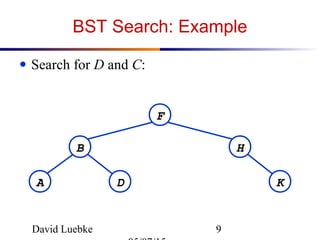
BST Search: Example
● Search for D and C:
F
B H
KDA
David Luebke 10
Operations on BSTs: Search
● Here’s another function that does the same:
TreeSearch(x, k)
while (x != NULL and k != key[x])
if (k < key[x])
x = left[x];
else
x = right[x];
return x;
● Which of these two functions is more efficient?
David Luebke 11
Operations of BSTs: Insert
● Adds an element x to the tree so that the binary
search tree property continues to hold
● The basic algorithm
■ Like the search procedure above
■ Insert x in place of NULL
■ Use a “trailing pointer” to keep track of where you
came from (like inserting into singly linked list)
David Luebke 12
BST Insert: Example
● Example: Insert C
F
B H
KDA
C
David Luebke 13
BST Search/Insert: Running Time
● What is the running time of TreeSearch() or
TreeInsert()?
● A: O(h), where h = height of tree
● What is the height of a binary search tree?
● A: worst case: h = O(n) when tree is just a
linear string of left or right children
■ We’ll keep all analysis in terms of h for now
■ Later we’ll see how to maintain h = O(lg n)
David Luebke 14
Sorting With Binary Search Trees
● Informal code for sorting array A of length n:
BSTSort(A)
for i=1 to n
TreeInsert(A[i]);
InorderTreeWalk(root);
● Argue that this is Ω(n lg n)
● What will be the running time in the
■ Worst case?
■ Average case? (hint: remind you of anything?)
David Luebke 15
Sorting With BSTs
● Average case analysis
■ It’s a form of quicksort!
for i=1 to n
TreeInsert(A[i]);
InorderTreeWalk(root);
3 1 8 2 6 7 5
5 7
1 2 8 6 7 5
2 6 7 5
3
1 8
2 6
5 7
David Luebke 16
Sorting with BSTs
● Same partitions are done as with quicksort, but
in a different order
■ In previous example
○ Everything was compared to 3 once
○ Then those items < 3 were compared to 1 once
○ Etc.
■ Same comparisons as quicksort, different order!
○ Example: consider inserting 5
David Luebke 17
Sorting with BSTs
● Since run time is proportional to the number of
comparisons, same time as quicksort: O(n lg n)
● Which do you think is better, quicksort or
BSTsort? Why?
David Luebke 18
Sorting with BSTs
● Since run time is proportional to the number of
comparisons, same time as quicksort: O(n lg n)
● Which do you think is better, quicksort or
BSTSort? Why?
● A: quicksort
■ Better constants
■ Sorts in place
■ Doesn’t need to build data structure
David Luebke 19
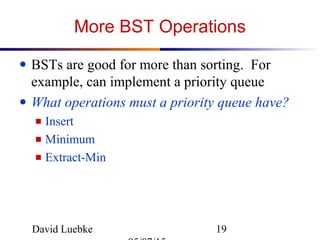
More BST Operations
● BSTs are good for more than sorting. For
example, can implement a priority queue
● What operations must a priority queue have?
■ Insert
■ Minimum
■ Extract-Min
David Luebke 20
BST Operations: Minimum
● How can we implement a Minimum() query?
● What is the running time?
David Luebke 21
BST Operations: Successor
● For deletion, we will need a Successor()
operation
● Draw Fig 13.2
● What is the successor of node 3? Node 15?
Node 13?
● What are the general rules for finding the
successor of node x? (hint: two cases)
David Luebke 22
BST Operations: Successor
● Two cases:
■ x has a right subtree: successor is minimum node
in right subtree
■ x has no right subtree: successor is first ancestor of
x whose left child is also ancestor of x
○ Intuition: As long as you move to the left up the tree,
you’re visiting smaller nodes.
● Predecessor: similar algorithm
David Luebke 23
BST Operations: Delete
● Deletion is a bit tricky
● 3 cases:
■ x has no children:
○ Remove x
■ x has one child:
○ Splice out x
■ x has two children:
○ Swap x with successor
○ Perform case 1 or 2 to delete it
F
B H
KDA
C
Example: delete K
or H or B
David Luebke 24
BST Operations: Delete
● Why will case 2 always go to case 0 or case 1?
● A: because when x has 2 children, its
successor is the minimum in its right subtree
● Could we swap x with predecessor instead of
successor?
● A: yes. Would it be a good idea?
● A: might be good to alternate
David Luebke 25
The End
● Up next: guaranteeing a O(lg n) height tree

4.2 bst 02

  • 1.
    David Luebke 1 CS332: Algorithms Go over exam Binary Search Trees
  • 2.
    David Luebke 2 Exam ●Hand back, go over exam
  • 3.
    David Luebke 3 Review:Dynamic Sets ● Next few lectures will focus on data structures rather than straight algorithms ● In particular, structures for dynamic sets ■ Elements have a key and satellite data ■ Dynamic sets support queries such as: ○ Search(S, k), Minimum(S), Maximum(S), Successor(S, x), Predecessor(S, x) ■ They may also support modifying operations like: ○ Insert(S, x), Delete(S, x)
  • 4.
    David Luebke 4 Review:Binary Search Trees ● Binary Search Trees (BSTs) are an important data structure for dynamic sets ● In addition to satellite data, eleements have: ■ key: an identifying field inducing a total ordering ■ left: pointer to a left child (may be NULL) ■ right: pointer to a right child (may be NULL) ■ p: pointer to a parent node (NULL for root)
  • 5.
    David Luebke 5 Review:Binary Search Trees ● BST property: key[leftSubtree(x)] ≤ key[x] ≤ key[rightSubtree(x)] ● Example: F B H KDA
  • 6.
    David Luebke 6 InorderTree Walk ● What does the following code do? TreeWalk(x) TreeWalk(left[x]); print(x); TreeWalk(right[x]); ● A: prints elements in sorted (increasing) order ● This is called an inorder tree walk ■ Preorder tree walk: print root, then left, then right ■ Postorder tree walk: print left, then right, then root
  • 7.
    David Luebke 7 InorderTree Walk ● Example: ● How long will a tree walk take? ● Prove that inorder walk prints in monotonically increasing order F B H KDA
  • 8.
    David Luebke 8 Operationson BSTs: Search ● Given a key and a pointer to a node, returns an element with that key or NULL: TreeSearch(x, k) if (x = NULL or k = key[x]) return x; if (k < key[x]) return TreeSearch(left[x], k); else return TreeSearch(right[x], k);
  • 9.
    David Luebke 9 BSTSearch: Example ● Search for D and C: F B H KDA
  • 10.
    David Luebke 10 Operationson BSTs: Search ● Here’s another function that does the same: TreeSearch(x, k) while (x != NULL and k != key[x]) if (k < key[x]) x = left[x]; else x = right[x]; return x; ● Which of these two functions is more efficient?
  • 11.
    David Luebke 11 Operationsof BSTs: Insert ● Adds an element x to the tree so that the binary search tree property continues to hold ● The basic algorithm ■ Like the search procedure above ■ Insert x in place of NULL ■ Use a “trailing pointer” to keep track of where you came from (like inserting into singly linked list)
  • 12.
    David Luebke 12 BSTInsert: Example ● Example: Insert C F B H KDA C
  • 13.
    David Luebke 13 BSTSearch/Insert: Running Time ● What is the running time of TreeSearch() or TreeInsert()? ● A: O(h), where h = height of tree ● What is the height of a binary search tree? ● A: worst case: h = O(n) when tree is just a linear string of left or right children ■ We’ll keep all analysis in terms of h for now ■ Later we’ll see how to maintain h = O(lg n)
  • 14.
    David Luebke 14 SortingWith Binary Search Trees ● Informal code for sorting array A of length n: BSTSort(A) for i=1 to n TreeInsert(A[i]); InorderTreeWalk(root); ● Argue that this is Ω(n lg n) ● What will be the running time in the ■ Worst case? ■ Average case? (hint: remind you of anything?)
  • 15.
    David Luebke 15 SortingWith BSTs ● Average case analysis ■ It’s a form of quicksort! for i=1 to n TreeInsert(A[i]); InorderTreeWalk(root); 3 1 8 2 6 7 5 5 7 1 2 8 6 7 5 2 6 7 5 3 1 8 2 6 5 7
  • 16.
    David Luebke 16 Sortingwith BSTs ● Same partitions are done as with quicksort, but in a different order ■ In previous example ○ Everything was compared to 3 once ○ Then those items < 3 were compared to 1 once ○ Etc. ■ Same comparisons as quicksort, different order! ○ Example: consider inserting 5
  • 17.
    David Luebke 17 Sortingwith BSTs ● Since run time is proportional to the number of comparisons, same time as quicksort: O(n lg n) ● Which do you think is better, quicksort or BSTsort? Why?
  • 18.
    David Luebke 18 Sortingwith BSTs ● Since run time is proportional to the number of comparisons, same time as quicksort: O(n lg n) ● Which do you think is better, quicksort or BSTSort? Why? ● A: quicksort ■ Better constants ■ Sorts in place ■ Doesn’t need to build data structure
  • 19.
    David Luebke 19 MoreBST Operations ● BSTs are good for more than sorting. For example, can implement a priority queue ● What operations must a priority queue have? ■ Insert ■ Minimum ■ Extract-Min
  • 20.
    David Luebke 20 BSTOperations: Minimum ● How can we implement a Minimum() query? ● What is the running time?
  • 21.
    David Luebke 21 BSTOperations: Successor ● For deletion, we will need a Successor() operation ● Draw Fig 13.2 ● What is the successor of node 3? Node 15? Node 13? ● What are the general rules for finding the successor of node x? (hint: two cases)
  • 22.
    David Luebke 22 BSTOperations: Successor ● Two cases: ■ x has a right subtree: successor is minimum node in right subtree ■ x has no right subtree: successor is first ancestor of x whose left child is also ancestor of x ○ Intuition: As long as you move to the left up the tree, you’re visiting smaller nodes. ● Predecessor: similar algorithm
  • 23.
    David Luebke 23 BSTOperations: Delete ● Deletion is a bit tricky ● 3 cases: ■ x has no children: ○ Remove x ■ x has one child: ○ Splice out x ■ x has two children: ○ Swap x with successor ○ Perform case 1 or 2 to delete it F B H KDA C Example: delete K or H or B
  • 24.
    David Luebke 24 BSTOperations: Delete ● Why will case 2 always go to case 0 or case 1? ● A: because when x has 2 children, its successor is the minimum in its right subtree ● Could we swap x with predecessor instead of successor? ● A: yes. Would it be a good idea? ● A: might be good to alternate
  • 25.
    David Luebke 25 TheEnd ● Up next: guaranteeing a O(lg n) height tree