Prof. Pier Luca Lanzi
Association Rules!
Data Mining andText Mining (UIC 583 @ Politecnico di Milano)
Prof. Pier Luca Lanzi
Readings
•  “Data Mining and Analysis” by Zaki & Meira
! Chapter 8
! Section 9.1
! Chapter 10 up to !
Section 10.2.1 included
! Section 12.1
•  http://www.dataminingbook.info
2
Prof. Pier Luca Lanzi
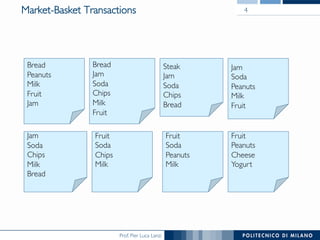
Market-Basket Transactions!
Bread
Peanuts
Milk
Fruit
Jam
Bread
Jam
Soda
Chips
Milk
Fruit
Steak
Jam
Soda
Chips
Bread
Jam
Soda
Chips
Milk
Bread
Fruit
Soda
Chips
Milk
Jam
Soda
Peanuts
Milk
Fruit
Fruit
Soda
Peanuts
Milk
Fruit
Peanuts
Cheese
Yogurt
4
Prof. Pier Luca Lanzi
What is Association Rule Mining?
•  Finding frequent patterns, associations, correlations, or causal
structures among sets of items or objects in transaction
databases, relational databases, and other information repositories
•  Applications
! Basket data analysis
! Cross-marketing
! Catalog design
! …
5
Prof. Pier Luca Lanzi
What is Association Rule Mining?
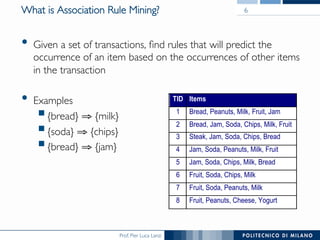
•  Given a set of transactions, find rules that will predict the
occurrence of an item based on the occurrences of other items
in the transaction
•  Examples
! {bread} ⇒ {milk}
! {soda} ⇒ {chips}
! {bread} ⇒ {jam}
TID Items
1 Bread, Peanuts, Milk, Fruit, Jam
2 Bread, Jam, Soda, Chips, Milk, Fruit
3 Steak, Jam, Soda, Chips, Bread
4 Jam, Soda, Peanuts, Milk, Fruit
5 Jam, Soda, Chips, Milk, Bread
6 Fruit, Soda, Chips, Milk
7 Fruit, Soda, Peanuts, Milk
8 Fruit, Peanuts, Cheese, Yogurt
6
Prof. Pier Luca Lanzi
Frequent Itemset
•  Itemset
!  A collection of one or more items,
e.g., {milk, bread, jam}
!  k-itemset, an itemset that !
contains k items
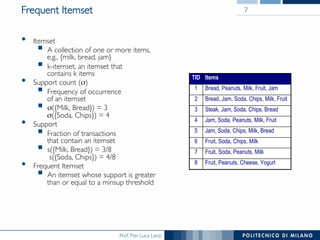
•  Support count (σ)
!  Frequency of occurrence !
of an itemset
!  σ({Milk, Bread}) = 3 !
σ({Soda, Chips}) = 4
•  Support
!  Fraction of transactions !
that contain an itemset
!  s({Milk, Bread}) = 3/8!
s({Soda, Chips}) = 4/8
•  Frequent Itemset
!  An itemset whose support is greater
than or equal to a minsup threshold
TID Items
1 Bread, Peanuts, Milk, Fruit, Jam
2 Bread, Jam, Soda, Chips, Milk, Fruit
3 Steak, Jam, Soda, Chips, Bread
4 Jam, Soda, Peanuts, Milk, Fruit
5 Jam, Soda, Chips, Milk, Bread
6 Fruit, Soda, Chips, Milk
7 Fruit, Soda, Peanuts, Milk
8 Fruit, Peanuts, Cheese, Yogurt
7
Prof. Pier Luca Lanzi
What is An Association Rule?
•  Implication of the form X ⇒ Y, where X and Y are itemsets
•  Example, {bread} ⇒ {milk}
•  Rule Evaluation Metrics, Suppor & Confidence
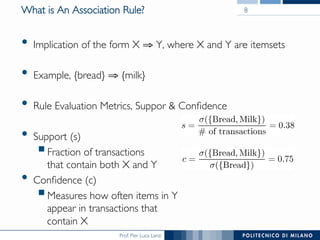
•  Support (s)
! Fraction of transactions !
that contain both X and Y
•  Confidence (c)
! Measures how often items in Y !
appear in transactions that!
contain X
8
Prof. Pier Luca Lanzi
What is the Goal?
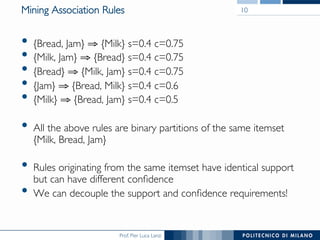
•  Given a set of transactions T, the goal of association rule mining is
to find all rules having
! support minsup threshold
! confidence minconf threshold
•  Brute-force approach
! List all possible association rules
! Compute the support and confidence for each rule
! Prune rules that fail the minsup and minconf thresholds
•  Brute-force approach is computationally prohibitive!
9
Prof. Pier Luca Lanzi
Mining Association Rules
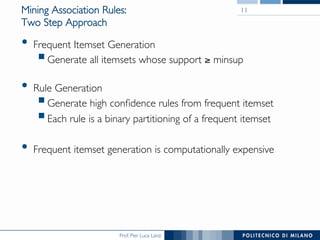
•  {Bread, Jam} ⇒ {Milk} s=0.4 c=0.75
•  {Milk, Jam} ⇒ {Bread} s=0.4 c=0.75
•  {Bread} ⇒ {Milk, Jam} s=0.4 c=0.75
•  {Jam} ⇒ {Bread, Milk} s=0.4 c=0.6
•  {Milk} ⇒ {Bread, Jam} s=0.4 c=0.5
•  All the above rules are binary partitions of the same itemset!
{Milk, Bread, Jam}
•  Rules originating from the same itemset have identical support
but can have different confidence
•  We can decouple the support and confidence requirements!
10
Prof. Pier Luca Lanzi
Mining Association Rules:!
Two Step Approach
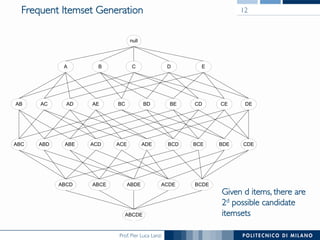
•  Frequent Itemset Generation
! Generate all itemsets whose support ≥ minsup
•  Rule Generation
! Generate high confidence rules from frequent itemset
! Each rule is a binary partitioning of a frequent itemset
•  Frequent itemset generation is computationally expensive
11
Prof. Pier Luca Lanzi
Frequent Itemset Generation
null
AB AC AD AE BC BD BE CD CE DE
A B C D E
ABC ABD ABE ACD ACE ADE BCD BCE BDE CDE
ABCD ABCE ABDE ACDE BCDE
ABCDE
Given d items, there are
2d possible candidate
itemsets
12
Prof. Pier Luca Lanzi
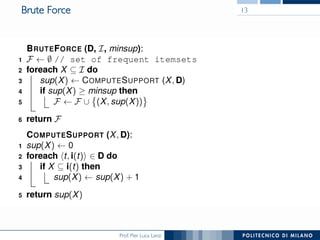
Brute Force 13
Prof. Pier Luca Lanzi
Frequent Itemset Generation
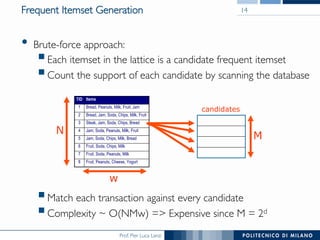
•  Brute-force approach:
! Each itemset in the lattice is a candidate frequent itemset
! Count the support of each candidate by scanning the database
! Match each transaction against every candidate
! Complexity ~ O(NMw) => Expensive since M = 2d
TID Items
1 Bread, Peanuts, Milk, Fruit, Jam
2 Bread, Jam, Soda, Chips, Milk, Fruit
3 Steak, Jam, Soda, Chips, Bread
4 Jam, Soda, Peanuts, Milk, Fruit
5 Jam, Soda, Chips, Milk, Bread
6 Fruit, Soda, Chips, Milk
7 Fruit, Soda, Peanuts, Milk
8 Fruit, Peanuts, Cheese, Yogurt
w
N
M
candidates
14
Prof. Pier Luca Lanzi
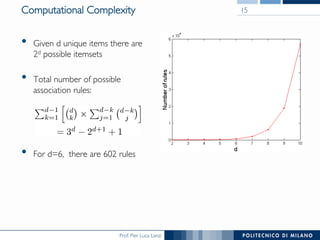
Computational Complexity
•  Given d unique items there are
2d possible itemsets
•  Total number of possible
association rules:
•  For d=6, there are 602 rules
15
Prof. Pier Luca Lanzi
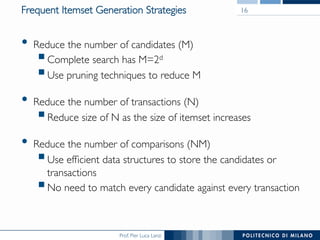
Frequent Itemset Generation Strategies
•  Reduce the number of candidates (M)
! Complete search has M=2d
! Use pruning techniques to reduce M
•  Reduce the number of transactions (N)
! Reduce size of N as the size of itemset increases
•  Reduce the number of comparisons (NM)
! Use efficient data structures to store the candidates or
transactions
! No need to match every candidate against every transaction
16
Prof. Pier Luca Lanzi
Reducing the Number of Candidates
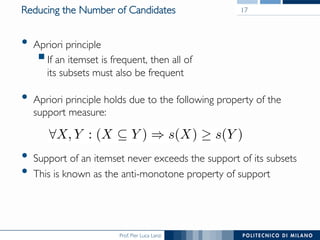
•  Apriori principle
! If an itemset is frequent, then all of !
its subsets must also be frequent
•  Apriori principle holds due to the following property of the
support measure:
•  Support of an itemset never exceeds the support of its subsets
•  This is known as the anti-monotone property of support
17
Prof. Pier Luca Lanzi
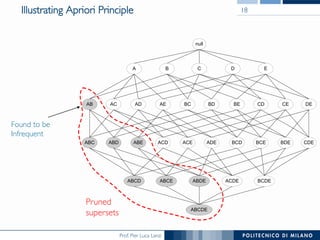
Illustrating Apriori Principle
Found to be
Infrequent
null
AB AC AD AE BC BD BE CD CE DE
A B C D E
ABC ABD ABE ACD ACE ADE BCD BCE BDE CDE
ABCD ABCE ABDE ACDE BCDE
ABCDE
null
AB AC AD AE BC BD BE CD CE DE
A B C D E
ABC ABD ABE ACD ACE ADE BCD BCE BDE CDE
ABCD ABCE ABDE ACDE BCDE
ABCDE
Pruned
supersets
18
Prof. Pier Luca Lanzi
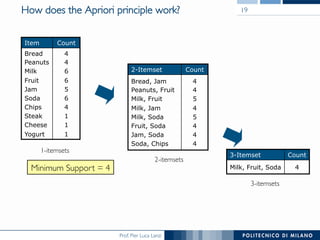
How does the Apriori principle work?
Item Count
Bread
Peanuts
Milk
Fruit
Jam
Soda
Chips
Steak
Cheese
Yogurt
4
4
6
6
5
6
4
1
1
1
2-Itemset Count
Bread, Jam
Peanuts, Fruit
Milk, Fruit
Milk, Jam
Milk, Soda
Fruit, Soda
Jam, Soda
Soda, Chips
4
4
5
4
5
4
4
4
3-Itemset Count
Milk, Fruit, Soda 4
1-itemsets
Minimum Support = 4
2-itemsets
3-itemsets
19
Prof. Pier Luca Lanzi
Example
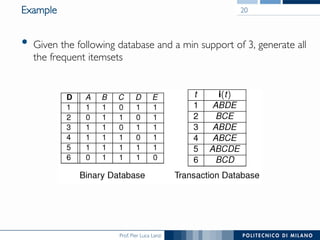
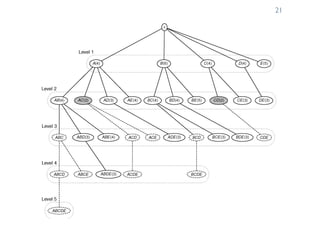
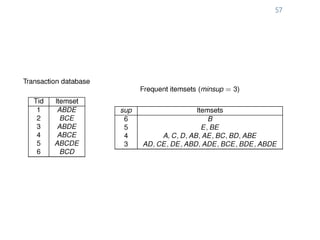
•  Given the following database and a min support of 3, generate all
the frequent itemsets
20
Prof. Pier Luca Lanzi
21
Prof. Pier Luca Lanzi
The Apriori Algorithm
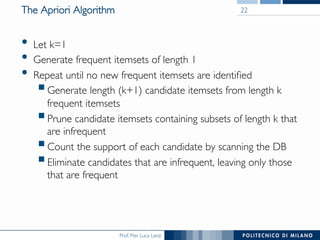
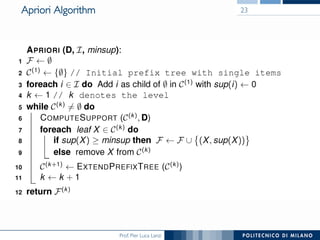
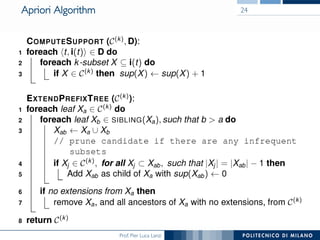
•  Let k=1
•  Generate frequent itemsets of length 1
•  Repeat until no new frequent itemsets are identified
! Generate length (k+1) candidate itemsets from length k
frequent itemsets
! Prune candidate itemsets containing subsets of length k that
are infrequent
! Count the support of each candidate by scanning the DB
! Eliminate candidates that are infrequent, leaving only those
that are frequent
22
Prof. Pier Luca Lanzi
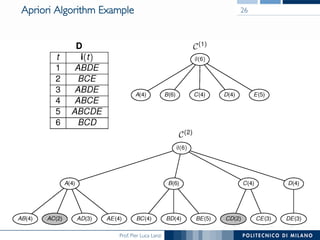
Apriori Algorithm 23
Prof. Pier Luca Lanzi
Apriori Algorithm 24
Prof. Pier Luca Lanzi
Apriori Algorithm Example 26
Prof. Pier Luca Lanzi
Eclat Algorithm
Prof. Pier Luca Lanzi
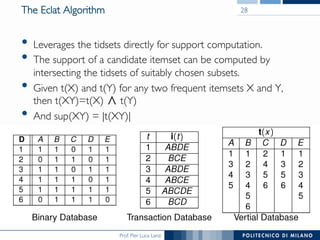
The Eclat Algorithm
•  Leverages the tidsets directly for support computation.
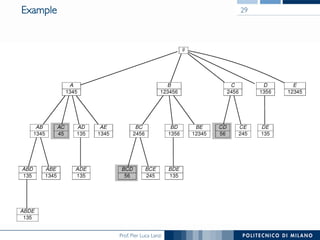
•  The support of a candidate itemset can be computed by
intersecting the tidsets of suitably chosen subsets.
•  Given t(X) and t(Y) for any two frequent itemsets X and Y, !
then t(XY)=t(X) t(Y)
•  And sup(XY) = |t(XY)|
28
Prof. Pier Luca Lanzi
Example 29
Prof. Pier Luca Lanzi
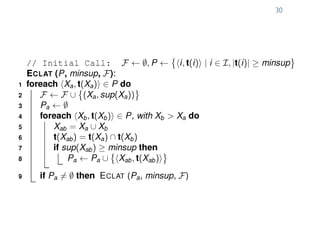
30
Prof. Pier Luca Lanzi
Frequent Patterns Mining
Without Candidate Generation
Prof. Pier Luca Lanzi
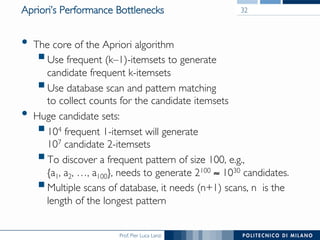
Apriori’s Performance Bottlenecks
•  The core of the Apriori algorithm
! Use frequent (k–1)-itemsets to generate !
candidate frequent k-itemsets
! Use database scan and pattern matching!
to collect counts for the candidate itemsets
•  Huge candidate sets:
! 104 frequent 1-itemset will generate !
107 candidate 2-itemsets
! To discover a frequent pattern of size 100, e.g., !
{a1, a2, …, a100}, needs to generate 2100 ≈ 1030 candidates.
! Multiple scans of database, it needs (n+1) scans, n is the
length of the longest pattern
32
Prof. Pier Luca Lanzi
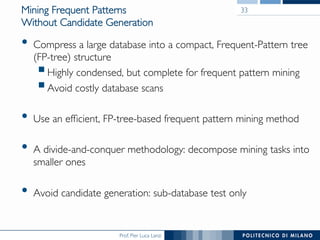
Mining Frequent Patterns !
Without Candidate Generation
•  Compress a large database into a compact, Frequent-Pattern tree
(FP-tree) structure
! Highly condensed, but complete for frequent pattern mining
! Avoid costly database scans
•  Use an efficient, FP-tree-based frequent pattern mining method
•  A divide-and-conquer methodology: decompose mining tasks into
smaller ones
•  Avoid candidate generation: sub-database test only
33
Prof. Pier Luca Lanzi
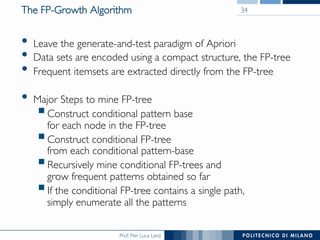
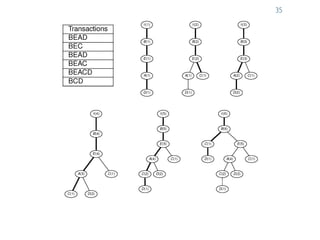
The FP-Growth Algorithm
•  Leave the generate-and-test paradigm of Apriori
•  Data sets are encoded using a compact structure, the FP-tree
•  Frequent itemsets are extracted directly from the FP-tree
•  Major Steps to mine FP-tree
! Construct conditional pattern base !
for each node in the FP-tree
! Construct conditional FP-tree !
from each conditional pattern-base
! Recursively mine conditional FP-trees and !
grow frequent patterns obtained so far
! If the conditional FP-tree contains a single path, !
simply enumerate all the patterns
34
Prof. Pier Luca Lanzi
35
Prof. Pier Luca Lanzi
Rule Generation
Prof. Pier Luca Lanzi
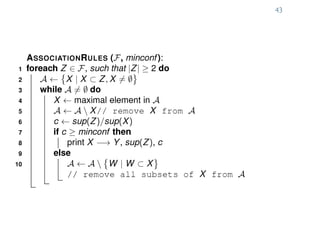
Rule Generation
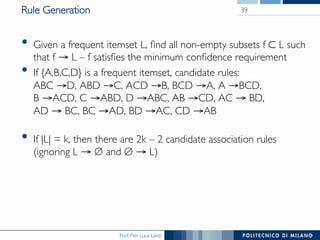
•  Given a frequent itemset L, find all non-empty subsets f ⊂ L such
that f → L – f satisfies the minimum confidence requirement
•  If {A,B,C,D} is a frequent itemset, candidate rules:!
ABC →D, ABD →C, ACD →B, BCD →A, A →BCD, !
B →ACD, C →ABD, D →ABC, AB →CD, AC → BD, !
AD → BC, BC →AD, BD →AC, CD →AB !
•  If |L| = k, then there are 2k – 2 candidate association rules
(ignoring L → ∅ and ∅ → L)
39
Prof. Pier Luca Lanzi
How to efficiently generate rules from frequent
itemsets?
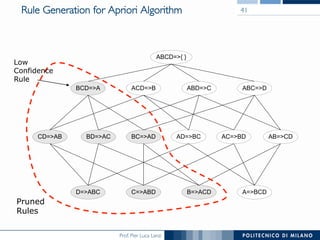
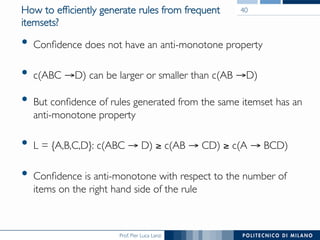
•  Confidence does not have an anti-monotone property
•  c(ABC →D) can be larger or smaller than c(AB →D)
•  But confidence of rules generated from the same itemset has an
anti-monotone property
•  L = {A,B,C,D}: c(ABC → D) ≥ c(AB → CD) ≥ c(A → BCD)
•  Confidence is anti-monotone with respect to the number of
items on the right hand side of the rule
40
Prof. Pier Luca Lanzi
Rule Generation for Apriori Algorithm
ABCD=>{ }
BCD=>A ACD=>B ABD=>C ABC=>D
BC=>ADBD=>ACCD=>AB AD=>BC AC=>BD AB=>CD
D=>ABC C=>ABD B=>ACD A=>BCD
ABCD=>{ }
BCD=>A ACD=>B ABD=>C ABC=>D
BC=>ADBD=>ACCD=>AB AD=>BC AC=>BD AB=>CD
D=>ABC C=>ABD B=>ACD A=>BCD
Pruned
Rules
Low
Confidence
Rule
41
Prof. Pier Luca Lanzi
Rule Generation for Apriori Algorithm
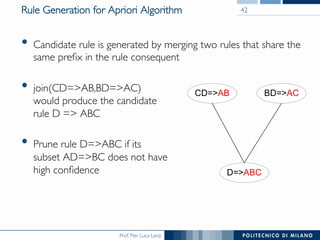
•  Candidate rule is generated by merging two rules that share the
same prefix in the rule consequent
•  join(CD=>AB,BD=>AC)!
would produce the candidate!
rule D => ABC
•  Prune rule D=>ABC if its!
subset AD=>BC does not have!
high confidence
BD=>ACCD=>AB
D=>ABC
42
Prof. Pier Luca Lanzi
43
Prof. Pier Luca Lanzi
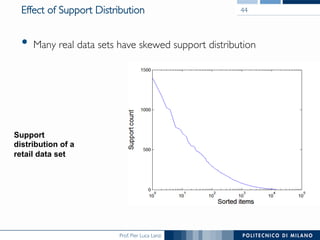
Effect of Support Distribution
•  Many real data sets have skewed support distribution
Support
distribution of a
retail data set
44
Prof. Pier Luca Lanzi
How to Set an Appropriate Minsup?
•  If minsup is set too high, we could miss itemsets involving
interesting rare items (e.g., expensive products)
•  If minsup is set too low, it is computationally expensive !
and the number of itemsets is very large
•  A single minimum support threshold may not be effective
45
Prof. Pier Luca Lanzi
Association Rule Mining in R
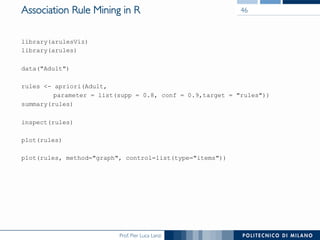
library(arulesViz)
library(arules)
data("Adult")
rules <- apriori(Adult,
parameter = list(supp = 0.8, conf = 0.9,target = "rules"))
summary(rules)
inspect(rules)
plot(rules)
plot(rules, method="graph", control=list(type="items"))
46
Prof. Pier Luca Lanzi
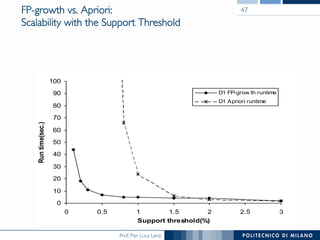
FP-growth vs. Apriori:!
Scalability with the Support Threshold
0
10
20
30
40
50
60
70
80
90
100
0 0.5 1 1.5 2 2.5 3
Support threshold(%)
Runtime(sec.)
D1 FP-grow th runtime
D1 Apriori runtime
47
Prof. Pier Luca Lanzi
Benefits of the FP-Tree Structure
•  Completeness
! Preserve complete information !
for frequent pattern mining
! Never break a long pattern of any transaction
•  Compactness
! Reduce irrelevant info—infrequent items are gone
! Items in frequency descending order: the more frequently
occurring, the more likely to be shared
! Never be larger than the original database (not count node-
links and the count field)
! For Connect-4 DB, compression ratio could be over 100
48
Prof. Pier Luca Lanzi
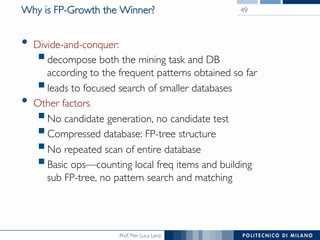
Why is FP-Growth the Winner?
•  Divide-and-conquer:
! decompose both the mining task and DB !
according to the frequent patterns obtained so far
! leads to focused search of smaller databases
•  Other factors
! No candidate generation, no candidate test
! Compressed database: FP-tree structure
! No repeated scan of entire database
! Basic ops—counting local freq items and building !
sub FP-tree, no pattern search and matching
49
Prof. Pier Luca Lanzi
Rule Assessment Measures
Prof. Pier Luca Lanzi
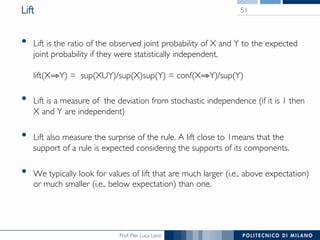
Lift
•  Lift is the ratio of the observed joint probability of X and Y to the expected
joint probability if they were statistically independent,!
!
lift(X⇒Y) = sup(XUY)/sup(X)sup(Y) = conf(X⇒Y)/sup(Y)
•  Lift is a measure of the deviation from stochastic independence (if it is 1 then
X and Y are independent)
•  Lift also measure the surprise of the rule. A lift close to 1means that the
support of a rule is expected considering the supports of its components.
•  We typically look for values of lift that are much larger (i.e., above expectation)
or much smaller (i.e., below expectation) than one.
51
Prof. Pier Luca Lanzi
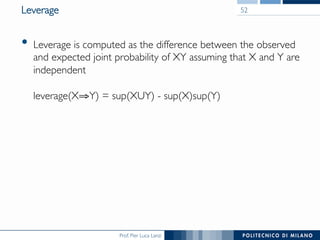
Leverage
•  Leverage is computed as the difference between the observed
and expected joint probability of XY assuming that X and Y are
independent!
!
leverage(X⇒Y) = sup(XUY) - sup(X)sup(Y)
52
Prof. Pier Luca Lanzi
Summarizing Itemsets
Prof. Pier Luca Lanzi
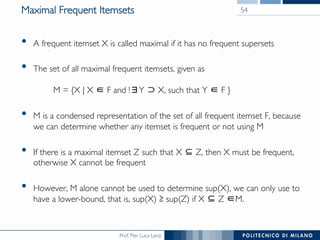
Maximal Frequent Itemsets
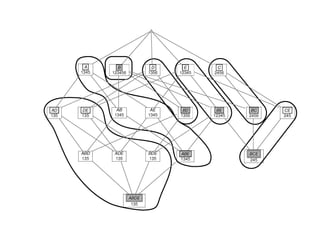
•  A frequent itemset X is called maximal if it has no frequent supersets
•  The set of all maximal frequent itemsets, given as!
!
M = {X | X F and ! Y X, such that Y F }
•  M is a condensed representation of the set of all frequent itemset F, because
we can determine whether any itemset is frequent or not using M
•  If there is a maximal itemset Z such that X Z, then X must be frequent,
otherwise X cannot be frequent
•  However, M alone cannot be used to determine sup(X), we can only use to
have a lower-bound, that is, sup(X) sup(Z) if X Z M.
54
Prof. Pier Luca Lanzi
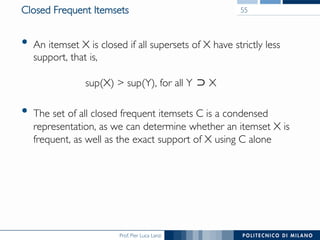
Closed Frequent Itemsets
•  An itemset X is closed if all supersets of X have strictly less
support, that is,!
!
sup(X) > sup(Y), for all Y X
•  The set of all closed frequent itemsets C is a condensed
representation, as we can determine whether an itemset X is
frequent, as well as the exact support of X using C alone
55
Prof. Pier Luca Lanzi
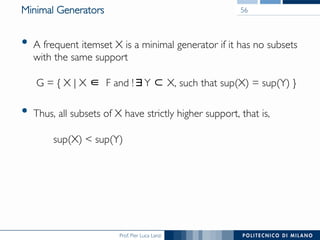
Minimal Generators
•  A frequent itemset X is a minimal generator if it has no subsets
with the same support!
!
G = { X | X F and ! Y X, such that sup(X) = sup(Y) }
•  Thus, all subsets of X have strictly higher support, that is, !
!
sup(X) < sup(Y)
56
Prof. Pier Luca Lanzi
57
Prof. Pier Luca Lanzi
Mining Frequent Sequences
Prof. Pier Luca Lanzi
Sequential Pattern Mining
•  Association rule mining does not consider !
the order of transactions
•  In many applications such orderings are significant
•  In market basket analysis, it is interesting to know whether people
buy some items in sequence
•  Example: buying bed first and then bed sheets later
•  In Web usage mining, it is useful to find navigational patterns of
users in a Web site from sequences of page visits of users
61
Prof. Pier Luca Lanzi
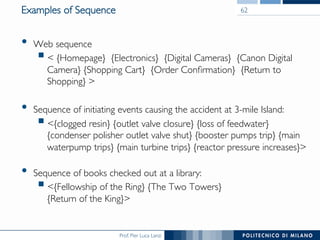
Examples of Sequence
•  Web sequence
! < {Homepage} {Electronics} {Digital Cameras} {Canon Digital
Camera} {Shopping Cart} {Order Confirmation} {Return to
Shopping} >
•  Sequence of initiating events causing the accident at 3-mile Island:
! <{clogged resin} {outlet valve closure} {loss of feedwater}
{condenser polisher outlet valve shut} {booster pumps trip} {main
waterpump trips} {main turbine trips} {reactor pressure increases}>!
•  Sequence of books checked out at a library:
! <{Fellowship of the Ring} {The Two Towers} !
{Return of the King}>
62
Prof. Pier Luca Lanzi
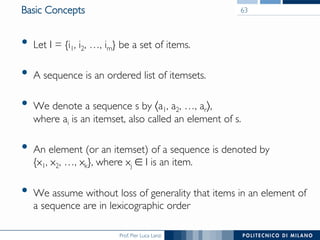
Basic Concepts
•  Let I = {i1, i2, …, im} be a set of items.
•  A sequence is an ordered list of itemsets.
•  We denote a sequence s by 〈a1, a2, …, ar〉, !
where ai is an itemset, also called an element of s.
•  An element (or an itemset) of a sequence is denoted by !
{x1, x2, …, xk}, where xj ∈ I is an item.
•  We assume without loss of generality that items in an element of
a sequence are in lexicographic order
63
Prof. Pier Luca Lanzi
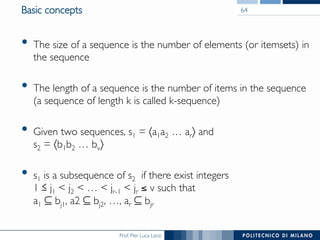
Basic concepts
•  The size of a sequence is the number of elements (or itemsets) in
the sequence
•  The length of a sequence is the number of items in the sequence!
(a sequence of length k is called k-sequence)
•  Given two sequences, s1 = 〈a1a2 … ar〉 and !
s2 = 〈b1b2 … bv〉
•  s1 is a subsequence of s2 if there exist integers !
1 j1 < j2 < … < jr-1 < jr ≤ v such that !
a1 ⊆ bj1, a2 ⊆ bj2, …, ar ⊆ bjr
64
Prof. Pier Luca Lanzi
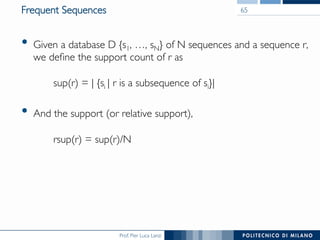
Frequent Sequences
•  Given a database D {s1, …, sN} of N sequences and a sequence r,
we define the support count of r as!
!
sup(r) = | {si | r is a subsequence of si}|
•  And the support (or relative support), !
!
rsup(r) = sup(r)/N
65
Prof. Pier Luca Lanzi
Example
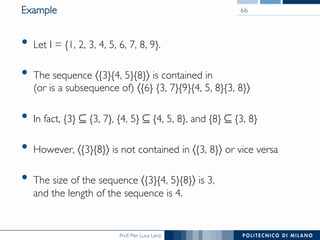
•  Let I = {1, 2, 3, 4, 5, 6, 7, 8, 9}.
•  The sequence 〈{3}{4, 5}{8}〉 is contained in !
(or is a subsequence of) 〈{6} {3, 7}{9}{4, 5, 8}{3, 8}〉
•  In fact, {3} ⊆ {3, 7}, {4, 5} ⊆ {4, 5, 8}, and {8} ⊆ {3, 8}
•  However, 〈{3}{8}〉 is not contained in 〈{3, 8}〉 or vice versa
•  The size of the sequence 〈{3}{4, 5}{8}〉 is 3, !
and the length of the sequence is 4.
66
Prof. Pier Luca Lanzi
Goal of Sequential Pattern Mining
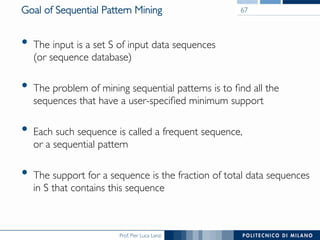
•  The input is a set S of input data sequences !
(or sequence database)
•  The problem of mining sequential patterns is to find all the
sequences that have a user-specified minimum support
•  Each such sequence is called a frequent sequence, !
or a sequential pattern
•  The support for a sequence is the fraction of total data sequences
in S that contains this sequence
67
Prof. Pier Luca Lanzi
Terminology
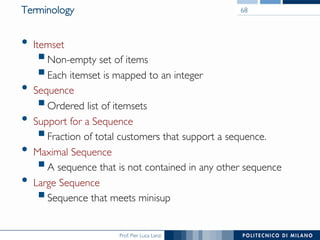
•  Itemset
! Non-empty set of items
! Each itemset is mapped to an integer
•  Sequence
! Ordered list of itemsets
•  Support for a Sequence
! Fraction of total customers that support a sequence.
•  Maximal Sequence
! A sequence that is not contained in any other sequence
•  Large Sequence
! Sequence that meets minisup
68
Prof. Pier Luca Lanzi
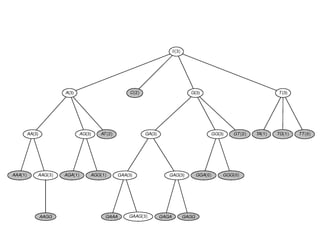
Example
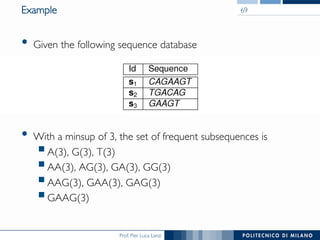
•  Given the following sequence database
•  With a minsup of 3, the set of frequent subsequences is
! A(3), G(3), T(3)
! AA(3), AG(3), GA(3), GG(3)
! AAG(3), GAA(3), GAG(3)
! GAAG(3)
69
Prof. Pier Luca Lanzi
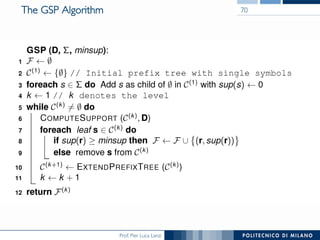
The GSP Algorithm 70
Prof. Pier Luca Lanzi
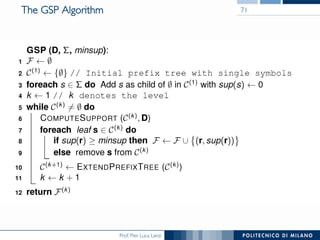
The GSP Algorithm 71
Prof. Pier Luca Lanzi
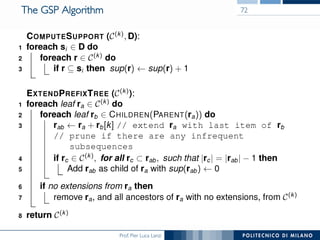
The GSP Algorithm 72
Prof. Pier Luca Lanzi
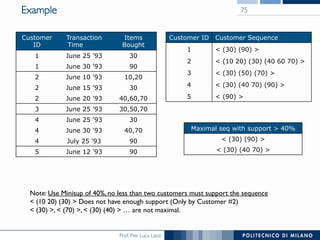
Example
Customer
ID
Transaction
Time
Items
Bought
1 June 25 '93 30
1 June 30 '93 90
2 June 10 '93 10,20
2 June 15 '93 30
2 June 20 '93 40,60,70
3 June 25 '93 30,50,70
4 June 25 '93 30
4 June 30 '93 40,70
4 July 25 '93 90
5 June 12 '93 90
Customer ID Customer Sequence
1 < (30) (90) >
2 < (10 20) (30) (40 60 70) >
3 < (30) (50) (70) >
4 < (30) (40 70) (90) >
5 < (90) >
Maximal seq with support > 40%
< (30) (90) >
< (30) (40 70) >
Note: Use Minisup of 40%, no less than two customers must support the sequence
< (10 20) (30) > Does not have enough support (Only by Customer #2)
< (30) >, < (70) >, < (30) (40) > … are not maximal.
75
Prof. Pier Luca Lanzi

DMTM 2015 - 05 Association Rules

  • 1.
    Prof. Pier LucaLanzi Association Rules! Data Mining andText Mining (UIC 583 @ Politecnico di Milano)
  • 2.
    Prof. Pier LucaLanzi Readings •  “Data Mining and Analysis” by Zaki & Meira ! Chapter 8 ! Section 9.1 ! Chapter 10 up to ! Section 10.2.1 included ! Section 12.1 •  http://www.dataminingbook.info 2
  • 3.
  • 4.
    Prof. Pier LucaLanzi Market-Basket Transactions! Bread Peanuts Milk Fruit Jam Bread Jam Soda Chips Milk Fruit Steak Jam Soda Chips Bread Jam Soda Chips Milk Bread Fruit Soda Chips Milk Jam Soda Peanuts Milk Fruit Fruit Soda Peanuts Milk Fruit Peanuts Cheese Yogurt 4
  • 5.
    Prof. Pier LucaLanzi What is Association Rule Mining? •  Finding frequent patterns, associations, correlations, or causal structures among sets of items or objects in transaction databases, relational databases, and other information repositories •  Applications ! Basket data analysis ! Cross-marketing ! Catalog design ! … 5
  • 6.
    Prof. Pier LucaLanzi What is Association Rule Mining? •  Given a set of transactions, find rules that will predict the occurrence of an item based on the occurrences of other items in the transaction •  Examples ! {bread} ⇒ {milk} ! {soda} ⇒ {chips} ! {bread} ⇒ {jam} TID Items 1 Bread, Peanuts, Milk, Fruit, Jam 2 Bread, Jam, Soda, Chips, Milk, Fruit 3 Steak, Jam, Soda, Chips, Bread 4 Jam, Soda, Peanuts, Milk, Fruit 5 Jam, Soda, Chips, Milk, Bread 6 Fruit, Soda, Chips, Milk 7 Fruit, Soda, Peanuts, Milk 8 Fruit, Peanuts, Cheese, Yogurt 6
  • 7.
    Prof. Pier LucaLanzi Frequent Itemset •  Itemset !  A collection of one or more items, e.g., {milk, bread, jam} !  k-itemset, an itemset that ! contains k items •  Support count (σ) !  Frequency of occurrence ! of an itemset !  σ({Milk, Bread}) = 3 ! σ({Soda, Chips}) = 4 •  Support !  Fraction of transactions ! that contain an itemset !  s({Milk, Bread}) = 3/8! s({Soda, Chips}) = 4/8 •  Frequent Itemset !  An itemset whose support is greater than or equal to a minsup threshold TID Items 1 Bread, Peanuts, Milk, Fruit, Jam 2 Bread, Jam, Soda, Chips, Milk, Fruit 3 Steak, Jam, Soda, Chips, Bread 4 Jam, Soda, Peanuts, Milk, Fruit 5 Jam, Soda, Chips, Milk, Bread 6 Fruit, Soda, Chips, Milk 7 Fruit, Soda, Peanuts, Milk 8 Fruit, Peanuts, Cheese, Yogurt 7
  • 8.
    Prof. Pier LucaLanzi What is An Association Rule? •  Implication of the form X ⇒ Y, where X and Y are itemsets •  Example, {bread} ⇒ {milk} •  Rule Evaluation Metrics, Suppor & Confidence •  Support (s) ! Fraction of transactions ! that contain both X and Y •  Confidence (c) ! Measures how often items in Y ! appear in transactions that! contain X 8
  • 9.
    Prof. Pier LucaLanzi What is the Goal? •  Given a set of transactions T, the goal of association rule mining is to find all rules having ! support minsup threshold ! confidence minconf threshold •  Brute-force approach ! List all possible association rules ! Compute the support and confidence for each rule ! Prune rules that fail the minsup and minconf thresholds •  Brute-force approach is computationally prohibitive! 9
  • 10.
    Prof. Pier LucaLanzi Mining Association Rules •  {Bread, Jam} ⇒ {Milk} s=0.4 c=0.75 •  {Milk, Jam} ⇒ {Bread} s=0.4 c=0.75 •  {Bread} ⇒ {Milk, Jam} s=0.4 c=0.75 •  {Jam} ⇒ {Bread, Milk} s=0.4 c=0.6 •  {Milk} ⇒ {Bread, Jam} s=0.4 c=0.5 •  All the above rules are binary partitions of the same itemset! {Milk, Bread, Jam} •  Rules originating from the same itemset have identical support but can have different confidence •  We can decouple the support and confidence requirements! 10
  • 11.
    Prof. Pier LucaLanzi Mining Association Rules:! Two Step Approach •  Frequent Itemset Generation ! Generate all itemsets whose support ≥ minsup •  Rule Generation ! Generate high confidence rules from frequent itemset ! Each rule is a binary partitioning of a frequent itemset •  Frequent itemset generation is computationally expensive 11
  • 12.
    Prof. Pier LucaLanzi Frequent Itemset Generation null AB AC AD AE BC BD BE CD CE DE A B C D E ABC ABD ABE ACD ACE ADE BCD BCE BDE CDE ABCD ABCE ABDE ACDE BCDE ABCDE Given d items, there are 2d possible candidate itemsets 12
  • 13.
    Prof. Pier LucaLanzi Brute Force 13
  • 14.
    Prof. Pier LucaLanzi Frequent Itemset Generation •  Brute-force approach: ! Each itemset in the lattice is a candidate frequent itemset ! Count the support of each candidate by scanning the database ! Match each transaction against every candidate ! Complexity ~ O(NMw) => Expensive since M = 2d TID Items 1 Bread, Peanuts, Milk, Fruit, Jam 2 Bread, Jam, Soda, Chips, Milk, Fruit 3 Steak, Jam, Soda, Chips, Bread 4 Jam, Soda, Peanuts, Milk, Fruit 5 Jam, Soda, Chips, Milk, Bread 6 Fruit, Soda, Chips, Milk 7 Fruit, Soda, Peanuts, Milk 8 Fruit, Peanuts, Cheese, Yogurt w N M candidates 14
  • 15.
    Prof. Pier LucaLanzi Computational Complexity •  Given d unique items there are 2d possible itemsets •  Total number of possible association rules: •  For d=6, there are 602 rules 15
  • 16.
    Prof. Pier LucaLanzi Frequent Itemset Generation Strategies •  Reduce the number of candidates (M) ! Complete search has M=2d ! Use pruning techniques to reduce M •  Reduce the number of transactions (N) ! Reduce size of N as the size of itemset increases •  Reduce the number of comparisons (NM) ! Use efficient data structures to store the candidates or transactions ! No need to match every candidate against every transaction 16
  • 17.
    Prof. Pier LucaLanzi Reducing the Number of Candidates •  Apriori principle ! If an itemset is frequent, then all of ! its subsets must also be frequent •  Apriori principle holds due to the following property of the support measure: •  Support of an itemset never exceeds the support of its subsets •  This is known as the anti-monotone property of support 17
  • 18.
    Prof. Pier LucaLanzi Illustrating Apriori Principle Found to be Infrequent null AB AC AD AE BC BD BE CD CE DE A B C D E ABC ABD ABE ACD ACE ADE BCD BCE BDE CDE ABCD ABCE ABDE ACDE BCDE ABCDE null AB AC AD AE BC BD BE CD CE DE A B C D E ABC ABD ABE ACD ACE ADE BCD BCE BDE CDE ABCD ABCE ABDE ACDE BCDE ABCDE Pruned supersets 18
  • 19.
    Prof. Pier LucaLanzi How does the Apriori principle work? Item Count Bread Peanuts Milk Fruit Jam Soda Chips Steak Cheese Yogurt 4 4 6 6 5 6 4 1 1 1 2-Itemset Count Bread, Jam Peanuts, Fruit Milk, Fruit Milk, Jam Milk, Soda Fruit, Soda Jam, Soda Soda, Chips 4 4 5 4 5 4 4 4 3-Itemset Count Milk, Fruit, Soda 4 1-itemsets Minimum Support = 4 2-itemsets 3-itemsets 19
  • 20.
    Prof. Pier LucaLanzi Example •  Given the following database and a min support of 3, generate all the frequent itemsets 20
  • 21.
  • 22.
    Prof. Pier LucaLanzi The Apriori Algorithm •  Let k=1 •  Generate frequent itemsets of length 1 •  Repeat until no new frequent itemsets are identified ! Generate length (k+1) candidate itemsets from length k frequent itemsets ! Prune candidate itemsets containing subsets of length k that are infrequent ! Count the support of each candidate by scanning the DB ! Eliminate candidates that are infrequent, leaving only those that are frequent 22
  • 23.
    Prof. Pier LucaLanzi Apriori Algorithm 23
  • 24.
    Prof. Pier LucaLanzi Apriori Algorithm 24
  • 25.
    Prof. Pier LucaLanzi Apriori Algorithm Example 26
  • 26.
    Prof. Pier LucaLanzi Eclat Algorithm
  • 27.
    Prof. Pier LucaLanzi The Eclat Algorithm •  Leverages the tidsets directly for support computation. •  The support of a candidate itemset can be computed by intersecting the tidsets of suitably chosen subsets. •  Given t(X) and t(Y) for any two frequent itemsets X and Y, ! then t(XY)=t(X) t(Y) •  And sup(XY) = |t(XY)| 28
  • 28.
    Prof. Pier LucaLanzi Example 29
  • 29.
  • 30.
    Prof. Pier LucaLanzi Frequent Patterns Mining Without Candidate Generation
  • 31.
    Prof. Pier LucaLanzi Apriori’s Performance Bottlenecks •  The core of the Apriori algorithm ! Use frequent (k–1)-itemsets to generate ! candidate frequent k-itemsets ! Use database scan and pattern matching! to collect counts for the candidate itemsets •  Huge candidate sets: ! 104 frequent 1-itemset will generate ! 107 candidate 2-itemsets ! To discover a frequent pattern of size 100, e.g., ! {a1, a2, …, a100}, needs to generate 2100 ≈ 1030 candidates. ! Multiple scans of database, it needs (n+1) scans, n is the length of the longest pattern 32
  • 32.
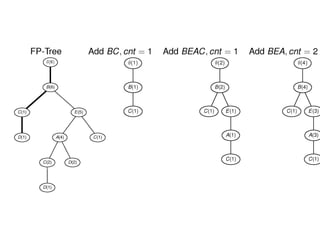
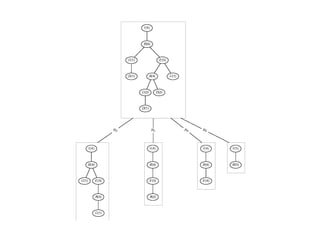
    Prof. Pier LucaLanzi Mining Frequent Patterns ! Without Candidate Generation •  Compress a large database into a compact, Frequent-Pattern tree (FP-tree) structure ! Highly condensed, but complete for frequent pattern mining ! Avoid costly database scans •  Use an efficient, FP-tree-based frequent pattern mining method •  A divide-and-conquer methodology: decompose mining tasks into smaller ones •  Avoid candidate generation: sub-database test only 33
  • 33.
    Prof. Pier LucaLanzi The FP-Growth Algorithm •  Leave the generate-and-test paradigm of Apriori •  Data sets are encoded using a compact structure, the FP-tree •  Frequent itemsets are extracted directly from the FP-tree •  Major Steps to mine FP-tree ! Construct conditional pattern base ! for each node in the FP-tree ! Construct conditional FP-tree ! from each conditional pattern-base ! Recursively mine conditional FP-trees and ! grow frequent patterns obtained so far ! If the conditional FP-tree contains a single path, ! simply enumerate all the patterns 34
  • 34.
  • 35.
  • 36.
  • 37.
    Prof. Pier LucaLanzi Rule Generation
  • 38.
    Prof. Pier LucaLanzi Rule Generation •  Given a frequent itemset L, find all non-empty subsets f ⊂ L such that f → L – f satisfies the minimum confidence requirement •  If {A,B,C,D} is a frequent itemset, candidate rules:! ABC →D, ABD →C, ACD →B, BCD →A, A →BCD, ! B →ACD, C →ABD, D →ABC, AB →CD, AC → BD, ! AD → BC, BC →AD, BD →AC, CD →AB ! •  If |L| = k, then there are 2k – 2 candidate association rules (ignoring L → ∅ and ∅ → L) 39
  • 39.
    Prof. Pier LucaLanzi How to efficiently generate rules from frequent itemsets? •  Confidence does not have an anti-monotone property •  c(ABC →D) can be larger or smaller than c(AB →D) •  But confidence of rules generated from the same itemset has an anti-monotone property •  L = {A,B,C,D}: c(ABC → D) ≥ c(AB → CD) ≥ c(A → BCD) •  Confidence is anti-monotone with respect to the number of items on the right hand side of the rule 40
  • 40.
    Prof. Pier LucaLanzi Rule Generation for Apriori Algorithm ABCD=>{ } BCD=>A ACD=>B ABD=>C ABC=>D BC=>ADBD=>ACCD=>AB AD=>BC AC=>BD AB=>CD D=>ABC C=>ABD B=>ACD A=>BCD ABCD=>{ } BCD=>A ACD=>B ABD=>C ABC=>D BC=>ADBD=>ACCD=>AB AD=>BC AC=>BD AB=>CD D=>ABC C=>ABD B=>ACD A=>BCD Pruned Rules Low Confidence Rule 41
  • 41.
    Prof. Pier LucaLanzi Rule Generation for Apriori Algorithm •  Candidate rule is generated by merging two rules that share the same prefix in the rule consequent •  join(CD=>AB,BD=>AC)! would produce the candidate! rule D => ABC •  Prune rule D=>ABC if its! subset AD=>BC does not have! high confidence BD=>ACCD=>AB D=>ABC 42
  • 42.
  • 43.
    Prof. Pier LucaLanzi Effect of Support Distribution •  Many real data sets have skewed support distribution Support distribution of a retail data set 44
  • 44.
    Prof. Pier LucaLanzi How to Set an Appropriate Minsup? •  If minsup is set too high, we could miss itemsets involving interesting rare items (e.g., expensive products) •  If minsup is set too low, it is computationally expensive ! and the number of itemsets is very large •  A single minimum support threshold may not be effective 45
  • 45.
    Prof. Pier LucaLanzi Association Rule Mining in R library(arulesViz) library(arules) data("Adult") rules <- apriori(Adult, parameter = list(supp = 0.8, conf = 0.9,target = "rules")) summary(rules) inspect(rules) plot(rules) plot(rules, method="graph", control=list(type="items")) 46
  • 46.
    Prof. Pier LucaLanzi FP-growth vs. Apriori:! Scalability with the Support Threshold 0 10 20 30 40 50 60 70 80 90 100 0 0.5 1 1.5 2 2.5 3 Support threshold(%) Runtime(sec.) D1 FP-grow th runtime D1 Apriori runtime 47
  • 47.
    Prof. Pier LucaLanzi Benefits of the FP-Tree Structure •  Completeness ! Preserve complete information ! for frequent pattern mining ! Never break a long pattern of any transaction •  Compactness ! Reduce irrelevant info—infrequent items are gone ! Items in frequency descending order: the more frequently occurring, the more likely to be shared ! Never be larger than the original database (not count node- links and the count field) ! For Connect-4 DB, compression ratio could be over 100 48
  • 48.
    Prof. Pier LucaLanzi Why is FP-Growth the Winner? •  Divide-and-conquer: ! decompose both the mining task and DB ! according to the frequent patterns obtained so far ! leads to focused search of smaller databases •  Other factors ! No candidate generation, no candidate test ! Compressed database: FP-tree structure ! No repeated scan of entire database ! Basic ops—counting local freq items and building ! sub FP-tree, no pattern search and matching 49
  • 49.
    Prof. Pier LucaLanzi Rule Assessment Measures
  • 50.
    Prof. Pier LucaLanzi Lift •  Lift is the ratio of the observed joint probability of X and Y to the expected joint probability if they were statistically independent,! ! lift(X⇒Y) = sup(XUY)/sup(X)sup(Y) = conf(X⇒Y)/sup(Y) •  Lift is a measure of the deviation from stochastic independence (if it is 1 then X and Y are independent) •  Lift also measure the surprise of the rule. A lift close to 1means that the support of a rule is expected considering the supports of its components. •  We typically look for values of lift that are much larger (i.e., above expectation) or much smaller (i.e., below expectation) than one. 51
  • 51.
    Prof. Pier LucaLanzi Leverage •  Leverage is computed as the difference between the observed and expected joint probability of XY assuming that X and Y are independent! ! leverage(X⇒Y) = sup(XUY) - sup(X)sup(Y) 52
  • 52.
    Prof. Pier LucaLanzi Summarizing Itemsets
  • 53.
    Prof. Pier LucaLanzi Maximal Frequent Itemsets •  A frequent itemset X is called maximal if it has no frequent supersets •  The set of all maximal frequent itemsets, given as! ! M = {X | X F and ! Y X, such that Y F } •  M is a condensed representation of the set of all frequent itemset F, because we can determine whether any itemset is frequent or not using M •  If there is a maximal itemset Z such that X Z, then X must be frequent, otherwise X cannot be frequent •  However, M alone cannot be used to determine sup(X), we can only use to have a lower-bound, that is, sup(X) sup(Z) if X Z M. 54
  • 54.
    Prof. Pier LucaLanzi Closed Frequent Itemsets •  An itemset X is closed if all supersets of X have strictly less support, that is,! ! sup(X) > sup(Y), for all Y X •  The set of all closed frequent itemsets C is a condensed representation, as we can determine whether an itemset X is frequent, as well as the exact support of X using C alone 55
  • 55.
    Prof. Pier LucaLanzi Minimal Generators •  A frequent itemset X is a minimal generator if it has no subsets with the same support! ! G = { X | X F and ! Y X, such that sup(X) = sup(Y) } •  Thus, all subsets of X have strictly higher support, that is, ! ! sup(X) < sup(Y) 56
  • 56.
  • 57.
  • 58.
    Prof. Pier LucaLanzi Mining Frequent Sequences
  • 59.
    Prof. Pier LucaLanzi Sequential Pattern Mining •  Association rule mining does not consider ! the order of transactions •  In many applications such orderings are significant •  In market basket analysis, it is interesting to know whether people buy some items in sequence •  Example: buying bed first and then bed sheets later •  In Web usage mining, it is useful to find navigational patterns of users in a Web site from sequences of page visits of users 61
  • 60.
    Prof. Pier LucaLanzi Examples of Sequence •  Web sequence ! < {Homepage} {Electronics} {Digital Cameras} {Canon Digital Camera} {Shopping Cart} {Order Confirmation} {Return to Shopping} > •  Sequence of initiating events causing the accident at 3-mile Island: ! <{clogged resin} {outlet valve closure} {loss of feedwater} {condenser polisher outlet valve shut} {booster pumps trip} {main waterpump trips} {main turbine trips} {reactor pressure increases}>! •  Sequence of books checked out at a library: ! <{Fellowship of the Ring} {The Two Towers} ! {Return of the King}> 62
  • 61.
    Prof. Pier LucaLanzi Basic Concepts •  Let I = {i1, i2, …, im} be a set of items. •  A sequence is an ordered list of itemsets. •  We denote a sequence s by 〈a1, a2, …, ar〉, ! where ai is an itemset, also called an element of s. •  An element (or an itemset) of a sequence is denoted by ! {x1, x2, …, xk}, where xj ∈ I is an item. •  We assume without loss of generality that items in an element of a sequence are in lexicographic order 63
  • 62.
    Prof. Pier LucaLanzi Basic concepts •  The size of a sequence is the number of elements (or itemsets) in the sequence •  The length of a sequence is the number of items in the sequence! (a sequence of length k is called k-sequence) •  Given two sequences, s1 = 〈a1a2 … ar〉 and ! s2 = 〈b1b2 … bv〉 •  s1 is a subsequence of s2 if there exist integers ! 1 j1 < j2 < … < jr-1 < jr ≤ v such that ! a1 ⊆ bj1, a2 ⊆ bj2, …, ar ⊆ bjr 64
  • 63.
    Prof. Pier LucaLanzi Frequent Sequences •  Given a database D {s1, …, sN} of N sequences and a sequence r, we define the support count of r as! ! sup(r) = | {si | r is a subsequence of si}| •  And the support (or relative support), ! ! rsup(r) = sup(r)/N 65
  • 64.
    Prof. Pier LucaLanzi Example •  Let I = {1, 2, 3, 4, 5, 6, 7, 8, 9}. •  The sequence 〈{3}{4, 5}{8}〉 is contained in ! (or is a subsequence of) 〈{6} {3, 7}{9}{4, 5, 8}{3, 8}〉 •  In fact, {3} ⊆ {3, 7}, {4, 5} ⊆ {4, 5, 8}, and {8} ⊆ {3, 8} •  However, 〈{3}{8}〉 is not contained in 〈{3, 8}〉 or vice versa •  The size of the sequence 〈{3}{4, 5}{8}〉 is 3, ! and the length of the sequence is 4. 66
  • 65.
    Prof. Pier LucaLanzi Goal of Sequential Pattern Mining •  The input is a set S of input data sequences ! (or sequence database) •  The problem of mining sequential patterns is to find all the sequences that have a user-specified minimum support •  Each such sequence is called a frequent sequence, ! or a sequential pattern •  The support for a sequence is the fraction of total data sequences in S that contains this sequence 67
  • 66.
    Prof. Pier LucaLanzi Terminology •  Itemset ! Non-empty set of items ! Each itemset is mapped to an integer •  Sequence ! Ordered list of itemsets •  Support for a Sequence ! Fraction of total customers that support a sequence. •  Maximal Sequence ! A sequence that is not contained in any other sequence •  Large Sequence ! Sequence that meets minisup 68
  • 67.
    Prof. Pier LucaLanzi Example •  Given the following sequence database •  With a minsup of 3, the set of frequent subsequences is ! A(3), G(3), T(3) ! AA(3), AG(3), GA(3), GG(3) ! AAG(3), GAA(3), GAG(3) ! GAAG(3) 69
  • 68.
    Prof. Pier LucaLanzi The GSP Algorithm 70
  • 69.
    Prof. Pier LucaLanzi The GSP Algorithm 71
  • 70.
    Prof. Pier LucaLanzi The GSP Algorithm 72
  • 71.
  • 72.
    Prof. Pier LucaLanzi Example Customer ID Transaction Time Items Bought 1 June 25 '93 30 1 June 30 '93 90 2 June 10 '93 10,20 2 June 15 '93 30 2 June 20 '93 40,60,70 3 June 25 '93 30,50,70 4 June 25 '93 30 4 June 30 '93 40,70 4 July 25 '93 90 5 June 12 '93 90 Customer ID Customer Sequence 1 < (30) (90) > 2 < (10 20) (30) (40 60 70) > 3 < (30) (50) (70) > 4 < (30) (40 70) (90) > 5 < (90) > Maximal seq with support > 40% < (30) (90) > < (30) (40 70) > Note: Use Minisup of 40%, no less than two customers must support the sequence < (10 20) (30) > Does not have enough support (Only by Customer #2) < (30) >, < (70) >, < (30) (40) > … are not maximal. 75
  • 73.