MINING SINGLE DIMENSIONAL BOOLEAN
ASSOCIATION RULES FROM TRANSACTIONAL
DATABASES
PRESENTED BY
M.RAMYA
M.sc(CS & IT)
NADAR SARASWATHI COLLEGE
OF ARTS & SCIENCE,THENI
INTRODUCTION
• The simplest form of association rules Single-dimensional , Single-level ,
Boolean association rules.
• Presenting Apriority a basic algorithm for finding frequent itemsets. A
procedure for generating strong association rules from frequent itemsets.
• Several variations to the Apriority algorithm for improved efficiency and
scalability presented methods for mining association rules that unlike
Apriori , do not involve the generation of ā€œcandidateā€ frequent itemsets.
• Apriority can be applied to improve the efficiency of answering iceberg
queries , which are common in market basket analysis.
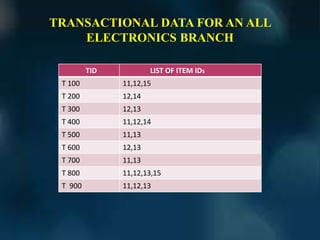
TRANSACTIONAL DATA FOR AN ALL
ELECTRONICS BRANCH
TID LIST OF ITEM IDS
T 100 11,12,15
T 200 12,14
T 300 12,13
T 400 11,12,14
T 500 11,13
T 600 12,13
T 700 11,13
T 800 11,12,13,15
T 900 11,12,13
THE APRIORI ALGORITHM: FINDING
FREQUENT ITEMSETS USING CANDIDATE
GENERATION
• Aprior is an influential algorithm for mining frequent itemsets for Boolean
association rules.
• The name of the algorithm is based on the fact that the algorithm uses prior
knowledge of frequent itemsets properties.
• Apriori employs an iterative approach know as a level-wise search , where
K-itemsets are used to explore (K+1)-itemsets.
• To improve the efficiency of the level-wise generation of frequent itemsets ,
an important property called the Apriority property is used to reduce the
search space.
• Apriori property , all nonempty subsets of a frequent itemset must also be
frequent.
• An itemset I does not satisfy the minimum support threshold , min_sup
then I is not frequent , that is , p(I) < min_sup.
• If an item A is added to the itemsets I , then the resulting itemset (i.e., I U
A) cannot occur more frequently than I . Therefore , I U A is not frequent
either , than is ,
p(I U A) < min_sup. This property belongs to a special category of
properties called anti-monotone.
• A two-steps process is followed , consisting of join and prune actions.
THE JOIN STEP
• To find LK , a set of candidate K-itemsets is generated by joining LK-1
with itself . This set of candidates is denoted CK. Let l1 and l2 be itemsets
in lK-1.
• Apriori assumes that items within a transaction or itemset are stored in
lexicographical order. The join LK-1 āˆž LK-1 is performed.
• That is members l1 and l2 of LK-1 are joined if (l1[1]=l2[1]) ^
(l1[2]=l2[2]) ^….^ (l1[K-2] = l2[K-2]) ^ (l1[K-1] < l2[K-1])
• The condition l1[K-1] < l2[K-1] simply ensures that no duplicates are
generated.
THE PRUNE STEP
• CK is a superset of LK that is , its members may or may not be frequent ,
but all of the frequent K-itemsets are included in CK. A scan of the
database to determine the count of each candidate in CK would result in the
determination of LK.
• CK can be huge and so this could involve heavy computation. To reduce
the size of CK.
• If any (K-1)subset of a candidate K-itemsets is not in LK-1 , then the
candidate cannot be frequent either and so can be removed from CK.
• This subset testing can be quickly by maintaining a hash tree of all frequent
itemsets.
GENERATING ASSOCIATION RULES FROM
FREQUENT ITEMSETS
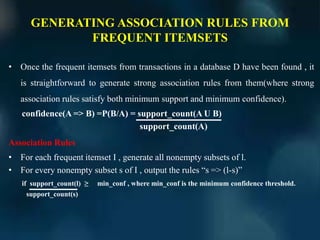
• Once the frequent itemsets from transactions in a database D have been found , it
is straightforward to generate strong association rules from them(where strong
association rules satisfy both minimum support and minimum confidence).
confidence(A => B) =P(B/A) = support_count(A U B)
support_count(A)
Association Rules
• For each frequent itemset I , generate all nonempty subsets of l.
• For every nonempty subset s of I , output the rules ā€œs => (l-s)ā€
if support_count(l) ≄ min_conf , where min_conf is the minimum confidence threshold.
support_count(s)
IMPROVING THE EFFICIENCY OF APRIORI
• Many variations of the Apriority algorithm have been proposed that focus
on improving the efficiency of the original algorithm. Several of these
variations are enumerated below
Hash-based technique
Transaction reduction
Partitioning
Sampling
Dynamic itemset counting
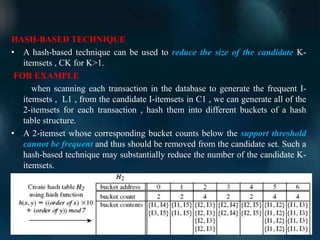
HASH-BASED TECHNIQUE
• A hash-based technique can be used to reduce the size of the candidate K-
itemsets , CK for K>1.
FOR EXAMPLE
when scanning each transaction in the database to generate the frequent I-
itemsets , L1 , from the candidate I-itemsets in C1 , we can generate all of the
2-itemsets for each transaction , hash them into different buckets of a hash
table structure.
• A 2-itemset whose corresponding bucket counts below the support threshold
cannot be frequent and thus should be removed from the candidate set. Such a
hash-based technique may substantially reduce the number of the candidate K-
itemsets.
TRANSACTION REDUCTION
• A transaction that does not contain any frequent K-
itemsets cannot contain any frequent (K+1)-itemsets.
Subsequent scans of the database for j- itemsets ,
where j>k , will not require it
PARTITIONING
• A partitioning technique can be used that requires just two database scans
to mine the frequent itemsets. It consists of two phases.
• In phase I , the algorithm subdivides the transactions of D into
nonoverlapping partitions.
• In phase II , a second scan of D is conducted in which the actual support of
each candidate is assessed in order to determine the global frequent
itemsets.
DYNAMIC ITEMSET COUNTING
• A dynamic itemset counting technique was proposed in which the database
is partitioned into blocks marked by start points.
• In this variation , new candidate itemsets can be added at any start point ,
unlike in Apriori , which determines new candidate itemsets only
immediately prior to each complete database scan.
MINING FREQUENT ITEMSETS WITHOUT
CANDIDATE GENERATION
• The Apriori candidate generate and test method reduces the size of
candidate sets significantly and leads to good performance gain. It may
suffer from two nontrivial costs.
It may need to generate a huge number of candidate sets.
It may need to repeatedly scan the database and check a large set
of candidates by pattern matching. This is especially the case for
mining long patterns.
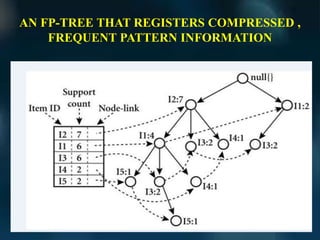
AN FP-TREE THAT REGISTERS COMPRESSED ,
FREQUENT PATTERN INFORMATION
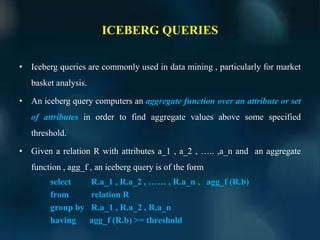
ICEBERG QUERIES
• Iceberg queries are commonly used in data mining , particularly for market
basket analysis.
• An iceberg query computers an aggregate function over an attribute or set
of attributes in order to find aggregate values above some specified
threshold.
• Given a relation R with attributes a_1 , a_2 , ….. ,a_n and an aggregate
function , agg_f , an iceberg query is of the form
select R.a_1 , R.a_2 , …… , R.a_n , agg_f (R.b)
from relation R
group by R.a_1 , R.a_2 , R.a_n
having agg_f (R.b) >= threshold
Mining single dimensional boolean association rules from transactional

Mining single dimensional boolean association rules from transactional

  • 1.
    MINING SINGLE DIMENSIONALBOOLEAN ASSOCIATION RULES FROM TRANSACTIONAL DATABASES PRESENTED BY M.RAMYA M.sc(CS & IT) NADAR SARASWATHI COLLEGE OF ARTS & SCIENCE,THENI
  • 2.
    INTRODUCTION • The simplestform of association rules Single-dimensional , Single-level , Boolean association rules. • Presenting Apriority a basic algorithm for finding frequent itemsets. A procedure for generating strong association rules from frequent itemsets. • Several variations to the Apriority algorithm for improved efficiency and scalability presented methods for mining association rules that unlike Apriori , do not involve the generation of ā€œcandidateā€ frequent itemsets. • Apriority can be applied to improve the efficiency of answering iceberg queries , which are common in market basket analysis.
  • 3.
    TRANSACTIONAL DATA FORAN ALL ELECTRONICS BRANCH TID LIST OF ITEM IDS T 100 11,12,15 T 200 12,14 T 300 12,13 T 400 11,12,14 T 500 11,13 T 600 12,13 T 700 11,13 T 800 11,12,13,15 T 900 11,12,13
  • 4.
    THE APRIORI ALGORITHM:FINDING FREQUENT ITEMSETS USING CANDIDATE GENERATION • Aprior is an influential algorithm for mining frequent itemsets for Boolean association rules. • The name of the algorithm is based on the fact that the algorithm uses prior knowledge of frequent itemsets properties. • Apriori employs an iterative approach know as a level-wise search , where K-itemsets are used to explore (K+1)-itemsets. • To improve the efficiency of the level-wise generation of frequent itemsets , an important property called the Apriority property is used to reduce the search space.
  • 5.
    • Apriori property, all nonempty subsets of a frequent itemset must also be frequent. • An itemset I does not satisfy the minimum support threshold , min_sup then I is not frequent , that is , p(I) < min_sup. • If an item A is added to the itemsets I , then the resulting itemset (i.e., I U A) cannot occur more frequently than I . Therefore , I U A is not frequent either , than is , p(I U A) < min_sup. This property belongs to a special category of properties called anti-monotone. • A two-steps process is followed , consisting of join and prune actions.
  • 6.
    THE JOIN STEP •To find LK , a set of candidate K-itemsets is generated by joining LK-1 with itself . This set of candidates is denoted CK. Let l1 and l2 be itemsets in lK-1. • Apriori assumes that items within a transaction or itemset are stored in lexicographical order. The join LK-1 āˆž LK-1 is performed. • That is members l1 and l2 of LK-1 are joined if (l1[1]=l2[1]) ^ (l1[2]=l2[2]) ^….^ (l1[K-2] = l2[K-2]) ^ (l1[K-1] < l2[K-1]) • The condition l1[K-1] < l2[K-1] simply ensures that no duplicates are generated.
  • 7.
    THE PRUNE STEP •CK is a superset of LK that is , its members may or may not be frequent , but all of the frequent K-itemsets are included in CK. A scan of the database to determine the count of each candidate in CK would result in the determination of LK. • CK can be huge and so this could involve heavy computation. To reduce the size of CK. • If any (K-1)subset of a candidate K-itemsets is not in LK-1 , then the candidate cannot be frequent either and so can be removed from CK. • This subset testing can be quickly by maintaining a hash tree of all frequent itemsets.
  • 8.
    GENERATING ASSOCIATION RULESFROM FREQUENT ITEMSETS • Once the frequent itemsets from transactions in a database D have been found , it is straightforward to generate strong association rules from them(where strong association rules satisfy both minimum support and minimum confidence). confidence(A => B) =P(B/A) = support_count(A U B) support_count(A) Association Rules • For each frequent itemset I , generate all nonempty subsets of l. • For every nonempty subset s of I , output the rules ā€œs => (l-s)ā€ if support_count(l) ≄ min_conf , where min_conf is the minimum confidence threshold. support_count(s)
  • 9.
    IMPROVING THE EFFICIENCYOF APRIORI • Many variations of the Apriority algorithm have been proposed that focus on improving the efficiency of the original algorithm. Several of these variations are enumerated below Hash-based technique Transaction reduction Partitioning Sampling Dynamic itemset counting
  • 10.
    HASH-BASED TECHNIQUE • Ahash-based technique can be used to reduce the size of the candidate K- itemsets , CK for K>1. FOR EXAMPLE when scanning each transaction in the database to generate the frequent I- itemsets , L1 , from the candidate I-itemsets in C1 , we can generate all of the 2-itemsets for each transaction , hash them into different buckets of a hash table structure. • A 2-itemset whose corresponding bucket counts below the support threshold cannot be frequent and thus should be removed from the candidate set. Such a hash-based technique may substantially reduce the number of the candidate K- itemsets.
  • 11.
    TRANSACTION REDUCTION • Atransaction that does not contain any frequent K- itemsets cannot contain any frequent (K+1)-itemsets. Subsequent scans of the database for j- itemsets , where j>k , will not require it
  • 12.
    PARTITIONING • A partitioningtechnique can be used that requires just two database scans to mine the frequent itemsets. It consists of two phases. • In phase I , the algorithm subdivides the transactions of D into nonoverlapping partitions. • In phase II , a second scan of D is conducted in which the actual support of each candidate is assessed in order to determine the global frequent itemsets. DYNAMIC ITEMSET COUNTING • A dynamic itemset counting technique was proposed in which the database is partitioned into blocks marked by start points. • In this variation , new candidate itemsets can be added at any start point , unlike in Apriori , which determines new candidate itemsets only immediately prior to each complete database scan.
  • 13.
    MINING FREQUENT ITEMSETSWITHOUT CANDIDATE GENERATION • The Apriori candidate generate and test method reduces the size of candidate sets significantly and leads to good performance gain. It may suffer from two nontrivial costs. It may need to generate a huge number of candidate sets. It may need to repeatedly scan the database and check a large set of candidates by pattern matching. This is especially the case for mining long patterns.
  • 14.
    AN FP-TREE THATREGISTERS COMPRESSED , FREQUENT PATTERN INFORMATION
  • 15.
    ICEBERG QUERIES • Icebergqueries are commonly used in data mining , particularly for market basket analysis. • An iceberg query computers an aggregate function over an attribute or set of attributes in order to find aggregate values above some specified threshold. • Given a relation R with attributes a_1 , a_2 , ….. ,a_n and an aggregate function , agg_f , an iceberg query is of the form select R.a_1 , R.a_2 , …… , R.a_n , agg_f (R.b) from relation R group by R.a_1 , R.a_2 , R.a_n having agg_f (R.b) >= threshold