ECLAT
By,
A.Deepa
Mining Association Rules
Given a set of transactions, find rules that
will predict the occurrence of an item based
on the occurrences of other items in the
transaction
Mining Association Rules
• Two-step approach:
1. Frequent Itemset Generation
– Generate all itemsets whose support  minsup
2. Rule Generation
– Generate high confidence rules from each frequent itemset,
• Frequent itemset generation is computationally
expensive
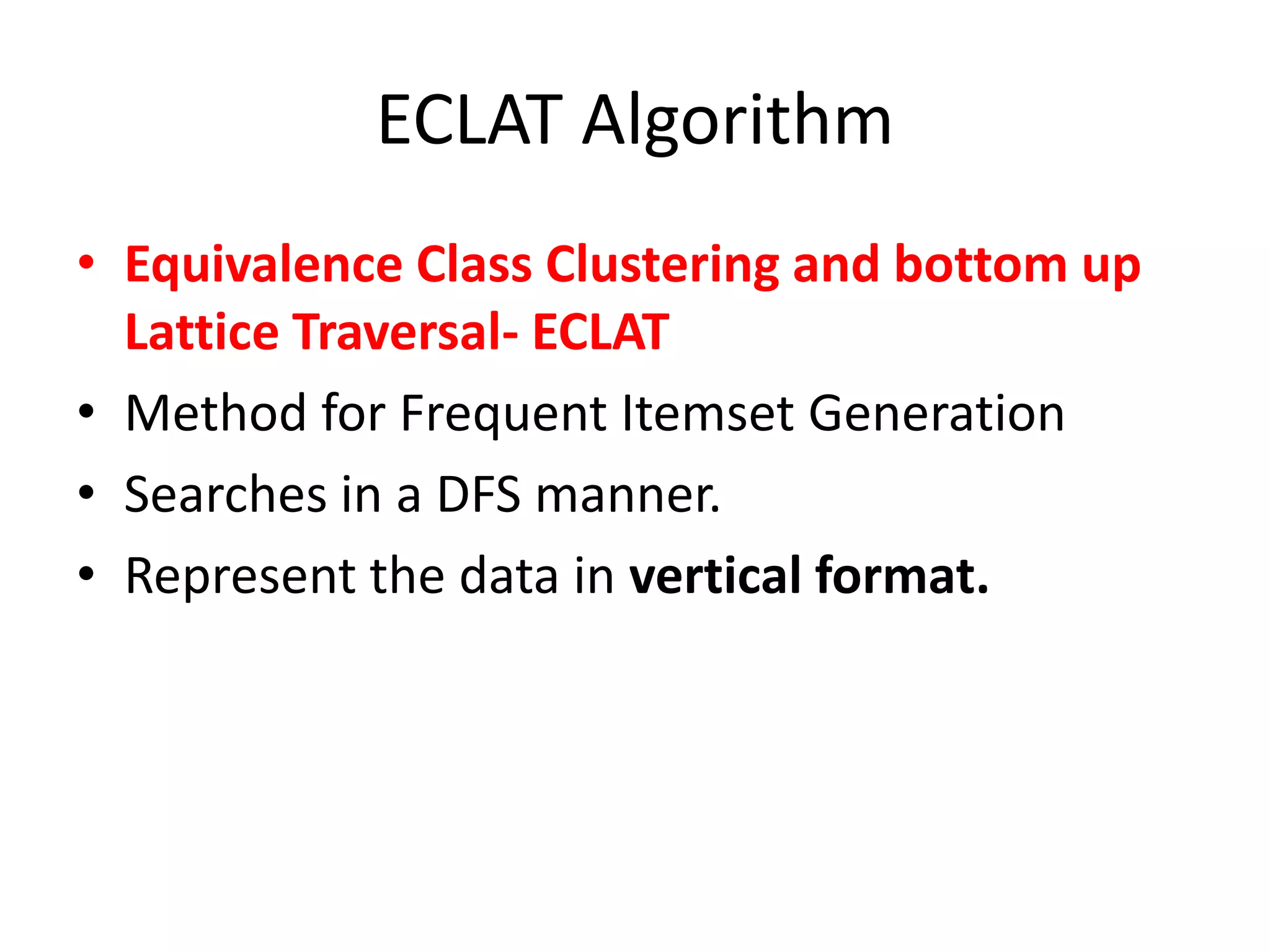
ECLAT Algorithm
• Equivalence Class Clustering and bottom up
Lattice Traversal- ECLAT
• Method for Frequent Itemset Generation
• Searches in a DFS manner.
• Represent the data in vertical format.
To Improve the Efficiency of Apriori : (Scalable Algorithms)
 FPGrowth
 ECLAT
 Mining Close Frequent Patterns and Maxpatterns
ECLAT
• Both Apriori and FP-growth use horizontal data format
• Alternatively data can also be represented in vertical
format
TID Items
1 Bread,Butter,Jam
2 Butter,Coke
3 Butter,Milk
4 Bread,Butter,Coke
5 Bread,Milk
6 Butter,Milk
7 Bread,Milk
8 Bread,Butter,Milk,Jam
9 Bread,Butter,Milk
Item Set TID set
Bread 1,4,5,7,8,9
Butter 1,2,3,4,6,8,9
Milk 3,5,6,7,8,9
Coke 2,4
Jam 1,8
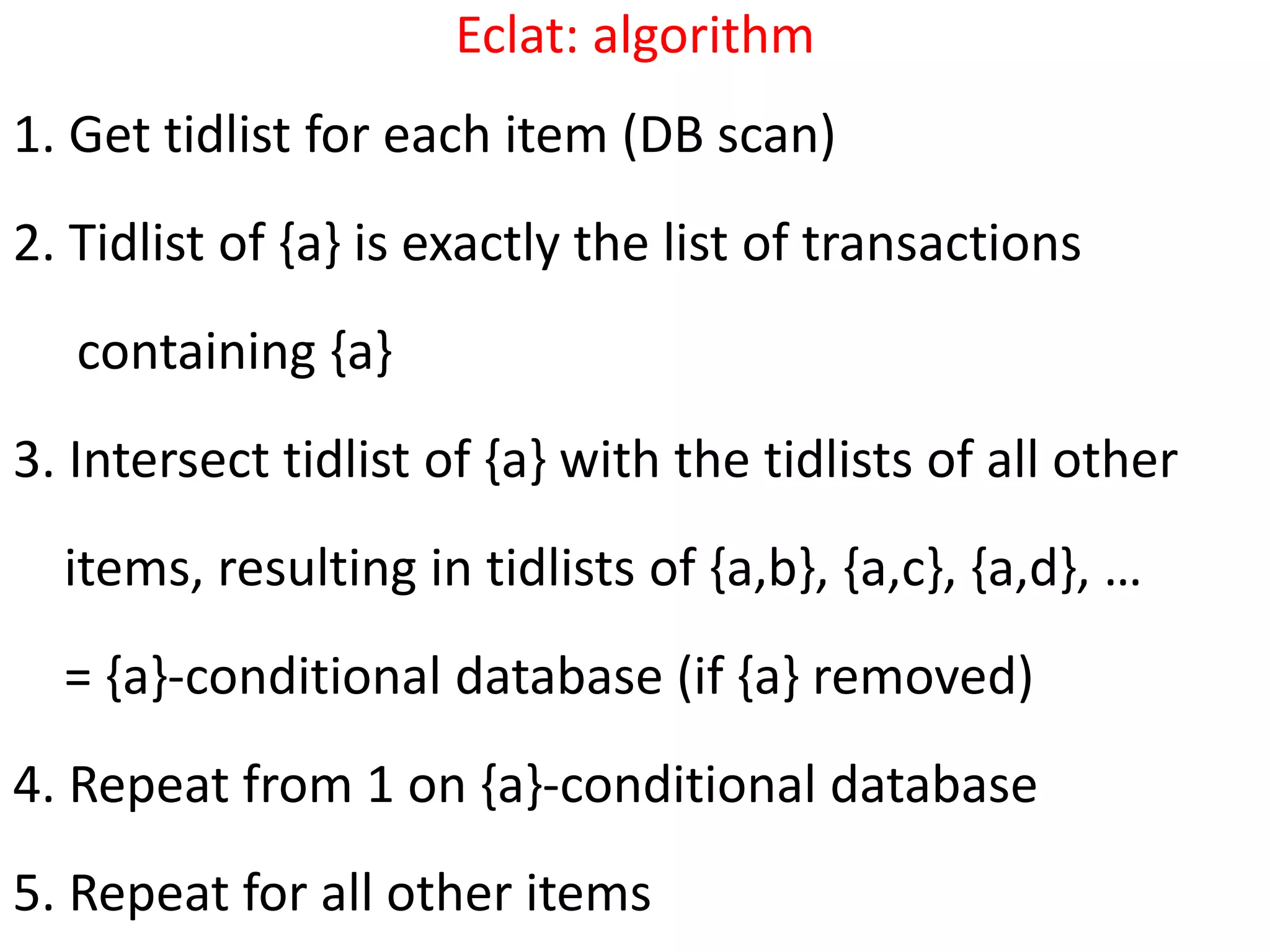
Eclat: algorithm
1. Get tidlist for each item (DB scan)
2. Tidlist of {a} is exactly the list of transactions
containing {a}
3. Intersect tidlist of {a} with the tidlists of all other
items, resulting in tidlists of {a,b}, {a,c}, {a,d}, …
= {a}-conditional database (if {a} removed)
4. Repeat from 1 on {a}-conditional database
5. Repeat for all other items
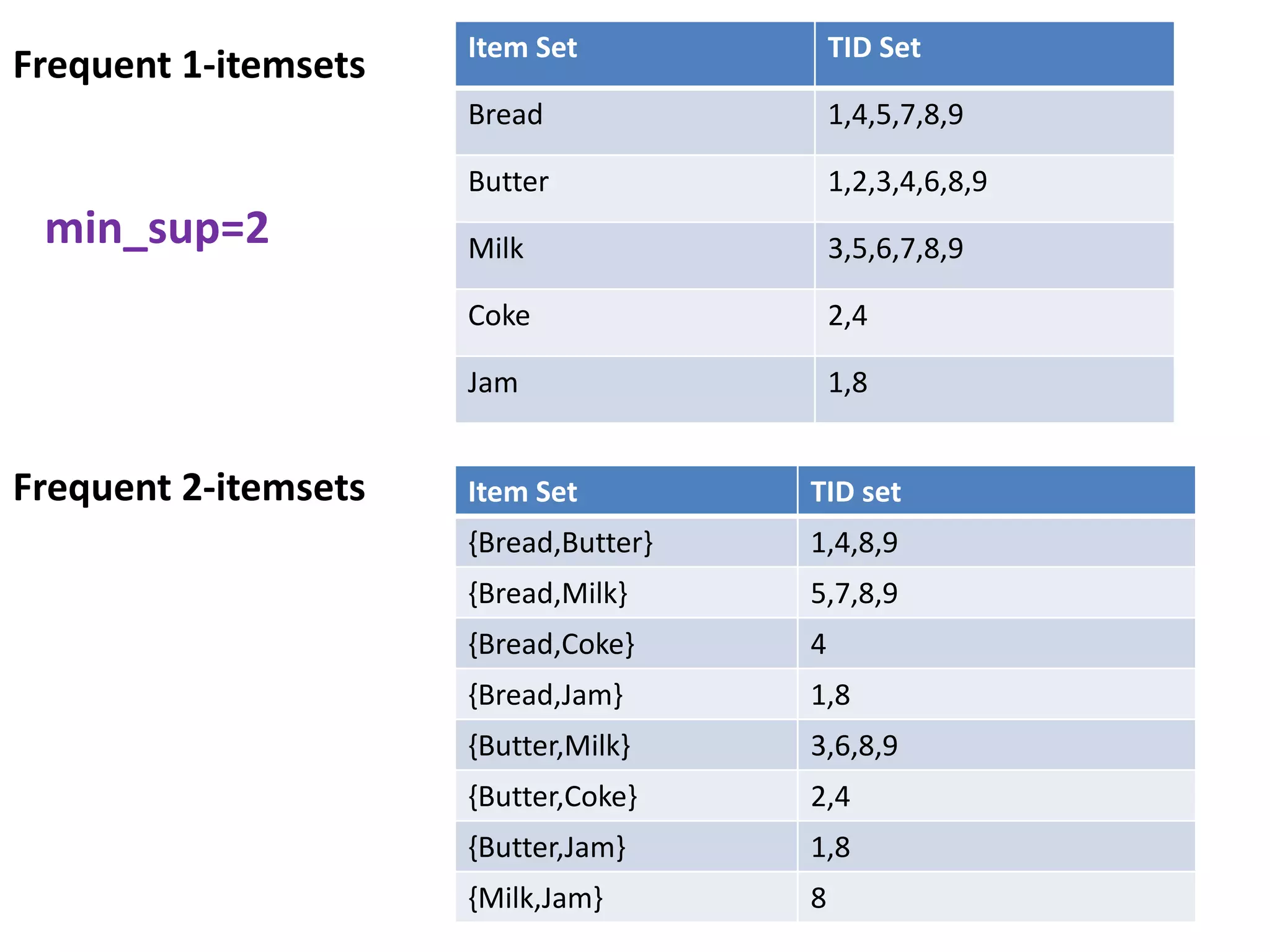
Frequent 1-itemsets
min_sup=2
Frequent 2-itemsets
Item Set TID Set
Bread 1,4,5,7,8,9
Butter 1,2,3,4,6,8,9
Milk 3,5,6,7,8,9
Coke 2,4
Jam 1,8
Item Set TID set
{Bread,Butter} 1,4,8,9
{Bread,Milk} 5,7,8,9
{Bread,Coke} 4
{Bread,Jam} 1,8
{Butter,Milk} 3,6,8,9
{Butter,Coke} 2,4
{Butter,Jam} 1,8
{Milk,Jam} 8
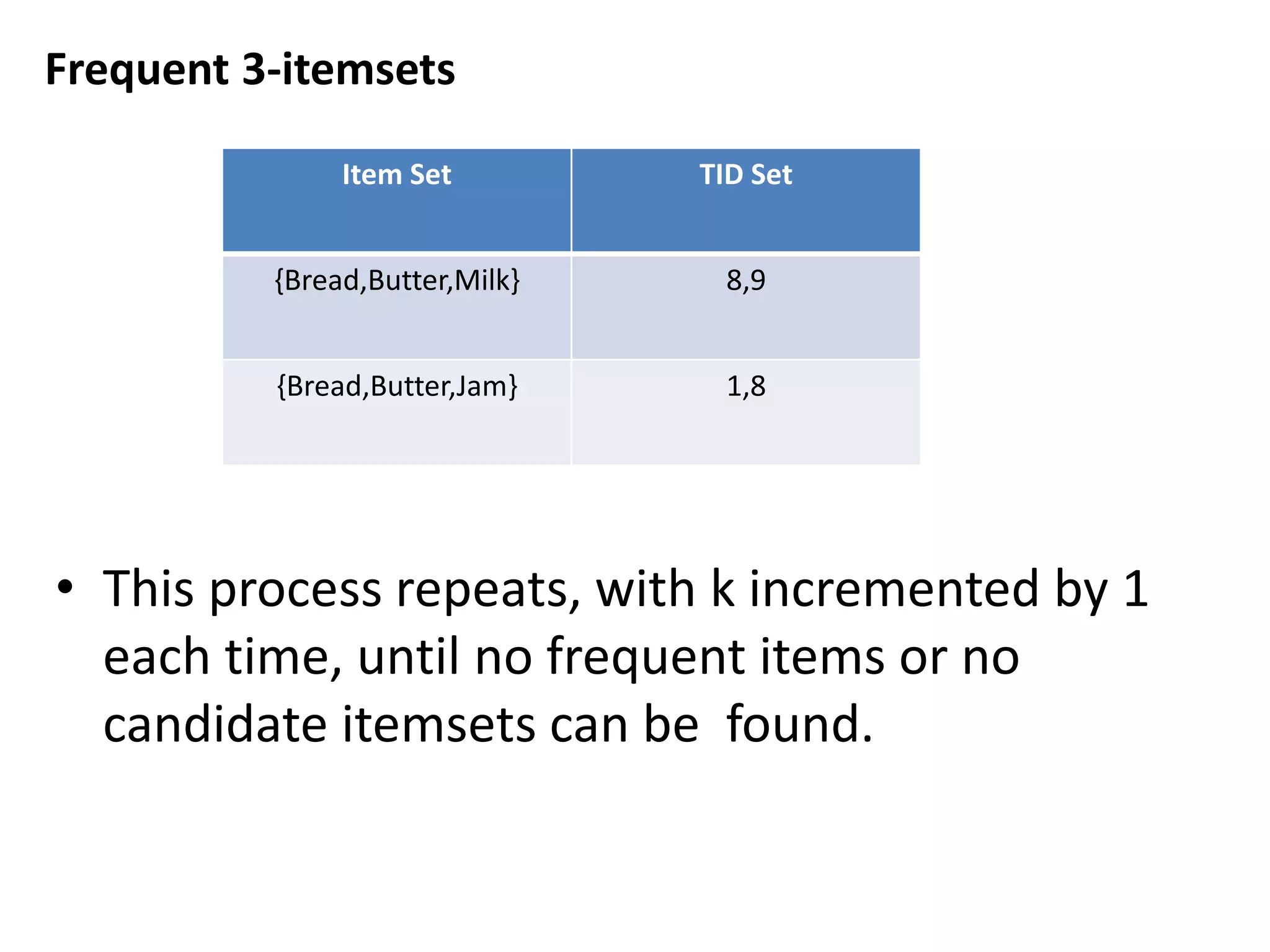
• This process repeats, with k incremented by 1
each time, until no frequent items or no
candidate itemsets can be found.
Frequent 3-itemsets
Item Set TID Set
{Bread,Butter,Milk} 8,9
{Bread,Butter,Jam} 1,8
Depth-first search reduces memory requirements
Usually (considerably) faster than Apriori
No need to scan the database to find the support of
(k+1) itemsets, for k>=1
Disadvantage
• The TID-sets can be quite long,
hence expensive to manipulate
Eclat algorithm in association rule mining

Eclat algorithm in association rule mining

  • 1.
  • 2.
    Mining Association Rules Givena set of transactions, find rules that will predict the occurrence of an item based on the occurrences of other items in the transaction
  • 3.
    Mining Association Rules •Two-step approach: 1. Frequent Itemset Generation – Generate all itemsets whose support  minsup 2. Rule Generation – Generate high confidence rules from each frequent itemset, • Frequent itemset generation is computationally expensive
  • 4.
    ECLAT Algorithm • EquivalenceClass Clustering and bottom up Lattice Traversal- ECLAT • Method for Frequent Itemset Generation • Searches in a DFS manner. • Represent the data in vertical format.
  • 5.
    To Improve theEfficiency of Apriori : (Scalable Algorithms)  FPGrowth  ECLAT  Mining Close Frequent Patterns and Maxpatterns ECLAT
  • 6.
    • Both Aprioriand FP-growth use horizontal data format • Alternatively data can also be represented in vertical format TID Items 1 Bread,Butter,Jam 2 Butter,Coke 3 Butter,Milk 4 Bread,Butter,Coke 5 Bread,Milk 6 Butter,Milk 7 Bread,Milk 8 Bread,Butter,Milk,Jam 9 Bread,Butter,Milk Item Set TID set Bread 1,4,5,7,8,9 Butter 1,2,3,4,6,8,9 Milk 3,5,6,7,8,9 Coke 2,4 Jam 1,8
  • 7.
    Eclat: algorithm 1. Gettidlist for each item (DB scan) 2. Tidlist of {a} is exactly the list of transactions containing {a} 3. Intersect tidlist of {a} with the tidlists of all other items, resulting in tidlists of {a,b}, {a,c}, {a,d}, … = {a}-conditional database (if {a} removed) 4. Repeat from 1 on {a}-conditional database 5. Repeat for all other items
  • 8.
    Frequent 1-itemsets min_sup=2 Frequent 2-itemsets ItemSet TID Set Bread 1,4,5,7,8,9 Butter 1,2,3,4,6,8,9 Milk 3,5,6,7,8,9 Coke 2,4 Jam 1,8 Item Set TID set {Bread,Butter} 1,4,8,9 {Bread,Milk} 5,7,8,9 {Bread,Coke} 4 {Bread,Jam} 1,8 {Butter,Milk} 3,6,8,9 {Butter,Coke} 2,4 {Butter,Jam} 1,8 {Milk,Jam} 8
  • 9.
    • This processrepeats, with k incremented by 1 each time, until no frequent items or no candidate itemsets can be found. Frequent 3-itemsets Item Set TID Set {Bread,Butter,Milk} 8,9 {Bread,Butter,Jam} 1,8
  • 10.
    Depth-first search reducesmemory requirements Usually (considerably) faster than Apriori No need to scan the database to find the support of (k+1) itemsets, for k>=1
  • 11.
    Disadvantage • The TID-setscan be quite long, hence expensive to manipulate