Basic Electrical DC
  Circuit Theory
    Science Olympiad 2013
It all starts with the
           ATOM
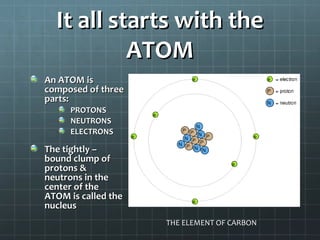
An ATOM is
composed of three
parts:
     PROTONS
     NEUTRONS
     ELECTRONS

The tightly –
bound clump of
protons &
neutrons in the
center of the
ATOM is called the
nucleus
                     THE ELEMENT OF CARBON
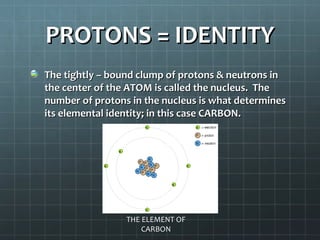
PROTONS = IDENTITY
The tightly – bound clump of protons & neutrons in
the center of the ATOM is called the nucleus. The
number of protons in the nucleus is what determines
its elemental identity; in this case CARBON.


                 THE ELEMENT OF
                     CARBON
NEUTRONS = MASS
If neutrons are added or gained in the nucleus the
ATOM will retain the same chemical identity, but its
MASS will change slightly and it may acquire strange
nuclear properties such as radioactivity
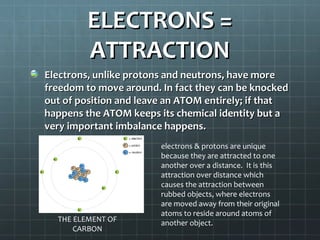
ELECTRONS =
         ATTRACTION
Electrons, unlike protons and neutrons, have more
freedom to move around. In fact they can be knocked
out of position and leave an ATOM entirely; if that
happens the ATOM keeps its chemical identity but a
very important imbalance happens.
                        electrons & protons are unique
                        because they are attracted to one
                        another over a distance. It is this
                        attraction over distance which
                        causes the attraction between
                        rubbed objects, where electrons
                        are moved away from their original
                        atoms to reside around atoms of
  THE ELEMENT OF        another object.
      CARBON
POSITIVE & NEGATIVE
                CHARGES
  ELECTRONS (-)                                                                       PROTONS (+)
       Have a NEGATIVE                                                                     Have a POSITIVE
       charge                                                                              charge
       An object whose                                                                     An object whose
       atoms have                                                                          atoms are lacking
       received a surplus                                                                  electrons is
       of electrons is                                                                     positively charged
       negatively
       charged

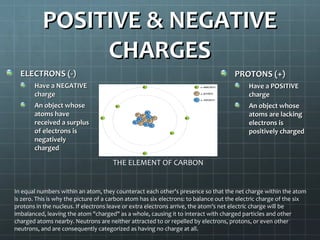
                                      THE ELEMENT OF CARBON


In equal numbers within an atom, they counteract each other's presence so that the net charge within the atom
is zero. This is why the picture of a carbon atom has six electrons: to balance out the electric charge of the six
protons in the nucleus. If electrons leave or extra electrons arrive, the atom's net electric charge will be
imbalanced, leaving the atom "charged" as a whole, causing it to interact with charged particles and other
charged atoms nearby. Neutrons are neither attracted to or repelled by electrons, protons, or even other
neutrons, and are consequently categorized as having no charge at all.
What is A Circuit?
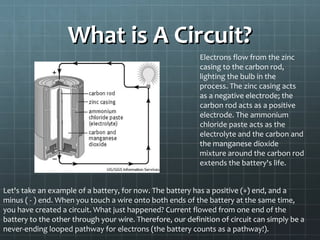
                                                            Electrons flow from the zinc
                                                            casing to the carbon rod,
                                                            lighting the bulb in the
                                                            process. The zinc casing acts
                                                            as a negative electrode; the
                                                            carbon rod acts as a positive
                                                            electrode. The ammonium
                                                            chloride paste acts as the
                                                            electrolyte and the carbon and
                                                            the manganese dioxide
                                                            mixture around the carbon rod
                                                            extends the battery's life.


Let's take an example of a battery, for now. The battery has a positive (+) end, and a
minus ( - ) end. When you touch a wire onto both ends of the battery at the same time,
you have created a circuit. What just happened? Current flowed from one end of the
battery to the other through your wire. Therefore, our definition of circuit can simply be a
never-ending looped pathway for electrons (the battery counts as a pathway!).
Requirements for a
        Circuit
Must have a closed conducting path which extends
from the positive terminal to the negative terminal.
     Think of this as a circle or a loop

ALL connections must be made by conducting
materials capable of carrying charge.
Current


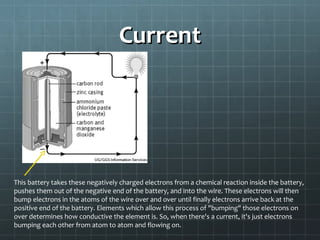
This battery takes these negatively charged electrons from a chemical reaction inside the battery,
pushes them out of the negative end of the battery, and into the wire. These electrons will then
bump electrons in the atoms of the wire over and over until finally electrons arrive back at the
positive end of the battery. Elements which allow this process of "bumping" those electrons on
over determines how conductive the element is. So, when there's a current, it's just electrons
bumping each other from atom to atom and flowing on.
Sources
http://scioly.org/wiki/index.php/Circuit_Lab_(Episode
s)

http://www.allaboutcircuits.com/vol_1/chpt_1/1.html

Basic dc circuit theory

  • 1.
    Basic Electrical DC Circuit Theory Science Olympiad 2013
  • 2.
    It all startswith the ATOM An ATOM is composed of three parts: PROTONS NEUTRONS ELECTRONS The tightly – bound clump of protons & neutrons in the center of the ATOM is called the nucleus THE ELEMENT OF CARBON
  • 3.
    PROTONS = IDENTITY Thetightly – bound clump of protons & neutrons in the center of the ATOM is called the nucleus. The number of protons in the nucleus is what determines its elemental identity; in this case CARBON. THE ELEMENT OF CARBON
  • 4.
    NEUTRONS = MASS Ifneutrons are added or gained in the nucleus the ATOM will retain the same chemical identity, but its MASS will change slightly and it may acquire strange nuclear properties such as radioactivity
  • 5.
    ELECTRONS = ATTRACTION Electrons, unlike protons and neutrons, have more freedom to move around. In fact they can be knocked out of position and leave an ATOM entirely; if that happens the ATOM keeps its chemical identity but a very important imbalance happens. electrons & protons are unique because they are attracted to one another over a distance. It is this attraction over distance which causes the attraction between rubbed objects, where electrons are moved away from their original atoms to reside around atoms of THE ELEMENT OF another object. CARBON
  • 6.
    POSITIVE & NEGATIVE CHARGES ELECTRONS (-) PROTONS (+) Have a NEGATIVE Have a POSITIVE charge charge An object whose An object whose atoms have atoms are lacking received a surplus electrons is of electrons is positively charged negatively charged THE ELEMENT OF CARBON In equal numbers within an atom, they counteract each other's presence so that the net charge within the atom is zero. This is why the picture of a carbon atom has six electrons: to balance out the electric charge of the six protons in the nucleus. If electrons leave or extra electrons arrive, the atom's net electric charge will be imbalanced, leaving the atom "charged" as a whole, causing it to interact with charged particles and other charged atoms nearby. Neutrons are neither attracted to or repelled by electrons, protons, or even other neutrons, and are consequently categorized as having no charge at all.
  • 7.
    What is ACircuit? Electrons flow from the zinc casing to the carbon rod, lighting the bulb in the process. The zinc casing acts as a negative electrode; the carbon rod acts as a positive electrode. The ammonium chloride paste acts as the electrolyte and the carbon and the manganese dioxide mixture around the carbon rod extends the battery's life. Let's take an example of a battery, for now. The battery has a positive (+) end, and a minus ( - ) end. When you touch a wire onto both ends of the battery at the same time, you have created a circuit. What just happened? Current flowed from one end of the battery to the other through your wire. Therefore, our definition of circuit can simply be a never-ending looped pathway for electrons (the battery counts as a pathway!).
  • 8.
    Requirements for a Circuit Must have a closed conducting path which extends from the positive terminal to the negative terminal. Think of this as a circle or a loop ALL connections must be made by conducting materials capable of carrying charge.
  • 9.
    Current This battery takesthese negatively charged electrons from a chemical reaction inside the battery, pushes them out of the negative end of the battery, and into the wire. These electrons will then bump electrons in the atoms of the wire over and over until finally electrons arrive back at the positive end of the battery. Elements which allow this process of "bumping" those electrons on over determines how conductive the element is. So, when there's a current, it's just electrons bumping each other from atom to atom and flowing on.
  • 10.