Kirchhoff’s Laws Physics 102:   Lecture   06
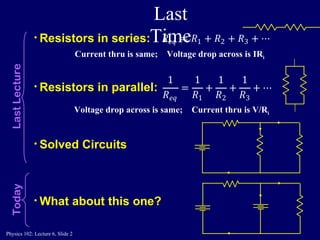
Last Time Resistors in series: Resistors in parallel: Current thru is same;  Voltage drop across is IR i Voltage drop across is same;  Current thru is V/R i Last Lecture Solved Circuits What about this one? Today
Kirchhoff’s Rules Kirchhoff’s Junction Rule (KJR): Current going in equals current coming out. Kirchhoff’s Loop Rule (KLR): Sum of voltage drops around a loop is zero.
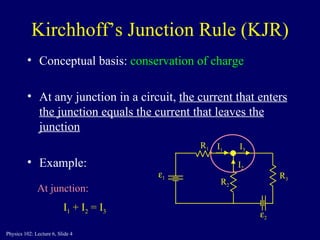
Conceptual basis:  conservation of charge At any junction in a circuit,  the current that enters the junction equals the current that leaves the junction Example: Kirchhoff’s Junction Rule (KJR) At junction: I 1  + I 2  = I 3 R 1 R 2 R 3 I 1 I 3 I 2  1  2
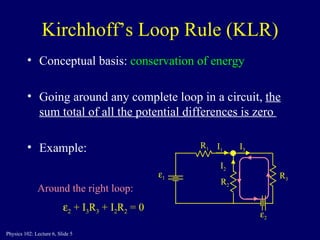
Conceptual basis:  conservation of energy Going around any complete loop in a circuit,  the sum total of all the potential differences is zero  Example: Kirchhoff’s Loop Rule (KLR) Around the right loop:  2  + I 3 R 3  + I 2 R 2  = 0 R 1 R 2 R 3 I 1 I 3 I 2  1  2
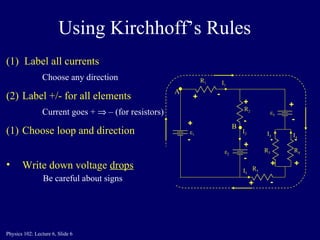
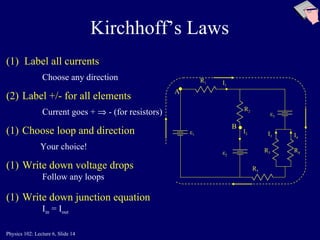
Using Kirchhoff’s Rules (1) Label all currents   Choose any direction (2) Label +/- for all elements Current goes +    – (for resistors) Choose loop and direction Write down voltage  drops   Be careful about signs R 4 + - + + + + - - - - + + + - - - R 1 ε 1 R 2 R 3 ε 2 ε 3 R 5 A B I 1 I 3 I 2 I 4 I 5
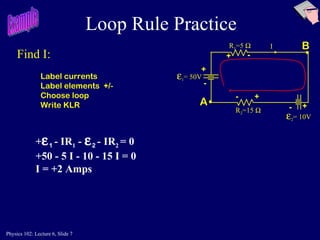
Loop Rule Practice R 1 =5   I +  1  - IR 1  -    2   -   IR 2  = 0 +50 - 5 I - 10 - 15 I = 0 I = +2 Amps   1 = 50V R 2 =15    2 = 10V A B Find I: Example Label currents Label elements  +/- Choose loop Write KLR + - + - + - + -
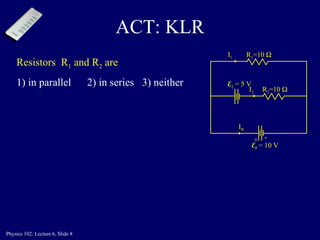
ACT: KLR R 1 =10   E 1  = 10 V I B I 1 E 2  = 5 V R 2 =10   I 2 Resistors  R 1  and R 2  are  1) in parallel  2) in series  3) neither   + -
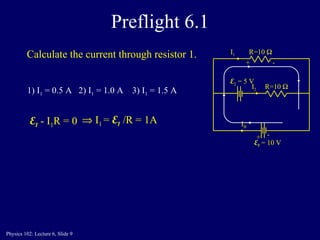
Preflight 6.1 R=10   E 1  = 10 V I B I 1 E 2  = 5 V R=10   I 2 1) I 1  = 0.5 A  2) I 1  = 1.0 A  3) I 1  = 1.5 A   + - + - E 1   - I 1 R = 0 Calculate the current through resistor 1.    I 1  =  E 1   /R = 1A
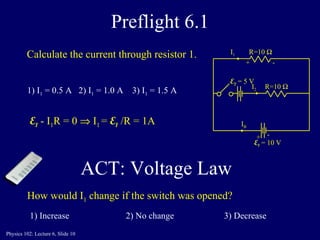
Preflight 6.1 R=10   E 1  = 10 V I B I 1 R=10   I 2 1) I 1  = 0.5 A  2) I 1  = 1.0 A  3) I 1  = 1.5 A   + - + - E 1   - I 1 R = 0    I 1  =  E 1   /R = 1A How would I 1  change if the switch was opened? E 2  = 5 V 1) Increase  2) No change     3) Decrease   Calculate the current through resistor 1. ACT: Voltage Law
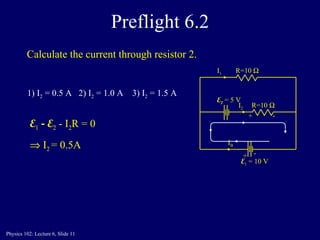
Preflight 6.2 R=10   E 1  = 10 V I B I 1 E 2  = 5 V R=10   I 2 1) I 2  = 0.5 A  2) I 2  = 1.0 A  3) I 2  = 1.5 A   + - + - E 1  -  E 2   - I 2 R = 0    I 2  = 0.5A Calculate the current through resistor 2.
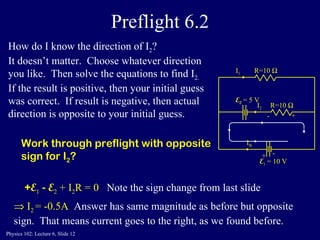
Preflight 6.2 R=10   E 1  = 10 V I B I 1 E 2  = 5 V R=10   I 2 - + + - + E 1  -  E 2   + I 2 R = 0  Note the sign change from last slide    I 2  = -0.5A  Answer has same magnitude as before but opposite sign.  That means current goes to the right, as we found before. How do I know the direction of I 2 ? It doesn’t matter.  Choose whatever direction you like.  Then solve the equations to find I 2. If the result is positive, then your initial guess was correct.  If result is negative, then actual direction is opposite to your initial guess. Work through preflight with opposite sign for I 2 ?
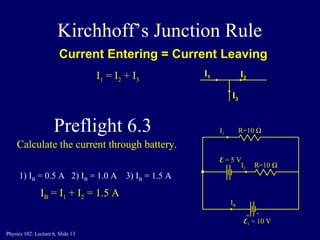
Kirchhoff’s Junction Rule Current Entering = Current Leaving I 1 I 2 I 3 I 1  = I 2  + I 3 1) I B  = 0.5 A  2) I B  = 1.0 A  3) I B  = 1.5 A   I B  = I 1  + I 2  = 1.5 A Calculate the current through battery. R=10   E 1  = 10 V I B I 1 E  = 5 V R=10   I 2 + - Preflight 6.3
Kirchhoff’s Laws (1) Label all currents   Choose any direction (2) Label +/- for all elements Current goes +    - (for resistors) Choose loop and direction Your choice! Write down voltage drops Follow any loops Write down junction equation I in  = I out   R 4 R 1 ε 1 R 2 R 3 ε 2 ε 3 I 1 I 3 I 2 I 4 R 5 A B
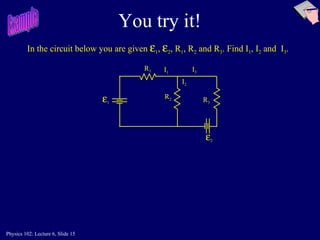
You try it! In the circuit below you are given   1 ,   2 , R 1 , R 2  and R 3 . Find I 1 , I 2  and  I 3 . Example R 1 R 2 R 3 I 1 I 3 I 2  1  2
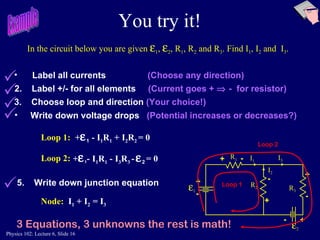
You try it! R 1 R 2 R 3 I 1 I 3 I 2 + - + + + Loop 1:  +  1   - I 1 R 1  +   I 2 R 2  = 0 Label all currents   (Choose any direction) 2.  Label +/- for all elements   (Current goes +    -  for resistor) 3.  Choose loop and direction   (Your choice!) Write down voltage drops   (Potential increases or decreases?) - - - Loop 2:  1 5.  Write down junction equation Node:   I 1  +   I 2  = I 3  2 3 Equations, 3 unknowns the rest is math! In the circuit below you are given   1 ,   2 , R 1 , R 2  and R 3 . Find I 1 , I 2  and  I 3 . Loop 1  + -   +  1 -   I 1 R 1  -   I 3 R 3  -    2   = 0   Example Loop 2
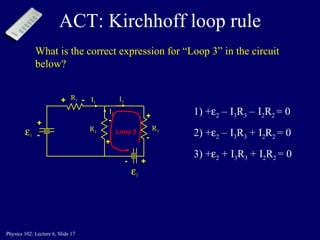
ACT: Kirchhoff loop rule What is the correct expression for “Loop 3” in the circuit below? Loop 3 R 2 R 3  1  2 R 1 1) +  2  –   I 3 R 3  –   I 2 R 2  = 0 2) +  2  –   I 3 R 3  +   I 2 R 2  = 0 3) +  2  +   I 3 R 3  +   I 2 R 2  = 0 I 1 I 3 I 2 + - + + + - - - + -
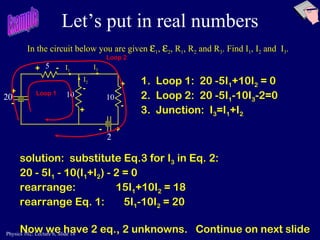
Let’s put in real numbers In the circuit below you are given   1 ,   2 , R 1 , R 2  and R 3 . Find I 1 , I 2  and  I 3 . Example 1.  Loop 1:  20 -5I 1 +10I 2  = 0 2.  Loop 2:  20 -5I 1 -10I 3 -2=0 3.  Junction:  I 3 =I 1 +I 2 solution:  substitute Eq.3 for I 3  in Eq. 2: 20 - 5I 1  - 10(I 1 +I 2 ) - 2 = 0 rearrange:  15I 1 +10I 2  = 18 rearrange Eq. 1:    5I 1 -10I 2  = 20 Now we have 2 eq., 2 unknowns.  Continue on next slide Loop 1 Loop 2  5 10 10 I 1 I 3 I 2 + - + + + - - -  + -
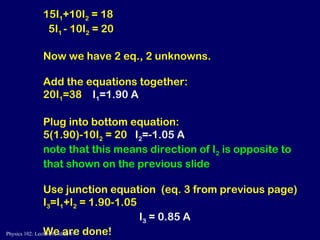
15I 1 +10I 2  = 18 5I 1  - 10I 2  = 20 Now we have 2 eq., 2 unknowns. Add the equations together: 20I 1 =38  I 1 =1.90 A Plug into bottom equation: 5(1.90)-10I 2  = 20  I 2 =-1.05 A  note that this means direction of I 2  is opposite to that shown on the previous slide Use junction equation  (eq. 3 from previous page) I 3 =I 1 +I 2  = 1.90-1.05  I 3  = 0.85 A We are done!
See you next time…

Lect06 handout

  • 1.
  • 2.
    Last Time Resistorsin series: Resistors in parallel: Current thru is same; Voltage drop across is IR i Voltage drop across is same; Current thru is V/R i Last Lecture Solved Circuits What about this one? Today
  • 3.
    Kirchhoff’s Rules Kirchhoff’sJunction Rule (KJR): Current going in equals current coming out. Kirchhoff’s Loop Rule (KLR): Sum of voltage drops around a loop is zero.
  • 4.
    Conceptual basis: conservation of charge At any junction in a circuit, the current that enters the junction equals the current that leaves the junction Example: Kirchhoff’s Junction Rule (KJR) At junction: I 1 + I 2 = I 3 R 1 R 2 R 3 I 1 I 3 I 2  1  2
  • 5.
    Conceptual basis: conservation of energy Going around any complete loop in a circuit, the sum total of all the potential differences is zero Example: Kirchhoff’s Loop Rule (KLR) Around the right loop:  2 + I 3 R 3 + I 2 R 2 = 0 R 1 R 2 R 3 I 1 I 3 I 2  1  2
  • 6.
    Using Kirchhoff’s Rules(1) Label all currents Choose any direction (2) Label +/- for all elements Current goes +  – (for resistors) Choose loop and direction Write down voltage drops Be careful about signs R 4 + - + + + + - - - - + + + - - - R 1 ε 1 R 2 R 3 ε 2 ε 3 R 5 A B I 1 I 3 I 2 I 4 I 5
  • 7.
    Loop Rule PracticeR 1 =5  I +  1 - IR 1 -  2 - IR 2 = 0 +50 - 5 I - 10 - 15 I = 0 I = +2 Amps  1 = 50V R 2 =15   2 = 10V A B Find I: Example Label currents Label elements +/- Choose loop Write KLR + - + - + - + -
  • 8.
    ACT: KLR R1 =10  E 1 = 10 V I B I 1 E 2 = 5 V R 2 =10  I 2 Resistors R 1 and R 2 are 1) in parallel 2) in series 3) neither + -
  • 9.
    Preflight 6.1 R=10  E 1 = 10 V I B I 1 E 2 = 5 V R=10  I 2 1) I 1 = 0.5 A 2) I 1 = 1.0 A 3) I 1 = 1.5 A + - + - E 1 - I 1 R = 0 Calculate the current through resistor 1.  I 1 = E 1 /R = 1A
  • 10.
    Preflight 6.1 R=10  E 1 = 10 V I B I 1 R=10  I 2 1) I 1 = 0.5 A 2) I 1 = 1.0 A 3) I 1 = 1.5 A + - + - E 1 - I 1 R = 0  I 1 = E 1 /R = 1A How would I 1 change if the switch was opened? E 2 = 5 V 1) Increase 2) No change 3) Decrease Calculate the current through resistor 1. ACT: Voltage Law
  • 11.
    Preflight 6.2 R=10  E 1 = 10 V I B I 1 E 2 = 5 V R=10  I 2 1) I 2 = 0.5 A 2) I 2 = 1.0 A 3) I 2 = 1.5 A + - + - E 1 - E 2 - I 2 R = 0  I 2 = 0.5A Calculate the current through resistor 2.
  • 12.
    Preflight 6.2 R=10  E 1 = 10 V I B I 1 E 2 = 5 V R=10  I 2 - + + - + E 1 - E 2 + I 2 R = 0 Note the sign change from last slide  I 2 = -0.5A Answer has same magnitude as before but opposite sign. That means current goes to the right, as we found before. How do I know the direction of I 2 ? It doesn’t matter. Choose whatever direction you like. Then solve the equations to find I 2. If the result is positive, then your initial guess was correct. If result is negative, then actual direction is opposite to your initial guess. Work through preflight with opposite sign for I 2 ?
  • 13.
    Kirchhoff’s Junction RuleCurrent Entering = Current Leaving I 1 I 2 I 3 I 1 = I 2 + I 3 1) I B = 0.5 A 2) I B = 1.0 A 3) I B = 1.5 A I B = I 1 + I 2 = 1.5 A Calculate the current through battery. R=10  E 1 = 10 V I B I 1 E = 5 V R=10  I 2 + - Preflight 6.3
  • 14.
    Kirchhoff’s Laws (1)Label all currents Choose any direction (2) Label +/- for all elements Current goes +  - (for resistors) Choose loop and direction Your choice! Write down voltage drops Follow any loops Write down junction equation I in = I out R 4 R 1 ε 1 R 2 R 3 ε 2 ε 3 I 1 I 3 I 2 I 4 R 5 A B
  • 15.
    You try it!In the circuit below you are given  1 ,  2 , R 1 , R 2 and R 3 . Find I 1 , I 2 and I 3 . Example R 1 R 2 R 3 I 1 I 3 I 2  1  2
  • 16.
    You try it!R 1 R 2 R 3 I 1 I 3 I 2 + - + + + Loop 1: +  1 - I 1 R 1 + I 2 R 2 = 0 Label all currents (Choose any direction) 2. Label +/- for all elements (Current goes +  - for resistor) 3. Choose loop and direction (Your choice!) Write down voltage drops (Potential increases or decreases?) - - - Loop 2:  1 5. Write down junction equation Node: I 1 + I 2 = I 3  2 3 Equations, 3 unknowns the rest is math! In the circuit below you are given  1 ,  2 , R 1 , R 2 and R 3 . Find I 1 , I 2 and I 3 . Loop 1  + -   +  1 - I 1 R 1 - I 3 R 3 -  2 = 0   Example Loop 2
  • 17.
    ACT: Kirchhoff looprule What is the correct expression for “Loop 3” in the circuit below? Loop 3 R 2 R 3  1  2 R 1 1) +  2 – I 3 R 3 – I 2 R 2 = 0 2) +  2 – I 3 R 3 + I 2 R 2 = 0 3) +  2 + I 3 R 3 + I 2 R 2 = 0 I 1 I 3 I 2 + - + + + - - - + -
  • 18.
    Let’s put inreal numbers In the circuit below you are given  1 ,  2 , R 1 , R 2 and R 3 . Find I 1 , I 2 and I 3 . Example 1. Loop 1: 20 -5I 1 +10I 2 = 0 2. Loop 2: 20 -5I 1 -10I 3 -2=0 3. Junction: I 3 =I 1 +I 2 solution: substitute Eq.3 for I 3 in Eq. 2: 20 - 5I 1 - 10(I 1 +I 2 ) - 2 = 0 rearrange: 15I 1 +10I 2 = 18 rearrange Eq. 1: 5I 1 -10I 2 = 20 Now we have 2 eq., 2 unknowns. Continue on next slide Loop 1 Loop 2  5 10 10 I 1 I 3 I 2 + - + + + - - -  + -
  • 19.
    15I 1 +10I2 = 18 5I 1 - 10I 2 = 20 Now we have 2 eq., 2 unknowns. Add the equations together: 20I 1 =38 I 1 =1.90 A Plug into bottom equation: 5(1.90)-10I 2 = 20 I 2 =-1.05 A note that this means direction of I 2 is opposite to that shown on the previous slide Use junction equation (eq. 3 from previous page) I 3 =I 1 +I 2 = 1.90-1.05 I 3 = 0.85 A We are done!
  • 20.
    See you nexttime…

Editor's Notes

  • #2 1 Lecture timing is fine. No need to rush
  • #7 Have students label I5, since it isn’t shown in their drawing
  • #8 Can ask if R1 and R5 are in series, parallel. Also make sure they understand potential at B is higher than at A.
  • #9 Note that nothing is in series or in parallel!
  • #10 Note that nothing is in series or in parallel!
  • #15 Have them go back to this slide and fill in (5)
  • #16 1) This will be given on the exam. Comment on 1 equation 2 unknowns. 2 eqs 3 unknowns finally 3 and 3
  • #17 1) This will be given on the exam. Comment on 1 equation 2 unknowns. 2 eqs 3 unknowns finally 3 and 3
  • #18 1) This will be given on the exam. Comment on 1 equation 2 unknowns. 2 eqs 3 unknowns finally 3 and 3
  • #19 1) This will be given on the exam. Comment on 1 equation 2 unknowns. 2 eqs 3 unknowns finally 3 and 3